Feeds:
Posts
Comments

Archive for the ‘Games’ Category

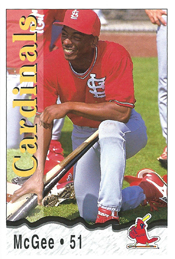
Twelve years after the Cardinals and Royals opposed one another in the World Series, the teams were matched for the first time in the regular season. Two constants linked those events: Willie McGee played and tempers flared.

In the seven-game 1985 World Series, McGee fielded flawlessly in center field for the Cardinals and produced seven hits, including two doubles and a home run.

When the Cardinals and Royals met for the first time in the regular season, on Aug. 29, 1997, at Kansas City, McGee was the only player in either lineup who had participated in the 1985 World Series.

Playing as the designated hitter in 1997, McGee hit a three-run triple, breaking a 6-6 tie and carrying the Cardinals to victory.

The next night, Aug. 30, in the second game of the regular-season series, players and coaches brawled on the field after Cardinals pitcher Mark Petkovsek plunked Johnny Damon with a pitch. Petkovsek and Damon were ejected.

The skirmish brought back memories of Game 7 of the 1985 World Series when Cardinals manager Whitey Herzog and pitcher Joaquin Andujar were ejected for arguing with umpire Don Denkinger.

Oldie but goodie

Major League Baseball began interleague play in the regular season in 1997. The Cardinals and Royals had met in exhibition games and the World Series, but not in the regular season since Kansas City joined the American League as an expansion franchise in 1969.

A crowd of 36,006 filled Kauffman Stadium for the series opener.

The Royals led, 6-5, through seven innings.

In the eighth, with reliever Hector Carrasco pitching for the Royals, Tom Lampkin singled. After Phil Plantier flied out, Delino DeShields tripled, driving in Lampkin and tying the score.

Gregg Olson relieved and struck out Royce Clayton.

Mark McGwire was up next. The Royals opted to walk him intentionally and take their chances with Ray Lankford.

The strategy backfired. Lankford worked a walk, loading the bases.

That brought McGee to the plate. A switch-hitter, McGee batted from the left side against Olson. He got a curve and slashed it down the first-base line. All three runners scored, putting the Cardinals ahead, 9-6, and McGee raced to third with a triple.

“He’s better than ever,” Cardinals manager Tony La Russa said of McGee, 38. “He just gets a little bit achier.”

Asked about the 1985 World Series, when the Royals won Game 6 after Denkinger’s botched call at first base and then routed the Cardinals in Game 7, McGee told the St. Louis Post-Dispatch, “I’ll never forget it. I was heartbroken.”

Closer Dennis Eckersley yielded a run in the ninth, but the Cardinals held on to win the first regular-season showdown versus the Royals, 9-7. Boxscore

Frustration shows

The Royals quickly took control of Game 2 of the series. They led 6-1 after three. In the fourth, the Royals scored eight runs against Petkovsek, who had relieved starter Manny Aybar, and went ahead, 14-1. Jermaine Dye capped the outburst with a grand slam.

Petkovsek’s first pitch to the next batter, Damon, hit him on the right ankle. Damon charged the mound. Petkovsek threw one punch _ and it clipped his catcher, Tom Pagnozzi, who had chased after Damon. Both benches and bullpens emptied.

Coaches Dave Duncan of the Cardinals and Jamie Quirk of the Royals wrestled on the ground. “We were talking about pitching rotations,” Quirk quipped to the Post-Dispatch.

Royals pitcher Tim Belcher had his uniform jersey shredded. He blamed Cardinals counterpart Andy Benes, whom he called “Sasquatch.”

“His hands are like feet,” Belcher said.

Macho men

Petkvosek said he didn’t intend to hit Damon with a pitch and La Russa added, “I don’t know what Petkovsek was doing except trying to get the ball down.”

In the sixth inning, Belcher hit Plantier with a pitch. “The pitch got away from me,” Belcher said.

The Royals won, 16-5. Boxscore

Asked his thoughts on the action-packed start to the rivalry, Royals catcher Mike Macfarlane said,  “These are two of the funnest games I’ve ever played in.”

Previously: Cardinals were Royals’ first opponent in Kansas City

Read Full Post »

(Updated Jan. 4, 2025)

In the last game the Cardinals played in Brooklyn, they faced a pair of 21-year-old emerging aces: Don Drysdale and Sandy Koufax.

Drysdale was effective; Koufax was not. They were two of six future Hall of Famers who played against the Cardinals on Aug. 25, 1957, at Ebbets Field. The others were Roy Campanella, Gil Hodges, Pee Wee Reese and Duke Snider.
Stan Musial, who a decade earlier got his nickname, “The Man,” from Dodgers fans, was injured and didn’t play for the Cardinals in their Ebbets Field finale. In the book “We Would Have Played For Nothing,” Dodgers pitcher Ralph Branca said of Musial, “Those fans in Brooklyn … used to give him a standing ovation. He got more cheers than the Dodgers because they respected his ability.”

Musial, who batted .359 with 223 hits in 163 career games in Brooklyn, hurt his left shoulder on Aug. 22 at Philadelphia. X-rays revealed a chip fracture in his shoulder blade.

“We’re a different ballclub, not nearly as dangerous, without Stan Musial in there,” Cardinals manager Fred Hutchinson told the St. Louis Post-Dispatch.

Sentimental journey

Though a move to Los Angeles for the 1958 season wasn’t official, it was widely known the Dodgers intended to leave Brooklyn, barring an 11th-hour deal for a new ballpark. The Dodgers planned to follow the Giants, who had announced their plans to depart New York for San Francisco after the season.

Ebbets Field had been the site of epic Cardinals-Dodgers games, especially in the 1940s when the two franchises accounted for seven National League pennants in a nine-year span from 1941-49.

The 1957 Cardinals were in the middle of a 22-game road trip that began Aug. 13 and would take them to Chicago, Milwaukee, New York, Philadelphia, Brooklyn, Pittsburgh, Chicago again and Cincinnati before ending Sept. 3.

A crowd of 10,883 turned out for the Cardinals’ farewell appearance at Brooklyn. A mist fell and wind whipped through Ebbets Field, bringing a raw feel to an atypical summer Sunday.

The game matched Drysdale against Sam Jones.

After retiring the first two batters, Drysdale walked Joe Cunningham and Wally Moon and plunked Ken Boyer with a pitch, loading the bases. He escaped unscathed by striking out Del Ennis.

Drysdale held the Cardinals hitless until Moon led off the fourth with a double.

Powered by Gil Hodges, who reached Jones for a two-run homer and RBI-double, the Dodgers led, 6-2, through seven.

Comeback bid

In the eighth, Moon drove in a run with a single, making the score 6-3 and knocking out Drysdale. Ed Roebuck relieved.

In the ninth, the Cardinals got within two, 6-4, on a Don Blasingame double that scored Bobby Smith and moved Dick Schofield to third.

With one out, Al Dark came to the plate, looking to drive in the runners from second and third and tie the score. Instead, Dark grounded out to Roebuck and the runners held. Disgusted, Dark flung his batting helmet into the dugout.

Plate umpire Augie Donatelli, thinking the player was upset with him, ejected Dark. “I resent Donatelli’s mind-reading act,” Dark said.

With Cunningham due next, Dodgers manager Walter Alston wanted a left-handed pitcher, so he removed Roebuck and brought in Koufax.

Hutchinson countered, sending Hal Smith, a right-handed batter, to face Koufax.

Old pro

Koufax walked Smith, loading the bases. The next batter, Moon, also walked, forcing in a run and making the score 6-5.

With the bases still loaded, Alston pulled Koufax and replaced him with a starter, Sal Maglie. Making his first relief appearance since May, Maglie, 40, was brought in to face Ken Boyer. Mixing guile with skill, Maglie struck out Boyer on three pitches, clinching the victory. Boxscore


Read Full Post »

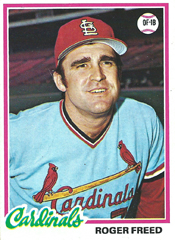
Capping a Cardinals rally, Roger Freed burned the team he cheered for as a boy.

Freed, a Los Angeles native reared in suburban Baldwin Park, Calif., hit a walkoff three-run home run, enabling the Cardinals to overcome a five-run deficit in the ninth inning and defeat the Dodgers.

Freed was batting for pitcher Al Hrabosky when he hit his game-winning home run against knuckleball specialist Charlie Hough.

At a time before cable television and the Internet, the game was showcased nationally as ABC’s “Monday Night Baseball” telecast.

“I knew my mother was watching (in Baldwin Park),” Freed said to the Los Angeles Times. “I kept telling myself I was going to hit one for Mom. She never gives up until the game is over. She’s been a baseball rooter ever since I was in Little League.”

No surrender

The Dodgers were comfortably in first place in the National League West, 9.5 games ahead of the Reds, entering their Aug. 22, 1977, game against the Cardinals at St. Louis.

Sparked by a Steve Yeager grand slam against John Denny, the Dodgers led, 6-1. Jerry Mumphrey opened the Cardinals’ ninth with a single and scored on Garry Templeton’s triple, cutting the deficit to 6-2. Dodgers manager Tommy Lasorda lifted starter Burt Hooton and replaced him with a rookie, Lance Rautzhan.

Ted Simmons singled, scoring Templeton and getting the Cardinals within three at 6-3. Keith Hernandez followed with a double just inside the first-base line. When the throw from right fielder Reggie Smith eluded cutoff man Bill Russell, Simmons continued home, making the score 6-4, and Hernandez went to third.

Hough, the Dodgers’ closer, relieved Rautzhan.

Dodgers dandy

With Mike Anderson at the plate, Hough unleashed a knuckler that got past Yeager. Hernandez scored and the Cardinals were within a run, 6-5.

After Anderson struck out for the first out of the inning, Ken Reitz singled and Rick Bosetti ran for him. Mike Tyson singled _ the Cardinals’ sixth hit of the inning _ and Bosetti moved to second.

With Hrabosky due up next, Cardinals manager Vern Rapp called on Freed to bat. Freed, acquired by the Cardinals from the Expos in the December minor-league draft, was batting .345 overall and .438 as a pinch hitter for St. Louis.

Hough went to work against him with his signature knuckler and got ahead on the count 1-and-2.

“The knuckler was dancing all over the place,” Freed said. “Hough has a dandy.”

Low liner

Then Hough threw Freed a knuckler that was at the bottom of the strike zone. “A good knuckler,” Hough said to the St. Louis Post-Dispatch.

Said Cardinals general manager Bing Devine: “It was low and away.”

Freed took a big swing and connected.

“I knew I hit it hard, but the pitch had been so low that I thought it might be right at the shortstop,” Freed said.

The line drive rose and carried over the left-field wall for a home run, giving the Cardinals an 8-6 victory. “I didn’t know it was gone until I looked up,” Freed said. Boxscore

Freed, a reserve first baseman and right fielder, finished the 1977 season with a .398 batting average (33-for-83). He hit .545 (6-for-11) with two outs and a runner in scoring position.

Freed batted .239 for the 1978 Cardinals and .258 for the 1979 Cardinals before he was released in April 1980.

Previously: Carl Taylor, Roger Freed experienced the ultimate

Read Full Post »

In the last game the Cardinals played against the Giants at the Polo Grounds in New York, Stan Musial delivered a performance worthy of Broadway.

On Aug. 21, 1957, Musial bid a dramatic farewell to the Giants at one of his favorite ballparks, hitting a home run in the first inning against former teammate Stu Miller at the Polo Grounds.

In two subsequent plate appearances that Wednesday afternoon, Musial also produced an infield single and a sacrifice fly before being removed from the game by Cardinals manager Fred Hutchinson.

Though Musial and the Cardinals never would play the Giants again at the Polo Grounds, they would return to the ballpark five years later, in 1962, when the Mets joined the National League as an expansion club.

Musial and the Cardinals would face the Mets at the Polo Grounds in 1962 and 1963. After the 1963 season, Musial retired, the Mets moved to Shea Stadium and the Polo Grounds was demolished.

In August 1957, however, there was no inkling that major-league baseball would be played at the Polo Grounds after that season.

Go west

In May 1957, National League club owners gave permission to the Giants to move from New York to San Francisco and for the Dodgers to transfer from Brooklyn to Los Angeles.

Three months later, on Aug. 19, the Giants’ board of directors, by an 8-to-1 vote, approved the proposal to relocate the franchise to San Francisco for the 1958 season. The Giants had been in New York for 74 years.

On Aug. 20, the day after the board made its decision, the Cardinals played a doubleheader against the Giants at the Polo Grounds. The Cardinals won both games before a crowd of 13,198.

The next day, Aug. 21, the Cardinals and Giants played for the final time at the Polo Grounds. The game drew 5,296 spectators to the ballpark along Eighth Avenue and West 159th Street between Coogan’s Bluff and the Harlem River in upper Manhattan.

NL’s best

The starting pitchers were Lindy McDaniel for St. Louis and Stu Miller, a former Cardinal, for the Giants.

Batting third in the orders were two of the all-time best _ Musial for the Cardinals and Willie Mays for the Giants.

The Polo Grounds had unusual dimensions. The distance from home plate to the deepest part of center field was about 480 feet. Down the lines, it was 258 feet from the plate to the right field foul pole and 279 feet from the plate to the left field foul pole.

In the first inning, Musial hit a home run into the upper deck in right.

In the Giants’ half of the first, Mays hit a home run over the left-field roof.

Facing 18-year-old rookie reliever Mike McCormick, Musial got an infield single in the third and a sacrifice fly in the fifth.

With the Giants ahead, 11-3, Hutchinson opted to give Musial a rest and removed him from the game in the sixth.

Musial, 36, was leading the National League in batting average (.342) and RBI (97) and had 29 home runs.

“As far as I’m concerned, he’s the most valuable player in the National League this year and it couldn’t happen to a nicer guy,” Cardinals general manager Frank Lane said to the St. Louis Post-Dispatch. Boxscore

Big Apple fan

In 11 games at the Polo Grounds in 1957, Musial batted .439 (18-for-41) with six home runs and 14 RBI.

Asked by New York writers whether he would miss the Polo Grounds, Musial replied, “Yes. The Polo Grounds makes a hero or a bum out of you. It can throw you into a terrible batting slump if you try to pull too much. It can give you the toughest out on the longest drives anywhere and the cheapest home runs. I’ve had my good years here and others not so good, but overall I’ve been fortunate. I’ll miss the park and the fans and the city’s legitimate theater, too.”

Musial and the Cardinals returned to the Polo Grounds to play the Mets on April 18, 1962. Musial had two hits and two RBI.

Three months later, on July 8, 1962, Musial, 41, hit three home runs against the Mets at the Polo Grounds. He’s the oldest player to hit three home runs in a big-league game.

Musial, 42, appeared at the Polo Grounds for the final time on Aug. 8, 1963, against the Mets. Pinch-hitting in the ninth, he drew a walk.

In 171 games at the Polo Grounds against the Giants and Mets, Musial batted .343 with 216 hits, including 49 home runs. He hit more home runs at the Polo Grounds than he did at any other ballpark outside St. Louis.

Previously: How Stan Musial made me a Cardinals fan

Previously: Stan Musial still oldest to belt 3 home runs in game

Read Full Post »

Lee May, one of the National League’s most consistent sluggers in the late 1960s and early 1970s, hit for both average and power against the Cardinals.

A first baseman known as “Big Bopper,” he played for the Reds (1965-71) and Astros (1972-74) in the National League before going to the American League with the Orioles and Royals.

In 103 games versus the Cardinals, May had 128 hits, 26 doubles, 16 home runs and 63 RBI. His career .327 batting average against the Cardinals is 60 points higher than his career major-league mark of .267.

A standout high school athlete in Birmingham, Ala., May was offered a football scholarship to play fullback at the University of Nebraska, but he elected to sign a baseball contract with the Reds. He modeled his swing after his boyhood idol, American League slugger Harmon Killebrew.

“May was a husky bear of a man with the disposition of a newborn cub, a guy with a wondrous sense of humor, a guy loved by everybody who came into contact with him,” wrote Hal McCoy in the Dayton Daily News.

From 1969-74, May ranked among the top 10 in the NL in home runs each year. In 1970, when he hit 34 home runs for the pennant-winning Reds, May delivered one of his most memorable long balls _ a grand slam against the Cardinals.

Keep swinging

On July 20, 1970, the Reds and Cardinals had a Monday twi-night doubleheader at Busch Stadium in St. Louis.

May was in a slump. He had batted .304 in May but .220 in June. Hitless in his three previous games, he entered the doubleheader with a .246 batting average.

“I’ve been pressing a little,” May said to the Associated Press. “It’s always natural for a guy in a slump to press. When you’re in a slump, you look at it like the other team has about 20 infielders and 20 outfielders. So it really doesn’t make any difference who is pitching.”

In the opener, May was 1-for-4. His two-out double in the eighth against Jerry Reuss drove in Tony Perez from second base. When left fielder Lou Brock bobbled the ball, Johnny Bench raced from first to home, tying the score at 3-3. A run-scoring single by Bobby Tolan in the ninth lifted the Reds to a 4-3 victory. Boxscore

Reds manager Sparky Anderson intended to rest May in the second game. “He’s been in a little slump,” Anderson said. “I was going to get him away from the field and give him a chance to relax. Then he said, ‘I don’t need mental help. I just need my swings.’ ”

Winning wallop

May started Game 2 and was in his usual fifth spot in the batting order.

The starting pitchers, Tony Cloninger of the Reds and Chuck Taylor of the Cardinals, engaged in a scoreless duel. Cloninger shut out the Cardinals for eight innings before being relieved by Wayne Granger. Taylor shut out the Reds through nine.

Taylor faced the minimum 27 batters before he was lifted for a pinch hitter. He yielded three singles, but two of the runners were erased on double play grounders and the other was caught by catcher Joe Torre attempting to steal second.

With the score at 0-0, a rookie, Bob Chlupsa, was chosen by Cardinals manager Red Schoendienst to pitch the 10th.

The Reds loaded the bases with one out on singles by Pete Rose and Bernie Carbo and a walk to Perez.

May stepped to plate and drove a pitch 400 feet over the wall in left-center for a grand slam.

“It was a fat pitch _ fastball, high _ and that’s what he gets paid to hit,” Chlupsa said to the St. Louis Post-Dispatch.

Said May: “I feel a little confidence coming back. I feel like I’m going to shake this thing.”

Granger retired the Cardinals in order in the bottom half of the 10th, giving the Reds a 4-0 victory and a sweep of the doubleheader. Boxscore

The Reds set a NL record in the game by playing 10 innings without leaving a runner on base.

Fast learner

Three months later, May hit .389 (7-for-18) with two doubles and two home runs against the Orioles in the 1970 World Series.

“He might get fooled on a pitch, but on that same pitch, the next time he sees it, he’ll knock it out of the park,” said Reds hitting coach Ted Kluszewski.

After the 1971 season, May was sent to the Astros in the trade that brought future Hall of Fame second baseman Joe Morgan to the Reds.

May played 18 seasons in the big leagues and produced 354 home runs and 1,244 RBI.

His brother, Carlos May, played 10 seasons (1968-77) in the big leagues as an outfielder for the White Sox, Yankees and Angels.

Previously: Johnny Bench was nemesis of Steve Carlton

Read Full Post »

Expected to supply power and run production, Mark McGwire was a dud in his first 10 games with the Cardinals.

Slow to adjust to National League pitching, McGwire batted .088 in 10 games after being acquired by the Cardinals from the Athletics on July 31, 1997.

McGwire had three hits and one RBI in his first 34 at-bats for the Cardinals. He produced two singles in seven games before hitting a home run in his eighth. He was hitless in the next two.

The Cardinals lost eight of those 10 games.

After that, McGwire recovered from his slump and delivered the offense most expected. In light of subsequent revelations, the question of whether performance-enhancing drugs aided his breakout cannot be dismissed.

In 2010, McGwire told the Associated Press he used steroids on and off for nearly a decade, beginning after the 1989 season.

“I remember trying steroids very briefly in the 1989-1990 offseason and then after I was injured in 1993, I used steroids again,” McGwire said. “I used them on occasion throughout the 1990s, including during the 1998 season.”

McGwire told Bob Costas of MLB Network that studying pitchers and making his swing shorter _ not performance-enhancing drugs _ led to his increase in home runs, but skeptics weren’t convinced.

“I think that’s a lot of horse muffins,” Hall of Fame pitcher Bob Feller said. “If it didn’t help him any, what the hell was he taking them for? Of course it helped him.”

Singles hitter

McGwire, acquired for pitchers T.J. Mathews, Eric Ludwick and Blake Stein, went hitless with a walk in his first Cardinals game on Aug. 1, 1997, at Philadelphia.

The next day, Aug. 2, he got his first Cardinals hit, an infield single against the Phillies’ Matt Beech.

McGwire was hitless over the next three games _ one at Philadelphia and two at New York versus the Mets.

On Aug. 6, he got his second Cardinals hit, a bloop single to center against the Braves’ Greg Maddux.

McGwire was hitless the next night, Aug. 7, versus the Braves. His batting average after seven road games versus the Phillies, Mets and Braves was .080.

“I’m big into visualization,” McGwire told the St. Louis Post-Dispatch. “You have to visualize how the pitch is going to come and what kind of pitch he has. When I’m facing a guy for the first time … they’re getting me out before I really see what they have.”

Cardinals manager Tony La Russa noted that Ray Lankford had been sidelined because of a hamstring injury since McGwire joined the team. La Russa had planned to bat Lankford third in the order. Without Lankford, McGwire, in the cleanup spot, batted behind a rotation of No. 3 hitters _ Phil Plantier, John Mabry, Willie McGee and Ron Gant.

Still, it was surprising, if not concerning, that McGwire, acquired to provide instant offense, was without an extra-base hit after seven games.

“All I can say is this is very humbling,” McGwire said.

Welcome home

McGwire’s eighth Cardinals game, on Aug. 8, was his first home game. He hadn’t been in St. Louis since playing there in an exhibition game for Team USA in 1983.

Lankford returned to the lineup for that night’s game against the Phillies at Busch Stadium. La Russa batted Lankford third and McGwire fourth in the order.

When McGwire came to the plate in the first inning, with runners on first and second, one out, most among the crowd of 38,300 gave him a standing ovation. McGwire popped out to the second baseman.

In the third, with the Cardinals ahead, 2-0, Lankford hit a solo home run against Mark Leiter. Two pitches later, McGwire followed with his first Cardinals home run. The ball, which barely avoided hooking into foul territory, traveled 441 feet before slamming into the glass exterior of the Stadium Club dining area above the left field bleachers.

The crowd roared its approval. After returning to the dugout, McGwire emerged onto the top step and waved to the fans. Video

“I don’t think I’ve ever heard a crowd so loud in a regular-season game,” McGwire said.

In his last two at-bats of the game, McGwire flied out to right and walked. The Cardinals won, 6-1. Boxscore

Many homers, no pennants

After the feel-good home debut, McGwire went hitless against the Phillies in the remaining two games of the series. The Cardinals lost both.

In the Aug. 10 game, the Busch Stadium scoreboard, at La Russa’s request, displayed McGwire’s combined 1997 batting average with the Athletics and Cardinals (.267) rather than just his St. Louis mark.

After 10 games with the Cardinals, McGwire had an .088 batting average, two singles, one home run, one RBI and 12 strikeouts in 34 at-bats. It also didn’t go unnoticed that Mathews had three wins for the Athletics since being dealt for McGwire.

On Aug. 12, McGwire hit a double and a home run against the Mets’ Dave Mlicki. From then on, he improved his production.

In 25 games in August, McGwire hit nine home runs with 18 RBI and had an on-base percentage of .408.

In 26 games in September, McGwire hit 15 home runs with 24 RBI and had an on-base percentage of .413.

Overall for the 1997 Cardinals, McGwire hit 24 home runs with 42 RBI in 51 games. The Cardinals finished 73-89.

He had two epic seasons for the Cardinals in 1998 and 1999. McGwire hit 70 home runs with 147 RBI in 1998 and 65 home runs with 147 RBI in 1999, but the Cardinals failed to qualify for the postseason both years.

Previously: How Cardinals were able to acquire Mark McGwire

Read Full Post »

« Newer Posts - Older Posts »