Feeds:
Posts
Comments

Archive for the ‘Games’ Category

Over a two-year period, when he lost far more than he won, Astros pitcher Bob Bruce prevailed in a series of duels with Cardinals ace Bob Gibson.
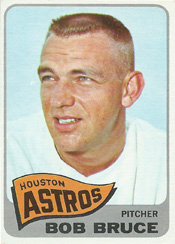
Bruce was 9-18 in 1965 and 3-13 in 1966 for a combined record of 12-31. Gibson was 20-12 in 1965 and 21-12 in 1966 for a combined record of 41-24. Yet, in the four starts pairing Bruce against Gibson in those two seasons, Bruce was 3-1 with a 1.69 ERA.

In nine years (1959-67) in the majors, primarily with losing Houston clubs, Bruce was 49-71 with a 3.85 ERA. Against the Cardinals, the right-hander was 4-8 with a 2.45 ERA in 20 appearances, including 14 starts.

In a relief appearance versus the Cardinals on April 19, 1964, at Houston, Bruce became the 12th major-league pitcher to strike out three batters on nine pitches, according to the Houston Chronicle. Bruce achieved the feat in the eighth inning, striking out Bill White, Charlie James and Ken Boyer on an assortment of off-speed pitches. In the ninth, after yielding a single to Johnny Lewis, Bruce struck out the side. Boxscore

Tim McCarver, Cardinals catcher, said Bruce was a right-handed version of St. Louis left-hander Curt Simmons.

“Bruce is rough on left-handed batters with his slow stuff,” McCarver said to the St. Louis Post-Dispatch. “He has a good motion like Simmons. He keeps the ball down. He keeps you honest with fastballs on the hands.”

Another Cardinal, Phil Gagliano, said, “Bruce never gives you anything good to hit.”

Though he started multiple games against Cardinals pitchers such as Ernie Broglio, Ray Sadecki and Ray Washburn, the St. Louis opponent Bruce faced the most was Gibson.

Hot stuff

Pitching for the Houston Colt .45s in their first season in the National League, Bruce was paired against Gibson for the first time on July 22, 1962. The Cardinals won, 3-1, on a sweltering Sunday afternoon at Colt Stadium.

With the temperature in the upper 90s, Bruce pitched seven innings, giving up all three runs in the second. Gibson contributed a two-out, RBI-single.

Relying primarily on fastballs and working on three days of rest, Gibson pitched 8.2 innings for the win.

Lindy McDaniel earned the save by getting Billy Goodman to ground out with runners on second and third, two outs, in the ninth.

“I wanted a breaking ball on Goodman and Gibson didn’t have enough left,” Cardinals manager Johnny Keane told the Post-Dispatch when asked why he lifted Gibson. Boxscore

Bruce and Gibson would not be paired against one another as starters for three years. Then Bruce began his stretch of winning three of four against Gibson.

Here’s a look at those games:

Surprise slugger

Bruce held the Cardinals to two runs in eight innings and got the win in a 5-2 Astros victory at St. Louis on June 4, 1965.

Gibson was burned by home runs from a pair of players who were physical opposites. In the sixth, Walt Bond, a 6-foot-7 outfielder, hit a two-run home run into the teeth of a wind blowing in from right field. With two outs in the ninth, Ron Brand, a 5-foot-7 catcher, hit a three-run home run, snapping a 2-2 tie. It was the second of three home runs Brand would hit in an eight-year career in the majors.

Brand had hit Gibson’s first pitch of the at-bat deep but foul. The home run came with the count 1-and-2. “That first pitch was surprise enough,” Brand said. “I hardly ever hit a ball that hard. I never hit two like that in one inning.”

The Cardinals had eight singles off Bruce until McCarver led off the bottom of the ninth with a double. Jim Owens relieved and retired the next three batters, preserving the win for Bruce. Boxscore

Home sweet dome

Bruce pitched a six-hit shutout in a 2-0 victory over the Cardinals at the Astrodome on July 21, 1965. All the St. Louis hits were singles.

Gibson yielded four hits in seven innings, though he injured the little finger on his right hand reaching for a hard grounder by Joe Morgan in the fifth.

With the finger swollen and painful _ the injury later was diagnosed as a torn capsule joint _ Gibson remained in the scoreless game.

Bob Lillis, a former Cardinals infielder, broke the tie that inning with a two-run double, a pop fly to right-center that barely eluded center fielder Curt Flood. “I was a step behind the ball and I might as well have been a day late,” Flood said.

Bruce, described by the Post-Dispatch as “no Humpty Dumpty,” preserved the win by getting McCarver to fly out with two on and two outs in the ninth. Boxscore

Solid Goldfinger

Though his injured finger remained swollen, Gibson limited the Astros to four singles in a 3-1 victory at St. Louis on Aug. 5, 1965.

Gibson, who greeted well-wishers by extending his left hand, said, “The finger doesn’t bother me so much when I throw a fastball, but it really smarts when I throw curves. I bunch the fingers to throw curves and the little finger presses against the next finger on curves.”

McCarver drove in two of the three runs off Bruce without a hit. McCarver hit a sacrifice fly in the fourth and his hard groundout to first in the sixth scored Flood from third.

“I’d like to be able to pitch like Gibson _ even with a sore finger,” Bruce said. Boxscore

Eyeing a win

In his final matchup against Gibson, Bruce held the Cardinals to two hits in eight innings in a 6-1 victory at St. Louis on July 8, 1966. Gibson was lifted after surrendering four runs and eight hits in 4.1 innings.

Bruce entered the game with a record of 1-6 and a 5.98 ERA. An infection in his right eye that threatened his sight had kept him from pitching from April 20 until June 5. After beating Gibson and the Cardinals, Bruce told the Post-Dispatch he still didn’t have satisfactory vision in the eye. Boxscore
 

Read Full Post »

Struggling to score, the Cardinals opened the 1997 season by losing a franchise-record six in a row.

From April 1-6, the 1997 Cardinals scored a total of 12 runs in losing three to the Expos at Montreal and three to the Astros at Houston. All the games were played indoors.
It was the first time the Cardinals started a season 0-6.

The ugly start put the Cardinals in a hole from which they couldn’t recover. Never getting their record above .500, the 1997 Cardinals finished 73-89.

Expectations had been for a much different outcome.

High hopes

In 1996, Tony La Russa’s first season as St. Louis manager, the Cardinals (88-74) won the National League Central Division title and swept the Padres in the NL Division Series. After getting within a win of clinching the 1996 pennant before losing to the Braves in the NL Championship Series, the Cardinals were supposed to be contenders in 1997.

At a banquet in February 1997, La Russa raised the stakes, predicting the Cardinals would repeat as division champions.

The Cardinals had a successful spring training in Florida, posting a 19-11 record in exhibition games.

“So far, the signs are outstanding _ the way they’ve gone through the drills, the way they’ve competed in the games and the way they’ve related to each other and the coaches,” La Russa said to the St. Louis Post-Dispatch. “The signs are all go.”

After departing Florida, the Cardinals went to Arlington, Texas, and to Baltimore to play exhibition games against the Rangers and Orioles before opening the season on April 1 at Montreal.

In his column for the Post-Dispatch, Bernie Miklasz wrote, “La Russa has had the game face on since, oh, about Dec. 26. It should be a good year. The Cardinals should repeat as Central Division champions.”

Loss #1, April 1, at Montreal

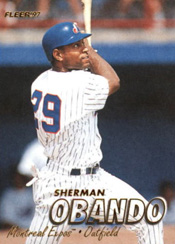
In the bottom of the ninth inning, with the score tied at 1-1, Cardinals reliever Tony Fossas walked pinch-hitter Sherman Obando with the bases loaded, forcing in the winning run and giving the Expos a 2-1 victory. Boxscore

Obando never took a swing in the six-pitch at-bat. “I didn’t see the ball up, so I didn’t swing,” Obando said.

The Cardinals scored their run in the sixth when Delino DeShields scampered home from third on a wild pitch from Jim Bullinger.

Loss #2, April 2, at Montreal

The Expos, behind the pitching of Jeff Juden, Omar Daal and 39-year-old Lee Smith, held the Cardinals to two singles and won, 4-1.

For the second consecutive game, the lone Cardinals run was scored by DeShields advancing from third to home on a wild pitch.

Said La Russa: “I have confidence that good hitters are going to hit.” Boxscore

Loss #3, April 3, at Montreal

The Cardinals blew leads of 2-0 and 4-2, losing 9-4. The Expos raked starter Alan Benes for 10 hits and seven runs in 4.2 innings.

“You can draw any conclusions you want to,” said La Russa. “They just flat outplayed us all three games.” Boxscore

The next day, in Houston, Miklasz met with La Russa before the game and described the manager as looking “as cheerful as your basic werewolf.”

“Those three insipid losses (at Montreal) made baseball’s most famous vegetarian more nauseated than he would by a plate stacked high with pepperoni, sausage and bacon,” Miklasz wrote.

Said La Russa: “We should have been more competitive in each of those three games. There’s no reason why we shouldn’t have done better in how we played _ and the manager should have done a better job.”

Loss #4, April 4, at Houston

Jeff Bagwell’s bases-loaded single off Eric Ludwick in the 11th snapped a 2-2 tie and lifted the Astros to a 3-2 victory.

The Cardinals started a season 0-4 for the first time since 1985.

St. Louis stranded 13 base runners. John Mabry drove in both Cardinals runs. Boxscore

In four games, the Cardinals were batting .167 with runners in scoring position.

“I feel terrific about our club,” La Russa said. “There isn’t anything we didn’t try to do tonight. The effort was there, the intensity, everything.”

Loss #5, April 5, at Houston

The Astros beat the Cardinals, 6-2. With their 0-5 record, the 1997 Cardinals matched the teams of 1902, 1919, 1960 and 1973 for worst start in franchise history.

Wrote Miklasz: “The lineup is as lethal as a Pez dispenser.”

Sid Fernandez started and earned the win in his final appearance of a 15-year major-league career. Ramon Garcia pitched four scoreless innings in relief for the save. Boxscore

“It’s a six-month test … I still like our club a lot,” said La Russa.

Loss #6, April 6, at Houston

Bagwell, hitting for infielder Tim Bogar in the eighth, delivered a two-run, two-out double off John Frascatore, erasing a 2-1 Cardinals lead and carrying the Astros to a 3-2 victory. Boxscore

The three-game sweep gave the Astros more wins against the Cardinals in 1997 than they had in 1996, when they lost 11 of 13 to St. Louis.

Having set the franchise record for most losses to begin a season, the Cardinals limped back to St. Louis for their home opener.

“I think I see guys trying to force things,” La Russa said. “It’s human nature. I hope they do. Otherwise, it means they don’t care.”

Said Cardinals third baseman Gary Gaetti: “It’s hard not to press when you’re really trying to get that first one.”

That’s a winner

After an off-day in St. Louis on April 7, the Cardinals played their home opener on April 8.

Willie McGee, 38, hitting for pitcher Mark Petkovsek, rescued the Cardinals by slashing a home run off Ugueth Urbina with two outs in the bottom of the ninth, giving St. Louis a 2-1 triumph over the Expos. Boxscore

“You couldn’t write a better script,” Mabry said of McGee’s streak-busting blast.

Said La Russa: “This was more dramatic than anything I’ve seen in a movie.”

Previously: Why Cards chose Delino DeShields over Ryne Sandberg

Read Full Post »

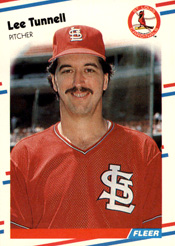
With his big-league career in decline, Lee Tunnell got an unexpected boost from a veteran scout and grabbed hold of an opportunity presented by the Cardinals. Six months later, Tunnell was pitching in the World Series.

During spring training in 1987, Cardinals scout Rube Walker was following the Pirates to assess whether catcher Tony Pena was a player St. Louis should acquire. While scouting Pena, Walker got to see Tunnell pitch.
Tunnell, a right-hander, was 11-6 with the Pirates in 1983, but skidded to 1-7 in 1984 and 4-10 in 1985. Tunnell spent the 1986 season in the minor leagues with Hawaii and was 4-11 with a 6.01 ERA.

“My career has been on a downhill slope, but (in 1986) it was pretty steep,” Tunnell said.

When he reported to spring training in 1987, the Pirates told Tunnell, 26, he no longer was in their plans and they would try to deal him. Tunnell handed the Pirates a list of places he’d like to pitch. St. Louis was one of those.

Scout’s honor

On April 1, 1987, the Pirates traded Pena to the Cardinals for outfielder Andy Van Slyke, catcher Mike LaValliere and pitcher Mike Dunne.

The Pirates also talked to the Cardinals about Tunnell. “We weren’t real interested in him because his record had been pretty weak,” Cardinals general manager Dal Maxvill said to the St. Louis Post-Dispatch.

Maxvill had a change of heart when he talked with Walker, a former pitching coach with the Mets and Braves. Walker told Maxvill that Tunnell had an effective fastball and breaking pitch. After reading Walker’s scouting report, Maxvill met with Lee Thomas, director of player development for the Cardinals. “We talked it over again and decided to go for him,” Maxvill said.

On April 6, 1987, the Cardinals purchased Tunnell’s contract from the Pirates and assigned him to their Class AAA minor-league affiliate at Louisville.

Rapid rise

Pitching for Louisville manager Mike Jorgensen, Tunnell regained his form and validated Walker’s endorsement. “This was just a time in my career where I needed a new start with somebody else,” said Tunnell. In six starts for Louisville, Tunnell was 4-1 with a 3.41 ERA.

On May 15, 1987, the Cardinals placed outfielder Jim Lindeman on the disabled list and called up Tunnell. Two days later, Tunnell got a start against the Reds in place of Joe Magrane, who had sprained an ankle.

The May 17 game between the Reds and Cardinals at St. Louis was a matchup of pitchers seeking to revive their careers. Starting for the Reds was Jerry Reuss, 37, a St. Louis native and former Cardinal who had joined the Reds after being released by the Dodgers.

Pitching in a big-league game for the first time in two years, Tunnell held the Reds to two runs in seven innings and got the win. Tunnell also singled and drove in a run in a 10-2 Cardinals victory. Reuss yielded 10 hits, two walks and seven runs in 4.2 innings. Boxscore

Tom Pagnozzi, who caught Tunnell’s gem and contributed a grand slam off reliever Guy Hoffman, said of the Cardinals starter, “His fastball was running in and out. He had a good slider and an outstanding curveball. He kept it down all game and they kept swinging and missing.”

Pena, watching from the Cardinals bench while on the disabled list, said of his former Pirates teammate: “He pitched today like he did in 1983. The Pirates lost confidence in him and then he lost his confidence. Sometimes it’s good to make a change. It was the right move and he’s excited about being here.”

Tunnell won three of his first four decisions with the Cardinals.

Big stage

In August 1987, he was placed on the 15-day disabled list because of a shoulder ailment. “Anytime I put effort into my fastball, it felt like my shoulder was coming out of its socket,” Tunnell said.

The rest enabled Tunnell to regain strength in the shoulder. On Aug. 29, he pitched effectively in a rehabilitation start for Class A Springfield, Ill. Three days later, he was reactivated by the Cardinals.

Utilized as a reliever, Tunnell pitched 8.2 scoreless innings in eight September appearances for the Cardinals, helping them clinch the National League East title.

His regular-season record: 4-4 with a 4.84 ERA.

For the NL Championship Series versus the Giants, Cardinals manager Whitey Herzog opted to keep eight pitchers on the postseason roster, leaving no room for Tunnell.

After the Cardinals won the pennant, Herzog determined injured first baseman Jack Clark wouldn’t be able to play in the World Series against the Twins, so he replaced Clark on the roster with Tunnell.

Tunnell appeared in relief in two World Series games, posting a 2.08 ERA in 4.1 innings.

In 1988, Tunnell spent the season at Louisville and was 6-8 with a 3.86 ERA. The Cardinals released him in October 1988.

Previously: Cardinals deal for Tony Pena not as lopsided as thought

Read Full Post »

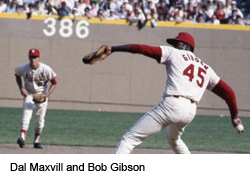
Clearly a believer in the Mark Twain adage of “Never let the truth stand in the way of a good story,” Bob Gibson told a terrific tale about the indignity of having Cardinals teammate Dal Maxvill pinch-hit for him. Problem is, it never happened.

Toward the end of an interview published in the March 11, 2017, St. Louis Post-Dispatch, Gibson was asked by Rick Hummel, “Worst experience in baseball?”

The Hall of Fame pitcher responded by spinning a story about the time manager Red Schoendienst called upon Maxvill, the light-hitting shortstop, to bat for Gibson.

“My worst experience in baseball was when Red had Maxvill pinch-hit for me,” Gibson said. “I was so mad. I sat on the bench and Maxie swung and missed a couple of pitches and then he popped up. I walked past Red and said, ‘Don’t ever do that again.’ I took a shower and went home.”

Either Gibson, a noted prankster, was playing a gag on Hummel, or the passage of time clouded the memory of the 81-year-old Cardinals legend.

Don’t blame Dal

The facts: Maxvill was not a successful pinch-hitter, but he never batted for Gibson in either a regular-season or postseason game.

Maxvill made 12 plate appearances as a big-league pinch-hitter, according to the reliable Web site retrosheet.org. He was 0-for-11, with a walk.

Gibson didn’t pitch in any of the 12 games Maxvill appeared as a pinch-hitter.

Maxvill made six pinch-hit appearances _ three in 1962 and three in 1963 _ when Johnny Keane was Cardinals manager. He made two pinch-hit appearances with the 1972 Athletics under manager Dick Williams.

Only four of his 12 pinch-hit appearances took place for the Cardinals when Schoendienst was manager. He had one in 1965, two in 1971 and one with the 1972 Cardinals before he was traded to the Athletics.

No Gibson sub

The four times Schoendienst sent Maxvill to pinch-hit resulted in:

_ Reached on an error as pinch-hitter for pitcher Ray Washburn on June 16, 1965. Boxscore

_ Grounded out to shortstop as pinch-hitter for pitcher Bob Chlupsa on June 4, 1971. Boxscore

_ Walked intentionally as pinch-hitter for pitcher Moe Drabowsky on June 8, 1971. Boxscore

_ Struck out as pinch-hitter for injured shortstop Dwain Anderson on Aug. 15, 1972. Boxscore

Only once did Maxvill pop out as a Cardinals pinch-hitter. That took place in his major-league debut on June 10, 1962, when Maxvill, batting for pitcher Bobby Shantz, hit a pop-up to Giants pitcher Billy O’Dell. Boxscore

This scenario fits

Perhaps Gibson was confusing Maxvill with Dick Schofield.

In 1968, Schofield was Maxvill’s backup at shortstop. Schofield, a .227 career hitter, batted .220 for the 1968 Cardinals.

On April 20, 1968, Schoendienst sent Schofield to bat for Gibson in the ninth inning.

Schofield popped out to third.

Gibson couldn’t have been happy. The Cubs won, 5-1, making Gibson winless in three starts. The Cardinals scored a total of seven runs in those three games.

Though he made 11 pinch-hit appearances for the 1968 Cardinals, Schofield never would bat for Gibson again.

Gibson would go on to have his most magnificent season in 1968, producing a 1.12 ERA and 28 complete games in 34 starts for the National League champions.

Gibson in a pinch

Maxvill has a career .217 batting average; Gibson, .206.

Gibson was more successful than Maxvill as a pinch-hitter.

In 14 career pinch-hit appearances for the Cardinals, Gibson produced three hits, two walks and a sacrifice bunt.

In 13 of those pinch-hit appearances, Gibson batted for a pitcher.

The exception was on May 27, 1966, when Gibson was Schoendienst’s choice to be a pinch-hitter for left fielder Bobby Tolan. Batting with a runner on third, one out and the Cardinals trailing by a run against the Reds, Gibson struck out against reliever Billy McCool. Boxscore

Read Full Post »

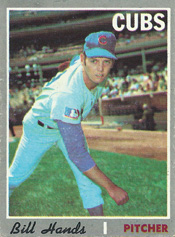
Bill Hands, whose effective starting pitching helped transform the Cubs from losers to contenders under manager Leo Durocher, was a familiar opponent of the Cardinals in the late 1960s and early 1970s. His best performance against the Cardinals came on a day when the behavior of the Wrigley Field Bleacher Bums got out of hand.

Hands pitched 11 seasons (1965-75) in the major leagues and had a career record of 111-110 with a 3.35 ERA.

A right-hander, Hands was best in a three-year stretch for the Cubs when he was 16-10 in 1968, 20-14 in 1969 and 18-15 in 1970.

Against the Cardinals, Hands was 14-12 with a 2.58 ERA in his career. He had more wins (14), innings pitched (205.2) and appearances (38) against the Cardinals than he did versus any other opponent.

After posting losing records in 13 of 14 seasons from 1953-66, the Cubs had 87 wins in 1967 and 84 in 1968. By 1969, they were a threat to the reign of the Cardinals, who had won consecutive National League pennants in 1967 and 1968.

Fired up

On June 28, 1969, the Cubs were in first place in the East Division at 46-26 entering a Saturday game with the Cardinals at Chicago. St. Louis was 35-37, 11 games behind the Cubs. Looking to put a dagger into the Cardinals’ title hopes, the Cubs started Hands against Dave Giusti.

The left field stands at Wrigley Field filled quickly with Cubs fans. Known as Bleacher Bums, the group was whipped into a frenzy by the early-season success of their hometown team and by the sight of the archrival Cardinals.

As Cardinals players appeared in the outfield to shag flies and play catch before the game, “bleacher fans showered the Redbirds players with flashlight batteries, quarters, paper cups, dry ice and other debris in pregame practice,” the St. Louis Post-Dispatch reported.

Cage match

Cardinals center fielder Curt Flood told the Chicago Tribune, “They were throwing steel ball bearings at me. If I turn and catch one in the eye, it’s bye-bye career. I can start carrying a lunch pail to work.”

Cardinals pitcher Mudcat Grant said he was hit in the mouth by a hard rubber ball thrown from the left-field bleachers. Someone also flung a hard hat at him. Teammate Bob Gibson picked up the hard hat and “played the conductor’s role in leading the Bleacher Bums as they jeered the Cardinals with chants,” the Post-Dispatch reported.

According to the Tribune, bleacher fans claimed Grant retaliated by hitting three of them with baseballs he threw into the stands.

“I just lobbed the ball,” Grant said to the Post-Dispatch. “They weren’t lobbing those nails and flashlight batteries and that helmet at me.”

Grant said he “scared” the fans by throwing two baseballs hard against the ivy-covered wall.

“You ought to put a cage over them,” Grant said.

The Bleacher Bums also taunted left fielder Lou Brock, a former Cub, with calls of “bush leaguer.”

“The thing that really bothers me about it is that they are showing you people (reporters) up,” Brock said. “You have glorified them and they show their gratitude by behaving like that. It’s not right.”

Bearing down

Once the game began, Hands became the story. He held the Cardinals to one hit _ a Tim McCarver single _ through five innings.

In the sixth, with the Cubs ahead, 1-0, Flood led off with a single to left. Brock stretched his hitting streak to 13 games with a double into the left-field corner, scoring Flood.

“Both the pitches they hit in that inning were mistakes,” Hands said. “Brock hit a fastball down the middle and Flood got a hanging slider.”

Reminding himself to bear down, Hands struck out Vada Pinson and Joe Torre _ “I got Pinson on a fastball on the corner and Torre missed a slider,” Hands said _ before McCarver flied out.

The Cubs went ahead, 2-1, when Willie Smith hit a home run off Giusti in the bottom half of the inning and they added a run in the seventh.

Hands retired the Cardinals in order in the last three innings, sealing the 3-1 win and finishing with a three-hitter. Boxscore

Koufax impressed

It was the third consecutive complete game pitched by Hands.

“I knew Hands was a good pitcher, but I didn’t know he was that good,” said Sandy Koufax, the retired Dodgers ace who was broadcasting the game for NBC. “He really showed me something today.”

Said Cardinals manager Red Schoendienst: “He threw a good slider about 85 percent of the time to our right-handed batters. He had marvelous control of it _ low and away.”

The loss dropped the Cardinals 12 games behind the Cubs. “They’re far enough behind us that they’ve got to win almost every one of the (13) games left between us,” said Cubs shortstop Don Kessinger.

Though the Cardinals didn’t catch them, the Cubs couldn’t hold onto the division lead. The Mets would finish in first place at 100-62. The Cubs (92-70) placed second and the Cardinals (87-75) were fourth.

Previously: How Mike Shannon put brakes on Cubs title hopes

Read Full Post »

In his spring training stint with the Cardinals, Mike Caldwell appeared to be a pitcher whose career was in decline. Shelled early and often, Caldwell showed no signs of developing into what he would become: a 20-game winner who would torment the Cardinals in the World Series.

Caldwell’s five-month stint as a Cardinal is a tale of a late bloomer who was in the wrong organization at the wrong time.

In March 1977, Caldwell, 28, was considered a leading candidate to fill a role in the Cardinals’ bullpen. Instead, he was traded before he got a chance to appear in a regular-season game for St. Louis.

Giant troubles

Caldwell, a left-hander, made his major-league debut with the 1971 Padres. He had a 13-25 record in three seasons with the Padres before he was traded to the Giants for slugger Willie McCovey.

In 1974, his first year with the Giants, Caldwell had a breakout season, posting a 14-5 record and 2.95 ERA.

After the season, Caldwell had surgery to remove bone spurs in his left elbow. When he returned, he struggled. “I lost some movement on my best pitch, the sinker, and I tightened up some and came sidearm at times,” Caldwell told the St. Louis Post-Dispatch.

By 1976, Caldwell was having troubles in the Giants clubhouse as well as on the mound. “I didn’t get along with a couple of the coaches and they took it personally,” Caldwell said.

The Giants’ pitching coach was the former catcher, Buck Rodgers.

Caldwell reached a low point on April 28, 1976, when Doug Clarey hit a home run, the lone hit of his big-league career, against him in the 16th inning, lifting the Cardinals to a 4-2 victory.

Caldwell finished 1-7 with a 4.86 ERA for the 1976 Giants. “I lost my confidence, tried too hard _ overthrew, I guess you’d say _ and I didn’t do very well,” Caldwell said.

Hope rekindled

On Oct. 26, 1976, the Giants traded Caldwell, pitcher John D’Acquisto and catcher Dave Rader to the Cardinals for pitcher John Curtis, outfielder Willie Crawford and utility player Vic Harris.

“I’m just glad to get away from a bad situation,” Caldwell said of leaving the Giants.

The Cardinals slotted Caldwell for the bullpen. “It’s common knowledge that the problem with the Cardinals last year was that middle relief and late relief, except for Al Hrabosky, couldn’t get the other clubs out,” said St. Louis manager Vern Rapp.

Said Caldwell: “I have no illusions. I’ve got to prove I’m good enough to make the staff.”

Bad audition

On March 12, in the Cardinals’ 1977 spring training opener against the Mets, Caldwell pitched two innings and gave up four runs. Three days later, Caldwell pitched an inning against the Dodgers and yielded three runs.

The Cardinals didn’t pitch him much after that.

On March 29, 1977, the Cardinals traded Caldwell to the Reds for pitcher Pat Darcy. In eight spring training innings, Caldwell yielded nine earned runs.

“Rapp called me in and told me, ‘Don’t get mad. You’re going to a contender,’ ” Caldwell said. “I wasn’t mad about that. I just thought he should’ve had some respect for me as a pitcher. That’s all I wanted: Throw me out there to see what I can do.”

Right fit

The Reds weren’t too impressed with Caldwell either. Three months after they acquired him, the Reds dealt Caldwell to the Brewers.

In 1978, Caldwell got a break when the Brewers named George Bamberger their manager. Under Bamberger, who had been a pitching coach for the Orioles, Caldwell fulfilled his potential. He was 22-9 with a 2.36 ERA and 23 complete games for the 1978 Brewers.

“Lots of people had given up on me,” Caldwell said to The Sporting News, noting he was traded by four clubs, including the Cardinals. “Maybe the people who gave up on me were responsible in an indirect way for my coming back. I knew I could pitch and I hope those who gave up on me will say now, ‘Well, he had the guts to battle back and win.’ ”

The third-base coach for Bamberger’s Brewers was Buck Rodgers, with whom Caldwell had feuded in his last season with the Giants. In 1980, Rodgers replaced Bamberger as Brewers manager.

Old wounds

Early in the 1982 season, Caldwell had a run-in with Rodgers aboard a plane, The Sporting News reported. In June 1982, Rodgers was fired and replaced by hitting coach Harvey Kuenn. Rodgers said disgruntled players had “tried to stab me in the back.”

Kuenn led the Brewers to the 1982 American League pennant and a matchup against St. Louis in the World Series.

Five years after he’d been dealt by the Cardinals, Caldwell would be facing them on baseball’s biggest stage.

Series drama

Caldwell, nicknamed “Mr. Warmth” by teammate Gorman Thomas because of his sometimes grumpy nature, was Kuenn’s choice to start Game 1.

Caldwell responded with a three-hit shutout in a 10-0 Brewers victory. Boxscore

Cardinals first baseman Keith Hernandez said he thought Caldwell was throwing a spitter, an illegal pitch. “He might have been throwing me screwballs, but I never saw a screwball drop like that,” Hernandez said.

Caldwell said he threw “natural sinkers.” Regarding the spitball accusation, Caldwell replied, “I look at it as a compliment. If the ball drops so much that they’re accusing me of throwing a spitter, I’ve got pretty good stuff.”

With the Series deadlocked at 2-2, Caldwell started Game 5 and again was the winning pitcher. He yielded 14 hits and two walks in 8.1 innings, but the Cardinals stranded 12 and the Brewers won, 6-4. Boxscore

The Cardinals won Game 6, setting up a deciding Game 7.

Clinging to a 4-3 lead in the eighth, the Cardinals had runners on first and second, two outs, when Kuenn lifted Moose Haas and replaced him with Caldwell. Darrell Porter and Steve Braun responded with RBI-singles, stretching the lead to 6-3, before Caldwell got Willie McGee to ground out.

Bruce Sutter set down the Brewers in order in the ninth, clinching the championship for the Cardinals. Boxscore


Read Full Post »

« Newer Posts - Older Posts »