Feeds:
Posts
Comments

Archive for the ‘Games’ Category

Mike Shannon and Jerry Buchek, the only St. Louis natives among the players on the 1966 Cardinals, had special roles in the first game played at Busch Memorial Stadium.
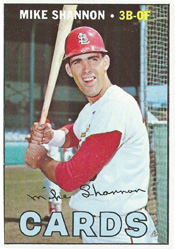
mike_shannon4On May 12, 1966, Shannon produced the first Cardinals hit and the first Cardinals RBI in the debut game at the $26 million circular stadium in downtown St. Louis. Buchek delivered a RBI-single that tied the score with two outs in the bottom of the ninth inning.

The Cardinals capped a successful evening when Lou Brock got a bases-loaded single in the 12th, giving the Cardinals a 4-3 victory over the Braves.

Sky high

A crowd of 46,048, a record for a sporting event in St. Louis at that time, turned out to see the Cardinals and their new home. Among those attending on that Thursday night were baseball commissioner William Eckert and National League president Warren Giles.

Each spectator was given a parchment “First Nighter” scroll as a souvenir. Many of the fans were dazzled by the scoreboard and its color graphics and animation. “No matter who hits a homer, the Anheuser-Busch eagle flaps its wings and a tiny, chirping redbird darts across one side of the board,” The Sporting News reported.

The seats were located farther from the field than those at the original Busch Stadium, formerly Sportsman’s Park, on North Grand Boulevard. The elevation of the upper deck was intimidating to some. “Fifteen more feet up and I’d be in heaven,” said former Cardinals manager Ray Blades.

Among the players, reviews of the stadium generally were favorable.

“This park is tailored to our type of club,” Cardinals outfielder Alex Johnson said to the Associated Press. “It’s a paradise for line drive hitters.”

Said Shannon: “There will be a lot of doubles and triples.”

Redbirds rally

Shannon had hoped his wife Judy and their four children would attend, but they couldn’t because they developed the mumps. “So Mike showed off his punch without Judy,” wrote Neal Russo of The Sporting News.

In the bottom of the first, Shannon singled against Braves starter Wade Blasingame for the first Cardinals hit. In the third, Shannon’s two-out triple off Blasingame scored Buchek from first with the first Cardinals run.

Braves leadoff batter Felipe Alou, playing on his 31st birthday, hit two solo home runs _ in the sixth off Ray Washburn and in the eighth against Tracy Stallard. The second home run gave the Braves a 3-2 lead.

In the bottom of the ninth, Alex Johnson was on third with two outs when Buchek batted against Billy O’Dell. With the count 2-and-2, Buchek swung at a pitch near his fists and looped a pop fly that fell into short right field for a single, scoring Johnson with the tying run.

As Buchek’s bloop fell safely between the Braves fielders, “a fast-retreating crowd set up a roar that would make the Metro-Goldwyn-Mayer lion sound like Mickey Mouse,” wrote St. Louis Post-Dispatch sports editor Bob Broeg.

Said Buchek: “It was a good pitch, in on me, and you’ve got to be lucky to hit the ball the way I did.”

Extra-inning drama

The Cardinals got a surprise in the 11th. Hal Woodeshick, a Cardinals relief pitcher, stroked a double off Phil Niekro. For Woodeshick, who had a career .092 batting average, it was his only extra-base hit in 11 big-league seasons. With two outs, Niekro issued an intentional walk to Julian Javier, then got Shannon to pop out to second, ending the inning.

In the 12th, the Braves threatened, putting runners on first and second, before Don Dennis escaped the jam by getting Alou to fly out to right.

The Cardinals took advantage of a Braves miscue in the bottom half of the 12th. Curt Flood led off and was hit by a Niekro pitch. Orlando Cepeda, the cleanup batter, bunted. Catcher Joe Torre fielded the ball and threw to second in a bid for a forceout. Instead, the ball sailed over the head of second baseman Frank Bolling. Flood advanced to third and Cepeda to second on the error.

After an intentional walk to Charlie Smith, filling the bases, Brock came to the plate against Niekro. With the infield drawn in for a play at the plate, Brock bounced a single up the middle, scoring Flood from third with the winning run. Boxscore

The next night, Shannon hit the first Cardinals home run at Busch Memorial Stadium. It was a solo shot off Braves starter Ken Johnson. Five days earlier, Shannon had hit the last Cardinals home run at the original Busch Stadium.

Previously: The story of the final game at original Busch Stadium

Previously: Here’s how Mike Shannon became a Cardinals catcher
Read Full Post »

(Updated Dec. 26, 2024)

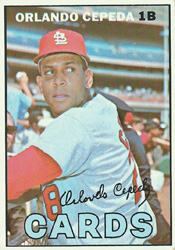
Feeling rejected and unappreciated by the Giants, Orlando Cepeda was traded to the Cardinals, who saw him as an asset rather than an outcast.

orlando_cepedaCepeda responded by providing the run production the Cardinals needed.
On May 8, 1966, the Giants sent Cepeda, 28, a first baseman recovering from knee surgery, to the Cardinals for Ray Sadecki, 25, a left-handed starting pitcher.

Cepeda was informed of the deal immediately after contributing two RBI to the Giants’ 10-5 victory over the Cardinals in the final game played at the original Busch Stadium in St. Louis.

In his book “Baby Bull,” Cepeda said, “In the clubhouse after the final game, I was as pleased as I could be. I was in the groove. That’s when I saw (Giants manager) Herman Franks walking toward me. I thought he was going to congratulate me … Instead, he told me I was traded to the St. Louis Cardinals. Just like that. No explanation … It came as a total shock.

“Initially, I was crushed,” Cepeda said. “So were my wife and my mother. At times, I had hoped a trade might happen, but it still hurt … The day I was traded I sat by my locker alone and cried. Jim Davenport (a third baseman) was the only non-Latin player to bid me goodbye and wish me well.”

After gathering his belongings, Cepeda went into the Cardinals clubhouse. He was welcomed warmly, describing his new teammates as “an incredible group of guys.”

“Stan Musial (team vice president) came down to see me and to tell me how happy he was to have me with the club,” Cepeda said. “Bob Bauman, the Cardinals’ trainer, made his position clear as well. ‘I’ll take care of your leg,’ he said. ‘You take care of the hits.’ ”

Cepeda called Cardinals catcher Tim McCarver “a special guy,” adding, “Tim never turned his back on me. He showed a strength of character and an unwavering friendship that I have not forgotten.”

On the morning after the trade, Cepeda had breakfast with manager Red Schoendienst and was presented with a contract that increased his yearly salary from $40,000 to $53,000. “Red told me I was going to play first base and hit cleanup,” Cepeda said.

Fitting the needs

The deal had been speculated for a week. The Cardinals needed a first baseman who could hit with power. Rookie George Kernek, who took over at first base in 1966 after Bill White was traded, struggled, with no home runs and three RBI in 20 games. The Giants wanted a left-hander for a rotation with right-handers Juan Marichal and Gaylord Perry.

Cepeda and Sadecki fit the needs.

Sadecki earned 20 wins for the 1964 Cardinals and was the winning pitcher in Game 1 of the World Series that year. He slumped to a 6-15 record and 5.21 ERA in 1965. He was 2-1 with a 2.22 ERA for the 1966 Cardinals.

Cepeda won the National League Rookie of the Year Award in 1958 and followed that with a string of successful seasons, including 1961 when he led the NL in home runs (46) and RBI (142) and 1962 when he produced 35 home runs and 114 RBI for the pennant-winning Giants. After undergoing surgery to remove cartilage from a knee in December 1964, Cepeda was limited to 34 at-bats in 1965, hitting .176. He batted .286 with 15 RBI in 19 games for the 1966 Giants.

A three-game series between the Cardinals and Giants at San Francisco in April 1966 heightened interest in a trade.

In the series opener April 29, Sadecki impressed the Giants, pitching a five-hitter against them in a 5-1 Cardinals victory. Boxscore

The Giants won the next two games, 6-1 and 2-0, highlighting the Cardinals’ lack of punch.

On May 1, 1966, the Oakland Tribune reported a deal of Cepeda-for-Sadecki was in the works.

Seeing is believing

Five days later, the Giants were in St. Louis for a three-game series. The Giants won the opener, 4-2. In the second game, Cepeda hit a grand slam off Art Mahaffey in a 15-2 Giants triumph. According to The Sporting News, Bauman and Cardinals surgeon Dr. I.C. Middleman checked Cepeda’s surgically repaired right knee that night. Middleman determined Cepeda’s knee was in good condition.

In the 1998 book “The Original San Francisco Giants,” Cepeda claimed he tricked Middleman. “The Cardinals team doctor checked my knee,” Cepeda told author Steve Bitker. “The funny thing is I gave him the left knee … Instead of giving him the bad knee, I gave him the good knee. He said, ‘You’re in great shape, man.’ ”

The next day, May 8, Cepeda hit a two-run double off Cardinals starter Larry Jaster in the first inning.

Convinced Cepeda was healthy and productive, Cardinals general manager Bob Howsam huddled with his counterpart, Chub Feeney of the Giants. In the fifth inning, Howsam and Feeney “completed the deal on the old Busch Stadium roof next to the press box,” the Oakland Tribune reported.

“Seeing the Baby Bull circle the bases must have convinced the Cardinals bosses that the Giants weren’t trying to unload a broken-down player,” wrote Tribune columnist Ed Levitt.

The deal was announced after the game.

Sadecki still was in the Cardinals locker room, talking with reporters about the trade, when pitcher Bob Gibson approached and, alluding to a league crackdown on fraternizing, said to him, “Get out of our clubhouse or they’ll fine us $25 for talking to you.”

Opinions vary

Cepeda’s presence was expected to take pressure off Cardinals batters.

Stan Musial told the San Francisco Examiner, “Cepeda is a great power hitter … You’ve got to be an aggressive hitter to be outstanding, and that’s what he is. I don’t know anybody outside of (Willie) Mays with the sheer power Cepeda has.”

Said Cardinals pitcher Hal Woodeshick: “He (Cepeda) ought to drive in 100 runs hitting behind (Curt) Flood and (Lou) Brock.”

As for Sadecki, Bob Stevens of The Sporting News wrote the deal “could mean a pennant to the Giants. Ray was what they needed and wanted.”

Schoendienst told United Press International that Sadecki “should win 20 games this season with all the Giants’ hitting power.”

Ed Levitt of the Oakland Tribune, though, expressed doubt, writing, “It grieves us to see (the Giants) turn loose a consistent slugger for an inconsistent pitcher … We question the value given for the value received.”

NL MVP

The deal worked out better for the Cardinals than it did the Giants.

Sadecki was 3-7 with a 5.40 ERA for the 1966 Giants. He twice had 12-win seasons for the Giants: 1967 and 1968. The Giants placed second to the champion Cardinals in both seasons.

Cepeda hit .303 with 17 home runs, 24 doubles and 58 RBI in 123 games for the 1966 Cardinals.

In 1967, Cepeda won the NL Most Valuable Player Award and helped the Cardinals to a World Series championship. He hit .325 with 25 home runs, 37 doubles and a NL-best 111 RBI.

Looking back on the deal, Howsam told The Sporting News in 1967, “I didn’t want to give up Sadecki, but we needed to rebuild and Cepeda was a pretty good start.”

Though the Cardinals repeated as NL champions in 1968, Cepeda faltered, hitting .248 with 16 home runs, 26 doubles and 73 RBI. In March 1969, he was traded by the Cardinals to the Braves for Joe Torre.


Read Full Post »

(Updated May 8, 2020)

The final day of baseball at the original Busch Stadium, formerly known as Sportsman’s Park, featured a melancholy mix of star power and nostalgia, with an unusual twist at the end.

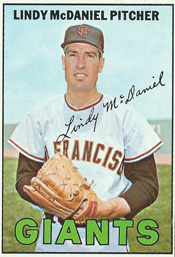
lindy_mcdanielOn May 8, 1966, the Giants beat the Cardinals, 10-5, in the last game played at the ballpark on North Grand Boulevard in St. Louis.
Known as Sportman’s Park until it was renamed Busch Stadium in 1953, the ballpark was the home of the Cardinals from 1920-66. It also was the home of the American League Browns from 1902-53.

Star power

On what The Sporting News described as “a delightfully warm Sunday afternoon,” the best all-time players from the two St. Louis franchises _ Stan Musial of the Cardinals and George Sisler of the Browns _ were honored in ceremonies before the game.

The starting pitchers were Larry Jaster for the Cardinals and Bob Shaw for the Giants before a crowd of 17,503.

The Giants led, 5-0, after three innings. The Cardinals rallied behind a barrage of home runs.

Tim McCarver and Bob Skinner each hit a two-run home run off Shaw in the fourth. Skinner’s blast landed deep in the center field bleachers. “That’s as good as I’ve ever hit a ball,” he said.

Mike Shannon, who first had played in the ballpark as a 14-year-old in the Catholic Youth Council tournament, hit a solo home run in the fifth off Joe Gibbon. It would be the last home run hit by a Cardinal in the ballpark.

In the sixth, with two outs and the score tied at 5-5, Giants slugger Willie McCovey, hitting for shortstop Hal Lanier, delivered the game-changing hit, a three-run, opposite-field home run to left off Tracy Stallard.

The Giants never looked back.

Milestone moments

With a fifth-inning single, Charlie Smith got the last hit by a Cardinal in the ballpark.

With a walk in the ninth, Jerry Buchek, a St. Louis native, was the last Cardinal to reach base in the ballpark.

Giants second baseman Tito Fuentes produced five singles in five at-bats.

Willie Mays hit the last home run at original Busch Stadium _ a solo shot in the ninth against Hal Woodeshick.

Lucky Lindy

Lindy McDaniel, who pitched for the Cardinals from 1955-62, earned the win with five innings of scoreless relief for the Giants.

In the bottom of the ninth, McDaniel struck out Jimy Williams, walked Buchek and got Alex Johnson to bounce into a double play.

“I didn’t really think much about it until that last inning and then I suddenly realized that if I held ’em I’d be the last pitcher to work there,” McDaniel said. “I was always a Cardinals fan as a kid. The Cardinals were the only club I really wanted to sign with. My idols were Stan Musial and Dizzy Dean before him. It was a real good feeling for me, winning the last game in the old ballpark in St. Louis.” Boxscore and Video

Bidding farewell

In a brief ceremony after the game, Cardinals owner Gussie Busch gave the deed to the ballpark to Richard Amberg, president of the Herbert Hoover Boys Club. The stands would be demolished but the field was to remain for use by the youths.

As a band played “Auld Lang Syne,” Bill Stocksick, who planted home plate in 1909, was given the honor of digging up the dish. It was transported by helicopter and placed in the new Busch Memorial Stadium in downtown St. Louis.

When the ceremonies ended, children were permitted to run around the bases. One of manager Red Schoendienst’s daughters scooped up some dirt around second base, where her father had performed as a player, and planned to place it in a bottle as a souvenir, The Sporting News reported.

A bulldozer appeared on the field, preparing to tear down the stands.

Stan and Red

In the Cardinals clubhouse, Musial walked into Schoendienst’s office.

“They say diamonds are a girl’s best friend, but this old diamond has been pretty good to us, Red,” Musial said to the manager.

Schoendienst nodded.

Wrote The Sporting News: “The two old Redbirds sipped a beer in a farewell toast to the old stadium where both became famous.”

Unusual twist

As the farewells played out, general managers Bob Howsam of the Cardinals and Chub Feeney of the Giants made a stunning announcement.

First baseman Orlando Cepeda, who was 2-for-4 with two RBI, a walk and a run scored in the Busch Stadium finale, was traded by the Giants to the Cardinals for pitcher Ray Sadecki.

Howsam and Feeney had agreed to the deal during the game.

The acquisition of Cepeda would be an important step in rebuilding the Cardinals into a championship club in 1967, their first full season in the new stadium.


Read Full Post »

One month after being released and having to return to the minor leagues to prove his worth as a pitcher, Ray Burris joined the Cardinals and showed them his bat was as valuable as his arm.

ray_burrisIn May 1986, Burris joined Dizzy Dean of the 1936 Cardinals as Redbirds pitchers to produce three RBI or more in consecutive games.
In 2016, Adam Wainwright matched the feats of Dean and Burris. Wainwright had three RBI for the Cardinals in their 11-4 victory over the Diamondbacks on April 27, 2016. Boxscore In the next game in which he batted, May 2, 2016, against the Phillies, Wainwright again had three RBI in a 10-3 Cardinals triumph. Boxscore

Eighty years earlier, Dean drove in three runs for the Cardinals in their 8-5 victory over the Braves on July 26, 1936. Boxscore In the next game in which he batted, July 31, 1936, against the Dodgers, Dean again had three RBI in an 8-6 Cardinals triumph. Boxscore

Like Bob Gibson and Bob Forsch, Dean and Wainwright are considered to be among the best-hitting Cardinals pitchers.

Burris didn’t have that kind of reputation. His performance was most unexpected.

Just hacking

Burris, 35, was released by the Brewers on April 1, 1986. The Cardinals signed him 10 days later and assigned him to Class AAA Louisville. He last had pitched in the minor leagues in 1974.

After producing a 1-1 record and 2.41 ERA in four starts for Louisville, Burris was called up to the Cardinals. “We got him because he can throw strikes,” St. Louis manager Whitey Herzog said to United Press International.

Burris, a 6-foot-5, 200-pound right-hander, was the starting pitcher in his Cardinals debut against the Giants on May 10, 1986, at St. Louis.

In the second inning, with the bases loaded and one out, Burris, facing Giants starter Roger Mason, swung at the first pitch, a ball down and in, and pulled it along the left-field line for a three-run double.

“Because I was having control troubles, I thought he’d be taking,” Mason said to the Sacramento Bee. “I was wrong.”

Burris: “I swing if the ball is in the vicinity of the plate … I guess it’s just hacking.”

Herzog: “I might bat Burris cleanup. It was nice to see that double.”

Burris pitched seven innings, departing to a standing ovation from the Saturday night crowd of 44,795, and got the win in a 6-3 Cardinals victory. Boxscore

“He’s just a crafty guy,” said Giants catcher Bob Brenly. “He takes off a little on a pitch, then puts it back on.”

Dream performance

The next game in which Burris batted was in a start on May 24, 1986, against the Braves at St. Louis.

Just like in his Cardinals debut, Burris batted in the second inning with the bases loaded. Again, he doubled along the left-field line, sending a shot past third baseman Ken Oberkfell for a three-run double off starter David Palmer.

“What I could have done was gotten ahead of him and made him hit my pitch,” Palmer told the Atlanta Journal-Constitution. “Instead, I got behind him and had to come in with one. He hit it where he should have hit it.”

Burris: “It was a flashback. It’s all a dream and I’m glad it’s happening … How can you explain it? I’m no Jack Clark.”

Herzog: “I think my pitchers are leading the team in RBI. Burris is doing the job at the plate.”

In the fifth, Burris produced his fourth RBI of the game, a run-scoring single off Duane Ward.

“The ball just keeps hitting my bat,” Burris said.

Burris pitched six innings and got the win in a 9-5 Cardinals triumph. Boxscore

Fading out

After winning his first two decisions for the Cardinals, Burris lost five of his next seven.

He was 4-5 with a 5.60 ERA in 23 appearances, including 10 starts, when the Cardinals released him on Aug. 27, 1986.

Burris produced a .148 batting mark (4-for-27) for the Cardinals, with three doubles and seven RBI.

Previously: Dizzy Dean’s dazzling RBI season for Cardinals

Previously: How Dizzy Dean did his David Freese impersonation

Read Full Post »

(Updated April 28, 2020)

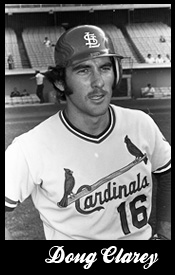
Though he appeared in only nine games for the Cardinals, Doug Clarey is a part of franchise lore because of an improbable home run.

doug_clareyOn April 28, 1976, Clarey produced the only hit of his big-league career, a two-run home run in the 16th inning that gave the Cardinals a 4-2 victory over the Giants.
The storybook feat occurred on a Wednesday afternoon at Candlestick Park in San Francisco, just north of Clarey’s boyhood home in Los Altos. Among the 4,193 in attendance were Clarey’s parents, high school coach and friends.

“It’s something you always dream about ever since I was a little boy watching the Giants play and just wishing I could be one of them,” Clarey told The Sporting News.

Just a few days before his dramatic home run, Clarey had been playing in the Class A Florida State League.

Called by Cards

Clarey, a second baseman, began his professional career in the Twins organization. The Cardinals claimed him in the December 1974 minor-league draft.

After hitting .206 for the Cardinals’ Class AA Arkansas club in 1975, Clarey was demoted to Class A St. Petersburg in 1976.

He got a break when Cardinals second baseman Mike Tyson suffered a knee injury in early April 1976.

Though Vic Harris came off the bench to replace Tyson as the starting second baseman, the Cardinals wanted someone who could fill in as a reserve fielder for a few weeks. Clarey, known more for his glove than his bat, fit the need because he could join the club quickly without having to clear waivers.

On April 20, 1976, his 22nd birthday, Clarey made his big-league debut. Batting in the sixth inning for pitcher Mike Wallace, Clarey faced Jon Matlack of the Mets and struck out. Boxscore

Stay fair

Eight days later, at San Francisco, Clarey got his second at-bat.

In the 16th inning, with the score tied at 2-2, the Cardinals had Don Kessinger on first base and two outs when acting manager Preston Gomez sent Clarey to bat for pitcher Mike Proly against Giants left-hander Mike Caldwell. Gomez was filling in for manager Red Schoendienst, who was in St. Louis to be with his daughter, Colleen, who was undergoing surgery. An inning earlier, Gomez told Clarey he’d bat if the Cardinals got a runner on base in the 16th.

“I was looking for something over the plate, something to hit,” Clarey told the San Francisco Examiner.

With the count at 1-and-1, Caldwell delivered a low, inside pitch. Giants catcher Dave Rader told the St. Louis Post-Dispatch it was a slider.

A right-handed batter, Clarey lifted the ball over the left-field fence.

“At first, I thought it was going to hook foul,” Clarey told the Oakland Tribune. “I kept saying to myself, ‘Stay fair, stay fair.’ ”

As the ball cleared the eight-foot fence, Kessinger said, ‘I couldn’t run the bases for jumping up and down. I’m so thrilled for him and us both.”

Danny Frisella retired the Giants in order in the bottom half of the 16th, saving the victory and securing Clarey’s place in Cardinals legend. Boxscore

“That’s the greatest experience of my life right there,” Clarey said. “I just wanted to get a piece of the ball.”

Said Caldwell: “That was the lowest point of my career.”

Giants manager Bill Rigney said, “Mike got it inside and his game is away. He made a bad pitch.”

After the season, the Giants traded Caldwell to the Cardinals.

Hailing a hero

In the Oakland Tribune, Ed Schoenfeld wrote of Clarey, “He’s a virtual unknown, even to his own teammates.”

The Sporting News referred to Clarey as the Cardinals’ “Cinderella Man.”

When Clarey entered the Cardinals clubhouse, he received a standing ovation. He also got a kiss from his mother and a handshake from his father, who built him a baseball backstop in the yard when Doug was almost 3 years old.

Afterward, the happy Cardinals boarded a bus to go to the airport for a flight to Los Angeles. The last to get on the bus was backup catcher Ken Rudolph, who was stationed in the bullpen when Clarey hit his home run. Rudolph alertly chased down the youths who grabbed the home run ball and traded three baseballs for the prize, the Post-Dispatch reported.

Inside the bus, Rudolph called for attention and said to Clarey, “First, the good news. Here is your home run ball. Now the bad news. Those three balls I traded cost $5 apiece. You owe the club $15.”

Clarey was speechless and everyone laughed, the Post-Dispatch reported.

When the Cardinals returned to St. Louis from their West Coast trip, the club rewarded Clarey for his achievement by presenting him with a watch, according to the Post-Dispatch.

Clarey appeared in one more game, May 4 vs. the Braves, before being returned to the minor leagues. He hit .228 in 63 games for manager Ken Boyer’s Class AAA Tulsa team.

Thanks, Mike

In July, Tyson got hurt again, breaking a finger, and the Cardinals called back Clarey.

“I’m keeping you in the big leagues,” Tyson told Clarey. “You ought to give me half your pay.”

In his second stint with the 1976 Cardinals, Clarey appeared in five games but didn’t get a hit.

End of the line

In March 1977, the Cardinals traded Clarey to the Mets for outfielder Benny Ayala. The Mets assigned Clarey to Class AAA Tidewater and he batted .125 in 28 games before he was released. Clarey signed with the Brewers and was sent to Class AA Holyoke.

In 1978, his last season as a player, Clarey joined the Orioles’ organization and hit .226 in 138 games for Class AA Charlotte.

His final big-league numbers for the Cardinals: nine games, four at-bats, one hit.


Read Full Post »

(Updated April 20, 2020)

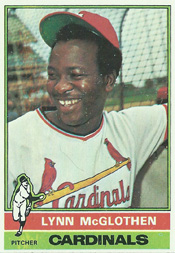
Tired of Del Unser pounding his pitches, Lynn McGlothen decided to pound Unser with a pitch.

lynn_mcglothenOn April 20, 1976, the Mets hit three two-run home runs off McGlothen in the first two innings at St. Louis and led 6-0.

Felix Millan and Unser hit home runs in the first inning and John Milner hit one in the second. Unser’s home run upset McGlothen the most.

Unser wasn’t a power hitter, but against McGlothen he swung like Babe Ruth. The year before, Unser hit two home runs against McGlothen.

When Unser came up again in the third inning, McGlothen nailed him in the left elbow with a pitch.

Enough is enough

“There are game situations where a pitcher goes out to hit a batter. This was one,” McGlothen said to the Associated Press. “He hit two home runs off me last year … I didn’t want to see it happen again.”

Said Unser: “If he’s upset because I hit a hanging curve, that’s his problem.”

McGlothen said a pitcher “has a right to try to contain the hitters. If a pitcher feels like he’s been intimidated, he has to do something.”

“I felt like I had a right to retaliate,” McGlothen told United Press International. “I threw that baseball to hit Unser. Let me make that perfectly clear.”

In response, Mets pitcher Tom Seaver told the New York Daily News, “He’s dumb if that’s his level of intelligence. If he couldn’t get the guy out, he should have walked off the mound.’

Storm the field

When McGlothen batted in the Cardinals’ half of the third, Mets starter Jon Matlack threw a brushback pitch. In the fourth, McGlothen threw two pitches near Matlack. The third struck Matlack in the hip.

Dave Kingman, the Mets’ 6-foot-6 right fielder, charged out of the dugout and rushed toward McGlothen, who “stepped off the mound, threw off his glove and struck a fighting pose,” the St. Louis Post-Dispatch reported.

Players from both dugouts stormed onto the field and fights erupted. “There was no bloodshed, but there were some bruises,” the Post-Dispatch noted.

Before Kingman could reach McGlothen, he was tackled by Cardinals first baseman Keith Hernandez, who told the Post-Dispatch, “He tried to bowl me over, and he did, but I tried to tackle him and I delayed him enough.”

In his book “I’m Keith Hernandez,” Hernandez said facing Kingman was “like a freshman defensive back in high school taking on an all-state fullback.”

“I barely had time to brace myself,” Hernandez said. “I remember being lifted off the ground from the initial shock of the attack, crashing onto the turf on my backside, and desperately trying to hang on to the V-neck of (Kingman’s) jersey as he literally crab-walked over me to get to Lynn.”

Charlie Galati, who charted pitches for the Cardinals, told the Post-Dispatch: “It looked like Mel Gray trying to block Otis Sistrunk.”

(Gray was a receiver for the St. Louis football Cardinals and Sistrunk was an imposing defensive tackle for the Oakland Raiders.)

Cardinals catcher Ted Simmons, who chased after Kingman, said, “Kingman ducked under me, and I flew over, hooking my knee.”

McGlothen told The Sporting News he was punched from behind by his former Cardinals teammate, Mets first baseman Joe Torre.

Cardinals left fielder Lou Brock said several Cardinals connected with shots to Kingman.

McGlothen and Cardinals manager Red Schoendienst were ejected. So was Mets shortstop Bud Harrelson.

No respect

Asked about McGlothen, Matlack said, “I really think I have no respect for the man.”

Said McGlothen: “I don’t think either one of us was trying to hurt anyone. I was throwing below the waist. If you want to mark a guy, you throw from the ribs up.”

Defending his pitcher, Schoendienst said, “(McGlothen) was wild all night. I’m surprised he hit anybody if he was trying.”

Regarding Unser, Schoendienst told the Post-Dispatch, “I always said that when a batter digs in, he’s digging his own hole and inviting the pitcher to come after him … When a batter goes into the ball like Unser, he stands a pretty good chance of being hit.”

The Mets won, 8-0. McGlothen was fined $300 and given a five-day suspension by National League president Chub Feeney. Boxscore

Five months later, on Sept. 19, 1976, Unser, who’d been traded by the Mets to the Expos in July, faced McGlothen in Montreal and hit a solo home run. Boxscore

Read Full Post »

« Newer Posts - Older Posts »