Feeds:
Posts
Comments

Archive for the ‘Games’ Category

(April 13, 2020)

Within a span of two months in the final season of his big-league pitching career, Milt Pappas experienced one of his worst and best performances against the Cardinals.
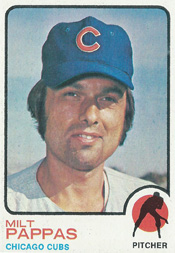
milt_pappasOn April 13, 1973, Pappas, pitching for the Cubs, yielded 13 hits and six runs in seven innings in a loss at St. Louis.

On June 24, 1973, Pappas pitched the last shutout of his career in a win at St. Louis.

Pappas pitched 17 years in the major leagues. The first nine were in the American League with the Orioles. The last eight were in the National League with the Reds, Braves and Cubs.

St. Louis blues

A two-time all-star, Pappas was a good pitcher who found the Cardinals to be a tough foe.

Pappas had a career record of 209-164. Against the Cardinals, he was 6-11 with a 4.71 ERA, his highest vs. any team. Pappas yielded 150 hits in 116.2 career innings against St. Louis.

Among those who often hit Pappas hard were:

_ Ted Simmons, .542 batting average (13-for-24).

_ Jose Cruz, .462 (6-for-13).

_ Ted Sizemore, .455 (10-for-22).

_ Curt Flood, .412 (14-for-34).

_ Lou Brock, .397 (23-for-58)

_ Tim McCarver, .377 (20-for-53) and six walks.

_ Joe Torre, .333 (14-for-42).

Cards end skid

With Bob Gibson of the Cardinals, Al Downing of the Dodgers and Steve Blass of the Pirates, Pappas was the 1971 National League co-leader in shutouts, with five.

In 1972, Pappas was 17-7 with a 2.77 ERA and 10 complete games for the Cubs. The next year, he was 7-13 with a 4.28 ERA.

The Cardinals were 0-5 when Pappas, in his second start of 1973, faced them at St. Louis on April 13.

Pappas had won his last 11 decisions of 1972, including a no-hitter versus the Padres, but the 1973 Cardinals handed him his first loss since July 28, 1972.

Pappas yielded hits in five of the first six innings, but limited the damage to two runs.

In the seventh, with the score tied at 2-2, the Cardinals broke through with four runs off Pappas. The big blow was a two-run home run by Cruz. It was the second home run in two days for Cruz. The other came against the Mets’ Tom Seaver. “The kid is strong,” Cardinals manager Red Schoendienst said to the Associated Press.

Every starter in the Cardinals’ lineup, except pitcher Rick Wise, had at least one hit off Pappas in the 6-3 victory.  Boxscore

Pickup game

In June 1973, the Cubs returned to St. Louis for a three-game series. The Cardinals won the first two _ 3-0 (a Reggie Cleveland three-hitter) and 3-2 in 11 innings.

Pappas was the Cubs’ starter for the finale on a Sunday afternoon before 41,517 at Busch Memorial Stadium. His season record was 3-5 with a 5.21 ERA and he had made 14 starts without pitching a complete game.

Pappas, 34, held the Cardinals to five singles (two by first baseman McCarver) in earning the final complete game of his career, a 2-0 triumph.

“This was a very selfish game for me,” Pappas told the Chicago Tribune. “I wanted to show some people I’m not finished in this game. I changed my game plan a little. The Cardinals had hurt me on the slider earlier, so I went to my fastball more to see what would happen. It worked out well.”

The Cubs broke a scoreless tie in the eighth. With Rick Monday on second base and Paul Popovich on first, reliever Rich Folkers threw a wild pitch, enabling each runner to advance a base. Glenn Beckert, batting for center fielder Gene Hiser, hit a Folkers screwball to center for a single, scoring Monday and Popovich.

When the game ended, Pappas stood “arm raised, fist clenched in triumph like a warrior of ancient Greece,” Bob Broeg of the St. Louis Post-Dispatch wrote.

“It was a long time coming,” Pappas said of his complete game, “and I’m very, very happy. It couldn’t have come at a better time after losing the first two games. I hope it picks up the ballclub. I know it picked me up.” Boxscore
 

Read Full Post »

(Updated July 12, 2019)

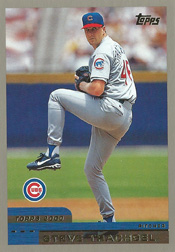
Steve Trachsel played a prominent role in two record-setting home run performances by the Cardinals. He was the starter the last time the Cardinals hit seven home runs in a game. Two years later, he yielded the home run to Mark McGwire that broke Roger Maris’ single-season big-league mark.

steve_trachselThe Cardinals’ team record for most home runs in a game is seven. They’ve done that twice.
The first time was May 7, 1940, in the Cardinals’ 18-2 victory over the Dodgers at St. Louis. Joe Medwick, Johnny Mize, Don Padgett, Eddie Lake and Stu Martin each hit a home run off starter Hugh Casey. Mize and Lake also each hit a home run off Max Macon. Boxscore

Fifty-six years later, the Cardinals did it again. On July 12, 1996, Gary Gaetti and Ron Gant each hit two home runs and John Mabry, Ray Lankford and Brian Jordan had one apiece in the Cardinals’ 13-3 victory over the Cubs at Chicago. Boxscore

All-star foe

The 1996 performance at Wrigley Field was surprising.

The Cardinals entered the game with the fewest home runs (71) in the National League, according to the Arlington Heights (Ill.) Daily Herald.

Trachsel, the Cubs’ starter, was considered an emerging ace.

Three days earlier, Trachsel had pitched a perfect inning for the National League in the All-Star Game, retiring Sandy Alomar, Cal Ripken and Alex Rodriguez.

Trachsel’s career record against the Cardinals then was 5-1.

“I know how good that young man is,” Cardinals manager Tony La Russa told the St. Louis Post-Dispatch. “I wouldn’t have bet a dime we’d hit one (home run), much less seven.”

Redbirds rip

Trachsel yielded four of the Cardinals’ seven home runs. In the third inning, Mabry hit a two-run shot and Gaetti followed with a solo home run. In the fifth, Lankford and Gant hit solo back-to-back shots, knocking Trachsel out of the game.

“They hit high pitches, low pitches, off-speed stuff, fastballs,” Trachsel said to the Chicago Sun-Times.

Said Cubs manager Jim Riggleman: “Even the elite have bad days.”

Rodney Myers relieved Trachsel and gave up the third home run of the fifth inning, a two-run shot by Gaetti, who was playing in his second career game at Wrigley Field.

“We haven’t been hitting like this,” Gaetti said to the Associated Press. “This ballpark is conducive to this, though.”

The sixth and seventh Cardinals home runs were a three-run shot by Jordan off Tanyon Sturtze in the sixth and a solo shot by Gant off Terry Adams in the eighth. Video

No. 62

Trachsel was the Cubs starter again on Sept. 8, 1998, against the Cardinals at St. Louis. In the fourth inning, McGwire hit his 62nd home run of the season, surpassing Maris’ total of 61 with the 1961 Yankees and linking Trachsel to one of baseball’s treasured records. Video

Lankford and Gant also hit home runs off Trachsel in a 6-3 Cardinals triumph. Boxscore

Trachsel yielded 28 home runs in 28 career starts vs. the Cardinals. Lankford hit four career home runs off Trachsel and McGwire hit three.

Read Full Post »

(Updated May 25, 2020)

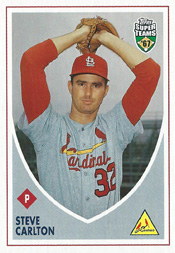
On May 21, 1970, Steve Carlton, a future Phillie, and Dick Allen, a former Phillie, delivered dramatic performances for the Cardinals against the Phillies, but it wasn’t enough to produce a win.

steve_carlton5Carlton struck out 16 Phillies and Allen sparked a Cardinals comeback with a ninth-inning home run, but the Phillies won, 4-3, at Connie Mack Stadium in Philadelphia.
The unusual occurrences didn’t end with the game’s conclusion. A few hours after their loss, the Cardinals were roused from their rooms when a fire broke out in the hotel. The Cardinals were unharmed and the fire quickly was extinguished.

For Carlton, the game was the third in his Cardinals career in which he struck out 16 or more. Each time, he didn’t win. Carlton struck out 19 and took the loss in a 4-3 Mets victory over the Cardinals on Sept. 15, 1969. He struck out 16 and took the loss in a 3-1 Phillies victory over the Cardinals on Sept. 20, 1967.

“It’s getting to be a phobia,” Carlton said to United Press International. “I get all these strikeouts, but I start thinking that one mistake can kill you.”

Allen returns

Before the game, the focus was Allen, not Carlton. Allen was playing at Philadelphia for the first time since the Phillies sent him to the Cardinals seven months earlier in the deal involving Curt Flood and Tim McCarver.

Allen, the Cardinals’ first baseman, “was welcomed by a chorus of boos mingled with cheers” when he appeared on the field, the Associated Press reported.

According to the Philadelphia Daily News, “Nobody came to sit on their hands or be neutral. There was electricity in the air.”

In the sixth inning, the Phillies snapped a scoreless tie with three runs against Carlton. Larry Hisle hit a RBI-triple and Don Money produced a two-run home run. “I hung a slider to Money,” Carlton said to the St. Louis Post-Dispatch.

Otherwise, Carlton was dominant. “My fastball was good and I was keeping it low and away all night,” Carlton said. “I kept hitting the corners.”

With the Phillies ahead 3-0, Phil Gagliano, batting for Carlton, led off the ninth with a routine groundball to Money at third base. The ball took a bad hop and struck Money in the eye. Gagliano was credited with a single. Experiencing double vision, Money was taken to a hospital and diagnosed with “a fracture of the orbit, the thin bone around the eye,” The Sporting News reported.

After the next two Cardinals batters made outs against starter Woodie Fryman, Allen, hitless in the game, came to the plate.

Redbirds rally

Fryman threw a slider, down and in, and Allen ripped it for a two-run home run into the left-field stands, turning the jeers into cheers.

“There aren’t many smarter hitters in this game,” Fryman said. “He goes up there with an idea.

“He’s got tremendously fast feet. He really knows how to use them to open up on an inside pitch.”

According to Philadelphia Daily News columnist Stan Hochman. Phillies broadcaster and former outfielder Richie Ashburn suggested pitchers should pitch to Allen “the way porcupines make love _ carefully.”

“I’m not going to pitch him outside because he’s liable to hit that right back at you,” Fryman said, “and I wouldn’t want to challenge that.”

Following Allen’s home run, Joe Torre walked and Vic Davalillo ran for him. Carl Taylor singled, moving Davalillo to second. Bill Wilson relieved Fryman and yielded a single to Joe Hague, scoring Davalillo with the tying run. The Cardinals loaded the bases, but the threat died when Mike Shannon, facing former teammate Joe Hoerner, popped out to third.

In the bottom of the ninth, Tony Taylor hit a two-out, RBI-single off Sal Campisi, giving the Phillies the victory. Boxscore and radio broadcast

Wakeup call

Early on the morning of May 22, a fire erupted on the 15th floor of the hotel where the Cardinals stayed. Smoke “shot up to several higher floors,” including the floors where most of the Cardinals had rooms, The Sporting News reported.

Shannon and Cardinals coach Billy Muffett awakened many of their teammates “by kicking against their doors,” according to The Sporting News.

“Our floor was full of smoke,” said Muffett, “and when I tried to go out an exit door, I had to turn back because of the heavy smoke.”

Some of the Cardinals gathered in the lobby until certain the fire was put out.

In his book “Red: A Baseball Life,” Cardinals manager Red Schoendienst said, “I was asleep and the sirens woke me up. I could see the red lights flickering in my window. That was all I needed to get me going. I threw on a pair of pants and a shirt and hightailed it downstairs.

“We were lucky nobody was hurt … Our clothes smelled liked smoke for a long time after that.”

It was that kind of night.


Read Full Post »

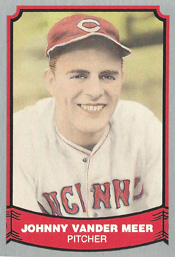
Flummoxed by the introduction of a dead baseball, the defending World Series champion Cardinals struggled to score a run at the start of the 1943 season. Desperate, Stan Musial broke the scoreless streak by attempting to steal home.

johnny_vandermeerThe 1943 Cardinals established a major-league record by going scoreless for the first 26 innings of the season.
The record stood for 73 years until the 2016 Padres began the season by failing to score in the first 30 innings. Jon Jay, a former Cardinals outfielder, snapped the Padres’ futility streak with a RBI-single in the fourth inning against the Rockies at Denver on April 8, 2016.

Musial’s mad dash

In 1943, the Cardinals started the season at Cincinnati. The Reds won the opener, 1-0, in 11 innings and also won, 1-0, again the next day in 10 innings.

After going scoreless in the first five innings of Game 3, the Cardinals had the bases loaded with one out in the sixth. Musial broke from third, attempting to steal home, and was trapped in a rundown.

When Musial dashed for the plate, third baseman Bert Haas tossed the ball to catcher Ray Mueller, who dropped it. Musial scored on the error for the Cardinals’ first run of the season. The Cardinals scored again in the eighth and won, 2-1.

Foul ball

After Reds general manager Warren Giles sent a telegram to National League president Ford Frick, complaining about the ball, an official with manufacturer A.G. Spalding admitted the ball produced by the company “did not measure up to specifications in resiliency,” The Sporting News reported.

According to Giles, the Spalding official said that the “rubber cement they were forced to use had affected the rebound of the 1943 baseball adversely.” Tests showed the resiliency of the 1943 balls were 25 percent less than in 1942.

In his book “Stan Musial: The Man’s Own Story,” Musial explained, “Because rubber was a war-priority item, the Spalding Company … decided to use re-processed rubber or, as it’s more accurately known, balata.”

Irate, Giles fumed to The Sporting News: “Asking big leaguers to play with the sort of a ball with which we are opening the season would be like asking our soldiers, sailors and Marines to win the war with blanks instead of real ammunition.”

Frick instructed NL teams to use leftover 1942 baseballs until Spalding could issue revamped 1943 balls.

Said Cardinals manager Billy Southworth of the dead balls: “It robs the game of the great hitting and great fielding plays which cause baseball to appeal to the public.”

Here is the look at the Cardinals’ first three games of the 1943 season:

Opening duel

In a matchup of aces Johnny Vander Meer of the Reds and Mort Cooper of the Cardinals, Vander Meer prevailed in the 1-0 Reds victory on April 21.

Vander Meer yielded two hits and five walks in 11 innings. Singles by Whitey Kurowski in the first inning and Frank Demaree in the third accounted for the St. Louis hits.

The Cardinals put three runners on base in the first but couldn’t score.

In the 11th, Lonny Frey led off for the Reds with a single against Cooper and advanced to second on Mike McCormick’s sacrifice bunt. Max Marshall drove in Frey with a single.

Cooper pitched 10.1 innings and gave up six hits and two walks. Boxscore

Choke up, fellas

In Game 2 on April 22, Ray Starr held the Cardinals to five hits in 10 innings. The Reds won, 1-0, when Frey scored from third on a Haas single off starter Ernie White with two outs in the 10th.

Musial had tripled with one out in the fourth, but was stranded.

“When I tripled off Ray Starr,” said Musial, “the ball sounded like a nickel rocket.”

Said Southworth to the Cardinals: “You’ll have to choke your bats, fellas, as they used to do in the old days, and bunt more often.” Boxscore

No RBI

In Game 3, on April 24, both of the Cardinals’ runs in their 2-1 victory were unearned.

The first came when Musial escaped the rundown after Mueller dropped the ball.

The second came in the eighth when Musial scored from third on a passed ball by Mueller. Boxscore

With better baseballs, the 1943 Cardinals’ offense came to life. They scored 679 runs (second only to the Dodgers in the NL) and won their second consecutive pennant, posting a 105-49 record.

Previously: How a B-17 nearly clipped Cardinals in World Series

Read Full Post »

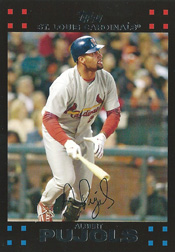
After becoming the second Cardinals player to hit home runs in four consecutive at-bats, Albert Pujols came close to becoming the first big-league player to achieve the feat in five at-bats in a row.

albert_pujols25In April 2006, Pujols joined Stan Musial as the only Cardinals to hit home runs in four straight at-bats.

Pujols, 26, a right-handed batter, hit home runs in each of his last three at-bats against the Reds on April 16, 2006, and in his first at-bat against the Pirates on April 17, 2006.

Musial, 41, a left-handed batter, hit a home run in his last at-bat against the Mets on July 7, 1962, and in each of his first three at-bats against the Mets on July 8, 1962.

Pujols was the first player to hit home runs in four consecutive at-bats since the Blue Jays’ Carlos Delgado did it in September 2003. Pujols tied the big-league record held by 34 others.

After hitting his fourth consecutive home run, Pujols nearly hit another in his next at-bat. The blast off Pirates starter Paul Maholm slammed against the wall in right-center at Pittsburgh and Pujols settled for a double.

Three in a row

Pujols’ streak began on Easter Sunday, April 16, 2006.

The Reds led the Cardinals, 4-2, in the fifth inning at St. Louis. With one out, Aaron Miles singled. Pujols followed with a home run off starter Bronson Arroyo that “smacked so hard against the Casino Queen Party Porch it could be heard miles away,” according to Joe Strauss of the Post-Dispatch.

In the seventh, with the Cardinals ahead, 5-4, two outs, Pujols hit a solo home run off former teammate Rick White.

Entering the bottom of the ninth, the Reds led, 7-6. Jason Marquis, pinch-hitting for fellow pitcher Braden Looper, led off with a single. Pujols stepped in against David Weathers and walloped a walkoff, two-run home run for an 8-7 Cardinals victory. Boxscore

The ball “flew high toward the foul pole in left (and) caused 40,068 to draw a hard breath,” wrote Bernie Miklasz of the Post-Dispatch. “Fair or foul? Count it.”

Describing the shot on television, broadcaster Joe Buck said, “How fair can it be? Just enough.”

The ball landed in the third deck and traveled 441 feet.

Hard to describe

“He’s a great hitter, but if you make your pitch you can get a double play,” Weathers said to the Associated Press. “It was just a bad pitch and he hammered it.”

Said Cardinals manager Tony La Russa: “This is one where you’ll be lost for words … I’m at a loss to describe it, man.”

“Indeed,” wrote Miklasz, “there are only so many ways to say that Pujols is the best hitter of his generation.”

Pujols told Strauss, “Hopefully tomorrow I’ll get three more and forget about today.” Check out this video of all three home runs.

Power in Pittsburgh

The next night, April 17, 2006, the Cardinals opened a series at Pittsburgh. In the first inning, So Taguchi singled with one out and Pujols hit a two-run home run to center off Maholm.

Those were the only Cardinals runs in a 2-1 triumph.

Pujols also doubled and walked before ending his on-base streak by flying out in the seventh against Salomon Torres.

Afterward, told by Rick Hummel of the Post-Dispatch that he had joined Musial as the only Cardinals with home runs in four consecutive at-bats, Pujols said, “That’s awesome, but it was more important we won the game.” Boxscore

Said La Russa: “He’s doing things that put him in the company of the greatest players of all time.”

Previously: Stan Musial still oldest to belt 3 home runs in a game

Read Full Post »

(Updated May 19, 2018)

In 1966, Ed Spiezio, hoping to jumpstart his career and contend for the Cardinals’ third base job, hit his first big-league home run for St. Louis. Forty years later, Scott Spiezio, hoping to jumpstart his career and fill a utility role with the Cardinals, hit his first National League home run for St. Louis.

ed_spiezioEd Spiezio and Scott Spiezio were the first father-son duo to hit home runs for the Cardinals. Ed Spiezio played five years (1964-69) for the Cardinals and hit five home runs for them. His son, Scott Spiezio, played two years (2006-07) for the Cardinals and hit 17 home runs for them.

Tony Pena and Francisco Pena became the second father-son duo to hit home runs for the Cardinals. Francisco Pena hit his first Cardinals home run, and his fourth overall in the major leagues, on May 18, 2018, versus the Phillies at St. Louis. His father Tony hit 107 big-league home runs, including 19 in three seasons (1987-89) with the Cardinals

Ed Spiezio, a right-handed batter, played nine big-league seasons (with the Cardinals, Padres and White Sox) and hit 39 regular-season home runs.

Scott Spiezio, a switch-hitter, played 12 big-league seasons (with the Athletics, Angels, Mariners and Cardinals) and hit 119 regular-season home runs. He also hit three postseason home runs, all for the Angels.

Pull hitter

Ed Spiezio hit 18 home runs in 112 games for the Cardinals’ Class AAA Tulsa club in 1966. Spiezio told The Sporting News that Tulsa manager Charlie Metro “wanted me to pull (the ball) because the fences in left are so close in most of the (Pacific Coast League) parks.”

Ed Spiezio said he had been a pull hitter since his youth because “if you tried to hit the ball to right field you were considered a sissy.”

The Cardinals called up Ed Spiezio in September 1966 and gave him a chance to play third base in place of the starter, Charlie Smith.

On Sept. 11, 1966, Ed Spiezio hit his first big-league home run, pulling a Bob Veale pitch over the scoreboard in left field at Forbes Field in Pittsburgh. The solo shot in the fifth inning helped the Cardinals to a 4-3 triumph over the Pirates. Boxscore

Two weeks later, on Sept. 30, 1966, Ed Spiezio hit a two-run home run off future Hall of Famer Ferguson Jenkins, producing all the runs in a 2-0 Cardinals victory over the Cubs at St. Louis. Boxscore

Ed Spiezo’s counterpart, Cubs third baseman Ron Santo, was impressed. “I like Spiezio a lot … He just needs a little more experience, like knowing the pitchers better,” Santo said. “I’ve always admired his poise at bat.”

Ed Spiezio was a utilityman with the 1967 and 1968 Cardinals and appeared in the World Series in both years for them. In December 1968, the Cardinals traded Ed Spiezio and three others to the Padres for pitcher Dave Giusti.

Like father, like son

In February 2006, the Cardinals signed Scott Spiezio, a free agent, to a minor-league contract and brought him to spring training to compete for a utility role.

Scott Spiezio had been the starting first baseman for the 2002 World Series champion Angels. His career spiraled, though, after he became a free agent and signed with the Mariners before the 2004 season. The Mariners released him in August 2005.

Scott Spiezio earned a spot on the Opening Day roster of the 2006 Cardinals.

On April 15, 2006, Scott Spiezio got his first Cardinals hit. In the seventh inning, with the Cardinals leading the Reds, 7-2, at St. Louis, Scott Spiezio slugged a two-run homer run off Mike Burns. Boxscore

Scott Spiezio’s teammates pushed him up the dugout steps for a curtain call from appreciative Cardinals fans. Scott told the St. Louis Post-Dispatch his father was at home, watching the game on television.

Ed Spiezio and Scott Spiezio became the third father and son to play for the Cardinals. The others were outfielder Ed Olivares and his son, pitcher Omar Olivares, and pitchers Pedro Borbon and Pedro Borbon Jr.

Among those pairs, only Omar Olivares hit a home run for the Cardinals.

Previously: Scott Spiezio replaced John Mabry as Cardinals utilityman

Read Full Post »

« Newer Posts - Older Posts »