Feeds:
Posts
Comments

Archive for the ‘Games’ Category

If Jedd Gyorko hits as well for the Cardinals as he did against them, St. Louis will have added a productive batter to its lineup.
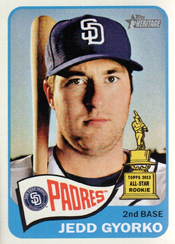
jedd_gyorkoAcquired by the Cardinals from the Padres in a trade for outfielder Jon Jay on Dec. 8, 2015, Gyorko entered the 2016 season as a versatile infielder who can perform at second base, shortstop and third base.

His career batting average versus the Cardinals is .342 (25-for-73), with five home runs and 16 RBI in 20 games.

Two of Gyorko’s best games came against the Cardinals in 2014.

Here is a look at those performances:

Sweet swing

Batting sixth and playing second base, Gyorko was 3-for-5 with four RBI and two runs scored against the Cardinals in a 12-1 Padres victory at San Diego on July 30, 2014.

He got a hit apiece off three pitchers.

Gyorko began his barrage with a solo home run in the fourth inning off starter Joe Kelly.

“Pitches were up that should have been down,” Kelly told the Associated Press.

In the sixth, Gyorko singled off Carlos Martinez. An inning later, with the bases loaded and one out, Gyorko hit a three-run double off Seth Maness, giving San Diego a 9-1 lead.

‘It was probably our ugliest loss of the year,” said Cardinals manager Mike Matheny.

Gyorko had been activated two days earlier after a 44-day stint on the disabled list because of foot problems.

“It obviously feels good to swing the bat the way I wanted to,” Gyorko said. “It feels a lot like how I was swinging it there at the end of the year last year. It’s something to build on, but I still have a long way to go.” Boxscore

Grand game

Two weeks later, on Aug. 16, 2014, at St. Louis, Gyorko hit a grand slam, lifting the Padres to a 9-5 victory over the Cardinals.

Batting fifth and playing second base, Gyorko was 2-for-3 with five RBI, two runs scored and two walks.

In the third, Gyorko’s two-out, RBI-single off Shelby Miller scored Abraham Almonte from third base, sparking a four-run Padres inning and tying the score at 4-4.

Said Miller: “Unacceptable. Obviously, it doesn’t sit well with me. I should have done a better job of making pitches.”

The Cardinals led, 5-4, entering the seventh. With one out and the bases loaded, Gyorko connected on a 94-mph fastball from reliever Kevin Siegrist, launching a grand slam over the left field wall and giving the Padres an 8-5 lead.

“It was a fastball down and in,” Gyorko said. “It probably wasn’t a bad pitch. I just put a good swing on it.”

The home run was the 31st of Gyorko’s big-league career, moving him past Mark Loretta as the Padres’ all-time home run leader as a second baseman.

“That’s a credit to the guys hitting in front of me,” Gyorko told the San Diego Union-Tribune. “Really, they are doing a great job of getting on base. I just have to capitalize more like tonight.”

The grand slam was the third of Gyorko’s big-league career and the only one yielded by Siegrist with the Cardinals. Boxscore

Afterward, Siegrist was demoted to the minor leagues and Martinez was recalled from Class AAA Memphis to replace him.

Said Matheny of Siegrist: “He feels physically strong, but there’s just something that’s a click off.”

Previously: Cards steals leader Jon Jay plays similar to Wally Moon

Previously: Jon Jay matched Curt Flood as flawless in center
Read Full Post »

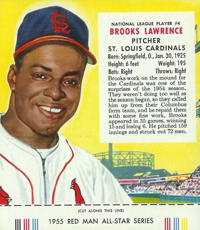
Brooks Lawrence, a 15-game winner as a Cardinals rookie pitcher in 1954, was their Opening Day starter in 1955, but he was weak from a bleeding ulcer, slumped and got demoted to the minor leagues.

brooks_lawrenceThe Cardinals decided Lawrence wouldn’t regain the effectiveness he had as a rookie.
On Jan. 31, 1956, the Cardinals traded Lawrence and pitcher Sonny Senerchia to the Reds for reliever Jackie Collum. It was the first deal general manager Frank Lane made since he joined the Cardinals in October 1955.

It turned out the Cardinals gave up on Lawrence too soon.

With his strength back and his ulcer under control, Lawrence pitched for the Reds in 1956 the way he had as a Cardinals rookie.

Long road to majors

In 1943, after graduating from high school in Springfield, Ohio, Lawrence joined the Army and served in the Pacific. He was awarded a Bronze Star for using a machine gun to fight off an enemy plane attacking U.S. soldiers. After military service, he attended Miami University in Ohio in 1947. Two years later, he began his professional pitching career in the Cleveland Indians’ farm system.

The Reds acquired Lawrence from the Indians in October 1953 on the recommendation of former Cardinals catcher Mickey Owen, who managed Lawrence in the winter league at Puerto Rico and taught him to throw a slider and a changeup. The Reds left Lawrence exposed in the 1953 minor-league draft and the Cardinals claimed him.

Lawrence opened the 1954 season with the Cardinals’ Class AAA club at Columbus, Ohio, and was promoted to St. Louis in June 1954.

Milestone performance

In his major-league debut against the Pirates at Pittsburgh, Lawrence, 29, started, pitched a four-hitter and became the first African-American pitcher to earn a win for the Cardinals. Boxscore

In 35 appearances for the 1954 Cardinals, Lawrence was 15-6 with a 3.74 ERA. He was adept at starting (9-2, 3.85 ERA) and relieving (6-4, 3.25 ERA).

Against the Cubs that season, Lawrence was 3-0 with a 1.82 ERA.

Medical emergency

Shortly after the 1954 season, Lawrence collapsed at his Springfield, Ohio, home. “I was coming out of the bathroom and passed out from loss of blood,” he told The Sporting News.

Diagnosed with a bleeding ulcer, Lawrence needed eight transfusions and spent 10 days in a hospital. “The doctor told me that if they had waited a half hour longer to bring me to the hospital it would have been too late,” Lawrence said.

According to The Sporting News, Lawrence was placed on a strict diet of milk, cream and baby food.

“I reported for spring training in 1955 weighing 217 pounds,” Lawrence said. “That’s about 12 pounds more than I usually weigh. I was healthy and looked it, but I wasn’t strong.”

Shaky season

Lawrence was the choice of manager Eddie Stanky to be the 1955 Cardinals’ Opening Day starter at Chicago against the Cubs, but he was shelled for five runs and lifted before he could complete the first inning. Boxscore

The poor start foreshadowed his season. In 46 games, including 10 starts, for the 1955 Cardinals, Lawrence was 3-8 with a 6.56 ERA.

He was equally bad as a starter (2-5, 6.58 ERA) and as a reliever (1-3, 6.55 ERA).

Against the Cubs that season, Lawrence was 0-3 with an 11.37 ERA.

After Lawrence was demoted to the minor leagues in August, Harry Walker, who had replaced Stanky as manager, said, “He’s a good man and I hope he proves again that he’s a good pitcher.”

Lawrence finished the season on an upswing, posting a 5-1 record and 2.37 ERA for Class AAA Oakland of the Pacific Coast League.

Change environment

After the 1955 season, Lane was tasked with rebuilding a club that finished 68-86.

Lane asked his Reds counterpart, Gabe Paul, about a pair of former Cardinals, Collum and third baseman Ray Jablonski. “When I heard what he wanted in return,” Lane said, “I told him he must have been the key man in the Brink’s holdup.”

Paul countered by saying Lane “was too much in love with St. Louis major- and minor-leaguers” to strike a deal.

Columnist Dick Young reported Paul contacted Lawrence “to ascertain that the pitcher’s ulcers have not been kicking up.”

Cardinals doctors declared Lawrence cured of ulcers, The Sporting News reported.

Said Lawrence: “There was nothing wrong with my arm last year. That ulcer was the trouble.”

Make a deal

The trade was made when Lane agreed to take only Collum in exchange for Lawrence and Senerchia.

“It’s not earth-shaking,” Lane said to United Press, “but it’s a start.”

Surprised, Lawrence said he thought the Cardinals “would have at least given me a good look” in spring training.

Lawrence worked for the water department in Springfield that winter and said, “I operated an air hammer. That takes the fat off you.”

Collum, who had pitched for the Cardinals from 1951-53 and was 9-8 for the 1955 Reds, “is not a great pitcher, but he’s a great competitor,” Lane said.

Used mostly in relief with the 1956 Cardinals, Collum was 6-2 with seven saves and a 4.20 ERA.

Lawrence won his first 13 decisions with the 1956 Reds and finished the season 19-10 with a 3.99 ERA.

Previously: The debut of Bill Greason, first black Cardinals pitcher

Read Full Post »

Vern Rapp, rebel? Indeed. As a manger in the Cardinals’ system, Rapp challenged authority in a manner that would have made the hairs on Al Hrabosky’s Fu Manchu stand on end.

vern_rapp2Known as an unyielding disciplinarian for implementing a policy against facial hair while Cardinals manager in 1977, Rapp clashed with several Cardinals players, including Hrabosky, who grew a Fu Manchu moustache while developing a persona as “The Mad Hungarian.”
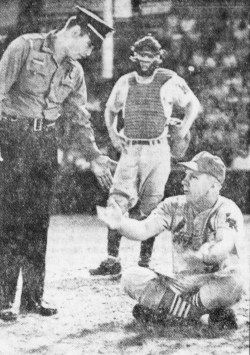
They may have been surprised to learn Rapp once caused such a fuss in an argument with an umpire that a police officer was called onto the field to intervene.

Sit down strike

Rapp, manager of the Cardinals’ Class AA Arkansas club, staged a protest by sitting on home plate after being ejected following a dispute with umpire Larry Barnett in a game at Albuquerque, N.M., on Aug. 13, 1966.

When Rapp refused to move, the umpire called police, who escorted Rapp from the field.

Photographs show police officer Fred Leyva standing over Rapp at home plate while Arkansas catcher Danny Breeden watches the drama unfold.

According to the Albuquerque Journal, “Rapp actually sat down on home plate and didn’t leave until a policeman talked him into leaving.” Rapp “had to be escorted off the field” by the officer, the newspaper reported.

Wrong word

The incident began when Rapp argued a close play at second base. Frank Godsoe, associate sports editor of the Amarillo Daily News, reported this exchange:

Barnett: “One more peep out of you and you’re out of the ballgame.”

Rapp: “Peep.”

That did it. Barnett ejected Rapp, who refused to leave because he felt the punishment didn’t fit the crime. Rapp said it was the first time he’d been ejected for saying the word “peep.”

“Before a ballgame, he is as friendly as a collie dog,” Godsoe wrote of Rapp. “Once in a game, he’ll use anything up to poison gas to try to beat you. He is a tough loser and in the heat of battle he can erupt like a volcano.”

Godsoe asked Texas League president Hugh Finnerty which manager in the league was toughest on umpires. “Vern Rapp,” Finnerty replied.

Rapp likely was fined $25 for the ejection, Godsoe reported.

No harm, no foul

The theatrics didn’t damage the careers of Rapp or Barnett

Barnett became a big-league umpire in 1969 and stayed on the job through 1999.

Rapp managed Arkansas to an 81-59 record in 1966 and was named Texas League manager of the year.

He managed Arkansas again in 1967 and 1968 before leaving the Cardinals’ organization to join the Reds as manager of their Class AAA Indianapolis team.

Rapp, a St. Louis native, managed Class AAA clubs through the 1976 season before getting his first big-league managing chance with the 1977 Cardinals, replacing Red Schoendienst.

Previously: The pitfalls of Cardinals rookie manager Vern Rapp

Read Full Post »

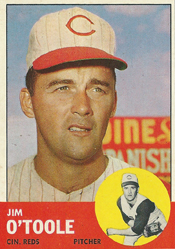
Of the many duels the Reds’ Jim O’Toole had with the Cardinals, the most bizarre was his performance in the first game of a 1963 doubleheader. Even without his nemesis, Ken Boyer, in the lineup, O’Toole was pummeled by the Cardinals, but still won.

jim_otooleA left-hander, O’Toole posted double-digit wins for the Reds in five consecutive seasons (1960-64) and was an All-Star Game starter in 1963. In nine years with Cincinnati, O’Toole was 10-14 with a 4.17 ERA in 38 appearances against the Cardinals.

His best game versus St. Louis was on May 6, 1960, when he pitched a four-hitter in a 1-0 Reds triumph. Boxscore

His worst game against St. Louis was on June 7, 1962, when he was rocked for six runs and 10 hits in 4.1 innings in an 8-2 Cardinals victory. Boxscore

Perhaps the most memorable was the escape act he performed on May 5, 1963, at Cincinnati.

Grim work

Though he yielded 12 hits, walked two, had two batters reach base on errors and threw a wild pitch before he was lifted with two on and none out in the seventh, O’Toole got his major league-leading sixth win of the season in a 5-4 Reds victory.

The Cardinals had two runners thrown out at home, two runners caught attempting to steal second, grounded into a double play and stranded nine.

In addition, “several Redbird smashes were kept in the ballpark by a treacherous wind,” The Sporting News reported.

“There’ll be games like that all season because the league is so well balanced,” said Cardinals general manager Bing Devine.

The Reds never trailed. Or, as the Associated Press noted, “The Reds scored three runs in the opening inning and held on grimly.”

O’Toole did the bulk of that grim work.

Unconventional script

Among the twists and turns:

_ O’Toole retired the first four batters he faced.

_ In the second inning, with the Reds ahead, 3-1, the Cardinals had Leo Burke on second and Gene Oliver on first with one out. Julian Javier grounded to shortstop Leo Cardenas, who booted the ball. Javier reached first safely on the error. Burke rounded third and headed for home. Cardenas recovered in time and threw to catcher Johnny Edwards, who tagged out Burke.

_ With two outs in the fourth and the Reds ahead, 4-2, the Cardinals had Javier on third and Ray Sadecki on first. O’Toole uncorked a wild pitch, enabling Sadecki to reach second. Dick Groat singled, scoring Javier but left fielder Frank Robinson’s throw to Edwards nailed Sadecki at the plate for the third out.

_ In the seventh, Curt Flood doubled and Groat followed with a RBI-single, knocking O’Toole from the game and cutting the Reds’ lead to 5-4. Al Worthington relieved and yielded a single to Bill White, moving Groat to third. The rally unraveled when George Altman struck out, White was caught attempting to steal and Charlie James flied out. Boxscore

Perhaps the outcome would have been different if Boyer had played.

O’Toole tormentor

Two nights earlier, in the series opener, Boyer was injured when Edwards spiked him while sliding into third. Boyer needed 13 stiches to close two wounds. He wouldn’t return to the lineup until after the Cardinals left Cincinnati.

Boyer had the most career hits (36) against O’Toole of any batter. He hit .468 (36-for-77) with five doubles, four home runs, 10 walks and 22 RBI versus O’Toole. Boyer’s career on-base percentage against him was .529.

In O’Toole’s first three full seasons with the Reds, Boyer haunted him, hitting .636 (7-for-11) in 1959, .462 (6-for-13) in 1960 and .750 (6-for-8) in 1961, according to Baseball-Reference.com.

O’Toole was the starting pitcher in the 1963 All-Star Game at Cleveland when the National League started an all-Cardinals infield of White at first, Javier at second, Groat at shortstop and Boyer at third.

In the second inning of that game, the American League had Leon Wagner on second, Zolio Versalles on first, two outs and pitcher Ken McBride at the plate.

McBride hit a grounder to Boyer’s left. He dived for the ball, but it deflected off his glove and into left field for a RBI-single, tying the score. Boxscore

Previously: 1963 NL all-stars started all-Cardinals infield

Previously: Why John Tsitouris forever will be linked to Cardinals

Read Full Post »

(Updated March 12, 2022)

When the Cardinals acquired Jamie Moyer, he was projected to pitch in their farm system. Moyer persevered and earned a spot in the Cardinals’ starting rotation, but instead of becoming a feel-good story, he went winless in seven starts. At 28, his big-league pitching career appeared near an end.

jamie_moyer3Who could have envisioned Moyer would recover to pitch in the majors until he was 49 and become one of the top 10 left-handers in career wins?
On Jan. 9, 1991, the Cardinals reached agreement with Moyer on a minor-league contract and invited him to their big-league spring training camp as a non-roster player.

“He’s young enough that we might want to take a look at him,” Cardinals general manager Dal Maxvill told the St. Louis Post-Dispatch.

Underwhelmed, Post-Dispatch columnist Bernie Miklasz reacted with two words and a punctuation mark: “Jamie Moyer?”

Moyer, who debuted with the Cubs in 1986, had a 2-6 record and 4.66 ERA in 33 appearances for the 1990 Rangers and was released after the season.

Two teams _ Cardinals and Expos _ made offers to Moyer.

“The people at Texas gave indication that he was throwing decently,” Maxvill said.

Moyer said he chose the Cardinals because “it seems like they have a lot of young arms who are not quite ready. I thought I could fit into the Cardinals’ plans before one of their younger guys comes up.”

“All I’m looking for is an opportunity … I’ve got to prove to people that I can pitch.” Moyer said.

Opportunity knocks

The 1991 Cardinals entered spring training with a projected rotation of Joe Magrane, Jose DeLeon, Bryn Smith, Bob Tewksbury and Ken Hill. However, on March 1, the Cardinals revealed Magrane had left elbow damage and would sit out the 1991 season.

Manager Joe Torre declared rookie Omar Olivares and Moyer as the top candidates to take Magrane’s spot in the rotation.

Moyer won the competition, producing a 1.63 ERA in spring training exhibition games compared with a 7.08 ERA for Olivares.

Torre said Moyer is “a changeup pitcher. He’s not going to impress you with his stuff. You have to go on the results.”

Not good enough

Moyer made his Cardinals debut on April 12, 1991, in a start against the Phillies and took the loss, giving up five runs and seven hits in two innings. Lenny Dykstra hit a two-run home run.

“I had no location at all … I pitched horribly,” said Moyer. “It’s a humbling game.” Boxscore

He earned a measure of redemption in each of his next two starts, pitching well enough to win but getting a loss and a no-decision instead.

Moyer held the Expos to one run in seven innings on April 17 and lost, 1-0. Boxscore He gave up two runs in six innings versus the Cubs on April 22 but reliever Juan Agosto got the win. Boxscore

Cardinals pitching coach Joe Coleman convinced Moyer to try a new approach by starting his delivery with his left foot on the third base side of the pitching rubber instead of the first base side, according to the Post-Dispatch.

After a loss to the Reds on May 14 _ “They didn’t hit a ball hard off him,” Torre said _ Moyer had an 0-4 record and 5.02 ERA. Boxscore

Moyer’s next start, on May 21 against the Pirates, would be the last game he’d pitch for the Cardinals. Barry Bonds hit two home runs off Moyer, who was lifted after yielding four runs in 2.2 innings. The Pirates won, 5-3, dropping Moyer’s record to 0-5 with a 5.74 ERA. Boxscore

“Moyer didn’t have it at all,” Torre said. “His location was bad.”

Two days later, the Cardinals sent Moyer to Class AAA Louisville and moved Olivares into the rotation.

“I’ve pitched well at times and I’ve pitched horribly at times,” Moyer said. “They gave me the opportunity in spring training and that’s all I could have asked for.”

Moyer spent the remainder of the 1991 season with Louisville, posting a 5-10 record and 3.80 ERA in 20 starts before the Cardinals released him in October.

Top 10 winner

After pitching for the Toledo Mud Hens in 1992, Moyer returned to the majors with the 1993 Orioles and established himself as a consistent and durable winner.

In 25 big-league seasons with eight teams _ Cubs, Rangers, Cardinals, Orioles, Red Sox, Mariners, Phillies and Rockies _ Moyer produced a 269-209 record. In April 2012, Moyer, six months shy of his 50th birthday, became the oldest pitcher to win a major-league game, going seven innings in a 5-3 Rockies victory over the Padres.

Moyer’s career record against the Cardinals: 5-1 with a 2.30 ERA in 13 appearances.

The top 10 left-handers in career big-league wins are:

_ Warren Spahn, 363

_ Steve Carlton, 329

_ Eddie Plank, 326

_ Tom Glavine, 305

_ Randy Johnson, 303

_ Lefty Grove, 300

_ Tommy John, 288

_ Jim Kaat, 283

_ Jamie Moyer, 269

_ Eppa Rixey, 266

All except John and Moyer have been elected to the National Baseball Hall of Fame.

Read Full Post »

Sunday night baseball, a standard feature on today’s major-league schedule, was a radical idea, born of necessity, when the Cardinals first experienced it in 1963.

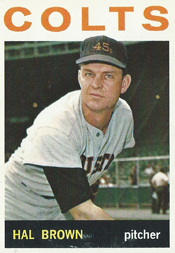
hal_brownAt that time, the Houston Colt .45s, in their second National League season, played their home games at an outdoor ballpark. In the summer, the oppressive Texas heat and humidity made day baseball uncomfortable, if not impractical, for fans and players.

“Rivals agreed that it’s too hot to play on Sunday afternoons,” United Press International reported.

The 1963 Colt .45s became the first big-league club to schedule Sunday night home games. The first was against the Giants on June 9. The second was played against the Cardinals on June 30. The winning pitcher in both was a 38-year-old knuckleball specialist, Hal Brown, a World War II combat veteran who had served as a gunner on U.S. Army Air Force bombers.

Need to be stingy

Brown, winding down his career with the weakest-hitting team in the National League, knew his best chance to win was to pitch a shutout for the Colt .45s.

The 1963 Colt .45s would rank last in the 10-team NL in runs (464), RBI (420) and home runs (62).

Brown earned five wins for the 1963 Colt .45s. He pitched complete-game shutouts _ two versus the Cardinals, including the Sunday night game, and one against the Phillies _ for three of those wins. In the other two, he pitched 6.1 innings of scoreless relief versus the Giants and held the Mets to three runs in a rain-shortened seven-inning start.

Thus, in his wins for the 1963 Colt .45s, Brown had an ERA of 0.66, yielding three runs in 49.1 innings.

Overall, Brown was 5-11 with a 3.31 ERA in 26 games, including 20 starts, for the 1963 Colt .45s. Brown yielded three runs or fewer in seven of his losses, with the Colt .45s scoring a total of five runs in those defeats.

Richards connection

Brown debuted in the major leagues with the 1951 White Sox. He also pitched for the Red Sox and Orioles before joining the Yankees in September 1962.

On April 21, 1963, the Yankees sent Brown to the Colt .45s for $25,000. Paul Richards, general manager of the Colt .45s, had been Brown’s manager with the White Sox and for most of his time with the Orioles. It was Richards who encouraged Brown to use the knuckleball.

“I don’t want a big knuckler,” Brown said to The Sporting News. “I want it to look just good enough to swing at. When you’re 38, you would rather get them out on one pitch than strike them out on three.”

Night moves

In the inaugural big-league Sunday night game, Brown relieved injured starter Turk Farrell with two outs in the third inning. Brown pitched the rest of the way, yielding one hit _ a Willie Mays single _ and retiring the last 17 Giants batters in a row for his first NL win in a 3-0 Colt .45s victory. Boxscore

Outside the ballpark, protesters opposed Sunday night baseball, according to the book “Colt .45s: A Six-Gun Salute.”

“It’s just plain wrong and ought not to be,” Baptist minister O.A. Taylor said of Sunday night games. “If they get by with this, they’ll start scheduling games on Sunday morning.”

Three weeks later, Brown got the start against the Cardinals in the second Sunday night game.

Brown pitched a complete-game seven hitter in a 1-0 Colt .45s victory. Houston scored in the fourth off starter Lew Burdette on John Bateman’s RBI-single.

Brown held the Cardinals to six singles and a triple, striking out six and walking one. He escaped several jams, including:

_ In the first inning, the Cardinals loaded the bases with two outs before Brown retired George Altman.

_ In the second, Curt Flood reached second with none out, but was caught attempting to steal third.

_ Altman tripled leading off the seventh. He was unable to advance on groundouts by Flood and Tim McCarver. Carl Sawatski flied out, ending the inning and stranding Altman at third.

_ In the eighth, the Cardinals had runners on first and third with one out. Brown retired Charlie James and Ken Boyer without allowing the runner from third to score.

“It was a weird but wonderful triumph,” wrote Mickey Herskowitz in The Sporting News.

Said Brown: “It’s a pretty good feeling to know you have to pitch a shutout to win and then to do it.” Boxscore

Brown shut out the Cardinals for the second time on Aug. 24, 1963, a Saturday night in Houston. He limited the Cardinals to four singles _ three by Flood and one by Altman _ in a 4-0 Colt .45s victory.

Stan Musial, making his final visit to Houston as a player and honored in ceremonies before the game, was 0-for-3 against Brown that night. Boxscore

Previously: From the start, Cardinals vs. Houston rivalry was special

Previously: Reds-Cardinals: Easter night to remember

Read Full Post »

« Newer Posts - Older Posts »