Feeds:
Posts
Comments

Archive for the ‘Games’ Category

(Updated April 29, 2018)

Like Yogi Berra, Hank Bauer, Elston Howard and Whitey Herzog, Norm Siebern was a St. Louis-area athlete who was bypassed by the Cardinals and began his professional baseball career in the Yankees organization. Toward the end of his big-league career, Siebern faced the Cardinals in the World Series and got three at-bats _  all against Bob Gibson.
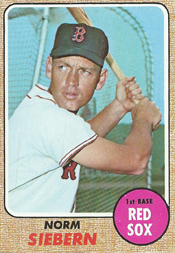
norm_siebernBorn in St. Louis and raised in the nearby town of Wellston, Mo., Siebern was an outfielder and first baseman for 12 years in the big leagues with the Yankees, Athletics, Orioles, Angels, Giants and Red Sox. He three times was named to the American League all-star team: 1962 and 1963 with the Athletics and 1964 with the Orioles.

Siebern was a basketball and baseball standout at Wellston High School in St. Louis County. He caught the attention of Yankees scout Lou Maguolo, who signed Siebern after he graduated from high school in 1951. During the baseball off-seasons, Siebern pursued a journalism degree from Missouri State (then known as Southwest Missouri) in Springfield. While there, he played on the 1952 and 1953 basketball teams that won NAIA (National Association of Intercollegiate Athletics) championships.

In 1957, Siebern had a breakout season with the Yankees’ Class AAA affiliate at Denver. He batted .349 with 45 doubles, 15 triples, 24 home runs, 118 RBI and 97 walks.

Boston bound

Ten years later, Siebern, 34, primarily was a pinch-hitter and role player. He began the 1967 season with the Giants and was dealt to the Red Sox in July.

The Red Sox were seeking a left-handed pinch-hitter and manager Dick Williams recommended they pursue Siebern. Williams, a St. Louis native, and Siebern were teammates with the 1960 Athletics.

Siebern hit .205 in 33 games for the 1967 Red Sox, but Williams kept him on the World Series roster.

Siebern vs. Gibson

In Game 1 at Boston, with Bob Gibson protecting a 2-1 Cardinals lead in the seventh inning, Reggie Smith was on first base with two outs when Williams sent Siebern to bat for catcher Russ Gibson. As Bob Gibson delivered a pitch, Smith attempted to swipe second and was thrown out on Tim McCarver’s peg to shortstop Dal Maxvill, ending the inning.

“He went on his own,” Williams said to The Sporting News. “I didn’t want him to go at that time.”

Because Siebern was at-bat, Williams was faced with either lifting him and wasting a plate appearance, or keeping him in the game. Williams opted for the latter, sending Siebern to play right field in place of Ken Harrelson.

Siebern led off the eighth with a single, moved to second on a bunt by Elston Howard and was stranded there. Gibson completed a six-hitter and got the win in a 2-1 Cardinals victory. Boxscore

In Game 4 at St. Louis, Siebern, batting for pitcher Dave Morehead, led off the eighth and flied out to center. The Cardinals won, 6-0, behind Gibson’s five-hit shutout. Boxscore

Final showdown

The decisive Game 7 in Boston was a matchup of aces: Gibson for the Cardinals and Jim Lonborg for the Red Sox.

Gibson again dominated.

In the eighth, the Red Sox, who trailed, 7-1, mounted their final threat. Rico Petrocelli doubled and advanced to third on Gibson’s wild pitch. Dalton Jones followed with a walk, putting runners on first and third with none out and “stirring the Boston crowd into shouts of encouragement,” The Sporting News reported.

Williams sent Siebern to bat for pitcher Jose Santiago.

In his book “From Ghetto to Glory,” Gibson said, “I was struggling. I decided to junk the fastball and go with the slider.”

Siebern, fooled by the slider, hit a groundball to Julian Javier at second. Javier tossed to Maxvill, retiring Jones at second on the force play, and Petrocelli scored from third. Siebern got a RBI, but Gibson, emboldened by the success of the slider, used it to retire the next two batters and defuse the threat.

Gibson completed a three-hitter in a 7-2 Cardinals victory, earning his third win of the World Series and carrying St. Louis to its second championship in four years. Boxscore

Siebern had this consolation: a World Series batting average of .333 (with a RBI) against the great Gibson.

The World Series duels versus Gibson were a last hurrah for Siebern. In 1968, his final big-league season, Siebern batted .067 in 27 games for the Red Sox before he was released in August.

Previously: Dick Williams couldn’t intimidate 1967 Cardinals

Previously: George Scott: Bob Gibson ‘won’t survive 5’ in Game 7

Previously: Do Cardinals still win if Dick Groat gets dealt for Roger Maris?
Read Full Post »

In September 1963, Reds pitcher John Tsitouris helped end the National League pennant chances of the Cardinals. A year later, Tsitouris helped the Cardinals become champions.

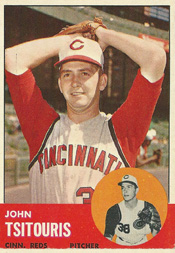
john_tsitourisTsitouris pitched 11 seasons with the Tigers, Athletics and Reds. His major-league career record was 34-38 with a 4.13 ERA, but against the Cardinals he was 8-4 with a 2.36 ERA.
The right-hander yielded 71 hits in 91.1 career innings against the Cardinals and had six complete games. Tsitouris had more wins versus the Cardinals than he had against any other club in his career.

September shutouts

A son of a Greek immigrant father, Tsitouris was acquired by the Reds in a January 1961 trade that sent pitcher Joe Nuxhall to the Athletics.

In 1963, Tsitouris had his best big-league season, posting a 12-8 record that included a pair of September shutouts against the Cardinals.

The 1963 Cardinals had moved within a game of the first-place Dodgers entering a three-game series against them Sept. 16-18 at St. Louis. The Dodgers swept, moving four ahead of the Cardinals.

In desperate need of a win to keep alive their pennant hopes, the Cardinals opened a series against the Reds at Cincinnati on Sept. 20. Tsitouris started for the Reds against Ray Sadecki and shut out the Cardinals, holding them to three singles in a 1-0 victory. Boxscore

The Cardinals’ loss, paired with a Dodgers victory that night over the Pirates, dropped St. Louis five games out of first with six to play. The Dodgers clinched the pennant on Sept. 24

Three days later, on Sept. 27, Tsitouris, matched again against Sadecki, pitched a two-hit shutout against the Cardinals at St. Louis. The Reds broke a scoreless tie with three runs in the top of the ninth. In the bottom of the inning, Dick Groat singled and Bill White walked with two outs before Tsitouris retired Ken Boyer on a groundout, sealing the Reds’ 3-0 victory. Boxscore

“John Tsitouris has become even harder for the St. Louis Cardinals to hit than his name is to spell,” the Associated Press reported.

Fateful Phillies

In 1964, Tsitouris continued to dominate the Cardinals. He was 3-1 with a 1.98 ERA against St. Louis in five starts, including a win on July 3 when he struck out 10. Boxscore

His success against the Cardinals might have kept them from winning the 1964 pennant if not for two September performances _ a win and a loss _ by Tsitouris versus the Phillies.

After play on Sept. 20, 1964, the Phillies were in first place, holding a 6.5-game lead over the second-place Cardinals and Reds with 12 to play.

The next night, Sept. 21, the Reds opened a series against the Phillies at Philadelphia and Tsitouris was matched against Art Mahaffey. In the sixth inning, with the game scoreless, Chico Ruiz was on third base, two outs and Frank Robinson at the plate for the Reds. On an 0-and-1 count, Ruiz streaked down the third-base line as Mahaffey delivered a pitch. The throw was wide and wild, skipping past catcher Clay Dalrymple, and Ruiz stole home. Tsitouris did the rest, shutting out the Phillies on a six-hitter in a 1-0 Reds victory. Boxscore

“He surprised me,” Reds manager Dick Sisler said to The Sporting News of Ruiz’s daring dash. “I would never have called for the move.”

Said Ruiz: “I was hoping I’d be safe because I didn’t want to hear what the manager would say if I was out.”

The play did more than provide a win for the Reds. It triggered a momentum change that sent the Phillies reeling. The Phillies lost 10 in a row, allowing the Cardinals and Reds to surpass them.

On the morning of Oct. 4, the final day of the regular season, the Cardinals and Reds were tied for first, a game ahead of the Phillies. The Cardinals closed with the Mets at St. Louis and the Reds were at home against the Phillies.

The Phillies started their ace, Jim Bunning. The Reds chose Tsitouris. Jim Maloney was the Reds’ ace, but he had pitched 11 innings on Sept. 30 and Sisler thought starting him on three days rest was too risky.

The Phillies broke a scoreless tie with three runs in the third off Tsitouris, who was lifted after 2.1 innings, and cruised to a 10-0 victory. Boxscore

When the Cardinals beat the Mets, 11-5, St. Louis was the NL champion for the first time in 18 seasons. Boxscore

“I can’t agree with anyone who says I should have pitched Maloney,” Sisler said. “Percentages favored Tsitouris in this game.”

Previously: 20th win for Ray Sadecki put 1964 Cardinals into 1st place

Read Full Post »

Johnny Keane made a commitment to the heart of Bob Gibson and the outcome was successful for the Cardinals.

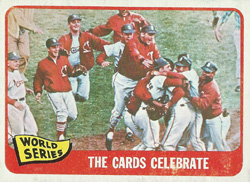
cards_celebrateOn Oct. 15, 1964, the Yankees and Cardinals played the decisive Game 7 of the World Series at St. Louis. The Cardinals started their ace, Gibson, and led, 7-3, entering the ninth inning.

Gibson, 28, had pitched eight innings in Game 2 and 10 innings in Game 5. He also had pitched eight innings in his final start of the regular season on Oct. 2 and four innings of relief in the pennant-clinching season finale on Oct. 4.

Keane, the Cardinals’ manager, never wavered in sending out Gibson to pitch the ninth inning of Game 7.

In his book, “Stranger to the Game,” Gibson said, “By this time, I was simply throwing as hard as I could on every pitch, grunting up my best frazzled-arm fastballs. Keane had sent me out there with the advice to throw nothing but fastballs, remarking that he didn’t think the Yankees could hit four home runs in one inning.”

Author David Halberstam, in his book “October 1964,” wrote, “Rarely had Bob Gibson wanted anything so badly as to finish this game. Johnny Keane, who knew (Gibson) was tired and knew he was wearing down, came over to Gibson and told him he was going to stay with him.”

Said Keane to Gibson: “Bob, I’m going with you in the ninth. Just throw it over the plate. Don’t be cute. Don’t go for the corners. Just get it over.”

Strikeouts and homers

The first batter, Tom Tresh, struck out. The next, No. 8 batter Clete Boyer, “jumped on the fastball he knew was coming,” Gibson said, and hit a home run over the left-field wall, making the score, 7-4.

Gibson struck out Johnny Blanchard, who was batting for pitcher Pete Mikkelsen.

With one more out, the Cardinals would be World Series champions.

Phil Linz, a shortstop who had hit five home runs during the regular season, batted next and hit a home run over the left-field wall.

The score was 7-5. Up next was Bobby Richardson, who had produced 13 hits in the Series. If Richardson reached base, Roger Maris would follow, then Mickey Mantle.

“I looked over to the dugout at Keane,” Gibson said, “wondering if perhaps he had overestimated my speed and underestimated the Yankees’ power.”

Lots of heart

Ray Sadecki, a left-hander who had started Games 1 and 4, was loosening in the bullpen. Keane decided he would bring in Sadecki to face the left-handed Maris if Richardson got on base.

After Gibson worked the count to 1-and-1 on Richardson, Keane went to the mound to talk with his pitcher. Catcher Tim McCarver “did not go all the way out because he knew Gibson hated it when the catcher came out _ and, besides, there was nothing to say,” Halberstam wrote.

The next pitch from Gibson was a fastball. Richardson swung and hit a pop-up to second baseman Dal Maxvill, who made the catch. Video

The Cardinals were World Series champions for the first time in 18 years.

Asked why he stayed with a tiring Gibson in the ninth, Keane replied, “He didn’t pitch only with his arm. He pitched with his heart. He’s got lots of heart … I went all the way with him because I was committed to this fellow’s heart.” Boxscore

Privately, a proud Keane said to Gibson after the game, “You’re on your way.”

In the New York Daily News, Phil Pepe wrote, “The story of the Cardinals’ world championship is the story of Johnny Keane and yesterday it was the story of Bob Gibson. It is the story of faith … of John Keane’s faith in Bob Gibson and of Bob Gibson’s faith in himself.”

Previously: 4 Series aces for Cards: Gibson, Porter, Eckstein, Freese

Previously: Johnny Keane to Gussie Busch: Take this job and shove it

Read Full Post »

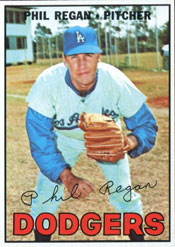
Phil Regan was the premier relief pitcher in the National League with the Dodgers and Cubs in the late 1960s. He twice led the league in saves, with 21 in 1966 and 25 in 1968.

phil_reganRegan’s best season was 1966, his first in the NL after the Dodgers acquired him from the Tigers. Closing games in support of a starting rotation that featured Sandy Koufax, Don Drysdale, Don Sutton and Claude Osteen, Regan posted a 14-1 record and 1.62 ERA, helping the Dodgers win the pennant.

After his 13-year career as a big-league pitcher ended in 1972 with the White Sox, Regan built a commendable reputation as an instructor. He has been a pitching coach with the Mariners, Indians and Cubs. In 1995, he managed the Orioles.

In 2015, Regan, 78, was pitching coach of the Class A minor-league St. Lucie Mets. He mentored most of the pitchers on the staff of the 2015 NL champion New York Mets.

On Oct. 28, 2015, I interviewed Regan near the Mets’ training complex in Port St. Lucie, Fla. Richard Stone, who organizes a sports card show in Sebastian, Fla., helped arrange the interview.

After Regan shared details about his career and his role instructing Mets pitchers, I asked him if he’d answer questions about his recollections of Cardinals. Regan generously agreed and thoughtfully provided his insights.

Here is a segment of that interview:

Q.: From 1963 through 1968, the Dodgers and Cardinals were the only clubs to win NL pennants. The Dodgers won in 1963, 1965 and 1966. The Cardinals won in 1964, 1967 and 1968. What was that rivalry like from your perspective with the Dodgers?

Regan: “It was like two organizations that were almost the same. Both of them were speed, pitching, good defense and playing the fundamentals very well.”

Q.: How did the Dodgers try to beat the Cardinals?

Regan: “We always felt that if we could get to Bob Gibson early _ get him in the first inning, because we didn’t get any runs off him after that _ we could hold on and win with our pitching.”

Q.: The 1967 and ’68 champion Cardinals had Lou Brock. Was he the batter in that lineup that pitchers needed to focus on?

Regan: “He was one of them … When I was with the Cubs, he would bunt on (first baseman) Ernie Banks. Ernie wasn’t very fast. Ernie couldn’t field the bunts. Brock would beat it out every time.”

Q.: Who else in that Cardinals lineup?

Regan: “Another guy who helped them was Roger Maris.”

Q.: Maris batted .077 (2-for-26) with no home runs against you in his career. How did you do it?

Regan: “I’ll tell you why. When I was with Detroit, I roomed with (pitcher) Frank Lary. And Lary would tell me, ‘Maris has his swing grooved. Anything inside, he’ll hit.’

“So, I threw him nothing but sinkers down and away and let him try to pull the ball. And I got him out.

“I threw him one slider inside in Detroit and he hit it foul, a bullet, and I said I’m going to stay with sinkers away. He was geared to pull everything. He geared his swing to hit home runs, but it took away the outer part of the plate, which is where I pitched him.”

Q.: What else do you recall about those 1967 and ’68 Cardinals?

Regan: “I came in to pitch at St. Louis (on Aug. 9, 1967) and loaded the bases with no outs. Wes Parker was playing first base and Jimmy Campanis was catching.

“I’m thinking, ‘How can I get out of this situation?’ The next hitter (Eddie Bressoud) pops up to first base, to Wes Parker, a great fielder, near the bag.

“(Mike Shannon) is on third base and he fakes like he’s going home after the catch. Wes Parker takes the ball and lobs it toward home plate. I’m backing up the play, near the fence.

“The ball hits in front of Campanis and scoots under his leg and goes halfway between the catcher and me _ and (Shannon) scores the winning run.”

(Here is the boxscore from that game. Shannon told the Associated Press, “I hesitated when I saw the ball roll away. I couldn’t tell how far it was going … but it just kept rolling, so I went.”)

Q.: As a successful instructor, you’re like the Mets’ version of the Cardinals’ George Kissell. Did you have any interaction with Kissell?

Regan: “I got a lot of his notes. He’s got a little book out, a handbook for managers on all phases of the game. Throughout it are his sayings.

“He told pitchers they should try to strike out 13 hitters a game. Now, that’s a lot. He’d say, ‘You strike out the first hitter of every inning _ that’s nine times _ and the pitcher four times.’

“Really, what he was saying was that the most important man in the inning to get out is that first hitter. Be ready to pitch to him. If you get him out, it stops everything.

“I use it all the time. If you get the first hitter out, you can load the bases and get out of the inning with one pitch. If you don’t get the first hitter out, he’ll score 80 percent of the time. I follow a lot of his stuff.”

Q.: A George Kissell disciple who came up through the Cardinals system was Jim Riggleman. In 1997 and ’98, Riggleman managed the Cubs and you were their pitching coach. How was that?

Regan: “I love Jim Riggleman. He was one of the best young managers. In 1997, we weren’t a very good club (68-94 and last place in the NL Central). In 1998, the general manager called us in and said, ‘I’m going to have to hold you guys responsible if you don’t turn it around.’ We went on to win a one-game playoff with the Giants and got into the postseason (with a 90-73 record).”

Q.: In 1994, when you were pitching coach for the Indians, one of the pitchers on your staff was Derek Lilliquist. Today, he’s the Cardinals’ pitching coach. Did you see then his potential to become an instructor?

Regan: “I didn’t know he would become the pitching coach that he is today. He loved the game. He was quite a jokester. A lot of times, I’d back up the pitcher when we were taking batting practice. One day, in Toronto, we noticed none of the balls were coming in from the outfield. He was the ringleader of this. I said, ‘Where are the balls?’ All of a sudden, they threw about 100 balls at me at the same time.

“He had fun playing the game. That’s one of the things that makes you a good coach. You can laugh and have a good time and yet they know when you’re serious, too.”

Q.: Any other Cardinals recollection to share?

Regan: “(In 1982), I got a call from an agent (Jack Childers) in Chicago, who said, ‘Phil, I remember when you played here with the Cubs. You had a good sinker. I have a player who has lost his fastball. I represent him. I need him to learn a sinker. Would you be willing to work with him?’ I said, ‘Yeah, I will. Who is it?’ He said, ‘Al Hrabosky, the Mad Hungarian.’ (Hrabosky had been released by the Braves.)

“I said, ‘We’re in our fall program at Grand Valley State (where Regan was head baseball coach). If he wants to come up here, I’ll work with him.’ So he came up and spent four days with us and worked on a sinker. He had lost his fastball. When he left, he said, ‘I’m going to Venezuela (winter league) to work on this sinker. Would you mind calling some people (in the big leagues) and telling them where I am and what I’m working on?’

“I called Jim Campbell with the Tigers and Roland Hemond with the White Sox. Then I read an article that said Seattle was looking for a left-handed reliever. I didn’t know anybody there. So, I called and got hold of the general manager, Dan O’Brien.”

O’Brien gave Regan a job as Mariners advance scout, returning him to the big leagues for the first time since his pitching career ended. Hemond invited Hrabosky to spring training for a tryout with White Sox manager Tony La Russa and pitching coach Dave Duncan.

Previously: Denny McLain on Dizzy Dean, Bob Gibson, ’68 Cards

Previously: Al Hrabosky’s last stand tested Dave Duncan, Tony La Russa

Read Full Post »

In a painfully fitting ending to the most miserable inning experienced by the Cardinals, a player who helped them win a World Series title delivered a hit that prevented them from earning another championship.

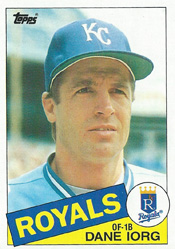
dane_iorg4On Oct. 26, 1985, in Game 6 of the World Series at Kansas City, Dane Iorg looped a two-run single against Todd Worrell in the bottom of the ninth inning, lifting the Royals from a one-run deficit to a 2-1 victory that evened the series. The Royals won Game 7 the next night, clinching their first World Series crown.

Three years earlier, Iorg had served as a designated hitter for the Cardinals in the 1982 World Series. He batted .529 (9-for-17) with four doubles, a triple and four runs scored, helping the Cardinals defeat the Brewers in seven games.

In eight seasons (1977-84) with St. Louis, Iorg batted .294, including .303 in 105 games in 1980 and .294 in 102 games in 1982. The Cardinals sold his contract to the Royals in May 1984.

Damn Denkinger

Iorg was in a position to beat the Cardinals in Game 6 of the 1985 World Series because of an infamous ninth-inning blown call by first-base umpire Don Denkinger, who ruled leadoff batter Jorge Orta safe at first base, even though Worrell, fielding a throw from first baseman Jack Clark, clearly had tagged the bag with his foot before Orta did.

With Orta on first, the Cardinals dug a deeper hole when Clark failed to catch a pop-up by Steve Balboni in foul territory _ Balboni, given a reprieve, singled _ and when Darrell Porter let a slider elude him for a passed ball, allowing runners on first and second to advance to second and third.

After Hal McRae was walked intentionally, loading the bases with one out, Royals manager Dick Howser chose Iorg to bat for reliever Dan Quisenberry.

Mix and match

In his only other at-bat of the 1985 World Series, Iorg faced Worrell in the opener and flied out to right, ending a game the Cardinals won, 3-1, but Clark had a bad feeling as Iorg batted in the ninth inning of Game 6.

“When Dane came up there, the Royals had the matchup they wanted,” Clark told the San Diego Union-Tribune. “Iorg has always been tough in those situations because he puts the ball in play.’

Though a left-hander, Ricky Horton, was loosening in the Cardinals bullpen, manager Whitey Herzog chose to stick with Worrell, a right-handed rookie.

The 1985 Cardinals hadn’t lost a lead in the ninth inning all year.

“If I thought about everything that was going on around me, I would have never made it to the plate,” Iorg told the Sacramento Bee. “I would have had a heart attack before I got there.”

The showdown

Worrell’s first pitch to Iorg was taken for a ball.

“I wasn’t looking for a pitch in a specific location,” Iorg said to the Richmond Times-Dispatch. “I was just looking for something I could get my bat on.”

The next pitch was belt high.

“He jammed me with a fastball,” Iorg told the Columbus Dispatch.

Said Worrell to the St. Louis Post-Dispatch: “I got it in on his hands.”

Iorg swung and lifted a soft liner into right field.

“It broke my bat, but I had a good enough stroke to get it to the outfield,” Iorg said. “I knew it was a hit. I was just hoping it would score two runs.”

Said Clark: “A nice piece of hitting.”

The throw

Right fielder Andy Van Slyke, who had been shaded toward right-center, said, “That ball just died on the (artificial) grass when it should have taken a good bounce up to me.”

Van Slyke retrieved the ball and unleashed a low, accurate throw toward the plate.

Pinch-runner Onix Concepcion scored easily from third with the tying run. Catcher Jim Sundberg, who had been on second base, was steaming toward the plate, representing the winning run.

“I couldn’t get the throw off I wanted to make,” said Van Slyke. “And the ball, it hung there in slow motion.”

Said Worrell: “If he (Iorg) hit it harder, we might have had a chance to get (Sundberg).”

Van Slyke’s peg was caught on the fly in front of the plate by Porter, who turned to try a sweep tag on Sundberg, diving head-first safely across the plate. Video

Special feeling

“Those are the kinds of situations that you dream about as a child when you’re in Little League or playing Babe Ruth ball,” Iorg said to the Akron Beacon-Journal. “To fulfill such a dream is very special.” Boxscore

Asked whether he had mixed emotions about beating his former team (Herzog had called Iorg “one of my favorite people.”), Iorg replied, “I didn’t think about that at all. That was a new pitcher (Worrell) that I basically never played with and a new team. The situation was important enough without thinking about the past and who it was against.”

(In the 2002 book “Whitey’s Boys,” Iorg admitted, “I had better friends on the Cardinals than on the Royals.”)

Regarding the historical impact of the hit, Iorg told the Sacramento Bee, “When I’m fishing with my brother for steelhead on the Mad River in northern California, it’ll probably hit me then. Right now, I’d like to think I did this for my father (in the lumber business). He sacrificed a lot for me to play baseball. This, in some way, is paying him back.”

Hero and villain

In his column for the Post-Dispatch, Kevin Horrigan best summarized the feelings of Cardinals fans.

“Dane Iorg got to be a hero,” Horrigan wrote. “That was the only good thing about the inning from an eastern Missouri point of view. Dane Iorg, a former Cardinal and one of the nicest men ever to wear the birds on the bat, got to be a hero by driving in the two runs with a single to right.

“In 1982, he was a World Series hero for the Cardinals. In 1985, he killed them. This was his job. Don Denkinger also killed them. This was not his job.”

Horrigan concluded, “Jesse James used to rob trains for a living. He’d ride up with his gang, pull a gun and heist the loot. Don Denkinger ought to be able to relate to that. He robbed the Cardinals blind last night.”

Previously: Dane Iorg excelled as World Series DH for Cardinals


Read Full Post »

If Tommy Lasorda had ordered Tom Niedenfuer to intentionally walk Jack Clark in the ninth inning of Game 6 in the National League Championship Series, Brian Harper likely would have been facing Jerry Reuss with the outcome on the line.

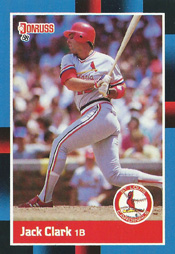
jack_clark5Instead, Lasorda, the Dodgers’ manager, made the fateful decision to allow Niedenfuer to pitch to Clark with Willie McGee on third, Ozzie Smith on second, first base open and two out.

On Oct. 16, 1985, Clark cracked a first-pitch fastball from Niedenfuer for a three-run home run, erasing a 5-4 Dodgers lead and carrying the Cardinals into the World Series with a 7-5 pennant-clinching victory at Los Angeles.

“After he hits the home run, even my wife knows I should have walked him,” Lasorda told the Daily Breeze of Torrance, Calif.

Match game

Jay Johnstone, a Dodgers reserve outfielder, wrote in his postseason column for the Daily News of Los Angeles that “Tommy, in fact, was going to walk him. Then he changed his mind.”

Andy Van Slyke, a left-handed batter, was on deck when Clark stepped to the plate against Niedenfuer.

“I was looking into the Dodgers dugout, waiting for Tommy to put up four fingers,” Van Slyke told reporters.

“If you were Tommy Lasorda, wouldn’t you rather pitch to me than to Jack Clark?”

Not, it turns out, if the pitcher is a right-hander, such as Niedenfuer.

If Clark had been walked intentionally, Lasorda intended to have a left-hander face Van Slyke. The left-hander the Dodgers had warming in the bullpen was Reuss, a former Cardinal.

In his book “White Rat: A Life in Baseball,” Cardinals manager Whitey Herzog said, “If Tommy walks Clark and brings in a lefty to pitch to Andy, I would have countered with Brian Harper, the only right-handed pinch-hitter I had left.”

Harper, a utility player, had batted .250 with no home runs in 43 games for the 1985 Cardinals.

In a rebuke of Lasorda, Herzog said, “I would rather let Brian Harper try to beat me than Jack Clark.”

Watching from the dugout, Harper was preparing for the chance to bat with the bases loaded. “Even when they pitched to Jack, I figured they would pitch around him,” Harper told the Daily Breeze.

Clark agreed, saying, “When they decided to pitch to me … I didn’t expect to get a pitch to hit.”

Cat and mouse

Niedenfuer was thinking the same. In the seventh inning, with the score tied 4-4 and Cardinals runners on first and third, Niedenfuer struck out Clark on sliders.

So, when Clark came to bat in the ninth, “I figured he wouldn’t be looking for a fastball,” Niedenfuer said.

Niedenfuer’s assumption had merit. In his book “You’re Missin’ a Great Game,” Herzog called Clark “the greatest fastball hitter of his era,” but said the slugger “took more heaters for strikes than any player I’ve ever seen.”

Said Herzog: “Jack Clark might have been the worst guesser I ever saw. He terrified people as a fastball hitter, but he took the wrong message from that. He believed nobody _ nobody _ would ever throw him a fastball. So he never sat on his best pitch. Jack would stand there waiting for the curve and … those pitchers would sneak heaters right by him.”

Knowing this, Niedenfuer said he intended to start Clark with a fastball on the outside part of the strike zone and try to get Clark to chase subsequent pitches outside the zone.

There were, however, two problems with this approach:

_ “I was looking for a fastball,” Clark said to the Daily News.

_ The fastball Niedenfuer delivered wasn’t on the outside corner. Instead, it was in the middle of the plate, about belt high.

Clark swung at the pitch and lifted a drive deep into the left-field bleachers.

“The only hope was that it would hit the Goodyear blimp and fall straight down,” Niedenfuer told Knight-Ridder Newspapers.

Said Clark: “It was the biggest, furthest, most important hit of my career.” Video

It also was the only home run Clark would hit in 47 career postseason at-bats. Boxscore

Previously: Trade for Jack Clark shook Cardinals from slumber

Read Full Post »

« Newer Posts - Older Posts »