Feeds:
Posts
Comments

Archive for the ‘Games’ Category

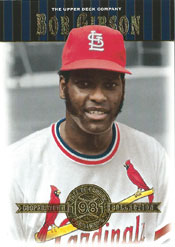
In 1972, at age 36, Bob Gibson lost his first five decisions, causing some to wonder whether he was finished as an effective player for the Cardinals. Instead, Gibson put together a remarkable season, leading Cardinals pitchers in wins and placing among the top five Cardinals hitters in home runs.

bob_gibson21Gibson had 19 wins and five home runs for the 1972 Cardinals. He tied outfielder Luis Melendez for fourth on the club in home runs. The only Cardinals to hit more home runs than Gibson that season were catcher Ted Simmons (16), third baseman Joe Torre (11) and right fielder Bernie Carbo (seven).
Gibson, though, had far fewer at-bats (103) than Simmons (594), Torre (544), Melendez (332) and Carbo (302). It’s not a stretch to think Gibson would have led the 1972 Cardinals in home runs if he had gotten as many at-bats as an everyday player.

Gibson holds the Cardinals record for most home runs in a season by a pitcher. He hit five twice _ in 1965 and 1972.

During a Cardinals career from 1959-75, Gibson hit 24 regular-season home runs and two World Series home runs.

Here is a look at Gibson’s two five-home run seasons:

5 in 1965

_ May 16, Cardinals 6, Pirates 3, at Pittsburgh: In the ninth, with the Cardinals ahead, 5-3, Gibson hit a solo home run off Tommie Sisk. Gibson got a complete-game win even though he yielded 10 hits. Boxscore

_ June 27, Cardinals 8, Cubs 0, at St. Louis: In the second, with the Cardinals ahead, 2-0, Gibson hit a two-run home run off former teammate Ernie Broglio. In pitching the shutout, Gibson struck out 12, including Ron Santo twice. Boxscore

_ Aug. 15, Cardinals 12, Reds 7, at St. Louis: In the second, with the Reds ahead, 3-1, Gibson hit a three-run home run off Sammy Ellis. Gibson yielded seven runs in seven innings, but the Cardinals scored eight in the eighth. Reliever Ray Washburn got the win. Boxscore

_ Aug. 31, Cardinals 3, Cubs 0, at Chicago: In the fifth, with the Cardinals ahead, 1-0, Gibson hit a solo home run off Dick Ellsworth. Gibson pitched a two-hit shutout. The Cubs got back-to-back singles by Don Landrum and Joey Amalfitano with two outs in the sixth. Boxscore

_ Sept. 29, Cardinals 8, Giants 6, at San Francisco: In the eighth, with the Cardinals ahead, 4-0, Gibson hit a grand slam off Gaylord Perry. Gibson gave up five runs in 8.1 innings and got the win. Boxscore

Much ado in ’72

_ June 4, Cardinals 4, Dodgers 0, at Los Angeles: In the ninth, with the Cardinals ahead, 2-0, Dal Maxvill singled with two outs and Gibson followed with a home run off Pete Richert. Gibson pitched a five-hit shutout. Bill Buckner and Wes Parker each singled twice for the Dodgers. Boxscore

_ June 21, Cardinals 14, Padres 3, at St. Louis: In the seventh, with the Cardinals ahead, 10-1, Carbo walked, Maxvill singled and Gibson hit a three-run home run off Mark Schaeffer. Boxscore

The win was Gibson’s 211th, moving him ahead of Jesse Haines and into first place all-time among Cardinals pitchers.

“What I enjoy most about the record is being able to stay with one club long enough to win that many games,” Gibson said to Dave Johnson of the Burlington (Iowa) Hawk Eye. “The longevity factor means more to me than breaking some guy’s record.”

According to the book “Gibson’s Last Stand,” the Cardinals’ ace “pitched most of the game with a pulled hamstring” after scoring on a Lou Brock triple in the second inning.

Stan Landes was the home plate umpire for Gibson’s record-setting win. Landes also was the home plate umpire when Gibson got his first career win on July 30, 1959, at Cincinnati.

_ July 12, Cardinals 7, Braves 0, at St. Louis: In the fourth, with the Cardinals ahead, 3-0, Gibson and Brock hit back-to-back solo home runs off Ron Schueler. Gibson pitched a six-hit shutout in a game played in less than two hours.

“It doesn’t take Gibson long to embarrass you,” Braves manager Lum Harris told the Associated Press.

Said Braves pinch-hitter Jim Breazeale, who struck out against Gibson: “I didn’t even need to carry a bat up there.” Boxscore

_ July 21, Cardinals 2, Braves 1, at Atlanta: With the Cardinals ahead, 1-0, Gibson led off the sixth with a home run off George Stone for the decisive run. Gibson pitched a complete game and earned his 11th consecutive win. Darrell Evans hit a home run in the seventh for the run off Gibson. Boxscore

_ Aug. 30, Giants 3, Cardinals 2, at St. Louis: Gibson led off the sixth with a home run against Jim Willoughby, tying the score at 1-1. The Giants rallied with two runs in the ninth. Gibson struck out 14, including Dave Kingman twice. Boxscore

Previously: Cardinals pitchers enjoy grand slam streak

Read Full Post »

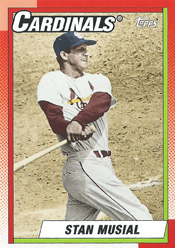
The 1946 Cardinals shifted Stan Musial from left field to first base and it worked out well.

stan_musial30Though he never had played first base as a professional, Musial replaced injured Dick Sisler on June 7, 1946, and started at first base the remainder of the season and in the World Series.
Musial, 25, started 114 regular-season games at first base for the 1946 Cardinals. He ranked second among National League first basemen in double plays turned (119), fourth in putouts (1,056) and fifth in fielding percentage (.989). Musial also led NL first basemen in errors (13).

The change in positions didn’t hurt Musial’s hitting. He led the NL in batting (.365), hits (228), singles (142), doubles (50), triples (20), extra-base hits (86) and total bases (366) for a Cardinals club that won the 1946 World Series championship.

In an editorial, The Sporting News opined, “Usually, so drastic a shift harries the player and hampers his hitting and fielding, but Stan jumped into his new position as if to the manor born.”

It was a remarkable and completely unexpected transformation.

Naval disaster

In 1945, Musial was called into military service and joined the Navy. At Bainbridge, Md., where he was sent for basic training, Musial played in a few ballgames with fellow servicemen.

In his book “Stan Musial: The Man’s Own Story,” Musial recalled, “Although by then I had a reputation as a good defensive outfielder in the big leagues, the Bainbridge athletic director, a lieutenant named Jerry O’Brien, put me at first base. I was amused. O’Brien was not.”

“Get out of there, Musial,” O’Brien ordered. “You’re terrible. You’ll never make anybody’s team at first base.”

Helping the team

That was the extent of Musial’s experience at first base until he got a surprise request a year later.

Sisler, a rookie, had been selected to be the first baseman for the 1946 Cardinals by first-year manager Eddie Dyer. Sisler replaced Ray Sanders, whose contract was sold to the Braves the day before the 1946 season opener.

Sisler was hitting .270 when he injured his hand on June 2, 1946. Harry Walker, an outfielder, replaced Sisler at first base, but Dyer had another player in mind for the position.

“When I reported in the clubhouse, I found a new first baseman’s glove in my locker,” Musial said. “I took the hint and began working out at the infield position.”

A few nights later, Musial said, Dyer asked him to play first base “for the good of the club.”

“I always liked to fool around the bag,” Musial said. “When Skip told me that I was to be the regular first sacker, I was delighted.”

On June 7, 1946, in a game against the Phillies at St. Louis, Musial made his debut as a professional first baseman. He turned two double plays, had 11 putouts and one assist and made no errors. Boxscore

Gamble pays off

After Sisler’s hand healed, Dyer kept Musial at first base.

“St. Louis players liked Musial’s work around the bag, thought the team was stronger with Stan on the infield and what started to be a makeshift developed into a permanent arrangement,” The Sporting News explained. “From all present indications, Stan will continue indefinitely at the position.”

Said Musial: “I would hate to go back to the outfield. Now I am in the game all the way in every play. Not like waiting out there for three or four chances.”

On Aug. 12, 1946, against the Cubs at Chicago, Musial handled 20 chances at first base _ 19 putouts and one assist. Boxscore

“I am quite thrilled over the way my move in converting Stan Musial into a first baseman has turned out,” Dyer told The Sporting News. “… I knew that shifting Musial to first base was a perilous adventure for me. Suppose he had fallen off in his hitting? … I had to risk that. But, then, it wasn’t too big a gamble, for I knew Musial.”

Self-assessment

Musial said his experience as a pitcher in high school and in the minor leagues helped prepare him to play first base with the 1946 Cardinals.

“That taught me how to get around the infield, field bunts and hot smashes, also to get some experience in covering first base when balls were hit to the first baseman,” Musial said.

Assessing his fielding, Musial said, “I am far from a polished first sacker.”

His weakness?

“That dilemma you find yourself in when you get a bad throw is my biggest problem,” Musial said. “Here’s what I mean: One of the infielders makes a wide relay to me. A player who is accustomed to playing the bag will leave it if he sees that he has to and will save the out. I am afraid I can’t do both. So I try to protect the bag and the ball at the same time.”

His strength?

“I can make that first-to-short-to-first double play and that throw to the pitcher when he covers the bag.”

Two-position player

In the 1946 World Series versus the Red Sox, Musial fielded flawlessly at first base. He made 61 putouts, had two assists, turned six double plays and committed no errors in 62 innings.

Musial played the entire 1947 season at first base. In 1948, Dyer moved Musial to right field and put Nippy Jones at first base.

From 1948-54, Musial primarily played outfield. He was the starting first baseman for the Cardinals from 1955-59 and returned primarily to the outfield for the last four years (1960-63) of his career.

Musial made 1,854 career regular-season starts in the outfield and 989 career regular-season starts at first base.

Read Full Post »

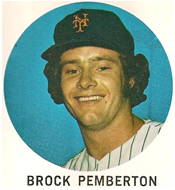
Brock Pemberton played in one of the most bizarre games involving the Cardinals. He also played for one of the most bizarre Cardinals affiliates. Yet Pemberton never played for the Cardinals.

brock_pembertonPemberton, a switch-hitting first baseman, got his first big-league hit against the Cardinals while pinch-hitting for the Mets in the bottom of the 25th inning in a 1974 game that started on the evening of Sept. 11 and ended on the morning of Sept. 12 at Shea Stadium in New York.

Two years later, Pemberton was traded by the Mets to the Cardinals and was assigned to their Class AAA affiliate, which had relocated from Tulsa to New Orleans.

As the everyday first baseman for the New Orleans Pelicans, Pemberton and teammates such as future big-league managers Tony La Russa and Jim Riggleman played for the worst team in the American Association before sparse gatherings in the cavernous Superdome.

That 1977 season with New Orleans represented Pemberton’s only year in the Cardinals’ organization.

Mets prospect

After Pemberton graduated from Marina High School in Huntington Beach, Calif., he signed with the Mets, who had selected him in the sixth round of the 1972 amateur draft.

Pemberton established himself as a premier prospect. He had 31 doubles for Class A Pompano Beach in 1973 and 37 doubles for Class AA Victoria in 1974.

In September 1974, the Mets called up Pemberton, 20, to the big leagues. On Sept. 10, in his first big-league at-bat, he struck out while pinch-hitting against Expos reliever Dale Murray.

Early morning magic

The next night, the Cardinals faced the Mets and staged an epic endurance test.

With two outs in the top of the ninth inning, the Cardinals’ Ken Reitz hit a two-run home run off Jerry Koosman, tying the score at 3-3. Neither team scored again until the 25th when the Cardinals’ Bake McBride scampered home from first after an errant pickoff throw from pitcher Hank Webb.

Sonny Siebert retired the first two Mets batters in the bottom half of the 25th before Pemberton, pinch-hitting for Webb, singled for his first big-league hit.

When the ball was removed from the game so that Pemberton would have a keepsake, Mets pitcher Tom Seaver quipped from the dugout, “Don’t give it to him. It’s the last ball we’ve got left.”

Siebert ended the drama by striking out John Milner. Boxscore

Time for change

After the 1974 season, the Mets acquired Joe Torre from the Cardinals and projected him to be their first baseman.

“Now we don’t have to rush the kids,” Mets manager Yogi Berra said.

Wrote The Sporting News: “One of the kids Berra had in mind is Brock Pemberton … Pemberton is regarded as one of the finest hitting prospects in the New York organization.”

Pemberton batted .297 for Class AAA Tidewater in 1975 and got another September promotion to the Mets. In 1976, Pemberton batted .290 for Tidewater.

The Mets, though, appeared set at first base with Milner.

On Dec. 9, 1976, the Mets sent Pemberton, 23, and minor-league outfielder Leon Brown to the Cardinals for minor-league first baseman Ed Kurpiel.

All that jazz

A. Ray Smith, owner of the Cardinals’ Class AAA affiliate at Tulsa, had moved the franchise to New Orleans after the 1976 season. Smith expected a big-league franchise would relocate to New Orleans and he wanted to be in a position to get in on that action.

New Orleans had been without a minor-league franchise since the 1958 Pelicans were the Class AA affiliate of the Yankees.

Smith leased the Superdome, which seated 53,000 for baseball, for $1,000 a game and tried to market New Orleans as a baseball town.

On April 30, 1977, the day of the Pelicans’ first home game, “horse-drawn carriages, jazz bands and baseball old-timers paraded through downtown New Orleans to the Louisiana Superdome,” The Sporting News reported.

Among the former players on hand to sign autographs and take part in the parade were Stan Musial, Satchel Paige, Cool Papa Bell and Paul Dean.

La Russa (an infielder in his final season as a player), Ken Oberkfell and Pat Scanlon hit home runs for New Orleans in the home opener, but Omaha beat the Pelicans, 13-8.

Manager prep

In June, Pelicans manager Lance Nichols took a leave of absence to receive treatment for lymphoma. La Russa was named interim manager and led the Pelicans to three wins in five games.

In the book “Tony La Russa: Man on a Mission,” Oberkfell said of La Russa’s first attempt at managing: “He was totally prepared. He managed those games as if he were the fulltime manager and it was his team.”

The 1977 Pelicans’ claim to fame is grooming two big-league managers.

Riggleman, who played third base and hit 17 home runs for New Orleans, became a Cardinals coach (1989-90) for Whitey Herzog and manager of the Padres, Cubs, Mariners and Nationals.

La Russa became a Hall of Fame manager of the White Sox, Athletics and Cardinals. He ranks third all-time in wins.

One and done

Pemberton hit .241 with 41 RBI in 113 games for the 1977 Pelicans. He hit the same number of home runs as La Russa: three.

The Pelicans finished with the worst record in the American Association at 57-79. Their total home attendance was 208,908.

With the Cardinals pressuring to have their Class AAA club closer to St. Louis, Smith relocated the franchise from New Orleans to Springfield, Ill., after the 1977 season.

Smith also joined a group of investors who sought to entice the Athletics of the American League to move from Oakland to New Orleans. The effort, however, failed and New Orleans was without a baseball team in 1978.

The Cardinals, committed to Keith Hernandez as their first baseman, cut their ties with Pemberton and went with Dane Iorg as their Class AAA first baseman at Springfield in 1978.


Read Full Post »

Seeking an impact player at second base for the 1996 season, Tony La Russa’s first as their manager, the Cardinals set their sights on Craig Biggio, then Tony Phillips.

tony_phillipsUnable to sign either free agent, the 1996 Cardinals settled on Luis Alicea and Mike Gallego as their primary second basemen.

Biggio remained with the Astros and went on to complete a career that earned him election to the National Baseball Hall of Fame.

Phillips, who had played for La Russa with the Athletics, elected to sign with the White Sox.

If Phillips had decided to go to the National League, his agent said, he would have chosen the Cardinals.

Surprise player

Jose Oquendo, playing his final season, and David Bell, a rookie, had gotten the most starts at second base for the 1995 Cardinals. Management decided the position needed an upgrade.

The Cardinals aggressively pursued Biggio. Phillips was squarely on their radar as well.

Phillips hit 27 home runs and scored 119 runs for the 1995 Angels.

In the Oct. 15, 1995, St. Louis Post-Dispatch, Rick Hummel wrote of the Cardinals, “A surprise player they might go after is California infielder Tony Phillips.”

Two months later, Hummel reported, “Tony Phillips may be on the way out with the California Angels _ and on his way to the Cardinals if they fail to land Biggio.”

The Cardinals offered Biggio a five-year, $25 million contract, the Associated Press reported, but Biggio took the Astros’ four-year, $22 million deal.

Turning their attention to Phillips, La Russa said, “His best position is wherever the club needs. He’s a real competitor and he would add a lot of spark to our ballclub.”

Substantial offer

The Cardinals wanted Phillips, who turned 37 in 1996, to play second base. The Cubs, who wanted him at third base, offered a one-year contract.

“If it wasn’t for more than one year, Tony wasn’t interested,” said agent Tony Attanasio to the Chicago Sun-Times. “He wanted, too, to stay in the American League. If he had gone to the National League, it probably would have been with the Cardinals. Their offer was more substantial.”

Phillips accepted a two-year, $3.6 million deal from the White Sox, who wanted him to replace Tim Raines in left field.

Drug trouble

With Alicea (whose 24 errors were the most among NL second basemen) and Gallego (who batted .210), the Cardinals won a division title and advanced to the NL Championship Series.

Phillips had a stellar season for the 1996 White Sox. He led the American League in walks (125), scored 119 runs and had an on-base percentage of .404.

The next year, though, while in his second stint with the Angels, Phillips pleaded guilty to a cocaine possession charge.

Released by the Angels on April 1, 1998, Phillips was out of baseball until the Blue Jays signed him to a minor-league contract on July 1, 1998. Four weeks later, the Blue Jays traded Phillips to the Mets, who were desperate for an outfielder.

Short fuse

On Aug. 21, 1998, in the first game of a doubleheader against the Cardinals at New York, Phillips batted leadoff and played left field for the Mets. Boxscore

Cardinals starter Matt Morris brushed back Phillips with a pitch. After Phillips flied out to end the seventh inning, he yelled at Morris, who responded by waving at Phillips, according to the Post-Dispatch.

Phillips approached the Cardinals dugout and challenged someone.

Said La Russa: “Tony’s fuse is always lit. You only get to yell one time. I said, `You’ve already had your yelling. Get out to left field.’

“If everybody played as hard as Tony Phillips,” La Russa concluded, “the game would be more fun to watch.”

Read Full Post »

Though known more for his skills with a glove than with a bat, Jim Davenport of the Giants delivered two standout hitting performances against a pair of Cardinals aces, future Hall of Famers Bob Gibson and Steve Carlton.

jim_davenportIn a 1961 game versus Gibson, Davenport had three doubles and two walks in five plate appearances. In a 1968 game against Carlton, Davenport produced four singles in four at-bats.

Davenport also broke Cardinals third baseman Ken Boyer’s streak of winning National League Gold Glove awards. Boyer got the award in four consecutive seasons (1958-61) before Davenport won it in 1962. Boyer earned his fifth and final Gold Glove the next year.

Reliable player

Though not of the caliber of teammates Willie Mays, Willie McCovey and Orlando Cepeda, or of third base counterparts such as Boyer and Ron Santo of the Cubs, Davenport was a dependable fielder (he three times led NL third basemen in fielding percentage) and clutch hitter (career .285 batting average with runners in scoring position).

He had some of his biggest successes against the Cardinals.

A career .258 hitter for the Giants from 1958-70, Davenport batted .273 versus St. Louis, with 32 doubles.

Here is a look at three of Davenport’s best games against the Cardinals:

On base 5 times

Davenport, batting second, ahead of McCovey, Mays and Cepeda, was 3-for-3 (all doubles), two walks and three runs scored versus Gibson on Aug. 26, 1961, at St. Louis.

Gibson, hitting better than he pitched, had four RBI with a two-run double and two sacrifice flies in an 8-5 Cardinals victory. Gibson got the win even though he yielded 10 hits and six walks in 8.1. innings.

Davenport doubled in the first and third innings and walked in the fourth and seventh.

In the ninth, with the Cardinals ahead, 8-3, Davenport doubled with one out and McCovey followed with a 410-foot home run to right-center, getting the Giants within three at 8-5.

After Gibson walked Mays, Ed Bauta relieved and retired Cepeda and Hobie Landrith, earning a save and preserving the Cardinals’ sixth victory in a row. Boxscore

Davenport had a career .245 batting mark (12-for-49) against Gibson, with five doubles and seven walks.

Hard-hitting shortstop

Batting sixth and playing shortstop, Davenport was 4-for-4 with three doubles, a single, a sacrifice bunt, a RBI and a run scored for the Giants in their 10-5 victory in 10 innings at St. Louis on May 5, 1965.

Davenport had two doubles and a single off starter Tracy Stallard.

In the 10th, with the score tied at 5-5, Davenport doubled against Ray Washburn, sparking a five-run inning for the Giants. Davenport scored the go-ahead run when second baseman Phil Gagliano bobbled Ed Bailey’s grounder and threw wildly to home plate. Boxscore

Jim Ray Hart had replaced Davenport as the everyday third baseman for the 1965 Giants. Davenport started at shortstop that season in 32 games, second to Dick Schofield.

“Davenport isn’t just adequate at short _ he’s good there,” Giants manager Herman Franks told The Sporting News.

Tough on left-handers

Batting second, Davenport was 4-for-4 against Carlton in the Giants’ 3-0 victory at St. Louis on July 18, 1968.

Davenport singled off Carlton in the first, third, fifth and seventh innings. He grounded out facing Ron Willis in the ninth. Boxscore

A lifetime .299 hitter versus left-handers, Davenport batted .364 (8-for-22) in his career against Carlton. All the hits were singles.

The loss snapped a six-game winning streak for the front-running Cardinals, but they still were 13 ahead of the fourth-place Giants.

Before the game, Franks told United Press International, “I’ll resign if the Giants don’t finish first.”

The Giants finished second, nine behind the champion Cardinals.

Clyde King, a former instructor and manager in the Cardinals’ system, replaced Franks as manager of the 1969 Giants.

Previously: The story of Bob Gibson, Gaylord Perry and a slam

Previously: Clyde King mentored young Cardinals of 1960s

Read Full Post »

In his debut series as a major-league pitcher, Jonathan Broxton handled Albert Pujols just fine. It was John Rodriguez who gave the big rookie trouble.

jonathon_broxtonIn 2016, Broxton, 31, entered his 12th year in the big leagues and his second as a Cardinals reliever.

The right-hander, an imposing 6 feet 4 and 305 pounds, is seeking an encore to his Cardinals performance in 2015, when he posted a 2.66 ERA in 26 appearances and struck out 26 in 23.2 innings after being acquired from the Brewers on July 31.

Broxton has built a solid big-league resume (3.23 ERA, 118 saves) since making his debut against the Cardinals a month after turning 21.

Right stuff

A second-round selection of the Dodgers in the 2002 amateur draft, Broxton began the 2005 season with Class AA Jacksonsville. Under manager John Shoemaker, Broxton was converted from a starter to a reliever. The transformation led to an increase in the velocity of Broxton’s fastball. It was recorded as high as 101 mph on the speed gun.

Before a series against the Cardinals at Dodger Stadium on the last weekend of July 2005, Broxton got the call to come to Los Angeles.

Asked why the Dodgers would have Broxton skip Class AAA and jump directly to the big leagues, Dodgers general manager Paul DePodesta told MLB.com, “Because he throws 101. He has the perfect makeup for the bullpen. After his first game pitching relief, he came back to the dugout and said, ‘I could do this the rest of my career.’ He just took off in the role and made himself a major league-ready pitcher.”

Debut game

On July 29, 2005, Broxton’s first night in the big leagues, the Dodgers led the Cardinals, 5-4, after five innings when manager Jim Tracy opted to replace starter Brad Penny with Broxton.

The first batter Broxton faced, David Eckstein, singled to center. The next, Abraham Nunez, also singled to center, moving Eckstein to second base.

Pujols, the Cardinals’ best hitter, stepped to the plate.

Broxton struck out Pujols on a pitch described by Matthew Leach of MLB.com as “a biting slider.”

“It was my first time facing the guy and that’s always tough,” Pujols said.

Broxton still wasn’t out of trouble.

With Jim Edmonds at the plate, Broxton unleashed a wild pitch, enabling Eckstein to move to third and Nunez to second.

Tracy ordered an intentional walk to Edmonds, loading the bases for Rodriguez.

A left-handed batter, Rodriguez, 27, had made his big-league debut with the Cardinals 11 days earlier on July 18.

Rodriguez hit a sacrifice fly to right, scoring Eckstein with the tying run.

Broxton limited the damage by striking out Mark Grudzielanek, ending the inning.

Passing grade

In the seventh, Duaner Sanchez relieved Broxton, held the Cardinals scoreless and got the win when the Dodgers scored twice in the bottom half of the inning off starter Matt Morris. Boxscore

“Despite displaying a 96 mph fastball as advertised, Broxton admitted to feeling jittery and pitched that way,” wrote Ken Gurnick of MLB.com.

Asked why he had Broxton make his debut in a pressure situation, Tracy replied, “It was quite a test and he passed. What are you going to wait for? A seven- or eight-run lead? You can’t find out much then. In situations like this, you find out about ability, about character, about poise. He passed. He handled it extremely well.”

The game was attended by Broxton’s father, who coached his son from T-ball through middle school in Georgia.

“I’ve always dreamed of getting to this level and it was great having him there to share it,” Broxton said in the book “Major League Dads.”

Back-to-back

The next night, July 30, Tracy called on Broxton again.

This time, the situation was different, though the batters were the same.

With the Cardinals ahead, 8-4, Broxton, the Dodgers’ fourth pitcher of the game, entered to work the eighth.

Eckstein led off and flied out to center. Nunez walked.

Again, Broxton struck out Pujols. (Through 2015, Pujols had a career .143 batting average, 3-for-21, against Broxton.)

Edmonds walked and Nunez advanced to second.

With a runner in scoring position, Rodriguez delivered again, singling to right and scoring Nunez.

Like the previous night, the inning ended with Broxton striking out Grudzielanek. Boxscore

Broxton would finish the 2005 season with a 1-0 record, 5.93 ERA and 22 strikeouts in 13.2 innings for the Dodgers.

Through 2015, his career numbers versus the Cardinals: 2.47 ERA, six saves and 40 strikeouts in 40 innings pitched.

Previously: Dodgers rake Tom Poholsky for 14 singles, lose to Cardinals

Read Full Post »

« Newer Posts - Older Posts »