Feeds:
Posts
Comments

Archive for the ‘Games’ Category

For a Cardinals lineup that featured standouts Albert Pujols, Jim Edmonds and Scott Rolen, general manager Walt Jocketty needed a right fielder who could be reliably productive, not necessarily spectacular.
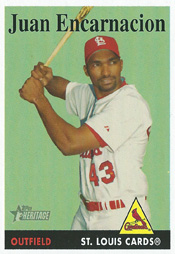
juan_encarnacionJuan Encarnacion, a player who did a lot well without much flash, filled the need.

On Dec. 23, 2005, Encarnacion, 29, agreed to a three-year, $15 million free-agent contract to become the Cardinals’ right fielder, replacing Larry Walker, who had retired.

The move launched Encarnacion into a star-crossed tenure with St. Louis. In 2006, he was a steady producer for a Cardinals club that won a World Series championship. A year later, he suffered a horrific injury that cut short his playing career.

Do less hacking

With the 2005 Marlins, Encarnacion, the right fielder in a lineup that included sluggers Miguel Cabrera and Carlos Delgado, batted .287 with 16 home runs and 76 RBI. He had an on-base percentage of .349.

Encarnacion hit .331 with runners in scoring position for the 2005 Marlins. He was most effective that season batting in the No. 6 spot, hitting .373 (28-for-75) with a .400 on-base percentage.

The Cardinals were impressed Encarnacion had produced 25 or more doubles in three consecutive seasons: 37 in 2003, 30 in 2004 and 27 in 2005.

In an interview with the St. Louis Post-Dispatch, Jocketty described Encarnacion as a player with “tremendous upside.”

“We have had Encarnacion at the top of our list among free-agent outfielders this off-season,” Jocketty told the Associated Press.

“We like his all-around makeup,” Jocketty added. “He hits for power, runs very well and plays a solid outfield.”

Noting Encarnacion struck out 104 times in 2005, Post-Dispatch columnist Bernie Miklasz wrote, “Plate discipline is the issue with Encarnacion … He just needs to work the counts, show more patience and do less hacking.”

Finding right spot

Based on what he observed during 2006 spring training, Cardinals manager Tony La Russa determined he’d place Encarnacion in the No. 2 spot in the batting order, ahead of Pujols, Edmonds and Rolen.

“He’s got extra-base pop and he’s got experience to understand the value of the (batters) behind him,” La Russa said.

Batting second on Opening Day, Encarnacion was 1-for-5 with two runs scored. It wasn’t a comfortable fit for him and La Russa soon dropped him lower in the batting order.

Encarnacion thrived for the 2006 Cardinals when batting cleanup (.327 batting average and a .362 on-base percentage) and at the No. 5 position (.322 batting mark and a .350 on-base percentage).

Encarnacion hit .310 with runners in scoring position in 2006. He was second on the 2006 Cardinals in both hits (155) and sacrifice flies (six) and was third in both RBI (79) and runs scored (74). Overall, he hit .278 with 25 doubles and 19 home runs.

Severe injury

On Aug. 31, 2007, Encarnacion, batting .283 for the Cardinals, was struck in the left eye by a foul ball off the bat of Aaron Miles while waiting in the on-deck circle to pinch-hit. His left eye socket was shattered and the optic nerve was severely damaged.

“It’s the worst trauma I’ve seen. Absolutely,” Dr. George Paletta told the Associated Press. “You hope the best for Juan, but he suffered a severe injury with a very guarded prognosis.”

Sadly, Encarnacion never appeared in another big-league game.
Read Full Post »

An undeterred underdog, Aaron Miles beat out the competition and emerged as the Opening Day starter at second base for the 2006 Cardinals.

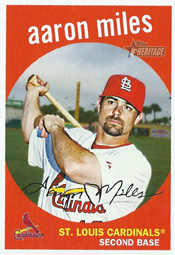
aaron_miles2On Dec. 7, 2005, the Cardinals traded disgruntled reliever Ray King to the Rockies for Miles and outfielder Larry Bigbie.
King, 9-6 with a 2.91 ERA in two seasons with St. Louis, had asked to be traded after not pitching in any of the Cardinals’ nine postseason games in 2005.

For Cardinals general manager Walt Jocketty, Bigbie was the prize in the deal.

Bigbie, 28, was seen as a leading candidate to replace the departed Reggie Sanders as the Cardinals’ starting left fielder in 2006. Also competing for the job were So Taguchi and John Rodriguez.

“Right now, I see him (Bigbie) as a starter for us,” Jocketty said after the trade. “He’s still a young player who we believe has high upside.”

Bigbie had hit a combined .239 for the Orioles and Rockies in 2005. He missed most of the second half of the season because of a strained Achilles’ tendon. The year before, he batted .280 and hit 15 home runs for the 2004 Orioles.

Good hit, no field?

Miles, 29, Deivi Cruz and Hector Luna were perceived as second-tier candidates behind front-runner Junior Spivey to replace the departed Mark Grudzielanek as the Cardinals’ starting second baseman in 2006.

“Miles is considered below average defensively but is adept at reaching base,” wrote Joe Strauss of the St. Louis Post-Dispatch.

Miles hit .281 in 99 games, including 58 starts at second base, for the 2005 Rockies.

At Cardinals spring training in 2006, Miles jammed his left hand diving into a base on March 3 and sat out for nearly two weeks. That appeared to clear the path for Spivey to win the second base job.

Spivey had played for the Brewers and Nationals in 2005, became a free agent after the season and signed with the Cardinals for a guaranteed $1.2 million. However, Spivey “struggled in all aspects of the game” during spring training, the Post-Dispatch reported. He “appeared tight defensively” and his spring training batting average at the end of March was .152.

When Miles returned to the spring training lineup, he went on a tear, with six hits in 12 at-bats. He struck out once in a stretch of 34 at-bats.

“He’s been a good player,” Cardinals manager Tony La Russa said of Miles. “He takes good at-bats. He’s caught the ball well to his left and right. He starts double plays.”

Right decision

Before the regular season began, the Cardinals released Cruz, sent Spivey to Class AAA Memphis and declared Luna the backup at second base to Miles.

Meanwhile, Bigbie suffered a stress fracture above his left heel and was placed on the disabled list. Taguchi opened the regular season as the Cardinals’ starting left fielder, with Jim Edmonds in center and Juan Encarnacion in right.

(Bigbie would play in 17 games for the 2006 Cardinals and hit .240. He became a free agent in October 2006 and signed with the Dodgers. A year later, in the Mitchell Report on steroid abuse in baseball, Bigbie admitted to using performance-enhancing drugs from 2001-05.)

The 2006 Cardinals opened the regular season on April 3 at Philadelphia against the Phillies. Miles, batting eighth, was 4-for-5 with two RBI and two runs scored. He produced two doubles, a triple and a single. Boxscore

“It feels good to make sure these guys (the Cardinals) know they made the right decision with me,” Miles said.

Said La Russa: “He’s a tough out and any eighth hitter that gives you a tough out creates a lot of possibilities in the National League game.”

On July 30, 2006, the Cardinals traded Luna to the Indians for their second baseman, Ronnie Belliard, who displaced Miles as the St. Louis starter. In 54 games, including 53 starts at second base, Belliard hit .237 for the 2006 Cardinals.

Miles batted .263 with 20 doubles in 135 games for the 2006 Cardinals. He made 71 starts at second base and 33 starts at shortstop.

The Cardinals that year won their first World Series championship since 1982, defeating the Tigers in five games. Miles was 1-for-6 with a walk and two runs scored in the 2006 World Series.

In four seasons with St. Louis (2006-08 and 2010), Miles batted .288.

Previously: Mark Grudzielanek fit a need for 2005 Cardinals

Previously: Aaron Miles keyed Cardinals’ comebacks of 2006

Previously: Ronnie Belliard re-ignited Cardinals in 2006 playoffs

Read Full Post »

After the 1955 season, the Cardinals looked to revamp their pitching staff and one of the first moves they made was to acquire the oldest pitcher in the big leagues.

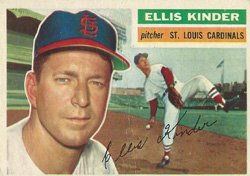
ellis_kinderOn Dec. 4, 1955, the Cardinals claimed on waivers Ellis Kinder, 41, from the Red Sox. Some saw it as desperation. To Cardinals general manager Frank Lane, it was opportunistic inspiration.
The 1955 Cardinals had finished with a 68-86 record and the worst ERA (4.56) in the National League. Their relief pitching was especially poor. Barney Schultz, who had a 7.89 ERA, was the team leader in saves, with four.

Cardinals owner Gussie Busch hired Lane, who had been successful as general manager of the White Sox, to rebuild the Cardinals. Lane’s first move was to hire Fred Hutchinson, formerly of the Tigers, as manager, replacing Harry Walker.

Lane received a call from Red Sox general manager Joe Cronin, who told him, “Francois, you pestered me plenty for Kinder when you were with the White Sox. You couldn’t have him then, but you’re in the other league now. Still want him?”

Kinder had cleared waivers in the American League, making him available to National League clubs. The Cardinals got Kinder “for a price slightly in excess of the waiver fee,” according to The Sporting News. Lane said the price was $7,500.

To Lane and Hutchinson, it was a bargain.

Control and heart

As American Leaguers, Lane and Hutchinson had seen how well Kinder pitched.

Kinder, who debuted in the big leagues as a 31-year-old rookie with the 1946 Browns, earned 23 wins as a starter for the 1949 Red Sox.

Converted to a reliever, Kinder, 39, had 27 saves, 10 wins and a 1.85 ERA in 69 appearances for the 1953 Red Sox.

In 1955, when Kinder turned 41, the right-hander still was effective, with 18 saves, five wins and a 2.84 ERA in 43 appearances for the Red Sox.

“At one time, Kinder had the greatest change-of-pace I’ve ever seen,” Hutchinson said. “He’s got control and heart _ a hell of a fine combination in a relief pitcher.”

Said Lane: “I don’t care if he’s 92 or if he does stagger in September. If he can help us early, we’re in luck.”

Kinder was stunned by the move. He had expected to end his career with the Red Sox. “There is nothing wrong with my arm and there’s no reason why I can’t help the Cardinals next year,” Kinder said.

Red Sox trainer Jack Fadden said Kinder’s arm was sound and called him “the most courageous man I have ever seen on the pitching mound _ absolutely fearless,” The Sporting News reported.

Use it or lose it

At spring training with the 1956 Cardinals, Kinder pitched effectively. “I throw every day,” Kinder said. “Pitchers should throw more, not less. I figure your arm is like your leg. The more you use it, the better shape it will be in.”

When Kinder made the Opening Day roster, he became the oldest Cardinals pitcher since Jesse Haines, 44, in 1937.

Hutchinson immediately showed his faith in Kinder.

On April 17, in their 1956 season opener against the Reds at Cincinnati, the Cardinals scored twice in the top of the ninth to break a 2-2 tie and take a 4-2 lead. In the bottom of the ninth, starter Vinegar Bend Mizell got George Crowe to ground out before Johnny Temple walked and Smoky Burgess singled. Ted Kluszewski flied out to center for the second out.

The next batter, right-handed Wally Post, slugged 40 home runs in 1955. Hutchinson lifted Mizell, a left-hander, and brought in Kinder to face Post.

Kinder threw three pitches _ each called a strike by umpire Babe Pinelli _ and Post struck out, ending the game and earning Kinder a save in his Cardinals debut. Boxscore

Earning his keep

On April 24, 1956, Kinder earned another save for Mizell and the Cardinals against the Reds. With two on and none out in the ninth, Kinder struck out Crowe on three pitches and got Temple to hit into a double play, giving St. Louis a 5-3 triumph. Boxscore

Six days later, Kinder earned his third save in four appearances when, with a runner on first and one out in the ninth, he retired Hank Aaron and Bobby Thomson to preserve a 2-0 Cardinals victory over the Braves. Boxscore.

“As far as I’m concerned, the old fellow has earned his salary already,” Hutchinson told writer Bob Broeg.

Said Mizell of Kinder: “If anything happens to him, I’m going to pack my bags and go home.”

Return to AL

In 12 appearances through June 6, Kinder was 2-0 with six saves and a 1.10 ERA. In his next 10 appearances through July 7, he had no saves and allowed nine runs. The Cardinals placed him on waivers and Kinder was claimed by the White Sox on July 11.

Kinder’s totals for the 1956 Cardinals: 2-0, six saves, 3.51 ERA in 22 games.

Kinder, who turned 42 two weeks after joining the White Sox, made a triumphant return to the American League. In 29 games for the 1956 White Sox, Kinder was 3-1 with three saves and a 2.73 ERA.

The next season, Kinder appeared in one game for the White Sox and was released in May 1957, bringing to an end his big-league pitching career.

Previously: Arthur Rhodes: 1 of 5 Cardinals age 40 in a World Series

Read Full Post »

Playing for a new manager, Vern Rapp, and with a core of young, highly regarded players, such as Keith Hernandez, Garry Templeton and John Denny, the Cardinals enjoyed a successful opening to the 1977 season.

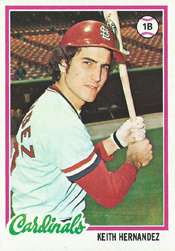
keith_hernandez5On April 7, 1977, amid strong winds and a mix of rain and light snow, the Cardinals beat the Pirates, 12-6, at Three Rivers Stadium in Pittsburgh.
New approach

The 1977 Cardinals opened the season as a franchise looking to rebuild.

In 1976, the Cardinals finished 72-90. Red Schoendienst, who had managed the Cardinals since 1965, was fired after that 1976 debacle. He was replaced by Rapp, a St. Louis native who had played and managed in the Cardinals’ system but who never had reached the major leagues.

A disciplinarian, Rapp instructed Cardinals players during 1977 spring training to shave off their moustaches and beards and keep their hair trim.

In the opener at Pittsburgh, the Cardinals started Denny, 24, against Jerry Reuss, a St. Louis native who began his career with his hometown team.

Along with established standouts such as left fielder Lou Brock and catcher Ted Simmons, the Cardinals’ lineup included Hernandez, 23, at first base and Garry Templeton, 21, at shortstop.

Denny and Templeton were making their first Opening Day starts in the big leagues.

Helped by three Pirates errors, the Cardinals scored four runs in the opening inning off Reuss. The Pirates’ sloppy start prompted “lusty boos from many of the 35,186 spectators,” the Associated Press reported.

The Cardinals never trailed. Denny held the Pirates to three runs in 5.2 innings and got the win. Templeton had two hits and scored three runs.

Hernandez, a left-handed batter, scored twice and had key hits against a pair of left-handed relievers. Hernandez hit a two-run double off Grant Jackson and a two-run home run (estimated at 425 feet) against Terry Forster. For Hernandez, it was his first four-RBI game in the big leagues.

Playing to win

“The thing about Vern Rapp is that he has us playing aggressive baseball, taking the extra base, playing at our maximum,” Hernandez said after the game. “We don’t have a lot of power, but we do have good hitting and exceptional speed and I think we’re going to make the most of it.”

Asked about playing without his signature moustache, Hernandez replied, “I’m here to play baseball. That’s what is important to me. I’ve got five months in the off-season to grow a moustache and long hair, but right now I want to help the Cardinals play winning baseball.” Boxscore

Behind stellars seasons by Hernandez (.291 batting average, 41 doubles, 91 RBI), Templeton (.322 batting average, 200 hits, 18 triples, 28 stolen bases), Simmons (.318 batting average, 21 home runs, 95 RBI) and pitcher Bob Forsch (20 wins), the 1977 Cardinals improved to 83-79.

Hernandez’s effective hitting against left-handers continued through the season. He batted .313 in 201 at-bats versus left-handers in 1977.

Previously: Cardinals debut was dream come true for Keith Hernandez

Previously: Pete Vuckovich was fearless in great escape for Cardinals

Read Full Post »

(Updated April 29, 2018)

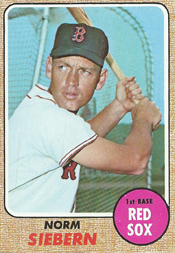
Like Yogi Berra, Hank Bauer, Elston Howard and Whitey Herzog, Norm Siebern was a St. Louis-area athlete who was bypassed by the Cardinals and began his professional baseball career in the Yankees organization. Toward the end of his big-league career, Siebern faced the Cardinals in the World Series and got three at-bats _  all against Bob Gibson.

norm_siebernBorn in St. Louis and raised in the nearby town of Wellston, Mo., Siebern was an outfielder and first baseman for 12 years in the big leagues with the Yankees, Athletics, Orioles, Angels, Giants and Red Sox. He three times was named to the American League all-star team: 1962 and 1963 with the Athletics and 1964 with the Orioles.
Siebern was a basketball and baseball standout at Wellston High School in St. Louis County. He caught the attention of Yankees scout Lou Maguolo, who signed Siebern after he graduated from high school in 1951. During the baseball off-seasons, Siebern pursued a journalism degree from Missouri State (then known as Southwest Missouri) in Springfield. While there, he played on the 1952 and 1953 basketball teams that won NAIA (National Association of Intercollegiate Athletics) championships.

In 1957, Siebern had a breakout season with the Yankees’ Class AAA affiliate at Denver. He batted .349 with 45 doubles, 15 triples, 24 home runs, 118 RBI and 97 walks.

Boston bound

Ten years later, Siebern, 34, primarily was a pinch-hitter and role player. He began the 1967 season with the Giants and was dealt to the Red Sox in July.

The Red Sox were seeking a left-handed pinch-hitter and manager Dick Williams recommended they pursue Siebern. Williams, a St. Louis native, and Siebern were teammates with the 1960 Athletics.

Siebern hit .205 in 33 games for the 1967 Red Sox, but Williams kept him on the World Series roster.

Siebern vs. Gibson

In Game 1 at Boston, with Bob Gibson protecting a 2-1 Cardinals lead in the seventh inning, Reggie Smith was on first base with two outs when Williams sent Siebern to bat for catcher Russ Gibson. As Bob Gibson delivered a pitch, Smith attempted to swipe second and was thrown out on Tim McCarver’s peg to shortstop Dal Maxvill, ending the inning.

“He went on his own,” Williams said to The Sporting News. “I didn’t want him to go at that time.”

Because Siebern was at-bat, Williams was faced with either lifting him and wasting a plate appearance, or keeping him in the game. Williams opted for the latter, sending Siebern to play right field in place of Ken Harrelson.

Siebern led off the eighth with a single, moved to second on a bunt by Elston Howard and was stranded there. Gibson completed a six-hitter and got the win in a 2-1 Cardinals victory. Boxscore

In Game 4 at St. Louis, Siebern, batting for pitcher Dave Morehead, led off the eighth and flied out to center. The Cardinals won, 6-0, behind Gibson’s five-hit shutout. Boxscore

Final showdown

The decisive Game 7 in Boston was a matchup of aces: Gibson for the Cardinals and Jim Lonborg for the Red Sox.

Gibson again dominated.

In the eighth, the Red Sox, who trailed, 7-1, mounted their final threat. Rico Petrocelli doubled and advanced to third on Gibson’s wild pitch. Dalton Jones followed with a walk, putting runners on first and third with none out and “stirring the Boston crowd into shouts of encouragement,” The Sporting News reported.

Williams sent Siebern to bat for pitcher Jose Santiago.

In his book “From Ghetto to Glory,” Gibson said, “I was struggling. I decided to junk the fastball and go with the slider.”

Siebern, fooled by the slider, hit a groundball to Julian Javier at second. Javier tossed to Maxvill, retiring Jones at second on the force play, and Petrocelli scored from third. Siebern got a RBI, but Gibson, emboldened by the success of the slider, used it to retire the next two batters and defuse the threat.

Gibson completed a three-hitter in a 7-2 Cardinals victory, earning his third win of the World Series and carrying St. Louis to its second championship in four years. Boxscore

Siebern had this consolation: a World Series batting average of .333 (with a RBI) against the great Gibson.

The World Series duels versus Gibson were a last hurrah for Siebern. In 1968, his final big-league season, Siebern batted .067 in 27 games for the Red Sox before he was released in August.

Previously: Dick Williams couldn’t intimidate 1967 Cardinals

Previously: George Scott: Bob Gibson ‘won’t survive 5’ in Game 7

Previously: Do Cardinals still win if Dick Groat gets dealt for Roger Maris?

Read Full Post »

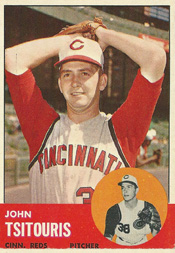
In September 1963, Reds pitcher John Tsitouris helped end the National League pennant chances of the Cardinals. A year later, Tsitouris helped the Cardinals become champions.

john_tsitourisTsitouris pitched 11 seasons with the Tigers, Athletics and Reds. His major-league career record was 34-38 with a 4.13 ERA, but against the Cardinals he was 8-4 with a 2.36 ERA.
The right-hander yielded 71 hits in 91.1 career innings against the Cardinals and had six complete games. Tsitouris had more wins versus the Cardinals than he had against any other club in his career.

September shutouts

A son of a Greek immigrant father, Tsitouris was acquired by the Reds in a January 1961 trade that sent pitcher Joe Nuxhall to the Athletics.

In 1963, Tsitouris had his best big-league season, posting a 12-8 record that included a pair of September shutouts against the Cardinals.

The 1963 Cardinals had moved within a game of the first-place Dodgers entering a three-game series against them Sept. 16-18 at St. Louis. The Dodgers swept, moving four ahead of the Cardinals.

In desperate need of a win to keep alive their pennant hopes, the Cardinals opened a series against the Reds at Cincinnati on Sept. 20. Tsitouris started for the Reds against Ray Sadecki and shut out the Cardinals, holding them to three singles in a 1-0 victory. Boxscore

The Cardinals’ loss, paired with a Dodgers victory that night over the Pirates, dropped St. Louis five games out of first with six to play. The Dodgers clinched the pennant on Sept. 24

Three days later, on Sept. 27, Tsitouris, matched again against Sadecki, pitched a two-hit shutout against the Cardinals at St. Louis. The Reds broke a scoreless tie with three runs in the top of the ninth. In the bottom of the inning, Dick Groat singled and Bill White walked with two outs before Tsitouris retired Ken Boyer on a groundout, sealing the Reds’ 3-0 victory. Boxscore

“John Tsitouris has become even harder for the St. Louis Cardinals to hit than his name is to spell,” the Associated Press reported.

Fateful Phillies

In 1964, Tsitouris continued to dominate the Cardinals. He was 3-1 with a 1.98 ERA against St. Louis in five starts, including a win on July 3 when he struck out 10. Boxscore

His success against the Cardinals might have kept them from winning the 1964 pennant if not for two September performances _ a win and a loss _ by Tsitouris versus the Phillies.

After play on Sept. 20, 1964, the Phillies were in first place, holding a 6.5-game lead over the second-place Cardinals and Reds with 12 to play.

The next night, Sept. 21, the Reds opened a series against the Phillies at Philadelphia and Tsitouris was matched against Art Mahaffey. In the sixth inning, with the game scoreless, Chico Ruiz was on third base, two outs and Frank Robinson at the plate for the Reds. On an 0-and-1 count, Ruiz streaked down the third-base line as Mahaffey delivered a pitch. The throw was wide and wild, skipping past catcher Clay Dalrymple, and Ruiz stole home. Tsitouris did the rest, shutting out the Phillies on a six-hitter in a 1-0 Reds victory. Boxscore

“He surprised me,” Reds manager Dick Sisler said to The Sporting News of Ruiz’s daring dash. “I would never have called for the move.”

Said Ruiz: “I was hoping I’d be safe because I didn’t want to hear what the manager would say if I was out.”

The play did more than provide a win for the Reds. It triggered a momentum change that sent the Phillies reeling. The Phillies lost 10 in a row, allowing the Cardinals and Reds to surpass them.

On the morning of Oct. 4, the final day of the regular season, the Cardinals and Reds were tied for first, a game ahead of the Phillies. The Cardinals closed with the Mets at St. Louis and the Reds were at home against the Phillies.

The Phillies started their ace, Jim Bunning. The Reds chose Tsitouris. Jim Maloney was the Reds’ ace, but he had pitched 11 innings on Sept. 30 and Sisler thought starting him on three days rest was too risky.

The Phillies broke a scoreless tie with three runs in the third off Tsitouris, who was lifted after 2.1 innings, and cruised to a 10-0 victory. Boxscore

When the Cardinals beat the Mets, 11-5, St. Louis was the NL champion for the first time in 18 seasons. Boxscore

“I can’t agree with anyone who says I should have pitched Maloney,” Sisler said. “Percentages favored Tsitouris in this game.”

Previously: 20th win for Ray Sadecki put 1964 Cardinals into 1st place

Read Full Post »

« Newer Posts - Older Posts »