Feeds:
Posts
Comments

Archive for the ‘Games’ Category

(Updated June 29, 2020)

Taking advantage of an unmotivated, jet-lagged team, Fernando Valenzuela pitched a no-hitter against the Cardinals. It was the second no-hitter pitched in the major leagues that night and the first versus the Cardinals in 12 years.

fernando_valenzuelaOn June 29, 1990, at Los Angeles, Valenzuela pitched the only no-hitter of his career in a 6-0 Dodgers victory over the Cardinals.

Earlier that night, Dave Stewart, Valenzuela’s former Dodgers teammate, pitched a no-hitter for manager Tony La Russa’s Athletics against the Blue Jays. It was the first time no-hitters had been pitched in both the American League and National League on the same day.

Valenzuela, 29, struck out seven and walked three. The Cardinals also had a runner reach on an error.

The left-hander pitched the first no-hitter against the Cardinals since Tom Seaver of the Reds on June 16, 1978.

Control, confidence

After beating the Pirates in a night game at St. Louis on June 28, the Cardinals stayed overnight at home and left the morning of June 29 for that night’s game against the Dodgers. The Cardinals arrived in Los Angeles about 12:30 in the afternoon Pacific Coast time.

The Dodgers watched on the clubhouse TV as Stewart completed his no-hitter at Toronto. Boxscore

Valenzuela turned to his teammates and said, “You’ve seen one on TV. Now come watch one live,” Rick Hummel of the St. Louis Post-Dispatch reported.

Valenzuela’s previous big-league best had been a two-hitter.

From the first pitch, Valenzuela was in command. “Throughout the game, I had excellent control,” he told the Orange County Register. “I had a lot of confidence.”

Timely tip

In the ninth, Vince Coleman led off for the Cardinals. The speedster was carrying a 10-game hitting streak and was the batter Valenzuela feared most in the St. Louis lineup. “Coleman makes a lot of contact and he can bunt,” Valenzuela said.

On a 2-and-1 pitch, Coleman hit a shot down the third-base line, but it was foul. With the count at 2-and-2, Coleman showed bunt, took a pitch outside and was called out on strikes by umpire Jerry Layne.

Referring to Layne’s strike zone, Cardinals manager Whitey Herzog told the Los Angeles Times, “I don’t want to take anything away from Fernando, but he had the right guy behind the plate.”

Willie McGee was up next and he walked on four pitches.

That brought to the plate Pedro Guerrero, who had been Valenzuela’s Dodgers teammate from 1980-88. Guerrero was playing on his 34th birthday.

“When Willie got on,” Guerrero told Hummel, “I said, ‘I’m going to be the one that’s going to do it.’ ”

With the count 0-and-2, Guerrero hit a grounder up the middle. As Valenzuela reached for the ball, it tipped his glove and was deflected to second baseman Juan Samuel, who stepped on second for the force on McGee and threw to first for the game-ending double play.

Jubilant Dodgers broadcaster Vin Scully told listeners, “If you have a sombrero, throw it to the sky.” Video of ninth inning

“Do you think if I don’t touch that ball, it goes through for a single? I think it does,” said Valenzuela. “I think if I don’t touch it, I’m in trouble.”

Said Guerrero: “I hit it pretty good. If he doesn’t get a glove on it, I think it’s through there.” Boxscore

Cardinals crusher

The loss was the fifth in six games for the Cardinals (30-44).

“We’re pathetic,” said Herzog.

Said Guerrero: “We didn’t look too good out there, but I think flying on game day had something to do with it.”

Stewart called the Dodgers clubhouse after the game to congratulate Valenzuela.

The no-hitter evened Valenzuela’s season record at 6-6 and lowered his ERA from 4.09 to 3.73.

Valenzuela was the fourth Dodgers pitcher to achieve a no-hitter since 1958 when the franchise moved from Brooklyn to Los Angeles. The others were Sandy Koufax, Bill Singer and Jerry Reuss.


Read Full Post »

(Updated June 27, 2020)

In his final career win as a starter, Bob Gibson achieved a milestone.

bob_gibson19On June 27, 1975, Gibson earned his 250th career win, pitching six innings in a 6-4 Cardinals victory over the Expos in Game 1 of a doubleheader at Montreal.

Gibson became the first and only Cardinals pitcher to achieve 250 wins. No one else has come close. The pitcher with the next-best career wins total as a Cardinal is Jesse Haines (210).

The win also was the first for Gibson since May 5, 1975.

“Number 250 doesn’t mean any more than 249,” Gibson said to the Associated Press. “It feels good to be able to win a game and help the ball club. I want to be part of a winning ball club. I haven’t lost that.”

Gibson told the St. Louis Post-Dispatch, “I’m not out there for anything more than pride.”

Breaking stuff

Gibson, 39, shut out the Expos through six innings.

“I was getting my breaking ball over,” Gibson said. “If you don’t have the breaking stuff. you just have the fastball. It’s tough to pitch with just the fastball.”

Gibson also contributed a RBI-single in the fifth off Expos starter Steve Rogers and scored on a Ted Sizemore two-run double.

“If his arm isn’t that good any more, he still has the heart,” Expos manager Gene Mauch said to the Montreal Gazette. “It looks like the heart is as big as ever.”

In the seventh, with the Cardinals ahead, 4-0, the first two Expos batters reached base and Gibson was lifted by manager Red Schoendienst. Ron Bryant relieved and yielded a RBI-double to Barry Foote. Rookie Greg Terlecky replaced Bryant and gave up a two-run single to Bob Bailey. Two of the runs were charged to Gibson.

Gibson’s line for the game: 6 innings, 5 hits, 2 runs, 6 walks, 1 strikeout. Boxscore

“His hard slider may not be able to chip the corner off a brick any more and his right arm feels like a toothache when he has finished pitching a game,” the Post-Dispatch observed.

Said Gibson: “I ache every time I take a step.”

One more win

Gibson made two more starts, the last of his career, against the Phillies and Giants, and lost both, dropping his season record to 2-8.

His 251st and final win of his career came in relief on July 27, 1975, against the Phillies at St. Louis.

Relieving rookie starter John Denny in the fourth, Gibson pitched four shutout innings in a 9-6 Cardinals triumph. Gibson struck out Larry Bowa and Mike Schmidt to end the sixth and struck out Greg Luzinski to start the seventh.

Gibson’s line for the game: 4 innings, 3 hits, 0 runs, 1 walk, 4 strikeouts. Boxscore

It was Gibson’s first win in relief since beating the Mets on the final day of the 1964 season, clinching the National League pennant for St. Louis.

Gibson made six more relief stints for the 1975 Cardinals and lost two, finishing his final season at 3-10 with a 5.04 ERA.

In 17 seasons (1959-75) with St. Louis, Gibson was 251-174 with a 2.91 ERA. Among his accomplishments: two NL Cy Young awards, two World Series Most Valuable Player awards, a NL MVP Award and nine Gold Glove awards. He was elected to the National Baseball Hall of Fame in 1981.

Previously: How Ron Reed replaced Bob Gibson in Cardinals rotation


Read Full Post »

(Updated July 23, 2022)

Joe Medwick was a special hitter for the Cardinals. He also was expensive and high maintenance. When his popularity waned, the Cardinals decided the value Medwick could bring them in a trade was greater than what he could produce for them in the lineup.

joe_medwick3On June 12, 1940, the Cardinals traded Medwick and pitcher Curt Davis to the Dodgers for $125,000 and four undistinguished players, or, as one writer described them, “a few ham sandwiches.”

Cardinals owner Sam Breadon and his top baseball executive, Branch Rickey, got exactly what they wanted. With attendance sagging and the Cardinals out of contention, Breadon and Rickey were seeking cash.

Rickey had a personal incentive to trade players for cash because his contract called for him to get a percentage of the sale as remuneration in addition to his salary.

As The Sporting News noted, the Cardinals traded Medwick “while he had high market value.”

Medwick, a hitter of Hall of Fame skills, had sulked about being lifted in the late innings for a defensive replacement. When he fell into a hitting funk, Cardinals fans taunted him from the Sportsman’s Park bleachers. Witnessing this, Breadon realized there wouldn’t be a public relations backlash if he traded the club’s standout hitter, and instructed Rickey to pursue a deal.

Breadon told the St. Louis Star-Times, “Medwick was through with the Cardinals. The fans had sent me that message.”

“The tide had turned,” wrote columnist Dan Daniel. “The fans would not shout against the departure of (Medwick).”

Remarkable hitter

A right-handed batter who swung at pitches outside the strike zone with savage aggressiveness, Medwick debuted with the Cardinals in September 1932 and became their starting left fielder in 1933.

Among his many remarkable hitting feats with the Cardinals, Medwick:

_ Achieved the Triple Crown in 1937, leading the National League in batting average (.374), home runs (31) and RBI (154). Medwick is the last NL player to accomplish the feat.

_ Won the NL Most Valuable Player Award in 1937. He also led the NL that season in runs (111), hits (237), doubles (56), slugging percentage (.641) and total bases (406).

_ Led the NL in hits in 1936 (223).

_ Led the NL in doubles in 1936 (64) and 1938 (47).

_ Led the NL in RBI in 1936 (138) and 1938 (122).

_ Hit .379 (11-for-29) with five RBI in the 1934 World Series vs. the Tigers.

Medwick remains the Cardinals’ all-time single-season leader in doubles (64) and RBI (154).

Interest from Dodgers

Dodgers president Larry MacPhail offered the Cardinals $200,000 for Medwick in 1939, The Sporting News reported, but the Cardinals were in contention and rejected the offer.

In 1940, the Cardinals started poorly, losing 20 of their first 32 games. On June 3, Medwick was hitting .297 _ good for most but subpar for him.

“I believe Joe is slowing up and will not be the star he was,” Breadon said to the St. Louis Star-Times. “He also proved conclusively to me he did not care to hustle for the Cards this year.”

Medwick felt disrespected by Breadon and Rickey. After his Triple Crown and MVP season in 1937, the Cardinals rewarded Medwick with a salary of $20,000 in 1938. When he followed his .374 batting average of 1937 with a .322 mark in 1938, the Cardinals cut his pay to $18,000 in 1939. After hitting .332 in 1939, Medwick demanded a $20,000 salary in 1940, but the Cardinals gave him $18,000.

“They ruined my incentive,” Medwick told the Brooklyn Daily Eagle.

Recalling MacPhail’s interest in Medwick, Rickey contacted the Dodgers in June 1940. “Rickey telephoned and said that the Cardinals were in the mood to do some trading,” MacPhail told The Sporting News.

The ensuing conversation:

MacPhail: “Who will you trade?”

Rickey: “Anybody.”

MacPhail: “Does that go for Medwick, too?”

Rickey: “Yes.”

MacPhail took a flight to St. Louis and closed the deal.

Said MacPhail: “Frankly, the Medwick deal surprised me more than anyone else. If you’d have told me a week before that we’d come up with Medwick, I’d have said you were crazy. A month ago, I put out a feeler for him and was told there wasn’t a chance.”

Finances a factor

In exchange for Medwick and Davis (who had 22 wins for the 1939 Cardinals), the Dodgers sent the cash, plus pitchers Carl Doyle and Sam Nahem, outfielder Ernie Koy and third baseman Bert Haas. The Cardinals assigned Nahem and Haas to the minor leagues.

“St. Louis believes the passing of Medwick and the development of a better feeling on the club, minus Joe and his $18,000 salary, will lift the (Cardinals),” Daniel wrote.

Said Breadon: “The Cardinals were going no place with Medwick and Davis on the job _ and they certainly couldn’t be any worse without them.”

The reduction in salaries paired with the infusion of cash helped the Cardinals overcome a drop in attendance. After drawing 400,245 paid customers in 1939, the Cardinals had a total home attendance of 324,078 in 1940. According to columnist Dick Farrington, Breadon was facing “the specter of a financial loss on the season.”

Hit by pitch

In joining the Dodgers, Medwick was reunited with his pal, manager Leo Durocher. They had been Cardinals teammates from 1933-37, and played golf together in the off-season. Medwick called Durocher “the greatest guy in the world,” the New York Daily News reported.

A New Jersey native, Medwick said, “Ever since I was a kid, I wanted to play in Brooklyn.” Regarding hitting in Ebbets Field, Medwick told the Brooklyn Daily Eagle, “That right field wall is going to be duck soup for me.”

On the day of the trade, the Dodgers and Reds were tied atop the National League standings. “No ballplayer is sorry to join a first-place club,” Medwick said to the St. Louis Post-Dispatch.

On June 18, in his sixth game for the Dodgers, Medwick faced the Cardinals at Brooklyn. In the first inning, a fastball from Bob Bowman struck Medwick behind the left ear, knocking him unconscious. As Medwick was carried on a stretcher to the clubhouse, MacPhail “stormed over to the Cardinals dugout and challenged the players, individually and collectively,” The Sporting News reported.

All of the Cardinals stood but none made a move. “Take it easy,” Cardinals outfielder Pepper Martin said to MacPhail.

Medwick was taken to a hospital and diagnosed with a concussion.

Bowman said he didn’t intend to hit him. “Medwick was looking for a curveball, expecting the ball to break,” Bowman said.

According to author Robert Creamer, Dodgers coach Chuck Dressen was stealing signs and would whistle when he thought a curve was coming. Bowman said he and catcher Don Padgett decided to try to fool Medwick. When Padgett called for a curve, Dressen whistled but Bowman threw a high inside fastball. Leaning in for the curve, Medwick couldn’t get out of the way.

After the game, Bowman was being escorted from the ballpark by two detectives when MacPhail approached and “sent a wild swing at him,” according to The Sporting News.

The Cardinals visited Medwick in the hospital. Manager Billy Southworth, the only member of the contingent admitted to the room, expressed regret for the injury. Medwick absolved the Cardinals, calling the incident “just one of those things.” Boxscore

Medwick was released from the hospital on June 21. He hit .300 in 106 games for the 1940 Dodgers. In 1941, he helped them win the pennant, hitting .318 with 18 home runs and 88 RBI.

Medwick returned to the Cardinals in 1947 and finished his playing career with them in 1948. He was elected to the National Baseball Hall of Fame in 1968.


Read Full Post »

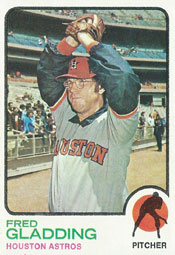
With one swing, Tim McCarver lifted the Cardinals to a victory and propelled Fred Gladding toward a long, productive coaching career.

fred_gladdingOn June 2, 1973, at St. Louis, McCarver hit a pinch-hit grand slam against Gladding in the eighth inning for a 6-2 win over the Astros.

It would be the last major-league appearance for Gladding. He was sent to the minors soon after and served that summer as a player-coach at Class AAA Denver. That experience launched him the following season into a 22-year career as a coach in the Tigers, Astros and Indians organizations, including three seasons as Detroit’s pitching coach.

Fading veterans

In June 1973, McCarver, 31, and Gladding, 36, were relegated to support roles after ranking among the best at their positions. McCarver was the starting catcher on Cardinals clubs that won three National League pennants and two World Series championships in the 1960s. He twice was an all-star with St. Louis (1966-67).

After he was traded to the Phillies in October 1969, McCarver was reacquired by the Cardinals from the Expos in November 1972 and given roles as backup to Ted Simmons at catcher and Joe Torre at first base.

Gladding had been a stellar reliever. He was 6-4 with 12 saves and a 1.99 ERA in 42 games for the 1967 Tigers. In November 1967, the right-hander was dealt to the Astros, completing a trade for third baseman Eddie Mathews.

In 1969, Gladding had a NL-leading 29 saves for Houston. He followed that with 18 saves for the 1970 Astros.

McCarver magic

On June 2, 1973, a Saturday night in St. Louis, the Astros led, 2-1, when the Cardinals batted in the bottom of the eighth against reliever Jim York. With two outs, Simmons doubled, scoring Dwain Anderson from first, tying the score at 2-2.

The next batter, Jose Cruz, was walked intentionally, putting runners at first and second and setting up a potential forceout. Luis Melendez followed with an infield single, loading the bases.

With Ken Reitz due to bat next, Astros manager Leo Durocher lifted York and replaced him with Gladding. Cardinals manager Red Schoendienst countered by calling on McCarver to bat for Reitz.

Gladding had a 4.11 ERA. McCarver, a left-handed batter, had no home runs.

McCarver swung at the first pitch from Gladding and hit it over the right-field wall for his fifth grand slam of his career.

“I said when we got him back last winter we could use his bat _ and I meant it,” Schoendienst told the Associated Press. “Tim is a tough out. I don’t care who is pitching.”

Rick Wise, the Cardinals’ starter, retired the Astros in the ninth, securing the win. Boxscore

New chapter

Deemed ineffective, Gladding was sent to the minor leagues for the first time since 1964. He went 0-2 with a 4.74 ERA and one save in 20 appearances for the Astros’ Class AAA Denver farm team. The Astros released him in October 1973.

Then, his full-time coaching career began.

The Tigers named Gladding the pitching coach for their 1974 Evansville farm club. Among the pitchers Gladding worked with were future major-leaguers Vern Ruhle and Steve Grilli.

In 1975, Gladding was again at Evansville when he got the chance to mentor a phenom, Mark Fidrych.

Fidrych had started the 1975 season with Class A Lakeland and skyrocketed through the Tigers system, going to Class AA Montgomery and then Class AAA Evansville. With Gladding as his pitching coach, Fidrych, 20, was 4-1 with a 1.58 ERA in six starts for Evansville.

Back in the bigs

In 1976, Gladding returned to the major leagues as pitching coach for Tigers manager Ralph Houk. Fidrych earned a spot in the Tigers’ starting rotation. The combination produced sensational results.

Nicknamed “The Bird,” Fidrych was 19-9 for the 1976 Tigers. He led the American League in ERA (2.34) and complete games (24), started the All-Star Game and was named winner of the Rookie of the Year Award.

In the book “The Bird: The Life and Legacy of Mark Fidrych,” Gladding said of his star pupil, “He was very easy to coach. He would listen to you and do what you suggested.”

Gladding remained Tigers pitching coach in 1977 and 1978, mentoring, among others, Jack Morris, who developed into Detroit’s ace. After the 1978 season, Houk retired and his successor, Les Moss, replaced Gladding with former Cardinals pitcher Johnny Grodzicki.

Gladding spent the remainder of his coaching career in the minor-league systems of the Astros and Indians.

In an interview with MLB.com, Steve Kline, the former Cardinals reliever, cited Gladding as a positive influence while Kline was in the Indians organization.


Read Full Post »

(Updated May 31, 2020)

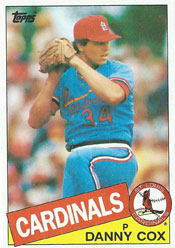
No Cardinals pitcher has achieved perfection, but Danny Cox came close.

danny_cox2On May 31, 1985, Cox retired the Reds in order through 7.2 innings at St. Louis.

Cox was fully aware of the drama his performance was creating. Asked about the ovation he received when batting in the seventh, Cox said, “I knew it wasn’t for my hitting.”

In the eighth, Cox retired the first two batters, Alan Knicely and Gary Redus, giving him 23 consecutive outs and putting him within four outs of the perfect game.

All about location

The next batter was Dave Concepcion. At 36, the shortstop was in his 16th season with the Reds and his last as an everyday player.

According to the St. Louis Post-Dispatch, when Concepcion got to the plate, he said to umpire Jerry Crawford and catcher Darrell Porter, “It’s all over,” referring to Cox’s bid for a perfect game.

Crawford laughed and Concepcion said, “Do you want to bet?”

Crawford declined and Porter said, “I can’t bet against you. You’re a dandy player.”

From the dugout, Reds outfielder Dave Parker yelled to Concepcion, “Break his heart, Davey, break his heart,” the Dayton Daily News reported.

The first pitch from Cox to Concepcion was a strike. The second was grounded into left field for a single.

“It was a fastball,” Cox told the Associated Press. “I tried to get it inside, but I left it out over the plate.”

Said Concepcion: “He was pitching me up and in. He got (the pitch) down a little.”

Ron Oester followed with a single, moving Concepcion to second. Protecting a 5-0 lead, Cox got Wayne Krenchicki to ground out to first, ending the inning.

Praise from Pete

In the ninth, Cox set down the Reds in order. Player-manager Pete Rose flied out to left, ending the game. Rose, who four months later would become baseball’s career hits leader, grounded out in each of his previous three at-bats.

“He changes speeds well and he throws a lot of strikes,” Rose said.

Cox used an effective combination of fastballs and changeups. “He throws his fastball so hard, he can freeze you with his changeup,” Cardinals first baseman Jack Clark told The Sporting News.

Parker said, “He’s got an exceptional changeup. His whole game revolved around the changeup.”

The line for Cox: 9 innings, 2 hits, 0 runs, 0 walks, 3 strikeouts, 96 pitches, 29 batters faced. The loss went to Reds starter John Stuper, the former Cardinal. Boxscore

Rare feat

Cox was trying to become the first National League pitcher to toss a perfect game since the Dodgers’ Sandy Koufax did it versus the Cubs on Sept. 9, 1965.

A perfect game is defined as one in which a pitcher earns a win, pitches a minimum of nine innings and no opposing player reaches base by any means. Games less than nine innings don’t qualify as perfect games. Nor do games in which an opposing player reaches base only in extra innings.

The Cardinals never have been involved in an official perfect game. They were involved in two unofficial ones.

On Aug. 11, 1907, in the second game of a doubleheader versus the Braves, Cardinals starter Ed Karger retired all 21 batters he faced. The game was called by mutual agreement after seven innings, with the Cardinals winning, 4-0. In those days, teams were allowed to shorten the second game of a doubleheader if both sides agreed.

Seventy-seven years later, on April 21, 1984, in the second game of a doubleheader versus the Cardinals, Expos starter David Palmer retired all 15 batters he faced. The game was called because of rain after five innings, with the Expos winning, 4-0.

Previously: Danny Cox vs. Mike Aldrete: Duel of 1987 Cardinals, Giants

Read Full Post »

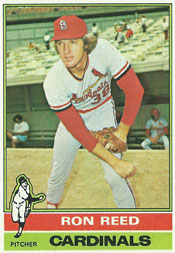
Convinced Bob Gibson no longer should be a starter, the Cardinals acquired Ron Reed from the Braves and put him in the rotation as the replacement for their long-time ace.

ron_reedOn May 28, 1975, the Cardinals traded relievers Ray Sadecki and Elias Sosa to the Braves for Reed and a player to be named. Five days later, the Braves sent Wayne Nordhagen, a minor-league outfielder, to the Cardinals, completing the deal.

At the time of the trade, the Cardinals’ rotation consisted of Gibson, Bob Forsch, Lynn McGlothen and John Curtis. With the May acquisitions of Reed from the Braves and Ron Bryant from the Giants, the Cardinals planned to move Gibson to the bullpen and go with a revamped rotation of Forsch, McGlothen, Reed, Curtis and Bryant.

Embarrassment to Bob

Gibson, 39, was upset with the decision.

“I think they’re making a mistake,” Gibson said to The Sporting News. “I still think I can throw better than 50 percent of the pitchers in the league. I think I’ve still got good stuff, not just competitive fire.”

Said Cardinals manager Red Schoendienst: “It was a tough decision to make. He’s still a good pitcher, but he’s not pitching as great as he has in the past.”

Gibson was a five-time 20-game winner and eight-time all-star with the Cardinals. He twice was named winner of the World Series Most Valuable Player Award and twice was named winner of the National League Cy Young Award.

In 1975, though, his record was 1-5 with a 4.80 ERA when he was dropped from the rotation on June 1. He yielded 71 hits in 65.2 innings and had more walks (33) than strikeouts (32).

Gibson was hampered by damaged knees. He also admitted he was reeling from a divorce.

In his 1994 book “Stranger to the Game,” Gibson said, “I didn’t conceal my anger at being sent to the bullpen, but I suspect now that some of it actually stemmed from my frustrations at home. There was a lot of pressure in suddenly being the primary parent for two teenage girls and a degree of devastation over the shattering of a family life that had been nearly 20 years in the making.”

Said Cardinals outfielder Reggie Smith: “When his body didn’t respond and then the club put him in the bullpen, it was an embarrassment to Bob.”

Two-sport standout

Reed, 32, was a good acquisition for the Cardinals. Bryant, 28, wasn’t.

Like Gibson, Reed was an outstanding basketball player. Gibson played basketball in college for Creighton and as a professional for the Harlem Globetrotters. Reed played basketball in college for Notre Dame and as a professional for the NBA’s Detroit Pistons.

A basketball and baseball standout at LaPorte (Ind.) High School, Reed was offered a contract by Athletics owner Charlie Finley, a LaPorte resident, after he graduated. Instead, Reed accepted a basketball scholarship from Notre Dame.

At 6 feet 6, Reed averaged 19 points and 14 rebounds per game in three varsity seasons at Notre Dame. He holds the Notre Dame single-season record for rebounding average at 17.7 per game.

After his senior season, Reed was selected by the Pistons in the third round of the 1965 NBA draft. Reed, who played baseball at Notre Dame only as a senior, wasn’t selected in the 1965 major-league amateur draft.

Looking for something to do in the summer before the start of the 1965-66 NBA season, Reed used a connection to contact Braves general manager John McHale, a fellow Notre Dame graduate. McHale signed Reed to a free-agent contract and assigned him to the minors.

The player-coach of the Pistons was Dave DeBusschere. He had pitched for the White Sox in 1962 and ’63. As a rookie, Reed averaged 7.5 points in 57 games for the Pistons. In his second season, Reed averaged 8.5 points in 62 games, including a 30-point performance on Dec. 16, 1966, versus the Baltimore Bullets.

At a crossroads, Reed opted for baseball. “At 6-foot-6, I was sort of caught in the middle (between forward and guard) and I doubt if I could have become anything more than a utility player in the NBA,” Reed told The Sporting News.

By 1968, Reed was in the Braves’ starting rotation. He achieved double-digit wins in five of his seven full seasons with the Braves.

Cardinals contributor

Reed was having breakfast when he learned he had been traded to the Cardinals. “I stood there with my mouth wide open,” Reed said. “I didn’t know how to react. I had never been traded before.”

In his Cardinals debut, on June 3, 1975, Reed got the start against the Braves and earned the win in a 4-2 Cardinals triumph. “When the game started, my knees began to shake,” Reed said. “I wasn’t scared … but my knees were just shaking.”

Reed won each of his first three starts with the Cardinals and had a 0.76 ERA.

Bryant, meanwhile, was a bust. A left-hander who had 24 wins for the 1973 Giants, Bryant was acquired by the Cardinals from San Francisco on May 9, 1975, for outfielder Larry Herndon and minor-league pitcher Tony Gonzalez.

In his first and only start for the Cardinals on June 16, 1975, Bryant gave up five runs in one inning against the Pirates.

Unimpressed, the Cardinals yanked Bryant from the rotation. Given a reprieve, Gibson replaced him and made four starts, winning one and losing three between June 21 and July 8. After the all-star break, Gibson was sent back to the bullpen, didn’t start again and retired in September.

John Denny and Harry Rasmussen were promoted from the minor leagues to join Forsch, McGlothen and Reed in the rotation, with Curtis being sent to the bullpen.

Reed won eight of his first 12 decisions with the Cardinals and finished 9-8 with a 3.23 ERA in 24 starts for St. Louis.

On Dec. 9, 1975, the Cardinals traded Reed to the Phillies for outfielder Mike Anderson. Converted to a reliever, Reed pitched for the Phillies in the 1980 and 1983 World Series.

Reed finished his career for manager Tony La Russa and pitching coach Dave Duncan with the 1984 White Sox. In 19 big-league seasons, Reed was 146-140 with a 3.46 ERA and 103 saves.

Previously: Bob Gibson and his final Opening Day with Cardinals

Read Full Post »

« Newer Posts - Older Posts »