Feeds:
Posts
Comments

Archive for the ‘Games’ Category

(Updated April 7, 2020)

At 39, his knees aching and his arm suspected of lacking its familiar zip, Bob Gibson made what he knew was his last Opening Day start for the Cardinals and delivered a performance in which he overpowered and fooled batters barely more than half his age.
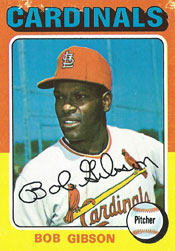
bob_gibson18On April 7, 1975, Gibson made the last of 11 consecutive Opening Day starts for the Cardinals. He struck out 12 Expos in eight innings, but took the loss in Montreal’s 8-4 victory at St. Louis.

Before the season began, Gibson had said 1975 would be his last year as a player.

In spring training at St. Petersburg, Fla., he told the Newspaper Enterprise Association, “I’d be a fool if I said I’m as good as I’ve ever been. But I wasn’t all that bad last season. I’ve been playing ball for something like 30 years _ 30 years! _ and I’m tired … Last season, I had my knee drained 22 times before almost every start and that’s tiring.”

Gibson had been the Cardinals’ Opening Day starting pitcher every year since 1965. (In the 1966 opener, Gibson started against the Phillies and pitched a perfect inning before the game was called off because of rain.)

In the zone

The 1975 opener matched Gibson against an Expos club that started seven players ages 24 or younger: shortstop Tim Foli (24), catcher Barry Foote (23), left fielder Tony Scott (23), second baseman Pete Mackanin (23), center fielder Pepe Mangual (22), third baseman Larry Parrish (21) and Gary Carter, a catching prospect who got the start in right field the night before his 21st birthday.

After seven innings, the Cardinals led, 4-3. Gibson struck out at least one batter in each of those innings. He struck out the side in the second.

In the eighth, Carter grounded out and Mackanin struck out, giving Gibson a dozen strikeouts in a game for the first time since he compiled 14 versus the Giants on Aug. 30, 1972.

With two outs and none on, Parrish singled to center. Larry Biittner, pinch-hitting for pitcher Dave McNally, singled to left.

Scott, a switch-hitter who would play for the Cardinals from 1977-81, was up next. He was 0-for-3 in his first game against Gibson.

Batting left-handed, Scott fell behind in the count 0-and-2. Gibson was a strike away from escaping the jam and preserving the lead.

His next pitch was high and Scott slashed at it, driving the ball down the line and into the left-field corner for a two-run double, putting the Expos ahead, 5-4.

“That was the first time I’d faced Gibson,” Scott told The Sporting News. “The only time I’d seen him was on TV. I like to hit off him because he’s always around the plate. He works so fast it seems like he doesn’t even take the sign.”

Gallant effort

Gibson was lifted for a pinch-hitter in the bottom of the eighth. In the ninth, Carter hit a three-run home run off Elias Sosa, making his Cardinals debut after being acquired from the Giants.

Gibson’s line: 8 innings, 9 hits, 5 runs, 5 walks, 12 strikeouts.

It was the 72nd and final time Gibson achieved double-digit strikeouts in a game.

“That’s as great as I’ve seen him pitch since ’73,” Expos manager Gene Mauch said to the Associated Press. “He mixed his pitches beautifully and threw the ball hard when he had to.”

Cardinals catcher Ted Simmons told the St. Louis Post-Dispatch, “It compares to nothing I’ve seen from him for a while.”

Said Carter, who was 5 years old when Gibson made his big-league debut in 1959: “Bob Gibson had good stuff out there. He’s a fantastic pitcher.”

Gibson threw 151 pitches.

“I guess my stuff was all right,” Gibson said to Steve Porter of the Alton (Ill.) Telegraph, “but I don’t care what I’ve done unless we win the game.” Boxscore
 

Read Full Post »

Bob Gibson and Steve Carlton appeared together in a regular-season game as Cardinals three times. Two of those games represented milestones for Carlton: his big-league debut and his first major-league save. In all three, Gibson started and Carlton relieved.

jim_landisThe first time Gibson and Carlton appeared together in a Cardinals regular-season game was April 12, 1965, the season opener for the defending World Series champions against the Cubs at Chicago.

Gibson left after yielding five runs in 3.1 innings.

In the 11th, with the score tied at 10-10, the Cubs had Ron Santo on second with one out and George Altman at the plate. Red Schoendienst, in his regular-season debut as Cardinals manager, lifted Barney Schultz and brought in Carlton to face Altman.

Carlton, 20, making his big-league debut, walked Altman. Schoendienst then brought in Bob Purkey, who got out of the jam without allowing a run.

At that point, the game was called because of darkness, ending in a tie. All the statistics counted. Boxscore

Mopping up

Four months later, on Aug. 25, 1965, Gibson faced the Cubs at St. Louis and gave up six runs in seven innings.

With the Cubs ahead, 6-1, Carlton relieved and pitched two scoreless innings. The Cubs won, 6-3.

Joey Amalfitano, a career .244 hitter, had a single off Gibson and a single off Carlton, becoming the first batter to get hits off both Cardinals in the same regular-season game. Boxscore

Carlton a closer

Entering the 1967 season, Schoendienst told The Sporting News, “We now have men like Dick Hughes, Steve Carlton and Nelson Briles, who can start or relieve. In fact, I’d say only Bob Gibson and Ray Washburn would have to be regarded strictly as starters.”

On April 16, 1967, Gibson faced the Astros at St. Louis. Lou Brock hit a pair of solo home runs off former teammate Mike Cuellar and the Cardinals built leads of 5-0 and 7-3. Gibson, though, wasn’t sharp.

“Gibson admitted he did not have anything today and that he was struggling throughout,” wrote Tom McNamara of the Edwardsville (Ill.) Intelligencer.

The Astros, paced by John Bateman’s two-run home run, scored four in the sixth off Gibson, tying the score at 7-7. The Cardinals regained the lead, 8-7, in the bottom half of the inning on an Orlando Cepeda home run off Carroll Sembera.

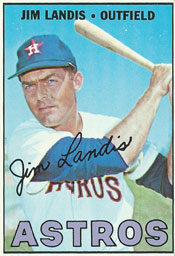
After Jim Landis led off the seventh with a double against Gibson, Carlton, making his first appearance of the season, relieved him.

Carlton retired Joe Morgan on a fly out and struck out Jim Wynn and Eddie Mathews, stranding Landis. Like Carlton, Morgan and Mathews were destined for election to the National Baseball Hall of Fame.

The Cardinals scored three off Turk Farrell in the bottom of the seventh, extending their lead to 11-7.

In the eighth, Carlton struck out the first two batters, Bob Aspromonte and Aaron Pointer, giving him four consecutive strikeouts, before Bateman grounded out.

The Astros scored a run in the ninth off Carlton. The key hit in the inning was a Landis double.

Landis, a career .247 hitter, joined Amalfitano as the only batters to get hits off Gibson and Carlton in the same regular-season game.

Carlton earned the save for Gibson in an 11-8 Cardinals victory. Carlton’s line: 3 innings, 1 run, 1 hit, 1 walk, 4 strikeouts. Boxscore

Carlton would earn 329 big-league wins but only two saves. His second came 20 years after his first.

On April 9, 1987, in his first regular-season appearance for the Indians, Carlton, 42, got the save with four shutout innings in relief of Phil Niekro, 48, in a 14-3 Cleveland victory at Toronto. Boxscore


Read Full Post »

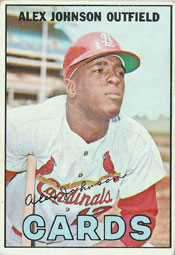
The Cardinals traded two all-star infielders, first baseman Bill White and shortstop Dick Groat, to acquire Alex Johnson and told Lou Brock to shift outfield positions to accommodate the heralded newcomer.

alex_johnsonJohnson never fulfilled his potential with St. Louis. Instead of joining Brock and Curt Flood as an outfield regular, Johnson got demoted to the minors in his first Cardinals season and backed up Roger Maris in his second and last year with St. Louis.

Phillies phenom

At 21, Johnson debuted in the big leagues with the 1964 Phillies. He hit .296 in two seasons with Philadelphia.

Cardinals general manager Bob Howsam envisioned Johnson as an ideal fit to join Brock and Flood in forming a fleet, productive St. Louis outfield.

On Oct. 27, 1965, the Cardinals dealt White, Groat and catcher Bob Uecker to the Phillies for Johnson, catcher Pat Corrales and pitcher Art Mahaffey.

White was a five-time all-star who hit .298 and won the Gold Glove Award six times. In three years with St. Louis, Groat was a two-time all-star who batted .289. Both were key contributors to the Cardinals’ World Series championship season in 1964.

Power potential

“We expect Johnson to hit the long ball for us,” Howsam told The Sporting News. “Playing everyday instead of just against left-handed pitchers, he may even surpass White in long-ball hitting over the full season.”

Said Cardinals vice president Stan Musial, who was consulted by Howsam before the deal was made: “Over the long haul is what we’re thinking about. We’re trying to analyze our team better and it’s a switch to the youth system.”

The Cardinals believed Johnson would hit for a higher average and had more speed than Mike Shannon, their right fielder in 1964 and 1965.

Johnson hit .307 against left-handed pitching for the 1965 Phillies. He also hit .424 in 11 games versus the Cardinals that season.

Move over, Lou

Johnson reported to the Cardinals’ Florida Instructional League camp at St. Petersburg and worked with manager Red Schoendienst and coach Dick Sisler. “He has a better arm than I thought he did,” Schoendienst said.

The Cardinals decided to shift Brock from left to right and start Johnson in left, with Flood in center. Shannon was relegated to a reserve role. “I know the Cardinals made a big deal to get Johnson, but all I want is a chance,” Shannon said. “… I think I can hit .300. I’m strong. I can run and I’ve got good power.”

Johnson hit .286 in spring training and opened the 1966 regular season as the left fielder. He started each of the Cardinals’ first 20 games and hit .195. The Cardinals’ record was 8-12 and Johnson received part of the blame. “It’s not the pitchers getting me out,” Johnson said. “I’ve been getting myself out. I’ve been going for the long taters.”

On May 8, 1966, the Cardinals played their final game at Busch Stadium, formerly Sportsman’s Park. Johnson had the last at-bat and hit into a game-ending double play. Boxscore

Four days later, the Cardinals played their first game at the new Busch Memorial Stadium. Johnson started in left field and was 1-for-4 with a run scored. Boxscore

On May 18, 1966, the Cardinals sent Johnson to Class AAA Tulsa and called up outfielder Bobby Tolan. Brock returned to left field and Shannon took over in right.

In 25 games with the Cardinals, Johnson batted .186 with two home runs.

“Johnson appeared overmatched in his first opportunity at a regular job.” The Sporting News declared. “He has plenty of raw talent and good speed. There is considerable hope for him, especially if he can develop the ability to learn from coaches both in the minors and in the majors. He has not adapted well to instruction and he has been easy to pitch to.”

At Tulsa, Johnson prospered under manager Charlie Metro, batting .355 with 104 hits in 80 games.

Carlton to Cubs?

After the 1966 season, Howsam agreed to a proposed deal to send Johnson, Tolan and pitchers Steve Carlton and Nelson Briles to the Cubs for outfielder Billy Williams, The Sporting News reported. The trade was vetoed by Cardinals “super brass,” who presumably included Musial. “We needed a lefthanded-hitting outfielder and we went after (Billy) Williams,” Musial confirmed.

After the proposed trade was nixed, Howsam dealt third baseman Charlie Smith to the Yankees for outfielder Roger Maris. Soon after, Howsam resigned to become general manager of the Reds and was replaced by Musial.

In spring training, the Cardinals assigned hitting instructor Joe Medwick to work with Johnson. “I told him, ‘The only guy who is keeping you down is yourself. You’ve got all the equipment,’ ” Medwick said. “Alex was pulling too many pitches.”

Some thought Johnson and Maris would platoon in right field for the 1967 Cardinals. Maris, though, won the job outright, with Shannon replacing Smith at third base and Johnson taking a reserve outfield role.

In May 1967, The Sporting News reported Johnson was “swinging at too many bad balls and fouling off too many good ones.” Musial “had tried hard to deal Johnson to an American League club, but there were no takers.”

Johnson hit .223 with one home run in 81 games for the 1967 Cardinals, who won the National League pennant. He didn’t appear in the World Series against the Red Sox.

After the Cardinals won the championship, Musial resigned in triumph and was replaced by Bing Devine, in his second stint as St. Louis general manager. Devine’s first trade was to send Johnson to the Reds for outfielder Dick Simpson on Jan.11, 1968.

In two seasons with the Cardinals, Johnson hit .211 in 106 games with three home runs and 18 RBI. “Alex just might put everything together one of these days and become quite a ballplayer,” Schoendienst said.

Red was right

Reunited with Howsam and Metro (who had become a Reds scout), Johnson hit .313 with 146 RBI in two seasons with Cincinnati.

Traded to the Angels, Johnson was the 1970 American League batting champion, hitting .329, but his career continued to be marred by controversy and accusations of an indifferent attitude.

Said Cardinals coach Dick Sisler: “The tag on Johnson is that he will not accept advice from a manager or a competent coach. He easily could have become a great Cardinal player, but he showed no interest.”

In 13 years with the Phillies, Cardinals, Reds, Angels, Indians, Rangers, Yankees and Tigers, Johnson batted .288 with 1,331 hits.

Previously: Here’s how Mike Shannon became a Cardinals catcher

Previously: Bill White: We thought Lou Brock deal was nuts

Previously: How Charlie Metro miffed Stan Musial

Read Full Post »

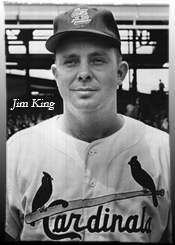
Jim King spent five years in the Cardinals organization, learning from the likes of George Kissell and Johnny Keane, but he twice departed and never got much of a chance to make an impact with St. Louis at the big-league level.

jim_kingKing, an outfielder who started in the first big-league game played in California, spent 11 seasons in the majors, primarily with the Senators.

After making his professional debut at 17 in 1950 with the independent Vernon Dusters of the Class D Longhorn League, King was signed by the Cardinals. He played in the St. Louis minor-league system from 1951-54, including two stints with Omaha clubs managed by Kissell, the franchise’s iconic instructor.

In 1954, King had his best season in the Cardinals organization, hitting .314 with 31 doubles and 25 home runs for Omaha. King, who had a strong arm, also contributed 19 outfield assists.

Courted by Cubs

King caught the attention of Wid Matthews, director of personnel for the Cubs, and on Nov. 22, 1954, the Cubs claimed King from the Cardinals in the minor-league draft.

King made his major-league debut with the Cubs in 1955 and played for them for two seasons.

In 1957, Cubs general manager John Holland was seeking to overhaul the roster. Cardinals general manager Frank Lane was seeking a left-handed pull hitter who could benefit from the Busch Stadium dimensions. The distance along the right field line from home plate to the outfield at the former Sportsman’s Park was an enticing 310 feet.

Holland made a special trip to Memphis to talk with Lane as the Cardinals headed north from spring training. Their talks continued in the Busch Stadium press box lounge when the Cubs and Cardinals played in St. Louis during the first week of the 1957 regular season, The Sporting News reported.

Second chance

On April 20, 1957, the Cardinals reacquired King from the Cubs for outfielder Bobby Del Greco and pitcher Ed Mayer.

“The deal for King was completed within 48 hours, culminating a lengthy series of conversations between Lane and Holland,” St. Louis writer Bob Broeg reported.

Broeg described King as “a pull hitter for whom the Busch Stadium dimensions are tailored” and declared the Cardinals were “stronger and deeper” with King on the roster.

Said Lane: “He’s got the knack of pulling, an asset especially with our short right field, and he won’t be handicapped in St. Louis by the wind blowing in as it does so often off the lake in Chicago, making hitting tough for left-handers.”

The Cardinals issued uniform No. 9 to King. It was the number worn by Cardinals standout Enos Slaughter before it was retired by the club.

King was used primarily as a pinch-hitter. On May 15, 1957, less than a month after he was acquired, the Cardinals sent King to Class AAA Omaha in order to get their roster to the mandated 25-player limit.

Wrote Broeg: “Entirely unexpected was the decision to send down King rather than Tom Alston, the good-field, no-hit first baseman … Although mum was the word around the club, it was apparent that owner Gussie Busch … had requested that Alston be given another chance or, at least, a longer look.”

At Omaha, King played for manager Johnny Keane (who, seven years later, would lead the Cardinals to a World Series title) and hit 20 home runs in 116 games before being called back to the Cardinals in September.

In 22 games overall for the 1957 Cardinals, King hit .314. All 11 of his hits were singles.

California connection

King appeared poised to earn a spot on the 1958 Cardinals. However, the Cardinals were seeking catching help and the Giants needed a lefthanded-hitting outfielder to replace Don Mueller. On April 2, 1958, the Cardinals traded King to the Giants for catcher Ray Katt.

When the Dodgers faced the Giants on April 15, 1958, at San Francisco’s Seals Stadium in the first regular-season major-league game played in California, King was in the starting lineup, playing left field and batting second, just ahead of Willie Mays. King was 2-for-3 with two walks, a run scored and a RBI-single off Don Drysdale. Boxscore

King had his best seasons with the 1963 Senators (24 home runs) and 1964 Senators (18 home runs). He broke Mickey Vernon’s Senators single-season record of 20 home runs by a left-handed batter. On June 8, 1964, King hit three solo home runs in a game at Washington against the Athletics. Boxscore

In a big-league career spanning 1955 to 1967 with the Cubs, Cardinals, Giants, Senators, White Sox and Indians, King hit .240 with 117 home runs.

Previously: How Cardinals nearly traded Bob Gibson to Senators

Read Full Post »

(Updated Feb. 8, 2016)

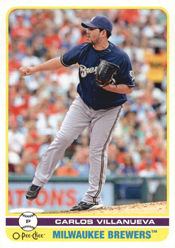
As a rookie, Carlos Villanueva almost kept the 2006 Cardinals from qualifying for the postseason and winning their first World Series title in 24 years.

carlos_villanuevaNine years later, Villanueva was competing for the 2015 Cardinals as an effective member of their relief staff.

On Oct. 1, 2006, the Cardinals entered the final day of the regular season needing a win over the Brewers at St. Louis or an Astros loss to the Braves in Atlanta to clinch outright the National League Central Division title. If the Cardinals lost and the Astros won, the Cardinals would need to win a regular-season makeup game against the Giants to clinch the division title and avoid a one-game playoff with the Astros to advance to the National League Division Series against the Padres.

Rookie starters

Cardinals manager Tony La Russa gambled and started rookie Anthony Reyes against the Brewers on three days of rest, choosing to hold back Chris Carpenter in the hope St. Louis would clinch the division crown versus Milwaukee and have their ace available for Game 1 of the NL Division Series.

Brewers manager Ned Yost chose Villanueva as his starter. Villanueva had faced the Cardinals for the first time on Sept. 20 at Milwaukee and pitched seven scoreless innings in a 1-0 Brewers victory. Boxscore

Reyes flopped.

The Brewers scored four in the first on a two-run home run by Prince Fielder, a solo home run by Geoff Jenkins and a RBI-single by David Bell. Reyes was lifted before he could complete the opening inning.

Keep me in, coach

Given a 4-0 lead, Villanueva faced Cardinals leadoff batter Aaron Miles. who “smacked a sharp one-hopper off Villanueva’s pitching hand,” the Milwaukee Journal Sentinel reported.

“It felt bad,” Villanueva said.

Yost went to the mound and asked his right-hander, “How are you doing?”

“Of course, I said, ‘I’m doing great,’ ” Villanueva said.

In truth, the hand throbbed.

Said Yost: “I came close to taking him out. He couldn’t even swing a bat. I kept an eye on him and if I noticed a drop-off in effectiveness I would have taken him out. But I didn’t see it.”

Villanueva baffled the Cardinals. With each inning, their hopes of beating the Brewers dimmed.

Bailout by Braves

Then, in the fifth, a roar erupted from the Busch Stadium crowd as the final from Atlanta was posted: Braves 3, Astros 1. The Braves had prevailed behind six shutout innings from starter John Smoltz and a home run by Jeff Francoeur. Boxscore

The loss by the Astros meant the Cardinals had clinched the division title, regardless of the outcome of their game with the Brewers.

As fans cheered in appreciation, Villanueva stepped off the mound. Derryl Cousins, the home plate umpire, motioned for the game to resume, but Villanueva lingered, letting “the celebration last a few more seconds,” the St. Louis Post-Dispatch reported.

“I wanted to give them their moment,” Villanueva said. “I knew what was going on.”

Drama in ninth

Villanueva shut out the Cardinals through eight innings, extending his scoreless streak against them to 15 innings over two starts.

In the bottom of the ninth, with the Brewers ahead, 5-0, Villanueva got Miles to fly out to right. Then, the Cardinals thundered to life. Chris Duncan launched a 414-foot home run. Albert Pujols followed with a 424-foot shot.

Francisco Cordero relieved and struck out Preston Wilson, but Scott Spiezio followed with a home run, cutting the deficit to two. Cordero then ended the drama _ and the regular season _ by striking out Juan Encarnacion, preserving a 5-3 victory for Villanueva and the Brewers. Boxscore

Unfazed, the Cardinals regrouped and beat the Padres in the NL Division Series, the Mets in the NL Championship Series and the Tigers in the World Series.

Previously: 2006 was critical to Tony La Russa earning Hall of Fame status

Read Full Post »

(Updated Dec. 14, 2015)

Imagine Pete Rose in a Cardinals lineup with Ted Simmons, Keith Hernandez, George Hendrick and Garry Templeton. The Cardinals tried to make it happen.

brock_roseThe catch: Rose likely would have been brought in to replace Lou Brock, relegating the popular Cardinals standout to a reserve role.

In November 1978, Rose left the Reds, his hometown team and the only one for whom he had played since entering the majors in 1963, and became a free agent. Five clubs _ Cardinals, Phillies, Braves, Pirates and Royals _ were finalists in bidding to sign him.

The Cardinals, determined to become contenders after finishing 24 games under .500 in 1978, wanted Rose, 37, to bring his hitting, hustle and hubris to St. Louis.

Rose chose the Phillies, even though the Cardinals and the others made more lucrative offers.

Sorely needed

Before the December 1978 baseball winter meetings began in Orlando, Rose met with Cardinals owner Gussie Busch, general manager John Claiborne and manager Ken Boyer in St. Louis “with the hope the Cardinals might be able to land a man who certainly would fit the type of offensive player so sorely needed by the Redbirds,” The Sporting News reported.

Rose, who started at third base for the 1978 Reds, likely would have played left field for the 1979 Cardinals, joining an outfield of Hendrick in right and Tony Scott in center. Simmons was the St. Louis catcher. The infield for the 1979 Cardinals was Hernandez at first, Ken Oberkfell at second, Templeton at shortstop and Ken Reitz at third.

Brock, the stolen base champion and future Hall of Famer who had sparked the Cardinals to three National League pennants and two World Series titles, had experienced a miserable 1978 season, batting .221 with no home runs and 12 RBI. He would turn 40 in 1979 and there were doubts whether he could be an effective everyday player.

In a 2014 interview with the Web site of Boston radio station WEEI, Rose recalled, “I went to St. Louis to talk with Gussie Busch, who offered me a Budweiser distributorship. I liked that, but he wanted me to replace Lou Brock and I didn’t want to get in that situation.”

(Brock remained the Cardinals’ regular left fielder in 1979 and rebounded strongly, hitting .304 in his final big-league season.)

In the book “The Lords of the Realm,” author John Helyar wrote that Busch talked with Rose about being a Budweiser spokesman and also discussed a distributorship. The meeting occurred at a St. Louis hospital, where Busch was preparing for hernia surgery.

“I probably would have had a hernia, too, if I had to carry all the money he was offering me,” Rose said.

In the Jan. 13, 1979, edition of The Sporting News, Claiborne denied Rose was offered a distributorship from Anheuser-Busch, though he confirmed the Cardinals “had made a very strong pitch for Rose.”

Treated like son

Indeed, Rose said the Phillies’ offer was lower than the bids of the Cardinals, Braves, Pirates and Royals.

“There were five bids and I took the lowest one,” Rose said. “Being conservative, I could have gotten at least another million and a half.

“I wish I could have played a year for each of the other four owners. They treated me like a son. But I had to analyze where I’d be the happiest. And the Phillies’ revised offer was enough that I didn’t have to worry about the money.”

The Phillies initially offered Rose a three-year, $2.1 million contract _ an average of $700,000 per year. When they sweetened the deal to $3.2 million for four years _ an average of $800,000 per year _ Rose accepted. He said his friendship with Phillies players Larry Bowa, Greg Luzinski and Mike Schmidt also persuaded him.

(The book “Pete Rose: A Biography” reports the breakdown of the Phillies deal as $905,000 the first year, $805,000 the second, $705,000 the third and $565,000 the fourth, with a $245,000 bonus if Rose played in 125 games.)

Chasing The Man

Royals owner Ewing Kauffman had made an aggressive bid, “but Rose has insisted all along he is a National Leaguer and what he lusts after most is Stan Musial’s record for hits in that league,” The Sporting News reported.

(Rose would surpass Musial’s NL record of 3,630 hits and then move ahead of Ty Cobb for the all-time mark. Cobb had 4,189 hits. Rose finished with 4,256.)

If Rose had selected the 1979 Royals, he would have played that season for manager Whitey Herzog.

The Braves thought Rose would pick them. Team owner Ted Turner offered Rose $1 million per year for “three years, four years, five years, whatever you want,” Sports Illustrated reported.

“A major network and a wire service columnist reported Rose was headed for the Braves,” wrote The Sporting News. “Team officials in Orlando for the winter meetings had Rose’s statistics printed upon the club’s letterhead and another member of the front office staff flew from Atlanta to Orlando with a Braves jersey and cap for Rose to wear at the signing.”

The contract Rose got from the Phillies made him baseball’s highest-paid player. “$3.2 million for a leadoff man, ye gods!” wrote Atlanta columnist Furman Bisher.

Phillies vs. Cardinals

Rose made his Phillies debut on Opening Day, April 6, 1979, against the Cardinals at St. Louis. Playing first base and batting leadoff a week before his 38th birthday, Rose was 1-for-3 with a walk against John Denny, who pitched a five-hitter in an 8-1 Cardinals triumph. Boxscore

The Cardinals would finish ahead of the Phillies in the NL East in 1979. The Cardinals were third at 86-76 and the Phillies were fourth at 84-78.

Rose had a spectacular 1979 season, collecting 208 hits and batting .331. He finished second to Hernandez (.344) for the NL batting title. Rose led the league in on-base percentage (.418), edging Hernandez (.417).

On Dec. 14, 2015, baseball commissioner Rob Manfred denied a request to reinstate Rose, who was banned from baseball in 1989 for misconduct related to gambling. In 2004, Rose admitted to betting on games during his tenure as Reds manager.


Read Full Post »

« Newer Posts - Older Posts »