Feeds:
Posts
Comments

Archive for the ‘Games’ Category

(Updated May 5, 2020)

In a showdown of two master showmen, Dizzy Dean upstaged Babe Ruth.
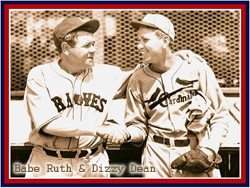
babe_dizzyRuth, 40, entered his final big-league season with the 1935 Braves. The fading home run king had gone to the National League after 21 years (1914-34) in the American League with the Red Sox and Yankees.

Dean, 25, was the colorful Cardinals ace and reigning NL strikeout king who had earned 30 wins the year before and pitched St. Louis to the 1934 World Series championship.

They faced one another for the first time in a regular-season game on May 5, 1935, at Boston before a crowd of at least 30,000, including three sons of President Franklin Roosevelt.

Seeking a strikeout

In the book “Diz,” Dean biographer Robert Gregory wrote, “He had been looking forward to his first league showdown with Babe Ruth and telling everybody he’d have no choice in the matter. He would have to strike him out.”

Ruth and Dean greeted each other cordially before the game and took part in a newspaper-sponsored promotion with local youth players.

Then, it was show time.

“Babe was watching me pretty closely while I was warming up before the game,” Dean said in the book “Ol’ Diz” by Vince Staten. “He had that old eagle eye of his on every move I made.”

In his first at-bat, Ruth walked.

When Ruth came to the plate for the second time, Dean upped the ante. “I figured that if I didn’t steal the show he would,” Dean said.

Play deep

As Ruth took his practice cuts, Dean smiled at him and turned toward his outfielders.

“He motioned them to play farther back,” wrote Gregory. “They retreated a few steps, but Diz shook his head, no, no, that’s not deep enough, and kept waving his glove until they were almost at the walls.”

Then, Dean went to work on Ruth. He got the count to 1-and-2. On his fourth delivery, Dean unleashed his best fastball. Ruth took a mighty swing and missed. Dean had his strikeout of the Bambino.

“Babe almost broke his back going for that steaming third fastball,” according to the Associated Press.

Dean “whiffed the great man with marvelous eclat,” wrote the Boston Globe.

In his third at-bat, Ruth got “a fast one through the middle, waist high,” the St. Louis Post-Dispatch reported. “Ruth took a tremendous swing at the ball, but he missed.”

Ruth and Dean looked at one another and laughed.

“I never saw a man take such a cut in my whole life,” Dean told the Post-Dispatch. “Lordy me, if he had hit that ball it would have gone to New York or Pensacola. I had to laugh at him swinging like that and he was laughing because he hadn’t expected to get a fast one like that, right through the heart of the plate.”

When the at-bat resumed, Ruth grounded out to shortstop Leo Durocher, who was playing back on the grass on the first base side of second.

Basking on the stage set for him, Dean slugged a home run that sailed over Ruth’s head before clearing the left-field wall. He earned the shutout in a 7-0 Cardinals victory. Boxscore

“Dizzy Dean stole the Babe’s thunder and color,” the Boston Globe declared.

Encore performance

Two weeks later, on May 19 at St. Louis, Ruth and Dean had a rematch. Again, Dean prevailed. Ruth was 0-for-4 with a strikeout. Dean pitched another complete game and drove in two runs, leading St. Louis to a 7-3 victory. Boxscore

In five games against the Cardinals in 1935, Ruth batted .071 (1-for-14) with a single, three walks and five strikeouts. With his overall average at .181 in 28 games that season, Ruth retired at the end of May.

In his prime, Ruth faced the Cardinals in two World Series. He hit .300 (6-for-20) with four home runs and 11 walks in the seven-game 1926 World Series. In the 1928 World Series, Ruth hit .625 (10-for-16) with three home runs and three doubles in four games.

Previously: Stan Musial: ‘Babe Ruth was the greatest who ever played’
 

Read Full Post »

(Updated Jan. 31, 2021)

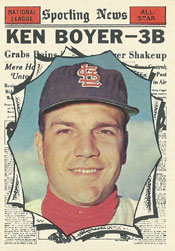
Ken Boyer is the only Cardinal to twice hit for the cycle. Each time, he enhanced the feat by raising the degree of difficulty.

ken_boyer10Boyer first achieved the cycle on Sept. 14, 1961, in the second game of a doubleheader against the Cubs at St. Louis. Boyer led off the 11th with a home run, giving the Cardinals a 6-5 victory and becoming the first big-league player to complete the cycle with a walkoff homer.

Three years later, on June 16, 1964, against the Colt .45s at Houston, Boyer achieved another rarity, completing a natural cycle by getting a single, double, triple and home run in that exact order in his first four at-bats.

Cubs tormenter

In the 1961 doubleheader, Boyer had a spectacular night, going 7-for-11 with five RBI against the Cubs.

Boyer was 2-for-5 in the opener, including a two-run triple in the fifth off starter Don Cardwell.

With the score 7-7 and the bases loaded in the ninth, Cubs reliever Barney Schultz delivered a pitch the Chicago Tribune described as a “puzzling knuckler” that “slithered away” from catcher Sammy Taylor, enabling Bob Lillis to scamper home from third for an 8-7 Cardinals victory. Boxscore

“The Cubs claimed Taylor’s recovery throw nailed Lillis at the plate, but they weren’t winning arguments _ or anything else _ on this night,” the Tribune reported.

That ending was a fitting prelude to Game 2.

Boyer was 5-for-6 and delivered extra-base hits in the ninth and the 11th.

In the first inning, Boyer hit a RBI-single against starter Jack Curtis. He singled again off Curtis in the third.

After grounding out in the fifth, Boyer tripled against Curtis in the seventh.

Facing Bob Anderson in the ninth, Boyer produced a RBI-double with one out, tying the score at 5-5.

In the 11th, Boyer led off with his game-winning home run against Don Elston. The victory gave the 1961 Cardinals an 11-0 home record against the Cubs. Boxscore

Since Boyer, others who have completed a cycle with a walkoff home run are Cesar Tovar of the 1972 Twins, George Brett of the 1979 Royals, Dwight Evans of the 1984 Red Sox, Carlos Gonzalez of the 2010 Rockies and Nolan Arenado of the 2017 Rockies. Arenado did it on June 18, 2017, versus the Giants at Denver. Boxscore

Hot in Houston

Boyer’s second cycle overshadowed the first Cardinals start of Lou Brock, who was acquired by St. Louis the day before in a trade with the Cubs.

Boyer that night became the 19th big-leaguer to hit for the cycle twice and the seventh to hit for the natural cycle.

In the second, Boyer beat out an infield single against starter Bob Bruce. He had a RBI-double against Bruce in the third and a RBI-triple off him in the fifth.

Boyer completed the natural cycle with a home run against Don Larsen leading off the seventh.

After flying out against Larry Yellen in the eighth, Boyer finished 4-for-5 with three RBI in a 7-1 victory that snapped a five-game Cardinals losing streak. Boxscore


Read Full Post »

mark_grudzielanek2(Updated July 1, 2022)

Batting leadoff for one of the few times in his Cardinals career, Mark Grudzielanek hit for the cycle.

On April 27, 2005, Grudzielanek, a second baseman in his lone season with St. Louis, became the 15th Cardinal to hit for the cycle, collecting a home run, triple, double and single against the Brewers at Busch Memorial Stadium.

Grudzielanek is one of three Cardinals to hit for the cycle at Busch Memorial Stadium, the team’s home from 1966-2005. The other two to do so _ Lou Brock in 1975 against the Padres and Ray Lankford in 1991 versus the Mets _ also batted leadoff in those games.

A right-handed batter, Grudzielanek was the first Cardinal to hit for the cycle since John Mabry did it against the Rockies at Denver in 1996.

Mabry, a reserve with the 2005 Cardinals, witnessed Grudzielanek’s performance. “I was hoping for him to get it,” Mabry told MLB.com. “They say it’s more rare than a no-hitter. It’s special.”

The cycle by Grudzielanek was the 16th in Cardinals history. Ken Boyer is the only Cardinal to achieve the feat twice (in 1961 and 1964). Joining Boyer, Brock, Lankford, Mabry and Grudzielanek as Cardinals who hit for the cycle: Cliff Heathcote (1918), Jim Bottomley (1927), Chick Hafey (1930), Pepper Martin (1933), Joe Medwick (1935), Johnny Mize (1940), Stan Musial (1949), Bill White (1960), Joe Torre (1973) and Willie McGee (1984).

On July 1, 2022, Nolan Arenado became the first Cardinal since Grudzielanek to hit for the cycle. Arenado did it against the Phillies at Philadelphia.

Top of the order

Shortstop David Eckstein normally batted leadoff and Grudzielanek sixth for the 2005 Cardinals. When manager Tony La Russa rested Eckstein against the Brewers on April 27, he put Grudzielanek in the leadoff spot against right-hander Victor Santos. Grudzielanek entered the game 7-for-16 (all singles) in his career versus Santos.

In the bottom of the first, Grudzielanek led off with a home run. He singled in the second.

With Santos still pitching, Grudzielanek hit a RBI-double in the fourth.

“It seemed like everything I threw to him he was right on it,” Santos said to the Associated Press. “As soon as I made a mistake, boom, he was right on it.”

Tough task

To complete the cycle, Grudzielanek needed a triple, or “the baseball equivalent of making an inside straight,” wrote Matthew Leach of MLB.com.

In his previous three seasons with the Dodgers (2002) and Cubs (2003-04), Grudzielanek had produced a total of two triples.

Facing left-hander Jorge De La Rosa in the sixth with one out and the bases empty, Grudzielanek said, “I was just trying to come up there and have the same approach that I did the previous at-bats and try to hit the ball hard.”

With the count 0-and-2, Grudzielanek sliced a shot down the right-field line. The ball eluded right fielder Geoff Jenkins and rolled into the corner as Grudzielanek steamed into third with the coveted triple. Video

“I saw (Jenkins) try to cut it off and saw it squeeze by and I thought, ‘Got to go,’ ” Grudzielanek told the St. Louis Post-Dispatch. “It’s just weird how it worked out.”

In the eighth, Grudzielanek grounded out against left-hander Tommy Phelps. He finished 4-for-5 with three runs and two RBI in a 6-3 Cardinals victory. The win boosted the Cardinals’ record to 14-5, their best start since the 1968 team had the same mark. Boxscore

Grudzielanek batted leadoff six times in 2005, hitting .381 (8-for-21). Overall, he hit .294 for the 2005 Cardinals, with 155 hits in 137 games.


Read Full Post »

(Updated April 23, 2020)

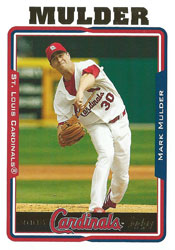
In the last classic pitchers duel at Busch Memorial Stadium, Mark Mulder gave the best performance of his Cardinals career, tossing 10 shutout innings and beating Roger Clemens and the Astros.

mark_mulder2On April 23, 2005, in the Cardinals’ final season at the ballpark that had been their home since 1966, Mulder pitched a masterpiece in a 1-0 victory.

Mulder, a left-hander, threw an efficient 101 pitches and faced 33 batters, three more than the minimum for 10 innings. Each of the Astros’ five hits was a single.

Clemens, 42, winner of seven Cy Young awards, was as good as expected, holding the Cardinals scoreless on four hits in seven innings before being relieved by Chad Qualls.

Mulder, 27, making his fourth Cardinals start after coming to St. Louis from the Athletics in a December 2004 trade, was up to the challenge of being matched against Clemens.

In a ballpark that had been the site of gems by Cardinals pitchers such as Bob Gibson, Steve Carlton, Bob Forsch, Joaquin Andujar and John Tudor, Mulder’s performance ranked among the best. It was the last 1-0 game played at Busch Memorial Stadium.

“Somewhere, Bob Gibson was smiling,” St. Louis Post-Dispatch columnist Bernie Miklasz wrote. “This was Gibby’s kind of hardball.”

Throwing strikes

Mulder became:

_ The first Cardinals starter to pitch an extra-inning shutout win since John Tudor did so on Sept. 11, 1985, in a 1-0 St. Louis victory over the Mets.

_ The first Cardinals starter to go 10 innings since Jose DeLeon went 11 against the Reds in a 2-0 Cincinnati victory on Aug. 30, 1989.

_ The first Cardinals starter to go 10 innings and win since Greg Mathews did so against the Mets in a 3-1 St. Louis victory on Aug. 16, 1986.

_ The first major-league starter to pitch a 10-inning shutout win since Roy Halladay of the Blue Jays did so against the Tigers in a 1-0 Toronto victory on Sept. 6, 2003.

“Any time it’s a 0-0 game or 1-0 game or 1-1, I love that,” Mulder told reporter Joe Strauss. “It makes me focus … I’m throwing strike one. I’m getting ahead. It’s enabling me to do a lot more things as far as working both sides of the plate.”

Said Cardinals pitching coach Dave Duncan: “He’s really changed his delivery, which has allowed him to repeat pitches better.”

Dodging trouble

In the fourth inning, Mulder escaped serious injury. Mike Lamb’s bat shattered when he hit a ground ball to second. The barrel of the bat struck Mulder on the ankle and he doubled over in pain. “It hit me right in a spot where it made my whole foot go numb,” Mulder said to MLB.com.

Feeling quickly returned to the ankle, though, and Mulder was able to continue.

Before sending Mulder to pitch the 10th, Cardinals manager Tony La Russa consulted with the pitcher. “He said he was OK to go,” La Russa said.

After setting down the Astros in the top half of the extra inning, Mulder was scheduled to lead off the bottom of the 10th. Reggie Sanders batted for him and produced an infield single. “It was a swinging bunt that feels just as good as a ringing line drive,” Sanders told the Associated Press.

Walker walkoff

The Cardinals capitalized on Sanders’ hit.

On a hit-and-run, David Eckstein grounded out, advancing Sanders to second.

With Larry Walker up next, Astros manager Phil Garner replaced Chad Qualls with Brad Lidge. Walker lined a hit into the right-center gap, scoring Sanders with the lone run. Boxscore and Video

“It was a fastball, down and away, and he reached for it,” Lidge said. “I’m not upset about the pitch at all.”

Said Walker: “To put the ball in play off (Lidge) is tough to do … He’s got phenomenal stuff.”

The victory gave La Russa 2,125 career wins as a major-league manager, moving him into a tie for fifth place with Joe McCarthy. “You win with great organizations and great players,” La Russa said. “I’ve been lucky enough to have had both.”

Read Full Post »

(Updated April 22, 2020)

With water filling the dugouts and lapping at the feet of spectators in the box seats, the Cardinals and Reds raced to complete a game at Cincinnati before flooding made conditions unplayable.

crosley_fieldCompleting nine innings in 1:56, the Reds beat the Cardinals, 6-1, on April 22, 1940, at Crosley Field.

The night before, the Ohio River reached the 55-foot stage. Reds officials knew Crosley Field, located near Mill Creek, started flooding when the river got to 57 feet, or five feet above normal flood stage, International News Service reported.

It was expected the river stage would reach 57 feet in late afternoon or early evening on April 22. The Reds moved up the starting time of their game with the Cardinals that afternoon by an hour, from 3 p.m. to 2 p.m.

At game time, however, water stood a foot deep in both dugouts _ even deeper in nearby parking lots _ and a crowd of 5,197 “had to puddle-jump their way into the park,” the Associated Press reported.

Patrons seated in field-level box seats behind third base “pulled their feet higher and higher” as the game progressed and water continued to rise.

“Shortly before game time, there was no water in the front row of the lower tier boxes,” the Cincinnati Enquirer reported, “but before the game was half over the fans in those seats were straddling quite a little pond. Most of them refused to move, although there were plenty of seats right in back of them.”

The players sat on benches in foul territory because the water in the dugouts eventually reached three feet deep, according to the book “Cardinals Journal.”

The game matched starting pitchers Bucky Walters, a 27-game winner in 1939 when he earned the National League Most Valuable Player Award, for the Reds against Bill McGee.

According to the St. Louis Globe-Democrat, “the Cardinals were at low tide” in their performance on the field.

Cincinnati, the defending National League champion, broke a scoreless tie with three runs in the fifth against McGee. The Reds added three more in the seventh off Clyde Shoun.

Walters drove in three runs and pitched eight scoreless innings before the Cardinals struck for a run in the ninth. By then, water was seeping onto the field. Boxscore

“Water backing up from sewers was ready to flow over the wall or the dugouts as the game ended,” the St. Louis Post-Dispatch reported.

The Cardinals were supposed to play the Reds again on April 23 and April 24, but both games were postponed. By then, the Ohio River had reached 58 feet and water covered the Crosley Field outfield. Another foot would put home plate under water.


Read Full Post »

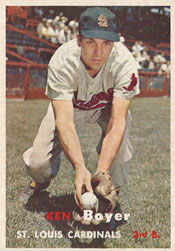
Before he played a game for the Cardinals, Ken Boyer was hyped as their best third baseman all-time. In his debut, he heightened expectations, hitting a home run against a Cardinals nemesis.

ken_boyer9On April 12, 1955, Boyer appeared in his first game in the majors, playing third and batting sixth in the Cardinals’ season opener against the Cubs at Chicago’s Wrigley Field.

In the eighth inning, with two outs, Red Schoendienst on first and the Cubs ahead, 14-2, Boyer slugged a home run off starter Paul Minner. The longball ignited a productive rookie season and a standout Cardinals career.

The Natural

After hitting .319 with 42 doubles, 21 home runs, 116 RBI and 29 stolen bases for the Cardinals’ minor-league Houston affiliate in 1954, Boyer was assured a spot with the 1955 Cardinals. In December 1954, the Cardinals traded their starting third baseman, Ray Jablonski, to the Reds, making Boyer the heir apparent at that position entering spring training.

In an interview with The Sporting News, Art Routzong, Houston’s general manager, said of Boyer, “He is the best prospect I’ve seen in 17 years in baseball.”

In a preview to spring training, St. Louis writer Bob Broeg opined, “If looks didn’t deceive, the Cardinals would have their greatest third baseman ever in Kenton Lloyd Boyer. It does seem possible _ it would be daring to say ‘probable’ _ that the rookie will become the Redbirds’ best at their most vexing position.”

Broeg’s colleague, J. Roy Stockton, added that Boyer “would be the Cardinals’ first complete infielder since Red Schoendienst.”

Solid spring

In spring training, Boyer played well at both third base and shortstop. In a poll of baseball correspondents for The Sporting News, Boyer and Indians pitcher Herb Score were selected the best rookies entering the 1955 season.

Scout Tony Kaufmann compared Boyer with a Hall of Famer, saying the rookie could become “another Pie Traynor.”

“He’s deadly efficient and with no apparent weakness,” Cardinals manager Eddie Stanky said of Boyer.

Wrote Broeg: “He can run fast, throw hard, field well and hit with power.”

Quick adjustment

Boyer’s performance in his debut game affirmed his skills and his ability to adapt.

Minner, a left-hander, often baffled the Cardinals. In a 10-year career with the Dodgers and Cubs, Minner was 21-8 versus St. Louis. He was 48-76 against the rest of the National League. In 1955, when he finished 9-9, Minner was 5-0 against the Cardinals.

In his first big-league at-bat in the season opener, Boyer flied out to right. In his next two at-bats, Boyer struck out against Minner, both times with a pair of runners on base.

In the eighth, Schoendienst singled with two outs. Boyer followed with his home run. Boxscore

(A month later, May 30, 1955, Boyer hit two home runs in a game against Minner, including a two-run, two-out shot in the bottom of the ninth that tied the score.)

Strong season

Boyer had a successful rookie year. He hit .264 with 27 doubles, 18 home runs and 22 stolen bases. Boyer was one of four National League players to achieve double figures in home runs and steals in 1955. The others: Willie Mays of the Giants (51 homers, 24 steals), Sandy Amoros of the Dodgers (10 homers, 10 steals) and Boyer’s teammate, Wally Moon (19 homers, 11 steals).

Among NL third basemen in 1955, Boyer ranked second in double plays turned (24), third in assists (253) and third in fielding percentage (.952).

Yet, Boyer’s teammate, outfielder Bill Virdon, won the 1955 NL Rookie of the Year Award. Virdon hit .281 with 18 doubles and 17 home runs.

As predicted, Boyer developed into the all-time best Cardinals third baseman. In 11 years with St. Louis, he hit .293 with 255 home runs and 1,001 RBI. Boyer also won five Gold Glove awards and the 1964 NL Most Valuable Player Award with the Cardinals.

Previously: 1964 effort supports Ken Boyer Hall of Fame case

Previously: With Ron Santo in Hall, Ken Boyer should be there, too

Previously: Ken Boyer converted from infield to center

Read Full Post »

« Newer Posts - Older Posts »