Feeds:
Posts
Comments

Archive for the ‘Games’ Category

There are many frustrating ways to lose a baseball game but perhaps none more so than this:

On Aug. 20, 1954, the Cardinals turned six double plays, tying a National League record, and still were beaten, 3-2, at home against the Reds.

Though they totaled 12 hits and eight walks, putting a runner on base in every inning, the Reds didn’t do much damage. They had two triples and a double, but none produced a run. The Reds scored one run on a double play and another on a wild pitch.

Meanwhile, the Cardinals ran into outs. They had four runners thrown out on the base paths, including two at home plate. The game ended when a Cardinals runner was nailed trying to score from second on a single.

Twists and turns

The Friday night game featured starting pitchers Joe Nuxhall, on his way to his first winning season with the Reds, against winless Cardinals rookie Ralph Beard, a Cincinnati native.

The first inning set the tone. For the Reds, Ted Kluszewski’s single scored Roy McMillan from second but Jim Greengrass ended the threat by grounding into a double play. For the Cardinals, Wally Moon was thrown out at second attempting to steal.

In the second, the Cardinals nearly turned a triple play. After Johnny Temple and Wally Post opened with singles, Hobie Landrith lined to second baseman Red Schoendienst. He tossed to shortstop Alex Grammas, who made the out on Temple at second, but Post beat Grammas’ peg to first “by a whisker,” the Dayton Daily News reported.

(Schoendienst started four of the double plays; Grammas started the other two.)

The Cardinals made another out on the base paths in the bottom half of the inning. With Rip Repulski on third and one out, Nuxhall snared Joe Cunningham’s grounder and then trapped Repulski, who had broken for home, in a rundown before tagging him out.

More buffoonery in the third: With two outs, Beard uncorked a wild pitch, enabling Bobby Adams to score and extending the Reds’ lead to 2-0.

The Reds scored the decisive run in the fourth. With runners on the corners, none out, Nuxhall rolled into a 4-6-3 double play, but Post came home from third, making the score 3-0.

St. Louis turned its fourth double play in the fifth on Gus Bell’s grounder.

Hits, runs, errors

The Cardinals scored twice in the sixth. With two outs, Stan Musial was on second and Ray Jablonski on first, when Bill Sarni singled to center. Musial scored, and when center fielder Gus Bell let the ball roll between his legs for an error, Jablonski streaked home from first with the second run. Sarni kept running, too, trying to take third, but left fielder Jim Greengrass, who retrieved the ball, fired to third baseman Bobby Adams in time to tag the runner, ending the inning.

The Reds got leadoff triples from Temple in the sixth and Post in the eighth, but failed to score. Kluszewski grounded into double plays in the seventh and ninth.

With two outs and none on in the St. Louis eighth, Reds manager Birdie Tebbetts used a four-man outfield, removing the shortstop, against Musial for the second time that season. Tebbetts wanted to prevent Musial from getting an extra-base hit that would put him in scoring position.

When Musial saw the defensive alignment, he called time and met with Cardinals manager Eddie Stanky. “I told Stan to get on base any way he could,” Stanky said to the St. Louis Post-Dispatch.

Attempting to hit the ball into the vacated shortstop spot for a single, Musial instead grounded out to third, ending the inning.

Hit and run

Clinging to the 3-2 lead, Nuxhall walked the leadoff batter, Ray Jablonski, in the ninth. Dick Schofield, 19, ran for Jablonski and advanced to second on Rip Repulski’s sacrifice bunt. Frank Smith, who threw sidearm, relieved Nuxhall.

Bill Sarni bounced out to Smith, with Schofield holding second. Then Joe Cunningham drilled a low line single to right. Wally Post charged the ball, gloved it and threw a strike to catcher Andy Seminick, nailing Schofield easily for the final out. Boxscore

(Note: The box score, which shows Schofield was on third when Cunningham singled, is wrong. Multiple newspaper accounts of the game report that Schofield was on second when Cunningham got his hit. None report him being on third.)

Asked about third-base coach Johnny Riddle’s decision to wave Schofield to the plate, Stanky said to the Post-Dispatch, “If he hadn’t sent the kid with two outs, I’d have shot him.”

The dramatic finish almost overshadowed the six double plays. It was the seventh time a National League team turned that many double plays in a game, and the third time the team achieving that fielding feat lost, The Cincinnati Post reported.

The Yankees of the American League established the big-league record by turning seven double plays in a win versus the Athletics on Aug. 14, 1942. Boxscore

Since then, the Astros equaled the Yankees’ mark, turning seven double plays in a 3-1 victory against the Giants at the Astrodome on May 4, 1969. Boxscore

Read Full Post »

May was indeed a merry month for Denny Lemaster when he pitched against the Cardinals. A left-hander, Lemaster hurled four shutouts versus the Cardinals, and all occurred in May during the 1960s.

In 11 seasons in the majors with the Braves (1962-67), Astros (1968-71) and Expos (1972), Lemaster was on the cusp of becoming an ace until injuries set him back. His record was 90-105, including 15-13 versus the Cardinals.

Lemaster experienced multiple family tragedies during his life: his sister drowned in a cesspool; his father died in a car crash; his wife also was killed in an auto accident.

Cesspool cave-in

Lemaster resided with his parents and younger sister in Camarillo, Calif., 50 miles north of Los Angeles. Denny’s father, Cyrus, milked cows for Adohr Farms and the family was housed in a residence court leased by the dairy for its workers.

On June 24, 1951, Denny’s sister, Lana, 8, and a playmate, Peggy Ziese, were skipping across the yard of the residence court when “the earth opened up beneath them,” the Los Angeles Times reported.

Rotten timbers covering a cesspool had given way and Lana fell in, the Associated Press reported. “Lana fell from sight through a hole about three feet in diameter,” the Times reported.

According to the Los Angeles Daily News, her friend Peggy “lost her footing but scrambled to safety” and screamed for help.

Two neighbors, Fred Luddenburg and Charles Simmons, were the first on the scene. According to the Camarillo Star, Lana’s father, Cyrus, soon joined them. The men lowered a garden hose to Lana.

“She grasped it and was nearly free of water when rotted timber gave way and struck her, causing her to lose her grip,” the Daily News reported. “Lana disappeared under an avalanche of dirt,” according to the Associated Press.

Her brother Denny, 12, had run to a fire station three blocks away for help, but rescuers arrived too late. “The rescue squad laid planks across the opening and lowered a ladder into the pit,” the Times reported. “Russell Griffin climbed down the ladder and carried Lana’s body to the surface.” Attempts to resuscitate failed.

Twenty minutes after she first fell, Lana was dead, drowned in the cesspool.

“Because of the tragic death of little Lana Lemaster, many local residents are advocating the immediate installation of a central sewage system,” the Camarillo Star reported.

(The Lemasters never considered a lawsuit. “We were poor, uneducated people,” Denny told the Times in 2021. “If that happened today, we’d have owned Adohr Farms.”)

Fatal accident

Three years later, on Dec. 3, 1954, Denny’s father, Cyrus, 44, died after his pickup truck skidded on a rain-slick road in Camarillo and slammed into a power pole, deputy coroner Virgil Payton said to the Oxnard Press-Courier.

A passing motorist stopped and found Cyrus in the pickup truck, bleeding badly. An ambulance was called to the scene, but Cyrus “had to be transferred to another ambulance when the first broke down (on its way) to the hospital,” the Ventura County Star reported. Cyrus was dead on arrival.

Pitching in

Without a father to support he and his mother, Denny worked 40 hours a week at a gas station while attending Oxnard High School, the Oxnard Press-Courier reported. He earned extra income from a second job with a lumber company.

When he wasn’t working or attending classes, Lemaster played high school baseball. He was a first baseman as a freshman and sophomore, then turned to pitching his junior and senior years.

As a senior in 1958, Lemaster had a stretch of 53 consecutive scoreless innings. He struck out 251 in 123 innings. Johnny Moore, West Coast scout for the reigning World Series champion Milwaukee Braves, signed Lemaster for $60,000 in June 1958. Moore previously signed Eddie Mathews and Del Crandall for the Braves.

(One of Lemaster’s prep teammates, Ken McMullen, signed with the Dodgers in 1960 and went on to play 16 seasons in the majors as a third baseman.)

Reaching the top

In 1962, his fifth season in the minors, Lemaster was 10-4 for Louisville when he got called to the Braves in July. Their ace left-hander, Warren Spahn, helped him adapt to the big leagues, showing him an effective pickoff move to first and how to add off-speed pitches to his mix.

“At Louisville, I could rear back and just throw it by some hitters,” Lemaster told the Ventura County Star, “but you can’t get away with that in the big leagues.”

In 1963, his first full season in the majors, Lemaster was 11-14, but the Braves were shut out in seven of those defeats and he lost another by a 2-1 score.

The next year, Lemaster had his best record _ 17-11 for the 1964 Braves. On May 24, he shut out the Cardinals for the first time, a three-hitter at Milwaukee. Boxscore

When he got to spring training in 1965, Lemaster’s shoulder ached. “Figuring he could work the stiffness out, he continued to pitch,” Newspaper Enterprise Association reported. “The pain increased. By July, the pain in his shoulder was as bad as his pitching record.” He finished the season with a 7-13 mark.

“I had torn tendons and there was nothing to do but rest,” Lemaster told reporter Sandy Padwe. “I was taking ultrasound and cobalt treatments and they were shooting my shoulder with cortisone. Finally, the shoulder began to respond and I could throw normally again.”

Pitching instead of throwing

In May 1966, the Cardinals moved into Busch Memorial Stadium in downtown St. Louis and defeated the Braves twice in their first two games there. The first pitcher to beat the Cardinals in their new home was Lemaster. He did it with a four-hit shutout and also drove in a run against Bob Gibson.

“Tonight I had to be a pitcher,” Lemaster told the Atlanta Journal. “I had to make a guy pop the ball up on a 3-1 pitch. I got another one to pop up on a 3-2 pitch and I got one to ground out on a 3-1 pitch. There’s a fine point between a good game like that and a bad game sometimes. If you make a little mistake in those situations, 3-1, 3-2, you can be in real trouble.

“So that’s why I get more satisfaction out of a game like (this) one. I made the pitches I had to when I had to make them.” Boxscore

With an 11-8 season record, Lemaster was warming up for an August 1966 start at San Francisco “when I felt something snap in my arm below the elbow,” he told Newspaper Enterprise Association. He pitched four innings, couldn’t straighten his arm and was shut down for the season.

Right stuff

The Cardinals were on their way to becoming World Series champions in 1967, but Lemaster was not intimidated. On May 24 in Atlanta, he pitched a one-hitter against them and won, 2-0.

“Just as soon as I started warming up, my fastball was going boom, boom, boom, right over the plate and I knew that I had it,” Lemaster told the Associated Press.

Catcher Joe Torre said to the Atlanta Constitution, “His fastball was as good as I ever saw it.”

The Cardinals’ lone hit was Lou Brock’s one-out single in the third, a low liner to center. “It almost tore my head off,” Lemaster said to the St. Louis Post-Dispatch.

Bob Gibson pitched a three-hitter for the Cardinals. One of those hits was Felipe Alou’s two-run home run in the fifth. More upsetting to Gibson, though, was what preceded the home run. With two outs and none on, Gibson issued a walk to Woody Woodward, who entered the game with a .197 batting average and had a career mark of .100 (3-for-30) versus Gibson.

“I should have thrown the ball right down the middle to Woodward,” Gibson said to the Post-Dispatch. Boxscore

More tragedy

After the 1967 season, Lemaster and infielder Denis Menke were dealt to the Astros for infielder Sonny Jackson and first baseman Chuck Harrison.

Lemaster shut out the Cardinals for the final time on May 2, 1968, a three-hitter at Houston. Lemaster had a 2.81 ERA for the 1968 Astros but a 10-15 record. Boxscore

He was moved fulltime to the bullpen by Astros manager Harry Walker in 1971 and finished his pitching career as a reliever with the 1972 Expos.

Lemaster became a custom home builder in Georgia, where he resided with his wife, Earlene, and their four children.

In October 1978, Earlene, 40, was killed and a daughter, Kim, 14, was injured in a traffic accident in Decatur, Ga. Earlene was driving her daughter home from school when she apparently ran a stop sign, a DeKalb County police official told the Atlanta Constitution. A truck slammed into the Cadillac and Earlene and her daughter were pinned in the wreckage for at least 30 minutes before rescuers could free them. The 20-year-old driver of the truck was not seriously injured and was not charged, police said.

Lemaster remarried in 1983. He was a master woodcarver, whose specialty was duck decoys.

Read Full Post »

During the 18 seasons he performed in the majors, left-hander Claude Osteen pitched 40 regular-season shutouts, the same total as Sandy Koufax and more than Lefty Grove (35) and Lefty Gomez (28).
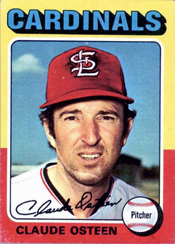
That doesn’t count the unofficial shutout Osteen crafted for the Cardinals.

On Aug. 15, 1974, the Cardinals acquired Osteen from the Astros for minor-league pitcher Ron Selak and a player to be named (another pitching prospect, Dan Larson).

Rusty from inactivity and unable to find a groove, Osteen didn’t produce a win for the contending Cardinals, but he did deliver a special performance in a remarkable game. 

Entering in the 14th inning, Osteen held the Mets scoreless until the 23rd _ 9.1 innings, or basically the equivalent of a complete game. Though he departed with the score still tied, the Cardinals eventually won in the 25th.

Prep phenom

Osteen was born in Caney Springs, Tennessee, a hamlet 45 miles south of Nashville. As The Tennessean newspaper noted, “Almost everybody who lives in Caney Springs is kin to Osteen.”

Growing up there, he played baseball in cow pastures, learned to throw a curve and advanced to a 4-H Club team when he was 12. At 14, he moved with his family to Cincinnati, where his father took a job with General Electric.

Pitching for Reading High School, Osteen was 29-3 in three varsity seasons, including 16-0 as a senior in 1957 when his team became state champions.

Though his high school coach scouted for the Dodgers, who made an offer, Osteen accepted a contract with the Reds on July 2, 1957. “I signed with Cincinnati for several reasons,” Osteen told the Nashville Banner. “My folks wanted me to, for one. Besides, (the Reds) promised me I could stay with the club for a while instead of going right out to the minors.”

(Cardinals general manager Frank Lane said to the Cincinnati Enquirer, “We were interested in Osteen, but not to the extent of … putting him on our roster.”)

Major step up

Four days after signing, Osteen, 17, made his big-league debut against the Cardinals at Cincinnati. Si Burick of the Dayton Daily News described him as a skinny southpaw, “his cap cocked on the side of his head,” who “doesn’t look strong enough to throw the ball to the plate.”

According to Earl Lawson of The Cincinnati Post, Reds pitcher Art Fowler, 35, took one look at Osteen warming up and said, “My son can throw harder than he can.”

Cardinals backup catcher Walker Cooper, 42, told Osteen, “Little Leaguers are supposed to pitch from 40 feet out,” Lawson reported.

Entering in the seventh inning with two on, one out and St. Louis ahead, 10-3, Osteen faced five batters. He retired two, walked one, gave up two singles, threw a wild pitch and yielded a run. “A lot of fun,” he told the Enquirer. “I was a little nervous and I thought I might have been worse than I was, but it was a thrill.” Boxscore

(Catching the rookie from Caney Springs, Tennessee, that day was Ed Bailey from Strawberry Plains, Tennessee.)

The next day, Osteen faced the Cardinals again and pitched a scoreless ninth. Boxscore

Having fulfilled their pledge to let Osteen experience the big leagues, the Reds sent him to their Nashville farm club managed by Dick Sisler, the former Cardinal. Called back in September, Osteen made one scoreless relief appearance against the Cubs, striking out Ernie Banks with the bases loaded. Boxscore

Good moves

Osteen spent most of the next two seasons (1958-59) in the minors. Primarily a reliever with the 1960 Reds, he had a 5.03 ERA and was demoted the next year.

Osteen never got a win for the Reds. Other pitching prospects, Jim Maloney and Jim O’Toole, advanced ahead of him. In the book “We Played the Game,” O’Toole said, “I didn’t let anybody push me around like they did Claude Osteen. He’d throw what the catcher wanted instead of his best pitches and get hit hard.”

In September 1961, with the Reds on their way to winning the pennant, Osteen, 22, was traded to the Washington Senators, an American League expansion team. The Senators finished in last place in each of Osteen’s first three seasons with them (1961-63) but he got to start regularly and figured out how to survive.

“The big difference in my pitching now and when I was in the minors and with the Reds is I no longer try to strike out a lot of guys,” Osteen told the Nashville Banner in July 1962. “I realize I can’t strike out everybody up here. So I’m just trying to make them hit a bad pitch and let my fielders do some work.”

Osteen’s breakout season came in 1964 when he won 15 for the ninth-place Senators (62-100). Afterward, the Dodgers acquired him in a deal that sent slugger Frank Howard to Washington. The move vaulted Osteen from baseball’s basement into a starting rotation with Sandy Koufax and Don Drysdale.

Hollywood material

When he joined the Dodgers, Osteen’s teammates nicknamed him Gomer because they thought he resembled actor Jim Nabors, who played the character of Gomer Pyle on “The Andy Griffith Show” (1962-64) and then on “Gomer Pyle: USMC” (1964-69). “One day, Jim Nabors comes to the clubhouse and we start talking about all that downhome stuff _ he’s from Alabama _ and doggoned if we didn’t become good friends,” Osteen told the Los Angeles Times.

Osteen (15 wins, 2.79 ERA) joined Koufax (26 wins, 2.04) and Drysdale (23 wins, 2.77) in forming a formidable top of the rotation for the 1965 Dodgers, who dethroned the Cardinals as National League champions.

After the Twins beat Drysdale and Koufax in the first two games of the World Series, Osteen turned the tide with a shutout in Game 3. The Dodgers went on to win the title in seven games. “If Claude hadn’t beaten us in that third game, we’d be the world champions,” Twins first baseman Don Mincher told The Tennessean. Boxscore

The Dodgers repeated as National League champions in 1966 (Osteen won 17 and had a 2.85 ERA) but were swept by the Orioles in the World Series. In Game 3, Osteen allowed one run in seven innings but Wally Bunker pitched a shutout and the Orioles won, 1-0. Boxscore

Osteen was a 20-game winner for the Dodgers in 1969 and again in 1972. He had double-digit wins in each of his nine seasons with them. “He is as dependable as sunset,” Jim Murray wrote in the Los Angeles Times.

Dodgers manager Walter Alston told The Tennessean, “There’s not a more reliable guy around … He gets about as much out of his stuff as anybody in the majors.”

In 1973, Osteen was 16-6 for the first-place Dodgers with one month remaining in the season, but he lost his last five decisions and the club went 12-14 in September, finishing second to the Reds. Afterward, he was traded to the Astros for outfielder Jim Wynn.

Houston, we have a problem

Osteen was the Astros’ first $100,000 salary player and was expected to make them contenders. [The highest-paid player in 1974 was White Sox slugger Dick Allen at $233,000, according to the Miami Herald. Leading the 1974 Cardinals: Bob Gibson ($160,000), Joe Torre ($140,000), Lou Brock ($110,000).]

One of the foes Osteen did best against in 1974 was the Cardinals. He beat them with a complete game in May and did it again in July. Osteen entered the all-star break at 9-7 with a 3.15 ERA. Boxscore and Boxscore

Though his fastball wasn’t sinking, and his curve and slider were hanging, “I was winning mostly on know-how and moving the ball around,” Osteen told The Sporting News.

Following the break, Osteen started twice and got shelled. He didn’t appear in a game for the next 17 days. “It was a very frustrating thing for me to find myself sitting on a bench,” Osteen told The Tennessean.

On Aug. 15, in a game against the Cubs, Osteen was told to get ready to relieve J.R. Richard. While Osteen warmed up, manager Preston Gomez waved for him to come to the dugout. “That’s when he took me aside and told me the deal had been made” with the Cardinals, Osteen told the St. Louis Post-Dispatch.

Stranger things

The first-place Cardinals projected Osteen, 35, as a replacement for ailing starter Sonny Siebert. Cardinals general manager Bing Devine “told me he had not bought my contract merely to have me help them finish out the 1974 season,” Osteen said to The Tennessean. “He said he thought I had a couple of more good years. I agree with him.”

In his Cardinals debut, a start against the Braves, Osteen couldn’t protect a 5-0 lead and was lifted in the fourth. For the 14th time in his career, Hank Aaron hit a home run against Osteen, sparking the Braves’ comeback. Boxscore

Moved to the bullpen, Osteen was used mostly in mop-up roles. As a starter, he’d developed a rhythm, knowing he’d pitch every four days. This was different.

“I had no idea how to go about being a reliever,” Osteen said to United Press International. “I didn’t know how to warm up, how long to warm up, how to get used to sitting around, waiting so much. At first, I found I was wearing myself out getting up and down (and) throwing.”

One and done

In a game against the Mets, Cardinals manager Red Schoendienst turned to Osteen in the 14th inning. Pitching like he had in his prime with the Dodgers, Osteen held the Mets scoreless until being relieved by Siebert with two outs in the 23rd. The Cardinals won in the 25th when Bake McBride scored from first base on a wild pickoff throw.

Osteen’s line: 9.1 innings, no runs, four hits, two walks. Boxscore

That was Osteen’s highlight as a Cardinal. He made eight appearances for them and was 0-2 with a 4.37 ERA. Osteen called the 1974 season “a totally lost year” and “confusing,” the Post-Dispatch reported.

At Cardinals spring training in 1975, Osteen was “a prime candidate for the job as No. 5 starter,” according to the Post-Dispatch.

The Cardinals, though, had acquired another veteran left-hander, Ray Sadecki, 35.

Osteen posted a 3.91 ERA in 23 innings during spring training. Sadecki had a 9.00 ERA in 13.2 innings, but the Cardinals opted to keep him and release Osteen. Sadecki is “used to coming out of the bullpen,” Red Schoendienst explained to the Post-Dispatch.

Cardinals coach

Athletics owner Charlie Finley said a deal to sign Osteen “is virtually completed,” the Oakland Tribune reported, but the White Sox swept in and got him instead.

Osteen, 36, made 37 starts for the 1975 White Sox but lost 16 of 23 decisions in his final season. His career record: 196-195, 3.30 ERA.

Osteen bought a chicken farm near Hershey, Pa. During the 1976 baseball season, he was pitching coach for the Phillies’ farm club in Reading, Pa.

In October 1976, the Cardinals hired Vern Rapp to replace Red Schoendienst as manager. Osteen was surprised when Bing Devine called, asking him to meet with Rapp in New York during the 1976 World Series to discuss the Cardinals’ pitching coach job.

“I had never met Rapp,” Osteen said to The Tennessean. “I spent about three hours with Vern, talking about pitching. Before we finished, he picked up the telephone and called Bing and told him I was the man he wanted.”

Osteen spent four seasons (1977-80) as Cardinals pitching coach. He had the same job with the Phillies (1982-88), Rangers (1993-94), Dodgers (1999-2000). Three Phillies pitchers won Cy Young awards with Osteen as their coach _ Steve Carlton (1982), John Denny (1983) and Steve Bedrosian (1987).

Read Full Post »

Pitcher Nelson Chittum never spent a full season in the majors, but during his time there he mingled with the sport’s aristocracy. For example:

_ In his big-league debut with the Cardinals, he got a start against the Dodgers and was opposed by Sandy Koufax.

_ In parts of three seasons in the majors, Chittum was a teammate of Stan Musial and Ted Williams. Chittum and Musial were road roommates for a while with the Cardinals. Then, with the Red Sox, Williams delivered a hit that helped set up Chittum to earn his first win.

_ In his best game as a Cardinal, Chittum struck out a pair of future Hall of Famers, Roberto Clemente and Bill Mazeroski.

In 40 big-league appearances, Chittum was 3-1 with a 3.84 ERA. Most of his professional career was spent as a starter in the minors.

Pitching prospect

Chittum moved with his family from Harrisonburg, Va., to Elizabethtown, Pa., about 20 miles from the state capital of Harrisburg, as a youth.

A right-handed pitcher, he threw two perfect games in high school. After he graduated in 1951, Chittum was approached by the Cardinals but opted instead to attend Elizabethtown College, according to the Elizabethtown Chronicle.

After two seasons of college baseball for coach Ira R. Herr, Chittum, 20, was signed by Cardinals scout Fred “Dutch” Dorman in October 1953. A week later, he was inducted into the U.S. Army and served for two years.

At 23, Chittum made his professional debut with the Cardinals’ Fresno farm club in the California League in 1956. A lanky sinkerball specialist, Chittum posted a 23-7 record in the regular season and pitched 266 innings. He earned three more wins in the playoffs, giving him a total of 26 for the year.

Promoted to the Cardinals’ Houston farm club, managed by Harry Walker, in 1957, Chittum was 16-12, developing a slider taught to him by pitching instructor Johnny Grodzicki.

“Nels is a low ball pitcher,” Houston general manager Art Routzong said to United Press. “He’s real tough and he’s got marvelous control until he lets loose with a high one. He’s hard to hit, real hard, when he keeps that ball down.”

Houston catcher Ray Dabek told the wire service, “You ought to get behind the screen and watch his ball move. He’s really got something on it. He has a good fastball that sort of sinks, and a good slider. Real good.”

Big-league debut

After compiling a 12-8 record and 2.84 ERA for manager Johnny Keane’s Omaha farm team in 1958, Chittum, 25, was called up to the Cardinals in August that year and given a start against Koufax and the Dodgers at Los Angeles.

Koufax, 22, was not yet the dominant ace he would become later with the Dodgers. He entered the start with a season record of 9-5 and a 4.19 ERA.

The first two Cardinals batters of the game, Curt Flood and Gene Freese, hit home runs against Koufax. The Cardinals totaled four runs in the inning.

Staked to the 4-0 lead, Chittum held the Dodgers scoreless in the first two innings. Koufax was taken out in the second.

The Cardinals made it 5-0 when Chittum got his first big-league hit, a single against Babe Birrer that scored catcher Gene Green from second.

Chittum, however, was unable to hold down the Dodgers, in part, because of poor fielding by his teammates. With two outs in the third, the Dodgers scored on a Gil Hodges bloop single “which Freese lost in the sun and which should, instead, have been taken in short left by Del Ennis,” the St. Louis Post-Dispatch reported. A Chittum balk brought in the Dodgers’ second run of the inning, cutting the St. Louis lead to 5-2.

In the fourth, the Cardinals scored three times, extending the lead to 8-2, but the Dodgers knocked out Chittum before he could retire a batter in the bottom half of the inning. Ken Boyer let a Charlie Neal grounder go over his shoulder for a fluke single. Two more singles followed, loading the bases. Carl Furillo, batting for reliever Fred Kipp, then doubled, driving in all three runners and making the score 8-5. After Jim Gilliam bunted for a single, Jim Brosnan relieved Chittum.

Brosnan limited the Dodgers to one run in six innings and got the win. Boxscore

St. Louis shakeup

Chittum next made two relief appearances for the Cardinals. The best of those outings was when he pitched 4.1 scoreless innings against the Pirates, including strikeouts of Clemente and Mazeroski. Boxscore

Three nights later, in the series finale versus the Pirates, Chittum started. He gave up three runs (a Dick Stuart solo home run and a two-run shot by Bob Skinner) in three innings and was the losing pitcher. Boxscore

Chittum pitched in nine more games, all in relief, for the 1958 Cardinals. According to the Spokane Spokesman-Review, the quiet rookie roomed with Musial on a couple of road trips.

With 10 games remaining, Cardinals general manager Bing Devine, on orders from club owner Gussie Busch, fired manager Fred Hutchinson.

A month later, with new manager Solly Hemus, the Cardinals traveled to Japan for a goodwill tour. Chittum opted not to go because he had committed to playing winter baseball in the Dominican Republic. “Maybe I missed my chance to impress (Hemus) in Japan,” Chittum told the Minneapolis Star Tribune, “but I know I didn’t stand much chance in the St. Louis organization.”

Moving on

At 1959 spring training, Cardinals pitcher Sal Maglie (who would become an instructor that season) said Chittum needed to develop a better curve to stay in the majors, the Elizabethtown Chronicle reported. Then, on March 15, 1959, Chittum was traded to the Red Sox for pitcher Dean Stone.

The Red Sox assigned Chittum to their farm team at Minneapolis, managed by Gene Mauch, who told the Star Tribune. “Nels … was one of the best right-handers in our league last year (with Omaha). He beat the top clubs.” One of those wins was a shutout against Minneapolis and Stone.

Red Sox farm director Johnny Murphy, a former Yankees reliever, noticed a flaw in Chittum’s delivery and worked with him to correct it. “When I let the ball go, it was traveling up instead of down, and it was taking all my stuff off,” Chittum told the Elizabethtown Chronicle. “John changed my motion so that now when I release the ball it travels in a downward arc.”

Chittum was 11-5 for Minneapolis when the Red Sox called him up for the last two months of the 1959 season.

On Aug. 28, 1959, the Orioles led the Red Sox, 4-2, in the seventh when Ted Williams, batting for catcher Sammy White, doubled, scoring Frank Malzone from second and getting Boston within a run at 4-3. Chittum entered in the eighth, pitched three scoreless innings and got the win, his first in the majors, when the Red Sox rallied. Boxscore

In September, Chittum got two more wins, beating the Indians and Senators. He finished 3-0 with a 1.19 ERA for the 1959 Red Sox. Chittum allowed earned runs in just two of 21 appearances and no one hit a home run against him.

No vacancies

Sal Maglie replaced Boo Ferriss as Red Sox pitching coach in 1960.

On April 6, on their way from spring training in St. Petersburg, Fla., to San Francisco to open the 1960 season at the new Candlestick Park, the Cardinals stopped in Scottsdale, Ariz., for an exhibition game against the Red Sox. Chittum, in relief of Bill Monbouquette, pitched 1.2 innings against his former team and gave up one run. Ted Williams had two singles in three at-bats but was upstaged by Stan Musial, whose three-run home run versus Ted Bowsfield in the eighth carried the Cardinals to a 13-10 victory.

(Asked on a 1962 questionnaire to name his biggest thrill in baseball, Chittum answered, “It has to be being teammates with two of the all-time great players _ Stan Musial and Ted Williams,” the Spokane Spokesman-Review reported.)

Chittum began the 1960 season with the Red Sox but on May 6 was traded to the Dodgers for Rip Repulski, the former Cardinal, and assigned to the minors. (In his first at-bat for the Red Sox, Repulski hit a grand slam. Boxscore)

Chittum never returned to the majors. In 1961, he was “packed and almost out the door” on his way to the Angels, an American League expansion club, but at the last moment the Dodgers reconsidered, the Elizabethtown Chronicle reported.

After pitching his last season for Rochester in 1964, Chittum managed a men’s clothing store and then became a U.S. postal inspector.

In February 1965, baseball innovator Bill Veeck told a banquet audience in Lancaster, Pa., he wanted to see interleague play, the elimination of the intentional walk, and a designated hitter for the pitcher.

Asked his opinion of a designated hitter, Chittum told the Lancaster New Era, “That’s a bunch of baloney … That would take the fun out of it. It’d be like telling some guys on a basketball team they had to play defense and couldn’t shoot.”

Read Full Post »

John Lackey was a big guy (6-foot-6) with a big presence on the mound who often came up big in the biggest games.

On July 31, 2014, the Cardinals acquired Lackey from the Red Sox for outfielder Allen Craig and pitcher Joe Kelly. The Red Sox also sent the Cardinals a minor-league pitcher, Corey Littrell, and $1.75 million cash.

Just nine months earlier with the Red Sox, Lackey beat the Cardinals in the decisive Game 6 of the 2013 World Series, making him the first pitcher to start and win the clinching game of a World Series for two franchises. As an Angels rookie, he started and won Game 7 of the 2002 World Series against the Giants.

David Eckstein, shortstop for two World Series champions (2002 Angels, 2006 Cardinals), said to the St. Louis Post-Dispatch about Lackey, “The bigger the stage, the better the performance. The bigger the game, the better he is.”

Lackey’s success in big games was an obvious quality that appealed to the Cardinals. Another was his demeanor. On the mound, Lackey was intense, edgy. Or, as Cubs catcher David Ross described it to the Chicago Tribune, full of “competitive fire.” The Cardinals would benefit from that kind of approach.

Pitching provides path

Lackey, naturally, came from a big state _ Texas. He was born and raised in Abilene. In high school, Lackey played almost exclusively at first base and hit .541 as a senior.

He went to the University of Texas-Arlington as a first baseman, but also was given the chance to pitch his freshman season. Then he enrolled at Grayson College in Denison, Texas, where he planned to play one season before transferring to Texas Tech.

At Grayson, Lackey, a right-hander, developed his pitching skills. “I like it a lot,” he told the Abilene News-Reporter in May 1999. “It gives me a chance to be in control of the game. It’s been fun so far. I still like to hit, though.”

Grayson won the national junior college baseball championship in 1999 and Lackey canceled his plans of transferring to Texas Tech when the Angels selected him in the second round of the 1999 amateur draft.

Three years later, in June 2002, he made his Angels debut, replacing Scott Schoeneweis in the starting rotation.

Rookie won’t rattle

Lackey, 23, made 18 regular-season starts for the 2002 Angels and was 9-4. He lost just once in his final seven starts of the season and won the game that clinched the Angels’ first playoff berth in 16 years.

“A lot of John’s success is due to his makeup, which started long before he pitched in the major leagues,” Angels manager Mike Scioscia told the San Gabriel Valley Tribune. “His passion for the game and his makeup and his willingness to work … You mix that with his talent, it’s an incredible combination.”

In the American League Championship Series against the Twins, Lackey started Game 4 and pitched seven scoreless innings for the win. Boxscore The Angels clinched the pennant the next day, reaching the World Series for the first time.

When Scioscia chose Lackey to start World Series Game 7 versus the Giants, Angels closer Troy Percival told the Los Angeles Times, “You couldn’t ask for a better man to be out there than Lackey. He’s not scared of anything.”

Lackey did the job, allowing one run in five innings and becoming the first rookie since the Pirates’ Babe Adams in 1909 to win a World Series Game 7. Boxscore

Noting how Lackey established the inside fastball early in the game, Angels pitching coach Bud Black told the New York Times, “You can’t discount experience, but a lot of times youthful aggressiveness pays off.”

Lackey said to the Los Angeles Times, “If you don’t want to go out there with a little pressure and pitching in big games, you shouldn’t be around.”

Lackey pitched eight seasons (2002-09) with the Angels, posting a 102-71 record, then became a free agent and took a five-year contract from the Red Sox for $82.5 million.

Getting it done

When the Red Sox missed qualifying for the playoffs in 2010 and 2011, “Lackey became one of the symbols of what had gone wrong,” the Boston Globe noted. “Fans booed him and Lackey’s angry exchanges with reporters caused team officials to wince.”

Lackey tore a ligament in his right elbow during the 2011 season, managed to make 28 starts but had a 6.41 ERA. He underwent surgery and sat out the 2012 season, when the Red Sox (69-93) finished in last place.

John Farrell, a former pitcher, replaced Bobby Valentine as Red Sox manager in 2013 and Lackey returned to the rotation. The 2013 Red Sox had the best record in the American League (97-65). In the playoffs, Lackey beat the Rays in Game 2 of the Division Series and won Game 3 of the League Championship Series against the Tigers. Then he beat the Cardinals in the decisive Game 6 of the World Series. Boxscore, Boxscore, Boxscore

“You can foresee him being successful for years to come because of the style of pitcher he is,” Farrell told the Globe. “He can put the ball on the ground. Because he throws the ball on a downhill angle, he doesn’t rely on velocity as much.”

When the Red Sox floundered in 2014 and sunk to last place in July, they shopped Lackey and fellow starter Jon Lester.

Finding a bargain

The 2014 Cardinals needed a boost. After losing, 12-1, to the Padres on July 30, the Cardinals (56-50) were in third place in a five-team division. That day, they acquired pitcher Justin Masterson (4-6, 5.51 ERA) from Cleveland for a prospect, outfielder James Ramsey.

Seeking another starter, the Cardinals had their eyes on Lackey, Lester and the Rays’ David Price, according to the Post-Dispatch.

Lackey, who would turn 36 in October, became their focus. In addition to his 11-7 record for the 2014 Red Sox, Lackey had an enticing contract structure. Though owed $5.08 million for the remainder of 2014, a clause in his contract gave his team the option to bring him back in 2015 for a salary of $500,000.

When the Cardinals agreed to include Joe Kelly (2-2, 4.37 ERA), along with Allen Craig (.237, 44 RBI), the trade was made.

Get to work

Craig and Kelly were “cherished teammates” among the Cardinals and the trade “left the clubhouse stunned,” the Post-Dispatch reported.

Cardinals general manager John Mozeliak was “a little stunned,” too, “by the immediate take of disappointment” among the players, he told the Post-Dispatch.

One of the players who applauded the deal was a newcomer, catcher A.J. Pierzynski, 37. Released by the Red Sox on July 16, he signed with St. Louis five days before Lackey was acquired.

“He brings a presence,” Pierzynski told the Post-Dispatch. “He brings competitiveness, He wants the ball. He’s won big games wherever he’s been.”

As the Post-Dispatch noted, Lackey “proved reliable, if not dominant,” for the 2014 Cardinals. In 10 starts, he was 3-3. Additionally, he “brought an edge to us,” Cardinals manager Mike Matheny told the Post-Dispatch.

From 2.5 games out of first place on the day Lackey was acquired, the Cardinals finished atop their division, two games ahead of the runner-up Pirates. The Cardinals were 34-22 after Lackey joined them and finished at 90-72.

Trading Craig and Kelly sent a message that served as a wakeup call to Cardinals players. “I think we came out of it as a stronger, tougher, more energized team,” Mozeliak said to the Post-Dispatch.

Wins matter

In the 2014 National League Division Series, Lackey pitched a gem in Game 3 (seven innings, one run) and beat the Dodgers. Boxscore

He started Game 3 of the National League Championship Series versus the Giants and was lifted for a pinch-hitter in the seventh inning with the score tied. The Giants won, 5-4, and eventually prevailed in the series. Boxscore

Back with the Cardinals in 2015, Lackey, 36, was 13-10 with a 2.77 ERA and led the team in starts (33) and innings pitched (218). No Cardinal has pitched that many innings in a season since. Video

The 2015 Cardinals (100-62) had the best record in the National League and were pitted in the playoffs against the third-place finisher from their division, the Cubs, a team they’d defeated 11 times in 19 tries.

In Game 1, matched against Jon Lester, Lackey was superb (no runs, two hits, 7.1 innings) and St. Louis won. Boxscore

It was a different story in Game 4. Lackey allowed four runs in three innings. The Cardinals came back and tied the score, but the Cubs prevailed and advanced to the next round. Boxscore

Granted free agency, Lackey joined the Cubs, whose manager, Joe Maddon, coached the Angels when Lackey was with them. Reflecting on how Lackey didn’t want to be bothered on days he pitched, Maddon said to the Chicago Tribune, “Honestly, you can’t talk to him that day in the dugout.”

Lackey was 11-8 (including 1-1 with a 2.03 ERA versus the Cardinals) in 29 starts for the 2016 Cubs. Though he didn’t win a game in the 2016 World Series against Cleveland, the Cubs prevailed for the first time since 1908.

After a final season with the Cubs in 2017, Lackey finished with a career record of 188-147 and three World Series championship rings.

Read Full Post »

A right-handed pitcher and protege of Cardinals ace Harry Brecheen, Jerry Walker became the right-hand man to Cardinals general manager Walt Jocketty.

Walker was involved with professional baseball most of his adult life. At 18, he went from high school to the majors with the Orioles and was nurtured by Brecheen, the pitching coach who’d been a World Series standout with the 1946 Cardinals.

At 20, Walker became the youngest pitcher to start in an All-Star Game. He played eight seasons in the American League with the Orioles (1957-60), Athletics (1961-62) and Indians (1963-64).

After his playing days, Walker managed in the minors, then returned to the big leagues as a scout and went on to become a coach and general manager. For 13 years (1995-2007), he was an executive in the Cardinals’ front office, advising Jocketty on player personnel.

Mighty leap

Born and raised in Ada, Okla., Walker was a high school baseball phenom, posting a varsity pitching record of 52-1 and leading his club to state titles in 1956 and 1957. He hit .529 as a junior and .526 his senior season.

Most big-league teams tried to sign him, including the Red Sox, who projected Walker as a third baseman, but he chose the Orioles, in large part, because of Brecheen, an Ada resident. “Brecheen had a great deal to do with Walker’s decision,” the Baltimore Sun noted.

Brecheen told the newspaper, “I’ve known the boy and his family for a long time … I thought when I saw him in high school that he had the best curve of any kid I’d ever seen.”

After signing with the Orioles on June 28, 1957, Walker joined a pitching staff with the likes of former Negro League fastballer Connie Johnson, World War II combat veteran Hal Brown and ex-Dodgers standout Billy Loes.

A week later, Walker made a jittery big-league debut at Boston’s Fenway Park. With the Red Sox ahead, 6-2, Orioles manager Paul Richards sent Walker to pitch the seventh. He issued walks to the first two batters _ two-time American League batting champion Mickey Vernon and Jackie Jensen (past and future AL RBI leader) _ and went to a 2-and-0 count on Frank Malzone before being relieved by Art Ceccarelli, a winless left-hander. Malzone mashed a pitch that soared over the the head of right fielder Tito Francona for a triple. Boxscore

After three relief appearances, Walker made his first start, facing the hapless Athletics at Kansas City. Nervous and overanxious, he didn’t last an inning. Boxscore

Breakout game

A month later, after a few relief stints, none longer than two innings, Walker got his second start, this time at home, against the Senators. Though destined to finish in the basement, the Senators had Roy Sievers, the slugger from St. Louis who would lead the American League in home runs (42) and RBI (114) that year.

Pitching with the poise and stamina, Walker shut out the Senators for 10 innings and got the win, 1-0. He allowed four singles and a walk, totaling 111 pitches.

“Here is a kid who had never pitched nine innings in his life,” Paul Richards said to the Baltimore Sun. “The high schools where Jerry played limit their games to seven innings.”

Brecheen told the newspaper, “We knew he had a lot of ability, and he’s got a lot of heart.”

Walker dressed quickly after the game and dashed out of the clubhouse. As the Sun explained, “With a pocketful of hot change, the quiet-spoken, crew-cut kid was busting out all over in his (eagerness) to reach the nearest coin telephone to place a long-distance call to (his parents in) Oklahoma.” Boxscore

Seeing stars

After a tune-up season in the minors at Knoxville (18-4, 2.61 ERA) in 1958, Walker was one of three 20-year-old pitchers (Jack Fisher and Milt Pappas being the others) who contributed to the Orioles in 1959.

Walker sizzled early, winning his first four decisions, including a five-hitter against the Yankees. He struck out Mickey Mantle three times. Boxscore

In a rematch in July, Walker again beat the Yankees, fanning Mantle three more times and totaling 10 strikeouts for the game. “For 20 years old, you’d have to say the young man was amazing the way he struck my men out,” Yankees manager Casey Stengel said to the Sun. Boxscore

(Though he whiffed 12 times versus Walker in his career, Mantle had an on-base percentage of .500 _ 13 hits and 11 walks _ against him and slugged four home runs. Of Walker’s four career wins versus the Yankees, three came in 1959.)

A month later, Stengel, the American League manager, chose Walker to start in the All-Star Game at Los Angeles. Walker got the win, allowing one run in three innings. He twice retired the Cardinals’ Ken Boyer, struck out Eddie Mathews and got Willie Mays and Ernie Banks to ground out. Boxscore

Working overtime

On Sept. 11, 1959, the first-place White Sox, headed for an American League pennant, were at Baltimore for a Friday doubleheader on Westinghouse Night. As the Sun noted, “The air was electric with tension.”

Jack Fisher shut out the White Sox in the opener, 3-0, limiting them to three hits. Boxscore

Walker started Game 2 against a lineup headed by future Hall of Famers Luis Aparicio and Nellie Fox. He gave up two singles in the first but the White Sox never advanced another runner as far as third the rest of the night.

White Sox pitchers Barry Latman (9.1 innings) and Gerry Staley, the ex-Cardinal, were superb, too, but Walker was better. He pitched 16 scoreless innings and the Orioles prevailed, 1-0, when Brooks Robinson’s two-out single versus Staley, 39, drove in Al Pilarcik from third.

“That two 20-year-olds should pitch 25 scoreless innings in one night against the league leaders, even the light-hitting White Sox, borders on the unbelievable,” wrote Ed Brandt of the Sun.

His colleague, Lou Hatter, offered, “Walker’s performance was extra-special, incredible and then some.”

Walker told United Press International, “I could have pitched another couple of innings.” Boxscore

He finished the year 11-10 with a 2.92 ERA, but never had another winning season in the majors.

On the move

In 1960, Walker suffered from allergies “that sapped his strength,” the Sun reported, and posted a 3-4 season record. “From what they told me, I guess I was allergic to just about everything,” Walker told the Kansas City Times. “They gave me some shots and also some pills to take regularly. The shots are a long-range treatment and the doctors seem to think they should clear up the trouble completely in two or three years.”

Traded to the Athletics in April 1961, he spent two years with them, went 16-23 and got dealt again, to Cleveland, where he played his final two seasons in the majors. A highlight came on July 13, 1963, when Walker pitched four scoreless innings of relief, helping Cleveland teammate Early Wynn, 43, get career win No. 300. Boxscore

In May 1964, Walker was loaned by Cleveland to the Cardinals’ Class AAA farm club, the Jacksonville Suns, managed by Harry Walker (no relation). His teammates included pitchers Mike Cuellar, Bob Humphreys, Gordon Richardson and Barney Schultz, who went on to help the Cardinals win a pennant and World Series championship that season.

Walker was 10-9 with Jacksonville, including a one-hitter in a 1-0 victory versus Richmond in 10 innings. Called up to Cleveland in September, he pitched his final big-league games that month.

Still in the game

Walker was a manager in the Yankees’ farm system for six seasons (1968-73) and his pitchers included a pair of future American League Cy Young Award winners _ Ron Guidry and LaMarr Hoyt. Walker was a Yankees scout from 1974 to 1981, then became their pitching coach for parts of the 1981 and 1982 seasons.

From 1983-85, Walker was Astros pitching coach. His staff ace was Nolan Ryan.

After a stint from 1986-91 as special assignment scout for the Tigers, Walker was promoted to general manager by club president Bo Schembechler and tasked with rebuilding the roster. As Gene Guidi of the Detroit Free Press noted, “Walker stepped into a tough spot in Detroit. He wants to make the Tigers a better team but he has few marketable players to trade and a limited spending budget to pursue free agents.”

In Walker’s first season as general manager, the Tigers were 75-87. They improved to 85-77 in 1993, but the franchise underwent an ownership change, and Walker was fired in January 1994.

Cardinals influencer

In November 1994, Walt Jocketty, who replaced Dal Maxvill as Cardinals general manager, hired Walker to be the club’s director of major league player personnel. “He was the first guy I hired in St. Louis,” Jocketty told the Cincinnati Enquirer.

“Walker’s duties will feature special assignment scouting and recommendations to Jocketty,” the St. Louis Post-Dispatch reported.

Three years later, in February 1997, Walker was promoted, with the title of vice president of player personnel. The Post-Dispatch referred to him as Jocketty’s “right-hand man.”

According to the Cardinals 1997 media guide, Walker “assists Jocketty in personnel matters with the major league club and he is also responsible for overseeing the Cardinals player development and scouting activities.”

One of the up-and-coming Cardinals staffers in 1997 was a scouting assistant, John Mozeliak. According to the Post-Dispatch, Walker was a mentor to Mozeliak.

During Walker’s 13 years with the Cardinals, they won two National League pennants (2004 and 2006) and a World Series title (2006).

In October 2007, Jocketty was fired and replaced by Mozeliak. “One of Walt’s strong points was how he used his people,” Walker told the Post-Dispatch. “He allowed Mo (Mozeliak) to be involved, to increase his responsibilities.”

When the Reds then hired Jocketty to be team president and general manager, he brought in Walker to serve as his special assistant for player personnel.

Read Full Post »

« Newer Posts - Older Posts »