Feeds:
Posts
Comments

Archive for the ‘Games’ Category

(Updated July 17, 2020)

For Bob Gibson, a win was more important than a record.

bob_gibson17Gibson became the first National League pitcher to achieve 3,000 career strikeouts. On July 17, 1974, the Cardinals ace struck out the Reds’ Cesar Geronimo to become the second big-league pitcher to strike out 3,000 batters.

Walter Johnson of the American League Senators struck out 3,509 from 1907-1927.

Gibson, 38, achieved his milestone by getting Geronimo to strike out on a high fastball to end the second inning. The crowd of 28,743 at Busch Stadium in St. Louis gave Gibson a lengthy standing ovation. As he neared the Cardinals dugout, he doffed his cap to the appreciative fans.

Before the game, quite aware Gibson was approaching the milestone, Reds first baseman Tony Perez ranked which teammates would be most likely to be Gibson’s 3,000th strikeout victim and he correctly predicted it would Geronimo, according to Bob Hertzel of the Cincinnati Enquirer.

With Tim McCarver catching on that Wednesday night, Gibson recorded three more strikeouts, including Johnny Bench and Geronimo again, before being lifted for pinch-hitter Luis Melendez in the seventh with the score tied at 4-4. The Reds won, 6-4, in 12 innings.

Pensive occasion

Afterward, reporters discovered Gibson departed the clubhouse quickly and wasn’t available to talk about his achievement.

In his book “Stranger to the Game,” Gibson said, “It wasn’t a grand occasion. I was taken out in the (seventh) for a pinch-hitter and we lost the game.”

Gibson yielded four runs and 10 hits, walking two.

“I thought he was getting a little tired,” Cardinals manager Red Schoendienst said to the Associated Press in explaining why he removed Gibson. “He was also leading off the (seventh) inning and I thought we might get a run.” Boxscore

Adding to a pensive atmosphere, despite the milestone strikeout, was the news Dizzy Dean, 64, had died that day. The Hall of Fame pitcher held the Cardinals’ record for career strikeouts (1,095) until Gibson surpassed the mark. Gibson finished his Cardinals career with a franchise-leading 3,117 strikeouts.

Geronimo struck out nine times in 21 career at-bats versus Gibson.

Big-name victims

The players who struck out the most against Gibson:

_ Willie Stargell, 41 strikeouts

_ Donn Clendenon, 37 strikeouts

_ Ron Santo, 35 strikeouts

_ Hank Aaron, 32 strikeouts

_ Roberto Clemente, 32 strikeouts

_ Tony Taylor, 32 strikeouts

The first big-league batter Gibson struck out was Willie “Puddin’ Head” Jones of the Reds on July 30, 1959. Boxscore

Jim Pagliaroni of the Pirates was the 1,000th batter to strike out against Gibson and Clemente was the 2,000th batter to do so.


Read Full Post »

(Updated June 12, 2023)

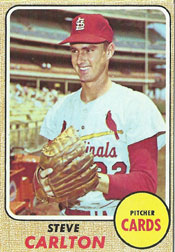
Steve Carlton posted a 1.65 ERA in 142 innings before the all-star break for the 1969 Cardinals.

steve_carlton4In five consecutive 1969 starts between June 27 and July 16, Carlton yielded a total of five runs, getting wins in all five games. That stretch boosted Carlton’s record to 12-5, earning him the National League starting pitching assignment for the All-Star Game.

Carlton credited an effective slider for his streak of success in the first half of 1969.

Tested in Japan

After the 1968 season, the Cardinals went on an exhibition tour of Japan. Carlton primarily had been using a fastball and a curve in the National League. He wanted to develop a third pitch and decided to use the games against the Japanese teams to test a slider.

“I needed something to keep the right-handed batters away from the plate,” Carlton said to The Sporting News. “I wasn’t throwing the fastball inside on right-handers enough and sometimes, when I got it inside, it would sail right over the plate _ and that’s a bad pitch.”

Carlton struck out Japanese home run king Sadaharu Oh on a slider. Confident in his ability to throw the pitch, Carlton informed Cardinals pitching coach Billy Muffett at spring training camp in February 1969 he intended to add the slider to his mix.

“Billy said he wanted to think about it,” Carlton said. “The slider puts more strain on your arm than a fastball or a curve.”

After Carlton lost four of his first six decisions in 1969, Muffett gave approval to use the slider.

“Billy said it was OK to try the slider so long as it didn’t strain my arm and didn’t take anything away from my curve,” Carlton said.

Salute from Sandy

The Sporting News hailed Carlton’s development of the slider to go with “one of the best curveballs in the business.”

Sandy Koufax, the retired Dodgers left-hander who was broadcasting games for NBC, congratulated Carlton after a win. “He said he was very impressed with my slider,” Carlton said.

Catcher Tim McCarver, in his book “Baseball for Brain Surgeons and Other Fans,” said, “Carlton had the best slider I’ve ever seen because he gripped the ball so tightly in his hand that it would spin like a gyroscope and go down into right-handed batters.

“Because he held the ball so tightly, its seams had, from the perspective of the catcher and batter, a dime spin. That means it moves faster and goes down with more bite. The tighter the spin, the more controlled the pitch can be, and Carlton could put it right where he wanted it.”

In explaining why the slider was so effective, Carlton said, “Now a batter can’t come up to the plate knowing he has to guess only curve or fastball. He has to think about the slider. The right-handed batters can’t just sit and wait for the fastball outside. I’ve been throwing the slider about 25 percent of the time. It’s easier to control than a big, sweeping curve.”

Carlton was the winning pitcher in the 1969 All-Star Game, yielding solo home runs to Frank Howard and Bill Freehan in three innings. He finished the 1969 season with a 17-11 record and ranked second in the National League in ERA at 2.17, behind Juan Marichal of the Giants (2.10) and just ahead of Cardinals teammate Bob Gibson (2.18).

After a 20-win season for the Cardinals in 1971, Carlton was traded to the Phillies. He won the Cy Young Award four times and finished his Hall of Fame career ranked second all-time in wins among left-handers at 329, behind Warren Spahn (363).


Read Full Post »

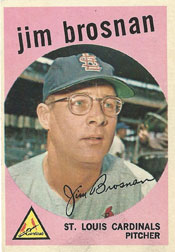
After the Cardinals acquired Jim Brosnan from the Cubs in 1958, he became a premier reliever and an accomplished author.

jim_brosnanBrosnan pitched for the Cardinals in 1958 and 1959 and wrote baseball books such as “The Long Season,” “Pennant Race” and “The Ted Simmons Story.”

“The Long Season” chronicled Brosnan’s 1959 season with the Cardinals and Reds. “Pennant Race” was a diary about Brosnan’s season with the 1961 National League champion Reds. Both books rank among the best and most influential written about baseball. Brosnan, nicknamed “Professor” during his playing days, wrote with sly wit and intelligence.

“The Ted Simmons Story,” written while the Hall of Fame catcher was at the height of his Cardinals career, was a perfect pairing of author and subject. Brosnan and Simmons were two of the smartest, original thinkers to play the game.

Scholar joins St. Louis

Acquired from the Cubs for shortstop Alvin Dark on May 20, 1958, Brosnan was a starting pitcher before being converted into a reliever by Cardinals manager Fred Hutchinson. In 12 starts for the 1958 Cardinals, Brosnan was 4-3 with a 4.50 ERA. In 21 relief appearances, he was 4-1 with seven saves and a 1.67 ERA. His overall numbers for the 1958 Cardinals: 8-4, 3.44 ERA in 33 games.

Oscar Kahan of The Sporting News wrote, “The scholarly, bespectacled right-hander … developed into one of the sharpest bullpen men in the National League.”

After the 1958 season, the Cardinals went on an exhibition tour of Japan. Brosnan filed articles about the trip for the St. Louis Post-Dispatch. In describing their arrival during a stopover in Hawaii, Brosnan wrote the team was greeted “by girls with leis who did their celebrated walk forward, placed the garlands around each blushing player’s neck and whispered ‘Aloha’ while nuzzling the right cheek.”

Aloha, Brosnan informed his St. Louis readers, “is used to say hello, to say goodbye and even just to be friendly when having nothing else to say.”

In “The Long Season,” Brosnan described how Cardinals teammates Don Blasingame and Joe Cunningham were out to “see everything and do everything” during the Japan trip.

“The Japanese bath is an unusual custom for an Occidental to enjoy, but it is an easy habit to get into,” Brosnan wrote. “If it’s not the first thing to do after you land in Japan, it may well be the last before you leave … Cunningham and Blasingame, in their anxiety to do the right thing by the Japanese as well as themselves, absorbed a maximum of Oriental culture on the last day and night of our stay in Tokyo. The rising sun found them padding quietly and contentedly through the lobby of the Imperial Hotel. Sleepless, perhaps, but loose as a goose, like they say.”

Columnist Red Smith described Brosnan the author as “provocative, blunt and highly entertaining. He writes well enough so he doesn’t have to rely on obscenity and scatology as a substitute for an ear for dialogue.”

St. Louis stumble

In 1959, Brosnan experienced a disastrous Opening Day against the Giants at St. Louis. With the Cardinals ahead, 4-3, manager Solly Hemus lifted starter Larry Jackson after seven innings and brought in Brosnan. The Giants scored twice against him in the eighth for a 5-4 lead.

In the bottom half of the inning, Alex Grammas had a RBI-single, tying the score at 5-5. Hemus could have removed Brosnan for a pinch-hitter, but allowed him to remain in the game to pitch the ninth.

Brosnan walked the leadoff batter and, one out later, Jackie Brandt hit a RBI-double. The Giants won, 6-5. Brosnan got the loss and was booed. Boxscore

In “The Long Season,” Brosnan wrote, “It doesn’t take very long, really, to lose your confidence. To embarrass yourself, jeopardize your position, maybe lose your job. Hemus went a long way with me. He could have taken me out. He should have taken me out.”

Heading to hometown

Brosnan allowed eight runs in six relief appearances from May 1 to May 10, 1959. In The Sporting News, Ralph Ray wrote, “From one of the best relief men in the NL a year ago … Brosnan turned into a dud as a fireman.”

Hoping a change in routine would help, Hemus gave Brosnan a start against the Phillies on June 7, 1959, at Philadelphia. It was a bust. Brosnan gave up four runs before he was yanked with one out in the first. The Phillies won, 11-9. Boxscore

The next day, back in St. Louis, Brosnan and his wife dined at Stan Musial’s restaurant. When they returned to the George Washington Hotel, where Brosnan resided during the season, a desk clerk called to Brosnan as he crossed the lobby.

“Solly Hemus was here just a while ago, Mr. Brosnan,” the clerk said. “He left this letter.”

Brosnan waited to open the envelope until he got to his room. The letter, from general manager Bing Devine, informed Brosnan he’d been traded to the Reds for pitcher Hal Jeffcoat. The date was June 8, 1959.

“I sat back on the couch, half-breathing as I waited for the indignation to flush good red blood to my head,” Brosnan wrote. “Nothing happened. I took a deep breath, then exhaled slowly. It’s true. The second time you’re sold you don’t feel a thing.”

Brosnan was 1-3 with two saves and a 4.91 ERA in 20 games for the 1959 Cardinals.

Born and raised in Cincinnati, he regained his form with the Reds and was reunited with Hutchinson, who became the Reds manager in July 1959. Brosnan was 10-4 with 16 saves and a 3.04 ERA in 53 appearances for the 1961 National League champion Reds.

In a nine-year major-league career with the Cubs, Cardinals, Reds and White Sox, Brosnan was 55-47 with 67 saves and a 3.54 ERA.

Read Full Post »

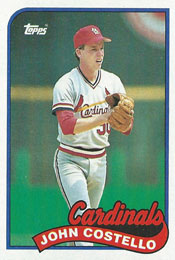
In his major-league debut, Cardinals reliever John Costello escaped an inherited bases-loaded jam, struck out the side in the next inning and earned the win.

john_costelloTwenty-six years later, on June 16, 2014, Nick Greenwood became the first Cardinals reliever to earn a win in his major-league debut since Costello did so on June 2, 1988, at Philadelphia.

Costello and Greenwood achieved their feats under very different circumstances.

Greenwood, 26, a left-hander, relieved starter Carlos Martinez to begin the fifth inning with the Cardinals leading the Mets, 2-1, at St. Louis. Greenwood held the Mets to a run in 3.1 innings and the Cardinals won, 6-2. Greenwood got the win because Martinez didn’t pitch the necessary five innings for a starter to qualify for a win. Boxscore

Costello, 27, a right-hander, was brought in by manager Whitey Herzog to replace reliever Steve Peters with the score tied at 2-2 in the 13th inning at Philadelphia. The Phillies had the bases loaded and one out.

“I didn’t have much alternative,” Herzog told the St. Louis Post-Dispatch.

Tough spot

The Cardinals had used six pitchers in the game after also using six the night before in a 13-inning victory against the Astros at Houston.

Said Herzog: “That was a hell of a place to put him in.”

After Herzog handed the ball to Costello and left the mound, catcher Tony Pena began a conversation with the newcomer. According to the Post-Dispatch, the talk went like this:

Pena: “What you got?”

Costello: “I’ve got three pitches _ fastball, slider, changeup.”

Then Costello told Pena to forget about the latter two and just call for the fastball.

“When he started laughing,” Costello told United Press International, “that broke the nervousness.”

Costello had another reason to focus on fastballs. He was experiencing stiffness in his right shoulder. “But the adrenaline took over and took the pain away,” Costello told the Post-Dispatch.

The first batter he faced, Chris James, hit a short fly out to right and the runners held. The next batter, Mike Young, flied out to left, ending the threat.

Pressure no problem

In the 14th, Cardinals cleanup hitter Tom Brunansky walked, stole second and scored on a two-out infield single by Pena.

Costello, throwing fastballs only, struck out all three Phillies he faced in the bottom half of the inning (Bill Almon, Danny Clay, Juan Samuel), earning the win in the Cardinals’ 3-2 triumph. Boxscore

“If I can handle that pressure right there, I guess I can handle some more along the line,” Costello said to the Post-Dispatch.

Said Herzog: “He was sneaky (fast), the way they were swinging. We’ll put him back out there.”

Costello, chosen by St. Louis in the 24th round of the 1983 amateur draft, went on to have a spectacular rookie season for the 1988 Cardinals. He was 5-2 with a save and a 1.81 earned run average in 36 games.

In 1989, Costello followed up with a 5-4 record, 3 saves and a 3.32 ERA in 48 games.

On April 23, 1990, the Cardinals traded Costello to the Expos for utility player Rex Hudler. Costello finished his big-league career with the 1991 Padres. In four major-league seasons, Costello was 11-6 with 4 saves and a 2.97 ERA in 119 games.

Previously: How Jose Oquendo became a Cardinals catcher

Read Full Post »

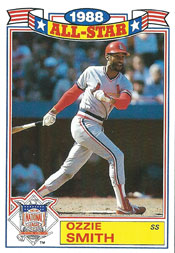
Ozzie Smith and Matt Adams, opposites in size, shared at least one common trait: Both were able to drive in key runs for the Cardinals over a stretch of games.

ozzie_smith8Adams in 2014 became the first Cardinals player to deliver game-winning RBI in four consecutive games since Smith did so in 1988, according to the Elias Sports Bureau.

A 6-foot-3, 260-pound first baseman, Adams primarily utilized power to produce his game winners in a stretch from June 13-16, 2014.

In three consecutive Cardinals wins over the Nationals at St. Louis from June 13-15, Adams hit a home run for the winning RBI in each game. The home runs were hit off Jordan Zimmerman, Stephen Strasburg and Doug Fister. The Cardinals won, 1-0, on June 13 Boxscore; 4-1 on June 14 Boxscore; and 5-2 on June 15. Boxscore

Adams snapped a 1-1 tie with a RBI-single off Jacob deGrom for the game-winning hit on June 16 in a 6-2 Cardinals victory over the Mets at St. Louis. Boxscore

Twenty-six years earlier, Smith used a very different combination of productive at-bats for his four consecutive game-winning RBI. A 5-foot-11, 150-pound shortstop, Smith had a bunt, but no home runs, among his game winners in a stretch from Sept. 8-11, 1988. Here’s what he did:

Cardinals 1, Phillies 0, at St. Louis, Sept. 8, 1988

The Cardinals had the bases loaded with two outs in the fifth inning when Smith came to bat against Phillies starter Kevin Gross. With the count at 3-and-2, Smith checked his swing and walked, forcing in Tony Pena from third base with the run. The Phillies appealed, saying Smith had swung and missed at strike three, but third-base umpire Steve Rippley upheld the call of home-plate umpire Fred Brocklander.

Phillies manager Lee Elia said Rippley blew the call.

Cardinals manager Whitey Herzog conceded to the St. Louis Post-Dispatch, “A lot of guys would have punched (Smith) out.” Boxscore

Cardinals 6, Cubs 2, at St. Louis, Sept. 9, 1988

With the Cubs ahead, 1-0, the Cardinals loaded the bases with one out in the sixth. Facing starter Calvin Schiraldi, Smith said he was trying for a sacrifice fly. Instead, he doubled off the right-field wall, driving in Jose Oquendo and Greg Mathews and giving the Cardinals a 2-1 lead.

Deflecting attention away from himself, Smith credited Pedro Guerrero, whom the Cardinals acquired from the Dodgers on Aug. 16, with boosting the offense. Guerrero had three RBI in the game.

“We’re a different team now,” Smith said. “We’re doing a lot more things with our pitching and a lot more with our offense. The addition of one person (Guerrero) has stabilized our offense.” Boxscore

Cardinals 9, Cubs 3, at St. Louis, Sept. 10, 1988

With the score tied at 2-2, Tom Pagnozzi at second and two outs, Smith doubled to center off starter Rick Sutcliffe, giving the Cardinals a 3-2 lead.

“What you’re seeing now is something that didn’t happen in spring training,” Smith said. “We never jelled offensively. We’re settling in now.” Boxscore

Cardinals 3, Cubs 2, at St. Louis, Sept. 11, 1988

In the seventh inning, with the score tied at 2-2, Curt Ford was on third with one out. With Smith at the plate, Herzog called for the squeeze play. Smith executed, dropping a bunt to the right side of the infield. Ford dashed home with the go-ahead run. The only play for pitcher Mike Harkey, who fielded the ball, was to toss to second baseman Ryne Sandberg, covering first, to retire Smith.

“You just hope you get a decent pitch and you can put it in play,” Smith said of the bunt.

Asked about the four consecutive game-winning RBI, Smith told the Post-Dispatch, “It’s good to be in a position to say you got the record game-winning RBI, but the important thing is we won the game.” Boxscore

Smith finished the 1988 season with 51 RBI and was tied with Pena for third on the team, behind Tom Brunansky (79) and Terry Pendleton (53). The Cardinals ranked 11th in the 12-team National League in both RBI (536) and runs (578).

Previously: Intimidation: Ozzie Smith, Will Clark and the Battle at Busch

Read Full Post »

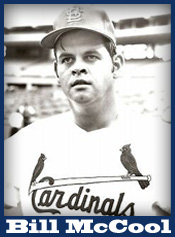
His name, perfect for a young, hard thrower, seemed the kind a novelist or screenwriter would conjure, but Billy McCool was real, a left-hander who broke into the majors with the Reds as a teenager and for two years was among the top relievers in the National League.

bill_mccoolThe Cardinals found McCool nearly untouchable in 1966, when he was a National League all-star.

McCool battled the Cardinals for six seasons, 1964-69. He pitched more innings and had more strikeouts versus the Cardinals than he did against any other big-league opponent.

In 1970, the Cardinals acquired McCool, 26, from the Padres, but his career had peaked. In 18 appearances for the 1970 Cardinals, he was 0-3 with a 6.23 ERA and a save.

Reds rookie

A standout athlete at Lawrenceburg, Ind., McCool was signed by the Reds as an amateur free agent in 1963. McCool, 19, made his big-league debut with the 1964 Reds and was a prominent pitcher for a club in the thick of a pennant race with the Cardinals and Phillies through the final day of the season.

McCool posted six wins and seven saves with a 2.42 ERA for the 1964 Reds. The Sporting News named him its National League Rookie Pitcher of the Year.

Against the Cardinals that season, McCool was 0-2 with a save in six appearances. On Sept. 19, the Reds beat Bob Gibson and the Cardinals in the first game of a doubleheader at Cincinnati. McCool got his first big-league start in the second game. Matched against Ray Sadecki, McCool was good, yielding two runs, striking out seven and issuing no walks in eight innings. Sadecki was better. He pitched eight scoreless innings and combined with Barney Schultz for the shutout in a 2-0 triumph for the Cardinals. Boxscore

After the season, McCool and his brother-in-law, a pharmacist, bought a drugstore in Lawrenceburg. Wrote The Sporting News: “Billy McCool not only throws aspirin tablets, he sells them.”

Billy the Kid

McCool sought a pay raise from the Reds for 1965. According to The Sporting News, contract talks between McCool and assistant general manager Phil Seghi included this exchange:

Seghi: “Billy, you’re just a kid yet. You’re asking for too much money.”

McCool: “If I’m only a kid, why do they give me a man’s job to do?”

Appearing in 62 games, including two starts, in 1965, McCool compiled nine wins and 21 saves for the Reds. He ranked second in the league in saves, behind the Cubs’ Ted Abernathy. McCool was 1-1 with four saves versus the Cardinals that season.

Used exclusively in relief in 1966, McCool had eight wins, 18 saves and a 2.48 ERA. He again ranked second in the league in saves, behind the Dodgers’ Phil Regan. In seven games against the 1966 Cardinals, McCool was 2-1 with three saves and a 1.04 ERA. He struck out 23 Cardinals in 17.1 innings and yielded two earned runs.

In the July 2, 1966, edition of The Sporting News, Mets second baseman Chuck Hiller said of McCool’s fastball, “It looks about the size of a Ping-Pong ball when it comes up to the plate.”

Said Mets third baseman and former Cardinals standout Ken Boyer: “That slider he’s throwing now is the best I’ve ever seen a left-hander have.”

McCool made 11 starts in 31 appearances in 1967 and four starts in 30 appearances in 1968.

Battles with Brock

He had two significant games against the 1968 Cardinals.

On April 23, 1968, the Reds led the Cardinals, 2-0, through eight innings at St. Louis. In the ninth, the Cardinals scored twice off starter George Culver, tying the score. In the 10th, Lou Brock hit a two-run walkoff home run against McCool, giving the Cardinals a 4-2 victory. Boxscore

Two months later, on June 14, McCool got a start at St. Louis. He held the Cardinals scoreless in six innings and limited them to two hits _ singles by Julian Javier and Tim McCarver _ and got the win in a 7-0 Reds triumph. Boxscore It was McCool’s last major-league win as a starter.

Brock hit .147, 5-for-34, with 12 strikeouts against McCool in his career. Another Cardinals hitter who struggled versus McCool was Mike Shannon. He hit .100, 2-for-20, with seven strikeouts. The Cardinals who hit McCool best: Javier at .400, 8-for-20, and Curt Flood at .292, 7-for-24.

The Reds made McCool, 24, available in the expansion draft after the 1968 season and he was selected by the Padres. In four appearances for the Padres against the 1969 Cardinals, McCool was 2-1 with a 4.15 ERA.

On Aug. 6, 1969, at San Diego, McCool relieved Clay Kirby in the ninth with the score tied at 2-2 and retired the Cardinals in order. When ex-Cardinal Ed Spiezio opened the Padres’ ninth with a home run off Steve Carlton, lifting San Diego to a 3-2 victory, McCool got the win, his last in the big leagues. Boxscore

Save for St. Louis

In April 1970, the Cardinals acquired McCool from the Padres for infielder Steve Huntz. After a stint at Class AAA Tulsa, McCool was promoted to the Cardinals in May.

In his third appearance, May 15, 1970, McCool earned a save with two scoreless innings in relief of Mike Torrez in a 1-0 victory over the Cubs at St. Louis. McCool retired Don Kessinger, Glenn Beckert and Billy Williams on ground balls in the eighth. In the ninth, after getting groundouts from Jim Hickman and Johnny Callison, McCool walked Ron Santo before retiring Cleo James on a fly ball. Boxscore

That was McCool’s highlight as a Cardinal. In July, he was demoted to Tulsa. After the season, the Cardinals traded him to the Red Sox for pitcher Bill Landis. McCool never returned to the major leagues.

In seven big-league seasons, he posted a 32-42 record with 58 saves and a 3.59 ERA. In 33 games against the Cardinals, McCool was 6-6 with eight saves, a 3.26 ERA and 68 strikeouts in 66.1 innings.

Previously: Cardinals vs. Reds: rich tradition of July 4 showdowns

Read Full Post »
« Newer Posts - Older Posts »