Feeds:
Posts
Comments

Archive for the ‘Games’ Category

(Updated on Sept. 12, 2018)

Helped by three newcomers, dubbed the Polish Falcons, the 1953 Cardinals led the major leagues in doubles with 281.

Eight members of the 1953 Cardinals each produced 20 or more doubles: Stan Musial (53), Red Schoendienst (35), Enos Slaughter (34), Solly Hemus (32), Rip Repulski (25), Steve Bilko (23), Ray Jablonski (23) and Del Rice (22).
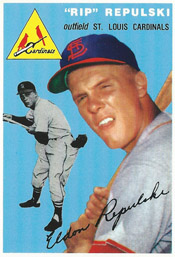
rip_repulski2Bilko, Jablonski and Repulski, all everyday starters for the first time in the big leagues, were called the Polish Falcons because of their Polish-American heritage. (Musial, in the majors since 1941, also was Polish-American.)

Eddie Stanky, manager of the 1953 Cardinals, played the trio in nearly every spring training game and they earned his trust. All three opened the season as starters _ Bilko at first base, Jablonski at third and Repulski in center.

(Stanky also was of Polish descent. He was born Edward Raymond Stankiewicz in Philadelphia.)

Bilko, 24, had appeared in 57 games for St. Louis from 1949-52, but never put in a full season with the Cardinals. Jablonski, 26, and Repulski, 24, both were making their big-league debuts with the 1953 Cardinals. All three had played together in 1952 for Rochester, a Cardinals farm team.

“During the training season, The Brat (Stanky) concentrated on the three Poles from Rochester, playing them daily, and they convinced him the Cardinals would field their strongest right-handed power since, first, Walker Cooper, and then George Kurowski left the Redbird batting order, seven and five years ago, respectively,” The Sporting News reported.

Said Stanky: “A lot of those left-handers who throw lollipops are going to find us an altogether different ballclub.”

In May, The Sporting News followed up with a glowing report on the Cardinals’ hitting: “The pickup in power had been a result largely of the presence of the three Polish Falcons, the newcomers from Rochester … They were hitting just about as had been hoped for.”

Polish power

Bilko, 6 feet 1 and at least 230 pounds, struck out a league-high 125 times in 1953, but he also punished pitchers with his power. On May 28, Bilko struck out five times in a game against the Reds. Boxscore The next day, against the Braves, Bilko doubled twice in the same inning _ one each against Vern Bickford and Ernie Johnson. Boxscore

In July, The Sporting News reported, “Although Repulski had been rested eight days after a slump and though Jablonski could look horrible in the field now and then and Bilko helpless against an occasional pitcher, the Falcons passed the first third of the season in fine style.”

The Falcons, all married with children, were friends as well as teammates. “On the road, they take in movies together (and) eat as a unit,” The Sporting News noted.

As the season wound down, the debut of the Polish Falcons was declared a success. “They’re better hitters than I thought they were and they’ll be even better next year with this season’s experience,” Musial said.

In a Sporting News story headlined “Cards Hit Jackpot with Polish Falcon trio,” Stanky said, “They have not only done as well as expected, but better.”

The final 1953 hitting statistics for the Falcons:

_ Bilko: 21 home runs, 84 RBI, .251 batting average.

_ Jablonski: 21 home runs, 112 RBI, .268 batting average.

_ Repulski: 15 home runs, 66 RBI, .275 batting average.

In voting for the National League Rookie of the Year Award, Jablonski placed third and Repulski tied with Braves outfielder Bill Bruton for fourth. The winner was Dodgers infielder Jim Gilliam, with Cardinals pitcher Harvey Haddix the runner-up.
Read Full Post »

In 1968, seven years after he broke Babe Ruth’s single-season home run record, Roger Maris hit the last homer of his career. He did it as a Cardinal on the afternoon St. Louis clinched its second consecutive National League pennant.

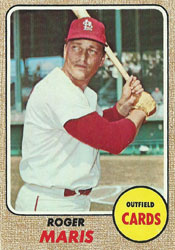
roger_maris2By then, Maris no longer was the slugger who had hit 61 home runs for the 1961 Yankees. Injury-plagued, he was tired of baseball and instead was looking forward to running an Anheuser-Busch distributorship in Florida.

Maris, 34, also was hampered by a right hand weakened by playing most of the 1965 season with a broken hamate bone. Without hand strength, Maris lacked a consistent power stroke, especially on fastballs. His home run production steadily decreased, dropping from 13 in 1966 to nine in 1967.

When Maris homered off a Don Wilson off-speed pitch on Sept. 15, 1968, at the Astrodome, it brought his season total to five. It was Maris’ first home run since July and the last of 275 over 12 big-league seasons. Boxscore

All five of the right fielder’s 1968 home runs were hit on the road. Three came against the Niekro brothers, Joe of the Cubs and Phil of the Braves.

Last hurrah

After Maris hit a two-run, third-inning homer off Phil Niekro on June 10, 1968, he removed himself from the game because of a bruised heel. After the all-star break, Maris improved and hit .359 (14-for-39) in July. On Aug. 5, Maris announced he would retire after the season.

A month later, when the Cardinals played the Mets for the last time that season in New York, where Maris had spent seven tumultuous years with the Yankees, the Shea Stadium scoreboard flashed this message in the third inning:

“To Roger Maris, making his last New York appearance as an active player today, we express our appreciation of an outstanding career and wish you and yours the best.”

Maris, who sat out that game, took quiet delight in hitting a double and two singles the previous night against the Mets in his New York finale. Boxscore

In the first two games of the Cardinals-Astros series at Houston Sept. 13-15, Maris went hitless in nine at-bats. After he popped out to the catcher in the Sept. 14 game, Maris “banged his bat hard against the roof of the dugout,” The Sporting News reported.

In his first at-bat against Wilson on Sept. 15, Maris struck out, extending his hitless skid to 10 in the series.

When he came up against Wilson in the third, with Curt Flood on first and one out, Maris launched a two-run home run, lifting the Cardinals to a 3-2 lead and sparking them to a 7-4 pennant-clinching victory. His last home run also was the only one he hit at the Astrodome.

Comfortable as Cardinal

On Sept. 29, the Cardinals honored Maris in ceremonies before the final game of the regular season at St. Louis’ Busch Stadium II.

After receiving a standing ovation from the crowd of 23,792, Maris said, “I want to thank the Cardinals for two of my most enjoyable years in baseball and I want to thank all the fans for accepting me the way they did.”

Maris, acquired by the Cardinals in a December 1966 trade with the Yankees, hit 14 home runs in his two seasons with St. Louis. Here is a look at those:

1967

1. May 9, solo HR vs. Woodie Fryman, at Pittsburgh.

2. May 21, solo HR vs. Don Cardwell, at New York.

3. June 10, 3-run HR vs. Dodgers’ Bob Miller, at St. Louis.

4. June 11, solo HR vs. Dodgers’ Ron Perranoski, at St. Louis.

5. June 23, solo HR vs. Phillies’ Rick Wise, at St. Louis.

6. July 16, solo HR vs. Mets’ Dick Selma, at St. Louis.

7. July 18, solo HR vs. Jim Maloney, at Cincinnati.

8. July 29, solo HR vs. Cecil Upshaw, at Atlanta.

9. Sept. 7, 2-run HR vs. Cal Koonce, at New York.

NOTE: Maris hit a solo homer off Jim Lonborg of the Red Sox in Game 5 of the 1967 World Series.

1968

1. April 14, 3-run HR vs. Joe Niekro, at Chicago.

2. April 14, solo HR vs. Joe Niekro, at Chicago.

3. June 10, 2-run HR vs. Phil Niekro, at Atlanta.

4. July 26, 2-run HR vs. Steve Blass, at Pittsburgh.

5. Sept. 15, 2-run HR vs. Don Wilson, at Houston.

Previously: Slider was key to 15 wins in a row for Bob Gibson in 1968

Read Full Post »

(Updated Sept. 13, 2025)

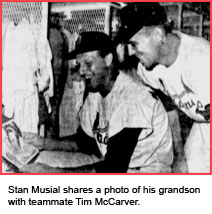
On the first swing of his first at-bat as a grandfather, Stan Musial had fans and teammates shouting, “Oh, baby!”

A few hours after his first grandchild was born, Musial, 42, hit the first pitch he saw from Cubs starter Glen Hobbie for a two-run home run atop the pavilion roof in right field at Busch Stadium in St. Louis.

stan_musial_mccarverSharon Musial, wife of Stan’s son, Dick, gave birth to a son, Jeffrey, on Sept. 10, 1963, at Fort Riley Kan., where Dick, 23, was stationed as an Army lieutenant.

Musial and his wife, Lil, had waited until 1:30 a.m. on Sept. 10 before heading to bed. In his book “Stan Musial: The Man’s Own Story,” Musial said, “Lil and I awakened with a start at exactly the same time _ 4:40 a.m. _ and got up, troubled. As she brewed coffee, I paced the floor. Suddenly, the phone rang. Son Dick was calling from Fort Riley, Kan. Sharon had given birth to a boy. When? Just two minutes after Lil and I woke up.”

In a story headlined “Grandpa Musial Shuffles to Plate _ Celebrates by Swatting Homer,” The Sporting News reported, “The Man took a nap later in the morning so he could be better rested for the night game coming up.”

When he arrived at the ballpark, Musial said, he handed out cigars in the clubhouse. The Cardinals were honoring former St. Louis-area major leaguers that night and the old-timers gave Musial a ribbing.

“Hey, Gramp, you belong with us,” retired outfielders Joe Medwick and Terry Moore said to Musial.

With a laugh, Musial replied, “Next year.”

Musial, batting third and playing left field, came up in the first inning with Dick Groat on first and one out. He hit Hobbie’s first pitch for his 11th home run of the season and 474th of his 22-year big-league career. The homer came fewer than 16 hours after the grandchild was born.

“The remarkable Stan Musial set another major league record: Most home runs by a new grandfather, 1,” the Associated Press reported.

Said Musial: “That one was for Jeffrey Stanton Musial.”

In the book “Few and Chosen,” Cardinals catcher Tim McCarver said Musial “probably was the greatest low-ball hitter ever. Even in his 40s, there was no more devastating a low-ball hitter than Stan. Throw him a pitch down in the strike zone, even below the zone, and he would leave his feet.”

Musial’s home run overshadowed the performance that night of Bob Gibson, who hit a three-run homer off Hobbie and pitched a shutout in the Cardinals’ 8-0 victory, their 13th win in 14 games. Boxscore

Gibson and Musial were two of six future Hall of Fame members who played in the game. The Cubs started the other four: right fielder Lou Brock, left fielder Billy Williams, third baseman Ron Santo and first baseman Ernie Banks.


Read Full Post »

Tony La Russa brought out the evil twin in Dusty Baker.

dusty_baker2On Sept. 3, 2003, the Cardinals and Cubs played the fourth game of an intense five-game series at Chicago’s Wrigley Field. La Russa, the Cardinals’ manager, and Baker, the Cubs’ manager, engaged in a shouting match that added a memorable but ugly chapter to the rivalry between the franchises.

In the second inning, Cubs starter Matt Clement hit Cardinals pitcher Dan Haren with a pitch. An inning later, Haren hit Clement. That prompted the theatrics from the managers.

Baker rushed onto the field, confronted the umpires, then pointed angrily at the visitors’ dugout, where La Russa stood, glaring.

“Even back in the dugout, Baker kept pointing and yelling as La Russa smirked,” wrote Chicago Sun-Times columnist Jay Mariotti.

“Baker hollered, ‘I’ll (mess) you up,’ at La Russa,” wrote St. Louis Post-Dispatch columnist Bernie Miklasz.

“TV cameras caught Baker telling La Russa he’d gladly take him on any time and La Russa telling him to bring it on,” reported Mike Kiley of the Sun-Times.

“The two managers yelled at each other from across the field,” wrote Joe Strauss of the Post-Dispatch. “Baker at one point flipped an obscene gesture at La Russa.”

Wrote Miklasz: “A rumpus with an opposing manager makes La Russa’s blood surge and raises his competitiveness to maximum-testosterone level.” Video

Cardinals fold after feud

The teams hardly needed motivation. The day before, they split a gritty doubleheader. The Cubs won the opener in 15 innings. The Cardinals won the second game, 2-0, behind Matt Morris. Cubs pitcher Kerry Wood twice knocked down Morris with pitches and dusted him with a third, prompting La Russa to say Wood “likes to scare people. I’ve heard he likes to hit people.”

Baker and Wood objected to La Russa’s remarks.

After the La Russa-Baker macho match that followed Haren and Clement being hit by pitches, the intensity was raised to a fever pitch.

The Cardinals, who entered the Sept, 3 game in first place in the National League Central, a half-game ahead of the Astros and 1.5 games ahead of the Cubs, led, 6-0, in the sixth, but the Cubs scored three in the sixth, three in the seventh and two in the eighth and won, 8-7. Boxscore

Wrote Miklasz: “La Russa was nearly inconsolable.”

Said La Russa: “As far as bad losses go, it’s tied for first with any that I can remember. There’s been some savage losses, but this is right there with the worst of them.”

A defiant Baker told the Post-Dispatch: “Nobody intimidates me but my dad and Bob Gibson and a bully I had in elementary school. And I grew bigger than him, so he couldn’t bully me.”

Mariotti suggested the Cubs change their logo because “a cuddly little cub doesn’t fit the image any more when Dusty Baker is threatening to kick Tony La Russa’s butt.”

Beware the Gemini

The next day, La Russa and Baker met on the field before the game and had what was described by Strauss as “a decidedly serious conversation” for about five minutes.

Said La Russa to the Post-Dispatch: “I explained to him that the Cardinals and my players come first with me and I recognized that the Cubs and his players come first with him. If we both have that understanding, I think it’s easy for us to maintain a respect and friendship with each other.”

Baker, in comments to both the Sun-Times and Post-Dispatch, revealed there is a bad Dusty that tries to overtake the good one.

“I’m not proud of myself when I display that kind of action because I don’t really like that person when he comes out,” Baker said. “And he rarely comes out unless he’s provoked to come out.

“I’m a Gemini and I’ve definitely got an evil twin. I don’t like that twin. That’s the mean side. He’s got to run his course, then go back in there for a while. Everybody has a side they don’t like. I can get even hotter.”

Previously: Dusty Baker ended playing career with Tony La Russa at helm

Read Full Post »

Whitey Herzog managed the Cardinals with a bold, creative style, which partly explains why he largely was successful. What elevated Herzog to Hall of Fame quality is he got his players to buy into that style.

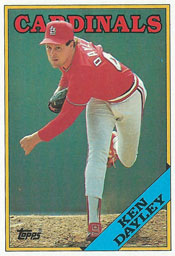
ken_dayleyA striking example of that occurred on Aug. 28, 1988, in a Sunday afternoon game between the Cardinals and Reds at Cincinnati.

Ken Dayley was one strike away from completing a three-inning save when Herzog abruptly pulled the reliever before he was finished pitching to the batter, Chris Sabo.

Dayley didn’t complain nor did anyone else with the Cardinals, which is testament to the trust and respect Herzog had with his players at that time.

Bob Forsch, in his last appearance as a Cardinal, started that game and pitched six innings. With the Cardinals ahead, 5-3, Forsch was relieved by Dayley after yielding a leadoff single to Sabo in the seventh.

Dayley held the Reds scoreless in the seventh and eighth.

In the ninth, Dayley retired the first two batters before Barry Larkin singled. Up next was Sabo.

A right-handed batter, Sabo, a rookie, presented a challenging matchup for the left-handed Dayley. The previous night, Sabo had four hits against the Cardinals, including three singles off left-handed pitching.

Cardinals closer Todd Worrell, a right-hander, was warming in the bullpen, but Herzog stayed with Dayley because Kal Daniels, a left-handed batter, was due up after Sabo. Herzog wasn’t figuring on Sabo hitting a home run. Dayley was unscored on in his last seven games.

Dayley got the count to 2-and-2 on Sabo. On the next pitch, Sabo drilled a line drive down the left-field line.

Worrell, who was in the left-field bullpen, told the St. Louis Post-Dispatch, “When it passed me, it was about three feet fair.”

Wrote the Associated Press: “Sabo’s liner flirted with the left-field foul screen … but the ball hooked at the last second.”

“It wasn’t foul by much, maybe two feet,” Cardinals left fielder Tom Lawless said.

Said Worrell: “You could slide a newspaper between the ball and the foul pole.”

Herzog immediately went to the mound and lifted Dayley for Worrell. The closer threw one pitch, a slider, which Sabo swung and missed by a foot, sealing the Cardinals’ 5-3 victory. Boxscore

“I’ll bet that was the easiest save he ever had,” Herzog said.

Said Dayley: “Whitey had seen enough. I don’t mind setting the table for him, but I’ll be damned if I’m going to feed him.”

Previously: Whiteyball: Willie McGee at shortstop; Ricky Horton in right

Read Full Post »

(Updated Nov. 25, 2024)

Using a combination of fastballs and sliders with control and confidence, Bob Gibson capped the most successful stretch of starts ever experienced by a Cardinals pitcher.

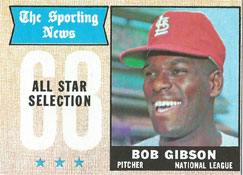
bob_gibson15On Aug. 19, 1968, Gibson got his 15th consecutive win, pitching a two-hitter in the Cardinals’ 2-0 victory over the Phillies at Philadelphia.

During the 15-game winning streak, from June 2 through Aug. 19, Gibson made 16 starts, with one no-decision. Ten of the 15 wins were shutouts. His ERA in that 16-start stretch was 0.68 in 146 innings, with 124 strikeouts. He pitched nine innings or more 16 games in a row.

“I haven’t seen anybody that good during the time I’ve been in the majors,” Cardinals outfielder Roger Maris said to The Sporting News.

Looking back on Gibson’s 1968 season, Cardinals catcher Tim McCarver told Cardinals Yearbook in 2018, “It got to a point where I could sense the helplessness when hitters came to bat … There were many times when I could feel a hitter’s legs buckle as one of Bob’s vicious sliders whizzed across the plate.”

Slip sliding away

Using only fastballs and sliders against the Phillies for his 15th win in a row, Gibson struck out 11, including Dick Allen four times and Bill White three times.

“He had great control of his slider,” McCarver said to the Associated Press. “The last strike on Rich Allen in the ninth broke a foot.”

Gibson credited the development of his slider with making him a dominant pitcher.

“My slider was nasty,” Gibson said in a conversation for the book “Sixty Feet, Six Inches.” “They could look for it and couldn’t hit it.

“Actually, I had two sliders … My main slider was my hardest one, and it would just break abruptly and mostly downward. And I had one where I’d twist my wrist a little more and give it a bigger break. That one didn’t have the speed or suddenness of the first one … but if I got it where I was supposed to get it, a right-handed batter wasn’t going to do anything with it.”

In his bid for the 15th consecutive win, Gibson held the Phillies hitless for five innings. In the sixth, with one out, pitcher John Boozer singled to center.

The Phillies’ only other hit came in the eighth when Johnny Callison, batting for Boozer, singled to right with two outs. Boxscore

Confidence equals control

The 15th consecutive win gave Gibson a season record of 18-5 with a 0.99 ERA in 234.2 innings. The shutout, his 10th, tied the Cardinals’ single-season record established by Mort Cooper in 1944.

“Of all the reasons behind his brilliance, I start with his command,” McCarver told Cardinals Yearbook. “Gibson threw hard and featured the best slider I’ve ever caught by a right-hander. His pitches exploded with movement a few feet from the plate. What made them even more effective was his ability to throw them where he wanted. He could consistently hit a target no wider than two baseballs.”

In discussing his slider with Cardinals Yearbook writer Stan McNeal, Gibson said, “I had pinpoint control in 1968 … If I wanted to throw it outside, I’d start it in the middle of the plate and I knew it was going to be outside … That was an unbelievable feeling. It really was. Hitters were at a disadvantage because I knew where the ball was going and I could throw it there in any count. Most pitchers would get to a 3-and-2 count and throw a fastball because they could control it, but I’d throw a slider because I could control it as well as the fastball. Sometimes it would break out of the strike zone, but they’d swing anyway.”

Gibson’s consecutive win streak ended in his next start, Aug. 24, at home against the Pirates. The Cardinals led, 4-0, after six. Willie Stargell hit a three-run home run off Gibson in the seventh. The Pirates scored a run in the eighth and two more in the ninth to win, 6-4, overcoming a 15-strikeout performance by Gibson. Three of the Pirates’ six runs were unearned. Boxscore

Gibson finished the 1968 season with a 22-9 record, and 1.12 ERA, pitching 13 shutouts and 28 complete games. In Game 1 of the 1968 World Series, he struck out 17 Tigers batters.

In a 2018 interview with Joe Schuster of Cardinals Yearbook, Willie Horton recalled how he became the 17th strikeout victim: “On the last pitch, he had me set up for a slider, so I was looking for a ball off the edge of the plate, maybe even six inches outside. I set up for a pitch out there, so if it broke I would have hit it, but it just stayed in on me and I couldn’t do anything with it. I learned later he had a backdoor slider. I can’t think of another right-handed pitcher who would try to throw a backdoor slider, because you can make so many mistakes with it. He had one _ and that shows how great he was.”

On Oct. 28, 1968, Gibson was named unanimous winner of the National League Cy Young Award. Two weeks later, on Nov. 13, he was named recipient of the NL Most Valuable Player Award.

In the book “Late Innings,” Gibson told author Roger Angell, “I was never that good again … I’d like to think I’d really perfected my pitching to that point.”

Read Full Post »

« Newer Posts - Older Posts »