Feeds:
Posts
Comments

Archive for the ‘Games’ Category

As a Cardinals rookie, Rick Ankiel struck out 11 batters in a game four times, twice doing it before his 21st birthday.
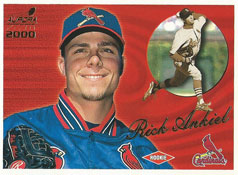
rick_ankiel3Here is a look at those performances:

_ Cardinals 7, Marlins 6, at St. Louis, May 25, 2000: Ankiel earned his fourth win of the season, striking out 11 in 6.2 innings.

The effort was controversial because Ankiel threw 121 pitches. Scott Boras, Ankiel’s agent, said he believed the Cardinals had agreed to limit Ankiel to 100 pitches a game.

Ankiel, who was averaging 4.25 walks per game, didn’t yield a walk to the Marlins. He struck out the side (Preston Wilson, Derrek Lee and Alex Gonzalez) in the second inning and did it again (Danny Bautista, Cliff Floyd and Wilson) in the fourth. Boxscore

_ Indians 3, Cardinals 2, at St. Louis, June 4, 2000: Six of the Indians’ first seven outs were on strikeouts. Ankiel struck out 11 in five innings and walked none, but was lifted after reaching 98 pitches.

“I had a lot of strikeouts, but I really wasn’t going that well,” Ankiel said to the St. Louis Post-Dispatch.

Ankiel struck out the side (Alex Ramirez, Jolbert Cabrera and Jim Brower) in the second and did it again (Sandy Alomar, Richie Sexson and Ramirez) in the fourth. Boxscore

_ Cardinals 12, Astros 1, at Houston, July 21, 2000: Two days after turning 21, Ankiel struck out 11 in seven innings and improved his record to 7-5. Ankiel struck out Craig Biggio twice and Lance Berkman once.

“He’s got an electric arm,” said Astros slugger Jeff Bagwell.

Said Cardinals manager Tony La Russa: “Sometimes it’s hard to remember how young he is. With him, it’s all about command. His stuff is so good.” Boxscore

_ Cardinals 9, Pirates 5, at Pittsburgh, Sept. 13, 2000: In the last game the Cardinals would play at Three Rivers Stadium before the Pirates moved into PNC Park, Ankiel struck out 11 in 6.2 innings, earning his ninth win of the season.

Ankiel struck out the side (John Wehner, Mike Benjamin and Adrian Brown) in the second.

“The ball explodes out of his hand,” said Pirates manager Gene Lamont. “He’s going to be one of the best pitchers we’ve seen in a long time.”

Said La Russa: “I’d love for him to get the Rookie of the Year (Award) because those nine wins do not reflect how well he’s pitched. He’s learning to pitch. He’s not just out there throwing.” Boxscore

Less than a month later, Oct. 3, 2000, Ankiel, a surprise starter in Game 1 of the National League Division Series against the Braves, walked six and threw five wild pitches in 2.2 innings, triggering the downward spiral that led to the end of his pitching career. Boxscore
Read Full Post »

(Updated Feb. 26, 2022)

In 1973, the Cardinals had such a dreadful start that general manager Bing Devine was asked almost daily whether he’d fire manager Red Schoendienst.

“I’m tired of hearing that question,” Devine said to The Sporting News. “I’ll be gone before Red.”

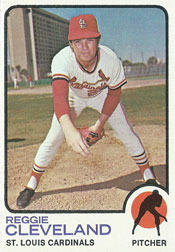
reggie_cleveland2The 1973 Cardinals lost their first five games and 12 of their first 13. Their 1-12 record ranked among the worst in big-league history, recalling the 0-13 start of the 1920 Tigers, the 1-12 record of the 1962 expansion Mets and the 1-15 mark of the 1969 Indians.

Nerves were raw; tension was high. After Cardinals starter Reggie Cleveland gave up a key two-run, two-out double to Bill Robinson in an April 22 loss to the Phillies, Schoendienst groused, “That’s why he’s a .500 pitcher.” Boxscore

The Cardinals’ skid extended into May. After the Giants beat the Cardinals, 9-7, on May 8 (Bob Gibson yielded four home runs, two to Bobby Bonds and one each to Willie McCovey and Dave Kingman), St. Louis had a 5-20 record, the worst in the major leagues, and was in last place in the National League East. Boxscore

The Cardinals were 1-7 in one-run decisions and 0-4 in extra-inning games.

After shoring up the bullpen by calling up left-handers Al Hrabosky and Rich Folkers from the minors and acquiring veteran junkball specialist Orlando Pena from the Orioles, as well as replacing Ray Busse at shortstop with Mike Tyson, the Cardinals began to stabilize, then thrive.

Regarding the replacement of Busse with Tyson, teammate Joe Torre told the New York Daily News, “Before Mike stepped in at shortstop, we were losing a lot of games early because of our infield. Routine ground balls were going straight into the outfield. We needed someone to hold the defense together.”

Years later, in an interview with Cardinals Magazine, Tyson credited Schoendienst and coach George Kissell.

“Red always put me in a good position,” Tyson said. “I didn’t have a particularly strong arm, but my range was good and I got rid of the ball quickly.”

As for Kissell, Tyson said, “George always had my back. Every day after practice in spring training he’d get a bucket of balls and he’d hit me grounder after grounder.”

From the low point of the 5-20 record, the Cardinals won 56 of their next 81 games, boosting their record to 61-50 by Aug. 5 and securing first place in the division, five games ahead of the second-place Cubs.

From there, the streaky Cardinals reverted to their early-season form.

Gibson injured his knee running the bases against the Mets and was sidelined from Aug. 4 to Sept. 29. From Aug. 6 to Aug. 18, St. Louis lost eight in a row and 11 of 12, falling to 62-61.

Overall, the Cardinals lost 31 of their last 51 games and finished in second place at 81-81, 1.5 games behind the Mets.

Read Full Post »

The 1968 Cardinals were stocked with players known for producing high drama. Bob Gibson. Lou Brock. Roger Maris. Orlando Cepeda. It was a supporting cast member, though, who delivered a storybook home run.

julian_javier3On May, 15, 1968, second baseman Julian Javier visited Mark Sandusky, 6, of McKeesport, Pa., at Children’s Hospital in Pittsburgh. The youngster’s legs had been crushed in a car accident that killed his sister. Javier often visited children in hospitals, The Sporting News reported.

Javier presented the boy with an autographed ball. “I want you to get better,” Javier told him, according to The Sporting News. “When you do, let me know and I’ll send you a bat to go along with the ball.”

Javier’s visit impressed the boy, who asked the Cardinals’ second baseman to hit a home run for him that night against the Pirates, the Associated Press reported.

“I’ll try,” Javier told the boy with a smile, according to The Sporting News, “but wouldn’t you settle for a couple of singles?”

“You’d better use a heavier bat,” the 6-year-old replied.

Javier, who hadn’t hit a homer that season, did the improbable.

Like a scene from “The Natural,” Javier hit Steve Blass’ first pitch of the fourth inning into the light tower next to the left-field scoreboard at Forbes Field, according to the Associated Press.

“I wasn’t thinking about it (during the at-bat),” Javier said. “But when I was running around the bases I thought, ‘Look what I did.’ ”

The run backed the four-hit pitching of Steve Carlton and carried the Cardinals to a 1-0 victory. Boxscore

In its lead paragraph to its story about the game, the Associated Press wrote, “Julian Javier will never be mistaken for Babe Ruth, but the slender St. Louis Cardinal is the Sultan of Swat today in the starry eyes of a McKeesport, Pa., youngster.”

Javier wouldn’t hit another home run until three months later, Aug, 28, 1968, also at Pittsburgh, against Roy Face. Javier finished the season with four homers.

In a 13-year major-league career, Javier hit 78 regular-season home runs.

Read Full Post »

The Cardinals-Rockies rivalry, known for its high-scoring games, began, improbably, with a shutout.

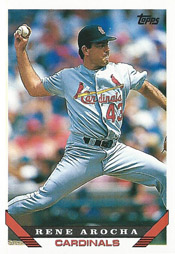
rene_arochaThe Rockies, a National League expansion team, faced the Cardinals for the first time on April 20, 1993, at St. Louis. The Cardinals won, 5-0, on a combined shutout by Rene Arocha and Omar Olivares.

There was a strong Cardinals connection to the first Rockies team that faced St. Louis. Don Baylor, the Rockies’ manager, had been the hitting coach on manager Joe Torre’s staff with the 1992 Cardinals. Rockies first baseman Andres Galarraga and starting pitcher Bryn Smith had played for the 1992 Cardinals. Center fielder Alex Cole had been in the Cardinals’ minor-league system.

Galarraga, who broke his wrist in the Cardinals’ second game in 1992 and finished with a .243 batting average and 39 RBI, signed with the Rockies as a free agent. He entered the Rockies’ first game against the Cardinals with a .422 batting mark and 14 RBI after 11 games.

Before facing the Cardinals, Galarraga told the St. Louis Post-Dispatch, “I’ve always been able to hit, even since I was a little boy in Venezuela. After the injury, I tried too hard when I came back. It got worse. I was swinging at bad pitches.”

Said Baylor: “He’s hitting the ball to right field more. That’s what he has to do to be successful.”

The starting lineups in the first Rockies-Cardinals game:

ROCKIES

1. Eric Young, second base

2. Alex Cole, center field

3. Dante Bichette, right field

4. Andres Galarraga, first base

5. Charlie Hayes, third base

6. Jerald Clark, left field

7. Joe Girardi, catcher

8. Freddie Benavides, shortstop

9. Bryn Smith, pitcher

CARDINALS

1. Geronimo Pena, second base

2. Ozzie Smith, shortstop

3. Gregg Jefferies, first base

4. Ray Lankford, center field

5. Mark Whiten, right field

6. Todd Zeile, third base

7. Brian Jordan, right field

8. Hector Villanueva, catcher

9. Rene Arocha, pitcher

On a chilly Tuesday night before 30,516 at Busch Stadium, the Cardinals scored three in the first and two in the fourth against Smith.

Arocha, a rookie, was cruising through 5.2 innings until a line drive by Bichette struck the pitcher’s gloved hand, fracturing a finger. Olivares relieved and retired the 10 batters he faced. So dominant were Arocha and Olivares that Cardinals outfielders handled just one fly out. Boxscore

The win was the only one Arocha earned against the Rockies in four big-league seasons. The Cardinals won seven of 12 games against the expansion Rockies.

Previously: Revisiting the Gregg Jefferies deal: Cardinals’ good gamble

Read Full Post »

(Updated Nov. 23, 2024)

Like the rest of the Cardinals’ rotation in May 1968, Bob Gibson nearly was untouchable. Unfortunately for Gibson and the Cardinals, he wasn’t unbeatable.

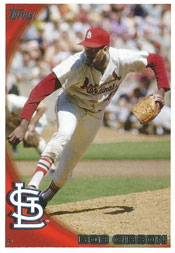
bob_gibson13Led by Gibson, Cardinals starters had an ERA of 2.03 in May 1968.

In six starts, Gibson’s ERA in May 1968 was 1.27, but his record that month was 2-4. Both wins required him to pitch extra innings.

Gibson yielded only 10 runs (eight earned) in 56.2 innings in May 1968, but the Cardinals never scored more than three runs in any of his six starts that month. In Gibson’s four May losses, the Cardinals scored three runs total.

Asked about that lack of run support in a 2018 interview with Stan McNeal of Cardinals Yearbook, Gibson said, “I was frustrated. Whenever I pitched, I would be pissed off even before I started because I knew we weren’t going to score.”

May was the only month Gibson had a losing record in 1968. He was a combined 12-0 in June and July.

Gibson finished the 1968 regular season with a 22-9 record, 1.12 ERA, 268 strikeouts, 28 complete games and 13 shutouts. He earned both the National League Most Valuable Player Award and Cy Young Award.

With better run support, he could have been a 25-game winner that season.

Here’s a game-by-game look at Gibson’s six May starts in 1968:

_ Cardinals 3, Astros 1, 12 innings, at Houston, May 1, 1968: Gibson limited the Astros to an unearned run in 12 innings. After the Cardinals scored twice in the 12th, Julio Gotay, a former Cardinal, led off the Astros’ half of the inning with a double. Gibson retired the next three batters on a pair of infield pop-ups and a fly out. Boxscore

_ Cardinals 2, Mets 1, 11 innings, at St. Louis, May 6, 1968: Gibson improved his career record against the Mets to 18-3 in winning a duel with Tom Seaver. Both aces went the distance. They worked so efficiently that the 11-inning game was completed in 2 hours, 10 minutes. In the 11th, Lou Brock tripled and scored on Orlando Cepeda’s single. Boxscore

_ Astros 3, Cardinals 2, at St. Louis, May 12, 1968: Gibson struck out 10 in eight innings, but Denis Menke lifted the Astros with a two-run single in the seventh. Boxscore

_ Phillies 1, Cardinals 0, 10 innings, at Philadelphia, May 17, 1968: In the 10th, Phillies pitcher Woodie Fryman singled. Two outs later, he scored on a single by Bill White, the former Cardinal and Gibson’s friend. Boxscore

_ Dodgers 2, Cardinals 0, at St. Louis, May 22, 1968: Gibson yielded one hit in eight innings. It was a RBI-double by Wes Parker in the third. The Dodgers added a run off reliever Joe Hoerner in the ninth. Boxscore

Frustrated that the Cardinals had failed to score in his last two starts, Gibson was in a foul mood when approached by his catcher after the loss to the Dodgers. In his book “Stranger to the Game,” Gibson said, “(Tim) McCarver followed me into the trainer’s room and said, ‘Hoot, I’m really sorry. I know our crappy hitting has gone on for too long.’ I stopped him in the middle of the apology and snapped, ‘I’m tired of listening to these … excuses.’ Then I turned and disappeared into the shower. I don’t why I took out my frustrations on McCarver _ I guess he was good for that _ but I wouldn’t talk to him for hours afterwards.”

_ Giants 3, Cardinals 1, at St. Louis, May 28, 1968: Gibson yielded a solo home run to Dick Dietz in the sixth and a two-run home run to Willie Mays in the seventh. The homer by Mays, 37, was the last of three in his career against Gibson. Boxscore


Read Full Post »

(Updated June 27, 2020)

When Lukasz Musial settled in Pennsylvania after leaving his native Poland, he enjoyed following the exploits of Babe Ruth, a symbol of all that was possible in America.

babe_ruthLike his father, young Stan Musial also became a fan of Ruth. He remained an admirer, even though his first encounter with Ruth left him somewhat astonished.

Imagine the significance to Musial when he broke one of Ruth’s most prominent records.

On May 8, 1963, Musial, 42, hit a home run off former teammate Bob Miller of the Dodgers, giving him 1,357 career extra-base hits and surpassing the record of 1,356 held by Ruth. Boxscore

In the 1964 book “Stan Musial: The Man’s Own Story,” Musial said, “I’m proud to have more extra-base hits than any player … but, to me, Ruth is still champ. After all, let’s face it, I went to bat some 2,500 more times than the No. 1 slugger.”

Musial was 20 and playing for the Cardinals’ farm club at Rochester, N.Y., in 1941 when he met Ruth, who came to town to put on a batting practice exhibition. In his autobiography, Musial offered a compelling description of that encounter, with help from the book’s contributor, St. Louis journalist Bob Broeg:

“The Babe was 47 then, heavy-bellied and out of competition for six years,” Musial recalled. “His timing was way off, but finally he connected with a pitch … and lifted it far out of the ballpark. I got a big thrill out of watching (him) demonstrate why my father thought there was only one Bambino. Pop was so right.

“I confess, though, that I was awed _ and maybe a little disillusioned _ when Ruth sat on our bench during the game, pulled out a pint of whiskey from his pocket and emptied it.”

Twenty-two years later, shortly after Musial broke Ruth’s extra-base hits record, a memo sheet posted on the Cardinals’ clubhouse bulletin board asked players whether they had participated in Babe Ruth League baseball. On the bottom of the sheet, The Sporting News reported, Musial wrote, “I played with Babe Ruth.”

In his book, Musial opened a chapter with this paragraph: “I believe Babe Ruth was the greatest who ever played because he was an outstanding pitcher and good outfielder who best combined the abilities to hit for great power and high average. Imagine, while hitting 714 homers, he struck out more than 1,300 times and still averaged .342 for his career.”

A couple of weeks after Musial set the extra-base hits mark, he was profiled in The Saturday Evening Post. “I’ll hit until I’m 50,” Musial said.

Asked by the publication for a set of guidelines he’d recommend a young player to follow in seeking a long big-league career, Musial offered six tips:

_ Keep your weight down.

_ Run a mile a day.

_ Get eight hours of sleep regularly.

_ If you must smoke, try lightweight cigars. They cut down on inhaling.

_ Take vitamins as recommended by a doctor.

_ Make it a point to bat .300.

The extra-base hits category (total of doubles, triples and home runs hit) is one of the most underrated in baseball. Musial eventually was surpassed by two others. The top seven in career extra-base hits are:

_ Hank Aaron, 1,477

_ Barry Bonds, 1,440

_ Stan Musial, 1,377

_ Babe Ruth, 1,356

_ Albert Pujols 1,333

_ Willie Mays, 1,323

_ Alex Rodriguez, 1,275

Previously: Total bases tell story of a total player: Stan Musial

Read Full Post »

« Newer Posts - Older Posts »