Feeds:
Posts
Comments

Archive for the ‘Games’ Category

(Updated April 3, 2018)

Curt Flood slugged two home runs against Dodgers ace Sandy Koufax. The first was part of a rare feat. The second was the last home run hit against Koufax.

sandy_koufaxOn Aug. 17, 1958, Flood and Gene Freese led off a game for the Cardinals against the Dodgers at the Los Angeles Coliseum with back-to-back home runs against Koufax.

Cardinals manager Fred Hutchinson stacked five right-handed batters among the top six in his order against the left-hander. The Coliseum, the Dodgers’ home in their first season after moving from Brooklyn, enticed right-handed batters to pull pitches to a left field fence 251 feet from home plate. A 42-foot screen was erected atop the fence, but batters weren’t deterred.

Flood, in his first season with St. Louis, opened the game by hitting a home run over the left-field screen. Freese, an infielder acquired by the Cardinals from the Pirates in a June trade, followed with a home run to the same spot.

The Cardinals scored four in the first against Koufax and he was lifted with one out in the second. Koufax faced 10 batters, yielded four hits and two walks and took the loss in a game won by the Cardinals, 12-7. Boxscore

“After going five straight games without coming close to a homer, Curt Flood and Gene Freese helped the Cards find the combination again at Los Angeles’ chummy left field fence in the Coliseum,” The Sporting News reported.

Eight years later, on Sept. 29, 1966, at St. Louis, in what would be his last appearance against the Cardinals, Koufax and Flood faced one another for the final time.

Koufax entered the game with 294 strikeouts, needing six more to become the first big-league pitcher to achieve 300 in a season three times. In the fourth inning, Koufax fanned Flood for strikeout No. 300 and got a standing ovation from the St. Louis crowd.

Seeking his 26th win of the season, Koufax and the Dodgers were ahead, 2-0, before Flood led off the seventh with a home run.

It would be the last home run hit against Koufax, who would retire after the season. (Koufax yielded 204 home runs in 12 big-league seasons, plus two in the 1963 World Series.)

In the ninth, Koufax struck out the first two batters, Lou Brock and Jerry Buchek, before Flood doubled to center.

“I got a little tired near the end and made a mistake with Flood,” Koufax said to United Press International. “Imagine, after eight or nine years in the league, I still don’t know how to pitch to Flood.”

Flood hit .296 [32-for-108] in his career against Koufax.

What happened next sparked much debate. Dodgers manager Walter Alston went to the mound and, according to United Press International and the Los Angeles Times, ordered Koufax to intentionally walk Orlando Cepeda, putting the potential go-ahead run on base.

“I didn’t argue,” Koufax said, “but I doubt that we would have done it if we were playing at home.”

Said Alston to the St. Louis Post-Dispatch: “I kind of stuck my neck out a little.”

Cepeda had five career home runs against Koufax. Alston preferred to take his chances with Mike Shannon, one of the top home run and RBI producers on the 1966 Cardinals.

Said Alston: “I went to the mound to Koufax after Curt Flood doubled and said, ‘Sandy, I think I’d rather have you pitch to the other guy (Shannon).’ Sandy agreed.”

Shannon flied out to center fielder Willie Davis, ending the game, a 2-1 Dodgers victory. Boxscore

“How about Alston putting that winning run on base?” said Cardinals manager Red Schoendienst. “I guess you can get away with it when you have Sandy Koufax on the mound.”

Morris McLemore, sports editor of the Miami News, wrote, “In a situation like that, baseball is the most exciting game ever devised, for the final decision was made of drama, great skill and chance-taking in almost equal proportion.”

Koufax finished with a four-hitter and 13 strikeouts.

“I thought I had a better curve ball than I have had at any other time this season,” Koufax said.
Read Full Post »

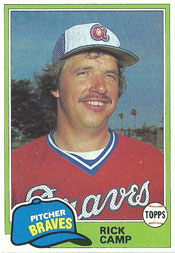
Not even a word from Bob Gibson could prevent Rick Camp from surrendering the hit that propelled the Cardinals to their first National League pennant in 14 years.

rick_campThe Cardinals completed a three-game sweep of the best-of-five 1982 National League Championship Series, beating Camp and the Braves, 6-2, in Game 3 at Atlanta. The victory vaulted them into the World Series for the first time since 1968, when Gibson was their ace.

Camp is remembered most for the home run he hit with two outs in the bottom of the 18th inning of a July 4, 1985, game against the Mets, tying the score 11-11. The Mets won, 16-13, in 19 innings and Camp was the losing pitcher. Boxscore

In Cardinals history, Camp is better recalled for his second-inning woes in the deciding game of the playoff series.

After Camp retired the Cardinals in order in the first, Keith Hernandez led off the second with a single and Darrell Porter walked. Camp thought he struck out Porter on a pitch instead ruled a checked swing.

George Hendrick singled, scoring Hernandez and advancing Porter to third, and St. Louis led, 1-0.

As Willie McGee approached the plate, Gibson, a Braves pitching coach for manager Joe Torre, went to the mound to talk with Camp. Torre split the pitching coach duties between Gibson and former catcher Rube Walker. “Rube teaches them how to pitch,” Torre told The Sporting News. “Gibby teaches them how to win.”

On Camp’s first pitch after Gibson’s visit, McGee tripled to right-center, scoring Porter and Hendrick.

“I made a bad pitch,” Camp told the Rome (Ga.) News-Tribune. “It was a fastball belt high, a fastball that was up, and that’s what broke it open.”

After the next batter, Ozzie Smith, singled to center, scoring McGee and giving the Cardinals a 4-0 lead, Torre lifted Camp for Pascual Perez. Boxscore

“From the beginning, in the bullpen, I didn’t have anything,” Camp said. “I thought maybe I would work it out in the first two or three innings.”

Instead, Camp faced eight batters, yielding four runs, four hits and a walk. Video

In a nine-year career with the Braves (1976-85), Camp made 28 appearances against the Cardinals, posting a 4-4 record and 4.25 ERA.

Read Full Post »

The 1954 Cardinals had the worst bullpen ERA (5.46) in franchise history.

So desperate for relief were they that Harvey Haddix, who led the club in games started (35) and wins (18), also ranked second in saves, with four in eight relief appearances.

Haddix was the starting and losing pitcher in the Cardinals’ season opener, a 13-4 loss to the Cubs on April 13, 1954, at St. Louis. Boxscore Two days later, in the Cardinals’ second game of the season, versus the Braves at Milwaukee, Haddix again was the losing pitcher _ this time, in relief. Boxscore He worked as long in his relief stint, 2.1 innings, as he did in his start.

Haddix didn’t pitch in the Cardinals’ third game of the season, but he was one of the few on the staff who didn’t. On April 17, 1954, the Cubs defeated the Cardinals, 23-13, at Chicago. Five Cardinals relievers combined to give up 16 runs in seven innings in relief of starter Gerry Staley. The game took 3 hours, 43 minutes to play _ the longest nine-inning game in National League history at that time. Boxscore

In The Sporting News, Bob Broeg wrote that the Cardinals’ start to the season was a “humorless first week when their pitching … was cuffed incredibly.”

After 10 games, manager Eddie Stanky said of his bullpen, “I don’t know what I’m going to do, but I know this _ I’m not going with what I’ve got.”

A look at the relievers who were the most prominent members of the infamous 1954 Cardinals bullpen:

_ Al Brazle. The side-arming left-hander was the Cardinals’ closer. He had been effective in the previous two years, saving 16 for St. Louis in 1952 and 18 in 1953, but he had just eight saves and a 4.16 ERA in 1954. He was far better on the road (2.27 ERA) than he was at home (5.55 ERA). Brazle, 40, was released after the season and never appeared in the big leagues again.

_ Cot Deal. A right-hander, Deal, 31, yielded 85 hits, including 14 home runs, in 71.2 innings. He had more walks (36) than strikeouts (25) and an ERA of 6.28. Left-handed batters hit .341 against him. Deal never pitched in the big leagues after 1954, but he went on to coach for 15 years in the majors, including on the staff of manager Johnny Keane’s 1965 Yankees.

_ Joe Presko. Primarily a Cardinals starter from 1951-53, the right-hander had an 8.61 ERA in 31 relief appearances for the 1954 Cardinals. He lost four relief decisions in a span from May 28 to June 17. Presko surrendered 59 hits in 38.2 innngs of relief. After the season, Presko, 25, was acquired by the Tigers.

_ Royce Lint. A 33-year-old rookie, Lint pitched two scoreless innings of relief in the Cardinals’ season opener, but the left-hander finished his lone big-league season with a 5.19 ERA in 26 relief appearances.

_ Stu Miller. Though The Sporting News would name this right-hander the National League Fireman of the Year with the 1961 Giants and the American League Fireman of the Year with the 1963 Orioles, Miller, 26, wasn’t an effective reliever for the 1954 Cardinals. He had a 5.96 ERA in 15 relief appearances, walking 16 in 25.2 innings.

Three pitchers on the 1954 Cardinals were used as both starters and relievers. They were:

_ Gerry Staley. He pitched in 48 games, 20 starts and 28 relief stints. He had a 3.77 ERA and three saves as a reliever.

_ Brooks Lawrence. The rookie pitched in 35 games, 18 starts and 17 relief appearances. He was 6-4 with a 3.25 ERA as a reliever.

_ Tom Poholsky. He pitched in 25 games, 13 starts and 12 relief stints. He had a 5.30 ERA as a reliever, yielding five home runs in 18.2 innings.

Previously: Bobby Shantz: First Cardinals pitcher to win Gold Glove

Read Full Post »

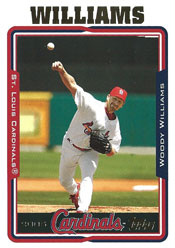
Entering the 2003 season, some were concerned Woody Williams no longer was effective. The Cardinals pitcher was 36, his spring training ERA was 14.54 and he had been limited to 17 starts in 2002 because of two stints on the disabled list.

woody_williams3In the St. Louis Post-Dispatch, Joe Strauss asked whether an aging, fragile Williams would be treated by the Cardinals like “a pricey piece of red-and-white pitching porcelain.”

Instead, Williams opened 2003 like a staff pillar, posting three wins without allowing a run in his first three starts.

Here’s what Williams achieved:

_ Cardinals 7, Brewers 0, April 2, 2003, at St. Louis: Williams held Milwaukee to two hits in 6.2 innings. The Brewers were hitless until Eric Young tripled with two outs in the sixth. Milwaukee’s only other hit off Williams was a single by Jeffrey Hammonds in the seventh.

“I picture doing that every game,” Williams said. “That’s what I strive to do _ not a no-hitter, but every inning I pitch I want to get a zero.”

Mike Matheny backed Williams’ effort with a three-hit, two-RBI performance. Boxscore

_ Cardinals 3, Astros 0, April 12, 2003, at Houston: After skipping his second scheduled start at Colorado because of neck stiffness, Williams showed no signs of a problem against the Astros, pitching six scoreless innings and extending his streak to 12.2.

A Houston native, Williams improved his career record versus the Astros to 6-2. “I worked ahead and threw good pitches when I needed to,” Williams said.

In the first inning, Houston threatened when Geoff Blum singled and Jeff Bagwell doubled. Lance Berkman followed with a groundball to first baseman Tino Martinez, who threw to the plate to nail Blum. “That’s a veteran Gold Glove play to come up with that throw,” Cardinals manager Tony La Russa said.

“The play Tino made was huge,” said Williams. “It stopped the momentum.”

_ Cardinals 6, Diamondbacks 3, April 18, 2003, at St. Louis: Williams yielded three hits in seven scoreless innings. Arizona was hitless until Lyle Overbay singled with one out in the fifth. The Diamondbacks scored their runs in the ninth off Russ Springer.

Williams’ scoreless innings streak was at 19.2. “If he ever comes out there and doesn’t have real good stuff and real good location, we’re all going to pass out,” La Russa said. Boxscore

_ Braves 4, Cardinals 3, April 24, 2003, at Atlanta: Williams kept the Braves scoreless for 5.1 innings before the streak ended at 25 when Julio Franco scored from third on a Johnny Estrada single. Boxscore

Williams rewarded the 2003 Cardinals by producing 18 wins in 220.2 innings, both single-season career highs for him.

Previously: Deal for Woody Williams sparked 2001 Cardinals

Read Full Post »

Cardinals players Tino Martinez and Mike Matheny were involved in an Easter Sunday brawl on April 20, 2003, at Busch Stadium. Martinez and Diamondbacks pitcher Miguel Batista sparked the fight.

tino_martinezBruised egos were the only serious damage either team experienced in the Holy Day melee.

Leading off the bottom of the fifth inning, Martinez was struck on the shoulder by a Batista pitch. It was the fourth time Martinez had been hit by a pitch in the young season.

Wrote Dan O’Neill of the St. Louis Post-Dispatch, “Martinez glared at Batista as he haltingly made his way toward first base. Instead of resuming his place on the mound, Batista stared back at Martinez, watching him all the way to the bag. Cardinals manager Tony La Russa then came out to first base to check on Martinez, and he exchanged stares and unpleasantries with Batista.”

The next batter, J.D. Drew, grounded to second baseman Junior Spivey, who tossed to shortstop Tony Womack, forcing Martinez at second base.

As Martinez headed toward the dugout, he and Batista exchanged looks, then Martinez charged the mound, the Associated Press reported. Martinez threw a punch; Batista fired the ball at him. Both missed.

Players from both sides poured onto the field and a brawl ensued. Wrote O’Neill, “One of the first Cardinals to join the fray was Matheny, who got in a few licks before he and Martinez were pulled down into the pile. Batista continued to throw punches as umpire Ed Montague and Arizona manager Bob Brenly backed him into left field. Martinez and Batista were ejected.”

Regarding Batista, Cardinals pitcher Brett Tomko said, “What makes it worse is he threw the ball at him. That’s just bush. You don’t do that stuff. I understand the guy is coming at you, but there are more things involved in a brawl. You don’t want to seriously injure somebody chucking a ball five feet away from him.”

Said La Russa: “The only thing I’m going to say is when you drill somebody and you stare at him like he stared, that is so unprofessional and so intentional-looking. I mean, he just stared at him like, ‘Hey, I meant to do it’ the whole time.

“Then he runs. That’s ridiculous. I don’t know what history is there, but that’s the kind of stuff that hitters take offense to when they take a plunking. That was brutal.”

The Diamondbacks accused La Russa of inflaming the situation by glaring at Batista. “Definitely,” said catcher Chad Moeller. “There’s no question about that.”

Said Diamondbacks outfielder Luis Gonzalez: “When that first situation happened, he (La Russa) goes up the line and he’s yelling at our pitcher. He’s trying to rattle our guys. That’s how he does it and that’s how he gets his team fired up.”

Brenly said, “I really don’t know what Batista is supposed to do to protect himself against a 240-pound charging bull who is supposed to leave the field immediately after he’s retired (on the forceout).”

Tempers flared again in the ninth. With two outs, reliever Jeff Fassero plunked Gonzalez with a pitch. Fassero and La Russa were ejected.

“That’s old baseball,” Fassero said. “I play old baseball … I still believe in the old ways, settling scores for teams and stuff like that, protect your guys.”

In the bottom half of the inning, with the Diamondbacks ahead, 1-0, Edgar Renteria led off with a double and Jim Edmonds walked against closer Matt Mantei. After Scott Rolen and Miguel Cairo struck out, Drew was hit by a pitch, loading the bases and bringing Matheny to the plate.

Throwing heat, Mantei struck out Matheny, ending the game. Mantei’s final pitch reached 100 mph.  Boxscore

Summing up the day, Arizona first baseman Mark Grace said, “It was one of those situations where boys will be boys … Guys get hit, guys get (mad), guys fight.”

Eight years later, Batista pitched for the Cardinals and La Russa.


Read Full Post »

From the very first game, Mark McGwire signaled that 1998 would be a special season for him.

mark_mcgwire3McGwire hit home runs in each of the Cardinals’ first four games of 1998, joining Willie Mays of the 1971 Giants as the only major-league players to begin a season in that manner. Since then, two others have done it: Nelson Cruz of the 2011 Rangers and Chris Davis of the 2013 Orioles, according to the Elias Sports Bureau.

The season-opening streak sparked McGwire to a record 70 home runs that year. Though tainted by subsequent revelations that McGwire used performance-enhancing drugs, the slugging feats remain official in the big-league record books.

McGwire’s home runs in the first four games of 1998 accounted for 12 RBI and lifted the Cardinals to three victories. Here is how it happened:

_ Cardinals 6, Dodgers 0, March 31, 1998, at St. Louis: Playing a regular-season game in March for the first time, the Cardinals’ opener was scoreless in the fifth inning when McGwire launched a grand slam off a floating change-up from Dodgers starter Ramon Martinez. Boxscore

The high drive carried 364 feet into the left-center stands at Busch Stadium II.

“You’re not going to see too many people hit a ball that high and have it leave the ballpark,” Dodgers left fielder Todd Hollandsworth said to the St. Louis Post-Dispatch.

Said McGwire to writer Rick Hummel: “It sort of surprised me the way it carried. I knew I hit it high enough. It was just a matter of far enough.

“I was juiced up. I don’t know my own strength. I hope I don’t hurt anybody.”

Speculation already was rampant that McGwire might challenge the single-season homer record of 61 by the Yankees’ Roger Maris. Under a headline of “McGwire’s Slam Drives Cards _ Countdown to 61 Begins,” Mike Eisenbath of the Post-Dispatch wrote in the lead paragraph of his game story, “Mark McGwire took what might be a first step toward immortality.”

_ Cardinals 8, Dodgers 5, April 2, 1998, at St. Louis: With two out in the 12th, McGwire hit a three-run walkoff home run off a curve from rookie reliever Frank Lankford. Boxscore

“You know anything is possible with him _ is that amazing?” said Cardinals manager Tony La Russa.

_ Padres 13, Cardinals 5, April 3, 1998, at St. Louis: McGwire’s two-run homer off Padres starter Mark Langston in the fifth was the highlight for St. Louis. Boxscore

_ Cardinals 8, Padres 6, April 4, 1998, at St. Louis: With the Cardinals clinging to a 3-2 lead in the sixth, McGwire provided a cushion with a three-run homer off reliever Don Wengert.

Counting the home runs he hit for St. Louis in the last two games of 1997, McGwire extended his long ball streak to six consecutive games over two seasons. Boxscore

“It’s unbelievable,” said Cardinals catcher Tom Lampkin. “(McGwire) has a chance to hit the ball out of the ballpark every time he walks up to the plate.”

McGwire’s streak ended on April 5, 1998, when he was limited to a single and a walk in five plate appearances against Padres starter Kevin Brown and reliever Trevor Hoffman. Boxscore

The Cardinals blew a 7-3 ninth-inning lead in that game and lost, 8-7. Wrote columnist Bernie Miklasz: “We have finally discovered Mark McGwire’s weakness: he can’t pitch.”

Previously: Willie McCovey and his legendary St. Louis home run

Read Full Post »

« Newer Posts - Older Posts »
