Feeds:
Posts
Comments

Archive for the ‘Games’ Category

The shortstop position was a model of stability when Ozzie Smith was on the Cardinals roster.
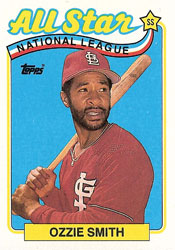
ozzie_smith5Smith played for the Cardinals for 15 seasons (1982-96). He was their starting shortstop on Opening Day in 13 of those years.

The exceptions: 1996, when first-year manager Tony La Russa went with newcomer Royce Clayton, and 1989, when Smith opened the season on the disabled list because of a pulled muscle in his left side.

If not for that injury, Smith would have made 14 consecutive Opening Day starts at shortstop for St. Louis.

The only player other than Smith to start at shortstop for the Cardinals from 1982 to 1995 was Jose Oquendo, who shifted from second base as the substitute for Smith in 1989.

On March 30, less than a week before the Cardinals’ 1989 regular-season opener, Smith was injured stealing third base in an exhibition game against the Blue Jays at Dunedin, Fla. The initial prognosis was he would be sidelined until May 1. Smith was placed on the disabled for the first time since 1984.

Manager Whitey Herzog decided to move Oquendo from second base to shortstop and place utilityman Tim Jones at second base. Asked why he opted for Oquendo rather than Jones at shortstop, Herzog told the St. Louis Post-Dispatch, “Jones can play it. I just think that Oquendo probably is as good a shortstop as there is in the National League.”

The Cardinals opened the 1989 season on April 3 at New York against the Mets. Oquendo, batting sixth, went 0-for-4, striking out twice against starter Dwight Gooden and once against Don Aase. The Mets won, 8-4. Boxscore

Oquendo, who had hit .384 (28-for-73) in spring training, appeared to be pressing. He went hitless in his first 13 at-bats.

The Cardinals stayed with the starting middle infield duo of Oquendo and Jones for the first seven games. Oquendo batted .167 and made one error. Jones hit .200 and fielded flawlessly.

Smith returned to the lineup on April 15, in the Cardinals’ second home game, against the Mets. Batting second, behind Vince Coleman, Smith was 2-for-5. His 10th-inning single moved Coleman from second to third _ “I can’t run into an out,” Coleman explained in why he agreed with third-base coach Rich Hacker’s stop sign _ and positioned Coleman to score the game-winning run on Pedro Guerrero’s one-out single.

Appearing comfortable with Smith in the lineup, Coleman swiped three bases in the Cardinals’ 3-2 victory. “I know he (Smith) is going to sacrifice himself so I can steal,” Coleman told the Post-Dispatch. Boxscore

With Smith at shortstop, Oquendo went back to second base and Jones to the bench.

Smith started in 152 games in 1989, leading National League shortstops in assists (483) and winning his 10th consecutive Gold Glove Award.

Previously: Buddy Bell almost joined Ozzie Smith in Cardinals’ infield
Read Full Post »

Imagine the Cardinals opening a season with a starting shortstop who had a career batting average of .217, more than twice as many strikeouts (68) as walks (29) and a reputation as an erratic fielder.

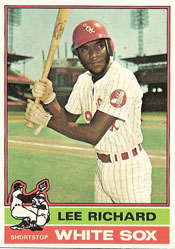
lee_richardThat’s precisely what the Cardinals did when they selected Lee “Bee Bee” Richard as their Opening Day shortstop in 1976.

Richard, a speedster, was acquired on Dec. 12, 1975, by the Cardinals from the White Sox for outfielder Buddy Bradford and pitcher Greg Terlecky. The Cardinals projected him as a backup to shortstop Don Kessinger, who joined St. Louis two months earlier in a trade with the Cubs.

Nicknamed “Bee Bee” as a hard-throwing high school pitcher in Louisiana, Richard attended Southern University and converted to shortstop.

Scouts were enamored with his speed and strong throwing arm. Richard was a first-round choice of the White Sox in the June 1970 amateur draft. He was the first shortstop selected. “We were fearful he might be picked by the time our turn came,” White Sox general manager Ed Short said to The Sporting News.

After watching Richard in a workout, White Sox coach Luke Appling, a Hall of Fame shortstop, said, “He’s got good hands. He’ll be a good one.”

Richard, 22, made his big-league debut on April 7, 1971, as the starting shortstop and leadoff batter for the White Sox in their season opener against the Athletics at Oakland. He singled twice against Catfish Hunter, drove in a run and was caught stealing by catcher Dave Duncan. Boxscore

Richard, however, wasn’t ready to be a big-league regular. He committed 26 errors in 68 games at shortstop in 1971. “I know some people told me I’d have been better off if I’d go down to the minors,” Richard said.

Undeterred, White Sox manager Chuck Tanner said, “He’s going to be a great shortstop … Give him a couple of years.”

Richard, who spent four seasons with the White Sox, was dubbed “The Juggler” by broadcaster Harry Caray because of poor fielding. The White Sox also tried him at center field, third base, second base, right field and designated hitter.

During a game in which Richard committed a pair of errors, the Washington Post reported, Caray told listeners, “Richard just picked up a hot dog wrapper. It’s the first thing he’s picked up all night.”

On April 9, 1976, the Cardinals opened their season at home against the Cubs and manager Red Schoendienst posted this batting order:

1. Lou Brock, left field.

2. Lee Richard, shortstop.

3. Bake McBride, center field.

4. Ted Simmons, catcher.

5. Reggie Smith, right field.

6. Keith Hernandez, first base.

7. Hector Cruz, third base.

8. Mike Tyson, second base.

9. Lynn McGlothen, pitcher.

After McGlothen retired the first two batters, Bill Madlock grounded to Richard, who booted the ball for an error on his first chance as a Cardinal. The next two batters reached before McGlothen worked out of the bases loaded jam.

Richard produced a single in four at-bats and St. Louis won, 5-0. Boxscore

Kessinger got the start at shortstop in the next game and remained the starter until the Cardinals called up rookie Garry Templeton in August.

In 13 games, six as a starter, at shortstop for the Cardinals, Richard committed four errors. By July 15, Richard’s batting average dropped to .059. Used primarily as a reserve infielder, Richard appeared in 66 games for the 1976 Cardinals, batted .176 and stole one base.

The Cardinals released him after the season and he never appeared in the major leagues again.

Read Full Post »

(Updated Nov. 27, 2018)

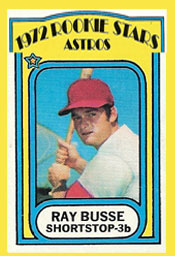
In 1973, the Cardinals lost a gamble when they selected Ray Busse as their starting shortstop.

ray_busseBusse was a top prospect in the Astros system when he hit .271 with 13 home runs in 92 games for Class AAA Oklahoma City in 1971. Bob Kennedy, the Cardinals’ director of player development, rated Busse the best shortstop in the minor leagues that year, The Sporting News reported.

Misfortune struck in 1972. Busse’s father committed suicide. Busse suffered a shoulder injury. Limited to 70 games, Busse hit .207 and committed 27 errors for Oklahoma City in 1972.

Cardinals general manager Bing Devine went to baseball’s winter meetings in November 1972 determined to find  “a shortstop with some sting in his bat,” The Sporting News reported. The Cardinals were seeking a replacement for Dal Maxvill, who they traded to the Athletics in August 1972.

Harry Walker, who joined the Cardinals as a hitting instructor after managing the Astros, recommended Busse. So did Kennedy.

On Nov. 28, 1972, the Cardinals dealt catcher Skip Jutze and infielder Milt Ramirez to the Astros for Busse and infielder Bobby Fenwick.

“Walker considers Busse a good gamble because of his age (24) and his batting potential,” Devine told The Sporting News.

Said Kennedy: “He (Busse) has a fine arm, good range and could become a good hitter.”

Busse went to spring training in competition with Mick Kelleher, Mike Tyson, Dwain Anderson and Ed Crosby for the starting shortstop position and “quickly took charge of the shortstop sweepstakes,” The Sporting News reported.

In his first spring training at-bat for the Cardinals, Busse singled in a run. Soon after, he hit a three-run home run against the Mets’ Ray Sadecki. Busse completed spring training as the Cardinals’ leader in RBI (11) and hit .254.

Though he ended spring training in an 0-for-18 slump, the Cardinals named him their starting shortstop. “He’s done a real fine job,” Cardinals manager Red Schoendienst told Larry Harnly of The State Journal-Register of Springfield, Ill. “He’s done everything expected of him … If you make a mistake on Busse, he’ll hit that ball.”

The Cardinals opened the 1973 regular season on April 6 at Pittsburgh with an all-rookie left side of the infield (Ken Reitz was at third base).

It was a disaster for Busse from the beginning.

Busse made an error on the first ball hit to him _ a grounder by Pirates leadoff batter Rennie Stennett in the first inning. Busse went 1-for-4, made two errors and the Pirates won, 7-5. Boxscore

The Cardinals lost 20 of their first 25 games. Busse took much of the blame.

On May 14, 1973, fans booed Busse and Reitz throughout a 10-5 Phillies victory at St. Louis. The loss dropped the Cardinals’ record to 8-23. Busse was batting .143 with 21 strikeouts in 24 games and he had committed 11 errors. Boxscore

After the game, Reitz shrugged off the boos when approached by reporters. Busse responded to the booing by saying, “Often I wonder what we come to the ballpark for. When you’re down, it’s pretty easy for somebody to get down on you, but that’s when you need them (the fans) the most.”

Busse never appeared in another game for the Cardinals. Schoendienst named Tyson the starting shortstop. Busse remained on the bench until the Cardinals traded him back to the Astros for infielder Stan Papi on June 8, 1973.

Asked by The Sporting News whether he had been given a fair shot by the Cardinals, Busse replied, “No, but that’s nobody’s fault but my own.”

Astros manager Leo Durocher said, “We’re tickled to get him back.”

Busse never recovered. He hit .059 in 15 games for the Astros in 1973 and .206 in 19 games for them in 1974, his last season in the major leagues.


Read Full Post »

Today, Jupiter, Fla., is as familiar as a spring training home to the Cardinals and their fans as the bird on bat is as a logo. In 1998, though, when the Cardinals left St. Petersburg for Jupiter, it was like landing on another planet.

mark_mcgwire2The Cardinals had trained in St. Petersburg, on Florida’s serene west coast, from 1938 through 1997 (with the exception of three years when travel was restricted during World War II).

Jupiter is on Florida’s east coast, in glitzy and congested Palm Beach County.

The move 200 miles southeast was prompted by several factors, including the chance to train in larger and more modern facilities and because the American League expansion team, the Tampa Bay Devil Rays, arrived in 1998 and made St. Petersburg their base.

Sharing the Jupiter complex with the Cardinals in 1998 were the Montreal Expos. Today, the Miami Marlins are the Cardinals’ spring-training neighbors.

Bob Broeg, longtime St. Louis baseball reporter, wrote in the February 1998 St. Louis Post-Dispatch he was looking forward to seeing the Cardinals’ new spring training site, “although it’s sad to see them leaving St. Petersburg, the ballclub’s home since Pepper Martin slid down a hotel’s emergency rope fire escape.”

Broeg described the scene at St. Petersburg in 1946, when players returned in droves from military service in World War II, and a pair of glamour teams, the Cardinals and Yankees, trained there:

“This was the last year of rickety old Waterfront Park in St. Pete.

“The memories of many of that spring … included a favorite watering trough – the crowded Sundown Club of lightly publicized St. Petersburg Beach. The beach would have superstars Joe DiMaggio and Stan Musial having a drink, back to back.

“As Red Schoendienst recalls, if a young ballplayer or young reporter would have had $2,500 to spend then, he could have acquired enough sand dune-seaweed waterfront real estate to make a small fortune.”

Schoendienst’s first spring in St. Petersburg was in the 1940s.

“I’ll miss St. Pete,” Schoendienst said to Mike Eisenbath of the Post-Dispatch in February 1998. “When we left St. Louis every year to go there, it was like going from your home to another home.”

Said Cardinals instructor George Kissell, who resided year-round in St. Petersburg: “It’s like being evicted from home. I’ve lived in St. Pete for 42 years, and for 42 years everybody came to me. But it made sense to move. This (Jupiter) will be a great place. You can’t judge it today. Wait until a year from today.”

Cardinals broadcaster Mike Shannon, who enjoyed St. Petersburg, quickly became a Jupiter booster because of the quality of the baseball facilities.

“St. Pete is a great city and has fantastic memories for the Cardinals,” Shannon said to the Post-Dispatch. “But comparing the facilities in St. Petersburg to the ones here, it was like having a minor-league outfit for a major-league team there. This is the big leagues here.”

In a preview of spring training 1998, Dan O’Neill of the Post-Dispatch wrote:

“For a number of Cardinals fans, the spring migration to the soft breezes and lazy life of St. Petersburg, Fla., was a given – like barbecuing in the summer and tree-shopping in December.

“In Palm Beach County, life, as well as traffic, moves more briskly.”

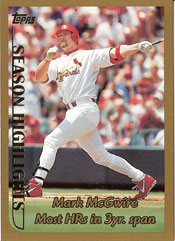
Adding to the excitement of the Cardinals’ first spring at Jupiter was the arrival of slugging first baseman Mark McGwire. He had been acquired by St. Louis in July 1997. He arrived early for his initial spring training at Jupiter.

“I love it,” McGwire said to Rick Hummel of the Post-Dispatch.

Said manager Tony La Russa: “When key guys get there early, it sends the right message.”

McGwire went on to hit a record 70 home runs that season.

The Cardinals won two World Series titles (2006 and 2011) since they started training at Jupiter. Playing at 6,800-seat Roger Dean Stadium, they had spring training game attendance averages in the years after those championships of 6,600 in 2007 and 6,700 in 2012, according to the Palm Beach Post.

Read Full Post »

(Updated Oct. 26, 2024)

To appreciate how far pitcher Chris Carpenter had to come to develop into an ace, it’s helpful to go back to the beginning of his Cardinals career.

chris_carpenter9As Carpenter prepared for his first regular-season start with the Cardinals in 2004, there were genuine doubts about whether he could be an effective member of the rotation. Carpenter hadn’t pitched in a regular-season big-league game in 18 months and he had endured two shoulder surgeries since then.

In 2004, Carpenter began to show he was recovered from his shoulder ailments when he started the Cardinals’ fifth game of the season, April 9, at Phoenix, against the Diamondbacks.

Carpenter had made his previous regular-season start on Aug. 13, 2002, for the Blue Jays, against the Athletics. After signing with the Cardinals in December 2002, Carpenter didn’t pitch in the big leagues in 2003.

He got cuffed around in spring training games in 2004. Joe Strauss of the St. Louis Post-Dispatch wrote: “Carpenter confronted bouts of doubt late in spring training. He experimented with pitching from the opposite corner of the rubber, began leaving pitches up and was hit hard in his final two Grapefruit League appearances. The almost-daily winter workouts with teammate Matt Morris couldn’t eliminate the apprehension of appearing in a (regular-season) game for the first time in nearly 20 months.”

Step forward

Carpenter arranged for his wife, children and in-laws to travel from New Hampshire to Arizona to witness his Cardinals’ regular-season debut, according to the Post-Dispatch.

It began ominously. When Steve Finley and Roberto Alomar each singled and Luis Gonzalez followed with a double, Carpenter had yielded a run before recording an out. Arizona scored three in the first.

Fortunately for Carpenter, Cardinals batters teed off against Diamondbacks starter Casey Daigle, making his major-league debut.

After the Cardinals built a 4-3 lead in the second, Carpenter, with Mike Matheny catching, retired 12 of the next 15 batters. Meanwhile, the Cardinals hit five home runs _ two by Reggie Sanders and one each by Albert Pujols, Ray Lankford and Scott Rolen _ in the first three innings against Daigle.

When Carpenter departed after six innings, the Cardinals led, 9-5. They went on to a 13-6 victory. Carpenter earned the win, his first since July 24, 2002, against the Orioles, and the first by a Cardinals starter in 2004. Boxscore

Carpenter’s fastball reached 92 mph, a sign his shoulder was solid. He credited team orthopedic surgeon Dr. George Paletta and his staff and trainers Barry Weinberg and Mark O’Neal for his recovery.

“Physically, I felt great,” Carpenter told the Post-Dispatch. “I knew my stuff was there … Now I can tell myself no matter how hard I throw, or what I did, if I make quality pitches I’ll get hitters out at this level.”

Good guidance

Carpenter had an inconsistent April. In his second start, an 11-1 Astros victory over the Cardinals, he gave up a three-run home run to Lance Berkman. After five starts, Carpenter was 2-1 with a 5.28 ERA.

Pitching coach Dave Duncan helped find a key to turning Carpenter into a consistent winner. Rick Hummel of the Post-Dispatch reported Duncan “has been working with Carpenter on getting on top in his delivery by shortening his stride and consequently keeping the ball down more.”

Years later, Carpenter told Stan McNeal of Cardinals Magazine, “Duncan really understood how to get the best out of each pitcher he worked with. For me, that required a major change in the stuff I threw. Before I got to St. Louis, I relied on a four-seam fastball, sinker, curveball and a little on a changeup. In my first meeting with Duncan, he made it clear that would not be the mix moving forward.

“It wasn’t like he told me to never throw my four-seamer, but he wanted me to focus on my sinker. The other big thing: he wanted me to establish my cutter more. It was about keeping the ball down.”

Carpenter finished the season 15-5 with a 3.46 ERA and helped the Cardinals win their first National League pennant in 17 years.

In nine seasons with St. Louis, Carpenter had a regular-season record of 95-44 and a postseason mark of 10-4, including 3-0 in World Series games.

Read Full Post »

As a Cardinals rookie in 1962, first baseman Fred Whitfield was one of the best power-hitting prospects the franchise had produced in years.

fred_whitfield“He has a quicker bat than anyone on the Cardinals and he can reach the roof at Busch Stadium,” coach Vern Benson told The Sporting News.

Said Phillies manager Gene Mauch after watching Whitfield pound Philadelphia pitching: “Fred Whitfield is the greatest hitter I’ve ever seen _ for the number of times I’ve seen him bat against us.”

The Sporting News hailed Whitfield as the Cardinals’ “biggest surprise of 1962” and Whitfield was selected by big-league managers, coaches and players as the first baseman on the 1962 Topps all-star rookie team.

Signed by Cardinals scout Mercer Harris, Whitfield was a standout in the minor leagues. He hit .309 with 23 home runs for Keokuk in 1958; .285 with 28 homers for Winston-Salem and Tulsa in 1959; .310 with 22 homers for Tulsa in 1960; and .301 with 18 homers for Charleston in 1961.

Whitfield, 24, went to the big-league spring training camp in 1962, but was sent to the Cardinals’ farm club in Atlanta before the season began. Atlanta manager Joe Schultz said Whitfield “could hit 30 home runs in our park.”

He was batting .323 and leading the International League in home runs (eight) and RBI (28) when he was promoted to the Cardinals on May 26, 1962.

The Cardinals were seeking a right-handed batter to replace injured outfielder Minnie Minoso. Because of a weak throwing arm after he hurt his shoulder as an American Legion pitcher, Whitfield only could play first base. Unlike Minoso, he batted left-handed.

According to The Sporting News, it was Cardinals business manager Art Routzong who convinced general manager Bing Devine and manager Johnny Keane to promote Whitfield.

Routzong asked, “Why not bring up the best hitter in our farm system, Fred Whitfield?”

Replied Keane: “Maybe you’ve got something there.”

In his first five pinch-hit appearances for the Cardinals, Whitfield produced three hits and a walk.

On June 10, 1962, in the second game of a doubleheader at St. Louis against the Giants, Cardinals first baseman Bill White pulled a thigh muscle and Whitfield replaced him. In the sixth inning, Billy Pierce twice brushed back Whitfield. On the next pitch, Whitfield hit a three-run home run. “The ball disappeared over the roof in right-center and sailed across Grand Boulevard,” The Sporting News reported. Boxscore

Whitfield went on a tear, with 10 RBI in four games. On June 12, 1962, his two-run homer in the eighth inning off Paul Brown erased a one-run deficit and lifted the Cardinals to a 3-2 victory over the Phillies. Boxscore

“In the five years I’ve been with the Cardinals,” said Routzong, “we have never brought up anyone who has come through with so many clutch hits in so few opportunities as Whitfield.”

Among Whitfield’s other big hits for St. Louis:

_ A three-run pinch-hit home run against the Braves’ Claude Raymond on July 3, 1962. Boxscore

_ A 10th-inning pinch-hit home run off Pirates closer Roy Face on July 15, 1962. Boxscore

_ A pinch-hit three-run home run against Jay Hook of the Mets on July 28, 1962. Boxscore

_ A grand slam off Phillies left-hander Bill Smith on Aug. 12, 1962. Boxscore

Whitfield finished the 1962 season with a .266 batting average, eight home runs and 34 RBI in 158 at-bats for the Cardinals. He hit .333 as a pinch-hitter and .412 with two outs and runners in scoring position. He was especially effective versus the Phillies, batting .313 with 13 RBI in 12 games.

“Fred did an exceptionally good job, especially as a pinch-hitter and part-time player, jobs usually handled by older, experienced men,” Devine said.

However, Whitfield became expendable because White, who batted left-handed, was entrenched at first base, and the Cardinals needed pitching.

On Dec. 15, 1962, the Cardinals dealt Whitfield to the Indians for pitcher Ron Taylor and infielder Jack Kubiszyn.

“If eyebrows were raised over the price Devine had to pay … it was understandable,” The Sporting News reported. “The Cardinals had not come up with a genuine longball threat for years until Fred Whitfield exploded on the scene early last summer.”

Whitfield hit 20 or more home runs three times for the Indians (21 in 1963, 26 in 1965 and 27 in 1966). In a nine-year major-league career (1962-70), he played for the Cardinals, Indians, Reds and Expos, batting .253 with 108 home runs.

Read Full Post »

« Newer Posts - Older Posts »