Feeds:
Posts
Comments

Archive for the ‘Games’ Category

(Updated Sept.30, 2017)

As a 20-year-old rookie, Matt Cain was put in the care of a 35-year-old veteran catcher, Mike Matheny.

With Matheny catching six of the right-hander’s seven starts for the 2005 Giants, Cain enjoyed a successful beginning to his major-league career.

Promoted to the Giants after posting a 10-5 record for Class AAA Fresno, Cain made his big-league debut on Aug. 29, 2005, against the Rockies at San Francisco.

With Matheny behind the plate, Cain, the youngest pitcher to start a game for the Giants since 20-year-old Mark Grant in 1984, limited the Rockies to two runs in five innings, but took the loss in a 2-1 Colorado victory. Matt Holliday, the Rockies’ cleanup batter, got two of the three Colorado hits against Cain _ a solo home run and a single. Boxscore

After the game, reporters approached Matheny for his assessment of the rookie.

“He has electric stuff, the kind of stuff you don’t see very often as far as velocity and late life,” Matheny said to the San Jose Mercury News. “His fluid motion makes him very deceptive.”

Matheny told the San Francisco Chronicle: “It’s just a shame we have such trouble scoring runs for these guys, especially after a first start like that, and he has to walk away with a loss. It’s a shame we couldn’t pull out a win for him.”

Working well with Matheny, Cain quickly achieved two milestones. He earned his first big-league win in his second start and recorded his first big-league complete game in his third start.

Cain held the Diamondbacks to a run on three hits through seven innings and got the win in the Giants’ 3-2 victory at Phoenix on Sept. 4. Boxscore

Five days later, Cain went the distance in earning the win in the Giants’ 2-1 victory over the Cubs at San Francisco. He gave up two hits and struck out eight. Boxscore

Cain earned 104 regular-season wins in 13 years (2005-17) with the Giants.

Against the Cardinals in his career, Cain was 2-7 with a 6.42 ERA in the regular season and 1-1 with a 2.19 ERA in the postseason. Both postseason appearances against the Cardinals occurred in 2012 when Matheny was in his first year as St. Louis manager.

Cain made his final big-league appearance on Sept. 30, 2017.

Previously: Pitcher for 1964 Cardinals was mentor to Mike Matheny

Read Full Post »

(Updated Aug. 19, 2025)

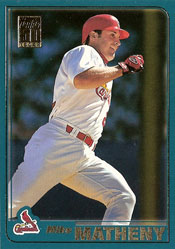
The Giants made Mike Matheny a financial offer he couldn’t refuse.

Though Matheny had said he wanted to remain with the Cardinals, he accepted a free-agent deal from San Francisco in December 2004.

Matheny was the Cardinals’ catcher from 2000 through 2004. He won three Gold Glove awards as a Cardinal and played a major-league record 252 consecutive errorless games over a period from 2003-04. The Cardinals qualified for the postseason in four of the five years Matheny was their catcher.

With Matheny’s three-year $8 million contract ending after the season, the Cardinals approached him during spring training of 2004 and offered a one-year $2 million extension through 2005. Matheny rejected it, the St. Louis Post-Dispatch reported.

Yadier Molina was a Cardinals rookie in 2004 and management wanted Matheny to mentor Molina through the 2005 season. Matheny would turn 36 in 2006 and the Cardinals planned for Molina to be the everyday catcher by then.

Matheny had other ideas. He played well in 2004. He contributed 50 RBI (his single-season best as a Cardinal) and made one error in 122 games, helping St. Louis win its first National League pennant in 17 years.

In December 2004, Matheny told the Post-Dispatch, “I don’t think I’ve made any secret that I’d prefer to remain with the Cardinals, but there has to be interest on their part as well.”

A few days later, the Cardinals offered Matheny a two-year contract worth about $4 million, the Post-Dispatch reported. The Dodgers, Phillies and Pirates also showed interest in signing Matheny, but it was the Giants who lured him.

On Dec. 15, 2004, Matheny accepted the Giants’ three-year $10 million deal. According to the Post-Dispatch, the pact included a $3 million signing bonus to be paid in annual installments of $500,000, $1 million and $1.5 million over three years. Matheny would be paid a base salary of $1 million in 2005, $2.25 million in 2006 and $2.25 million in 2007. In addition, the Giants held a $4 million option for 2008 that could be bought out for $2 million.

“As soon as the Giants hit the scene, it really opened the eyes of my wife and myself,” Matheny said. “We realized this could be a very special opportunity.”

On July 8, 2005, at San Francisco, the Cardinals faced the Giants for the first time since Matheny departed. During batting practice, Matheny embraced former teammates. At home plate before the game, Cardinals manager Tony La Russa, pitching coach Dave Duncan, players and support staff gathered to present Matheny with his 2004 Gold Glove Award.

Matheny had two hits in the game (a double off Mark Mulder and a single off Jason Isringhausen) and nailed David Eckstein attempting to swipe second. The Cardinals won, 3-1. Boxscore

“Those are some of the best friends I’ve ever had in the game,” Matheny said of the Cardinals. “… You don’t come across that all the time in this game. There are tight bonds. It comes with the winning, but it also goes beyond baseball. There are families involved. I see my son over there with them. The guys are excited to see him. It’s a pretty neat thing. It doesn’t happen everywhere that you have those kinds of relationships. They are very, very special to me.”

A month later, Aug. 19, 2005, Matheny played his first game at St. Louis as a Giant. The Cardinals presented him with a National League championship ring before the game.

When Matheny batted for the first time in the game, the crowd of 46,200 gave a prolonged ovation. Cardinals pitcher Chris Carpenter stepped off the mound to allow the applause to continue.

The Cardinals won, 5-4. Matheny went hitless in three at-bats against Carpenter and drew an intentional walk from Julian Tavarez. Boxscore

Matheny enjoyed a stellar first season with the Giants. He produced 13 home runs and 59 RBI, both career highs. He also won another Gold Glove Award while leading NL catchers in assists (77) and runners caught attempting to steal (39). He posted a .999 fielding percentage (one error in 132 games caught).

In late May 2006, Matheny was struck by several foul balls during a three-game series against the Marlins. On May 31, in the series finale, Matheny was removed from the game in the third inning after getting conked by a foul tip. He was diagnosed with a concussion and never played in another game.

Matheny became manager of the Cardinals when Tony La Russa left after winning the 2011 World Series championship. Matheny managed the Cardinals to a pennant in 2013 and postseason appearances in each of his first four seasons, but was fired in July 2018 as the club headed to a third consecutive year without a postseason bid.

He managed the Royals from 2020 to 2022.

In January 2024, Matheny suffered a life-threatening subarachnoid hemorrhage while doing a routine workout at a gym near his home in Florida. Rushed to a hospital, it was discovered a blood vessel in Matheny’s brain had burst. According to Cardinals Magazine, “Matheny’s life remained in a precarious state for days, a situation so scary that when family members and friends visited, they didn’t know if they were saying their final goodbyes.”

Doctors informed Matheny there was no evidence his history of concussions triggered the hemorrhage.

“It’s hard to disassociate the two, right?” Matheny said to Stan McNeal of Cardinals Magazine. “My career ended (in 2006) because of trauma to the brain, and (now) I get this brain thing that almost kills me.”

Read Full Post »

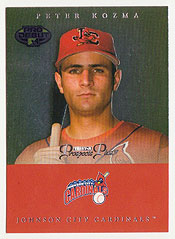
In 2007, Cardinals scout Steve Gossett pushed hard for the franchise to draft Pete Kozma. Gossett saw more than baseball skills from the Oklahoma high school shortstop. He saw a player whose character and dedication could pay dividends.

Gossett was betting on Kozma’s heart.

The Cardinals followed Gossett’s advice and in 2012 they benefitted from it.

After replacing the injured Rafael Furcal in September as the everyday shortstop, Kozma played a significant role in helping the Cardinals reach the 2012 National League Championship Series against the Giants.

Kozma, 24, hit .333 (24-for-72) in the 2012 regular season for the Cardinals and achieved an on-base percentage of .383. In the postseason, his two-run single in the ninth inning capped the Cardinals’ come-from-behind 9-7 victory over the Nationals in Game 5 of the NL Division Series. Boxscore

Because he often struggled in the minor leagues since being selected as the 18th pick in the first round of the 2007 amateur draft, Kozma’s productive play for the Cardinals was a surprise to most, but Gossett saw Kozma as a standout after coaching him in an Oklahoma summer league while Kozma was in high school.

In 2007, his senior season at Owasso High School in suburban Tulsa, Kozma hit .522 and struck out five times in 113 at-bats. His first-inning home run lifted Owasso to a 1-0 victory in the Oklahoma Class 6A state championship game. The Oklahoman newspaper named Kozma all-state player of the year.

“I would play every day if I could,” Kozma said to The Oklahoman.

Owasso coach Larry Turner told the Associated Press that Kozma was “the best player I’ve ever had.”

Draft forecasters expected the Cardinals to take a college player with their first pick. Gossett advised Jeff Luhnow, the Cardinals’ vice president in charge of their draft, to select Kozma.

“I got to know this kid,” Gossett said. “I know what’s in his heart. I know what kind of family he comes from, his work ethic.”

Gossett predicted the Cardinals “are going to love the way (Kozma) attacks the game.”

“The one thing that stuck out in my mind about Pete is you look in his eyes and you see a guy that you really feel is going to play in the big leagues,” Gossett said.

Baseball America magazine had forecast Kozma being selected by the Reds with the 15th choice in the first round. The magazine rated Kozma “the best all-around middle infielder in the draft,” but the Reds chose catcher Devin Mesaraco.

According to the St. Louis Post-Dispatch, the Cardinals were prepared to select pitcher Blake Beavan in the first round, but the Rangers, with the pick just ahead of St. Louis, drafted Beavan.

Though pitchers such as Rick Porcello and Jordan Zimmerman were available, the Cardinals took Kozma.

“This is a first-round talent,” Luhnow told Derrick Goold of the Post-Dispatch. “He has the potential to be a real impact in the big leagues at a premium position.”

(In the third round of that 2007 draft, the Cardinals chose infielder Daniel Descalso. In the Cardinals’ four-run ninth inning against Washington in Game 5 of the 2012 NL Division Series, Descalso got the two-run single that tied the score and Kozma followed with the two-run single that produced the winning runs.)

Kozma became the third infielder selected by the Cardinals in the first round since 1997. The others were Adam Kennedy (1997) and Tyler Greene (2005).

Though he had committed to play college baseball at Wichita State, Kozma signed with St. Louis.

He wasn’t a sensation.

In 2009, his third minor-league season, Kozma appeared to be regressing. He hit .231 and had almost as many strikeouts (104) as hits (111). Baseball America did name him the best defensive shortstop in the Texas League, but in 2010 Kozma committed 34 errors at shortstop.

In 2011, Kozma received fielding instruction from coach Jose Oquendo during a brief stay at the big-league spring training camp. It was enough to steady his defensive play. In May 2011, Kozma was called up to the Cardinals from Class AAA Memphis as a replacement for injured utility player Nick Punto. Kozma produced a RBI-double in his first big-league at-bat (against the Astros’ Bud Norris), becoming the first Cardinal to get an extra-base hit in his first at-bat since Hector Luna (a home run) in April 2004. Boxscore

That was the highlight of his initial St. Louis stay. Kozma batted .176 (3-for-17) for the Cardinals and soon was returned to Memphis. There, his struggles continued. He hit .214 for Memphis and finished the 2011 Class AAA season with more strikeouts (91) than hits (85).

Kozma opened 2012, his sixth professional season, at Memphis again. He hit .232. When the Cardinals tabbed him to replace Furcal in September, some wondered whether rookie Ryan Jackson would have been a better choice, but Cardinals manager Mike Matheny liked Kozma’s defense.

“To me, Pete has impressed everybody at every level with his defensive ability,” Matheny said to the Post-Dispatch on Sept. 8. “When we have a need around here … there is no question that takes priority.”

It proved to be the right choice.

Previously: Cardinals would do well to develop another Dal Maxvill

Read Full Post »

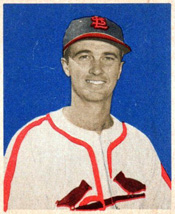
In 1946, the Cardinals started pitcher Howie Pollet in the postseason, knowing he was injured and in pain.

Pollet lasted one-third of an inning, surrendering a run on three hits, before he was relieved in Game 5 of the 1946 World Series against the Red Sox.

In his return to the Cardinals following two years of military service, Pollet, 25, was St. Louis’ ace in 1946. He led the National League that season in wins (21), ERA (2.10) and innings pitched (266). Pollet pitched in 40 regular-season games, making 32 starts.

Under the heavy workload, Pollet was ailing in September. His back ached and he either had a torn shoulder muscle or a torn side muscle, according to conflicting published reports.

Nonetheless, Pollet kept taking his turn in the rotation. When the Cardinals and Dodgers finished the regular season tied for first place, they went to a best-of-three playoff series to determine the NL champion. Cardinals manager Eddie Dyer selected Pollet to start Game 1.

According to The Sporting News, Pollet agreed to the start despite a torn muscle in his left shoulder. (The publication subsequently reported the injury as a torn muscle in his side.)

Pollet pitched a complete game and the Cardinals won, 4-2. Boxscore

Five days later, Pollet was the starting pitcher in Game 1 of the World Series. Pitching with what the Associated Press described as an aching side, Pollet carried the Cardinals into the ninth inning with a 2-1 lead. He was one strike away from retiring the final batter until Tom McBride poked a single between short and third, scoring pinch-runner Don Gutteridge.

In the 10th, with two outs, Rudy York hit a Pollet curve into the last row of the left-field seats at Sportsman’s Park for a home run, giving the Red Sox a 3-2 victory. Boxscore

Said Pollet: “Yes, my back bothered me a couple of times, but I didn’t think it was affecting my pitching.”

With the World Series even at two wins apiece, Pollet was the Cardinals’ choice to start Game 5 at Boston. After three of the first four batters singled, giving the Red Sox a 1-0 lead, Al Brazle relieved Pollet. The Red Sox scored five runs off Brazle in 6.2 innings and won, 6-3. Boxscore

Wrote Sam Levy in the Milwaukee Journal: “The biggest surprise to the 35,982 fans … was the rapid exit of Howie Pollet.”

Pollet experienced an “extremely painful back ailment” and “torn side muscle,” the Associated Press reported.

Cardinals team doctor Robert Hyland instructed Pollet not to pitch again until spring training. “Howie figures that if he had taken a full week off in September after he first pulled a muscle in his back he would have been in better condition for the World Series,” The Sporting News reported.

Pollet continued to pitch in the major leagues until 1956. He was a 20-game winner for the 1949 Cardinals. In nine seasons with St. Louis, Pollet was 97-65. Pollet also was a Cardinals coach from 1959-64.

Previously: How Chase Riddle got Steve Carlton for Cardinals

Read Full Post »

(Updated April 18, 2021)

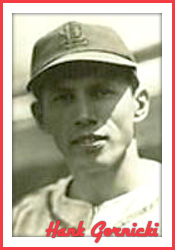
On May 3, 1941, in his first major-league start, Hank Gornicki pitched a one-hit shutout for the Cardinals against the Phillies at Philadelphia.

It was the only start Gornicki ever made for the Cardinals. Less than a month later, he was returned to the minor leagues. Before the season ended, he was shipped to the Cubs.

A right-hander, Gornicki was a 30-year-old rookie with the 1941 Cardinals. He pitched with success in the Cardinals’ farm system for six years, posting double-figure win totals each season, before earning a spot with the big-league club.

At the time, his claim to fame was being dubbed the “wood chopper of the Great Smokies” because he kept fit during the off-seasons by cutting down trees on his father’s property in North Carolina.

After two relief appearances with the 1941 Cardinals, manager Billy Southworth gave Gornicki the start against the Phillies because Southworth decided the rookie should be given the chance, The Sporting News reported.

Before the game, Cardinals coach Mike Gonzalez “told visitors to the St. Louis bench that he didn’t think Gornicki had a good enough fastball to last nine innings,” the Philadelphia Inquirer reported.

According to the St. Louis Star-Times, “Southworth was afraid to use him without keeping a veteran warmed up for emergency duty. Out of the corner of his eye, Gornicki could see Bill McGee toiling in the bullpen through most of the game, but Bill might as well have spent the afternoon at a movie.”

On a chilly Saturday afternoon at Shibe Park, Gornicki held the Phillies hitless until Stan Benjamin lined a single to center with two outs in the sixth.

Gornicki finished with five strikeouts and five walks in pitching the Cardinals to a 6-0 victory. He also contributed a RBI-single in the seventh. Boxscore

“He pumped the ball overhand with fine speed and a very sharp-breaking curve,” the St. Louis Globe-Democrat reported.

According to the Philadelphia Inquirer, Gornicki “has a fine curveball, a good fastball and perfect poise on the mound. His only apparent weakness was his tendency to get the count to 3-and-2. With a good-hitting club, this might prove fatal.”

The victory was the eighth in a row for the pitching-rich Cardinals and it improved their record to 13-3.

Though Gornicki dazzled in his start, Southworth returned him to the bullpen because the Cardinals already had quality starters such as Lon Warneke, Ernie White, Mort Cooper, Max Lanier, Harry Gumpert and Howie Krist.

As Fred Lieb of The Sporting News wrote, “Like the old lady in the shoe, Billy Southworth had so many good young pitchers he didn’t know what to do.”

Gornicki didn’t appear in another game for almost two weeks. He pitched less than an inning in relief on May 15 against the Braves. Soon after that, he was sent to Rochester of the International League.

With Rochester, Gornicki was 12-9 with a 2.83 ERA in 26 games. On Sept. 2, the Cardinals sent Gornicki to the Cubs in a cash transaction. He appeared once in relief for the Cubs before baseball commissioner Judge Kenesaw Mountain Landis voided the deal, saying it had violated the waiver rule. The Reds had claimed Gornicki on waivers before the Cardinals had sent him to the Cubs.

Returned to the Cardinals, Gornicki was in no-man’s land, unwanted and unsure of where he belonged. In December, the Cardinals dealt him to the Pirates.

Gornicki spent three seasons (1942, 1943 and 1946) with the Pirates in a stint that was interrupted by two years of military service during World War II. He posted a big-league career record of 15-19 with a 3.38 ERA in 79 games, including 33 starts.

Read Full Post »

The actions of manager Eddie Stanky caused the Cardinals to forfeit a home game to the Phillies. When the Busch Stadium public address announcer declared the umpires had awarded the Phillies a victory, Cardinals fans cheered to show their displeasure with Stanky.
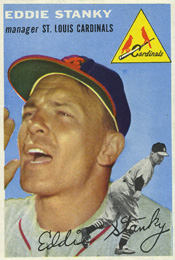
On July 18, 1954, the Cardinals forfeited a brawl-marred game to the Phillies because umpires ruled the combative Stanky, nicknamed “The Brat,” intentionally used stalling tactics in an attempt to avoid a loss.

After being suspended by National League president Warren Giles, Stanky issued an emotional public apology.

Pressure mounts

Booed with increasing regularity by Cardinals fans because his team was mired in sixth place in the eight-team league, Stanky was dealing with a series of setbacks and strains.

On July 17, a Saturday afternoon when the temperature reached 100 degrees, the first-place Giants built a 9-0 lead after three innings against the Cardinals at St. Louis. The Cardinals fought back impressively, scoring five runs in the sixth, three in the seventh and one in the eighth, tying the score, but the Giants won, 10-9, with a run in the 11th, dropping the Cardinals 17 games out of first with a 41-44 record. Boxscore

The next day, Sunday, July 18, the Phillies were in St. Louis for a doubleheader with the Cardinals.

Amid growing speculation about Stanky’s job security, club owner Gussie Busch issued a vote of confidence, saying, “I know there are many loyal Cardinal fans all over the country who are impatient and unhappy with the present standing … but I think it is altogether too simple and too easy to blame the manager every time something goes wrong or doesn’t work out exactly as it should.”

Adding to the drama was the matchup between Stanky and his Phillies counterpart. Three days earlier, the Phillies fired manager Steve O’Neill and replaced him with Terry Moore, the ex-Cardinals outfielder. When Stanky became Cardinals manager in 1952, Moore was on his coaching staff. Stanky fired him after the season. Moore reacted by ripping Stanky, telling reporters, “When he loses a ballgame, he acts more like a 9-year-old boy than a manager. The job is too big for him. Stanky is temperamentally unsuited for the job of manager.”

It was under this backdrop _ the booing by Cardinals fans, the speculation about his job status and the sight of Moore managing against him _ that Stanky approached the first game of the July 18 doubleheader.

Snap, crackle, pop

It didn’t unfold as Stanky hoped. The game was delayed 1 hour and 18 minutes by rain in the seventh. The Cardinals led 8-7 after eight. The Phillies scored three in the ninth for a 10-8 lead. The Cardinals rallied, tying the score in the bottom half of the inning on a two-out, two-run single by Solly Hemus, but the Phillies scored in the 10th, the Cardinals stranded Wally Moon on third with one out in the bottom half of the inning, and Philadelphia won, 11-10. Boxscore

In consecutive games, the Cardinals had scored 19 total runs _ and lost each by a run in extra innings.

Because of the rain delay and extra inning in the opener, the second game of the doubleheader didn’t begin until after 6 p.m. The Cardinals and umpires mistakenly thought a league rule prohibited ballpark lights from being turned on for a Sunday game beginning after 6. (The rule had been erased before the 1954 season.)

When the Phillies took an 8-1 lead, Stanky began making a series of deliberate pitching changes in an effort to prevent the game from being completed in the mandatory five innings before darkness arrived.

Each Cardinals reliever appeared to work slowly and issue pitches outside the strike zone. Tensions built as the game inched into the top of the fifth and darkness approached.

At that point, Cardinals catcher Sal Yvars and Phillies first baseman Earl Torgeson, who had a long-running feud, began fighting one another on the field. Moore raced toward the pair and grabbed Yvars. Stanky bolted toward the combatants and tackled Moore. The benches emptied and fighting continued until police broke up the melee.

When Stanky went to the mound to make another pitching change, umpire Babe Pinelli declared a forfeit in favor of the Phillies.

Wakeup call

Giles backed his umpires, saying, “The tactics employed in the game were palpably designed to delay the game.”

Stanky disagreed, telling the Associated Press: “My pitchers have been wild and ineffective all season, not only during this game.”

The next day, Giles suspended Stanky for five days and fined him $100. Yvars was suspended for three days and Torgeson for two.

Humbled, Stanky apologized for his actions and read a statement. Some excerpts:

“I called this press conference because of the impression I received Sunday when I heard the St. Louis people applaud Pinelli’s decision, forfeiting the game to the Phillies. I know in my heart indirectly that I have embarrassed and hurt the St. Louis people, baseball nationally, my reputation as a baseball man … and Gussie Busch and the Cardinals’ front office.

“… My spirit and desire to win could never be broken. However, my human and public relations will be improved. This affair Sunday has opened my eyes.”

Said Cardinals general manager Dick Meyer: “It takes a tremendous amount of fortitude to make the type of statement Eddie made unsolicited.”

Some were skeptical. “He said the same thing in 1952 right after he got the job, but the reform didn’t last long,” Moore said.

Stanky survived the season, but was fired in May 1955 after the Cardinals got off to a 17-19 start. Moore returned to the Cardinals in 1956 as a coach for manager Fred Hutchinson.


Read Full Post »
« Newer Posts - Older Posts »