Feeds:
Posts
Comments

Archive for the ‘Games’ Category

The similarities between Lance Lynn and Alan Benes are striking.

Lynn, a Cardinals right-hander and Indiana native who turned 25 in 2012, struck out at least 11 batters in consecutive games that year.
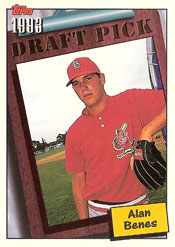
Benes, a Cardinals right-hander and Indiana native who turned 25 in 1997, struck out at least 11 batters in consecutive games that year.

Lynn became the first Cardinals pitcher since Benes to strike out at least 11 in consecutive games.

One area where they differed, though, was in the results of those back-to-back high-strikeout games.

Lynn got wins in both _ he struck out 11 in six innings in the Cardinals’ 14-2 victory over the Astros at Houston on June 7, 2012, Boxscore and followed that with a 12-strikeout performance in 7.1 innings in the Cardinals’ 1-0 victory over the White Sox at St. Louis on June 13. Boxscore

Benes got the win when he struck out 11 in six innings in the Cardinals’ 8-3 victory over the Padres at San Diego on June 11, 1997. Benes was even better in his next start, June 16 against the Brewers. Like Lynn, it involved a 1-0 game, but Benes wasn’t as fortunate.

In a duel of power pitchers, Benes was matched against Ben McDonald in the first interleague game at Milwaukee’s County Stadium. (The Brewers, now with the Cardinals in the National League Central Division, then were members of the American League.)

Both starters were sharp. McDonald struck out 12 in eight innings before being lifted for Bob Wickman. When Brewers second baseman Mark Loretta struck out leading off the bottom of the ninth, it was the 11th strikeout recorded by Benes. (Among his other strikeout victims that night was Brewers catcher Mike Matheny.)

At that point, Benes had yielded three hits, all singles, in the scoreless game.

Jeromy Burnitz, the Brewers’ strapping left-handed batter, then stepped to the plate. Benes got ahead of the count with a fastball on the outside corner. Benes’ next pitch was similar to the first _ but this time Burnitz was ready. He crushed the thigh-high fastball 410 feet to straightaway center field for a walkoff home run and 1-0 Brewers victory. Boxscore

“It wasn’t a bad pitch to a lot of guys, but to Burnitz in that situation, it wasn’t a great pitch,” Benes told the Milwaukee Journal Sentinel. “He’s a guy who likes to take the fastball away from you, and I had done a good job of changing speeds against him all day.”

Said Burnitz: “I knew it had a chance because I smoked it. I was excited. I’d never hit a game-winning home run before.”

The ninth-inning setback in a scoreless game was the second Benes experienced within a month. On May 16, Benes held the Braves hitless for 8.2 innings in Atlanta until Michael Tucker doubled. The Braves won, 1-0, in the 13th against reliever John Frascatore. Boxscore

Asked how his effort against the Brewers rated with his performance against the Braves, Benes replied, “Comparable stuff, or at least close.”

A week earlier, Cardinals manager Tony La Russa had told Rick Hummel for The Sporting News that Benes was as good as any young pitcher in baseball. The Brewers were believers.

“That guy has got great stuff,” Burnitz said of Benes.

Said Milwaukee manager Phil Garner: “We were duly impressed by him. It’s OK if we don’t see him again until next year.”

Previously: Near no-hitter by Alan Benes became crushing loss
Read Full Post »

Early in the 1943 season, a report circulated that Mort Cooper, ace of the Cardinals’ rotation, had a sore arm. A few weeks later, The Sporting News claimed “warm weather brought the (arm) around.”

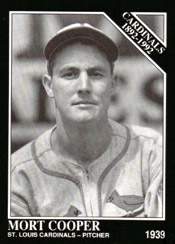
Whatever the explanation, Cooper recovered and became the only Cardinal to pitch one-hitters in consecutive complete-game starts.
Cooper’s back-to-back one-hitters occurred five years after the Reds’ Johnny Vander Meer became the only big-league pitcher to toss consecutive no-hitters.

On Memorial Day, May 31, 1943, Cooper held the Dodgers to one hit in the Cardinals’ 7-0 victory in the opener of a doubleheader at St. Louis.

Billy Herman got the lone Dodgers hit. Herman’s double to start the fifth inning was “a high, twisting two-bagger just inside the foul line,” United Press reported, and it fell beyond the reach of right fielder Stan Musial.

Herman, who also walked, and Augie Galan, who walked twice, were the only Dodgers baserunners. Cooper struck out two and improved his record to 5-3. His brother, catcher Walker Cooper, and Musial drove in two runs apiece. Boxscore

“If Cooper still has a sore arm,” wrote Hugh Fullerton Jr. of the Associated Press, “manager Billy Southworth probably wishes that all his other pitchers would go out and get one just like it.”

Four nights later, June 4, 1943, at St. Louis, Cooper held the Phillies hitless for seven innings and settled for a one-hitter in the Cardinals’ 5-0 victory.

Jimmy Wasdell of the Phillies opened the eighth by lining a single to left. Pinky May, who reached on an error by Cooper and was erased on a double play, was the only other Phillies baserunner. Cooper struck out five in a game that took 1:42 to complete. Boxscore

Jack Cuddy of United Press described why Cooper was so effective:

“Mort can provide the pitch that’s needed at a proper time _ fastball, screwball, forkball or curve. His fastball is the most effective pitch. This is blurred lightning, with a hop at the end. But to southpaw batsmen, he feeds screwballs, keeping them on the outside so that they can’t be pulled to right field.

“Right-handed hitters get the fastball and the forkball. The latter approaches the plate in drunken fashion, like a knuckler’s butterfly pitch. It’s almost impossible to smack the ‘fork’ solidly. In addition, Mort has unusual control. With a 3-and-2 count on the batsman, he can produce a feint or an actual in the strike zone that forces (1) a waiting called strike or (2) a whiff.”

In his start after the second one-hitter, Cooper pitched another complete game and earned the win in the Cardinals’ 4-3 victory over the Pirates on June 9, 1943, at St. Louis. The Pirates got seven hits, two apiece by Vince DiMaggio and pitcher Rip Sewell. Boxscore

Helping the Cardinals win their second consecutive pennant, Cooper, 30, finished 1943 with a 21-8 record and 2.30 ERA. He had six shutouts and 24 complete games among his 32 starts.

His back-to-back gems in 1943 were the only one-hitters of his major-league career.


Read Full Post »

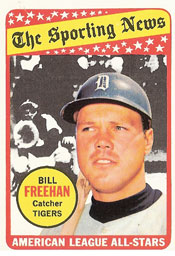
When Mike Matheny played baseball for the University of Michigan, his coach the final two seasons was Bill Freehan, who had been an all-star catcher for the Detroit Tigers.

Freehan foresaw Matheny as a big-league ballplayer and manager. He mentored Matheny with those goals in mind and instilled confidence in the college catcher.

“It was very interesting that he saw that,” Matheny told Jenifer Langosch of MLB.com in February 2012. “It wasn’t just some random guy. It was a guy with great credibility.”

Freehan, an 11-time American League all-star and five-time Gold Glove Award winner who played 15 years (1961-76) for the Tigers, encouraged Matheny to take Spanish courses so he could communicate fully with Hispanic players.

“He (Freehan) called me into his office one day and said, ‘If you’re going to be in this game for a long time, even after your playing days, you need to change all your electives to learning Spanish,’ ” Matheny said to Chris Girandola of MLB.com.

Matheny earned his degree in sports management and communication, with a minor in Spanish. He managed the Cardinals from 2012-2018 and led them to a National League pennant in 2013.

A native of the Columbus suburb of Reynoldsburg, Ohio, Matheny was recruited to Michigan by baseball coach Bud Middaugh. After the 1989 season, Matheny’s first with the Michigan varsity, Middaugh resigned amid allegations he had diverted money to baseball players from the sale of football game programs.

Michigan athletic director Bo Schembechler turned to Freehan, who had been an all-America catcher at Michigan in 1961.

In six seasons (1990-95), Freehan coached Michigan to a 166-167-1 record, including 76-89 in the Big Ten. In 1991, Freehan named Matheny co-captain. A three-year letter winner (1989-91) and academic all-Big Ten (1990), Matheny was named Michigan’s most valuable player in 1991. He also met his wife, Kristin, a varsity field hockey player for Michigan.

Matheny was selected by the Brewers in the eighth round of the 1991 major league draft, extending a tradition of Michigan baseball players who became professionals. Like Matheny, other Michigan standouts who would play for the Cardinals included infielders Dave Campbell, Chris Sabo and Ted Sizemore, and pitcher Lary Sorensen. Branch Rickey, who was Michigan’s baseball coach from 1910-13 while earning a law degree from the school, became manager and chief baseball executive of the Cardinals.

(Ted Simmons is a Michigan graduate. The physical education and speech major earned his degree in 1996, 29 years after enrolling. Simmons, a catcher, never played for Michigan’s baseball program. Instead, he signed with the Cardinals after graduating from high school in 1967.)

Matheny would go on to win four Gold Glove awards (with the Cardinals in 2000, 2003 and 2004, and with the 2005 Giants) and help St. Louis to four postseason appearances and a National League pennant.

Freehan won his Gold Glove awards in consecutive years (1965-69).

Previously: Bill Freehan, Lou Brock and a World Series controversy

Previously: Should Curt Flood have caught Jim Northrup’s drive?

Read Full Post »

In February 1954, Jack Buck was hired to join Harry Caray on the Cardinals broadcast team.

Caray was entering his 10th season as play-by-play voice of the Cardinals when Buck was chosen to join him after calling minor-league games for Rochester in 1953. Buck replaced former catcher Gus Mancuso as Caray’s broadcast partner.
Buck had been given a tryout in 1953, broadcasting a Cardinals-Giants regular-season game from New York. In his book, “That’s a Winner,” Buck said, “What stood out to me that day was how helpful some people were, like the Giants’ announcer, Russ Hodges. He gave me all the information I needed and offered a lot of encouragement.”

In April 1954, two months after Buck got the offer to join Caray on the broadcast team, Milo Hamilton, who had done television work in the St. Louis area for WTVI of Belleville, Ill., was hired “to handle commercials and color on road broadcasts,” meaning Buck’s work in the booth initially was limited to home games.

“(Hamilton) and I split time on the air,” Buck said. “Milo went on the road with Caray for the first half of the season. I did the scoring updates and commercials from the studio. We switched at the all-star break, and I went on the road, but didn’t have a lot to do because the broadcasts definitely were Harry’s. I did a couple of innings a game, and that was it.”

Caray didn’t get along with Buck and Hamilton. “It didn’t take me long to realize that Harry and I not only had different styles of announcing, we had different personalities and lifestyles,” Buck said. “Our relationship got off badly because he didn’t want me to get the job in the first place. He wanted the Cardinals to hire Chick Hearn, who at the time was a broadcaster in Peoria, Illinois (and eventually would become the voice of the NBA Lakers.)

“Harry didn’t get along with Milo any better than he got along with me at the time,” Buck said, “and we knew he wanted to get somebody else on the broadcast with whom he was more friendly. The man he wanted _ and got _ was Joe Garagiola.” (Hamilton was fired after the 1954 season and replaced by Garagiola.)

All three members of the Cardinals’ 1954 broadcast team would receive the Ford C. Frick Award from the National Baseball Hall of Fame for their career achievements. (Buck won the award in 1987; Caray in 1989; and Hamilton, 1992.)

Buck’s first regular-season Cardinals broadcast as an official member of the team was the 1954 season opener on April 13 at St. Louis. The Cubs beat the Cardinals, 13-4, behind the hitting of Clyde McCullough (4-for-5, two RBI) and Randy Jackson (three RBI). Paul Minner earned a complete-game win for Chicago. Among the Cardinals’ few highlights were solo home runs by Wally Moon and Stan Musial. Boxscore

“The most memorable event of my first season in St. Louis came on a Sunday afternoon, May 2, 1954, in a rain-delayed doubleheader against the Giants,” said Buck. “Stan Musial hit five home runs, three in the first game, two in the second, and might have had another with the longest ball he hit all day, but it was to straightaway center and was caught by Willie Mays. Caray was on the air for all five homers, and it was just as well. It used to bother him when he wasn’t on the air when something really big happened.” Game 1 and Game 2

Read Full Post »

The Cardinals have been a part of the Royals’ history ever since Kansas City entered the American League as an expansion franchise in 1969.

The Cardinals were the opponent for the Royals’ first game at Kansas City, an exhibition on Saturday, April 5, on the weekend before the opening of the 1969 regular season.
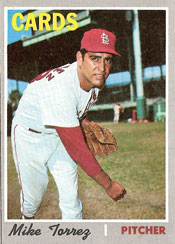
St. Louis won, 1-0, behind the pitching of Mike Torrez and Dave Giusti. Torrez, a native of Topeka, Kan., held Kansas City to three singles in five innings and scored the lone run. Left fielder Lou Brock drove in Torrez with a triple to right-center off Roger Nelson after Torrez had doubled into right field with two outs in the third.

Giusti, one of the Cardinals’ key off-season acquisitions, limited the Royals to a hit over the last four innings. In addition to Nelson, who went five innings, the Royals also pitched Bill Butler and Dave Wickersham.

Stan Musial, who would be inducted into the National Baseball Hall of Fame that summer, delivered the ceremonial first pitch for the second and last game of the exhibition series the following day, Easter Sunday, April 6. St. Louis won, 6-5.

“If the Cardinals don’t clinch the pennant by July, there ought to be an investigation,” Royals coach Charlie Metro said to The Sporting News.

After winning National League pennants in 1967 and 1968, plus the 1967 World Series championship, the Cardinals were considered favorites to at least finish atop the NL East in 1969, the first year Major League Baseball split the two leagues into two divisions each. In addition to adding Giusti, a former Astro, St. Louis had acquired Vada Pinson from the Reds to replace Roger Maris in right field and Joe Torre from the Braves to replace Orlando Cepeda at first base.

“As much as everyone liked Roger Maris and appreciated what he did for us, I think Vada will help us more,” Cardinals reliever Ron Willis said.

Pinson hit .449 in spring training for St. Louis. Third baseman Mike Shannon batted .371 with 17 RBI in the spring exhibition season.

“Mike looks 50 percent better, at bat and at third base,” said St. Louis hitting coach Dick Sisler.

Said Cardinals infielder Phil Gagliano: “Those first three hitters (Brock, Curt Flood and Pinson) are tough. Moon (Shannon) will drive in 100 runs _ if Torre doesn’t get ’em first.”

After winning the two exhibition games at Kansas City, the Cardinals went to St. Louis to open the regular season with three games against the Pirates. “It’ll take a lot of luck to stop the Cardinals,” Pirates manager Larry Shepard said to the Associated Press. “They’re far and away the best club. This is the best team they’ve had in three years.”

Only Cardinals manager Red Schoendienst expressed caution. Asked whether the Cubs were the Cardinals’ top threat, Schoendienst said, “The Cubs and the Mets. The Mets have had great pitching the last couple of years and now some of their young guys at the other positions are coming through. They’re not making so many mistakes as they used to.”

Unfortunately for the Cardinals, Schoendienst was right and everyone else was wrong. The Pirates swept the opening series against the Cardinals. Pinson didn’t live up to expectations, batting .255 in 1969 and posting a weak on-base percentage of .303. Shannon fell far short of 100 RBI, with 55. The Cardinals finished in fourth place in the six-team NL East, a game behind the third-place Pirates.

The Mets, dubbed a miracle team by most, developed just as Schoendienst had feared, winning the division and league titles and defeating the Orioles in the World Series.

The Royals? The expansion club finished as high in the standings as the Cardinals _ fourth in the six-team American League West.

Read Full Post »

(Updated Dec. 15, 2018)

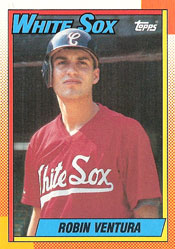
Robin Ventura had a record of delivering knockout blows against the Cardinals.

In a 16-year playing career (1989-2004) as a third baseman for the White Sox, Mets, Yankees and Dodgers, Ventura hit .250 versus the Cardinals, with five home runs and 19 RBI.

Two of his most devastating hits came on June 10, 1998, at Chicago. The Cardinals had built a 7-0 lead through five innings and were ahead of the White Sox, 8-4, entering the bottom of the ninth.

Curtis King retired the first two batters of the inning and needed one out to seal a Cardinals win, but Mike Caruso got an infield hit, Frank Thomas walked and Albert Belle slugged a three-run home run, making the score 8-7. Ventura followed with a home run, tying the score.

In the 11th, Belle singled with one out and Ventura hit a 3-and-0 pitch from Sean Lowe over the right-field fence for a two-run walkoff home run and a 10-8 White Sox victory. Boxscore

“I was just trying to get a pitch to hit in the air and I did,” Ventura said to the Arlington Daily Herald.

Asked about Ventura swinging on a 3-and-0 count, White Sox manager Jerry Manuel replied, “All three of those guys (Ventura, Belle and Thomas) have the green light to hit. They’re marquee players.”

Ventura became a free agent after the 1998 season and signed with the Mets. On June 17, 1999, he went 3-for-4 with two RBI and a run scored in the Mets’ 4-3 victory over the Cardinals at St. Louis. Ventura’s two-run home run to right-center in the sixth off Kent Mercker pushed the Mets’ lead from 2-1 to 4-1 and produced the winning run. Boxscore

“I made a bad pitch to Ventura and it cost me a game,” Mercker said to the St. Louis Post-Dispatch. “It was probably right down the middle of the plate. Three-and-two count, you leave a pitch down the middle to Robin Ventura … You expect bad things to happen.”

In 2000, Ventura had consecutive three-RBI games in Mets victories over the Cardinals at St. Louis, 5-2 on May 26 Boxscore and 12-8 on May 27. Boxscore

The Cardinals and Mets advanced to the National League Championship Series that year, with New York winning in five games. Ventura had the key hit in Game 4, a two-run first-inning double off Darryl Kile that landed between center fielder Jim Edmonds and right fielder J.D. Drew and gave New York a 3-2 lead. Ventura had a team-high three RBI in the game, which the Mets won, 10-6, at Shea Stadium. Boxscore

A year later, the Mets traded Ventura to the Yankees for outfielder David Justice. On June 15, 2003, Ventura won a classic duel with pitcher Woody Williams and lifted the Yankees to a 5-2 victory over the Cardinals in New York. Boxscore

In the sixth inning, with the Cardinals ahead 2-1, the Yankees had runners on first and second. Ventura faced Williams, who quickly got two strikes on the batter. Ventura fouled off four two-strike pitches. On the 10th pitch of the at-bat, Williams threw a high fastball on a 3-and-2 count and Ventura laced a two-run double into the gap in right-center, giving New York a 3-2 lead.

“That was a huge at-bat,” Yankees manager Joe Torre said to the New York Daily News. “He got behind and he was fighting off and fighting off. Those are the kind of at-bats we need.”

Read Full Post »

« Newer Posts - Older Posts »