Feeds:
Posts
Comments

Archive for the ‘Games’ Category

When the Cardinals played in Dodger Stadium for the first time the weekend of May 18-20, 1962, they felt right at home. The Cardinals swept the three-game series, receiving complete-game wins from each of their starting pitchers, and Stan Musial stroked a single, surpassing Honus Wagner to become the National League all-time hits leader.

Moved from Brooklyn to Los Angeles after the 1957 season, the Dodgers played four years at the Coliseum while Dodger Stadium was being built. On April 10, 1962, in the first regular-season game at Dodger Stadium, the Reds defeated the Dodgers, 6-3. Boxscore

As the Cardinals-Dodgers series opened May 18, the Dodgers were in second place, three games behind the Giants, at 23-12. The Dodgers had won four in a row and eight of their last nine. The Cardinals were in third place at 18-13 and had lost five of their last seven.

The Cardinals’ arrival brought out the entertainment crowd. While the Cardinals were warming up before the first game, comedian Milton Berle, seated near the dugout, performed card tricks for Musial, Red Schoendienst and Ernie Broglio, the Los Angeles Times reported.

The opener matched Johnny Podres against Larry Jackson. In the first inning, Ken Boyer smashed a drive that struck Podres in the left forearm. Podres threw three pitches out of the strike zone to the next batter, Gene Oliver, and walked off the field, unable to pitch. X-rays revealed a severe bruise, no fracture.

Bill White drove in three runs, Charlie James scored three runs and knocked in two, and Jackson went the distance as the Cardinals won, 8-3, before 38,951. Boxscore

“I had a pretty good curve and fastball,” Jackson told the St. Louis Post-Dispatch.

The story the next night, May 19, normally would have been the pitching of Cardinals left-hander Ray Sadecki. The Dodgers had defeated six consecutive left-handers and Sadecki was 0-3 in his career against them, but Sadecki changed the script, pitching his first complete game of the season and got the win in the Cardinals’ 8-1 triumph before 44,559. Boxscore

The headlines, however, went to Musial, the 41-year-old left fielder. His single to right field in the ninth inning off a curve from Ron Perranoski gave Musial his 3,431st hit and moved him ahead of Wagner for No. 1 on the NL career list, breaking a mark that had been held for 45 years. Dodgers first baseman Wally Moon, a former Cardinals teammate, fielded the throw from right fielder Frank Howard and handed the ball to Musial, who received a standing ovation.

“Stan hit a good curveball,” Perranoski told The Sporting News.

Said Musial: “I never worked so hard for two hits.”

(Musial had hit the record-tying single off Juan Marichal in San Francisco on May 16, ending a string of 15 hitless at-bats. He went hitless in nine more after that until he connected on the 0-and-1 pitch from Perranoski.)

“At least I got it in a beautiful new park and against the Dodgers, who have been good to me over the years,” Musial said.

Only Ty Cobb (4,191) and Tris Speaker (3,515) had more career hits than Musial at that time.

After the game, Musial and teammates Boyer and Schoendienst went to the Stadium Club at the ballpark. Musial enjoyed a steak sandwich and French fries. As Neal Russo reported in The Sporting News, few tables had a trio with more hits _ a total surpassing 7,000.

Exhausted by the strain to break the record, “I just about wilted when I got to first base with the record hit,” Musial said.

While Musial sat out the series finale on Sunday afternoon, May 20, Schoendienst, 39, started at second base for the fifth consecutive game. He was filling in for Julian Javier, who was sidelined because of a torn fingernail on his right index finger.

Curt Simmons yielded three runs, none earned, and got the complete-game win in the Cardinals’ 4-3 victory before 38,474. Boxscore

The Cardinals had swept a series in Los Angeles for the first time since the Dodgers left Brooklyn. They moved into a second-place tie with the Dodgers and got within 4.5 games of the Giants.

Previously: How Stan Musial turned in a great comeback year at 41
Read Full Post »

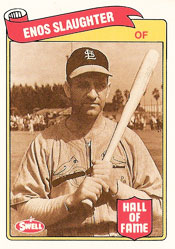
Discovered at a tryout camp in Greensboro, N.C., at age 18 in the autumn of 1934, Enos Slaughter made a rapid rise through the Cardinals’ system. From almost the first day Slaughter arrived at the Cardinals’ major-league spring training site in Daytona Beach, Fla., in 1938, manager Frankie Frisch deemed the rookie the starting right fielder.

Confident and talented, Slaughter collected an extra-base hit in each of his first five regular-season games for the 1938 Cardinals.
Slaughter, a left-handed batter, had an extra-base hit in each of five games against the Pirates and Cubs from April 19 through April 23 in 1938. Slaughter, who would turn 22 on April 27, had three doubles, a triple and a home run in that stretch, with a batting average of .435 and a slugging percentage of .783.

In a report about Slaughter in The Sporting News in May 1938,  J. Roy Stockton wrote: “The farm system and the scouts can take pride in his development and point to him as a shining example of how rapidly a young man can advance in the club’s great organization if he has the stuff.”

Slaughter, a native of Roxboro, N.C., was a standout high school player. He attended the Cardinals’ tryout camp as a second baseman. He had trouble fielding grounders consistently, but displayed a strong arm, speed and hitting ability. The Cardinals signed Slaughter and converted him into an outfielder.

In his first professional season, 1935 at Class D Martinsville (Va.), Slaughter had 25 doubles, 11 triples and 18 home runs in 109 games. He went to Class B Columbus (Ga.) in 1936. Playing for manager Eddie Dyer, Slaughter hit .325 with 31 doubles and 20 triples in 151 games.

At Class AA Columbus (Ohio) in 1937, Slaughter put together a season that earned him his chance at the major-league roster the following year. Slaughter hit .382 and compiled a .609 slugging percentage, with 245 hits, 42 doubles, 13 triples and 26 home runs in 154 games.

While at Columbus, manager Burt Shotton gave Slaughter the nickname “Country.” Wrote The Sporting News: “It appealed to the youngster who loves the cows and chickens and the earth which his family has tilled through many generations.”

At spring training in 1938, Frisch was seeking a right fielder to replace Don Padgett, who hit .314 but committed 11 errors in 1937, and join an outfield of Joe Medwick in left and Terry Moore in center. Slaughter was the immediate choice.

“Enos hits to all fields, has made a goodly share of extra-base blows and has shown as strong a punch against left-handers as against the supposedly easier right-handers,” The Sporting News reported.

In his major-league debut, in the Cardinals’ 1938 opener at home against the Pirates on April 19, Slaughter, batting third, was 3-for-5 with a double, starting his extra-base streak. Boxscore

The next day, Slaughter hit his first big-league home run, a two-run shot in the ninth inning off Jim Tobin of the Pirates. Boxscore

The 1938 Cardinals lost their first three games and appeared headed to a fourth consecutive loss when they trailed the Cubs, 5-2, heading into the ninth inning at Chicago on April 22. Slaughter rescued the Cardinals, hitting a bases-loaded triple and scoring the winning run on an error, giving St. Louis a 6-5 victory. Boxscore

Asked to explain the difference between minor-league and big-league pitching, Slaughter replied, “It’s the better control that makes the pitchers harder to hit up here.”

Slaughter finished his rookie season with a .276 batting mark, .438 slugging percentage, 20 doubles, 10 triples and eight home runs.

He played 13 years for the Cardinals in a 19-season major-league career that earned him induction into the National Baseball Hall of Fame in 1985.

Previously: Hornsby, Musial, Slaughter, Brock all singled for hit No. 2,000

Read Full Post »

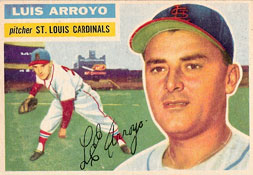
Luis Arroyo was the most unlikely of Cardinals pitchers to open a season with wins in each of his first six starts.

Arroyo, a rookie left-hander who barely made the 1955 Opening Day roster and nearly got knocked out in the first inning of his first start, posted a 6-0 record and 1.56 ERA through eight appearances (including two relief stints) and earned a spot on the National League all-star team.
Arroyo, a native of Puerto Rico, signed a professional contract in 1948 and joined the Cardinals’ organization in 1950. He hurt his left arm and sat out the 1952 and 1953 seasons. He re-emerged in 1954 as a prospect, posting an 8-6 record and 2.49 ERA for Class A Columbus (Ga.) and an 8-3 record and 2.35 ERA for Class AA Houston.

Arroyo, who credited Cardinals scout and retired catcher Gus Mancuso with teaching him an improved curve, pitched a no-hitter for Houston and had strikeout totals of 17 in one game and 15 in another. His combined record for Columbus and Houston in 1954 was 16-9 with a 2.42 ERA.

Invited to join the 1955 Cardinals in spring training, Arroyo pitched poorly, yielding 14 earned runs in 18 innings. However, the Cardinals, managed by Eddie Stanky, were desperate for left-handed pitching and placed Arroyo, 28, on the season-opening roster.

His big-league debut occurred on April 20, 1955, with a start against the Reds at Cincinnati. It almost ended soon after it began.

In the Reds’ half of the first, Johnny Temple led off with a single and advanced to second on a wild pitch. Wally Post walked. When Arroyo ran the count to 3-and-0 against the next batter, Gus Bell, Stanky sent coach Dixie Walker to confer with the pitcher.

Arroyo, reported The Sporting News, “came within one pitch of being yanked and sent to the minors.”

Walker told Arroyo, “You’ve been pitching scared all spring. There’s no use being nervous out there. You either do or you don’t _ that’s all there is to it. Get the ball over and get ’em out.”

Arroyo struck out Bell. On the third strike, Temple was thrown out attempting to steal third base. Ted Kluszewski grounded out to second, ending the inning.

In the third, Arroyo got another break. Temple was on second when Kluszewski singled, but Temple was thrown out trying to score.

Gaining confidence, Arroyo shut out the Reds for 7.2 innings before being relieved. He earned the win in the Cardinals’ 3-0 victory. Boxscore

Unimpressed, Reds manager Birdie Tebbetts told reporters he’d be surprised if Arroyo still was in the major leagues in July.

After two relief appearances, Arroyo returned to the rotation and won each of his next five starts. Two of those wins were against the Pirates, one came against the Phillies and two more were against the Reds.

After Arroyo beat Cincinnati for the third time, Tebbetts said, “He’s looking like one of the league’s better left-handers, who, I am sorry to say, will be around all year, at least.”

Arroyo’s six-game winning streak was snapped on June 6 at Brooklyn. Arroyo took a 4-3 lead into the bottom of the ninth, but Gil Hodges walked and Jackie Robinson followed with a home run for a 5-4 Dodgers victory. Boxscore

Arroyo accounted for eight of the Cardinals’ first 26 victories. After getting the win in the Cardinals’ 5-3 triumph over the Giants at St. Louis on June 25, Arroyo’s record was 9-2 with a 2.02 ERA.

In The Sporting News, Bob Broeg wrote of Arroyo, “He’s got a lively fastball, a pitch that moves away from right-handed hitters, causing them to pop up, and he’s got a good enough curve, change and control, too.”

Selected to the all-star team, Arroyo was the only one of seven NL pitchers not used by manager Leo Durocher in a game Stan Musial decided with a 12th-inning home run off Boston’s Frank Sullivan.

Arroyo’s second half of the 1955 season wasn’t as successful as his first half. He lost his final four decisions, and five of the last six. He finished at 11-8 with a 4.19 ERA in 35 games (24 starts). Arroyo and Harvey Haddix were Cardinals co-leaders in complete games (nine apiece) and only Haddix (12) had more wins for St. Louis.

In 1956, with Fred Hutchinson as manager, the Cardinals restructured their rotation. Arroyo was sent to Class AAA Omaha after spring training. He was 1-0 in five games for Omaha before the Cardinals traded him to the Pirates for pitcher Max Surkont.

Unable to repeat the success of his rookie season, Arroyo bounced from the Pirates to the Reds. He was in the Reds’ minor-league system when the Yankees purchased his contract in July 1960.

The move revived his career. Arroyo helped the 1960 Yankees win the American League pennant, posting a 5-1 record with seven saves and a 2.88 ERA in 29 games. A year later, Arroyo enjoyed his best big-league season. He was named AL Fireman of the Year by The Sporting News, with a 15-5 record, 29 saves and a 2.19 ERA in 65 games for the league-champion Yankees. Arroyo also was the winning pitcher in Game 3 of the 1961 World Series against the Reds.

Arroyo had one other claim to fame. According to Baseball Digest, he was the first major-league reliever to ride to the mound from the bullpen on a motorized cart. The bullpen cart was introduced at a Yankees-Red Sox game shortly before the 1961 All-Star Game at Fenway Park.

Read Full Post »

(Updated Aug. 27, 2015)

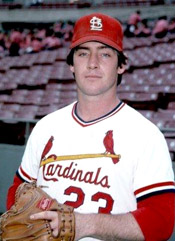
An indicator of how special a hitter Ted Simmons was is the number of four-hit games he had for the Cardinals.

Simmons achieved four hits in a game 19 times as a Cardinal.

Simmons had more four-hit games (six) against the Cubs than any other opponent.

Here is a look at Simmons’ five most notable four-hit games as a Cardinal:

_ Cardinals 11, Pirates 0, Aug. 14, 1971, at Pittsburgh: Simmons caught Bob Gibson’s only career no-hitter and went 4-for-6 with a RBI and two runs scored. It was Simmons’ first four-hit game in the big leagues.

Simmons is the only Cardinals catcher to achieve four hits in a game in which he caught a no-hitter.

Simmons’ four hits came against three pitchers: a RBI-single off Bob Johnson in the first, a fifth-inning double off Bob Moose, and singles in the sixth and eighth innings off Bob Veale. Boxscore

In the book “The Ted Simmons Story,” Simmons said of the no-hit game by Gibson, “I’d never seen anything like it. I guess it will always remain my biggest thrill in baseball.”

_ Cardinals 2, Cubs 1, Sept. 30, 1972, at Chicago: In an admirable display of durability and productivity, Simmons was 4-for-7, scored the winning run, caught all 16 innings, made 15 putouts and committed no errors in a game that took 4:49 to complete.

In the 16th, Simmons led off with a double against Tom Phoebus and scored on Ted Sizemore’s single to left, breaking the 1-1 tie. Boxscore

_ Cardinals 8, Reds 0, June 13, 1973, at Cincinnati: Simmons came stunningly close to catching another no-hitter while collecting four hits.

Rick Wise held the Reds hitless until Joe Morgan singled to center with one out in the ninth. Wise settled for a one-hitter and the win.

Morgan singled sharply on a 2-and-1 belt-high fastball. Simmons had called for a curve.

“You have to go with your pitcher _ he’s the man who’s going for the no-hitter,” Simmons said to The Sporting News. “He wanted to challenge them with his best pitch. I thought when Pete Rose (first batter in the ninth) flied out, the no-hitter was in the bag. Rick had pinpoint control. He was painting the outside corners on both right- and left-handed batters.”

Simmons was 4-for-5, including a two-run single off Jack Billingham in the Cardinals’ seven-run third inning. Boxscore

_ Cardinals 8, Braves 7, May 4, 1976, at Atlanta: Simmons was 4-for-5 with three RBI, including the game-winning hit.

With the score 7-7 in the 12th, Simmons hit a one-out double to the right-center field gap off Adrian Devine, scoring Bake McBride from first. Boxscore

It was Simmons’ second four-hit game in four days. As the starting left fielder, he had four hits on May 1 against the Dodgers.

_ Cardinals 8, Braves 5, June 9, 1980, at Atlanta: Simmons played an integral role in assuring Whitey Herzog’s first game as St. Louis manager was a success. Simmons was 4-for-4 and scored three runs.

In the 10th, with the score tied 5-5 and Larry Bradford pitching, Keith Hernandez walked and Simmons followed with a single to center. Bradford was replaced by Gene Garber, who yielded a three-run home run to the first batter he faced, George Hendrick. Boxscore

Previously: The story of how Ted Simmons became a Cardinal

Read Full Post »

In 1968, Larry Jaster made a conversion from reliever to starter for the Cardinals.

Jaster began the 1968 season in the bullpen. A 24-year-old left-hander, Jaster was 1-1 with a 2.13 ERA in seven relief appearances until he moved into the rotation in late May.
Here is how he did in his first four starts that season:

_ Cardinals 2, Dodgers 1, May 20, 1968, at St. Louis: Jaster pitched a two-hitter, yielding singles to Wes Parker and Paul Popovich, and stopped the Cardinals’ four-game losing streak.

The Dodgers scored an unearned run in the first. Willie Davis walked, took second on a passed ball by Tim McCarver, was bunted to third and scored on a groundout by ex-Cardinal Ken Boyer.

Jaster had pitched five consecutive shutouts against the Dodgers in 1966. After he baffled the Dodgers again with his first start of 1968, frustrated Los Angeles manager Walter Alston stormed into the clubhouse, grabbed a box of bubble gum and threw it across the room “as players and the chewy pellets scattered,” The Sporting News reported. Boxscore

_ Phillies 1, Cardinals 0, May 25, 1968, at St. Louis: Lack of run support led to Jaster taking a loss, even though he held Philadelphia to one earned run in 7.1 innings.

The Phillies scored in the sixth when a sacrifice fly by Don Lock drove in Johnny Callison from third.

St. Louis was held to five singles by ex-Cardinal Larry Jackson and reliever Turk Farrell. The Cardinals had two on with one out in the ninth when Farrell relieved and got Phil Gagliano to pop out and Dave Ricketts to line out. Boxscore

_ Cardinals 2, Mets 0, May 31, 1968, at New York: Outdueling Tom Seaver with a dazzling curve to complement his fastball and changeup, Jaster pitched a two-hitter, walking none.

The Mets were hitless until Greg Goossen singled between short and third with two outs in the eighth.

“It wasn’t a bad pitch. The pitch (a curve) was lower than waist high,” Jaster said to The Sporting News.

A ninth-inning single by Don Bosch accounted for New York’s other hit.

“I think I would have got the perfect game if I had got past Goossen,” Jaster said. Boxscore

_ Cardinals 3, Astros 1, June 5, 1968, at Houston: Jaster allowed one earned run in eight innings. Wayne Granger pitched the ninth for the save. Bob Aspromonte drove in Jim Wynn from third with a single for Houston’s run. Boxscore

Jaster was 4-2 with a 0.98 ERA after the win over Houston. He won just once after July 23, losing eight of his last nine decisions and finishing 9-13 with a 3.51 ERA.

Read Full Post »

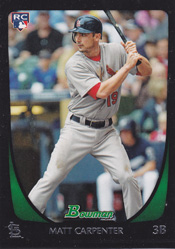
With a dominating hitting performance, Matt Carpenter joined an exclusive and eclectic Cardinals rookie club.

Batting sixth and starting at first base, Carpenter was 4-for-4 with five RBI, a home run and a triple in the Cardinals’ 10-3 victory over the Cubs on April 15 in St. Louis. Carpenter, a left-handed batter, had a RBI-single off left-hander Paul Maholm in the second inning, a two-run homer off right-hander Lendy Castillo in the fifth and a two-run triple off right-hander Rodrigo Lopez in the seventh. Boxscore

According to the Elias Sports Bureau, Carpenter is the third Cardinals rookie with four hits, five RBI and a home run in a game. The others are third baseman Les Bell (1925) and first baseman Fred Whitfield (1962).

The St. Louis Post-Dispatch and MLB.com, using information supplied by a Cardinals media relations staffer, reported outfielder Joe Hague also had four hits, five RBI and a home run in a 1970 game as a St. Louis rookie.

(Though Hague did achieve such a performance, I believe he wasn’t a rookie when it occurred. According to Major League Baseball, a player is considered a rookie if he hasn’t exceeded 130 big-league at-bats and hasn’t accumulated more than 45 days on a big-league team’s active roster. Hague accumulated more than 45 days on the Cardinals’ roster in 1969. He opened the ’69 season with the Cardinals and was with them until being demoted to the minor leagues in mid-June.)

Nonetheless, the magnitude of Carpenter’s achievement is placed in perspective when one considers it’s been at least four decades (and probably longer) since any other Cardinals rookie did the same.

Here’s how the others did it:

LES BELL

After appearing in fewer than 18 games for St. Louis in 1923 and again in 1924, Bell, 23, opened the 1925 season as the Cardinals’ everyday third baseman.

On April 18 at Chicago, the rookie, batting fifth, went 5-for-6 with two home runs and six RBI in the Cardinals’ 20-5 victory over the Cubs.

A right-handed batter, Bell hit a three-run homer off right-hander Guy Bush in the fourth and a two-run homer off right-hander Elmer Jacobs in the seventh. Bell also had two doubles and a single. It would be the only five-hit game of his nine-year big-league career. Boxscore

FRED WHITFIELD

A first baseman and left-handed batter, Whitfield as a rookie had a reputation as a potent hitter held back by fielding deficiences. On Aug. 12, 1962, Whitfield, 24, started at first base in the second game of a doubleheader against the Phillies at St. Louis. Batting third, he went 4-for-5 with a home run and five RBI, though the Phillies completed a sweep with a 9-7 victory.

In the sixth inning, Whitfield hit a grand slam off left-hander Bill Smith, giving the Cardinals a 7-6 lead. It was St. Louis’ first grand slam of the season. Whitfield also had a double and two singles. Boxscore

“Fred Whitfield is the greatest hitter I’ve ever seen _ for the number of times I’ve seen him bat against us,” Phillies manager Gene Mauch said to The Sporting News.

In 1970, Whitfield finished his nine-year big-league career with the Expos, managed by Mauch.

JOE HAGUE

Whether or not he was a rookie, Hague, a left-handed batter, deserves mention here for going 4-for-5 with a home run and five RBI in the Cardinals’ 9-2 victory over the Mets on May 28, 1970, at New York.

Batting sixth and playing right field, Hague, 26, had a two-run single off right-hander Don Cardwell in the first, a solo homer off left-hander Tug McGraw in the eighth and a two-run single off McGraw in the ninth. Hague also singled in the sixth. Boxscore

The home run was the first by a Cardinals batter other than Richie Allen or Joe Torre in nearly three weeks.

(Note: In the next game after Carpenter’s historic performance, he hit a bases-loaded sacrifice fly in the 10th inning to give the Cardinals a 2-1 win over the Reds on April 17. According to Elias Sports Bureau, Carpenter is the first rookie with a walk-off RBI in the major leagues this season.)

Previously: Is David Freese capable of 100-RBI season?

Read Full Post »

« Newer Posts - Older Posts »