Feeds:
Posts
Comments

Archive for the ‘Games’ Category

Jerry Lynch, one of the premier pinch-hitters in National League history, had more career hits, including two of his most dramatic, against the Cardinals than any other team.
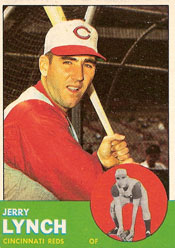
A career .277 batter in 13 big-league seasons (1954-66) with the Pirates and Reds, Lynch hit .301 with 16 home runs against the Cardinals. His 128 hits off St. Louis pitching were his most against any opponent.

A left-handed batter, Lynch especially enjoyed hitting in Sportsman’s Park (Busch Stadium I). His batting average in that St. Louis ballpark was .321 (71-for-221).

In 1961, when Lynch helped the Reds to their first NL pennant in 21 years, he had a .404 batting average as a pinch-hitter (19-for-47), with five home runs. Against the Cardinals that season, Lynch hit .333 (10-for-30) overall, with two homers.

Lynch retired as the major league career leader in pinch-hit homers (18). He had broken the big-league record of 14 established by ex-Cardinal George Crowe. Though his big-league mark since has been surpassed by Matt Stairs (23 pinch-hit homers) and Cliff Johnson (20), Lynch’s 18 pinch-hit homers remain the NL record.

Lynch, an outfielder, hit two big-league grand slams _ both against the Cardinals.

The first occurred on Aug. 7, 1960, in the opener of a doubleheader at St. Louis. Lynch hit an eighth-inning grand slam off reliever Ron Kline, helping the Reds to an 18-4 victory. (Kline and Lynch had been Pirates teammates and eventually became business partners). Boxscore

Four years later, July 21, 1964, at St. Louis, Lynch hit a fifth-inning grand slam against reliever Ron Taylor, lifting the Pirates to an 8-4 triumph. Boxscore

Lynch had at least three other significant hitting performances against the Cardinals.

Twice in 1959 Lynch had four-hit games against St. Louis.

On June 28, 1959, Lynch, batting third and playing left field, was 4-for-5 with two doubles and a RBI for the Reds in the Cardinals’ 11-8 victory in Game 2 of a doubleheader at Cincinnati. Boxscore

Less than three weeks later, Lynch, batting fifth and playing left field, went 4-for-5 with four RBI, including a two-run homer off Ernie Broglio, in the Reds’ 7-5 win at St. Louis on July 16, 1959. Boxscore

In the May 1959 edition of Baseball Digest, Si Burick wrote of Lynch:

He was an outfielder who performed atrociously on defense. He moved uncertainly after fly balls. He wasn’t adept at fielding ground balls. He had just a fair arm. What kept him in business was his bat. Even when he wasn’t hitting for an average, he swung with an authority that was recognized by all who saw him.

Lynch hit Bob Gibson well. He was 18-for-58 (.310) against the Cardinals ace. In the last game he started for the Reds, Lynch drove in three and hit two doubles, both against Gibson, in Cincinnati’s 10-6 victory at St. Louis on May 19, 1963. Boxscore

Four days later, the Reds traded Lynch to the Pirates for outfielder Bob Skinner (who would play for the Cardinals from 1964-66 and help them to a World Series title).

Lynch had started his big-league career with the Pirates in 1954 before being acquired by Cincinnati in December 1956. After receiving word he had been reacquired by Pittsburgh in May 1963, Lynch told The Sporting News, “I sure was surprised.”

After his playing career, Lynch co-owned a golf course in Pennsylvania with former Cardinals shortstop Dick Groat.

Previously: George Crowe: mentor to Curt Flood
Read Full Post »

(Updated Dec. 24, 2018)

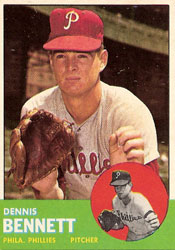
Dennis Bennett played a role in the drama that enabled the Cardinals to overcome the Phillies in the final two weeks of the regular season and win the 1964 National League pennant.

Bennett was a member of the Phillies’ starting rotation in 1964. Before the season, he predicted he’d win 20. His record through July 5 was 9-5, but he lost his next seven decisions.
In early September, Bennett began to regain his winning form, giving Phillies manager Gene Mauch hope for a reliable starter to join stalwarts Jim Bunning and Chris Short. Crediting a sidearm delivery with giving him better control and enabling him to keep his pitches low in the strike zone, Bennett told The Sporting News, “My ball is moving much more. The curve is really breaking off now.”

A left shoulder ailment knocked Bennett off track again.

Bennett, who lost to the Cardinals on May 4 Boxscore and again on July 25 Boxscore, made his last start of the 1964 season on Sept. 29 at St. Louis.

The Cardinals and Phillies were headed in opposite directions. St. Louis had won six in a row and Philadelphia had lost eight in a row. The Cardinals began the day a game behind the first-place Reds and a half-game ahead of the Phillies.

According to the David Halberstam book “October 1964,” Bennett had tendinitis in his left shoulder, resulting in “a dead arm.” Pitching in pain, Bennett was no match for the red-hot Cardinals. They scored a run in the first on a Dick Groat RBI-double and scored twice in the second on a Tim McCarver RBI-single and a Curt Flood RBI-groundout. Bennett was lifted after giving up three runs, five hits and a walk in 1.1 innings.

The Cardinals won, 4-2, and, paired with the Pirates’ 2-0 victory over the Reds, moved into a tie with Cincinnati for first place. The Associated Press reported the defeat was “a near-fatal blow to the Phillies’ slim pennant hopes.” Boxscore

St. Louis went on to win the pennant and the World Series title. Bennett, who finished 12-14 in 1964, was 0-3 with a 15.83 ERA in four games against the Cardinals that season. On Nov. 29, 1964, Bennett was traded to the Red Sox for first baseman Dick Stuart.

Boston, which had a 4.50 team ERA in 1964, was desperate for pitching and was hopng Bennett would become their best left-handed starter since Mel Parnell, who retired after the 1956 season.

Bennett never developed into a big winner. He pitched for the Red Sox, Mets and Angels, appearing in his final big-league game in 1968. He was 43-47 with a 3.69 ERA in seven major-league seasons.

Bennett did get a measure of revenge against the Cardinals. His final big-league win came against them at St. Louis in the first game of a doubleheader on July 16, 1967. Starting for the Mets, Bennett held the Cardinals to one run in seven innings and New York won, 2-1, on Ed Kranepool’s two-run home run against Ray Washburn in the seventh. Boxscore

In 14 career appearances against the Cardinals, Bennett was 2-7 with a 5.95 ERA.

Previously: Ryne Duren threw roadblock at 1964 Cardinals

Read Full Post »

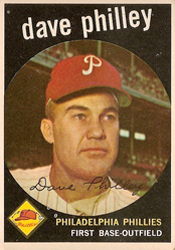
In an 18-year big-league career, Dave Philley spent three seasons in the National League and did some serious damage against the Cardinals.

One of the all-time best pinch-hitters, Philley was a career .270 batter who finished with 1,700 hits. The team against whom he had the highest batting average was the Cardinals.
Philley batted .370 (30-for-81) in 37 career games against the Cardinals. In 1959, playing for the Phillies, Philley blistered Cardinals pitching at a .422 clip (19-for-45).

A switch hitter, Philley made his big-league debut with the White Sox in 1941, served in the military and returned to the majors in 1946. He was an outfielder and first baseman with the White Sox, Athletics, Indians, Orioles and Tigers until joining the Phillies in 1958.

From 1957 through 1959, Philley was one of the premier pinch-hitters in the game. His batting averages as a pinch-hitter in those years:

_ .436 (17-for-39) in 1957 (White Sox and Tigers).

_ .409 (18-for-44) in 1958 (Phillies).

_ .395 (15-for-38) in 1959 (Phillies).

In 1958, Philley hit safely in eight consecutive pinch-hit appearances. When he got a pinch hit in his first appearance of 1959, Philley extended the streak to a major-league record nine.

In 1959, when he turned 40 in May, Philley pounded Cardinals pitching. It began in spring training when Philley ripped a pinch-hit grand slam against Sal Maglie of the Cardinals on March 29 at St. Petersburg, Fla.

Some of Philley’s many highlights versus the Cardinals in 1959:

_ May 5, 1959, Phillies 8, Cardinals 7, at Philadelphia: The Cardinals took a 7-3 lead into the bottom of the ninth, but Philadelphia rallied for five runs against starter Vinegar Bend Mizell and relievers Larry Jackson and Jim Brosnan. Boxscore

Philley, pinch-hitting for catcher Jim Hegan, contributed to the comeback with a RBI-single off Brosnan.

Cardinals manager Solly Hemus told The Sporting News the bullpen collapse was “the worst exhibition I ever saw _ terrible.”

_ June 6, 1959, Phillies 4, Cardinals 3, at Philadelphia: In the 10th inning, Philley, pinch-hitting for catcher Valmy Thomas with two outs and the bases loaded, singled to right against Lindy McDaniel, scoring Richie Ashburn from third for the victory. Boxscore

_ Aug. 9, 1959, Phillies 4, Cardinals 2, at St. Louis: In the ninth inning of the second game of a doubleheader, Philley, pinch-hitting for pitcher Jim Owens, singled to left off Marshall Bridges, driving in Joe Koppe from third with the tie-breaking run. Boxscore

“I’m a better hitter now than I ever was,” Philley said in a 1959 interview with The Sporting News, “and if I had known 10 years ago what I know now, I would have been able to make a potful of money out of this game.

“Of course, as you get older you get smarter up there at the plate and figure the pitchers better, but the main thing is that I’ve cut down on my swing. When I first came up and, in fact, until a few years ago, I was trying to hit home runs. I swung too hard and I had too long a swing. Now I’ve cut my swing down and I have control of the bat and I can wait longer on a pitch.”

In his book “Stan Musial: The Man’s Own Story,” Musial said Philley became “an outstanding pinch-hitter past 40 because he worked so hard to stay in shape.”

Philley was a mentor to the rookie second baseman of the 1959 Phillies, Sparky Anderson. The Sporting News reported Anderson, the future Hall of Fame manager of the Reds and Tigers, “has been one of the most consistent seekers of advice from Philley and believes Dave has helped him in many ways. The two usually sit together on the club’s plane rides and talk baseball by the hour.”

Previously: Cardinals’ collapse part of Larry Jackson’s painful 1961 season

Read Full Post »

(Updated March 24, 2019)

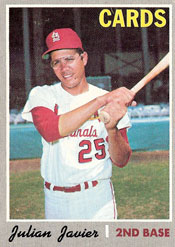
The second baseman who participated in one of the happiest periods in Cardinals history parted with the franchise in an unhappy manner.

Only three players _ Frankie Frisch, Julian Javier and Tommy Herr _ have been the everyday second basemen on three Cardinals pennant winners. Javier started for the National League championship clubs of 1964, 1967 and 1968.
By 1972, Javier, 35, no longer was prominent in the Cardinals’ plans. Ted Sizemore had taken over as St. Louis’ second baseman and Ed Crosby was seen as a capable backup.

On March 24, 1972, the Cardinals traded Javier to the Reds for pitcher Tony Cloninger. Bob Howsam, who’d been Cardinals general manager before taking the same role with the Reds, acquired Javier to back up Joe Morgan at second base and Denis Menke at third.

After the deal was made, Javier indicated he was unhappy with general manager Bing Devine and manager Red Schoendienst for not getting the chance to play more in spring training and compete for a starting job.

“I feel too good, like 20, to be sitting around,” Javier said to the Associated Press.

During the off-season, Devine and Schoendienst had talked with Javier about his future and were of the impression Javier had agreed to a reserve role in 1972, the St. Louis Post-Dispatch reported. “I thought Bing and I had a perfect understanding with Hoolie,” Schoendienst said to The Sporting News.

At spring training, however, Javier asked the Cardinals for his release because he was upset Schoendienst was taking a look at other candidates for a reserve infield role, according to Post-Dispatch sports editor Bob Broeg.

Javier told Schoendienst, “I think I can play everyday for two more years,” the Dayton Journal Herald reported.

Javier’s complaints prompted an uncharacteristic blast from Schoendienst, a former all-star second baseman. “Hoolie wasn’t in shape, didn’t want to play and scarcely could get the ball from second base to first, yet he wants to say we didn’t use him,” Schoendienst told Broeg. “I’m tired of people who don’t want to play but say they do.”

In 12 seasons (1960-71) with the Cardinals, Javier twice was named an all-star (1963 and 1968), twice led National League second basemen in putouts (1963 and 1964) and collected 1,450 hits.

A right-handed batter, Javier hit .299 against left-handed pitching during his major-league career.

Javier’s role with the Cardinals changed after the 1970 season when the club acquired Sizemore from the Dodgers for first baseman Dick Allen.

Javier was found to owe back taxes to the U.S. government, leading to speculation the native of the Dominican Republic could become entangled in a legal case that might jeopardize his career. However, Javier worked out a settlement on his tax problems. When he reported to spring training in 1971, he was 10 pounds lighter (at 180) and performed more like the player he’d been on those championship teams.

Because of an injury to Dal Maxvill, Sizemore opened the 1971 season at shortstop and Javier remained the starter at second base. Javier batted .309 in the first two months of the season, slumped and entered July at .234. Maxvill returned to shortstop and Sizemore moved to second, replacing Javier.

At spring training in 1972, the Cardinals determined they were ready to move on without Javier. The trade to the Reds turned out to be a blessing for him. Javier had several key hits for the Reds and helped them win the 1972 NL pennant. Among the highlights:

_ Reds 11, Cardinals, 2, May 13, at Cincinnati: Facing Cloninger, the pitcher for whom he was traded, Javier delivered a RBI-single, scoring Johnny Bench. Boxscore

_ Reds 4, Giants 3, May 16, at San Francisco: Starting at third base, Javier hit a three-run home run against left-hander Ron Bryant. Boxscore

_ Reds 6, Phillies 5, June 3, at Philadelphia: Javier hit a two-run home run against left-hander Steve Carlton, a former Cardinals teammate. It was the 78th and last homer of Javier’s big-league career. Boxscore

_ Reds 8, Mets 2, June 17, at Cincinnati: Facing another former Cardinals teammate, left-hander Ray Sadecki, Javier hit a two-run single. Boxscore

Javier capped his career by appearing in four games for the Reds against the Athletics in the 1972 World Series.


Read Full Post »

(Updated Sept. 28, 2019)

At the time, the Cardinals’ game against the Mets on Sept. 28, 1971, seemed of little importance. In retrospect, it was a significantly historic matchup because of the starting pitchers involved and what happened to them after the season.

In the next-to-last game of the 1971 season for both teams, attendance that Tuesday afternoon at Shea Stadium was 3,338. The Cardinals were assured of finishing in second place in the National League East Division; the Mets were battling the Cubs for third.
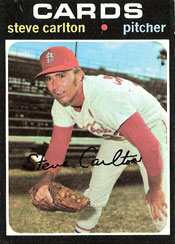
The starting pitchers were Steve Carlton for the Cardinals and Nolan Ryan for the Mets. What no one knew was this would be the last game each would play for his team.

In trades each team long would regret, the Mets sent Ryan to the Angels in December 1971 and the Cardinals dealt Carlton to the Phillies in February 1972.

Each pitcher would go on to enjoy a spectacular career that earned enshrinement into the National Baseball Hall of Fame. Carlton finished with 329 wins, 4,136 strikeouts and four Cy Young awards. Ryan finished with 324 wins, 5,714 strikeouts and seven no-hitters.

Their pairing on Sept. 28, 1971, hardly was viewed as a matchup of baseball giants who should have been the cornerstones of their franchises for the next decade or more.

Instead, Carlton, 27, was seen by some as an underachiever. He had 19 losses the season before. Although he had experienced a turnaround in 1971, with 19 wins heading into the game against Ryan and the Mets, he’d lost two of his previous three decisions.

Like Carlton, Ryan, 24, clearly had talent but too often disappointed. He began the 1971 season with a big-league career record of 19-24. Entering the game against Carlton and the Cardinals, Ryan had won two of his last 13 starts and had a season record of 10-13.

Ryan’s lack of command hurt him immediately against the Cardinals. He walked the first four batters _ Lou Brock, Ted Sizemore, Matty Alou and Joe Torre, forcing in a run. When Ted Simmons followed with a single to right, scoring Sizemore and Alou, manager Gil Hodges lifted Ryan.

Ryan’s final appearance as a Met resulted in five batters faced, four walks and a hit without recording an out.

“It was the most distressing day of my life,” Ryan told the St. Louis Post-Dispatch. “I never was so embarrassed.”

Said Hodges: “It seemed he was just throwing the ball because it had to be thrown.”

The Cardinals scored twice in the second inning. Carlton ignited the offense with a leadoff single. Handed a 5-0 lead, Carlton clamped down on the Mets. He pitched a seven-hitter, striking out eight, as St. Louis won, 5-2, for its 90th victory of the season. Boxscore

Carlton (20-9) became a 20-game winner for the first time in the big leagues and the first Cardinals left-hander to achieve the feat since Ray Sadecki in 1964. The complete game was Carlton’s 18th in 36 starts that season.

“There was a lot of skepticism about me before the season,” Carlton said to The Sporting News. “A lot of people didn’t think I could bounce back after last year (and the 19 losses).”

Carlton credited an effective slider with enabling him to beat the Mets.

“The Mets are like the Giants and the Reds for me _ they all wait for my fastball,” said Carlton. “My slider was good when I was warming up, so I decided to go with it.”

Ryan (10-14) was the subject of trade speculation soon after the season ended, but in an Oct. 9, 1971, story in The Sporting News headlined, “Mets Swap Ryan? ‘No Way,’ Says Gil,” Hodges denied the Mets wanted to deal the pitcher.

“We never have given any consideration to trade Nolan Ryan,” Hodges said. “You cannot give up this easily on a guy who has as much talent as he has. You would hate to give up on him and then see him develop into what he can be with some other club.”

On Dec. 10, 1971, Mets general manager Bob Scheffing traded Ryan, outfielder Leroy Stanton, pitcher Don Rose and catcher Frank Estrada to the Angels for Jim Fregosi, a shortstop whom the Mets planned to move to third base.

After the deal was made, Hodges reiterated to The Sporting News his belief Ryan had all-star potential. “When or if or how he’s going to do it, I don’t know. But he’s got ability,” Hodges said.

Fregosi hit .232 for the Mets in 1972 and was dealt to the Rangers a year later. Ryan earned 19 wins with nine shutouts, 329 strikeouts and a 2.28 ERA for the 1972 Angels.

Two months after the Mets traded Ryan, Carlton made contract demands, angering Cardinals owner Gussie Busch, who ordered general manager Bing Devine to trade Carlton.

In his book, “The Memoirs of Bing Devine,” Devine said, “Mr. Busch had a meeting with me and Dick Meyer, his right-hand man at Anheuser-Busch. And the team brain trust, if that’s what you want to call it, decided we ought to trade Carlton because we didn’t have him signed and he wanted too much money. Basically, Mr. Busch wanted him gone. I don’t want to cop a plea here, but getting rid of Carlton was not a deal that I initiated or tried to talk anybody into. It was just the relationship between Carlton and Mr. Busch.”

The Cardinals sent Carlton to the Phillies for pitcher Rick Wise on Feb. 25, 1972. Wise was 16-16 for the 1972 Cardinals. Carlton, pitching for a last-place Phillies team, was 27-10 with a 1.97 ERA, 329 strikeouts, nine shutouts and 30 complete games.

Previously: Mets messed with Steve Carlton’s sub-2.00 ERA

Read Full Post »

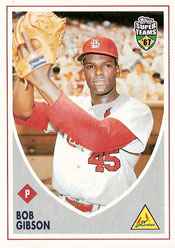
Two players who battled Bob Gibson in World Series competition had the most success against him in All-Star Game showdowns.

Red Sox outfielder Carl Yastrzemski and Tigers catcher Bill Freehan are the only players to get more than one hit against Gibson in the six all-star appearances made by the Cardinals pitcher.

In 11 All-Star Game innings, Gibson gave up 11 hits to nine players.

Yastrzemski was 2-for-3 against Gibson in all-star competition. He had singles in the 1967 and 1970 games, and grounded out in the 1972 game.

In the 1967 World Series, Yastrzemski hit .273 (3-for-11) against Gibson, with two singles and a double.

Like Yastrzemski, Freehan also was 2-for-3 against Gibson as an all-star. He had a single in 1965, struck out in 1967 and delivered a RBI-single in 1969.

In the 1968 World Series, Freehan hit .111 (1-for-9) and struck out five times against Gibson, but the hit (a Game 7 double) drove in a run.

Here are the players who got hits against Gibson in all-star play:

_ Tom Tresh, Yankees (double, 1962)

_ Bill Freehan, Tigers (single, 1965; single, 1969)

_ Tony Oliva, Twins (double, 1965)

_ Carl Yastrzemski, Red Sox (single, 1967; single, 1970)

_ Don Mincher, Angels (single, 1967)

_ Sal Bando, Athletics (single, 1969)

_ Willie Horton, Tigers (single, 1970)

_ Brooks Robinson, Orioles (triple, 1970)

_ Reggie Jackson, Athletics (double, 1972)

Of the nine, Yastrzemski, Robinson and Jackson, like Gibson, are enshrined in the National Baseball Hall of Fame.

Gibson earned his first all-star selection in 1962. In his book “Stranger to the Game,” Gibson expressed how important that selection was to his career: “To the surprise of many, including myself, I was named to my first National League all-star team. With that, the rehabilitation of my confidence was nearly complete … I loved the recognition _ it was bound to help me as a pitcher, I figured, by establishing my credentials in the eyes of the batters _ and soaked up the hoopla.”

In the 1965 All-Star Game, Gibson earned the save, holding the American League scoreless in the eighth and ninth innings of a 6-5 National League victory. Boxscore

The National League catcher was the Braves’ Joe Torre, who later became a teammate and friend of Gibson, but, at that time, Torre, like all opponents, was viewed as the enemy by Gibson, who never fraternized. Torre said Gibson wouldn’t speak to him during the All-Star Game.

In the clubhouse after the game, Torre offered his congratulations to Gibson, but “he didn’t acknowledge I was even in the neighborhood. … Baseball was war for him,” Torre told the St. Louis Post-Dispatch.

Gibson was 0-0 with a 3.27 ERA and 10 strikeouts as an all-star. Among his strikeout victims were Hall of Famers Harmon Killebrew of the Twins and Luis Aparicio of the White Sox, and sluggers such as Rocky Colavito of the Tigers and Tony Conigliaro of the Red Sox.


Read Full Post »

« Newer Posts - Older Posts »