Feeds:
Posts
Comments

Archive for the ‘Games’ Category

Jose DeLeon had the talent, but not the won-loss record, to be an ace. Some of it was bad luck. Some of it was bad teams. Some of it was his own doing.

DeLeon was the first Cardinals pitcher since Bob Gibson to lead the National League in strikeouts. He outdueled Roger Clemens twice in five days. Some of the game’s best hitters were helpless against him. Cal Ripken was hitless in 12 at-bats versus DeLeon. George Brett batted .091 (1-for-11) against him.

“George Brett told me he (DeLeon) was the toughest guy he ever hit against,” Cardinals manager Whitey Herzog said to the St. Louis Post-Dispatch in 1988. “He said his stuff was nasty.”

Yet DeLeon twice had 19 losses in a season and his career record in the majors was 86-119.

A right-hander who threw four pitches (fastball, curve, forkball and slider), DeLeon pitched 13 seasons (1983-95) in the majors with the Pirates, White Sox, Cardinals, Phillies and Expos.

Playing favorites

DeLeon was 11 when he moved with his family from the Dominican Republic to Perth Amboy, N.J., in 1972. He followed baseball and adopted pitcher Mike Torrez as his favorite player. Like DeLeon, Torrez, who began his major-league career with the Cardinals, was a big right-hander.

Though he played only one season of varsity high school baseball, DeLeon, 18, was drafted by the Pirates in 1979 and called up to the majors in July 1983. In his third appearance, a start versus the Mets, he was matched against Mike Torrez.

The result was storybook. As the New York Daily News put it, “Jose DeLeon waged a brilliant pitching war with his longtime idol, Mike Torrez.”

DeLeon, 22, held the Mets hitless until Hubie Brooks lined a single with one out in the ninth. DeLeon totaled nine scoreless innings. Torrez, 36, was even better: 11 scoreless innings. Neither got a decision. The Mets won, 1-0, in the 12th. Boxscore

Torrez said to the Daily News, “I pitched well enough to win. DeLeon pitched well enough to win. Sometimes, this game can drive you batty.”

Told that DeLeon was a fan of his, Torrez replied to the newspaper, “That’s a nice compliment. He showed a lot of poise and showed he’s a big-league pitcher.”

Three weeks later, DeLeon beat the Reds, pitching a two-hit shutout and striking out 13. “He has the best forkball I’ve ever seen,” Reds shortstop Dave Concepcion told the Dayton Daily News. “It looks like a knuckleball.” Boxscore

No-win situations

DeLeon was 7-3 with the 1983 Pirates, but it would be five years before he’d have another winning season in the majors.

“I had success early, then I thought it would be easy,” DeLeon told Mike Eisenbath of the Post-Dispatch. “My arm was ready, but my mind wasn’t.”

With the 1984 Pirates, he finished 7-13, including 0-4 versus the Cardinals. The Pirates were shut out in six of his 13 losses and scored only one run in five others. On Aug. 24, 1984, DeLeon pitched a one-hitter against the Reds _ and lost, 2-0. Boxscore

The next year was worse. His 2-19 record for the 1985 Pirates included an 0-2 mark versus the Cardinals. (DeLeon never beat the Cardinals in his career.) The Pirates were held to two runs or less in 14 of his 19 losses. They averaged 2.3 runs in his 25 starts.

Nonetheless, “His problems are a combination of his being too nice a guy and relying strictly on his arm,” Pirates general manager Syd Thrift told The Pittsburgh Press. “He has to take charge from the first pitch.”

In July 1986, DeLeon was traded to the White Sox for Bobby Bonilla. His first two wins for them came against Roger Clemens, the American League Cy Young Award recipient that year. Boxscore and Boxscore

Though he was 11-12 for the 1987 White Sox, DeLeon won six of his last seven decisions, totaled more than 200 innings (206) for the first time in the big leagues and led the White Sox in strikeouts (153).

“Trying to catch his forkball is like trying to catch Charlie Hough throwing a 90 mph knuckleball,” White Sox catcher Carlton Fisk told The Pittsburgh Press.

The Cardinals saw DeLeon, 27, as a pitcher on the verge of fulfilling his potential. On Feb. 9, 1988, they sent Ricky Horton, Lance Johnson and cash to the White Sox for DeLeon.

That’s a winner

For the next two seasons, DeLeon was a winner and did things no Cardinals pitcher had done since Bob Gibson.

In 1988, DeLeon struck out 208 batters, the most for a Cardinal since Gibson had the same total in 1972. DeLeon averaged 8.2 strikeouts per nine innings. He had a 13-10 record, but the Cardinals were 20-14 in his 34 starts. In DeLeon’s 10 losses, the Cardinals scored a total of 15 runs.

(DeLeon did it all that season. In a 19-inning marathon against the Braves, he played the outfield for four innings while Jose Oquendo pitched.)

On Sept. 6, 1988, DeLeon beat the Expos with a three-hit shutout. He also doubled versus Dennis Martinez and scored the game’s lone run. Boxscore

“His forkball and curveball were really working,” Expos slugger Andres Galarraga told the Post-Dispatch. “You didn’t know what to expect.” (Galarraga, a National League batting champion, hit .061 in 33 career at-bats versus DeLeon.)

Late in the 1988 season, DeLeon pitched in Pittsburgh for the first time since the Pirates traded him. He threw a three-hitter and won. “He looks different and acts different,” The Pittsburgh Press noted. “This was not the confused, defeated, befuddled child of a man the Pirates had traded away. This was a confident, mature adult who stuck it to the Pirates.” Boxscore

The 1989 season was DeLeon’s best. He was 16-12 and had 201 strikeouts, becoming the first Cardinals pitcher since Gibson in 1968 to lead the league in fanning the most batters. DeLeon also joined Gibson as the only Cardinals pitchers then with consecutive seasons of 200 strikeouts.

Batters hit .197 versus DeLeon in 1989. Right-handed batters had the most trouble against him, hitting .146 with more than twice as many strikeouts (115) as hits (54).

“I wish I had what he had,” Scott Sanderson, an 11-game winner with the 1989 Cubs, said to the Post-Dispatch.

On April 21, 1989, DeLeon beat the Expos on a two-hit shutout. Boxscore Four months later, he did even better _ holding the Reds scoreless on one hit (a Luis Quinones broken-bat single) for 11 innings. The Cardinals, though, stranded 16 base runners and the Reds won, 2-0, in the 13th against reliever Todd Worrell. Boxscore

Down and out

DeLeon appeared headed for another good season in 1990, winning four of his first six decisions. One of those wins came against the Reds when DeLeon pitched 7.1 scoreless innings _ “The Reds appeared to be swinging at pebbles” columnist Bernie Miklasz wrote in the Post-Dispatch _  and also tripled and scored versus Tom Browning. The triple occurred when right fielder Paul O’Neill tried unsuccessfully to make a shoestring catch and the ball skipped to the warning track. “DeLeon had no choice but to leg out a slow-motion triple,” Jack Brennan of The Cincinnati Post observed. Boxscore

After beating the Expos on June 17, DeLeon’s record was 6-5. Then he went 1-14 over his last 18 starts, finishing at 7-19.

Cardinals broadcaster Mike Shannon told Bill Conlin of the Philadelphia Daily News, “Jose DeLeon defines the word ‘siesta.’ If he could just establish some intensity, there’s no doubt he could be the best pitcher in the game. He’s got the best pure stuff in our league.”

DeLeon pitched a lot better for the Cardinals in 1991 (2.71 ERA in 28 starts) but his record was 5-9. The Cardinals totaled 17 runs in his nine losses. DeLeon had the lowest run support among National League starters (3.5 runs per nine innings). “Bad luck seems to find him,” Cardinals manager Joe Torre said to the Post-Dispatch.

Back-to-back seasons like DeLeon had in 1990 and 1991 might put almost anyone into a funk. Torre and pitching coach Joe Coleman worked to boost his confidence. “I was really down,” DeLeon said to Dan O’Neill of the Post-Dispatch. “In my mind, everything was negative.”

After a strong spring training, DeLeon was named the 1992 Cardinals’ Opening Day starter. He pitched well (one run in seven innings) but the Mets won. Boxscore and video

From there, his season unraveled. In a stretch from May 22 to June 8, DeLeon lost four consecutive starts, dropping his record to 2-6, and was moved to the bullpen. The Cardinals released him on Aug. 31 and he got picked up by the Phillies.

“DeLeon is a swell fellow,” Bernie Miklasz wrote in the Post-Dispatch. “Quiet. Unobtrusive. A gentleman. Doesn’t whine. Doesn’t blame others for his problems. Doesn’t make excuses _ but he doesn’t win as many games as he should.”

Read Full Post »

The number stands out from the stats line like a wart, ugly and embarrassing: 162.00. That’s the earned run average Tom Qualters had in his rookie season with the Phillies.

The Cardinals were responsible for giving him that statistical shiner. Qualters, 18, made his big-league debut against them. He faced seven Cardinals and retired one. Six scored. His line: 0.1 innings, six runs, 162.00 ERA in his lone appearance of the 1953 regular season.
To his credit, Qualters recovered from that clobbering. He eventually went to the minors and became a teammate of Satchel Paige and Whitey Herzog. Then he returned to the majors and pitched for an American League pennant contender, retiring the likes of Mickey Mantle and Ted Williams.

Bonus baby

A standout amateur athlete in McKeesport, Pa., near Pittsburgh, Qualters developed into a dominating right-handed pitcher. He struck out 22 in a no-hitter against Donora (hometown of Stan Musial). In 1951, at Pittsburgh’s Forbes Field, Qualters started for a team of American Legion all-stars managed by Hall of Famer Pie Traynor.

After he graduated from high school in June 1953, Qualters was offered a signing bonus of at least $25,000 by Pirates general manager Branch Rickey, according to The Pittsburgh Press, but instead accepted a $40,000 offer from the Phillies. Qualters “had his heart set on joining the Phillies from the time he was in knee pants,” The Sporting News reported.

Major League Baseball had a rule then that any amateur who got a signing bonus of more than $4,000 had to stay with the big-league club for two full years. (It was intended to keep the wealthiest clubs from signing scores of prospects and stockpiling them in the minors.) That meant Qualters, who signed on June 16, 1953, had to remain in the majors with the Phillies until at least June 16, 1955.

“I might have been better off going to the minors for experience and a chance to pitch regularly, but I just couldn’t pass up that money,” Qualters said to The Pittsburgh Press. “I used most of it to fix up our home in McKeesport and also pay for an operation on my mother.”

(More than 30 years later, in a 1987 interview with the Pittsburgh Post-Gazette, Qualters said baseball’s bonus rule “was devastating to me” because “I had no business being there” in the majors.)

Learning curve

When he joined the Phillies, “I was really scared,” Qualters said to The Pittsburgh Press. “It was the first time I ever had been away from home and I didn’t know what kind of a reception I’d receive … Being a bonus player, I thought they’d give me the cold shoulder, but they treated me like one of the boys and were always giving me advice. I spent a lot of time with Jim Konstanty in the bullpen and he went out of his way to be nice. Robin Roberts, too.”

(Decades later, Qualters gave conflicting versions of how his Phillies teammates received him. In 1984, Qualters said to the Philadelphia Daily News, “Guys like Robin Roberts, Curt Simmons, Richie Ashburn _ they were great. They made the ride a little smoother, and they certainly didn’t have to.” Three years later, Qualters told the Pittsburgh Post-Gazette, “The players and the manager (Steve O’Neill) were from the old school and didn’t accept me. You can imagine the resentment. As a result, I was off by myself most of the time.”)

The Phillies’ plan was for Qualters to learn by observing rather than pitching. Though he was occupying a roster spot, there was no desire to put him into a regular-season game. “I was a batting practice pitcher, a high-priced batting practice pitcher,” Qualters told the Philadelphia Daily News.

On June 29, 1953, in an exhibition between the Phillies and Athletics for the benefit of the Junior Baseball Federation of Philadelphia, Qualters started before a crowd of 15,293 at Shibe Park. The jittery teen got through the first inning, but gave up six runs in the second before he was lifted.

Two weeks later, Qualters pitched in another exhibition game for the Phillies against the minor-league Baltimore Orioles and yielded five runs in three innings.

Though those exhibition performances did nothing to entice manager Steve O’Neill to pitch Qualters when the Phillies played for keeps, he told the Philadelphia Bulletin, “The boy has everything he needs, a fastball and a terrific curve. If he isn’t a real pitching prospect, then I’ve never seen one.”

Rough stuff

On Sept. 13, 1953, a Sunday at St. Louis, the Cardinals led the Phillies, 11-1, entering the bottom of the eighth. With the outcome not much in doubt, O’Neill waved a proverbial white flag, choosing to let Qualters make his official debut. The Cardinals, though, were all business.

The first batter Qualters faced, hulking slugger Steve Bilko, slammed a home run. The next to come up was Bilko’s physical opposite, Peanuts Lowrey. He drew a walk, then scooted to second on a Qualters wild pitch.

Qualters hit the next batter, Rip Repulski, with a pitch. Harvey Haddix, the Cardinals’ pitcher, followed with a single, loading the bases. Solly Hemus also singled, scoring Lowrey, and reloading the bases.

The first out Qualters recorded came when a future Hall of Famer, Red Schoendienst, grounded to first. Hemus was forced out at second, but Repulski scored from third on the play.

Next up was Stan Musial.

“I was told never to give him the same pitch twice, and this stuck with me like a nursery rhyme,” Qualters said to The Pittsburgh Press. “Our catcher (Stan Lopata) called for a slow curve and Musial swung and missed. I felt pretty good. Then the catcher decided to call for the same pitch and I shuddered. I knew what the boys in the bullpen told me, but who was I to shake off the catcher? So I threw the slow curve again and Musial hit it against the wall.”

Musial’s two-run double knocked Qualters out of the game. Jim Konstanty relieved and gave up a single to Enos Slaughter, driving in Musial and making the score 17-1. Boxscore

It would be four years before Qualters pitched in another regular-season game in the majors.

Starting over

Qualters spent the entire 1954 season with the Phillies and, though healthy, never played in a regular-season game. 

In 1955, as mandated by the bonus rule, the Phillies began the season with Qualters on their roster but he again didn’t get into a regular-season game. The Sporting News referred to him as “Money Bags” because he was being paid without having to perform.

When Qualters completed his two-year stint on the big-league roster in June 1955, he was sent to a Class B farm club in Reidsville, N.C. “I just want to pitch in games, somewhere, anywhere,” Qualters said to the Associated Press.

Years later, he told the Pittsburgh Post-Gazette, “When I went to Reidsville, I found I had lost my velocity. I didn’t have my riding fastball anymore.”

With the Class AAA Miami Marlins in 1956, Qualters, 21, was a teammate of Satchel Paige, 50. Paige was 11-4 with a 1.86 ERA. Qualters had his first good season as a pro _ 5-5 with a 3.38 ERA.

Paige and Qualters were back with Miami in 1957. Joining them was an outfielder, Whitey Herzog, 25, who hit .272. Qualters led the pitching staff in appearances (46) and innings pitched (186) and won 11. Paige had 10 wins and a 2.42 ERA.

Qualters admired the glove Paige used, an aged Mort Cooper model. “It looks like it belongs in the museum at Cooperstown but I like the way it handles,” Qualters told the Miami News. Qualters swapped Paige a new glove for his relic.

The Phillies called up Qualters in September 1957 and he made six relief appearances for them. In one, against the Cardinals, he gave up two runs in 0.2 innings. Boxscore

Qualters began the 1958 season with the Phillies, pitched in one game, got waived and was claimed by the White Sox.

A highlight came on May 25, 1958, in a game against the Red Sox. Qualters relieved starter Dick Donovan with the bases loaded and got Ted Williams to fly out to center. Boxscore

Two months later, at Yankee Stadium, Qualters pitched two scoreless innings and retired Mickey Mantle on a pop-up to second. Boxscore

Qualters made 26 relief appearance for the 1958 White Sox, who finished second behind the American League champion Yankees.

The White Sox had Qualters in their plans for 1959 until he injured his pitching elbow in spring training. Assigned to Class AAA Indianapolis, managed by Mort Cooper’s brother, Walker Cooper, Qualters developed nerve problems in his pitching hand and never got back to the majors. The 1959 White Sox won the American League pennant. “I was all set to be on that pitching staff (until getting injured),” Qualters said to the Pittsburgh Post-Gazette. “That really hurt.”

Qualters became a regional supervisor for the Pennsylvania Fish Commission and was responsible for overseeing enforcement for 10 counties, according to the Pittsburgh Post-Gazette. He was in charge of 15 field officers and 80 deputies.

Read Full Post »

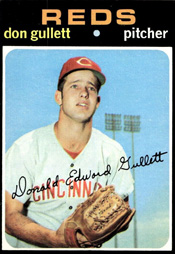
On a Big Red Machine team of Johnny Bench, Joe Morgan, Pete Rose and Tony Perez, the player who consistently confounded the Cardinals was Don Gullett.

A left-handed pitcher, Gullett was 14-3 versus the Cardinals, including 7-0 at Busch Memorial Stadium. He also liked to hit in St. Louis. His batting average there was .281.

Gullett played for six pennant winners in nine seasons in the majors and pitched in five World Series with the Reds and Yankees. His career record was 109-50.

Teen talent

In high school at South Shore, Ky., on the south bank of the Ohio River, Gullett excelled in football (scoring 11 touchdowns and kicking six extra points in one game) and basketball (scoring 47 points in one game) but turned down college scholarship offers because he wanted to become a professional baseball player.

He dazzled scouts when he pitched a seven-inning perfect game in high school, striking out 20 and retiring one batter who bunted.

The Reds selected him in the first round of the June 1969 amateur draft. (The Cardinals also chose a left-handed high school pitcher in that first round, but Charles Minott never advanced above the Class A level of the minors.)

Sent to the Sioux Falls (S.D.) Packers of the Northern League, Gullett, 18, struck out 87 in 78 innings and was 7-2 with a 1.96 ERA.

Invited to Reds spring training in 1970 as a non-roster player, Gullett, 19, impressed first-year manager Sparky Anderson. “For a kid his age, Gullett’s poise is amazing,” Anderson said to The Sporting News. “He just doesn’t scare.”

After striking out against Gullett in spring training, Pirates slugger Willie Stargell told The Sporting News, “Man, that kid throws nothing but wall to wall heat.”

Gullett got a spot on the 1970 Reds Opening Day roster as a reliever.

Rookie sensation

A year after pitching against high schoolers, Gullett made his big-league debut with 1.1 scoreless innings in relief of Ray Washburn versus the Giants. Boxscore

In his first win, against the Dodgers, Gullett pitched five scoreless innings in relief of Jim Maloney. “The kid showed them smoke,” catcher Johnny Bench told The Cincinnati Post. “I mean it was real heat.” Gullett also walked, stole a base, tripled and scored twice. Boxscore

A week later, facing the Cardinals for the first time, Gullett got his first save. With the Reds ahead, 3-2, in the ninth, the Cardinals had a runner on first, two outs, and Jim Campbell at the plate when Gullett replaced closer Wayne Granger.

Asked why he brought in the rookie, Sparky Anderson replied to the Dayton Daily News, “If you’ve got a guy with a lot of stuff like Gullett on your staff and you’re afraid to use him just because he’s 19, then you shouldn’t have him on the team.”

Gullett got Campbell to hit a fly to short center. Center fielder Bobby Tolan couldn’t get to the ball _ “It looked like an in-betweener base hit to me,” Gullett said to the Dayton newspaper  _  but shortstop Dave Concepcion made a twisting catch on the run to end the game. Boxscore

Near the end of Gullett’s rookie season, Dodgers manager Walter Alston told The Sporting News, “Gullett comes as close to matching Sandy Koufax’s fastball as anyone I’ve seen.”

(Gullett said he met Koufax at Cincinnati’s Crosley Field early in the 1970 season. “He showed me how he threw his curveball, how he put his fingers on the seams, and all that,” Gullett said to Dick Kaegel of the St. Louis Post-Dispatch. The next year, Sparky Anderson arranged a meeting of Gullett and Koufax in Chicago. Anderson told the Post-Dispatch, “Sandy told him to think not up and down with his pitches. He told him to think in and out.”)

In 44 games for the 1970 Reds, Gullett was 5-2 with six saves and a 2.43 ERA. He also earned two saves and yielded no runs in the National League Championship Series versus the Pirates and one earned run in three World Series games against the Orioles. Video

Hot stuff

Gullett, 20, moved into the Reds’ starting rotation in 1971 and responded with a 16-6 record. He was 3-0 against the Cardinals, shutting them out twice, and would have had a fourth win if he’d protected a ninth-inning lead.

On June 16, 1971, Gullett pitched a four-hitter in a 1-0 Reds victory. The Cardinals threatened in the eighth, getting a runner to third with two outs, but Matty Alou struck out looking. (Alou, a National League batting champion, had one hit in 19 career at-bats versus Gullett.)

“He threw a fastball right on the black part of the plate,” catcher Pat Corrales told the Dayton Daily News. “As hard as he can throw, and with the location of that pitch, there wasn’t anything else for Alou to do but look at it and go sit down.”

Gullett said to the Cincinnati Enquirer, “I had my best fastball of the year” and an effective slider. Corrales told the newspaper that with Gullett’s slider, “You can’t tell when it’s coming. The rotation is just like on his fastball. A right-hander goes to swing at it, and all of a sudden it hits him on the fists.” Boxscore

Two months later, Gullett was matched against Bob Gibson. In their previous starts, Gibson pitched a no-hitter against the Pirates and Gullett limited the Cubs to one hit in eight innings.

The showdown turned out to be no contest. Gullett and the Reds won, 5-0. Joe Torre (the league batting champion that year) and Ted Simmons were a combined 0-for-8.

“Gullett’s got a fastball that rides away from you, plus a slider that comes in on you,” Torre told the Post-Dispatch. “You can’t tell which one’s coming.”

(Torre adjusted impressively. He had 20 career hits versus Gullett, batting .370.)

Asked whether Gullett was equal to American League left-hander Vida Blue, Sparky Anderson said to the Cincinnati Enquirer, “I wouldn’t trade him even up for Blue.” Boxscore

The Cardinals got some satisfaction against Gullett 11 days later. Gullett and the Reds led, 3-2, with two outs in the bottom of the ninth, but Lou Brock tied the score with a home run. The Cardinals went on to win in the 11th when Clay Carroll walked Ted Sizemore with the bases loaded. Boxscore

(Like Torre, Brock had success against Gullett, totaling 19 hits and batting .322.)

Bat man

Gullett also caused trouble for the Cardinals with his bat.

On July 16, 1974, Gullett, who batted right-handed, had three hits, three RBI and was the winning pitcher in a 12-7 Reds triumph against the Cardinals.

Gullett had a two-run double that knocked Bob Forsch from the game in the first inning, and drove in another run with a single versus John Curtis in the second. He added a single against Rich Folkers in the sixth. Boxscore

In 1975, Gullett, 24, was 4-0 with an 0.28 ERA versus the Cardinals. He allowed one run (a Ted Simmons home run) in 32 innings against them. One of those wins beat Gibson, who was trying for his 250th career victory. Boxscore

Gullett experienced an array of health problems and injuries, including hepatitis (1972), chronic back spasms (1974), a fractured left thumb (1975) and a dislocated ankle tendon (1976).

After the Reds repeated as World Series champions in 1976, Gullett became a free agent and signed a six-year contract with the Yankees. “We feel Gullett is a modern Whitey Ford,” Yankees president Gabe Paul told the New York Times.

Late in September 1978, Gullett underwent surgery for a double tear of the rotator cuff in his left shoulder and was done pitching at age 27. “Sometimes, I dream that I come back as a right-handed pitcher,” Gullett said years later to Bill Peterson of The Cincinnati Post.

In 1986, Gullett, 35, had a heart attack. Four years later, he had triple bypass surgery. Gullett recovered and coached for the Reds for 13 seasons (1993-2005).

Read Full Post »

In a spring training camp with Reggie Jackson, Rick Monday and Sal Bando, another hitter who caught the eye of Joe DiMaggio was Tony La Russa.

In 1968, DiMaggio was in a green and gold Oakland Athletics uniform, giving instruction to players. La Russa was trying to make the team as a reserve infielder and return to the majors for the first time in five years.

DiMaggio became one of La Russa’s biggest boosters.

Bay Area bonanza

After the 1967 season, the Athletics moved from Kansas City to Oakland. Club owner Charlie Finley approached Joe DiMaggio and offered him a front-office position with the title of executive vice president. DiMaggio accepted, signing a two-year contract.

In explaining why he took the job, DiMaggio said to the Associated Press, “Probably the biggest thing was the shift of the club to Oakland. It’s only 25 minutes from home (in San Francisco).”

During the previous six years, DiMaggio had been a visiting batting instructor at Yankees spring training in Fort Lauderdale, Fla., but when club co-owner Dan Topping asked him to take a fulltime job, “I turned him down,” DiMaggio said to The Sporting News. “I decided to join Mr. Finley and the A’s because it was home.”

Frank Lane, former general manager of the Cardinals and Kansas City Athletics, said to the San Francisco Examiner, “The smartest move Finley made when he moved to Oakland was to hire DiMaggio. That gave the club instant prestige.”

As The Sporting News noted, Finley and DiMaggio agreed to “an extremely loose arrangement as far as office responsibilities are concerned.” His duties were to include advising on personnel decisions and player transactions.

DiMaggio emphasized he wouldn’t do community relations and promotional tasks. “I’m not going around talking to groups or making appearances at banquets,” he told The Sporting News. “As I understand the job, I’ll be busy all of the time with player personnel, working on possible trades and serving as an adviser.”

At the baseball winter meetings in Mexico City in December 1967, DiMaggio “was much in evidence (as) the spokesman for the club,” The Sporting News reported. When Athletics manager Bob Kennedy asked him to be an instructor at spring training, DiMaggio said yes.

Advanced placement

On Feb. 26, 1968, when the Athletics had their first spring workout at Bradenton, Fla., DiMaggio, 53, was in uniform. According to the Bradenton Herald, he “posed obligingly for photographers, chatted freely with reporters and smilingly handed out autographs.” He also gave batting tips to a 22-year-old catcher, Dave Duncan.

United Press International columnist Milton Richman was impressed by how DiMaggio fit in. “He hangs his street clothes in the same simple wooden lockers as the players do,” Richman observed. “His locker is between those of coaches Sherm Lollar and John McNamara.”

DiMaggio became engaged in the instructor’s role. He enjoyed working with the players and connected with them.

“This kid Rick Monday is shaping up as a hell of a fine ballplayer,” DiMaggio said to Richman. “He’s only 22 and I like the way he swings the bat. He bears down all the time … This boy knows he’s good, but he’ll listen when you tell him something.

“There’s another outfielder, Reggie Jackson, I’ve been working with. He’ll take a little time to learn, but he’s going to be a good one, too.”

DiMaggio worked with Jackson on hitting, fielding and base running. “He’s such a symbol of greatness to a ballplayer, something to strive for, someone to get approval from,” Jackson said to The Sporting News. “It would be embarrassing not to hustle in front of such a man.”

After seeing DiMaggio swing the bat, Jackson told columnist Joe Falls, “He’s the Rope Man. He hangs out those frozen ropes.”

Asked about his approach to teaching, DiMaggio said to Jack Hand of the Associated Press, “There is no set way of hitting. One fellow bats one way, another has a different style. Honus Wagner, Babe Ruth, Ty Cobb, Rogers Hornsby all had different styles, but they followed the same fundamentals. The main thing is being comfortable, holding the head rigid, taking a short stride, having the bat ready to swing.

“You can’t tell anybody how to hit. Nobody ever tried to teach me. If I tried to bat like Stan Musial, all curled up in that crouch, I’d be wound up in a knot. It’s the same way with my wide stance. A lot of fellows couldn’t do it my way. I didn’t start out that way either.

“If I see a fellow who has a decided weakness, I’ll talk to him. I wouldn’t try to change a player unless he has been around a while and had not shown any improvement.”

Strong man

Tony La Russa was 18 when he debuted in the majors with the 1963 Athletics. He spent the next four seasons in the minors. Injuries played a part in stalling his career. He dislocated his right shoulder twice, tore ligaments in his right knee, and injured his back and throwing arm.

When he got to spring training in 1968, La Russa, 23, told the Oakland Tribune, “I worked pretty hard during the winter to strengthen the spots where I had my injuries. I feel 100 percent now and I don’t feel I’m injury prone.”

Working with weights at a Tampa gym, La Russa bulked up and was bigger than his listed weight of 175 pounds. The Bradenton Herald described him as having “tremendously thick forearms and wrists, and Ted Kluszewski-sized biceps.”

“I’m staying right at 195 pounds now and never felt better,” La Russa said to reporter Vince Smith. “I figured I’d better start doing something about building myself up. If I was bigger and stronger, I wouldn’t be getting hurt all the time.”

Second base was La Russa’s best position, but the Athletics had John Donaldson and Dick Green there. Manager Bob Kennedy viewed La Russa as a backup to Sal Bando at third and possibly Bert Campaneris at shortstop, and planned to play him at those spots throughout spring training.

(“I’m the most uncomfortable at third,” La Russa said to the Oakland Tribune.)

Asked about La Russa, Kennedy said to the San Francisco Examiner, “We’re looking at the kid as a top prospect for infield utility duty … We certainly don’t want to give up on him. We feel there’s a good chance he’ll help us.”

DiMaggio took an interest in La Russa. After watching La Russa take swings in the batting cage at spring training, he offered advice. “He told me he noticed I had a little hitch in my swing and I was letting the ball get by me before I had my wrists cocked,” La Russa told the Bradenton Herald. “When he tells me something like that, naturally I’m going to listen.”

DiMaggio said to the Herald, “I think he really has a chance to make it. When you get the injuries this kid has had since he started, you never really get a chance to get going. He seems to be in real good shape out here now. He swings that bat and he swings it pretty good.”

According to the Oakland Tribune, La Russa went on to lead the Athletics in hitting (.364) in spring training games and earned a spot on the 1968 Opening Day roster as a backup infielder.

Highs and lows

Near the end of spring training, DiMaggio agreed to Kennedy’s request to be a coach all season. “He will be on the bench with me,” Kennedy said to The Sporting News. “This entails a fulltime duty with the club. I can think of no better man to teach young hitters and young outfielders than Joe DiMaggio.”

In explaining why he accepted the role, DiMaggio said to the Oakland Tribune, “These kids we have are the major reason I’ve decided to coach. They’re just great. I’ve become attached to them and the club. I think I can do a service.”

In introductions before the Athletics’ home opener on April 17, 1968, DiMaggio got the loudest ovation from the crowd of 50,164. Gov. Ronald Reagan threw the ceremonial first pitch and was booed, the Oakland Tribune reported.

In the game that followed, Dave McNally of the Orioles held the Athletics to two hits _ a Rick Monday home run and pinch-hit single by La Russa. Boxscore

Three weeks later, after just three at-bats, La Russa was placed on waivers and went unclaimed. The Athletics sent him to their Vancouver farm club and called up outfielder Joe Rudi.

DiMaggio had a successful season as a coach. As The Sporting News noted, “Being a coach in uniform this year has enabled DiMaggio to escape a desk job with vague responsibilities and ill-defined duties, and make a real contribution to the team. His mere presence has inspired the young A’s players, who hold him in high esteem but not the overwhelming awe they showed him when he first appeared in spring training.”

The 1968 Athletics finished 82-80, but Bob Kennedy was fired and replaced by Hank Bauer, who had been DiMaggio’s outfield teammate with the Yankees. DiMaggio said he didn’t want to coach again in 1969, the last year of his contract, but Bauer convinced him to change his mind.

La Russa began the 1969 season in the minors at Des Moines, hit .306 and got called up to the Athletics in June after Dick Green tore knee ligaments. La Russa got only eight at-bats with the 1969 Athletics and went hitless.

Read Full Post »

Stan Musial and Red Schoendienst had a high regard for Pirates pitcher Al McBean; so much so that there was talk of a swap involving him and Curt Flood.

A right-hander from the Virgin Islands who pitched 10 years (1961-70) in the majors, McBean was a good pitcher (67-50, 63 saves) who was as effective with a bat as he was with his arm against the Cardinals.

McBean twice hit home runs in wins versus the Cardinals. In turn, the Cardinals used home runs to beat him. The most striking example came in 1964 when McBean was as good as any reliever in the National League. He yielded a mere four home runs that season _ and all were hit by Cardinals.

A sinkerball specialist with a showman’s flair, McBean struck out more Cardinals (92) than he did any other foe, but his record against them was 6-8.

Picture this

McBean played baseball as a youth on St. Thomas, one of the U.S. Virgin Islands, but had no plans to become a pro. When he finished his schooling, he worked as a photographer for a local daily newspaper, The Home Journal. “I only played ball on Sundays because there was nothing else to do on Sundays,” he recalled to columnist Larry Merchant.

The Pirates held a tryout camp on St. Thomas and McBean’s newspaper assigned him to cover it. A former coach saw him and encouraged McBean to join the prospects on the diamond. According to the Philadelphia Daily News, McBean was sent to center field, told to throw a ball toward home plate and delivered a missile. Then he was instructed to try it from the mound. The Pirates liked what they saw and signed him.

McBean, 20, began his pro career in the Pirates’ farm system in 1958. Three years later, in July 1961, he got called up to the big leagues and pitched in relief for the reigning World Series champions.

In a game against the Cardinals that season, the rookie gave up a grand slam to Bill White. The towering drive carried to the back of the screen on the pavilion roof at St. Louis. (White would torment McBean throughout his career, hitting .440 with four home runs against him.) Boxscore

Two weeks later, Stan Musial slugged a two-run homer versus McBean. Boxscore

Overall, though, McBean (3-2, 3.75) showed enough for the Pirates to put him in their plans for 1962.

Bold buccaneer

With Joe Gibbon and Vern Law having arm ailments in 1962, the Pirates moved McBean into the starting rotation. He delivered a 15-10 record, including 3-1 versus the Cardinals.

McBean got married in Pittsburgh during that 1962 season. Serving as best man at the wedding was his road roommate, Roberto Clemente.

McBean embraced the spotlight _ both on and off the field.

A lithe (165-pound) athlete, McBean’s voice had “the lilt of a calypso melody and is as bouncy as a bongo,” according to Milton Gross of the North American Newspaper Alliance.

McBean wore clothes designed for attention. A purple suit. A white Nehru jacket. Or, as Milton Gross described, “The large red bandana he pulls from his hip pocket to wipe his face on the mound is only a pale reflection of his vivid personality. He may, for instance, be seen coming to or leaving the ballpark clothed in an ascot, a Rex Harrison (houndstooth) hat, red vest, canary yellow shirt, dark sports jacket, checked pants and a rolled umbrella swinging from his arm.”

His flashy style wasn’t limited to his wardrobe.

Before games, McBean put on shows during infield practice, scooping grounders with behind-the-back moves. “He makes an infield drill look like a Harlem Globetrotters warmup with his uncanny fielding style and non-stop chatter,” Bill Conlin of the Philadelphia Daily News observed.

Red Schoendienst said to the Pittsburgh Post-Gazette, “Funniest guy I’ve ever seen in a uniform. McBean is full of fun, especially before a game in practice.”

In his prime years, when he went back to being a reliever, McBean walked from the bullpen to the mound with a swagger.

“McBean saunters into a game,” Pirates manager Danny Murtaugh said to the Philadelphia Daily News.

Columnist Stan Hochman wrote, “He sashays out of the bullpen.”

Or, as Pittsburgh Courier sports editor Bill Nunn Jr. noted, “If one envisions a rooster strutting, you have McBean’s walk. The swaying of his fanny is the equal to the backlash generated by most show girls. His quick gait does justice to a fancy-stepping drum major.”

One time, when he got called into a 1963 game, McBean reached the mound, handed his sunglasses to the bat boy, then sent him to the dugout for a different shade of glove, according to columnist Stan Hochman.

“He wants to be noticed,” Pirates general manager Joe Brown said to the North American Newspaper Alliance. “He does things to be seen. He’s an individualist who doesn’t want to stay in a mold. Everything he does, he wants to be different _ his clothes, his windup, the way he walks, the way he talks. He’s like a faucet. Turn him on and he goes until you turn him off.”

Trading places

McBean had the stuff to back up his struts.

He was 13-3 with 11 saves in 1963 and 8-3 with 21 saves and a 1.91 ERA in 1964. “He’s good, all right, and he’s cocky, too, but he gets the job done,” Cubs slugger Ron Santo said to The Pittsburgh Press. “McBean is as fast as anybody in the league. He just throws the ball right by you.”

From late July 1963 to mid August 1964, McBean pitched in 62 games for the Pirates without a defeat, totaling 11 wins and 19 saves.

He threw from a variety of arm angles and his pitches darted in a maze of directions. One year, when McBean struggled, his manager, Larry Shepard, advised him to quit trying to be so precise with location of his pitches. “I told him to throw the ball down the middle,” Shepard recalled to the Philadelphia Daily News. “The way his ball moves, there’s no way he can throw a strike down the middle anyway. So why try to hit the corners?”

According to the Pittsburgh Courier, Stan Musial described McBean as a “pitcher who moves the ball around on every pitch.”

Al Abrams of the Pittsburgh-Post Gazette wrote that Musial and Schoendienst “persisted for years in asking, ‘What’s a guy with Al McBean’s pitching talent doing in the bullpen?’ They would have loved to have had him pitch for the Cardinals. They almost did.”

In June 1967, when the Cardinals had Musial as general manager and Schoendienst as manager, the Pirates offered to trade McBean, outfielder Manny Mota and catcher Jim Pagliaroni to St. Louis for outfielder Curt Flood, reliever Hal Woodeshick and catcher Johnny Romano, The Sporting News reported.

The Pirates “came close” to making the deal, but “word is that Cardinals owner Gussie Busch vetoed the trade at the last minute,” according to the Pittsburgh Post-Gazette.

Muscling up

At the plate, McBean usually swung with all his slender might (in 1962, for instance, he struck out 32 times in 67 at-bats), but when he connected the ball could carry.

On June 16, 1963, at St. Louis, the score was tied at 3-3 in the 12th inning when McBean faced Ed Bauta and walloped a 400-foot home run halfway up the bleachers in left.

“Nobody believes me when I say I’m a good hitter,” McBean said to The Pittsburgh Press, “but when Ed Bauta gave me what I like _ a high, slow curve _ I almost jumped. This was right down my alley.”

In addition to his home run, McBean pitched six innings of scoreless relief and got the win. Boxscore

Five years later, in a 1968 game against the Cardinals at Pittsburgh, McBean hit a grand slam against Larry Jaster in a 7-1 Pirates victory. The Cardinals collected 13 hits and a walk against McBean but stranded 12 runners and hit into two double plays. Boxscore

In 1964, when McBean pitched in 58 games, the only team to hit home runs against him was St. Louis. Bill White hit two and Ken Boyer and Lou Brock had one apiece. Brock’s was a walkoff shot _ his first in the majors _ in the 13th inning. It landed on the right field roof and gave the Cardinals a 7-6 victory.

“He gave me a high, inside fastball and I jumped on it,” Brock told The Pittsburgh Press. “It was too good to be true.” Boxscore

For his career, Brock hit .476 with three home runs against McBean.

Some other future Hall of Famers didn’t fare as well. Hank Aaron batted .176 with one home run versus McBean and had more strikeouts (10) than hits (nine) against him. In 57 at-bats versus McBean, Ernie Banks hit .175 with no homers.

In 1967, after Jim Lonborg’s one-hitter versus St. Louis in World Series Game 2, Brock told the Boston Globe, “He had darn good stuff, but he’s not a (Juan) Marichal or a (Gaylord) Perry. He doesn’t even have the speed of Al McBean.”

Read Full Post »

An introduction to the big leagues with the 1966 Cardinals was about as challenging as it gets for Jimy Williams.

A middle infielder whose professional baseball experience consisted of one season at the Class A level of the minors, Williams got his first at-bat in the majors against none other than Sandy Koufax. His second plate appearance also came against a future Hall of Famer, Juan Marichal.

As if that wasn’t enough of a test, the rookie leaped into a frog-jumping contest involving Cardinals and Giants players.

Though his stint with the Cardinals was short, Williams went on to become a manager in the majors with the Blue Jays, Red Sox and Astros. He also managed the Cardinals’ top farm team.

Name of the game

James Francis Williams, known as Jimmy, was the son of farmers who raised cattle and garbanzo beans on 800 acres in Arroyo Grande, Calif. (Asked where Arroyo Grande is located, Williams told the Boston Globe, “It’s about three miles past ‘Resume Speed.’ “)

In high school, Williams changed the spelling of Jimmy, dropping one “m” as a prank. “I spelled it that way on a term paper or a test, and the teacher didn’t say anything about it, so I kept it,” he told the San Luis Obispo Tribune.

Williams played college baseball at Fresno State, earned a degree in agribusiness and was signed in June 1965 by Red Sox scouts Bobby Doerr and Glenn Wright. With Class A Waterloo (Iowa) that summer, Williams led the Midwest League’s shortstops in fielding percentage and hit .287.

When the Red Sox didn’t protect Williams on their winter roster, the Cardinals drafted him in November 1965 on the recommendation of scout Joe Mathes.

After Cardinals manager Red Schoendienst got his first look at Williams during 1966 spring training, he said to the St. Louis Post-Dispatch, “I can see why Joe was so hot about the kid. He sure looks like a comer.”

According to the Post-Dispatch, Williams at shortstop displayed “agility as he moved with speed to field balls hit to either side.”

Schoendienst, whose career as a second baseman got him elected to the Baseball Hall of Fame, mentored Williams on how to play that position and was pleased by the rookie’s progress in making the double play, the Post-Dispatch reported.

By being able to play both shortstop and second base, Williams enhanced his value as a utility player and earned a spot on the 1966 Cardinals’ Opening Day roster, joining Jerry Buchek, Phil Gagliano, Julian Javier and Dal Maxvill as the middle infielders.

On their way from St. Petersburg to St. Louis to begin the season, the Cardinals stopped in Kansas City to play exhibition games against the Athletics. In one, Williams entered as a replacement for Javier at second base and produced two hits and three RBI in the Cardinals’ 7-6 triumph.

Candlestick croakers

When the 1966 season opened, Williams sat for two weeks. His debut came on April 26 at Dodger Stadium when he replaced Maxvill at shortstop in the sixth inning. The first batter, Nate Oliver, hit a ground ball to Williams. The next, John Kennedy, hit a pop fly to him. Williams handled both chances flawlessly.

In the eighth, Williams got his first at-bat, facing Koufax. Asked what he was thinking as he came to the plate, Williams replied to the San Luis Obispo Tribune, “That I was going to get a hit. That’s the only reason to get into the batter’s box.”

Koufax struck him out. “I punched out two foul balls and got a hook (curveball) and it was, ‘Sit down, Jimy Williams,’ ” the rookie said to the San Luis Obispo newspaper. Boxscore

Two weeks later, at St. Louis, Williams got his second plate appearance. Facing Marichal, he grounded out, but two innings later, he singled to center versus Marichal, driving in Tim McCarver from third. Boxscore

In the time between his at-bats versus Koufax and Marichal, Williams and the Cardinals were in San Francisco for a series. A frog-jumping contest was planned at Candlestick Park before the Sunday finale. Ten players _ five Cardinals (Nelson Briles, Curt Flood, Mike Shannon, Bob Skinner and Williams) and five Giants (Bob Barton, Len Gabrielson, Bill Henry, Ron Herbel and Bob Priddy) _ were the participants. The player who coaxed his frog to make the longest jump would win $50 and the frog would be entered in the Calaveras Frog Jumping Contest made famous in the Mark Twain short story.

“I can sure use the $50 prize,” Williams told the Post-Dispatch. According to the newspaper, Williams practiced at a pond the day before the contest. (In a line Twain might have appreciated, Williams said to the Boston Globe, “If a frog had wings, he wouldn’t bump his booty.”)

The winner, however, was Gabrielson, whose frog (named Bat Legs) jumped 11 feet, eight inches. Priddy placed second (10 feet even) and Williams was third (nine feet, one inch).

In the game that followed, Gabrielson hit a home run against Bob Gibson, and the Giants won. “What a day,” Gabrielson exclaimed to the Oakland Tribune. Boxscore

Big break

Williams, 22, rarely played for the 1966 Cardinals. He had three hits in 11 at-bats before his season was cut short by a six-month stint in the Army reserve.

The Cardinals sent Williams to the minors in 1967. He returned to them in September, played in one game and was traded after the season with Pat Corrales to the Reds for Johnny Edwards.

Williams never again played in the big leagues. He was in the farm systems of the Reds, Expos and Mets before a bum shoulder ended his career in 1971. Williams hurt the shoulder in 1969 while working an off-season job at a Ford plant in St. Louis. “An employee who was playing around threw a Styrofoam cup at me,” Williams recalled to the San Luis Obispo Tribune. “When I threw it back at him, I felt something pop in my shoulder.”

After his playing career, Williams returned to St. Louis and operated a convenience store for two years, according to the San Luis Obispo newspaper.

A former Fresno State teammate, Tom Sommers, brought Williams back into baseball. Sommers was director of minor league operations for the Angels and needed a manager in 1974 for the Class A Quad Cities team in Davenport, Iowa. He gave the job to Williams, 30. “I was the happiest man in the world when Sommers called,” Williams said to the El Paso Times.

Williams rose through the Angels’ system and managed their top farm team, the Salt Lake City Gulls, in 1976 and 1977.

“I like to get young players to do things they don’t think they can,” Williams told the Deseret News. “That way, they boost their confidence and increase their potential. Our players will have freedom on the field to expand their talents.”

Back and forth

In October 1977, Tom Sommers was fired by Angels general manager Harry Dalton. Many of Sommers’ hires, including Williams, got fired, too.

Williams landed back in the Cardinals’ organization as manager of their Class AAA Springfield (Ill.) club in 1978. He accepted the job after Florida State University baseball coach Woody Woodward turned it down, according to Larry Harnly in The Sporting News.

Springfield had players such as Terry Kennedy, Dane Iorg, Tommy Herr, Ken Oberkfell, Silvio Martinez and Aurelio Lopez. The club finished 70-66.

According to the Salt Lake Tribune, Williams and A. Ray Smith, owner of the Springfield franchise, had “a personality conflict” and Williams was looking to manage somewhere else in 1979.

Art Teece, owner of the Salt Lake City franchise, pushed for the Angels to rehire Williams, and they agreed. “Bringing Jimy back to Salt Lake was the key in my resuming a working agreement with the Angels,” Teece told The Sporting News.

Williams said to the Salt Lake Tribune, “I enjoyed being with the Cardinals. They have a good organization and good people, but I really had a nice time in Salt Lake and I’m anxious to return.”

Major moves

Salt Lake City was nice but it wasn’t the majors. When Williams was offered a chance to be third-base coach on the staff of Blue Jays manager Bobby Mattick in 1980, he took it. After Bobby Cox replaced Mattick in 1982, he retained Williams.

After leading the Blue Jays to their first division title in 1985, Cox became general manager of the Braves and Williams replaced him. “Cox did a great job with the players, but I think Jimy’s style might be a little more imaginative,” Blue Jays general manager Pat Gillick told The Sporting News.

(When Gillick fired him in 1989, he told the Toronto Star that Williams was “too nice a guy and too honest.”)

In 12 seasons as a big-league manager with the Blue Jays (1986-89), Red Sox (1997-2001) and Astros (2002-04), Williams had a 909-790 record, but never had a pennant winner.

(When the Red Sox fired Williams in 2001, Cardinals manager Tony La Russa said he was “shocked,” the Post-Dispatch reported. “I think he’s a hell of a baseball man,” La Russa said. “He’s as qualified as anybody around and he got results. You kind of scratch your head.”)

As a coach with the Braves (1990-96) and Phillies (2007-08), Williams was part of five National League pennant winners and two World Series championship teams.

Read Full Post »

« Newer Posts - Older Posts »