Feeds:
Posts
Comments

Archive for the ‘Games’ Category

On May 7, 1940, the Cardinals raked Dodgers starter Hugh Casey for 15 hits, 13 runs and five home runs in seven innings during an 18-2 victory at St. Louis.

The Cardinals also hit two home runs against reliever Max Macon, giving them a total of seven for the game.

The outburst came against the hottest team in the National League. The 1940 Dodgers, managed by Leo Durocher, entered the Tuesday game at Sportsman’s Park with an 11-1 record. The Cardinals were 5-10.

Brooklyn featured a lineup of Dolph Camilli and Dixie Walker, and rookie shortstop Pee Wee Reese.

Casey, 26, was one of their top pitchers. The right-hander recorded 15 wins and a 2.93 ERA for the 1939 Dodgers.

Casey earned complete-game wins against the Giants and Phillies in his first two starts of 1940 before he stumbled against the Reds, yielding eight runs in four innings in Brooklyn’s first  loss.

In the series opener against the Cardinals on Sunday, May 5, Casey entered in relief, pitched a scoreless ninth and earned the save in Brooklyn’s 9-6 victory. Boxscore

Two days later, he was the starting pitcher, bringing a 2-1 record and 3.52 ERA against a Cardinals lineup that included three future Hall of Fame players: Joe Medwick, Johnny Mize and Enos Slaughter. All-star shortstop Marty Marion was unavailable because of a knee injury.

After a scoreless first inning, the Cardinals went to work against Casey. Don Padgett, Stu Martin and Eddie Lake hit solo home runs, and Medwick and Mize each launched a two-run homer. The home run by Lake, a slight second baseman, was the first of his big-league career.

Casey knocked down several Cardinals batters and hit three, the St. Louis Post-Dispatch reported.

Macon, a former Cardinal, relieved Casey in the eighth and yielded five runs, including another homer apiece by Mize and Lake. Boxscore

The Cardinals collected 49 total bases, topping the league mark of 47 established by the Giants in 1931. Their seven total home runs tied a league record shared by five others.

The Associated Press reported Durocher kept Casey in the game for seven innings “to save wear and tear on his other pitchers.”

“It was at his own request” that Casey remained in the game through seven innings, The Sporting News reported.

According to The Brooklyn Daily Eagle, Casey said to Durocher after giving up five runs in the third inning, “Let me keep pitching. I need the work.”

Casey’s performance got the headlines, but the game featured another significant development.

In the ninth inning, the Cardinals sent in Bill DeLancey to replace Padgett at catcher, drawing a big cheer from the few remaining in the announced crowd of 2,298. It was DeLancey’s first big-league appearance since 1935. He was attempting a comeback after more than four years spent in Arizona to overcome a lung ailment, The Sporting News reported.

(DeLancey would appear in 15 games for the Cardinals in 1940, his last big-league season. He died on his 35th birthday, Nov. 28, 1946).

After their sizzling start, the 1940 Dodgers finished in second place at 88-65, 12 games behind the champion Reds and four ahead of the Cardinals (84-69).

Casey was moved to the bullpen in early June and finished the 1940 season with an 11-8 record and 3.62 ERA.

Casey befriended the writer, Ernest Hemingway, pitched for Dodgers pennant winners in 1941 and 1947, earned two wins and a save in the 1947 World Series against the Yankees, and finished a nine-year big-league career with a 75-42 record, 55 saves and a 3.45 ERA.

On July 3, 1951, Casey, 37, died from a self-inflicted shotgun blast to the neck. The suicide occurred seconds after he had assured his wife in a telephone call he was innocent of a charge he fathered a son out of wedlock, according to the Associated Press.
Read Full Post »

The 1973 Cardinals eventually reached first place after losing 12 of their first 13 games of the season.

On April 22, 1973, the Cardinals lost both games of a doubleheader, dropping their record to 1-12. Rookie Mike Schmidt’s home run off Bob Gibson with two outs in the bottom of the ninth in Game 2 broke a 1-1 tie and gave the Phillies a sweep. “I never remember being this excited about anything,” Schmidt told the Associated Press. Boxscore
St. Louis’ slow start attracted national attention. An editorial in The Sporting News noted, “There was the Card record _ won 1, lost 12, pct. .077 _ jumping out from the standings like a stink weed at a flower show. Not surprisingly, the critics were in full cry. Their blasts flooded a nightly sports talk show on a St. Louis radio station.”

Noting that the 1951 Giants started 2-12 and recovered to win the pennant, the editorial concluded, “All of which indicates it may be a little early to consign the Redbirds to the wait-til-next-year category.”

Cardinals general manager Bing Devine asked for patience. “This is a young club that will make mistakes,” he said.

St. Louis correspondent Neal Russo wrote, “There were concerns because of the early leaks in the defense, especially the outfield. In three different losses, an outfield failure proved costly. There was concern because the pitching was porous in the early going. And there was concern because of the lack of timely hitting.”

By the end of May, the Cardinals had climbed ahead of the Phillies and into fifth place at 19-25. The Cardinals won eight of their final nine games in May.

They began June by winning their first five. By June 30, the Cardinals reached .500 (37-37) and moved into second place, seven games behind the Cubs. Gibson and Reggie Cleveland each went 4-1 in June. Ted Simmons hit .333 with five home runs during the month. Joe Torre batted .302 with five homers in June.

On July 22, a Sunday afternoon, the Cardinals erased a 4-2 deficit by scoring three runs in the bottom of the eighth against Dodgers reliever Jim Brewer. Simmons tied the score with a two-run single and Bernie Carbo’s RBI-double was the game-winner. The 5-4 victory moved St. Louis (51-45) into first place, a half-game ahead of the Cubs. Boxscore

Russo wrote in The Sporting News, “Excellent pitching and brilliant defense were the keys to the rebounding by a club that had been booed and vilified for the first five weeks of the season.”

Shortstop Mike Tyson, second baseman Ted Sizemore, center fielder Luis Melendez and right fielder Jose Cruz were singled out for steadying the defense.

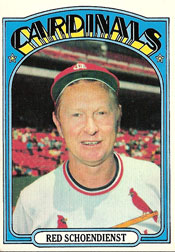
Said manager Red Schoendienst: “Defense makes pitching.”

It appeared the Cardinals, Cubs and Pirates would battle for the division title. On the day the Cardinals moved into first place, the Mets (42-51) were in last place, 7.5 games behind St. Louis.

The Cardinals (56-48) ended July with a two-game lead over the second-place Cubs.

On Aug. 4, at New York’s Shea Stadium, Gibson injured his right knee while running the bases. He required surgery and didn’t pitch again until Sept. 29, when he beat the Phillies.

Without their ace, the Cardinals stumbled, losing 11 of 12 from Aug. 6 to Aug. 18. Yet, on Sept. 11, the Cardinals (72-72) still clung to first place by a half game over the Pirates.

The Mets, however, surged, winning 20 of their final 28. The Cardinals went 13-15 over the same period. A seven-game losing streak, during which they scored a total of 14 runs, from Sept. 7 to Sept. 15 was the Cardinals’ undoing.

Even though St. Louis finished the season with a five-game winning streak, the Mets, who took over first place Sept. 21, won the division championship with an 82-79 mark, 1.5 games ahead of the runner-up Cardinals (81-81).

Russo spoke for many when he wrote, “You could spend all fall and winter replaying those nightmarish giveaways, the games that made the difference between winning and finishing second.”

Read Full Post »

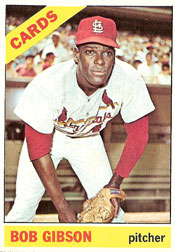
Eight times during his Cardinals career Bob Gibson had three hits or more in a game in which he pitched and earned the win.

Here are the eight games Gibson won while collecting at least three hits:
_ July 8, 1962, Cardinals 15, Mets 1, at New York: Gibson pitched a three-hitter for his 10th win of the season, and went 3-for-5 to improve his batting mark to .300 for the year. One of the hits was a leadoff home run in the third inning off Jay Hook, giving St. Louis a 3-0 lead. Boxscore

_ Sept. 29, 1965, Cardinals 8, Giants 6, at San Francisco: In a matchup of future Hall of Famers, Gibson belted an eighth-inning grand slam against Gaylord Perry.

It was Gibson’s fifth homer of the season, the first grand slam of his professional career and his third hit of the game.

“I knew it was going to the fence, but I didn’t think it was going over,” Gibson told the Associated Press.

With the Cardinals ahead 8-0 entering the bottom of the ninth, the Giants rallied for six runs against Gibson and Curt Simmons. With two on and two out, Hal Woodeshick struck out Willie McCovey on a 3-and-2 curve a foot outside the plate, ending the game and preserving Gibson’s 19th win of the season. Boxscore

_ May 12, 1969, Cardinals 6, Dodgers 2, at St. Louis: Gibson hit three singles, including one with the bases loaded that knocked in two runs in the fourth against Claude Osteen.

His seven-hitter earned Gibson his fourth win of the season. Boxscore

_ Sept. 10, 1969, Cardinals 11, Pirates 2, at Pittsburgh: Gibson stroked four hits, including a double and a single against Steve Blass, and notched his 17th win of the season with a six-hitter in the opener of a doubleheader. Boxscore

_ June 3, 1970, Cardinals 6, Giants 5, at St. Louis: With the score 5-5 in the seventh, Gibson gave the Cardinals the lead with his third hit, a two-out single to right against Frank Reberger that scored Ted Simmons from third.

In pitching an eight-hitter for his fifth win of the season, Gibson retired Willie Mays and Willie McCovey with two on in the ninth. Mays and McCovey went a combined 0-for-9 against Gibson. Boxscore

_ June 26, 1970, Cardinals 7, Phillies 0, at St. Louis: Gibson went 3-for-4 with a RBI and pitched a four-hit shutout for his 10th win of the year. He limited the Phillies to one hit over the last five innings. Boxscore

_ July 1, 1972, Cardinals 6, Phillies 4, at Philadelphia: In the opener of a doubleheader, Gibson hit a double and two singles, and pitched a seven-hitter, leading St. Louis to its fourth consecutive victory and its 11th in its last 12 games. Boxscore

_ Sept. 1, 1974, Cardinals 8, Giants 1, at San Francisco: Gibson, who had lost three of his previous four starts, pitched a seven-hitter and led all St. Louis batters with his three hits. Boxscore

Read Full Post »

(Updated April 2, 2026)

Solly Hemus, Ted Sizemore, Reggie Smith and Colby Rasmus are Cardinals who drew five walks in a game.

Here’s a look:

_ Sept. 15, 1951, Cardinals 10, Braves 1, at St. Louis: Batting leadoff, Hemus walked in all five plate appearances against four different pitchers and scored three times.

Braves starter Dave Cole issued walks to Hemus, Red Schoendienst and Stan Musial in the first inning and plunked Enos Slaughter with a pitch, forcing in Hemus with a run.

In the seventh, with George Estock pitching and St. Louis ahead 8-1, Hemus drew his fifth walk. Hemus attempted to steal second but was thrown out by rookie catcher Ebba St. Claire. Boxscore

_ Aug. 12, 1974, Cardinals 6, Padres 5, at St. Louis: Sizemore, batting second, went 0-for-2 with a run scored and five walks.

In the ninth, with Lou Brock on second, one out and a 5-5 score, Bill Laxton intentionally walked Sizemore and pitched instead to Bake McBride, who hit .309 that season. McBride reached on an error by third baseman Dave Hilton, loading the bases, but Laxton retired Luis Melendez on a pop-up and Ted Simmons on a fly out, forcing extra innings.

In the 13th, with Danny Godby on third, Brock on first and one out, Laxton again gave an intentional pass to Sizemore, loading the bases. McBride’s sacrifice fly to center scored Godby with the winning run. Boxscore

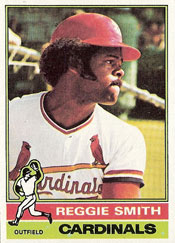
_ Sept. 13, 1974, Cardinals 7, Phillies 3, at Philadelphia: In the first inning, Smith was hit by a pitch from Jim Lonborg, his teammate on the 1967 American League champion Red Sox. Smith got his revenge in the third, with a RBI-single to right against Lonborg.

Smith drew his fifth walk of the game in the 14th inning.

In the 17th, the Cardinals scored five runs against Jesus Hernaiz, Eddie Watt and Tom Underwood. With two outs, Smith was batting against Underwood when the game was halted because of rain at 12:19 a.m. After a delay of 1:41, Smith resumed his at-bat against Underwood and flied out to left.

Philadelphia scored a run in the bottom of the 17th before Bill Robinson lined into a double play against Alan Foster to end it. Boxscore

The Cardinals had played a 25-inning game against the Mets on Sept. 11-12 and a 3-hour game against the Mets on Sept. 12 before the 17-inning rain-interrupted marathon against the Phillies on Sept. 13. The Cardinals won all three.

“Anybody caught getting back to the hotel before 4:30 a.m. is fined $100,” Smith told The Sporting News. “We’re an after-hours club. If anybody gets us past the ninth or 10th innings, they’re in trouble.”

Said manager Red Schoendienst: “We haven’t been getting to bed very early, but we’re winning.”

_ May 22, 2011, Cardinals 9, Royals 8, at Kansas City: Rasmus walked five times against five different pitchers. His bases-loaded walk in the top of the 10th broke a 7-7 tie.

Cardinals manager Tony La Russa told the St. Louis Post-Dispatch the five walks given to Rasmus were “a sign of respect. It’s also a sign of him maturing as a hitter _ to have a good strike zone and not chase.”

However, Rasmus said to the newspaper, “I wasn’t looking to take a pitch at all. I was going up there every at-bat looking to swing at the first pitch.” Boxscore

Read Full Post »

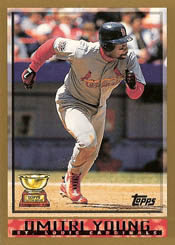
In the first at-bat by a Cardinals designated hitter in a regular-season game, Dmitri Young singled to center field in the second inning against the Brewers’ Ben McDonald on June 16, 1997, at Milwaukee. The Brewers then were an American League franchise.

That successful start set the tone for what has been a well-utilized position for the Cardinals.
According to the Elias Sports Bureau, Cardinals designated hitters have a .321 batting average and 83 RBI in regular-season games played in American League ballparks since interleague play began in 1997. No other National League team’s designated hitters have produced more RBI and none have managed a cumulative batting average as high as .280. 

Among the best-producing DHs for the Cardinals are Albert Pujols (.360 in 12 starts), Scott Spiezio (.333 in 11 starts) and Chris Duncan (.333 in nine starts), Elias Sports Bureau reported.

Dmitri Young, a switch-hitting first baseman and outfielder, went 1-for-4 as the first Cardinals designated hitter in a regular-season game. It was his only appearance as a designated hitter that season. Boxscore

(In a 13-year big-league career with the Cardinals, Reds, Tigers and Nationals, Young went on to appear in 318 games as a designated hitter, hitting .285 with 53 home runs from that position).

Cardinals manager Tony La Russa used four players as designated hitters in the first year that National League teams were able to employ the position during the regular season at American League ballparks.

After trying Young in that first game, he played Ron Gant and Scott Livingstone at designated hitter in consecutive games at Milwaukee.

In a three-game series in August 1997 at Kansas City, La Russa exclusively used Willie McGee as designated hitter. McGee’s three-run triple in the eighth inning snapped a 6-6 tie and carried St. Louis to a 9-7 victory on Aug. 29. Boxscore

Here is how Cardinals regular-season designated hitters have fared each year:

_ 1997: .160 batting average (4-for-25), 0 home runs, 3 RBI.

_ 1998: .294 batting average (10-for-34), 0 home runs, 4 RBI.

_ 1999: .320 batting average (8-for-25), 0 home runs, 3 RBI.

_ 2000: .394 batting average (13-for-33), 3 home runs, 11 RBI.

_ 2001: .292 batting average (7-for-24), 0 home runs, 1 RBI.

_ 2002: .200 batting average (4-for-20), 1 home run, 4 RBI.

_ 2003: .424 batting average (14-for-33), 4 home runs, 10 RBI.

_ 2004: .154 batting average (4-for-26), 0 home runs, 3 RBI.

_ 2005: .429 batting average (12-for-28), 3 home runs, 10 RBI.

_ 2006: .342 batting average (13-for-38), 1 home run, 5 RBI.

_ 2007: .378 batting average (14-for-37), 2 home runs, 10 RBI.

_ 2008: .371 batting average (13-for-35), 2 home runs, 7 RBI.

_ 2009: .333 batting average (7-for-21), 2 home runs, 6 RBI.

_ 2010: .211 batting average (4-for-19), 0 home runs, 1 RBI.

_ 2011: .182 batting average (2-for-11), 1 home run, 3 RBI.

The first Cardinals designated hitter in a post-season game was Gene Tenace, who went 0-for-3, in Game 1 of the 1982 World Series. Boxscore Cardinals designated hitters batted .462 (12-for-26) in the seven-game series, playing an integral role in St. Louis winning the championship.

Read Full Post »

(Updated Dec. 2, 2024)

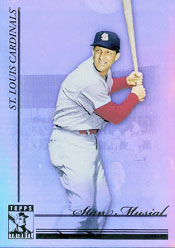
Stan Musial is the oldest player to hit three home runs in a major-league game.

Musial was 41 when he hit three home runs against the Mets on July 8, 1962, at the Polo Grounds in New York.

It capped a stretch of four home runs in four consecutive at-bats for Musial.

Power streak

On July 7, 1962, Musial snapped a 2-2 tie with a home run off former teammate Craig Anderson in the eighth inning of the second game of a doubleheader at the Polo Grounds, lifting the Cardinals to a 3-2 victory over the Mets. Boxscore

The next day, a Sunday afternoon, Musial hit home runs his first three times at-bat, giving him four in a row over two games (tying a major-league record) and helping the Cardinals to a 15-1 victory.

“Trouble with the Amazin’ Mets isn’t that they have old ballplayers; it’s that they don’t have any old ballplayers named Musial,” wrote Dick Young in the New York Daily News.

Musial hit a solo shot in the first inning and a two-run home run in the fourth, both off Jay Hook. The first home run against Hook came on a 2-and-0 changeup. “The ball probably would have been caught in St. Louis, but it found the range in the Polo Grounds, which has a fence only 257 feet from the plate at the foul line,” the St. Louis Post-Dispatch reported.

The second home run off Hook was hit into the upper deck on a 3-and-1 slider.

(In the book “Voices From Cooperstown,” Musial said to author Anthony J. Connor, “Because of the fast break, I found the slider much more difficult to pick up than the fastball, curve or changeup.”)

Musial led off the seventh with a home run against Willard Hunter on a 2-and-2 fastball, up and in. Musial “tomahawked that one viciously against the right field roof,” the Post-Dispatch reported.

In the book “Stan Musial: The Man’s Own Story,” Musial said, “The pitch was too far inside. Hunter seemed surprised I didn’t take it, but I didn’t believe in letting an inside pitch get away at the Polo Grounds.”

It was the second time in his big-league career Musial slugged three home runs in a game, and he was especially thrilled that his wife Lil and daughter Janet were in attendance to witness the feat.

Trying for another

In the eighth, facing former teammate Bob Miller with a chance for a fifth consecutive home run and No. 4 in the game, Musial admitted, “I was going for the fence.”

With the count 2-and-0, Musial watched a fastball cross the plate for a strike. Miller’s next pitch was a curve and Musial took “a wild, off-balance swing” and missed, the Daily News reported. Miller came back with another curve in the dirt. Musial tried to check his swing but couldn’t and struck out, but the ball eluded catcher Chris Cannizzaro and Musial reached first base safely. He was removed for a pinch-runner and received a roaring ovation from the New York crowd. Boxscore

Signing for kids

After the game, Musial posed for photographers with family and friends on the field. “An 11-year-old freckled red-haired boy named Kevin Charkowicz was brought down to the field, where he presented the ball” Musial hit for his third home run of the game, the Post-Dispatch reported. (See his comment in the response section below.)

According to the Post-Dispatch, Musial “stayed on the field to sign for youngsters who clustered around him.”

Among the group of kids cheering for Musial and getting autographs from him were Little League players in gray uniforms, the St. Louis Globe-Democrat noted.

Musial headed into the all-star break with a .333 batting average, .403 on-base percentage and .523 slugging percentage. Not bad for 41 years old.

Other sluggers at 40

Besides Musial, three others who reached 40 years of age hit three home runs in a game. The most recent was Jason Giambi, 40, who hit three home runs for the Rockies on May 19, 2011.

Babe Ruth (in 1935 for the Braves) and Reggie Jackson (in 1986 for the Angels) also hit three home runs in a game at age 40.

Alex Rodriguez of the Yankees was 39 when he hit three home runs in a game vs. the Twins on July 25, 2015 _ two days before his 40th birthday.

Read Full Post »

« Newer Posts - Older Posts »