Feeds:
Posts
Comments

Archive for the ‘Games’ Category

(Updated Jan. 9, 2025)

A couple of Hoosiers made life miserable in Brooklyn for the Cardinals.

In 1953, the Cardinals were 0-11 for the season against the Dodgers at Ebbets Field in Brooklyn’s Flatbush section.

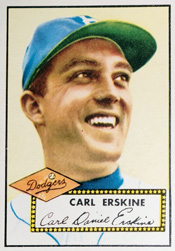
The players most responsible for the Cardinals’ troubles there were pitcher Carl Erskine of Anderson, Ind., and first baseman Gil Hodges of Princeton, Ind.

Dominant Dodgers

The 1953 Brooklyn Dodgers, subjects of the Roger Kahn book, “The Boys of Summer,” were a powerhouse, featuring a lineup with five future Hall of Famers _ Roy Campanella, Gil Hodges, Pee Wee Reese, Jackie Robinson and Duke Snider.

They rolled to the National League pennant with a 105-49 mark, finishing 13 games ahead of the runner-up Braves (92-62) and 22 ahead of St. Louis (83-71).

The Cardinals won seven of 11 against the 1953 Dodgers at St. Louis, but it was a much different story at Brooklyn. Not only did they lose all 11 games at Ebbets Field, they often got crushed. The Dodgers outscored them, 109 to 36, in those 11 games at Brooklyn.

The Cardinals were beaten by scores of 10-1 on June 7, 9-2 on July 16, 14-0 on July 17, 14-6 on July 18, 20-4 on Aug. 30 and 12-5 on Sept. 1.

There were two one-run games, the Dodgers winning both by scores of 5-4. The cruelest for the Cardinals was on June 6, when Hodges wiped out a 4-2 St. Louis lead with a three-run walkoff home run versus Stu Miller in the ninth. Boxscore

Home sweet home

Many players contributed to the Dodgers’ perfect home record against the Cardinals in 1953, but Erskine and Hodges did the most damage.

A right-hander who mixed an overhand curve and changeup with his fastball, Erskine, 26, was nearly unbeatable at Ebbets Field that year. He ended the regular season with a home record of 12-1, including 4-0 versus the Cardinals. All four of his home wins against St. Louis were complete games.

Erskine also won Game 3 of the 1953 World Series at Ebbets Field, setting a record by striking out 14 Yankees batters, including Mickey Mantle four times. “Erskine made the Yankees look like blind men swatting at wasps,” J. Roy Stockton reported in the St. Louis Post-Dispatch. Boxscore

(Since then, the only pitchers with more strikeouts in a World Series game are Bob Gibson, who fanned 17 Tigers in Game 1 in 1968, and Sandy Koufax, who struck out 15 Yankees in Game 1 in 1963.)

“Look, up in the sky….”

When Erskine beat the Cardinals with a five-hitter on May 6, 1953, at Brooklyn, it was his seventh consecutive win against them, dating back to September 1950. Erskine went undefeated versus the Cardinals in 1951 (4-0) and 1952 (2-0). Boxscore

The streak was snapped a week later, May 14, 1953, at St. Louis when Erskine was knocked out in the first inning without retiring a batter. “He had no control, no stuff and no outs,” Dick Young reported in the New York Daily News. “He warmed up for 15 minutes and pitched for five.” Boxscore

Back in Brooklyn, Erskine ducked into a phone booth, donned his Superman cape and beat the Cardinals for the second time in 1953, a four-hitter in a 10-1 rout on June 7. “It was the sort of affair that grew progressively more one-sided and monotonous, finally reaching the stage where many of the fans amused themselves by launching paper planes onto the field,” Dick Young reported. “Some of these came close to hitting Erskine. So did the Cardinals, but not many succeeded.” Boxscore

A month later, Erskine beat the Cardinals at Brooklyn for a third time, even though he gave up nine hits and two walks, threw a wild pitch and committed two errors. Boxscore

Erskine’s fourth home win against the 1953 Cardinals, on Aug. 30, also was his 13th consecutive win at Ebbets Field. Erskine contributed three RBI and scored a run. Boxscore

“Some pitchers were spooked by the thought of working in Ebbets Field with its cozy fences, but not Erskine,” the New York Times noted.

(In his next start, the Braves gave Erskine his lone home loss of 1953. With the score tied at 1-1 in the eighth, Eddie Mathews hit a three-run home run and Jim Pendleton had a two-run shot. Boxscore)

Erskine finished 1953 with a regular-season record of 20-6, including 6-2 versus the Cardinals.

For his career with the Dodgers, Erskine was 122-78, including 66-28 at Brooklyn. He was 23-8 against the Cardinals _ 13-2 at Ebbets Field.

(Erskine’s second win in the majors came against the Cardinals in a 1948 relief appearance. In the book “We Would Have Played For Nothing,” Erskine recalled, “I beat Howie Pollet and he waited for me after the game in the runway to congratulate me. He said, ‘I like the way you throw.’ He was a class act. I think he identified with me because he had a unique pitch _ a straight change _ and I could throw that pitch.” Boxscore)

Among the Cardinals regularly baffled by Erskine were Enos Slaughter (.162 batting average against) and Red Schoendienst (.211). The exception, naturally, was Stan Musial. He batted .336 with eight home runs versus Erskine. According to Time Magazine, Erskine said, “I’ve had pretty good success with Stan by throwing him my best pitch and backing up third.”

In July 2023, Erskine, 96, recalled to Tyler Kepner of the New York Times that Musial “almost never missed a swing. He always hit the ball somewhere.”

In his book, “Stan Musial: The Man’s Own Story,” Musial said, “Erskine had control, a remarkable changeup and a great overhand curve.”

(Erskine had an association with the Cardinals in 1971 when he joined play-by-play men Jack Buck and Jim Woods as a guest analyst on select telecasts of games on KSD-TV Channel 5 in St. Louis.)

Lots of lumber

Three pitchers _ Stu Miller (0-3), Joe Presko (0-3) and Gerry Staley (0-2) _ accounted for eight of the 11 Cardinals losses at Ebbets Field in 1953.

Dodgers hitters were led by Gil Hodges, who had eight home runs and 23 RBI against Cardinals pitching in the 11 games at Brooklyn. Hodges had 16 hits and seven walks in those games.

(In 31 at-bats at St. Louis in 1953, Hodges had no home runs, no RBI and batted .129.)

Others who hammered the 1953 Cardinals at Ebbets Field were Roy Campanella (18 hits, 18 RBI), Jackie Robinson (18 hits, 11 RBI) and Duke Snider (four home runs and 11 RBI).

Read Full Post »

Danny Cox began the 1983 baseball season in the low level of the minors and ended it as a member of the starting rotation of the reigning World Series champion Cardinals.

Matched against Steve Carlton and facing a lineup with Pete Rose, Joe Morgan and Mike Schmidt, Cox pitched 10 scoreless innings versus the Phillies in his big-league debut on Aug. 6, 1983.
The stellar performance didn’t get Cox a win, though. That came a couple of weeks later when he opposed another future Hall of Fame pitcher, Nolan Ryan.

Fun in Florida

A right-hander attending Troy University, Cox, 21, was chosen by the Cardinals in the 13th round of the 1981 amateur draft, a couple of picks after the Mets took a high school outfielder, Lenny Dykstra, in the same round.

Cox pitched for a rookie team and a Class A club his first two seasons in the Cardinals’ farm system. Then in 1983, he was assigned to rookie manager Jim Riggleman’s Class A team, the St. Petersburg Cardinals. Even at that level, Cox was matched against an exceptional pitching opponent.

After losing his first two decisions in 1983, Cox, 23, started on May 12 at home against the Fort Myers Royals. Their starter, Bret Saberhagen, 19, was in his first season of professional ball. (Two years later, Saberhagen received the first of his two American League Cy Young awards with the Kansas City Royals.)

Pitching before 882 spectators at Al Lang Stadium in St. Petersburg, Cox threw a four-hitter in a 2-1 victory. Saberhagen went six innings and allowed both runs.

Facing a Fort Myers lineup that included future big-leaguers Mike Kingery and Bill Pecota, Cox retired the last 11 batters in a row. “He dominated,” St. Petersburg catcher Barry Sayler told the St. Petersburg Times. “He was working the inside of the plate, mixed his fastball and slider, and threw hard.”

Cox credited the advice he received from St. Petersburg teammate and closer Mark Riggins (who went on to become pitching coach of the St. Louis Cardinals, Chicago Cubs and Cincinnati Reds). “I started off throwing my fastball inside, and then Mark Riggins told me to take a little off my slider and mess up their timing,” Cox said to the St. Petersburg Times. “I was wanting to win real bad.”

Five days later, in a rematch at Fort Myers, Cox, with relief help from Riggins, again beat Saberhagen in a 7-2 St. Petersburg triumph.

On the rise

After five starts for St. Petersburg (2-2, 2.53 ERA), Cox was promoted to Class AA Arkansas. Playing for manager Nick Leyva, Cox was 8-3 with a 2.29 ERA in 11 starts. In July, he got promoted again, to manager Jim Fregosi’s Class AAA Louisville club. Cox made two starts for Louisville and pitched well (2.45 ERA).

Then came a special audition. The St. Louis Cardinals chose him to start against the Baltimore Orioles in the Baseball Hall of Fame exhibition game at Cooperstown, N.Y., on Aug. 1.

The Orioles, on their way to an American League pennant and World Series championship in 1983, were limited to three hits and no runs in the six innings Cox worked against them. “He was very impressive,” Cardinals manager Whitey Herzog said to the St. Louis Post-Dispatch.

Herzog wanted to see more. The Cardinals put Cox on their roster. His next start came in a big-league game against the Phillies.

Tough task

Cox’s debut assignment was daunting. The opposing starter, Steve Carlton, had dominated the Cardinals since being traded by them to the Phillies in 1972.

The matchup was intriguing for other reasons as well:

Chase Riddle, head coach of Troy’s baseball team when Cox pitched there, was the Cardinals scout who signed Carlton two decades earlier.

_ Like Cox, Carlton also impressed the Cardinals by pitching well in a Hall of Fame exhibition game. On July 25, 1966, Carlton, 21, was at Class AAA Tulsa when the Cardinals chose him to start against the Minnesota Twins in the Cooperstown exhibition. Carlton pitched a complete game, striking out nine, and was the winning pitcher. He never went back to the minors.

Carlton and Cox engaged in a mighty duel. The ace was in top form, pitching nine scoreless innings. The newcomer matched him, then surpassed him, pitching a scoreless 10th after Carlton was relieved by Al Holland.

Cox “didn’t look like a rookie to me,” Joe Morgan told the Associated Press. “I was really impressed by the way he located his pitches and hit the corners.”

Phillies manager Paul Owens said to the Philadelphia Inquirer, “He moved the ball around and threw strikes. That kid was excellent.”

Bruce Sutter, who hadn’t pitched in a week because of the funeral of his father, took over for Cox in the 11th and gave up a run. The 1-0 victory moved the Phillies ahead of the Pirates and into first place in the National League East.

“That was a World Series type of game,” Owens told the Inquirer. “Nobody even left the park.”

Morgan said, “These are the games that win pennants.”

Indeed, the Phillies went on to become National League champions in 1983. Boxscore

Sweet win

In his next start, Cox gave up a grand slam to ex-Cardinal Leon Durham and was beaten by the Cubs. Boxscore

His first win came in his fourth start on Aug, 21. Matched against Nolan Ryan and the Astros, Cox prevailed in a 5-2 Cardinals victory. Cox pitched 7.2 innings and allowed two runs. Ryan surrendered five runs in six innings. Cox also got his first big-league hit in that game, a single against Ryan in a two-run sixth. Boxscore

Cox made 12 starts for the 1983 Cardinals and was 3-6 with a 3.25 ERA. He pitched a total of 218 innings _ 129.1 in the minors, 83 with the Cardinals and another six in the Hall of Fame exhibition game.

Money ball

Two years later, Cox had his best year in the majors. He was 18-9 for the Cardinals during the 1985 regular season, flirted with a perfect game bid against the Reds, and won Game 3 of the National League Championship Series versus the Dodgers.

The 1985 World Series matched Cox and the Cardinals against Bret Saberhagen and the Royals. In starts against Joaquin Andujar and John Tudor, Saberhagen beat the Cardinals twice, including Game 7, and was named most valuable player of the World Series. Cox was just as good but not as fortunate. He started Games 2 and 6, allowed just two runs in 14 total innings, but didn’t get a decision in either game.

Cox helped the Cardinals win another pennant in 1987. He shut out the Giants in Game 7 of the National League Championship Series. Video

In the World Series versus the Twins, Cox won Game 5, beating Bert Blyleven, but was the losing pitcher in relief of Joe Magrane in Game 7.

In six seasons with St. Louis, Cox was 56-56. As a reliever with the 1993 Blue Jays, he got to be part of a World Series championship club.

Read Full Post »

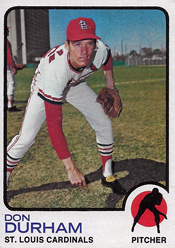
On a team with little pop, pitcher Don Durham qualified as somewhat of a slugger for the Cardinals.

A rookie right-hander with St. Louis in 1972, Durham had as many home runs (two) as wins (two). He batted .500 (seven hits in 14 at-bats) and had a slugging percentage of .929.

Durham was part of a Cardinals pitching trio, along with Bob Gibson and Rick Wise, that provided as much power as some of the infielders and outfielders.

Gibson (five), Durham (two) and Wise (one) combined for eight home runs on a club that ranked last in the 12-team National League in home runs (70) in 1972.

Catcher Ted Simmons (16) and third baseman Joe Torre (11) were the lone 1972 Cardinals to reach double digits in home runs. They and outfielder Bernie Carbo (seven) were the only Cardinals with more home runs than Gibson that year.

Even Durham, with his two in 14 at-bats, had as many home runs as second baseman Ted Sizemore (two in 439 at-bats) and center fielder Jose Cruz (two in 332 at-bats), and more than shortstop Dal Maxvill (one in 276 at-bats) and third baseman Ken Reitz (none in 78 at-bats).

Promising prospect

Though born in Kentucky, Durham was a resident of the Ohio village of Arlington Heights near Cincinnati between the ages of 6 and 9, according to the Cincinnati Enquirer. He played Little League baseball there and faithfully followed the 1950s Reds, The Sporting News reported,

At Western Kentucky University, Durham was a first baseman and pitcher. Though slender at 6 feet and less than 170 pounds, he threw hard and hit for power.

In a 1969 doubleheader versus Austin Peay, Durham started and won the first game, then belted a grand slam to help Western Kentucky complete the sweep, according to The Park City Daily News of Bowling Green, Ky. A year later, he struck out 14 in pitching a no-hitter against Bellarmine. Durham led the team in hitting (.418) his final season, according to The Sporting News.

On the recommendation of scout Mo Mozzali (who signed Ted Simmons three years earlier), the Cardinals chose Durham in the seventh round of the 1970 draft. After a strong season with Class A Modesto in 1971 (13-7, 2.80 ERA, 202 strikeouts in 177 innings, plus a .240 batting average), the Cardinals decided Durham should bypass Class AA and move to Class AAA Tulsa in 1972.

On June 3, 1972, Durham pitched a shutout and hit a home run against Indianapolis. The two-run homer came after Durham fouled off two pitches trying to bunt and then was told by manager Jack Krol to swing away. “I’ve always been proud of my hitting,” Durham said to the Tulsa World.

Four days later, with Tulsa ahead, 1-0, in the last of the ninth inning at Evansville, Durham needed one out to complete a no-hitter, but Bob Coluccio grounded a single to left. Exasperated, Durham flung his glove into the air. After a brief discussion with Krol on the mound, Durham faced Darrell Porter, who the night before lined a two-out, two-run home run in the bottom of the ninth to lift Evansville to a 4-2 victory.

On Durham’s first pitch to him, Porter lofted a high fly that carried over the fence, barely beyond the reach of right fielder Bob Wissler, for a game-winning home run. “To tell you the truth, I didn’t think I hit the ball that good,” Porter said to Tom Tuley of The Evansville Press. “I thought it was going to be caught.”

Sitting alone on the dugout steps after going from possible no-hitter to losing pitcher in two pitches, Durham told Tuley, “I’m still in shock.”

Fitting in

A week later, Durham, 23, was called up to the Cardinals and put into the starting rotation, even though he had pitched only a partial season at a level higher than Class A.

He made his big-league debut against his boyhood favorite, the Reds, at St. Louis on July 16, 1972. The first batter he faced, Pete Rose, grounded out. The next, Joe Morgan, flied out. In the second inning, Durham struck out the side. One of the victims was Tony Perez.

Durham went seven innings, allowed three runs, got little support and was the losing pitcher in a 4-1 Reds triumph. Bobby Tolan hit a solo home run _ the only homer Durham would allow in 47.2 innings for the 1972 Cardinals.

“The kid had good stuff,” Cardinals manager Red Schoendienst said to the St. Louis Post-Dispatch. “He’s going to be a good pitcher. He had a good fastball and his control was good. We just didn’t get a break for him.”

Reds manager Sparky Anderson told the Dayton Daily News, “The kid had a good fastball and he kept it around the plate real well.”

According to the Post-Dispatch, Cardinals catcher Ted Simmons nicknamed Durham “The Rattlesnake” because of the way he uncoiled as he delivered a pitch. Boxscore

Tough going

On Aug. 4, 1972, when the Phillies faced the Cardinals, the starting pitchers had a combined season record of 0-11. Ken Reynolds was 0-8 and Durham was 0-3.

In the second inning, using a Bob Gibson bat, Durham got his first big-league hit, a three-run home run on a fastball down the chute from Reynolds. Then he retired the Phillies in order in the second through fifth innings and contributed two more hits, both singles. “If ever a pitcher seemed destined for victory, Durham was the guy,” the Post-Dispatch noted.

It wasn’t to be, though. The Phillies scored six runs in the eighth and won, 8-3. “Sitting forlornly in the clubhouse,” Durham was “so despondent he could hardly bring himself to talk,” the Post-Dispatch reported. 

He described himself to the newspaper as “a choke artist.” Boxscore

Giant killer

After losing a fifth consecutive decision, Durham finally got his first big-league win on Aug. 18, 1972, against the Giants at Candlestick Park in San Francisco.

In addition to limiting the Giants to a run in 6.1 innings before being relieved by Diego Segui, Durham scored the Cardinals’ first two runs. Using a Ted Simmons bat, he singled and scored in the third and walloped a hanging slider from Jim Willoughby for a solo home run in the fifth.

After the game, Durham went around the clubhouse, getting autographs on a baseball from all of his teammates, the Post-Dispatch reported.

“My confidence has been restored,” Durham told the Post-Dispatch. Boxscore

Durham got one more win and again it came against the Giants. Facing a lineup with the likes of Bobby Bonds, Willie McCovey and Dave Kingman, Durham pitched a three-hitter. He also stroked two singles _ one against Juan Marichal and the other versus Sam McDowell.

“After the first inning, I zeroed in nicely on the outside zone and took the power away from their big hitters,” Durham told the San Francisco Examiner. Boxscore

End game

Durham pitched in 10 games, making eight starts, for the 1972 Cardinals and was 2-7 with a 4.34 ERA.

At some point, he experienced elbow problems and was sent back to Tulsa for the 1973 season.

On July 16, 1973, the Cardinals traded Durham to the Texas Rangers, who were managed by Whitey Herzog. The American League had the designated hitter rule, so Durham didn’t get a chance to bat. When he pitched, he wasn’t effective.

After posting a record of 0-4 with a 7.59 ERA for the 1973 Rangers, Durham, 24, was finished in the big leagues.

Read Full Post »

Johnny Stuart was a rattled rookie when he made his first start in the majors for the Cardinals and failed to get an out. A year later, on the day he made his second start in the big leagues, he also made his third, and the results were much better.

On July 10, 1923, Stuart started both games of a doubleheader for the Cardinals against the Braves and earned complete-game wins in both.

The iron man feat was a highlight of his four seasons in the majors with the Cardinals, but it wasn’t his only impressive sports accomplishment.

Razzle dazzle

Stuart played baseball and football at Ohio State University. He was a halfback, punt returner and punter for the football team.

In those days, players were taught to just fall on a punted ball that hit the ground rather than risk a fumble. Fleet and sure-handed, Stuart had other ideas. According to a syndicated column in The Cincinnati Post, “He handles a football that is rolling along the ground just as if it was a grounder in baseball. Stuart has thrown tradition to the wind in handling such punts. He races in on them on the bound and is on the way toward the opposition goal at full speed.”

His daring approach sparked Ohio State to victory against Michigan in 1921.

Scoreless in the second quarter, Michigan punted from deep in its territory. It was a lousy kick and the ball wobbled to the Michigan 34-yard line. 

“With the agility of a cat, Stuart pounced on the pigskin,” the Detroit Free Press reported. “With the narrow margin of three yards, Stuart managed to twist through many aspiring Michigan tacklers.”

According to the Cleveland Plain Dealer, Stuart “swept past the entire astonished and dumbfounded Michigan team” and crossed the goal line for a touchdown.

Stuart’s punting was as important as his touchdown because he kept Michigan’s offense from getting good field position. “Time and again Stuart kicked the ball 50 and 60 yards,” the Free Press reported. “His punts were all well-placed and Michigan men found them difficult to gather in.”

Ohio State won, 14-0, putting “Johnny Stuart’s name on the lips of every Ohio State rooter,” the Plain Dealer noted.

The big show

Football was fun but baseball offered Stuart his best chance at a professional career. A right-hander, he excelled as a college pitcher and the Cardinals were impressed. They signed him in July 1922 and brought him directly to the majors.

When he left his home in Huntington, W. Va., and joined the Cardinals in New York, Stuart “was not even city broke,” let alone ready to face batters in the big leagues, the Springfield (Ohio) News-Sun reported.

On July 27, 1922, one day after Stuart joined the team, manager Branch Rickey gave him the start against the reigning World Series champion Giants at the Polo Grounds. The Cardinals (57-38), who trailed the first-place Giants (56-34) by 1.5 games, were in the middle of a stretch of eight games in seven days and Rickey hoped Stuart could give the rotation a lift.

The task, though, was daunting. The Giants, managed by the irascible John McGraw, had a lineup that featured three future Hall of Famers (Dave Bancroft, Frankie Frisch and High Pockets Kelly) and an outfielder, Casey Stengel, who was batting .387 for the season.

Cardinals batters did their best to help the rookie, scoring four in the top of the first against two-time 20-game winner Jesse Barnes, but when it came Stuart’s turn to take the mound the 4-0 lead was no comfort to him.

“Stuart became all fussed before he got started,” the New York Daily News noted.

According to the St. Louis Globe-Democrat, Stuart, 21, was “unnerved by the taunts hurled at him from the Giants’ bench and from the spectators.”

He walked the first batter (Bancroft), then committed a balk, hit the second batter (Johnny Rawlings) with a pitch, and threw a couple of balls out of the strike zone to the third batter (Frisch) before being removed by Rickey.

Two of the runners Stuart put on eventually scored. The Giants won, 12-7. Boxscore

“Several baseball critics over the country are poking fun at manager Branch Rickey in starting Johnny Stuart against the Giants when first place was at stake,” the Springfield (Ohio) News-Sun reported.

The day after his inauspicious big-league debut, Stuart pitched two innings of relief against the Giants and allowed a two-run single to Frisch. Boxscore

Mercifully, the Cardinals shipped him to a farm club, the Syracuse Stars, managed by Shag Shaughnessy, a former baseball and football standout at Notre Dame.

Start me up

Eager to see how Stuart developed after his stint at Syracuse, Rickey included him on a team of prospects he took on a barnstorming tour after the 1922 season. Stuart impressed, pitching a no-hitter against a team of locals in De Soto, Mo., the St. Louis Star-Times reported.

After a good spring training, Stuart earned a spot on the Cardinals’ 1923 Opening Day roster as a reliever. Throughout the season, he “carried with him a tennis ball, which he gripped and squeezed continually to improve the strength of his pitching hand,” the St. Louis Post-Dispatch reported.

Stuart also became a protege of Fred Toney, 34, a two-time 20-game winner who was with the 1923 Cardinals for his 12th and final season in the majors. Toney taught Stuart to throw a fadeaway ball and how to pitch to a batter’s weakness. “He and Toney were constantly talking baseball,” the Post-Dispatch noted.

Stuart made 17 appearances, all in relief, for the 1923 Cardinals before Rickey chose him to start the opener of a July 10 doubleheader against the Braves at Boston. It was Stuart’s first start for the Cardinals since his rough debut versus the Giants a year earlier.

The result this time was much different. Stuart pitched a three-hitter and the Cardinals cruised to an 11-1 victory. Stuart finished strong, getting 12 consecutive outs after Stuffy McInnis led off the sixth with a single. Boxscore

Stuart then asked Rickey to start him in the second game. “There is a dearth of pitchers on the Cardinals club right now,” the Globe-Democrat reported, so Rickey accepted Stuart’s offer.

Stuart retired the first four batters of Game 2 before Tony Boeckel bunted for a single. He held the Braves to a run through seven innings, then gave up two in the eighth, but completed the game, a 6-3 Cardinals triumph.

“It was not until the very end of his second game that he showed the least signs of wear and tear,” the Boston Globe reported.

One of the keys for Stuart was that he induced the Braves to hit into outs. He didn’t strike out a batter in his 18 innings. Boxscore

On Sept. 3, 1923, Stuart pitched a five-hit shutout in the Cardinals’ 1-0 triumph against the Cubs at Chicago. In the fourth inning, two outs came on his pickoffs of runners at first base. Boxscore

Stuart, 22, finished the 1923 season with a 9-5 record. He was 7-2 as a starter.

“His fastball is sweet and he has developed a slow fadeaway which bothers the best hitters in the league,” the Star-Times reported.

Fade away

Stuart was the Cardinals’ 1924 Opening Day starter against the Cubs, but got the flu in late May and didn’t make a start in June. He recovered, pitched a four-hitter against the Pirates on July 1 but finished the season 9-11 with a 4.75 ERA.

Returned to the bullpen in 1925, Stuart struggled. On May 21, he gave up 10 runs against the Braves. A month later, he was shelled for 16 runs versus the Pirates.

Rogers Hornsby replaced Branch Rickey as manager and when the Cardinals, assured of a fourth-place finish, went to Chicago for the final series of the season, he gave Stuart a start against the Cubs. Matched against Grover Cleveland Alexander, Stuart responded with a four-hitter in a 4-3 Cardinals triumph. Boxscore

It turned out to be Stuart’s final big-league game. He was 24 years old. His overall Cardinals record: 20-18, including 5-0 against the Cubs.

In 1927, Stuart was hired to be a college head coach of the baseball and basketball teams at Marshall in the town he resided, Huntington, W. Va. He later became manager of a minor-league team in Huntington and operated a baseball school there.

Read Full Post »

Ken Raffensberger began his major-league career with the Cardinals, then spent a big part of it pitching against them.

A left-hander who relied on pinpoint control and an assortment of breaking pitches, Raffensberger faced the Cardinals a lot _ 79 times, including 59 starts. He lost (34 times) more than he won (23 times) versus St. Louis, but when he was good he was nearly unhittable.

In 1948, Raffensberger pitched two one-hitters against the Cardinals.

Making the rounds

A Pennsylvania Dutch boy from the town of York, home of the Peppermint Pattie, Raffensberger entered the Cardinals’ farm system in 1937. His manager at Rochester in 1938, Ray Blades, managed the Cardinals in 1939 and put Raffensberger, 21, on the Opening Day roster.

“He has exceptional wrist action,” The Sporting News noted. “He flexes the wrist with each throw and the result is speed that is a bit startling to the hitter. There is no evidence of the speed in his delivery, which makes for deception.”

The St. Louis Star-Times reported, “He delivers the ball with little or nothing on it _ so it seems _ but it gains speed, twist, curve and what have you, as it floats toward the plate.”

In his lone appearance for the 1939 Cardinals, Raffensberger pitched a scoreless inning against the Reds, then was sent back to Rochester. Boxscore

(The 1939 Cardinals were the only team Raffensberger played for in his 15 years in the majors that finished a season with a winning record. As the York Sunday News noted, “A pennant race was as foreign to Raffensberger as a French dictionary.”)

Traded to the Cubs in December 1939, Raffensberger was mentored in 1940 by their player-manager, catcher Gabby Hartnett. “He taught me the value of control,” Raffensberger told The Sporting News. “I learned almost everything I know about pitching from him.”

Raffensberger spent most of the next three seasons (1941-43) in the minors, learning how to get batters to hit into outs, before being traded to the Phillies in September 1943.

The Phillies were bad but provided Raffensberger with opportunity, if not many runs. In 1944, he had a 2.72 ERA versus the Cardinals in 53 innings pitched, but his record against them that season was 1-5. The win was a shutout Boxscore and, in one of the losses, he pitched 16 innings in a duel of endurance with Mort Cooper. Boxscore

Named to the National League all-star team for the only time in his career, Raffensberger pitched two scoreless innings and was the winning pitcher against the American League in the 1944 game. Boxscore

Despite a 3.06 ERA, Raffensberger was 13-20 for the 1944 Phillies (61-92), who finished 43.5 games behind the league champion Cardinals (105-49).

On May 18, 1947, Raffensberger pitched a 12-inning shutout against the Cardinals, but a month later, after he lost four in a row, the Phillies traded him to the Reds. Boxscore

Slow and steady

Raffensberger, 30, made two starts against the Cardinals in April 1948 and got no decision in either. Stan Musial went a combined 5-for-8 (two singles, a double, a triple and a home run) against him in those games.

Raffensberger spent most of the next month in the bullpen. He had a 4.34 ERA for the season when he got a start in the second game of a Memorial Day doubleheader against the Cardinals at Cincinnati.

United Press called him a “creaking” veteran. The St. Louis Post-Dispatch described him as a “softball-throwing” pitcher. According to The Sporting News, wise-guy teammates nicknamed him “Cannonball” because of his slow pitches.

Nothing indicated the performance he was about to give.

With two outs in the first inning, Raffensberger walked Musial and Whitey Kurowski before retiring Enos Slaughter. Then he set down the Cardinals in order in every inning from the second through the seventh with what the Post-Dispatch called “his nuthin’-at-all pitch.”

Nippy Jones, leading off the eighth, got the Cardinals’ first hit, a lined single to center, but Raffensberger retired the next three batters.

In the ninth, Musial walked with two outs, but Raffensberger got Kurowski on a grounder to shortstop, completing the one-hit shutout. He achieved it with one strikeout. Boxscore

No fluke

The next time Raffensberger faced the Cardinals, on July 4 at Cincinnati, they beat him, scoring four runs in seven innings. His ERA for the season was 4.57 when he got another start, at St. Louis, on July 11.

After the Reds scored in the first, Raffensberger retired the first 10 batters before Marty Marion singled with one out in the fourth. Don Lang drew a two-out walk in the inning but Enos Slaughter’s grounder to third ended the threat.

The Cardinals got only two more base runners (Musial walked in the seventh and Nippy Jones reached on an error in the eighth), and Raffensberger completed his second one-hitter in the Reds’ 1-0 victory. None of the Cardinals’ outs were strikeouts. Boxscore

“His slider, when acting right, breaks about six inches in toward right-handed batters, making them hit it with the handle of their bats,” Reds catcher Ray Lamanno told The Sporting News. “Left-handed batters see it suddenly break away from them. It starts spinning rapidly just as it begins to break. By that time, batters usually are off stride. Kenny threw curves to Musial in both his one-hitters, keeping the ball away from him.”

In a story headlined, “Raffensberger Zero Ball Too Fast for Cards,” Cubs general Jim Gallagher, in St. Louis to see the game, told the St. Louis Star-Times, “Gremlins carry the ball up to the plate for the last 20 feet.”

Raffensberger said to The Sporting News, “To listen to the hitters, I don’t have anything. I take a lot of kidding that I don’t have a fastball, and don’t have a curveball. All I got, I guess, is confidence in myself to get that ball over.”

For the 1948 season, Raffensberger was 11-12 with four shutouts and only 37 walks in 180.1 innings. He made nine starts against the Cardinals and was 3-3 with a 3.04 ERA. 

High praise

In 1949, Raffensberger was 18-17 for a Reds team that won just 62. He led the National League in shutouts (five). On Aug. 14, he pitched 12 innings against the Cubs and three days later he went 13 innings versus the Cardinals. Boxscore

Branch Rickey, the Cardinals’ executive who traded Raffensberger in 1939, tried multiples times to acquire him for the Dodgers in 1949, but the Reds wouldn’t deal, The Sporting News reported.

Raffensberger beat the Cardinals four times in 1951. In one of those wins, he pitched 14 innings before his catcher, Johnny Pramesa, walloped a walkoff grand slam. Boxscore

Raffensberger, 35, again led the National League in shutouts (six) in 1952, won 17 (including four versus the Cardinals) and posted a 2.81 ERA. He walked 45 in 247 innings. “I was the best control pitcher in the big leagues during my time,” he told the York Sunday News.

He pitched his last game in the majors for the Reds in June 1954, finishing with a career mark of 119-154. He achieved four one-hitters: one each versus the Cubs and Dodgers and two against the Cardinals.

Asked by The Sporting News to name the toughest batters he faced, Raffensberger chose Musial, Jackie Robinson and Carl Furillo. Musial returned the compliment. According to the Associated Press, when Musial appeared on “The Ed Sullivan Show” he named Raffensberger as the toughest pitcher he had faced.

In 201 at-bats against Raffensberger, Musial hit .323 with six home runs but also struck out 20 times, according to Retrosheet.org. Only Warren Spahn struck out Musial (30 times) more often than Raffensberger did.

In his autobiography, “Stan Musial: The Man’s Own Story,” Musial said, “The toughest pitchers for me were Ken Raffensberger, Johnny Vander Meer and Curt Simmons, left-handers, and Clem Labine, a right-hander.”

Raffensberger “had nothing except slow stuff, and a forkball,” Musial said. “With changing speeds and control, he made those pitches seem so fat when they weren’t. The forkball looked as big as a grapefruit but fell off the table, low. I stubbornly tried to slug with him and didn’t have much success.”


Read Full Post »

(Updated Dec. 27, 2025)

When Homer Jones made a catch, he turned the football field into a dance floor, spinning and shifting with an array of flashy moves.

A receiver with the 1960s New York Giants, Jones was a master at producing long gains. He did it either one of two ways _ hauling in deep passes, or using his deft footwork to add yardage after a grab. His career average of 22.3 yards per catch is a NFL record.

The St. Louis Cardinals faced him often, and then he joined them for a brief time at the tail end of his playing career.

Music man

A high school saxophonist in Pittsburg, Texas, Jones played football his senior year because “I wanted to go to college and they didn’t give scholarships to sax players,” he told the St. Louis Post-Dispatch.

At Texas Southern, Jones excelled in track as well as football. He and Bob Hayes of Florida A&M were two of the fastest sprinters in the United States. Jones and Hayes were on the men’s 400-meter relay team that beat the Russians in an international dual meet at Palo Alto, Calif., in July 1962.

A year later, at the National Association of Intercollegiate Athletics meet at Sioux Falls. S.D., in June 1963, Jones won the 220-yard dash, nipping Hayes at the finish line in 21 seconds.

(Later that month, Hayes won the 100-yard dash in 9.1 seconds, a world record, at the Amateur Athletic Union meet in St. Louis. Described as “the world’s fastest human,” Bullet Bob Hayes won two gold medals, in the 100 meters and as a member of the 4×100-meter relay team, at the 1964 Summer Olympics. Like Jones, Hayes became a NFL receiver, with the Dallas Cowboys.)

Jones was a flanker at Texas Southern and one of his favorite plays was a reverse. It basically called for a ball carrier to hand off to a receiver running in the reverse direction. Jones added a twist. “I reversed the reverses on my own just to see how that would work,” Jones told the Post-Dispatch. “I guess I was the first scrambling flanker in Texas.”

Drafted in 1963 by the Houston Oilers of the American Football League and the New York Giants of the National Football League, Jones opted for the Oilers, but reported to training camp with a twisted knee.

“I couldn’t do any knee bends, and you couldn’t play for the Oilers unless you did knee bends,” Jones said to the Post-Dispatch.

Released, Jones contacted the Giants, who signed him to their practice squad in July 1963. After a doctor repaired the cartilage damage in the knee, Jones and the Giants were relieved to discover he still had speed.

Freestyle football

After spending most of the 1963 and 1964 seasons on the practice squad, Jones, a raw talent, filled in for injured Giants receiver Del Shofner in 1965.

“They used to call him Homer Q, and Jones himself said the Q stood for questionable,” Milton Gross of the North American Newspaper Alliance noted.

“They can never tell what I’m going to do,” Jones said.

He inverted the pass routes designed for him and had trouble holding onto the ball. As the New York Daily News noted, “Homer has a reputation for ad-libbing pass patterns.”

Giants quarterback Earl Morrall told Milton Gross, “You look at the films and at times you’re wondering where he’s wandering to.”

“They used to laugh (head coach Allie Sherman almost cried) when Homer lined up in the wrong place, ran pass patterns in reverse, missed blocks and signals,” The New York Times reported.

Jones explained to Milton Gross, “You’ve got to confuse the defense as much as he confuses you. The one who confuses the most comes out the winner.”

Crowd pleaser

In warmup drills before the Giants played the Philadelphia Eagles on Oct. 17, 1965, at Yankee Stadium, Jones dropped nine passes in a row, the New York Times reported.

Show time was another matter.

In the second quarter, the Giants were on their 11-yard line when Earl Morrall called for Jones to run a fly pattern down the sideline. Morrall backpedaled and was near the goal line when he heaved the ball.

At the Eagles’ 40, Jones turned and looked up. “The sun was pretty strong,” he told the New York Daily News. “I saw a black spot in the sky and I didn’t know whether it was a bird or the ball.”

Jones reached for the object, speared it “and then completed a full pivot around defender Irv Cross, who went sprawling out of bounds,” the Daily News reported. Jones sprinted to the end zone, completing an 89-yard play for his first NFL touchdown.

According to NFL.com, Jones wanted to throw the ball to fans in the stands, but the league would fine a player $500 for doing that, so he flicked it into the ground. He is “believed to be the first player to spike a football after a touchdown,” NFL.com reported. Video and Game stats

Hard to stop

Jones averaged 23 yards per catch each year between 1966 and 1968. His 14 touchdowns (13 receiving and one rushing) in 14 games led the NFL in 1967. He made 49 catches that year, averaging 24.7 yards per reception.

In the 1967 season opener against the Cardinals at St. Louis, Jones had five catches for 175 yards and two touchdowns. On one of the scores, Jones beat cornerback Jimmy Burson, made a jumping catch of a Fran Tarkenton pass at the Cardinals’ 10 and “dragged tackler Larry Wilson the last five yards across the goal line,” the Post-Dispatch reported. Game stats

In the season finale rematch at Yankee Stadium, Jones had five catches for 125 yards and a touchdown. Here’s how the Daily News described his score: “Homer caught a turn-in pass in front of Phil Spiller on the St. Louis 45, foot-shuffled his way past a few defenders and shook off rookie Mike Barnes at the 10 to make it a 69-yard play.” Game stats

“Homer is the top offensive weapon in football today,” Tarkenton said to the Daily News in 1967. “Catching the ball is only part of his value. It’s what he does after the catch that makes him so remarkable. He’s a tough man to bring down.”

(In his autobiography, Tarkenton said, “Homer was the fastest guy I ever saw in a football suit, without question … He didn’t have much refinement as a receiver, and sometimes he missed the easy passes, but if he ever got a step on a defensive back, you couldn’t keep him in the stadium.”)

Giants radio broadcaster Marty Glickman told the Daily News, “There have been receivers who had, or have, Homer’s great speed. There have been receivers who are strong and can break tackles. But I never saw both _ the tremendous speed and the power running _ in one man until I saw Homer Jones.”

Teams regularly double-covered Jones. “We feel that any time they play me one-on-one I have a better than 75 percent chance of beating him,” Jones told Newsday. “I myself feel I have a 99 percent chance of beating him. Only a great play by him can stop me.”

In addition to speed and strength, Jones had huge hands. “He palms watermelons,” the Post-Dispatch declared.

Jones made one-handed catches before those became commonplace. He wore a size 13 glove. (A size 11 is considered XL.) According to the North American Newspaper Alliance, when shaking hands, “his fingers reach up to your forearm.”

Stepping out

In January 1970, the Giants traded Jones to the Cleveland Browns for running back Ron Johnson, defensive tackle Jim Kanicki and linebacker Wayne Meylan. Jones was nearly 29, but “there are some in the Giants family” who suspect he is two or three years older than his listed age, the Daily News reported.

The Browns acquired Jones to replace Paul Warfield, who was dealt to the Miami Dolphins, but a second-year player, Fair Hooker, outperformed Jones at training camp in 1970 and won the starting job.

Jones was used primarily as a kick returner with the 1970 Browns. He returned 29 kickoffs for 739 yards, including one for a touchdown against the New York Jets. Video

On July 13, 1971, the Browns traded Jones to the Cardinals for a draft choice. The Cardinals envisioned Jones rounding out a wide receiver corps that featured John Gilliam, Dave Williams, Fred Hyatt and rookie Mel Gray.

“When a receiver of the caliber of a Homer Jones becomes available, you just have to take a look at him,” St. Louis head coach Bob Hollway explained to the Post-Dispatch. “We felt he could add depth and experience. He’s bound to upgrade the receivers and create hard competition.”

Jones told the newspaper, “I’d say it was a happy day. I’ve always had respect for the Cardinals and I like the idea of playing for them.”

Two weeks later, though, when he was supposed to report to Cardinals training camp, Jones had a change of heart. He informed the club he was finished playing.

“When I broke into pro football, I said I would play for five years,” Jones told the Post-Dispatch. “I played for eight and I’ve thought about quitting for some time.” Video highlights

Read Full Post »

« Newer Posts - Older Posts »