Feeds:
Posts
Comments

Archive for the ‘Games’ Category

Julian Javier hit only four home runs for the 1968 Cardinals, but two of those resulted in 1-0 victories.

Three times in his career, Javier hit a home run in a 1-0 Cardinals victory. The only other player to hit a home run in three 1-0 Cardinals triumphs is Ken Boyer, according to researcher Tom Orf.

Just as noteworthy is the list of Cardinals who never hit a home run in a 1-0 win. Stan Musial never did it, according to Orf. Neither did Lou Brock, Jim Edmonds, Mark McGwire, Johnny Mize, Ted Simmons or Enos Slaughter as Cardinals.

Boyer blasts

Boyer ranks third in most career home runs (255) for the Cardinals.

The first time he hit a home run in a 1-0 Cardinals victory was Sept. 7, 1956, against the Reds’ Joe Nuxhall at St. Louis.

Swinging at a Nuxhall curve with one out in the seventh, Boyer hit “a tremendous shot that cut through a strong headwind to land well up in the left field bleachers” at the original Busch Stadium, the Cincinnati Enquirer reported.

The home run was Boyer’s first since July 26 and helped snap Nuxhall’s six-game winning streak. Boyer hit .330 with five home runs versus Nuxhall in his career. Boxscore

Two years later, on July 19, 1958, the Reds again were the opponent when Boyer hit a home run in a 1-0 Cardinals win at Cincinnati.

Leading off the 10th, Boyer hit an Alex Kellner curve over the Crosley Field wall in left for his fifth home run against the Reds that season, helping end a seven-game Cardinals losing skid. Boxscore

The final time Boyer hit a home run in a 1-0 Cardinals win was June 25, 1960, at Philadelphia. Leading off the ninth, he lined the first pitch from Jim Owens just over a railing into the first row of seats in left at Connie Mack Stadium.

“It was a good pitch, high and inside,” Boyer told the St. Louis Post-Dispatch. “I hit it good.”

Curt Simmons, facing the Phillies for the first time since they released him in May, earned his first Cardinals winBoxscore

Good timing

While Julian Javier was visiting children at a Pittsburgh hospital, a 6-year-old boy asked him to hit a home run that night against the Pirates. Javier delivered, connecting against Steve Blass for a 1-0 Cardinals victory at Forbes Field on May 15, 1968. Boxscore

Four months later, as the Cardinals were closing in on clinching a second consecutive National League pennant, Javier hit another improbable home run to give the Cardinals a 1-0 victory.

On Sept. 2, 1968, at Cincinnati, Javier led off the 10th against the Reds’ Ted Abernathy, who had a 2.07 ERA and hadn’t allowed a home run since July. Abernathy threw low strikes with an underhanded submarine delivery. Javier, who batted .174 versus Abernathy, called him Abernasty, the Post-Dispatch reported, “because he doesn’t give you many good pitches to hit.”

To Javier’s surprise, he got a hanging curve from Abernathy and drove the pitch into the left field screen at Crosley Field for a home run.

“I do not see many high pitches from Abernathy, so I am glad I got a good cut at the one he gave me,” Javier said to the Dayton Journal Herald.

The home run gave the Cardinals a 1-0 victory and earned the 20th win of the season for Bob Gibson, who was on his way to winning the National League Most Valuable Player and Cy Young awards. The shutout was the 12th of Gibson’s 13 that season. Boxscore

Javier, who had 76 regular-season home runs for the Cardinals, got the last of his 1-0 game-winners on Aug. 26, 1969, against the Astros at St. Louis. His home run beat Larry Dierker, who allowed two hits in seven innings. Boxscore

Read Full Post »

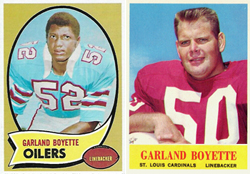
Undrafted, Garland Boyette overcame the odds, earning a roster spot at a position he’d never played and becoming a starting linebacker for the NFL St. Louis Cardinals in 1962.

Two years later, the Cardinals cut him, but that wasn’t the only insult he endured. Philadelphia Chewing Gum Corporation produced a football card of Boyette that year, but fumbled the assignment. The name on the card was Garland Boyette, but the photo was of Don Gillis, a former Cardinals center who no longer was in the league. Boyette was black and Gillis was white.

Boyette went to Canada, revived his career and returned to the United States, launching a successful stint as a two-time Pro Bowl selection at linebacker with the Houston Oilers.

Awesome athlete

Boyette played college football at Grambling and primarily was a defensive lineman. His teammates included other future NFL players such as Buck Buchanan, Willie Brown, Ernie Ladd and Roosevelt Taylor. Ladd, 6 feet 9 and about 320 pounds, was Boyette’s nephew. Ladd’s mother was Boyette’s sister.

Boyette, 6 feet 1 and about 220 pounds, also was a standout track and field athlete who excelled in the decathlon.

After his senior football season at Grambling in 1961, Boyette wasn’t selected in either the AFL or NFL draft. The Cardinals signed him in February 1962 and invited him to training camp.

Ernie Ladd, who made his pro football debut with the San Diego Chargers in 1961, and a friend, Len Burnett, a defensive back for the 1961 Pittsburgh Steelers, worked out with Boyette and offered him advice before he joined the Cardinals.

“They suggested that with my speed and agility I ought to be able to play cornerback in pro football, or with more weight, maybe linebacker,” Boyette told the St. Louis Post-Dispatch. “Ernie told me to get on the weights and get my weight up, so I did.”

Boyette firmed up to about 235 pounds, and, though he never had played linebacker in college, he “landed in an outside linebacker spot, playing behind the Cardinals’ ace outside linebacker, Bill Koman,” the Post-Dispatch reported.

On-the-job training

With the Cardinals loaded with veteran linebackers, Boyette, 22, didn’t play much early in the 1962 season. “I found it discouraging,” Boyette told the Post-Dispatch. “I’d always played first string in college, but it gave me time to learn.”

When several linebackers, including Ted Bates, Ed Henke, Dale Meinert and Marion Rushing _ “All of whom figured to give the Cardinals a tremendous ground defense and a big rush,” The Pittsburgh Press noted _ got sidelined because of injuries, Boyette got his chance.

Against the San Francisco 49ers on Nov. 25, Boyette played at left linebacker, with Koman moving to the right side, and “did a commendable job,” Cardinals head coach Wally Lemm told the St. Louis Globe-Democrat.

Boyette started at left side linebacker in the Dec. 7 game against the Steelers and played well, sacking Ed Brown for a 15-yard loss.

“I told Bill Koman I’d learned more in that one game at Pittsburgh than I’d learned in five years of football earlier,” Boyette said to the Post-Dispatch. “I’m learning more by getting to play. I’ve found nobody ever relaxes in this game.”

After the Cardinals completed the 1962 season, the Globe-Democrat declared, “Boyette came along so well.”

On the move

The Cardinals went into their 1963 exhibition game opener with Boyette, Koman and Meinert as the starting linebackers, but, a couple of weeks later, rookie Larry Stallings was named a starter, replacing Boyette, according to the Post-Dispatch.

In October, Boyette tore ligaments in a knee. He came back in late November and made a key play in a game against the New York Giants, setting up the winning touchdown by recovering Eddie Dove’s fumble on the New York 20-yard line.

As for that football card snafu, Don Gillis wore No. 50 when he played for the Cardinals from 1958-61, and Boyette wore the same uniform number for the Cardinals in 1962 and 1963.

“The card companies would ask the team who wears what numbers,” Boyette told the Monroe (La.) News-Star, “but how the hell do you get that screwed up?”

With Koman, Meinert and Stallings returning in 1964, and Dave Meggyesy pushing for playing time as well, the Cardinals deemed Boyette expendable and placed him on waivers on Sept. 2, according to the Post-Dispatch.

A few days later, Boyette was signed by the Montreal Alouettes of the Canadian Football League. Montreal’s head coach was Jim Trimble. Cardinals defensive coordinator Chuck Drulis had been an assistant on Trimble’s staff when Trimble was head coach of the Philadelphia Eagles in 1954 and 1955.

Boyette played two seasons (1964-65) with the Alouettes and made a favorable impression. “He is the best athlete on my team,” Trimble told the Montreal Star. “Garland is one of the finest athletes I’ve ever known.”

After Trimble departed, Boyette signed with the AFL’s Houston Oilers, who’d hired Wally Lemm to be their head coach in 1966.

“The only reason he was cut by the Cardinals was he made too many mistakes,” Lemm told The Sporting News. “We are hoping now that he is older, and with two years of Canadian ball behind him, he will have matured.”

In 1967, Boyette became the Oilers’ middle linebacker. That same season, rookie Willie Lanier started at middle linebacker for the Kansas City Chiefs. According to the Houston Chronicle, Boyette and Lanier were the first black starting middle linebackers in pro football in the U.S.

A year later, Sports Illustrated described Boyette as “an exceptional athlete who can be one of the great middle linebackers.”

Boyette was named to the Pro Bowl in 1968 and 1969, and played with the Oilers until 1972.

Read Full Post »

When the Cardinals had Bobby Shantz in their lineup, it was like having two players instead of one _ a reliable reliever and a fifth infielder.
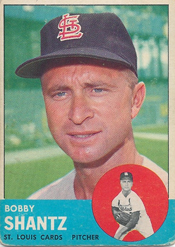
On May 7, 1962, the Cardinals traded pitcher John Anderson and outfielder Carl Warwick to the Houston Colt .45s for Shantz.

A month earlier, Shantz, 36, was the starting pitcher for the Colt .45s in the franchise’s first regular-season game. The Cardinals got him for the bullpen.

A left-hander who baffled batters with precision pitches and fielded with graceful glovework, Shantz gave the Cardinals what they hoped. In three seasons with them (1962-64), Shantz was 12-10 with 15 saves and a 2.51 ERA, and became the first Cardinals pitcher to earn a Gold Glove Award for fielding excellence.

Big talent

Born and raised in Pottstown, Pa., Shantz moved with his parents to the Frankford neighborhood of Philadelphia after he graduated from high school. He was 19 when he joined the Army in December 1944, and was discharged two years later.

Shantz was playing sandlot baseball in Philadelphia when he was signed by the hometown Athletics in November 1947 on the recommendation of Tony Parisse, a butcher and former big-league catcher.

Though no more than 5 feet 6 and 140 pounds, Shantz showed a big-league assortment of pitches. Assigned to Lincoln, Neb., in 1948, Shantz was 18-7 in his lone season in the minors.

Shantz, 23, opened the 1949 season with the Athletics, managed by 86-year-old Connie Mack. After debuting in relief against the Senators on May 1, Shantz was told he was being sent to the minors, but the Athletics changed their minds when another pitcher developed a sore arm.

Bravo, Bobby

On May 6, Shantz appeared in his second big-league game and gave a performance that, as the Philadelphia Inquirer described, “bordered on the incredible.”

Relieving Carl Scheib with none out in the fourth and the A’s trailing, 3-1, Shantz pitched nine hitless innings against the Tigers. He allowed no hits from the fourth through the 12th.

After the Athletics went ahead, 5-3, with two runs in the 13th, Shantz gave up two hits and a run in the bottom half of the inning, but held on for a 5-4 win.

The game showcased Shantz’s fielding as well as his pitching.

In the eighth, “Bob Swift cracked Shantz’s shins with a line drive, and Johnny Lipon bowled him over with a screamer to the throat in the 10th,” the Inquirer reported. “Both times Bobby picked himself up, grabbed the ball and threw his man out. After that, local rooters were with the kid.”

In the bottom of the 13th, George Kell led off with a double and scored on Vic Wertz’s single. Attempting to move Wertz into scoring position, Hoot Evers bunted. The ball was popped up near the first-base line. Catcher Buddy Rosar lunged for it and missed, but Shantz vaulted over the fallen catcher, caught the ball and whipped a throw to first base to nab Wertz for a rally-killing double play. Shantz struck out the next batter, Swift, to secure his first big-league win. Boxscore

Doing it all

Following an 18-10 season for the 1951 Athletics, Shantz was 24-7 for them in 1952 and received the American League Most Valuable Player Award.

“He does everything you could ask any player to do,” Browns manager Rogers Hornsby told The Sporting News. “He pitches well, he fields superbly and he can hit the ball.”

(A right-handed batter, Shantz had 107 hits and 46 RBI in 16 years in the majors. His lone home run was a liner to left against Allie Reynolds at Yankee Stadium in 1950. Boxscore)

Yankees manager Casey Stengel called Shantz the greatest fielding pitcher. “The best I ever saw,” Stengel told the New York Journal-American. “He’s all over the infield.”

Shantz was with the Yankees the first time a Gold Glove Award was given in 1957. He won the award in eight consecutive seasons (1957-1964).

In four years with the Yankees (1957-60), Shantz was 30-18 with 19 saves and a 2.73 ERA. He pitched in six World Series games for them.

After the Senators claimed him in the American League expansion draft in December 1960, the Cardinals tried to acquire him, offering Bob Gibson, but the Senators dealt Shantz to the Pirates. After posting a 6-3 record, including a complete-game win against the Cardinals, for the 1961 Pirates, Shantz was selected by the Colt .45s in the National League expansion draft. Boxscore

Houston calling

Though The Sporting News described his fastball as “mostly a figure of speech,” Shantz, 36, dazzled with his all-around skills at spring training with the Colt .45s.

“That little fellow is a remarkable athlete,” manager Harry Craft said. “Have you ever noticed the way he moves toward every ball hit on the ground? He could play anywhere. I wouldn’t be afraid to let him catch. He’d be a darned fine catcher. Before the season is over, you may see him at third base.”

Shantz was the Opening Day starting pitcher against the Cubs at Houston. The first batter he faced was Lou Brock, who struck out. Shantz pitched a five-hitter in a 11-2 win. Brock was 0-for-3 with a sacrifice fly. Boxscore

(Two years later, Shantz was among the players the Cardinals dealt to the Cubs for Brock.)

In his next start, Shantz pitched 5.2 scoreless innings against the Mets before his shoulder tightened. Ten days later, he started against the Braves, allowed one earned run in six innings, but continued to experience tightness in his shoulder.

Short man

Because of the shoulder ailment, Shantz didn’t think he could pitch deep into games as a starter, but could be effective in short relief. The Cardinals determined he was worth the risk and traded for him.

“The only thing Shantz can’t do any more is pitch long or often,” Cardinals general manager Bing Devine told the Philadelphia Daily News.

In his Cardinals debut, Shantz pitched two scoreless innings against the Giants. Boxscore

(Shantz faced the Giants three times in 1962 and in each game Willie McCovey was lifted for a pinch-hitter against him. McCovey was 0-for-8 versus Shantz in his career.)

Special save

Shantz got his first Cardinals save with 1.2 scoreless innings against the Phillies on May 21.

With the Cardinals ahead, 4-1, in the eighth, the Phillies had Ted Savage on third and Johnny Callison on second, one out, when Shantz relieved Ray Washburn. Cleanup hitter Tony Gonzalez scorched a line drive toward the right of the mound. Shantz lunged, snared the ball backhanded, whirled and fired a strike to Ken Boyer at third, “doubling up a startled and stranded Savage, who had been on his way home, sure the ball would get through,” the St. Louis Post-Dispatch reported. Boxscore

The Philadelphia Inquirer described it as “a play that had to be seen to be believed.”

Shantz “makes improbable plays look easy, and impossible plays just a trifle harder,” Stan Hochman wrote in the Philadelphia Daily News.

Bobby vs. Goliath

Shantz got his first Cardinals win on June 10 with three scoreless innings against the Giants. Boxscore

On Aug. 10, he had two infield hits and a RBI, and pitched four innings for the win against the Phillies. Boxscore

Shantz got a save in his final appearance of 1962. Trailing 7-4, the Giants had runners on first and third, two outs, in the bottom of the ninth when Shantz struck out Willie Mays. Boxscore

“Shantz caught Mays off-balance with a changeup for the third strike,” Curley Grieve of the San Francisco Examiner reported. “Catcher Gene Oliver called it a Stu Miller pitch _ all motion and nothing on the ball. The swing Willie took was just a gesture. He knew he was hooked.”

Shantz was 5-3 with four saves and a 2.18 ERA for the 1962 Cardinals.

The next year,  he appeared in 55 games for St. Louis and was 6-4 with 11 saves and a 2.61 ERA.

One of his highlights with the 1963 Cardinals occurred on July 16 when he struck out eight of 11 batters faced in a win against the Reds. Vada Pinson, 0-for-13 against Shantz in his career, struck out twice. Shantz also fanned Frank Robinson and Pete Rose. Boxscore

“He’s unbelievable,” Cardinals catcher Tim McCarver told the Post-Dispatch. “His control, his change of speed. I’ve never caught anybody who could change speeds like that.”

Shantz said, “I had about as good a curveball as I’ve had all year, but it still took a lot of luck. If they don’t swing at a lot of those balls, I’m in trouble because some of them were bad pitches.”

Shantz had a 1-3 record when he was sent to the Cubs in the Brock deal in June 1964. Two months later, his contract was sold to the Phillies, who were in first place. In 14 appearances with the Phillies, Shantz was 1-1 with a 2.25 ERA, but the Cardinals clinched the pennant on the last day of the season.


Read Full Post »
(Updated June 12, 2022)

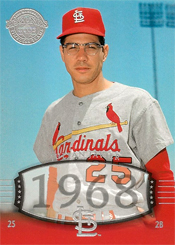
Facing Ernie Broglio for the first time since they were traded for one another, Lou Brock ignited a rally with a bunt.

On July 28, 1964, Broglio started for the Cubs against the Cardinals at Wrigley Field in Chicago. It was the first time the Cardinals and Cubs played one another since the June 15 deal of Brock and pitchers Jack Spring and Paul Toth to the Cardinals for Broglio, pitcher Bobby Shantz and outfielder Doug Clemens.

Broglio, who was 3-5 with a 3.50 ERA for the 1964 Cardinals, entered the series with a 1-4 record and 5.70 ERA for the Cubs. Pitching with an aching right elbow, he lost his first four decisions with the Cubs before beating the Mets with a 10-hit complete game.

Brock, who batted .251 for the 1964 Cubs, entered the series with a .338 batting average and 11 stolen bases for the Cardinals. Brock’s speed, base running and hitting drew comparison’s with former Cardinals standout Enos Slaughter.

“He’s about as close to Slaughter as you can get,” Cardinals manager Johnny Keane told the Associated Press, “and he’s faster. His running has made a great difference to this ballclub.”

Brock said, “Stealing bases is like hitting. It’s timing and rhythm. I don’t study pitchers much. When you have the timing and rhythm, a pitcher can do anything and you can still steal the base.”

Lighting a spark

The Tuesday afternoon game was played before 16,052 spectators on a day when the Chicago temperature exceeded 90 degrees.

Brock grounded out and struck out in his first two plate appearances against Broglio.

In the sixth, with the Cubs ahead, 4-1, Brock gave the Cardinals a chance to climb back. With one out and none one, he pushed a bunt toward the mound. Broglio fielded the ball, but Brock streaked to first with a single. Ken Boyer drove him in with a triple, and Bill White followed with a home run, tying the score at 4-4.

Though the Cubs regained the lead in the bottom of the sixth against an ineffective Bob Gibson, Broglio couldn’t protect it and the Cardinals knocked him out with two runs in the seventh. Broglio and Gibson each gave up six runs.

The game was delayed for five minutes before the start of the ninth because of excessive heat and humidity. Plate umpire Doug Harvey was overcome by exhaustion and was replaced by Lee Weyer.

The Cardinals prevailed, 12-7, in 10 innings, with another of their former pitchers, Larry Jackson, taking the loss. Boxscore

Chicago blues

Brock faced Broglio twice more in 1964, going 0-for-2 with a walk on Sept. 6 and 2-for-4 (two singles) on Sept. 11.

In the Sept. 6 game, Broglio pitched 6.1 innings and allowed one earned run, but he told The Sporting News, “I felt as if I had pulled everything inside the elbow.” Boxscore

The last match between them was on June 27, 1965, when Brock drove in a run with a groundout. Boxscore

As a Cardinal, Brock was 3-for-10 versus Broglio. As a Cub, he was 7-for-31, with two home runs. His home run on July 19, 1962, ended a streak of 11.1 scoreless innings for Broglio. Boxscore

Overall, Brock hit .244 versus Broglio with five RBI.

Brock excelled against the Cubs throughout his Cardinals career. His .334 batting mark versus the Cubs was his best against any opponent. Brock also had career highs in hits (342) and doubles (64) against the Cubs.

In four starts against the Cardinals, Broglio was 0-2 with a 5.32 ERA. He underwent right elbow surgery after the 1964 season for removal of four bone fragments, and told The Sporting News he had been taking cortisone shots once every two weeks for two years.

In March 1965, Broglio said to United Press International, “I’d felt pain in my elbow for four seasons … Those chips which were removed looked to me like four pearls. They must have been calcifying since I was playing high school basketball.”

Broglio pitched two more years (1965-66) for the Cubs and was 30 when he played his last game in the majors.

Brock and Broglio developed a friendship after their playing careers. Broglio displayed a photo from Brock, who inscribed it to “a hell of a player.”

“Ernie is top of the charts,” Brock told ESPN. “He is a good man, a man with integrity. We have a good relationship.”

Read Full Post »

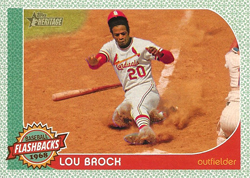
What happened to Bob Gibson on a frigid night at Connie Mack Stadium was weird even by Philadelphia standards. Almost as weird as Santa Claus being booed and pelted with snowballs, or a team mascot getting attacked by an opposing manager.

On April 16, 1962, Gibson gave away a six-run Cardinals lead in the first and didn’t last the inning against the Phillies.
For a pitcher who usually excelled at protecting leads and dominated the Phillies, the failure by Gibson defied the odds and illustrated just how difficult and unpredictable the game could be, even for those at the top of the profession. 

Frozen tundra

After winning their first three games of the 1962 season, the Cardinals were in Philadelphia to play the Phillies on a Monday night. According to the St. Louis Globe-Democrat, the temperature at game time was “a bone-chilling cold” 32 degrees.

“The ball was slick and cold, just like a piece of ice,” Cardinals manager Johnny Keane told the St. Louis Post-Dispatch.

The starting pitchers were Gibson, 26, and Cal McLish, 36, whose full name was Calvin Coolidge Julius Caesar Tuskahoma McLish.

Both were making their first appearances of the season. Against the Phillies in 1961, Gibson was 3-0 with an 0.67 ERA, allowing two earned runs in 27 innings. An Oklahoma native who followed the Cardinals as a youth, McLish was making his Phillies debut after being acquired from the White Sox a month earlier. (In 1982, McLish was the pitching coach for the Brewers, who opposed the Cardinals in the World Series.)

An audience of 3,895 settled in to see the show.

Out of control

Struggling to get pitches over the plate, McLish “was in the showers before you could pronounce his whole name,” Neal Russo of the Post-Dispatch observed.

McLish walked the first two batters, Don Landrum and Julian Javier. Bill White doubled, scoring Landrum and moving Javier to third. After Stan Musial was walked intentionally, loading the bases, Ken Boyer walked unintentionally, scoring Javier.

Gene Oliver made the first out, popping up to third. Doug Clemens, who grew up in Leesport, about 70 miles northwest of Philadelphia, cleared the bases with a double, making the score 5-0.

Phillies manager Gene Mauch replaced McLish with Dallas Green. “It wasn’t that bad pitching out there,” McLish said to the Post-Dispatch, “but I kept fighting myself and got in a rut.”

Green drilled Julio Gotay with a fastball. “It was a knockdown pitch,” Keane told the Post-Dispatch.

The next batter, Gibson, wasn’t intimidated. He rapped a grounder into the hole on the left side for an infield single, and, when shortstop Ruben Amaro made a wild throw after gloving the ball, Clemens scored, giving the Cardinals a 6-0 lead.

Not worth the wait

“Thirty minutes elapsed before Dallas Green got the side out, and, by that time, Gibson was as stiff as a fungo bat,” Stan Hochman noted in the Philadelphia Daily News.

Keane told the Post-Dispatch, “Gibson was cooled off by the time he got to the mound. Maybe we missed the boat by not sending him to the bullpen while we were at bat so long.”

Like McLish did in the top half of the inning, Gibson walked the first two batters (Tony Taylor and Johnny Callison), but Tony Gonzalez struck out and Wes Covington flied out to center.

Then the next six Phillies batters reached base.

Billy Klaus singled, scoring Taylor. Frank Torre walked, loading the bases, and Clay Dalrymple followed with a two-run single, getting the Phillies within three at 6-3.

Amaro walked, reloading the bases, and Gibson was relieved by Ernie Broglio.

“I have no excuses,” Gibson said to the Post-Dispatch. “I was just wild. My ball was moving real good _ in fact, it was moving a little too much. I had good stuff.”

Keane said, “Gibson, with his fastball, usually knocks the bats out of their hands on a cold night like this one.”

Roy Sievers batted for Dallas Green and drew a walk from Broglio, scoring Torre from third. Tony Taylor followed with a two-run single, tying the score at 6-6.

With Broglio shutting out the Phillies over the last eight innings, the Cardinals rallied for four runs against Don Ferrarese and two versus Jack Baldschun, winning 12-6. Boxscore

(Two weeks later, Ferrarese was traded to the Cardinals for Bobby Locke.)

Back on track

In his book “Stranger to the Game,” Gibson recalled, “After that, our pitching coach, Howie Pollet, made me throw more pitches and simulate game conditions in the bullpen, which seemed to help.”

Two weeks later, Gibson pitched a two-hitter to beat the Houston Colt .45s. Boxscore

Gibson was 15-13, including 3-1 versus the Phillies, in 1962 before he broke his right leg during batting practice before a September game against the Dodgers.

For his career, Gibson was 30-12 with a 2.59 ERA versus the Phillies. He had more career wins against the Phillies than he did versus any other club.

Read Full Post »

On his 37th birthday, Lou Brock hit an inside-the-park home run.

Brock hit nine home runs inside the park _ three with the Cubs and six with the Cardinals. He was 22 when he hit the first and 38 when he hit the ninth.

Brock had the power to hit balls over the walls at any big-league ballpark and also the speed to circle the bases on balls hit inside the park.

Out of the park

The first time Brock hit a big-league home run was on April 13, 1962, for the Cubs in their home opener against the Cardinals at Wrigley Field in Chicago. Leading off the bottom of the first inning against rookie Ray Washburn, Brock hit a pitch over the bleachers in right-center and onto Sheffield Avenue. The ball carried at least 450 feet, according to the St. Louis Post-Dispatch.

“Two years ago, I batted against Washburn in the NAIA (National Association of Intercollegiate Athletics) tournament and all I got were three strikeouts and a little bunt single,” Brock told the Post-Dispatch. “When I told the boys at Southern U. last winter that I would have to face Washburn in the majors, they asked me if I was going to jump behind the water cooler and hide when he pitched.” Boxscore

(Brock had six hits in 14 career at-bats in the big leagues versus Washburn _ a .429 batting mark. Brock and Washburn were Cardinals teammates from 1964-69, playing on three National League pennant winners and two World Series championship teams.)

Friendly Forbes Field

Four days after his homer against Washburn, Brock hit his second home run, and his first inside the park, against the Pirates’ Tom Sturdivant at Wrigley Field. Boxscore

Brock “sped around the bases while Donn Clendenon was chasing the ball in the left field corner,” the Chicago Tribune reported.

Sturdivant again was the pitcher when Brock hit his next inside-the-park homer on April 23, 1963, at Pittsburgh’s Forbes Field. Boxscore

Brock’s drive to center struck the wire screen of a light tower (the screen, or cage, was in play) and bounded back past center fielder Bill Virdon. Brock circled the bases as Willie Stargell retrieved the ball.

A right-hander who played 10 years in the majors and pitched in six World Series games for the Yankees, Sturdivant was no match for Brock. In seven career plate appearances versus Sturdivant, Brock had four hits and two walks _ an on-base percentage of .857.

Three months later, on July 21, 1963, Brock hit his second inside-the-park homer of the season, and the third of his career, against the Pirates’ Don Cardwell at Forbes Field. The drive hit the center field wall. Boxscore

Igniting the offense

In June 1964, Brock was traded to the Cardinals and transformed the lineup with his hitting, speed and intimidating base running.

Brock’s first Cardinals home run was launched onto the pavilion roof in right at the original Busch Stadium in St. Louis against the Giants’ Jack Sanford on June 21, 1964.

Brock’s second Cardinals home run was inside the park _ again at Forbes Field _ versus the Pirates’ Steve Blass in the first game of a July 13 doubleheader.

Batting second in the order, between Curt Flood and Dick Groat, Brock hit a shot that landed in deep right-center, bounced against an iron gate, and caromed away from right fielder Roberto Clemente. Brock scored without a slide ahead of the relay throw from Bill Mazeroski. Boxscore

Brock’s performance in the doubleheader illustrated his multiple skills. In the second game, he powered a home run into the upper deck in right. He totaled seven hits, a walk, two RBI and five runs scored in the doubleheader. Boxscore

For his career, Brock hit .299 with six home runs in 79 games at Forbes Field, which was the Pirates’ home until July 1970.

(Brock wasn’t alone in finding the large outfield at Forbes Field to be good for hitting homers inside the park. The Cardinals’ Terry Moore hit two in one game there in 1939.)

Hit and run

From 1965 to 1975, Brock hit two homers inside the park _ on May 22, 1965, versus the Mets’ Jack Fisher at the original Busch Stadium, and on May 3, 1970, against the Astros’ Tom Griffin at Busch Memorial Stadium.

In 1976, Brock hit two inside-the-park homers.

The first of those came on June 18, his 37th birthday, and it was the second homer hit inside the park by a Cardinals batter that night at Busch Memorial Stadium.

In the fourth inning, the Cardinals’ Hector Cruz hit a pitch from the Padres’ Randy Jones deep to left-center. As Willie Davis leaped for it, he banged into the wall and the ball careened back toward the infield. Cruz circled the bases as Davis chased the ball, and scored just ahead of the relay throw from Enzo Hernandez.

Brock batted in the next inning against Jones and hit a drive to right-center. The ball got past Dave Winfield, hit a seam in the artificial surface, bounced over Davis, who was backing up the play, and rolled to the wall. Brock raced around the bases before Tito Fuentes could make a relay throw to the plate. Boxscore

“All in a day’s work _ a hard day’s work,” Brock said to the Post-Dispatch.

Asked about achieving the feat at 37, Brock replied to the Associated Press, “Age don’t mean nothing. It’s only when you can’t do the job any more that it counts.”

Three months later, on Sept. 8, 1976, Brock hit another homer inside the park at St. Louis. The pitcher was the Expos’ Chuck Taylor, Brock’s former Cardinals teammate.

Brock’s final inside-the-park homer was hit on Sept. 21, 1977, against the Expos’ Hal Dues at Montreal. Boxscore

The career leader in inside-the-park home runs is Jesse Burkett, who played in the majors from 1890 to 1905. He hit 55 inside-the-park homers, including 19 with the Cardinals and eight with the Browns.

Read Full Post »

« Newer Posts - Older Posts »