Feeds:
Posts
Comments

Archive for the ‘Games’ Category

During a stretch in the 1960s, Jim Maloney was as overpowering as National League contemporaries Bob Gibson and Sandy Koufax, but by the early 1970s, when the Cardinals took a chance on him, Maloney’s pitching skill no longer was the same.

On Jan. 4, 1972, the Cardinals signed Maloney, hoping he could join a starting rotation with Gibson, Steve Carlton and Jerry Reuss.

Three months later, Maloney was gone, and so, too, were Carlton and Reuss.

Fresno fireballer

Maloney was born and raised in Fresno, Calif. For most of his youth, the Cardinals had a farm club in Fresno and Maloney attended the games. He got to see Cardinals pitching prospects such as Larry Jackson (28-4 for Fresno in 1952) and Tom Hughes (20-6 in 1955).

At Fresno High School, Maloney was the shortstop on a team that included a couple of other future big-leaguers: catcher Pat Corrales and pitcher Dick Ellsworth. (Tom Seaver, four years younger, went to Fresno High School after Maloney did.)

On the recommendation of Reds scout Bobby Mattick, Maloney converted from shortstop to pitcher at Fresno City College. The Reds signed him in April 1959 and he got to the majors with them the next year.

A right-hander, Maloney had exceptional velocity.

In his 1968 book “From Ghetto to Glory,” Gibson said, “I don’t throw as hard as Jim Maloney. Nobody throws as hard as Maloney. He’s the only guy who can simply overpower you. You know he’s going to throw the fastball, you set for it, but you still can’t catch up with it.”

Maloney had 15 wins or more for the Reds each season from 1963-68. He remains the Reds’ franchise leader in career strikeouts (1,592).

In 1963, when he turned 23, Maloney was 23-7 with a 2.77 ERA and 265 strikeouts. On May 21 against the Braves, Maloney struck out 16 batters, including eight in a row, in 8.1 innings. “He was faster than anyone else I’ve seen this season,” Hank Aaron told The Cincinnati Post. “Yes, he was faster than Sandy Koufax.” Boxscore

Three months later, after Maloney pitched a two-hit shutout against the Giants, their manager, Al Dark, called him a “right-handed Sandy Koufax,” according to the Dayton Daily News. Boxscore

In the book “We Played the Game,” Reds pitcher Jim O’Toole said, “Maloney had such a great fastball and curve that he was unhittable if he got them both over. He was as good as Koufax.”

In the 1963 season finale, Maloney gave up a pair of singles to Stan Musial, who was playing his last career game with the Cardinals. Afterward, Maloney went to the Cardinals clubhouse to congratulate Musial. When Musial saw him, he said aloud, “Here’s a real tough guy. He had me worried.” Said Maloney to reporters: “I was glad to see him go out hitting.” Boxscore

Hard to hit

In 1965, Maloney finished 20-9 with a 2.54 ERA and 244 strikeouts.

On June 14, he held the Mets hitless for 10 innings before a former Cardinal, Johnny Lewis, led off the 11th with a home run. Maloney struck out 18, but the Mets won, 1-0. Boxscore

Two months later, on Aug. 19 against the Cubs, Maloney got the first of his two no-hitters. He walked 10, hit a batter and struck out 12 in a 1-0 victory in 10 innings. The losing pitcher was Larry Jackson, the former Cardinal who Maloney used to watch pitch for minor-league Fresno. Boxscore and Video

“Basically, every time I went out I told myself I was going to throw a perfect game,” Maloney said to The Cincinnati Post.

Maloney pitched his second no-hitter in 1969 against the Astros, striking out 13. Boxscore (The next Reds pitcher to achieve a no-hitter was Tom Seaver, Maloney’s fellow Fresno High School alumnus, in 1978 against the Cardinals.)

Maloney also pitched five one-hitters in the majors.

Johnny Edwards, the Reds’ catcher before joining the Cardinals in 1968, told The Cincinnati Post, “Jim had what you’d call a light fastball, really easy to catch, because it was a rising fastball, but you’d look at your hand after the game and you’d have a bone bruise.”

Though the Cardinals won three National League pennants during Maloney’s prime years, he was 14-5 against them in his career. In 1968, Maloney was 3-0 with a 1.88 ERA versus the National League champions.

Rough time

An injury on April 16, 1970, sent Maloney’s career into a spiral. In trying to beat the throw of the Dodgers’ Maury Wills on a grounder to deep short, Maloney lunged toward first base and felt intense pain in his left foot. He’d ruptured the Achilles tendon that connects the muscles in the calf to the heel bone.

Fans at Crosley Field booed Maloney as he was carried off the field. “A sad night for Cincinnati baseball,” Bob Hertzel wrote in the Cincinnati Enquirer. Boxscore

Maloney didn’t pitch again for the Reds until September. In seven total appearances for them in 1970, he was 0-1 with an 11.34 ERA. He told The Sporting News, “When I started throwing again in September, I was within a fraction of being my old self. I’m sure I can be just as good as I was before.”

The Reds didn’t want to wait to find out. They offered Maloney to the Cardinals, who were interested “but didn’t feel they could afford what the Reds were after then _ a couple of young prospects,” the St. Louis Post-Dispatch reported.

In December 1970, the Reds traded Maloney to the Angels for pitcher Greg Garrett. Angels manager Lefty Phillips was a friend and mentor to Reds manager Sparky Anderson. “I told Lefty that Maloney is capable of winning the division for them,” Anderson informed the Cincinnati Enquirer.

Instead, the 1971 Angels finished 76-86. Maloney, sidelined by a groin pull, pitched in 13 games and was 0-3 with a 5.04 ERA. Lefty Phillips and general manager Dick Walsh were fired, and Maloney was released.

Tumultuous time

Maloney, 31, contacted the Cardinals and asked for a chance. Fred Koenig, hired by the Cardinals to manage in their farm system after being an Angels coach in 1971, vouched for Maloney. In his last four appearances for the Angels, covering a total of seven innings, Maloney allowed one run. “Koenig said Maloney threw as well as he ever threw,” Cardinals general manager Bing Devine said to The Sporting News.

Admitting it was “a kind of shaking the dice,” Devine signed Maloney and projected him to compete in spring training with Al Santorini, Santiago Guzman and Jim Bibby for the fifth spot in the Cardinals’ starting rotation. The Cardinals’ top four starting spots appeared set with Bob Gibson, Steve Carlton, Jerry Reuss and Reggie Cleveland.

“I have more velocity on my pitches than three-fourths of the pitchers in the majors leagues,” Maloney told The Sporting News.

He reported two weeks early to Cardinals camp and made an effort to be in top shape, walking two to five miles daily and jogging on the beach.

The spring of 1972 turned into a time of upheaval for the Cardinals. In February, Steve Carlton was traded to the Phillies for Rick Wise after club owner Gussie Busch became upset with Carlton’s salary demands. In April, Jerry Reuss was traded to the Astros for Scipio Spinks after Busch became upset with Reuss for growing a moustache.

In four spring training games totaling 13.2 innings, Maloney was 0-3 with a 7.07 ERA and was released by the Cardinals on April 9.

Maloney signed with the Giants, who sent him to their Phoenix farm club. He was 5-1 with a 2.61 ERA in seven appearances for Phoenix, but when no team showed interest in bringing him to the big leagues, he retired in June 1972, soon after turning 32.

After leaving baseball, Maloney said he started drinking too much. “I sort of had a hard time sliding back into society,” he told The Cincinnati Post.

The Giants hired him to manage their Fresno farm team in 1982, but the club finished 50-90 and Maloney was out of baseball again. In 1985, he underwent treatment for alcoholism. He completed the program and went on to become director of Fresno’s Alcoholism and Drug Abuse Council.

Read Full Post »

Cardinals manager Red Schoendienst had the self-confidence to make a bold decision when he thought it would give his team its best chance to win.

A prime example of how Schoendienst put team ahead of individual occurred on July 22, 1968, when the Cardinals trailed the Phillies by two runs in the bottom of the ninth inning.
With two on and none out, Orlando Cepeda was due to bat for the Cardinals. Cepeda was the cleanup hitter and the most recent winner of the National League Most Valuable Player Award, but he hadn’t been producing lately with runners in scoring position.

Schoendienst chose to let Lou Brock bat for Cepeda. The move stunned Cepeda, who never had been removed for a pinch-hitter, but the decision to let one future Hall of Famer bat for another turned out well.

Setting the table

Sparked by a three-run home run from Don Lock against Steve Carlton, the Phillies led the Cardinals, 4-2, entering the last of the ninth at Busch Memorial Stadium in St. Louis.

The Cardinals’ first batter was Julian Javier. Using a bat borrowed from Curt Flood, he fought off an inside fastball from Phillies left-hander Woodie Fryman and blooped a single into shallow right, breaking the bat.

“It was my sweet stroker,” Flood told the St. Louis Post-Dispatch when asked about the bat. “I had used it a couple of weeks.”

John Boozer, a right-hander with a 1-0 record and five saves, relieved Fryman. The first batter he faced, Flood, noticed that third baseman Tony Taylor was playing back on the infield and guarding the line against an extra-base hit. Flood made the decision to try for a bunt single.

“Flood laid down a gorgeous drag bunt,” the Philadelphia Daily News reported.

Taylor charged in, grabbed the ball and threw high to first. Flood easily beat the throw for a single, and Javier advanced to second.

Phillies manager Bob Skinner, a former Cardinals teammate of Flood, said, “Give the guy credit for making the play. It’s a do or die play.”

Rare opportunity

With runners on first and second, none out, the situation seemed ideal for Cepeda, who had 111 RBI for the Cardinals the previous year, but Schoendienst had other ideas.

Cepeda had produced a mere two RBI for the month and none since July 13. (He ended up with five RBI for July.) Cardinals fans booed him the day before when he was 0-for-4 with three strikeouts versus Mets left-hander Jerry Koosman.

Though Cepeda hit well against Boozer in his career (.375 with two home runs), it was a different story in 1968. Cepeda would go hitless in four at-bats versus Boozer for the year.

Schoendienst liked the notion of having Brock, a left-handed batter, face Boozer. (Brock would hit .391 versus Boozer in his career and go 3-for-5 against him in 1968. Also, left-handed batters would hit .352 versus Boozer for the season.) Plus, Schoendienst figured Brock was less likely to hit into a double play. (Cepeda grounded into a team-high 13 double plays in 1968 compared with four by Brock.)

With the Phillies starting a left-hander (Fryman), Schoendienst had intended to give Brock, who complained of leg muscle soreness, a day off, but with the game on the line and Boozer on the mound, the manager couldn’t resist making a move.

“You don’t always have a Brock sitting on your bench in such a situation,” Schoendienst said to the Post-Dispatch. “If there was no Brock, I wouldn’t have used anyone to pinch-hit.”

Right stuff

Cepeda told the Post-Dispatch he never had been lifted for a pinch-hitter at any level of amateur or professional baseball. When Schoendienst sent Brock to bat for him, Cepeda flung his helmet and stormed into the clubhouse.

“Anyone who knows this proud Puerto Rican must realize what a severe blow it was to his pride,” The Sporting News noted.

Brock was seeking his first hit versus the Phillies in 1968. He had gone hitless in 17 at-bats against them.

Using a bat borrowed from Javier, Brock grounded a 2-and-1 pitch from Boozer into right field for a single, scoring Javier and narrowing the Phillies’ lead to 4-3. Flood advanced to third on the play.

It was Brock’s only hit in three appearances as a pinch-batter in 1968. (For his career, Brock batted .258 with 33 hits as a pinch-batter.)

Mike Shannon followed and belted a 2-and-0 pitch from Boozer over Lock’s head in right. The ball bounced into the seats for a ground-rule double. The hit drove in Flood, tying the score at 4-4, and moved Brock to third.

Left-hander Grant Jackson replaced Boozer. Tim McCarver, a left-handed batter, smacked Jackson’s first pitch to deep center, a sacrifice fly that scored Brock with the winning run. Boxscore

Learning experience

Soon afterward, Schoendienst went to the clubhouse and met with Cepeda.

“Cepeda was mad, and it’s good that he was mad because it shows he wants to play,” Schoendienst told the Post-Dispatch.

Cepeda said, “This is a new experience for me. I wanted to bat. I was mad at first, but you never stop learning in this game. The manager made the right move. I haven’t been hitting. You know Brock is not going to hit into many double plays. He’s been hitting well.”

The next night, Cepeda had two hits and scored three runs in a Cardinals rout of the Phillies.

After hitting .325 with 25 home runs and 111 RBI in 1967, Cepeda finished at .248 with 16 homers and 73 RBI in 1968. For the season, he hit .217 with runners in scoring position, but the Cardinals still won their second consecutive National League pennant.

In March 1969, the Cardinals traded Cepeda to the Braves for Joe Torre.

Read Full Post »

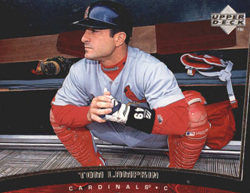
When the Cardinals got Tom Lampkin, it was not with the expectation he would be their Opening Day catcher in each of the next two seasons.

On Dec. 19, 1996, the Cardinals acquired Lampkin from the Giants for a player to be named. Two months later, the Giants chose pitcher Rene Arocha from a list of four players offered by the Cardinals, completing the deal.

Lampkin was projected to be a backup, but when starter Tom Pagnozzi got injured in 1997 and 1998, Lampkin was in the Cardinals’ Opening Day lineup both years.

Supporting role

After graduating from the University of Portland with a degree in marketing and management, Lampkin reached the major leagues in September 1988 with the Cleveland Indians. The next year, he was traded to the Padres.

In 1991, Lampkin began a season on a major-league roster for the first time, serving as backup to Padres catcher Benito Santiago. The Padres traded Lampkin to the Brewers in 1993. The Giants signed him after the season when he became a free agent.

Lampkin spent a full season in the majors for the first time in 1995 when he was backup to Kirt Manwaring. After the Giants traded Manwaring to the Astros in July 1996, Lampkin became the starter.

“He’s done a good job with the young (pitchers), especially Shawn Estes and William VanLandingham,” Giants manager Dusty Baker told the San Francisco Examiner.

Lampkin nailed 17 of 33 runners attempting to steal (51.5 percent, best in the National League) in 1996 and didn’t allow a passed ball, but he became expendable when the Giants deemed Rick Wilkins and Marcus Jensen to be their catchers in 1997.

Good fit

The Cardinals had a three-time Gold Glove Award winner, Tom Pagnozzi, as their catcher, with Danny Sheaffer as the backup, but both were right-handed batters. Lampkin appealed to the Cardinals because he batted from the left side.

“This creates a little competition,” Cardinals general manager Walt Jocketty told the St. Louis Post-Dispatch after he acquired Lampkin.

Manager Tony La Russa said Lampkin “comes with really good endorsements from pitchers whom he’s caught and managers he’s played for. He’s a good thrower, has good hands and he’s a left-handed hitter who’s a dangerous out. I think this really adds balance to our catching corps.”

With the Giants in 1996, Lampkin had batted .264 versus right-handers and had one of his best games in May when he produced three hits and a walk and scored four times against the Cardinals. Boxscore

After joining St. Louis, Lampkin told the Post-Dispatch, “I don’t intend to be named the starting catcher, but I’m not going to lay down … I know La Russa. He’s the kind of manager who likes to keep all his players ready. Hopefully I’ll get to see some playing time.”

Stepping in

Lampkin’s value increased late in spring training of 1997 when Pagnozzi, 34, went on the disabled list because of a strained calf muscle.

The Cardinals began the regular season with Lampkin, 33, and Sheaffer, 35, as the catchers. Lampkin was the Opening Day starter against the Expos at Montreal Boxscore and in the Cardinals’ home opener. Boxscore

Pagnozzi missed the first 19 games of the season, returned and soon suffered a torn hip flexor, sidelining him until August.

The Cardinals called up Mike Difelice, 27, from Class AA and demoted Sheaffer. A defensive specialist, Difelice platooned with Lampkin.

Lampkin hit seven home runs, including a game-winner versus LaTroy Hawkins of the Twins on July 1. Boxscore

He batted .245 in 108 games for the 1997 Cardinals, but a mere .209 with runners in scoring position. He also disappointed as a pinch-hitter (.171).

Lampkin wasn’t as good on defense for the 1997 Cardinals as he was the year before with the Giants. He threw out 22 of 77 runners attempting to steal against him (29 percent) and was charged with six passed balls.

The Cardinals had five catchers make starts for them in 1997: Difelice (81), Lampkin (56), Eli Marrero (13), Pagnozzi (11) and Sheaffer (one). A right-handed batter, Marrero hit .273 with 20 home runs in the minors in 1997 and was considered the heir apparent to Pagnozzi

Helping hand

After the 1997 season, Difelice was selected by the Tampa Bay Rays in the expansion draft, leaving the Cardinals with a catching corps of Pagnozzi, Lampkin and Marrero.

What seemed a team strength turned into a weakness during 1998 spring training. Marrero, 24, had a cancerous thyroid gland removed in March. Pagnozzi became sidelined because of a shoulder problem.

When the Cardinals opened the 1998 regular season, Lampkin was their starting catcher. Boxscore  “I prepared myself every spring to play every day,” Lampkin told the Post-Dispatch. “Now it’s paid off because it’s actually happening.”

Lampkin eventually split time with Marrero and Pagnozzi when they got healthy enough to return.

Noting Lampkin’s intensity, La Russa said, “He’s too gung-ho, too Marine-like to play every day. He’s a good player and there’s no question he’d do anything to try to win for this team.”

Lampkin hit .231 in 93 games for the 1998 Cardinals. He hit .246 with runners in scoring position and .304 as a pinch-hitter.

Lampkin also caught 13 of 43 runners attempting to steal against him (30 percent) and allowed four passed balls.

Marrero made 67 starts at catcher for the 1998 Cardinals. Lampkin had 54 starts and Pagnozzi made the rest.

Lampkin became a free agent after the 1998 season and was considered “most likely to return” to the Cardinals, the Post-Dispatch reported, but he opted to sign with the Mariners.

He spent three seasons with the Mariners as backup to Dan Wilson before finishing his playing career as the primary catcher for the 2002 Padres.

In his last eight seasons (1995-2002), Lampkin played for four managers who were among the game’s most successful: Dusty Baker, Tony La Russa, Lou Piniella and Bruce Bochy.

Read Full Post »

In building a bullpen for the 1982 season, the Cardinals took a look at a pitcher described as the Cy Young of Mexico.

On Dec. 9, 1981, the Cardinals signed Vicente Romo and invited him to their major-league spring training camp.
Romo hadn’t pitched in the big leagues since 1974 and was nearly 39 years old, but he was a consistent winner in the Mexican League and the Cardinals considered him a talent worth exploring.

Reaching the top

Romo was born in Santa Rosalia, a port city on Mexico’s Baja peninsula. The family moved to the fishing hub of Guaymas, on the other side of the Gulf of California in the state of Sonoma, when Romo was a youth.

Romo was 19 when he became a professional ballplayer in the Mexican League in 1962. The Cleveland Indians purchased his contract in October 1964 and he was sent into their farm system.

In 1967, Romo almost made the Indians’ Opening Day roster, but was sent back to the minors at the 11th hour. The Dodgers selected him in the November 1967 Rule 5 draft.

A right-hander, Romo began the 1968 season with the Dodgers and pitched in one game for them. When the Dodgers called up Don Sutton from the minors in April, they tried to assign Romo to a farm club, but the Indians reclaimed him.

Indians pitching coach Jack Sanford became Romo’s tutor and helped him develop into a reliable reliever. Mixing a sidearm fastball with an assortments of curves, Romo was 5-3 with 12 saves and a 1.62 ERA for the 1968 Indians.

In April 1969, the Indians traded Romo to the Red Sox. He was 6-0 with six saves and a 2.43 ERA for them as a reliever in 1970; 1-3 with a 6.10 ERA in 10 starts.

On May 30, 1970, at Boston’s Fenway Park, Romo pitched four scoreless innings of relief against the White Sox and hit a game-winning home run over the 37-foot wall in left. Boxscore

Romo also pitched for the White Sox (1971-72) and Padres (1973-74) before going back to the Mexican League.

Better with age

In Mexico, Romo thrived as a starting pitcher. According to the Society for American Baseball Research, “He is viewed as his nation’s Cy Young.” For seven consecutive seasons (1975-81), he never had an ERA higher than 2.63. In 1981, he was 16-6 with a 1.40 ERA for Coatzacoalcos.

The Cardinals were seeking depth for a bullpen projected to include Bruce Sutter, Doug Bair, Jim Kaat and Mark Littell in 1982. Scouting reports on Romo indicated he could help.

At spring training camp in St. Petersburg, Fla., in 1982, Kaat was 43 and Romo was a month away from turning 39, though speculation was he might be older. Fourteen years earlier, in 1968, they first pitched against one another when Kaat was with the Twins and Romo was with the Indians. Boxscore

Romo made a strong bid to make the Cardinals’ Opening Day roster, posting a 1.80 ERA in 15 innings in spring training games. “I thought I pitched very well,” he told the St. Louis Post-Dispatch.

The final bullpen spot on the roster apparently came down to a choice between Kaat and Romo. The Cardinals kept Kaat, a much-needed left-hander, but as the Post-Dispatch noted, “The way the gag goes, they decided to keep 43-year-old Kaat over 39-year-old Romo because Kaat was younger.”

Back where he began

The Cardinals wanted Romo to go to their Class AAA Louisville farm club, but he opted to return to the Mexican League.

Pitching for Coatzacoalcos, Romo was 7-0 with a 1.54 ERA in eight starts when the Dodgers purchased his contract on May 24, 1982.

The Dodgers’ move surprised Cardinals manager Whitey Herzog, who indicated he’d hoped Romo could come back to the Cardinals. “Herzog said his scout in Mexico, Willie Calvino, had not kept him apprised that Romo was doing so well,” the Post-Dispatch reported.

Pitching in the big leagues for the first time in eight years, Romo thrived as a Dodgers reliever. On June 18, he got a save against the Reds. Boxscore It was his first big-league save since July 9, 1974.

After posting a 1.29 ERA in nine relief appearances, Romo was moved into the Dodgers’ starting rotation. On July 19, he pitched seven scoreless innings versus the Expos and got the win, his first in the majors as a starter since April 1970. Boxscore

“He used all his pitches, and that means about seven or eight of them,” said Dodgers catcher Mike Scioscia. 

Expos manager Jim Fanning said, “He fooled us all night.”

In late July, Romo injured his left knee and was done for the season. His record for the 1982 Dodgers: 1-2 with a 3.03 ERA.

Romo returned to the Mexican League in 1983. He went to spring training with the California Angels in 1984, but was included in the first roster cut and spent the season, his last, in the Mexican League.

In eight years in the majors, Romo was 32-33 with 52 saves and a 3.36 ERA. In nine games versus the Cardinals, he was 0-1 with three saves and a 2.45 ERA.

A younger brother, Enrique Romo, pitched six years in the majors, including 1979, when he was 10-5 with five saves for the World Series champion Pirates. Against the Cardinals in his career, Enrique Romo was 6-1 with three saves.

Read Full Post »

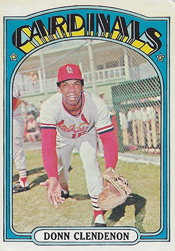
Donn Clendenon made magic with the Mets, but the wizardry waned when he joined the Cardinals.

In December 1971, Clendenon connected with the Cardinals. Released by the Mets, the slugging first baseman worked out a deal to play for St. Louis.

The Cardinals had two left-handed batters, Matty Alou and Joe Hague, at first base. Clendenon, an experienced run producer, figured to provide power from the right side.

Making his mark

In 1935, a pregnant Helen Clendenon was expecting a daughter and planned to name her Donna, Bob Broeg of the St. Louis Post-Dispatch reported. When instead she gave birth to a boy, she added a second “n” to his name, Donn.

Donn Clendenon was born in Neosho, Mo., about 25 miles from Joplin. His father, Claude, a professor of mathematics and psychology at Langston University in Oklahoma, had moved back to his hometown of Neosho when diagnosed with leukemia.

Claude Clendenon died about six months after Donn’s birth, and Helen moved from Neosho to her hometown, Atlanta.

Donn Clendenon developed into a top athlete in multiple sports. He enrolled at Morehouse College and excelled in football and basketball. The NFL Cleveland Browns and basketball’s Harlem Globetrotters and New York Knicks wanted him, but his stepfather, Nish Williams, a former Negro League baseball player, encouraged Donn to attend a Pittsburgh Pirates tryout camp.

The Pirates signed Clendenon and he reached the big leagues with them in September 1961.

Big swinger

A rangy 6 feet 4, Clendenon was a significant contributor to a lineup that included future Hall of Famers Roberto Clemente, Willie Stargell and Bill Mazeroski.

In 1965, Clendenon hit .301 with 32 doubles, 14 triples, 14 home runs and 96 RBI. On June 15, he belted two home runs in a game against the Cardinals, one each versus Tracy Stallard and Barney Schultz. Boxscore The next day, he hit another home run against the Cardinals’ Bob Purkey. Boxscore

Clendenon batted .299 with 28 home runs and 98 RBI for the 1966 Pirates.

He also twice led the National League in most times striking out: 136 in 1963 and 163 in 1968.

Dick Young of the New York Daily News wrote, “Against a left-handed pitcher, Donn Clendenon has a good home run swing. Against a right-handed pitcher, he has a good strikeout swing.”

After the 1968 season, the Expos chose Clendenon in the National League expansion draft, then traded him and Jesus Alou to the Astros for Rusty Staub.

When Clendenon told the Astros he was retiring, baseball commissioner Bowie Kuhn interceded. He got the Expos to send two pitchers, Jack Billingham and Skip Guinn, plus cash, to the Astros as compensation for the loss of Clendenon. Then the Expos enticed Clendenon to stay by giving him a two-year contract, unusual for the time, with a hefty raise.

Amazing season

In need of right-handed power, the Mets had been pursuing Clendenon for a while. When they offered the Expos a package of prospects, including pitcher Steve Renko, a deal was done in June 1969.

Clendenon developed a knack for getting important hits for the Mets. Two of the most prominent were a pair of home runs against the Cardinals on Sept. 24 when the Mets clinched their first division title. Clendenon hit a three-run home run against Steve Carlton in the first inning, sending the Shea Stadium crowd into a frenzy, and followed with a solo shot versus Dave Giusti in the fifth. Boxscore

“I never hit a bigger home run than the one I got in the first inning tonight,” Clendenon told the Post-Dispatch. “I was keyed up for the game.”

A month later, Clendenon was named Most Valuable Player of the World Series when he hit .357 and slugged three home runs against the Orioles. Video

In 1970, Clendenon set a Mets single-season record for RBI (97). He achieved the total in fewer than 400 at-bats. 

Platooned at first base with Ed Kranepool in 1971, Clendenon went into a funk, finishing the season with 37 RBI. Manager Gil Hodges said “one of the reasons he stopped playing Clendenon was that pitchers were throwing fastballs right by him,” The Sporting News reported.

In October 1971, the Mets released Clendenon. “He more or less asked for it,” The Sporting News reported.

The Mets suggested to Clendenon he could make a lot of money playing in Japan, but he wanted to stay in the big leagues.

High hopes

In December 1971, Cardinals general manager Bing Devine told the Post-Dispatch he got a call from Clendenon, 36, who said he could help the club. “We then indicated that we were interested in him,” Devine said.

The signing was announced Jan. 6, 1972. Clendenon “was acquired primarily to lend some balance to an offense that is much too lefthanded-hitting,” The Sporting News noted.

Clendenon hit .292 against left-handers in his big-league career.

In a spring training game at St. Petersburg, Fla., in March 1972, Clendenon hit two home runs for the Cardinals against Mets left-hander Jon Matlack. Clendenon told the Post-Dispatch, “It’s nice to hit against a club that releases you _ even when the game doesn’t count. I think I can hit, and also hit home runs, if I play more than I did in New York.”

According to columnist Dick Young, Clendenon switched from using a 38-ounce bat to a 35-ounce model.

Running on empty

Clendenon made the Cardinals’ 1972 Opening Day roster as a role player, but he went hitless in his first 18 at-bats.

A highlight came on June 8 at Candlestick Park in San Francisco when Clendenon hit a game-winning home run against Don McMahon, the Giants’ 42-year-old reliever who also served as their pitching coach. Boxscore

“That’s the swing Clendenon has been trying for all season,” teammate Lou Brock told the Post-Dispatch.

On July 11, Brock got five hits, using Clendenon’s bat, in a game versus the Braves. Boxscore

The bat worked better for Brock than it did for his teammate. Clendenon hit .191 with four home runs for Cardinals.

In August, with the Cardinals out of contention and preparing to call up prospects from the minors, Devine informed Clendenon he wouldn’t play much. According to the Post-Dispatch, Devine “offered him the option of staying with the club or obtaining his release.”

Clendenon chose to be released, ending his playing career.

“I am disappointed I was unable to perform as expected and I realize the present conditions would further limit my playing time,” Clendenon said.

In 1978, Clendenon earned a law degree from Duquesne University and practiced criminal law.

Read Full Post »

Johnny Bench could have ended his playing career as a member of the Cardinals, but turned down the chance.

In June 1983, the Cardinals contacted the Reds with a trade offer for Bench. According to the Cincinnati Enquirer, the Cardinals were willing to send first baseman Keith Hernandez to the Reds for Bench and starting pitcher Frank Pastore.

Cardinals manager Whitey Herzog envisioned playing Bench at first base and third base against left-handed pitching. “We inquired about Bench,” Herzog confirmed to the St. Louis Post-Dispatch.

Good try

Bench, 35, was the Opening Day third baseman for the Reds in 1983 and Alex Trevino was the catcher. Bench was destined for election to the Baseball Hall of Fame as a catcher, but hadn’t played the position regularly since 1980. Bench was a Reds first baseman in 1981 and their third baseman in 1982.

On June 10, 1983, Bench said he would retire from playing after the season. When Bench informed Reds management of his decision, “he was asked if he would consider going to another club,” the Dayton Daily News reported.

According to the Cincinnati Enquirer, “They offered him the chance to continue his career with the St. Louis Cardinals.”

Reds general manager Dick Wagner explained to Bench that the Cardinals had called with the trade offer. The Cardinals were the defending World Series champions and were contending again in 1983, leading the East Division on June 10. The Reds were in last place in the West.

Joining the Cardinals would enable Bench to be involved in a pennant chase in his final season, but he “politely declined,” the Cincinnati Enquirer reported.

“I wouldn’t sacrifice my association with Cincinnati to go to St. Louis for two or three months,” said Bench, who played his entire career with the Reds.

Later that season, when Bench and Herzog exchanged lineup cards before a game, Herzog said Bench asked, “Just where did you plan to use me if you got me?” Herzog replied, “We’d been vulnerable to left-handed pitching. I’d have used you against them.”

Bench strength

Herzog was looking to trade Keith Hernandez because the relationship between the two had deteriorated. Herzog said Hernandez was loafing during games.

Bench appealed to Herzog because of his ability to play multiple positions and he could hit. A right-handed batter with power, Bench hit .282 in April and .298 in May for the 1983 Reds.

“He has given me everything he has,” Reds manager Russ Nixon told The Sporting News. “He’s one veteran who has run out every ground ball.”

If the Cardinals had obtained Bench, Herzog could play him at first base against left-handers, and shift Dane Iorg or Andy Van Slyke from the outfield to first base versus right-handers. Bench also could play third base against left-handers, substituting for Ken Oberkfell, a left-handed batter. in 1983, Bench batted .284 versus left-handers.

The Cardinals wanted Frank Pastore in the deal to add to a starting rotation with Joaquin Andujar, Bob Forsch, John Stuper and Dave LaPoint. “We’ve been talking about him since spring training,” Herzog told the Post-Dispatch.

Pastore was 5-0 versus the Cardinals in his career.

Keith Hernandez would have provided a significant upgrade to the Reds in the field and at the plate. Dan Driessen (.277) ended up leading the 1983 Reds in batting and Ron Oester had the most RBI (58).

When Bench turned down the Cardinals, they traded Hernandez to the Mets for pitchers Neil Allen and Rick Ownbey. Herzog moved George Hendrick from right field to first base for the remainder of the season.

Delivering drama

Three months after the trade talk, the Reds were in St. Louis for the final time that season. Before the series finale on Sept. 4, Cardinals players presented Bench with a gold-plated golf putter as a retirement gift. Cardinals management gave him a plaque featuring an illustration by Post-Dispatch artist Amadee.

In the eighth inning, the Cardinals led, 4-1, when the Reds got two runners on base with one out against Joaquin Andujar. Bruce Sutter relieved and fanned Gary Redus for the second out. Rookie right fielder Dallas Williams was up next, but Bench was sent to bat for him.

Bench swung at Sutter’s first pitch, a split-fingered fastball, and pulled it into foul territory along the line in left.

As left fielder Lonnie Smith gave a futile chase, Cardinals catcher Glenn Brummer yelled, “Catch the ball, catch the ball,” Bench said to the Cincinnati Enquirer.

“(Brummer) told me, ‘You’ll hit that pitch out if you get it again,’ ” Bench recalled.

Sutter’s next delivery was another split-fingered pitch and Bench slammed it over the wall in left for a three-run home run, tying the score at 4-4.

“When I crossed the plate,” Bench said, “I told (Brummer), ‘You were right.’ “

The Cardinals came back with a run in the ninth and won, 5-4, but the story of the game was Bench’s home run in his final Busch Memorial Stadium plate appearance.  Boxscore

The home run was the 388th of his career. It was Bench’s only hit versus the Cardinals in 10 at-bats against them that year. For his career, Bench hit .247 versus the Cardinals with 24 home runs and 85 RBI. Those were the fewest home run and RBI totals he had versus any team.

On Sept. 17, when the Reds held Johnny Bench Night at Riverfront Stadium, Bench started at catcher in a game for the final time. In the third inning, he hit his last home run, a two-run shot against the Astros’ Mike Madden. Boxscore and Video

Read Full Post »

« Newer Posts - Older Posts »