Feeds:
Posts
Comments

Archive for the ‘Games’ Category

(Updated Sept. 12, 2021)

Three future Hall of Famers converged on center stage for a climactic scene in a Cardinals classic. On the mound, Bob Gibson. Behind the plate, Ted Simmons. In the batter’s box, Willie Stargell.

On Aug. 14, 1971, Gibson got his lone no-hitter when he struck out Stargell for the last out.

Finishing a no-hitter is a formidable task under any circumstance, but for Gibson the degree of difficulty was heightened. Stargell was leading the majors in home runs and RBI.

Simmons, in his first full season as Cardinals catcher, had an intriguing role in the drama. He earned respect with his bat, but took pride in his catching, too. Being involved in a Gibson no-hitter would help secure Simmons’ reputation.

Pride still matters

Gibson earned his second National League Cy Young Award in 1970. At 35, he looked as dominant as ever at the start of the 1971 season, winning three of his first four decisions. The only loss in that stretch was in extra innings to the Cubs’ Ferguson Jenkins.

Trouble soon followed. In his last April start, Gibson got shelled in a loss to the Mets’ Tom Seaver. In May, Gibson was 1-3 with a 5.21 ERA. He tore a thigh muscle late in the month and didn’t pitch from May 30 through June 20. When he returned, he lost two June starts, dropping his record to 4-7 with a 4.31 ERA.

Losing none of his intensity and focus, Gibson told The Sporting News, “I get paid for winning,” and he set his sights on earning the money.

Gibson was 5-2, including consecutive shutouts of the Phillies and Mets, with a 1.95 ERA in seven starts in July.

“Pride keeps him going,” teammate Joe Torre told The Sporting News. “He’s the greatest competitor I ever saw.”

On Aug. 4, with Simmons catching, Gibson struck out nine, including Willie Mays twice, and beat Gaylord Perry and the Giants for his 200th career victory. Boxscore

Overpowering stuff

Ten days later, Gibson was the starter against the Pirates on a Saturday night at Three Rivers Stadium in Pittsburgh.

The Cardinals knocked out Pirates starter Bob Johnson in the first inning and also pounded relievers Bob Moose and Bob Veale. Gibson contributed three RBI. Simmons had four hits, a RBI and scored three times. Torre also had four hits and a RBI, and scored twice.

On the mound, Gibson was in command.

“This was the first time in my life I ever was overpowered by anyone,” Pirates center fielder Al Oliver said to the St. Louis Post-Dispatch. “I never was able to get my bat around in time.”

Pirates second baseman and future Hall of Famer Bill Mazeroski told the Associated Press, “Gibson was throwing them right where he wanted. He hit the outside corner every time. I broke two of my bats.”

Simmons told the Baseball Hall of Fame yearbook in 2021, “I can remember specifically thinking in the fourth inning that I was watching something that was pretty special … The slider was just so wicked. Complete and total command of a fastball that he could ride and sink, four-seam and two-seam.”

When the Cardinals scored three runs in the eighth to take an 11-0 lead, the outcome wasn’t in doubt. The focus was on whether the Pirates would get a hit. Gibson never had pitched a no-hitter at any level, amateur or professional.

“In the last two innings, I was bearing down extra hard,” Gibson told The Sporting News. “I was trying not to make any bad pitches. Even when I was falling behind in the count, I was being careful not to groove any pitches. I was throwing sliders and curves on 3-and-2 counts.”

Despite his best efforts, Gibson made a mistake to Dave Cash. With two outs in the eighth, Gibson said he hung a slider. Cash hit a high bouncer to third. For a moment, Joe Torre couldn’t see it in the lights.

“It scared the heck out of me, man,” Torre told the Baseball Hall of Fame yearbook in 2021. “I’m thinking, ‘I’m going to whiff this thing,’ but it didn’t happen. I was able to make the play.”

Stretching on tiptoes, he snared the ball and fired a throw to first to nip Cash.

Friend or foe?

“By the ninth inning, I was so nervous my knees were actually knocking,” Gibson said in his book “Stranger to the Game.”

The first batter was Vic Davalillo, a former Cardinal who started in right field instead of Roberto Clemente. Gibson got him to ground out to shortstop Dal Maxvill.

Al Oliver followed and grounded out to second baseman Ted Kubiak.

Willie Stargell was all that stood between Gibson and a no-hitter _ and he stood like a giant from the left side of the plate.

“His weight shifting rhythmically from one foot to the other, his bat moving in circles like an airplane propeller, Stargell creates a feeling of menace as he waits for the pitch,” Newspaper Enterprise Association reported.

At that point in the season, Stargell had 39 home runs and 101 RBI. No one else in the majors had more.

Stargell also had hit four home runs in his career versus Gibson then.

(The final career numbers for Stargell against Gibson: .290 batting average, .388 on-base percentage, five home runs, 20 walks and 41 strikeouts. According to baseball-reference.com, Stargell struck out more times versus Gibson than he did against any other pitcher. Gibson and Phil Niekro were the only pitchers to issue as many as 20 walks to Stargell.)

In “Stranger to the Game,” Gibson said, “Aside from former teammates, the only opposing player I ever really made friends with was Willie Stargell. I don’t have a good excuse for this, except that Stargell’s personality left me no choice. I was just fortunate he didn’t spread around the league that I was a nice guy or something. I couldn’t have that.”

Caught looking

Increasing the tension with every pitch, Gibson got ahead in the count, 1-and-2, on Stargell. On the next one, “I was looking for a fastball,” Stargell told The Sporting News.

Instead, with his 124th pitch of the game, Gibson threw a slider.

Stargell watched it go into Simmons’ mitt and heard umpire Harry Wendelstedt call, “Strike three!”

“That last pitch to Stargell really exploded,” Cardinals manager Red Schoendienst said to The Sporting News.

Stargell said the slider “cut over the plate at the last instant.” Boxscore and Video

“You can tell all those people who have been saying that Gibson was washed up that they should have been at the plate with a bat in their hands,” Stargell said.

Jack Buck, calling the ninth inning on the KMOX radio broadcast, said after the completion of the no-hitter, “If you were here, it would have made you cry.” Audio broadcast of Jack Buck and Jim Woods

Gibson’s no-hitter was the first in a big-league game in Pittsburgh since 1907 when rookie Nick Maddox of the Pirates did it against the Dodgers at Exposition Park. No big-leaguer pitched a no-hitter at Forbes Field, the Pirates’ home from 1909-69.

Gibson finished the season with a 16-13 record, 3.04 ERA, 20 complete games and five shutouts, his most since his most dominant season in 1968.

Read Full Post »

(Updated July 31, 2025)

Whitey Herzog had Jose Oquendo as his secret weapon when he managed the Cardinals. Tony La Russa had his own version, Miguel Cairo.

On Aug. 10, 2001, Cairo signed with the Cardinals after he was placed on waivers by the Cubs.

Intelligent and versatile, Cairo played multiple positions and helped the Cardinals reach the playoffs. He was similar to Oquendo, who got nicknamed “Secret Weapon” because of the many ways he helped Herzog’s teams in the late 1980s.

In commenting about Cairo’s attributes, La Russa told the St. Louis Post-Dispatch, “Oquendo is a very good comparison.”

Making the rounds

Born and raised in Venezuela, Cairo was 16 when he signed with the Dodgers. A right-handed batter, he played in the farm systems of the Dodgers and Mariners before making his debut in the majors with the Blue Jays when he was 21.

In November 1996, the Blue Jays dealt Cairo to the Cubs. His first multi-hit game in the majors came against the Cardinals. Boxscore

The Devil Rays chose Cairo in the November 1997 expansion draft and he was the starting second baseman in the franchise’s first regular-season game. Boxscore

“Defensively, he’s as good as I’ve seen,” Devil Rays third baseman and future Hall of Famer Wade Boggs told The Sporting News.

Possessing smooth hands, speed and athleticism, Cairo was the Devil Rays’ second baseman in their first three seasons. He said it was a thrill when he and a fellow Venezuelan, shortstop Ozzie Guillen, formed the Devil Rays’ keystone combination in 2000.

Released in November 2000, Cairo signed with the Athletics, who dealt him to the Cubs in March 2001.

Smart pickup

Cairo opened the 2001 season in the minors but was called up to the Cubs in May. He helped fill in for injured third baseman Bill Mueller and also backed up Eric Young at second base.

Cairo hit .285 in 66 games for the 2001 Cubs, but was placed on waivers when Mueller was close to returning from the disabled list.

When the Cardinals claimed him, they were in third place in their division, trailing the front-running Cubs by seven games.

The Cardinals envisioned Cairo, 27, as a player who could provide infield depth and a right-handed bat off the bench.

“I’m a utility player for the Cardinals,” Cairo told the Post-Dispatch. “I know my role. I’m ready.”

While the Cubs nosedived, with records of 13-16 in August and 10-12 in September, and dropped from contention, the Cardinals got hot. They were 20-10 in August and 17-5 in September, finishing in a tie for first with the Astros and qualifying for the playoffs.

Pitcher Woody Williams, acquired in August from the Padres for Ray Lankford, was a major factor in the Cardinals’ surge, posting a 7-1 record in 11 starts, but Williams also credited the performance of Cairo.

“To tell you the truth, when I got here, it didn’t seem like anybody was heading in the right direction,” Williams told the Post-Dispatch. “I was shocked. It changed when Miguel got here. He’s been the lucky horseshoe.”

Cairo hit a three-run, game-winning home run against the Phillies on Aug. 18. It was his first career home run as a pinch-hitter. Boxscore

A month later, Cairo had three doubles in a win versus the Pirates, even though he didn’t enter the game until the fifth inning. Boxscore

Cairo hit .333 for the 2001 Cardinals, including .429 in September. He hit .368 as a pinch-hitter. His overall batting average against left-handers was .538.

The 2001 Cardinals used Cairo at five positions: left field and all four infield spots.

“We could tell from watching him with the Cubs that he knew the game,” La Russa said to the Chicago Tribune. “Since we’ve gotten him, we’ve been even more impressed. He has a nice stroke, can hit all over the park and knows when to be aggressive or take a pitch.”

La Russa told the Post-Dispatch, “What you don’t know until you are around him is that he’s really an intelligent player.”

Mutual respect

Cairo made valuable contributions to the Cardinals again in 2002. He hit .322 as a pinch-hitter and was second in the National League in pinch-hits (19).

He played seven positions for the 2002 Cardinals: left field, right field, designated hitter and all four infield spots.

In the postseason, Cairo hit .529. He entered Game 2 of the National League Division Series versus the Diamondbacks after third baseman Scott Rolen was injured and drove in the winning run in the ninth inning. Boxscore and Video at 3:06.41 mark

In Game 3, Cairo was 3-for-3 with two RBI and reached base four times. Boxscore

Cairo hit .385 in the National League Championship Series against the Giants and had a home run versus Kirk Rueter in Game 1. Boxscore

La Russa, a former utility infielder before turning to coaching and managing, became a role model for Cairo.

“Miguel will be an outstanding coach like Jose Oquendo is,” La Russa predicted to the Post-Dispatch. “You watch how active he is during the game. He’s conversing with guys. He’s seeing things and making comments. He’s really helpful.”

Cairo said, “I like to learn about the game. When I’m not playing, I like to see what happens in certain situations. I like to see how Tony handles it. I watch him a lot when he manages.”

After hitting .245 for the 2003 Cardinals, Cairo became a free agent and signed with the Yankees. Released in August 2007, he rejoined the Cardinals and hit .444 for them as a pinch-hitter.

Cairo also played for the Mariners (2008), Phillies (2009) and Reds (2010-12). He produced 1,044 hits in 17 seasons in the majors.

After the 2012 season, Cairo became a special assistant to Reds general manager Walt Jocketty. It was Jocketty who brought Cairo to the Cardinals in 2001.

In 2021, when La Russa returned to managing with the White Sox, he chose Cairo to be the team’s bench coach.

Cairo became White Sox manager at the end of August 2022 when La Russa took a leave of absence. The White Sox were 18-15 with Cairo as manager.

In July 2025, Cairo replaced Dave Martinez as manager of the Nationals.

Read Full Post »

In his 20th season in the big leagues, pitcher Arthur Rhodes fulfilled his goal of playing in a World Series, but not with the team he expected.

On Aug. 11, 2011, the Cardinals signed Rhodes after he was released by the Rangers. Two months later, the Cardinals beat the Rangers in an epic seven-game World Series.
Rhodes, who turned 42 during the World Series, contributed significantly to the Cardinals’ effort. A left-handed reliever, he pitched in eight postseason games for the 2011 Cardinals and didn’t allow a run. Three of his appearances came in the World Series, including the decisive Game 7.

Career builder

A high school pitcher selected by the Orioles in the second round of the 1988 draft, Rhodes was 21 when he made his debut in the majors with them in 1991.

Converted from starter to reliever in 1995, Rhodes was 9-1 for the Orioles in 1996 and 10-3 in 1997.

He became a friend of teammate Cal Ripken, who set the major-league record for consecutive games played despite engaging in a risky ritual.

“We wrestled every day before the game, rolling around the floor. Every day,” Rhodes told Cincinnati Enquirer columnist Paul Daugherty. “He was in such good shape, he never worried about getting hurt.”

After the 1999 season, Rhodes became a free agent. He pitched for the Mariners, Athletics, Indians and Phillies before sitting out the 2007 season because of reconstructive surgery on his left elbow.

Heart-wrenching loss

In 2008, Rhodes returned to the Mariners and finished the season with the Marlins. He became a free agent after the season and received interest from multiple teams, including the Cardinals.

“For years, we wanted Arthur on our ballclub and it never worked,” Cardinals manager Tony La Russa told the St. Louis Post-Dispatch.

Rhodes signed with the Reds on Dec. 12, 2008. Four days before Christmas, he was devastated when his 5-year-old son, Jordan, died from an illness.

Afterward, whenever Rhodes came into a game to pitch, he etched his son’s initials, J.R., behind the pitching rubber. As Mike Lopresti of Gannett News Service wrote, “When he takes the mound, the first act comes not from his arm but his heart.”

Rhodes also had a tattoo of angel wings put on his right calf in memory of his son. “He loved to wake up in the morning,” Rhodes told the Cincinnati Enquirer. “He loved going outside. He loved just playing. Whatever I loved doing, he loved doing, too.”

Despite his heartache, Rhodes produced two terrific seasons for the Reds. He had a 2.53 ERA in 66 appearances in 2009 and a 2.29 ERA in 69 games in 2010. Rhodes had 33 consecutive scoreless appearances for the 2010 Reds and was selected an all-star for the only time in his career. In seven games against the Cardinals in 2010, Rhodes yielded no runs in 6.1 total innings.

Match game

A free agent after the 2010 season, Rhodes, 41, wanted to sign with a team that would give him his best chance at reaching the World Series for the first time. He chose the Rangers, the 2010 American League champions.

The Rangers were as good as Rhodes hoped they’d be, but at the end of July they made a pair of trades for relievers, getting Koji Uehara from the Orioles and Mike Adams from the Padres.

Though left-handed batters hit .216 against him as a Ranger. Rhodes (3-3, 4.81 ERA) was deemed expendable. The Rangers released him on Aug. 8.

The Phillies, who had the best record in the National League, made an offer. Rhodes said he was tempted until the Phillies told him they wanted him to first go to their farm team in Clearwater, Fla., and get some work in.

“I had enough work for four months,” Rhodes told the Philadelphia Daily News. “Why should I go down to Clearwater and wait? If I don’t get called up, I’d be at home.”

The Red Sox, who had the best record in the American League, also called, but Rhodes liked best what he heard from the Cardinals. He said when they called, they said, “We want you.”

The Cardinals were in second place in their division and were not assured of reaching the playoffs, let alone the World Series, but Rhodes said he was sold on playing for La Russa.

Dream come true

Rhodes gave the Cardinals a second left-handed reliever, joining Marc Rzepczynski.

Rhodes made 19 regular-season appearances for the Cardinals and was unscored on in 15 of those. Overall, he was 0-1 with a 4.15 ERA.

The Cardinals finished fourth in the National League, but got into the playoffs as a wild-card entry. Rhodes played a valuable role for them in each step toward the championship.

In the National League Division Series against the Phillies, he made three appearances, totaling an inning, and allowed no runs or hits.

Rhodes got into two games in the National League Championship Series versus the Brewers, totaled two-thirds of an inning and allowed no runs or hits, helping the Cardinals win the pennant.

Regarding Rhodes reaching the World Series in his 20th season, La Russa told the Philadelphia Daily News, “That’s a lot of dues. So very special. Special as it gets.”

The pattern was the same in the World Series. In three appearances totaling an inning, Rhodes gave up no runs or hits. Video

“Not only is he an effective pitcher, but he’s got a dynamic presence,” La Russa said to the Post-Dispatch.

The World Series championship was a fitting way for Rhodes to end his pitching career.

He became the third big-leaguer to play for both World Series participants in the same season, joining Lonnie Smith (1985 Cardinals and Royals) and Bengie Molina (2010 Giants and Rangers).

Rhodes finished with a career record of 87-70 and 33 saves in the big leagues. He was better as a reliever (69-48, 3.43) than as a starter (18-22, 5.81). He limited left-handed batters to a .217 batting average.

Read Full Post »

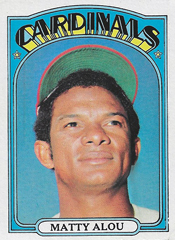
Matty Alou had the perfect audience to appreciate a daring dash around the bases.

On Aug. 7, 1971, Alou used skill, imagination and nerve to produce the winning run for the Cardinals in a victory versus the Dodgers at St. Louis.

With the score tied at 2-2, Alou batted with one out and none on in the 10th inning. He reached base on a bunt single, then made a fearless sprint from first to home while the Dodgers botched every attempt to catch him.

Alou’s aggressive baserunning was reminiscent of Enos Slaughter, who scored the winning run for the Cardinals on a mad scramble from first to home in Game 7 of the 1946 World Series.

Twenty-five years later, Slaughter and several of his contemporaries were in St. Louis for a reunion of the 1946 World Series teams and were at the ballpark to witness Alou’s performance.

Making it happen

After sweeping the Giants, the Cardinals (62-50) were seven games behind the division-leading Pirates (69-43) as they entered a three-game series with the Dodgers at Busch Memorial Stadium.

The opening game, played on a Saturday night, featured left-handed starting pitchers Claude Osteen of the Dodgers and Steve Carlton of the Cardinals. The Dodgers went ahead, 2-0, with a pair of runs in the sixth, but the Cardinals tied the score in the seventh on a RBI apiece by Jim Beauchamp and Jerry McNertney.

When the game moved to the bottom of the 10th, Pete Mikkelsen, a former Cardinal, came in to pitch. He struck out the first batter, Julian Javier, before Alou, batting .325, stepped to the plate.

Batting left-handed, Alou executed a drag bunt between first base and the mound. Another former Cardinal, first baseman Dick Allen, fielded the ball, but Alou eluded his tag attempt and reached base safely.

Meeting over

Cleanup batter Joe Torre was up next, but Mikkelsen was focused on Alou. He gathered second baseman Jim Lefebvre and shortstop Maury Wills for a conference between the mound and second to discuss whether to try a pitchout on the first pitch.

As the group gabbed, Alou realized no one had called timeout, so he bolted for second. “I thought I could beat them to the base,” Alou told the Los Angeles Times.

Dodgers manager Walter Alston said, “There’s an umpire at every base. All you’ve got to do is call time.”

Though caught by surprise, Lefebvre got to the bag before Alou did. “The consensus among the Dodgers was Alou would have been out by 10 feet if Mikkelsen had made a good throw,” the St. Louis Post-Dispatch reported.

Instead, Mikkelsen hurried a high toss to Lefebvre. As Lefebvre reached for it, the ball went off the top of his glove and into center field. Alou kept running and headed to third on Mikkelsen’s error.

“I went to third because I know on the AstroTurf the ball would go a long way,” Alou explained to the Los Angeles Times.

However, Alston noted, “The ball only went 15 feet.”

Bold move

Lefebvre got to the ball, but failed to field it cleanly while trying to keep an eye on Alou.

“When I saw Lefebvre couldn’t pick the ball up, I thought I could score,” Alou told the Los Angeles Times.

Alou sped for the plate and arrived ahead of Lefebvre’s throw to catcher Joe Ferguson, giving the Cardinals a 3-2 triumph. Boxscore

“I’ve never seen anything like that,” Alston told the Post-Dispatch, “and I never want to see it again.”

Dom DiMaggio, center fielder for the Red Sox team that opposed the Cardinals in the 1946 World Series, said, “They were running fools then, like Alou now.”

In baseball, though, a bum one day can be a hero the next. Sure enough, the day after his role in the Dodgers’ lapse, Lefebvre got redemption, hitting a three-run home run against Jerry Reuss and helping the Dodgers recover for a 4-2 victory. Boxscore

Alou finished with 192 hits, 85 runs and a career-high 74 RBI for the 1971 Cardinals.

Read Full Post »

With the sort of name once found in dime store novels, Pickles Dillhoefer made quite an impression as a Cardinals catcher.

At 5 feet 7, 154 pounds, Pickles was a gherkin who played a position filled with hulks. What he lacked in size he made up for in spirit. Aggressive and energetic, Dillhoefer was popular with teammates and fans.

An example of his fiery approach occurred on Aug. 4, 1921, when he came to the defense of a fallen teammate in a game against the Giants.

Sadly, six months later, soon after one of the happiest events of his life, Dillhoefer experienced a tragic twist of fate.

On the move

William Martin Dillhoefer was born and raised in Cleveland. The first four letters of his surname led to him being called Pickles by boyhood pals, according to the Society for American Baseball Research. The nickname followed Dillhoefer into baseball.

Dillhoefer reached the big leagues with the Cubs as a backup catcher in 1917 and made his debut in a game against the Cardinals. Boxscore

After the season, the Cubs swapped Dillhoefer, Mike Prendergast and $55,000 to the Phillies for Bill Killefer and future Hall of Famer Grover Cleveland Alexander. Dillhoefer played in eight games for the 1918 Phillies before enlisting in the Army during World War I.

Discharged, he was packaged in a trade on Jan. 21, 1919. The Phillies sent third baseman Milt Stock, pitcher Dixie Davis and Dillhoefer to the Cardinals for pitcher Gene Packard and infielders Doug Baird and Stuffy Stewart.

Handy man

Frank Snyder was the Cardinals’ Opening Day catcher in 1919, with Dillhoefer and Verne Clemons the backups. When the Cardinals dealt Snyder to the Giants in July 1919, Clemons became the starter.

Sometimes, when Dillhoefer wasn’t playing, manager Branch Rickey used him as a coach on the baselines. Dillhoefer possessed a “foghorn voice and peppery coaching tactics,” the St. Louis Star-Times noted.

A right-handed batter with little power, Dillhoefer made 24 starts at catcher for the Cardinals in 1919 and 57 in 1920.

The Star-Times described Dillhoefer as “a brainy player noted for his aggressiveness.”

According to the St. Louis Post-Dispatch, “Dillhoefer was one of the most popular players in St. Louis. He had such a fighting spirit, boundless enthusiasm and excellent baseline coaching qualities. He was considered one of the club’s best assets on the field and at the box office.”

Playing rough

On Thursday afternoon, Aug. 4, 1921, when the Giants and Cardinals played at Sportsman’s Park in St. Louis, the catchers were Frank Snyder, the former Cardinal, and Dillhoefer.

The Cardinals broke a scoreless tie in the sixth inning. Joe Schultz led off with a single, advanced to second on Milt Stock’s sacrifice bunt and scored on a Rogers Hornsby single.

In the eighth, Schultz collapsed when hit behind the left ear by a pitch from Art Nehf. The plunking apparently was unintentional because Nehf’s “groan of regret could be heard in the press box,” the Post-Dispatch reported.

Cardinals rushed from the dugout to attend to Schultz. “After two or three minutes, he was able to sit up and take a drink,” according to the Post-Dispatch.

Dillhoefer barked at the Giants, accusing Nehf of trying to brush back Schultz. He warned them to be ready to duck when it was their turn to bat.

Those were fighting words to Frank Snyder. He approached Dillhoefer, threw down his mask and glove, and “began swinging rights and lefts,” the Post-Dispatch reported.

Snyder landed at least one punch to Dillhoefer’s face, according to the New York Daily News.

Snyder was 6 feet 2 and 185 pounds, five inches taller and more than 30 pounds heavier than his counterpart, but Dillhoefer “waded right in and was holding his own” until umpire Ernie Quigley got between the two men.

Quigley “locked his arm around Snyder and pushed him halfway across the diamond,” the Post-Dispatch reported. “Either Quigley is very strong, or Snyder did not want to fight any more, for Quigley wheeled him around the field like a toy wheelbarrow.”

Snyder and Dillhoefer were ejected. As Schultz was helped to the dugout, “several policemen appeared on the scene, half a dozen Cardinals held the enraged Dillhoefer, and the crowd yelled at Snyder,” the Post-Dispatch reported.

According to the Star-Times, Snyder “tried to climb into the stands” to reach the hecklers, and was escorted by two policemen to the dugout.

Angered by something a spectator said, Giants outfielder Casey Stengel started a fight and was ejected. “In the excitement,” the Post-Dispatch noted, “half a dozen bottles and several seat cushions were thrown in the general direction of the Giants’ dugout.”

After play resumed, Cardinals rookie starter Bill Pertica completed a six-hit shutout. Boxscore

Heartbreaking turn

Dillhoefer made 42 starts for the 1921 Cardinals and was in their plans for the next season.

On Jan. 14, 1922, Dillhoefer married teacher Massie Slocum in her hometown of Mobile, Ala. After a honeymoon in New Orleans, they were returning to St. Louis when Dillhoefer became ill. He was admitted to St. John’s Hospital in St. Louis on Jan. 19 and was diagnosed with typhoid fever.

According to the Mayo Clinic, typhoid fever is caused by salmonella typhi bacteria. Contaminated food and water or close contact with an infected person cause typhoid fever.

Dillhoefer, 28, still was in the hospital when he died on Feb. 23, barely a month after his wedding.

“I can hardly believe Dilly is gone,” manager Branch Rickey told the Star-Times from the Cardinals’ spring training camp in Orange, Texas.

“I knew he was a very sick man, but it is a big shock to learn of his death. Dillhoefer endeared himself to me and all the players. He wasn’t very big as catchers go, but he made up for lack of size by possessing a lion heart.”

Two days after his death, Dillhoefer was buried in Mobile. Among the pallbearers were Rickey, Cardinals players Verne Clemons, Bill Sherdel and Milt Stock, and Cardinals scout Charley Barrett, the Associated Press reported.

The St. Louis Browns, who held spring training in Mobile, were represented at the funeral by manager Lee Fohl, coach Lefty Leifield and catchers Hank Severeid and Pat Collins.

According to the Society for American Baseball Research, Dillhoefer’s widow remained a teacher and never remarried. She died in 1985, 63 years after her wedding, and was buried beside her husband.

Read Full Post »

Howie Krist, who had his share of hard luck, experienced a season of unusual good fortune with the Cardinals.

In 1941, Krist posted a 10-0 record for them.

A right-hander, Krist is the only National League pitcher to have at least 10 wins and no losses in a season. Three did it in the American League: Tom Zachary (12-0) of the 1929 Yankees, Dennis Lamp (11-0) of the 1985 Blue Jays and Aaron Small (10-0) of the 2005 Yankees.

Ups and downs

Krist was born in West Henrietta, N.Y., near Rochester, and raised on a family farm. His father, from Germany, and mother, from Denmark, immigrated to the United States, according to the Society for American Baseball Research.

Krist was 18 when he was signed by Warren Giles, president and general manager of the Cardinals’ Rochester farm club and future National League president.

In 1936, his second season as a professional, Krist recovered from appendicitis and posted a 20-9 record for the Cardinals’ farm club in Columbus, Ga. Eddie Dyer was the manager.

Krist had several setbacks, including a severe case of influenza and a broken ankle, in 1937, but persevered and got called up to the Cardinals in September. He pitched in six games, including four starts, for the 1937 Cardinals and was 3-1.

Krist began the 1938 season with the Cardinals, but was returned to the minors in April.

In March 1939, Krist underwent surgery on his right elbow. “Several small pieces of bone that had become embedded in the soft tissue surrounding the joint were cut out of his elbow,” the St. Louis Post-Dispatch reported.

Remarkably, Krist pitched 103 innings in 1939 for the Cardinals’ Houston farm team. With Eddie Dyer again his manager, Krist posted a 5-2 record.

The next year, Krist was back with Houston and playing for Dyer. Pain-free, Krist was 22-9 with a 1.71 ERA for Houston in 1940. He issued 50 walks in 253 innings and was dubbed “a master of control” by the St. Louis Globe-Democrat.

Good impression

Krist, 25, was given a serious look by the Cardinals at spring training in 1941 and made the Opening Day roster as a reliever.

He got into only one game in April and, according to The Sporting News, the Cardinals were considering returning him to the minors to get more work.

Needing a spot starter for a game versus the Phillies on May 2, manager Billy Southworth turned to Krist.

Krist was “fighting for his job,” the Globe-Democrat reported.

He responded by pitching a complete game and limiting the Phillies to five hits in a 4-2 Cardinals victory. Boxscore

After that, the Cardinals changed their minds about sending Krist to the minors.

Used as a reliever and spot starter, Krist showed “fine control as well as deceptive stuff,” the St. Louis Star-Times reported.

Though described as “frail,” Krist, 6 feet 2 and 175 pounds, “has shown he can stop the best of the league’s hitters,” the Post-Dispatch noted.

After Krist boosted his season record to 6-0 with a win in relief against the Giants on July 10, the Post-Dispatch declared, “You can bet the Cardinals’ manager is happy today he held onto Krist three months ago when he was trimming the pitching staff.” Boxscore

Krist got his 10th win on Sept. 14 in another relief stint versus the Giants. Boxscore

Pennant chances damaged

Though Krist never was the losing pitcher in a game, the season wasn’t without its setbacks for him.

The Cardinals entered play on Sept. 20 a half-game behind the league-leading Dodgers. At St. Louis that day, the Cardinals led, 3-1, after eight innings against the Cubs.

In the ninth, the Cubs tied the score versus starter Lon Warneke, who departed with runners on second and third. Krist relieved and gave an intentional walk to Clyde McCullough, loading the bases. Rookie Bob Scheffing, batting for shortstop Johnny Hudson, swung at Krist’s first pitch and socked it deep into the seats in left for a grand slam.

The Cubs won, 7-3, with the loss going to Warneke. The Dodgers, who swept a doubleheader from the Phillies, moved two games ahead of the Cardinals. Boxscore

Winning five of their last seven, the Dodgers (100-54) finished in first place, 2.5 games ahead of the Cardinals (97-56).

Krist finished 10-0 with two saves and a 4.03 ERA. He was 6-0 with a 3.03 ERA in 29 relief appearances and 4-0 with a 5.23 ERA in eight starts.

Five of Krist’s 10 wins came against the Phillies.

More adversity

Krist helped the Cardinals win consecutive pennants in 1942 and 1943. He was 13-3 with a save in 1942 and 11-5 with three saves in 1943.

Serving in the Army in 1944 and 1945, Krist experienced combat in Europe during World War II. According to The Sporting News, he was seriously injured in France in November 1944 and spent considerable time in a hospital in England, recovering from leg wounds.

“I tore a bunch of muscles in my leg when I was carrying a machine gun and stepped in a hole,” Krist told the Post-Dispatch.

A few days after his discharge in January 1946, Krist suffered a fractured jaw and lost several teeth when the car he was driving struck a culvert near Wellsville, N.Y. State police said a front tire blew out, causing the accident. Krist’s wife (bruised back and cuts) and 4-year-old daughter (sprained knee) also were injured.

Two months later, Krist reported to Cardinals’ spring training camp. Eddie Dyer, in his first season as Cardinals manager, gave Krist a spot on the team. He was 0-2 in 15 relief appearances, but remained on the roster as the Cardinals went on to become World Series champions.

The 1946 season was Krist’s last in the majors. His career record with the Cardinals was 37-11, including 17-2 versus the Phillies.

Three years later, Krist was shot in the right hip and groin in a hunting accident in Delevan, N.Y.

According to the Associated Press, “The accident occurred when Krist banged his rifle on the ground to catch a young woodchuck. The stock broke and the gun discharged, causing the .22 caliber bullet to enter the groin through the hip.”

Hospital officials described the injury as a “flesh wound” and said Krist was in good condition, the Associated Press reported.

Read Full Post »

« Newer Posts - Older Posts »