Feeds:
Posts
Comments

Archive for the ‘Games’ Category

In a move that was important to their bid for a 1982 World Series championship, the Cardinals kept the pitcher they wanted at the price they wanted.
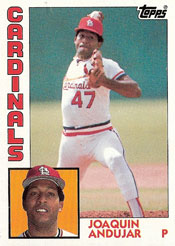
On Nov. 13, 1981, Joaquin Andujar became a free agent after finishing the 1981 season with the Cardinals.

Though he preferred to stay with the Cardinals and they wanted him to return, a contract agreement was not a given.

The determining factor was salary, and, for a while, neither side was willing to compromise.

Good fit

Acquired from the Astros in June 1981 for outfielder Tony Scott, Andujar was 6-1 with a 3.74 ERA for the Cardinals that season.

Andujar liked playing for manager Whitey Herzog and for pitching coach Hub Kittle, who mentored him in the Dominican Republic winter league, but he also wanted to test his worth on the open market.

Represented by brothers Alan and David Hendricks, Andujar sought a contract of $2 million for three years. The Cardinals offered $1 million for the same time frame, according to the St. Louis Post-Dispatch.

Andujar figured he had leverage because the Cardinals needed another starter to bolster a rotation led by Bob Forsch and including the likes of John Martin and Andy Rincon.

Agent Alan Hendricks told the Post-Dispatch he “wanted to see Joaquin wind up with the Cardinals because Whitey Herzog and the club are good for him.”

Herzog’s assistant, Joe McDonald, said, “We’re still very keen on Andujar. We like the guy and he likes it here.”

Price isn’t right

The good vibes began to fade when neither Andujar nor the Cardinals budged on their salary number. The Sporting News reported Andujar “is likely to be gone” from the Cardinals.

Herzog told the Post-Dispatch he had a financial figure he was sticking with and “I’m not going to lose any sleep over it.”

Agent David Hendricks said six teams were interested in Andujar. It soon became evident to Herzog that the interest was tepid _ at least at the salary Andujar was seeking.

The Philadelphia Daily News accused Andujar of “harboring delusions of grandeur.”

According to the Oakland Tribune, Giants second baseman Joe Morgan, who was Andujar’s teammate with the 1980 Astros, lobbied for the Giants to sign Andujar, but it didn’t work out.

Bargaining power

David Hendricks said the Cardinals remained Andujar’s first choice and “the ingredients are still right” for a signing with them.

According to the Post-Dispatch, the Cardinals could get a deal done with Andujar for $1.5 million, splitting the difference between what Andujar was asking and what the club was offering, but Herzog stuck to a lower number.

Herzog, who had the dual role of manager and general manager, sized up the soft competition for Andujar and said, “I’m not going up on my offer. Nobody is higher than us. If he doesn’t like it, he can sit in the Dominican for a year.”

A couple of days later, Herzog turned up the heat again. “His agents keep asking me to raise my offer,” he told the Post-Dispatch. “Why should I outbid myself? I’ve got the best offer out there.”

With his options dwindling, Andujar and his agents lowered their asking price.

On Dec. 30, 1981, Andujar signed with the Cardinals for $1.2 million over three years. According to the Post-Dispatch, the $1.2 million figure was the amount Herzog and the Cardinals were prepared to settle for all along.

The signing took place at Andujar’s home in the Dominican Republic. Attending for the Cardinals was assistant general manager Joe McDonald and scout Willie Calvino. In 1969, when he worked for the Reds, Calvino was the scout who signed Andujar to his first professional contract.

Andujar rewarded the Cardinals with 15 wins, including five shutouts, during the 1982 season. He was the winning pitcher in their pennant-clinching game against the Braves in the National League Championship Series. Then he earned two wins versus the Brewers in the World Series, including the title clincher in Game 7. Boxscore and Video

Though a 20-game winner in both 1984 and 1985, Andujar was traded to the Athletics after he had a confrontation with umpire Don Denkinger during Game 7 of the 1985 World Series.


Read Full Post »

(Updated July 31, 2023)

In a game that brought together the three best National League hit producers _ Hank Aaron, Pete Rose and Stan Musial _ the most prominent catcher of the era started in center field.

On May 17, 1970, Johnny Bench was the Reds’ center fielder in the second game of a doubleheader against the Braves at Cincinnati. For Bench, the National League’s Gold Glove-winning catcher, it was the first time he played the outfield in a major-league game.
Bench fielded flawlessly and hit a home run, helping the Reds complete a doubleheader sweep, but the spotlight was on Aaron, who got his 3,000th career hit in the game. 

Musial, the retired Cardinals’ standout and the last player before Aaron to achieve 3,000 hits, was in the stands to witness the feat, and Rose, who would become baseball’s all-time hits leader, was in right field that day for the Reds.

Hot ticket

With Sparky Anderson in his first season as their manager, the Reds won 13 of their first 17 games in 1970. Entering the Sunday doubleheader on May 17, the Reds were 25-10 and five games ahead of the second-place Braves.

A combination of the Reds’ hot start and the chance to possibly see Aaron get his 3,000th hit generated a big turnout at Crosley Field. Swelled by 4,000 standing room-only tickets sold, the doubleheader drew 33,217 spectators, the Reds’ largest home crowd since 36,961 came out for a Sunday doubleheader versus the Pirates on April 27, 1947.

The Braves were playing at Crosley Field for the last time. When they next returned to Cincinnati to open a series on June 30, the Braves were the Reds’ first opponent in the new Riverfront Stadium.

Special support

Aaron got his 2,999th career hit on Saturday afternoon, May 16, at Crosley Field. Musial wanted to be present when Aaron got No. 3,000. Wearing a blue suit, Musial, 49, arrived at the Cincinnati airport at 10:48 on Sunday morning, May 17, stopped to get his shoes shined and headed to Crosley Field.

At 11:55 a.m., Aaron and Musial posed for pictures inside the clubhouse. “They laughed and swapped stories about baseball,” the Atlanta Constitution reported.

As Aaron headed to the field for batting practice, Musial took a front-row box seat next to Braves owner Bill Bartholomay.

In Game 1, Aaron went hitless in four at-bats against Jim Merritt. Bench caught all nine innings and had a RBI in the 5-1 Reds victory. Boxscore

Bold move

Bench, 22, entered Game 2 of the doubleheader with 10 home runs and 30 RBI for the young season. Wanting to keep Bench’s bat in the lineup but not wanting him to catch two games in one day, Sparky Anderson looked to shift Bench to another position in Game 2.

Bench had started three games at first base in place of an ailing Lee May in April, but the Braves were starting a left-hander, George Stone in Game 2, and Anderson wanted all of his right-handed sluggers, Bench, May and third baseman Tony Perez, in the lineup. The Reds’ regular center field, ex-Cardinal Bobby Tolan, batted left.

Bench’s favorite player as a youth was Yankees center fielder and fellow Oklahoman Mickey Mantle, so when Anderson suggested Bench play center field in Game 2, he got an enthusiastic response.

“This sort of fulfills a boyhood dream,” Bench told the Cincinnati Enquirer.

Anderson said, “I believe Bench can play anywhere and do a major-league job. I was going to play him in right field, but he said he has trouble with balls curving away from him. In center, everything is hit straight at you, so he shouldn’t have any trouble.”

Magic moment

The Reds’ starting outfield in Game 2 was Hal McRae in left, Bench in center and Pete Rose in right. Ex-Cardinal Pat Corrales was their catcher. The Reds’ starting pitcher, rookie Wayne Simpson, was 5-1 with a 2.05 ERA.

Aaron, 36, got his 3,000th hit when he faced Simpson, 21, in the first inning. Aaron’s grounder was scooped on the shortstop side of second by second baseman Woody Woodward, who couldn’t make a throw. Felix Millan scored from second on the play. Video

As the crowd gave Aaron a standing ovation, Musial vaulted over the railing in front of his seat and joined him at first base. Photographers snapped pictures of the only living 3,000-hit players.

According to the Dayton Daily News, Musial said to Aaron, “It’s a thrill for me to be here and see this.”

Aaron replied, “I really appreciate your taking the time to come from St. Louis to Cincinnati for this.”

In his autobiography, “I Had a Hammer,” Aaron said, “I was proud to be joining a man I admired so much and pleased to carry on his tradition.”

Musial was playing left field the night Aaron got his first hit in the majors. It came against the Cardinals’ Vic Raschi on April 15, 1954, at Milwaukee.

After witnessing Aaron get his 3,000th hit, Musial told the Cincinnati Enquirer, “Right after I got my 3,000 hits (the milestone came in May 1958), I was playing against the Braves. I was standing around the batting cage and I told Henry he’d be the next man to reach 3,000. It wasn’t too hard to predict. He looked like a great hitter, he could run, and you could see he wasn’t the kind of player who would be injured often.”

Elite group

Hit No. 3,000 for Aaron came in the 2,460th game of his career.

Aaron was the ninth player with 3,000 hits. The others: Cap Anson, Ty Cobb, Tris Speaker, Honus Wagner, Eddie Collins, Nap Lajoie, Paul Waner and Musial.

Aaron was the first to get 3,000 hits and 500 home runs.

Two innings after his 3,000th hit, Aaron hit his 570th home run, a two-run shot against Simpson.

“If he hits like this now,” Simpson said to the Dayton Daily News, “how did he hit 10 years ago? I’m glad I wasn’t pitching then.”

After the game, Aaron told the Atlanta Constitution that Willie Mays and Pete Rose were the most likely to next reach 3,000 hits.

Rose, who played his entire career in the National League, went on to become baseball’s all-time leader in hits (4,256). Cobb, an American Leaguer, is second at 4,189. Aaron ranks third (3,771) and Musial is fourth (3,630).

Aaron had 3,600 hits as a National League player with the Braves and 171 as an American Leaguer with the Brewers. Thus, the top three in career hits in the National League are Rose (a switch-hitter), Musial (who batted left) and Aaron (who batted right).

Versatile and durable

Almost overlooked in the drama surrounding Aaron was the play of Bench in center. He had no problems fielding the position, but in the ninth inning, with the score tied at 3-3, Bench went back to catching and Tolan took over in center.

After the Braves scored three times in the top of the 10th, the Reds rallied against Ron Kline, an ex-Cardinal. Tony Perez stroked his fifth hit of the game, and Bench and Lee May followed with home runs, tying the score at 6-6.

The game reached the 15th inning before 19-year-old rookie Don Gullet, who pitched two scoreless innings, drove in the winning run for the Reds with a single. Boxscore

Nine days later, against the Padres at San Diego, Bench started in center field for the second and last time. Boxscore

In 15 total innings as a center fielder, Bench made three putouts and no errors.

Bench made 17 outfield starts _ eight in left, seven in right and two in center _ in 1970, plus five starts at first base.

In 17 seasons in the majors, Bench made 1,627 starts at catcher, 182 at third base, 98 at first base and 96 in the outfield.

In the book “Season Ticket,” Cardinals catcher Ted Simmons told author Roger Angell that as a catcher “Bench was picture perfect. A marvelous mechanical catcher. There’s no better.”

Read Full Post »

Like a fading supermodel, reliever Chuck Hartenstein found himself out of fashion soon after he joined the Cardinals.

Described by The Sporting News as “a little stick of a guy who stands 5 feet 10 and weighs 150 pounds” and who “doesn’t show anything in the way of muscles,” Hartenstein was given the nickname Twiggy by a teammate.

In the late 1960s, when Hartenstein was at his peak as a National League closer, British fashion model Twiggy, 5 feet 6 and 110 pounds, was a cultural icon among the hip crowd. About the time Twiggy retired from modeling, Hartenstein was struggling to remain in the majors.

A right-hander whose signature pitch was a sidearm sinker, Hartenstein had a short stint with the Cardinals in 1970. He had a second career as a coach and scout in the majors and instructor in the minors.

Thick and thin

Born and raised in Texas, Hartenstein went to the University of Texas and was a teammate of future Cardinals first baseman Joe Hague. Hartenstein earned a bachelor’s degree in business administration and marketing, but opted to pursue a professional baseball career, signing with the Cubs in May 1964.

Hartenstein became a protege of Cubs minor-league instructor Fred Martin, a former Cardinals pitcher, who taught him to throw the sinker. Years later, future Hall of Famer Bruce Sutter learned the split-fingered fastball from Martin.

“(Martin) taught me just about everything I know,” Hartenstein told The Sporting News.

Hartenstein had his breakout season in 1967. Called up to the Cubs in June, he became their closer, posting a 9-5 record and team-leading 11 saves.

Reliever Dick Radatz, dubbed “The Monster” because of his 6-foot-6, 230-pound frame, gave Hartenstein the Twiggy nickname, The Sporting News reported, but Hartenstein told the Society for American Baseball Research it was outfielder Billy Williams who came up with the tag.

According to the Pittsburgh Press, Hartenstein was so skinny “he could tread water in a test tube.”

Hartenstein entered 1968 as the Cubs’ closer, but his season quickly unraveled. In April, his errant fastball struck Braves batter Joe Torre in the head. “Torre went down like a fallen tree,” the Atlanta Constitution reported.

In his book, “Chasing the Dream,” Torre said, “I never saw it. It smashed against my cheek. It split my palate, broke my cheek and my nose. My teammates had to carry me off the field. I was in shock.”

Hartenstein told the Chicago Tribune, “I’m sorry it happened. I couldn’t believe the ball hit him. It was a fastball and it bore in on him. I had thrown two away from him for strikes, and this one was supposed to brush him back. I certainly didn’t want to hit him, but he just didn’t move.”

Hartenstein had a terrible April (0-2, 6.75 ERA) and was replaced as closer by Phil Regan. After clashing with manager Leo Durocher, Hartenstein was demoted to the minors in June.

“I found out one thing about Durocher: When you got in his doghouse, you never got out of it,” Hartenstein told the Pittsburgh Post-Gazette.

Snapped twig

The Cubs traded Hartenstein to the Pirates in January 1969. He led the 1969 Pirates in saves (10) and was 5-4. Hartenstein was effective against the Cardinals that year, yielding no hits or runs in four appearances totaling five innings.

In 1970, Hartenstein had another bad April (7.04 ERA) and was replaced as closer by Dave Giusti, who was acquired from the Cardinals.

Placed on waivers in June, Hartenstein was selected by the Cardinals. According to the Pittsburgh Press, when Pirates general manager Joe Brown called and told him he was going to the Cardinals, Hartenstein asked, “Football or baseball?”

The transaction made Hartenstein a teammate of Joe Torre, who was traded by the Braves to the Cardinals a year earlier. Hartenstein was thrilled to join a team that featured a lineup with hitters such as Torre, Dick Allen and Lou Brock. “This club could win it all,” he told the Pittsburgh Press.

The 1970 Cardinals could hit, but their bullpen was weak. The Cardinals would finish the season with the fewest saves (20) in the major leagues.

Manager Red Schoendienst said to the St. Louis Post-Dispatch, “Twiggy told me he’ll pitch everyday if we want him to,” but Hartenstein didn’t help. After pitching three scoreless innings against the Pirates in his Cardinals debut, he was shelled in his next five outings. Boxscore

In July, when Nelson Briles came off the disabled list, going into the starting rotation and bumping Chuck Taylor into the bullpen, Hartenstein was given his unconditional release.

In six appearances for the Cardinals, Hartenstein had an 8.77 ERA, surrendering 13 runs in 13.1 innings.

Hartenstein blamed the AstroTurf infields at Busch Memorial Stadium and other National League ballparks for his troubles.

“Sure, I’ve pitched some bad games,” he told the Boston Globe, “but almost everything hit on the ground was finding holes. An infielder playing on the AstroTurf has to be a step quicker than when he plays on a grass infield.”

In Hartenstein’s short time with the Cardinals, he wore three different uniform numbers (22, 26 and 50), according to baseball-reference.com.

The Red Sox, who played on a grass infield, signed Hartenstein for the remainder of the 1970 season and he flopped with them, too (0-3, 8.05 ERA).

Learning to teach

Hartenstein spent the next six seasons (1971-76) in the Pacific Coast League, pitching for farm clubs of the White Sox, Giants and Padres.

In 1977, Hartenstein, 35, returned to the majors with the Blue Jays, an American League expansion club. In May, Rod Carew hit a ball that struck Hartenstein, dislocating his right thumb. When he recovered, Hartenstein gave up four home runs _ to Bernie Carbo, Butch Hobson, Fred Lynn and Jim Rice _ in a July 4 loss to the Red Sox at Fenway Park. Boxscore

“It was great instruction for anyone who wants to be a pitching coach,” Hartenstein said to the Boston Globe. “I showed exactly what you shouldn’t do.”

After finishing 0-2 with a 6.59 ERA for the 1977 Blue Jays, Hartenstein became a minor-league instructor. In 1979, he got back to the majors as pitching coach for the Indians. The club’s bullpen coach was Dave Duncan, who years later was Cardinals pitching coach.

Hartenstein also was Brewers pitching coach from 1987-89 when Dan Plesac developed into a top closer.

In six seasons as a big-league pitcher, Hartenstein was 17-19 with 24 saves. In 13 appearances versus the Cardinals, he had a 1.96 ERA.

Read Full Post »

(Updated Dec. 8, 2024)

Bob Klinger, a good pitcher put into a bad spot by his manager, was involved in one of the most exciting plays in Cardinals lore.

On Oct. 15, 1946, Klinger was the Red Sox pitcher who gave up the winning run to the Cardinals in World Series Game 7.

Though he hadn’t pitched in a month, Klinger was brought into a situation packed with pressure: bottom of the eighth inning, score tied, a championship on the line.

Adding to the degree of difficulty, the first man Klinger, a right-hander, had to face was a fearsome left-handed hitter.

He almost completed the task unscathed, but Enos Slaughter’s daring dash from first base on a Harry Walker hit lifted the Cardinals to victory and made Klinger the losing pitcher.

Rescued by Pirates

Klinger was born in Allenton, Mo., before the small railroad town was annexed by Eureka, Mo., home to the Six Flags St. Louis amusement park.

The Cardinals signed him and he spent nine years in their farm system.

After posting a 16-12 record for Elmira, N.Y., in 1933, Klinger was called up to the Cardinals in September but didn’t get into a game, according to the Society for American Baseball Research. He was on the Cardinals’ roster at spring training in 1934, but was returned to the minors before the season started.

Selected by the Pirates in the Rule 5 draft for $7,500 in October 1937, Klinger, 29, made his major-league debut on April 19, 1938, pitching two scoreless innings of relief and getting the win against the Cardinals at St. Louis. Boxscore

Moved into the starting rotation at the end of May, Klinger had a splendid rookie season (12-5, 2.99 ERA) for the second-place Pirates. Against the Cardinals that year, he was 4-1 with a 1.66 ERA.

Klinger was 62-58 in six seasons with the Pirates before he entered the Navy in April 1944. Discharged in December 1945, Klinger was released by the Pirates before he got to pitch for them again in the regular season. The Red Sox signed him on May 9, 1946, hoping he would bolster their bullpen.

“Klinger has the reputation of being a fireball pitcher,” the Boston Globe reported, “and that is the kind of fellow any club needs … for relief work.”

Title contender

Klinger, 38, joined a smoking hot Red Sox team that won 21 of its first 24 games and cruised to the American League championship.

At a time when most starting pitchers took pride in completing games, Klinger contributed nine saves, tops in the American League in 1946, and was 3-2 with a 2.37 ERA, but his season ended on a downbeat note.

On Sept. 19, against the Browns at St. Louis, Klinger entered in the ninth inning to protect a 5-4 lead, but all four batters he faced reached base and two scored, giving the Browns a victory and Klinger a loss. He didn’t appear in any more games that month. Boxscore

Ten days later, before the Red Sox played their Sept. 29 season finale at home against the Senators, Klinger learned his 2-year-old son was seriously ill “with what was feared to be polio,” the Boston Globe reported. Klinger left immediately to return home to Pacific, Mo.

The Red Sox, who finished 12 games ahead of the second-place Tigers, waited to learn who they would play in the World Series. The Cardinals and Dodgers completed the National League schedule tied for first and needed a best-of-three playoff to determine the champion.

After the Cardinals clinched the pennant on Oct. 3, the World Series opened in St. Louis on Oct. 6. The Cardinals and Red Sox split six games, setting up the finale at Sportsman’s Park.

Trailing 3-1, the Red Sox rallied for two runs in the top of the eighth. Reliever Joe Dobson was lifted for a pinch-hitter during the inning, and Red Sox manager Joe Cronin had two possible replacements warming in the bullpen, Klinger and Earl Johnson, a left-hander.

Controversial choice

With Enos Slaughter, a left-handed batter who led the National League in RBI in 1946, due to lead off the bottom of the eighth, Earl Johnson seemed to some to be the obvious choice, but Cronin opted for Klinger.

“Why bring in Bob Klinger, a National League castoff, to pitch to the Cardinals in the eighth inning of the deciding game with the score tied?,” New York Sun columnist Herbert Goren wrote. “With Slaughter leading the inning, the percentage selection would have been Johnson.”

Others thought Cronin should have used right-hander Tex Hughson, a 20-game winner. Two days earlier, Hughson pitched 4.1 scoreless innings of relief in Game 6. As Sid Keener of the St. Louis Star-Times noted, Hughson held “a higher rating than Klinger in any manager’s book.”

Klinger hadn’t pitched in a game since his shelling against the Browns on Sept. 19, but Cronin apparently chose him because he was the club’s saves leader and had knowledge of National League hitters.

The problem with that logic was hitters were familiar with Klinger, too. Slaughter had a career batting average against Klinger of .338, with 23 hits. Harry Walker, who also batted left, had a career batting average versus Klinger of .300, with nine hits.

Hitting and running

Slaughter greeted Klinger with a sharp single to center. Whitey Kurowski, attempting to bunt Slaughter to second, popped out to Klinger.

Del Rice, a right-handed batter who had one home run for the season, hit “a towering fly to deep, darkest left field,” the Boston Globe reported, but Ted Williams caught it for the second out and Slaughter held at first base.

Harry Walker was up next. The Cardinals called for a hit-and-run. Slaughter started running as Klinger delivered a 2-and-1 pitch and Walker stroked it to the gap in left-center.

“Slaughter turned second base, approaching third base at full speed, and was hell-bent for home,” the St. Louis Star-Times reported.

Center fielder Leon Culberson, who had replaced an injured Dom DiMaggio, gloved the ball and threw to the cutoff man, shortstop Johnny Pesky. With Slaughter steaming toward home, Pesky threw to the plate “a looping toss with no oomph behind it,” the Star-Times noted.

Red Schoendienst, Slaughter’s teammate, recalled to Cardinals Yearbook, “If it had been a better throw, he would’ve gotten Enos.”

Slaughter slid in safely, giving the Cardinals a 4-3 lead. They survived a Red Sox threat in the ninth, clinching their third World Series title in five years. Boxscore and Video

Klinger pitched one more season in the majors, going 1-1 with five saves for the 1947 Red Sox. At 40, he returned to the Cardinals’ system in 1948, pitching for manager Johnny Keane at Houston.

Read Full Post »

If not for an injury, Cloyd Boyer might have been to Cardinals pitching what his brother, Ken Boyer, was to Cardinals hitting and fielding.

A right-handed pitcher, Cloyd Boyer had an exceptional fastball when he got to the big leagues with the Cardinals, drawing comparisons to ace Mort Cooper, but he wasn’t the same after hurting his shoulder.

Boyer pitched in four seasons for the Cardinals and had a record of 15-18 with a 4.24 ERA. After his playing days, he had a long career as a major-league pitching coach and minor-league manager.

Baseball family

Born in Missouri’s Jasper County near Joplin, Cloyd was the oldest son of the 14 children of Vern and Mabel Boyer.

Cloyd and his six brothers all became professional baseball players. Cloyd, Ken and Clete reached the majors. Wayne, Lynn, Ron and Len spent all their time in the minors.

Ken and Clete were standout third basemen. Ken earned five Gold Glove awards with the Cardinals and won the National League Most Valuable Player Award in 1964 when the Cardinals were World Series champions. Clete played for the Yankees in five World Series, including in 1964 against Ken and the Cardinals.

The Boyer boys got their passion for baseball from their father Vern, who worked a variety of jobs, including marble-cutter and blacksmith, and helped build a lighted baseball diamond across the street from the family house in Alba, Mo.

“He bought us a couple of gloves that were nothing bigger than your hand and we used corn cobs for balls,” Cloyd recalled to the St. Louis Post-Dispatch. “He loved the game. If it hadn’t been for him, I would have never been in baseball.”

In 1944, when Cloyd was 17 and working for a farmer, Vern learned the Cardinals were conducting a tryout camp at nearby Carthage, Mo. “My father came and took me off the hay baler and carried me to the tryout camp,” Cloyd said in the book “Ken Boyer: All-Star, MVP, Captain.”

Cardinals scout Runt Marr and administrator Walter Shannon, who were running the tryout camp, became impressed “the minute Boyer powered a throw to the plate from the outfield,” the Post-Dispatch reported. They met with Cloyd and his father in Alba that night and signed the teen to a contract.

Hard thrower

After his first season in the Cardinals’ farm system in 1945, Cloyd enlisted in the Navy when he turned 18 in September that year. He served for almost a year, including three months aboard the USS Iowa, and was discharged in time to pitch in five games in the minors at the end of the 1946 season.

Cloyd began an ascension in the Cardinals’ farm system with consecutive 16-win seasons in 1947 and 1948.

“Boyer has a terrific fastball,” Cardinals farm director Joe Mathes told The Sporting News in 1948.

Cloyd, 21, earned a spot on the Cardinals Opening Day roster in 1949.

Comparing Boyer to Johnny Beazley, who had 21 wins as a rookie for the 1942 Cardiinals, Bob Broeg of the Post-Dispatch wrote, “Cloyd was shy, almost bashful, when he came up to the Cardinals, but was not too shy to knock down a hitter who dug in too earnestly against his swift, side-armed fastball.”

Cloyd made his major-league debut on April 23, 1949, with two scoreless innings of relief against the Cubs, but was returned to the minors after three appearances. Boxscore

Tough guy

Boyer stuck with the Cardinals in 1950, beginning the season as a reliever and moving into the starting rotation in late July.

“There isn’t a veteran pitcher on my squad who can match the speed of Cloyd Boyer,” Cardinals manager Eddie Dyer told The Sporting News.

Dyer was impressed as much by Cloyd’s courage and poise as he was with his fastball.

On July 17, 1950, the Dodgers’ Carl Furillo lined a pitch that struck Boyer “hard on the right thumb, glanced off and slammed against his throat,” Dick Young of the New York Daily News reported.

Boyer retrieved the ball and threw to first base in time to get Furillo, but “almost fainted a moment later, gasping for breath,” the Daily News reported. “His mates had him lie on the hill for several minutes, regaining his wind.”

Once he could breathe freely, Boyer got to his feet and walked off the field. X-rays disclosed a ruptured blood vessel at the heel of his hand. “He’s lucky he’s alive,” the Daily News declared. “Getting his hand in the way of Furillo’s comeback bullet just in time to prevent it from tearing into his neck probably saved the guy’s life, or at least his voice.” Boxscore

Four days later, Boyer pitched 11 innings in a start against the Giants. Boxscore

On July 27, 1950, 10 days after being struck by the Furillo liner, Boyer faced the Dodgers again and pitched a complete game for the win, holding Furillo hitless. Boxscore

“The kid’s got moxie,” Cardinals scout Fred Hawn said to the Post-Dispatch.

Pitching in pain

Two months later, on Sept. 15, 1950, Boyer hurt his right shoulder on the last pitch of his warmup before a start against the Dodgers and couldn’t continue. Cardinals trainer Doc Weaver described the injury as “an inflamed nerve,” the St. Louis Globe-Democrat reported.

According to the book “Ken Boyer: All-Star, MVP, Captain,” Cloyd “likely damaged his rotator cuff, but the mentality of managers and pitching coaches at the time was to pitch through the pain.”

Incredibly, Boyer started against the Braves five days later, on Sept. 20, and pitched a four-hit shutout. Boxscore

The performance took a toll, though. On Sept. 29, while warming up before a start versus the Cubs, Boyer’s pitches “lacked the usual zip.” the Post-Dispatch reported.

He started the game and, “flinching on several throws,” got the count to 3-and-2 before yielding a double to leadoff batter Randy Jackson. Dyer ran to the mound and removed the ailing pitcher. Boxscore

Boyer finished the season 7-7 with a 3.52 ERA. He was 3-0 against the Dodgers.

Helping others

First-year Cardinals manager Marty Marion figured on Boyer for a spot in the starting rotation in 1951, but his arm wasn’t right. Ineffective, he was sent to the minors in July. Though brought back to the Cardinals at the end of the month, Boyer finished 2-5 with a 5.26 ERA for them in 1951.

“Boyer, until he suffered arm trouble, was considered another prospect like Mort Cooper,” The Sporting News noted.

Boyer was 6-6 with a 4.24 ERA for the Cardinals in 1952, then spent the next two seasons in the minors.

The Athletics acquired him and he pitched his last season in the majors for them in 1955, posting a 5-5 record and 6.22 ERA. 

Cloyd never got to play a big-league game with brother Ken, but he did with brother Clete, who was 18 when he made his debut in the majors with the 1955 Athletics.

Cloyd became a big-league coach for the Yankees (1975 and 1977), Braves (1978-81) and Royals (1982-83). Otherwise, from the 1960s to the 1990s, he was a scout, coach and manager in the minors.

Among the pitchers he managed in the minors were 17-year-old Pat Hentgen, who became an American League Cy Young Award recipient and a 15-game winner with the 2000 Cardinals.

Cloyd also managed a couple of 18-year-old pitchers, Steve Avery and Mark Wohlers, who became key members of 1990s pennant-winning Braves teams.

Read Full Post »

The Cardinals’ climax to a year of strangeness was fittingly bizarre.

On Oct. 2, 1981, the Cardinals’ chances of reaching the playoffs evaporated in the ninth inning of a game played in a mostly empty stadium on a night with the feel of winter in Pittsburgh.

After the Cardinals came from behind with a pair of home runs in the top of the ninth to tie the score, the last-place Pirates got a run in the bottom half of the inning against the National League’s best closer and won, 8-7.

The loss dropped the Cardinals 1.5 games behind the first-place Expos with two left to play. The Expos clinched the division title the next day, beating the Mets.

In a year when baseball made a sick joke of the season _ foreshadowing a series of decisions that purposely devalue regular-season excellence and reward mediocrity _ the Cardinals finished the 1981 schedule with the best record in the National League East and were excluded from the farce called the postseason.

Bonehead baseball

After major-league players went on strike in June 1981 and ended the walkout in August, those who run baseball decided to have two regular seasons in 1981. All division leaders at the time the strike began were declared champions of the first season. The second season consisted of games played after the strike. Like with the first season, those who finished in first place in a division went to the playoffs.

It didn’t matter to baseball officials that all teams didn’t play the same number of games in either season, or that some played more road games than home games. Baseball held an expanded playoffs _ with four division champions in each league instead of two _ and hoped the manufactured excitement would make fans forget being spat on by the strike.

The Cardinals (30-20) placed second to the Phillies (34-21) in the East Division in the first season.

With three games remaining in the second season, the Cardinals (27-22) trailed the first-place Expos (28-22) by a half-game. The Cardinals closed with a series at Pittsburgh versus the Pirates while the Expos were at New York against the Mets.

Winter wonderland

The series opener at Pittsburgh’s Three Rivers Stadium was played on a Friday night when the temperature at game time was 39 degrees and the wind chill made it feel like 25.

“A swirling wind made pop-ups adventurous, and intermittent drizzle felt like snowflakes,” the Pittsburgh Press reported.

According to the Pittsburgh Post-Gazette, “The weather conditions were fitting for a Steelers playoff game in late December.”

A mere 2,348 spectators attended in a stadium with capacity for 47,971. It was the smallest attendance for a Pirates game since the stadium opened in 1970.

The brand of baseball the frozen faithful witnessed that Friday night caused shivers, too. The Pirates made four errors, one more than the Cardinals.

“Even on ordinary plays, balls popped out of gloves like in a game of flip,” the Pittsburgh Press noted. “There were more drops than in an eye doctor’s office.”

Blaming the weather, Pirates manager Chuck Tanner said, “Hard gloves and cold hands produce a lot of errors.”

Cardinals catcher Darrell Porter suggested frayed nerves played a factor, too. “I wouldn’t say we’re tight, but we haven’t played like we’re in a pennant race,” Porter said.

Coming back

Trailing 7-2, the Cardinals scored three in the sixth to get within two.

In the ninth, George Hendrick led off with a home run against Rod Scurry, working his third inning of relief, but the next two batters made outs.

Porter was the Cardinals’ last hope. After he fell behind in the count, 1-and-2, Porter pounced on an inside fastball.

“I don’t know if I’ve ever hit a ball better than that,” Porter told the St. Louis Post-Dispatch.

The ball barely stayed inside the foul pole but cleared the wall in right by plenty for a home run, tying the score at 7-7.

“When something like that happens, you think you’re going to win,” Porter said to the Pittsburgh Post-Gazette.

Especially, Porter might have added, when the Cardinals had Bruce Sutter to pitch the bottom of the ninth.

Sutter led the National League in saves for the third consecutive year in 1981.

Walks will haunt

Speedster Omar Moreno led off the ninth for the Pirates and drew a walk. After Tim Foli’s sacrifice bunt moved Moreno to second, Sutter gave an intentional pass to Dave Parker.

Mike Easler batted next. He played in the Cardinals’ farm system in 1976, and he would become the Cardinals’ hitting coach for three years when Tony La Russa was manager.

With the count 2-and-2, Easler sliced a double to left-center, scoring Moreno with the winning run. Boxscore

“Sutter has to pitch low to be effective,” Easler told the Pittsburgh Press. “His pitches dropped a foot. The one I hit did, too, only it was high and dropped right into my swing.”

Flim-flam

In its game story, the Pittsburgh Press declared, “The Pirates didn’t bury the Cardinals. The Cardinals picked up the shovel, dug the hole and jumped in.”

The loss to the Pirates, coupled with the Expos’ 3-0 victory that night, meant the Expos would have to lose their remaining two games for the Cardinals to have a chance to finish atop the division. It didn’t happen. The Expos finished (30-23) a half-game ahead of the Cardinals (29-23).

The Cardinals completed the 1981 schedule with the best overall record in the East Division at 59-43, two games ahead of the Expos (60-48) and 2.5 ahead of the Phillies (59-48).

The Reds had the best overall record in the West Division at 66-42, but, like the Cardinals, didn’t finish atop the division in either season, and didn’t get into the 1981 playoffs.

Incredibly, baseball devised a system in which four National League teams got into the 1981 playoffs, but excluded the two with the best overall records.

Whitey Herzog, who served the dual roles of Cardinals manager and general manager, said baseball’s hierarchy were “dumb dips,” The Sporting News reported.

“This second season is a farce,” Herzog said. “As good as the game was, I can’t believe they messed with it. You wonder why you beat your brains out.”

Since then, baseball has continued to dilute the regular season. Now, a team with the fifth-best record in its league qualifies for the playoffs.

It will get worse. Team owners want to expand the playoffs, following the model from 2020, when 16 teams qualified after the regular season was reduced because of the pandemic. Two of the playoff qualifiers had losing records. Three others, including the Cardinals, who didn’t even play all their scheduled games, got in by finishing two wins over .500.

Read Full Post »

« Newer Posts - Older Posts »