Feeds:
Posts
Comments

Archive for the ‘Games’ Category

Eight months after his “shot heard around the world” won the pennant for the Giants, Bobby Thomson shocked the Cardinals with another walkoff home run.

On June 16, 1952, Thomson hit a grand slam in the bottom of the ninth, erasing a 7-4 Cardinals lead and lifting the Giants to an 8-7 victory at the Polo Grounds in New York.

It was Thomson’s first walkoff home run since his three-run shot in the bottom of the ninth on Oct. 3, 1951, at the Polo Grounds. That home run, against the Dodgers’ Ralph Branca, carried the Giants from a 4-2 deficit to a 5-4 triumph in the decisive game of a playoff series to determine the National League champion. Boxscore and video

Though the walkoff grand slam versus the Cardinals didn’t clinch a championship, it had a magic of its own.

Hit and miss

The Monday afternoon game between the Cardinals and Giants was poorly played. Giants pitchers gave up 16 hits, four walks and hit two batters. The Giants also made three errors. The Cardinals could have had more than a three-run lead entering the ninth, but they hit into five double plays and stranded 10.

Rookie right-hander Eddie Yuhas, working his fifth inning in relief of starter Harry Brecheen, was the Cardinals’ pitcher in the bottom of the ninth. He walked the leadoff batter, Hank Thompson.

George Wilson followed with a line drive. Second baseman Red Schoendienst grabbed it backhanded “with a graceful leap to his right,” the St. Louis Post-Dispatch reported.

Schoendienst whirled and fired to first baseman Dick Sisler in an attempt to nail Hank Thompson, who had ventured far off the bag, but the throw was high and wild. Hank Thompson advanced to second on the error.

The next batter, Davey Williams, grounded sharply to right. Schoendienst broke the wrong way and the ball skipped into the outfield for a single, advancing Hank Thompson to third.

Mix and match

With Whitey Lockman, a left-handed batter, coming up next, Cardinals manager Eddie Stanky wanted a left-hander to pitch. Stanky lifted Yuhas and brought in Bill Werle. Lockman walked, loading the bases and bringing Bobby Thomson to the plate.

A right-handed batter, Thomson was hitless in his last 17 at-bats. Stanky, who eight months earlier was the Giants’ second baseman when Thomson hit his walkoff home run against the Dodgers, wanted a right-hander to face his former teammate.

Stanky brought in rookie Willard Schmidt, who earned a save against the Giants the day before.

“Thomson and everybody in the park knew Schmidt, with three on base, was not going to go cute,” The Sporting News noted. “He was coming in with the fastball to get the first strike if possible.”

Sure enough, Schmidt’s first pitch was a fastball. Thomson leaned into it “like a man who knew his business,” United Press International reported.

Far and fair

Thomson pulled the pitch down the left field line, “a vicious, high drive,” the Post-Dispatch reported.

The ball curled around the foul pole and “cleared the left field roof, not more than four feet from the foul line,” the New York Daily News noted.

Augie Donatelli, umpiring at third, carefully followed the ball’s track and signaled the ball stayed fair. Cardinals catcher Del Rice argued otherwise, to no avail.

As Thomson circled the bases and approached the plate following the three runners ahead of him, “it looked like Pennant Day all over again,” the Daily News observed. “The entire team was there to greet him, shake his hand and pound his back.”

Schmidt “stood on the mound as though paralyzed,” the Daily News noted. Boxscore

Fantastic feat

Fans and media marveled at Thomson’s knack for delivering dramatic endings.

_ “Yes, children, there is a miracle man,” International News Service wrote as its lead to the game story.

_ “This is an act which cannot be improved.” declared The Sporting News.

_ “Had the game been in a World Series or in a crucial pennant stretch drive, the finish would have been immortalized just as was that golden victory that clinched a pennant for the Giants over Brooklyn last October,” United Press International concluded. “As it was, folks who saw it won’t forget it for a long time.”

In his book “The Giants Win The Pennant,” Thomson said, “I can remember leaving the clubhouse early. I was walking across center field and some diehard fans who were still in the stands gave me a great ovation. I’m sure a lot of them were remembering my homer the year before. It was as if I was continuing the heroics.”


Read Full Post »

(Updated March 19, 2021)

From the first game he pitched in the National League to the last, Stan Williams had a significant connection to the Cardinals.

A right-hander with a reputation for intimidating batters, Williams played in the majors for 14 seasons.

He was 21 when he made his big-league debut for the Dodgers against the Cardinals at St. Louis in July 1958. He was 35 when he pitched his final National League game as a Cardinals reliever in September 1971.

Williams’ time with the Cardinals was brief, but successful. He made 10 relief appearances for them and was 3-0 with a 1.42 ERA.

Big and fast

Born in New Hampshire, Williams was a toddler when his family moved to Denver. He played organized baseball for the first time in high school and attracted scouts because of his fastball. “I was a Stan Musial fan and kept track of his hits every day,” Williams said in the book “We Played the Game.”

Williams was 17 when the Dodgers signed him in 1954 and sent him to the minors.

It was at Newport News in 1955, he said, that he got the reputation for being mean. The Dodgers taught pitchers “that when you got ahead of a hitter you kept him off the outside corner by pitching him in and knocking him back or down,” Williams told author Danny Peary.

“I just started rearing back and throwing it as hard as I could at their chins and let them get out of the way.”

Williams, who grew to 6 feet 5 and 230 pounds, was imposing and erratic. In 242 innings for Newport News, he struck out 301, walked 158 and hit 16 batters.

After a teammate, catcher Bob Schmidt, taught him to throw a slider during winter ball in the Dominican Republic, Williams progressed. He was in his fifth season in the minors when he got called up to the Dodgers in 1958.

Joltin’ Joe

Williams made his debut in the majors on May 17, 1958, at St. Louis. Entering in the fifth, he worked two scoreless innings before giving up three runs in the seventh. Joe Cunningham hit a two-run home run against him. Boxscore

A left-handed hitter, Cunningham battered Williams throughout his career. In 36 plate appearances versus Williams, Cunningham had 13 hits, eight walks and twice was hit by pitches _ an on-base percentage of .639. His career batting average against Williams was .500.

That’s entertainment

Two months after his debut versus the Cardinals, Williams had a noteworthy encounter with them. 

On Aug. 15, 1958, at Los Angeles Memorial Coliseum, Williams, 21, was matched against the Cardinals’ Sal Maglie, 41, a former Dodger nicknamed “The Barber” for the close shaves he gave batters with pitches.

According to the St. Louis Post-Dispatch, the Cardinals were “highly irritated” by the amount of time Williams was taking to deliver pitches. When Williams came to bat in the fourth, Maglie “took off his shoe, emptied it of dirt and slowly put it on again, tying his laces with much care.”

As the crowd roared, Williams backed out of the box and “kicked some imaginary mud from his cleats,” the Los Angeles Times noted.

Then Williams stepped back in and hit Maglie’s first pitch over the high screen in left for a home run, his first in the majors. Boxscore

Teddy bear

“Nobody in the league has a better fastball than Stan Williams,” Cardinals slugger Ken Boyer told the Los Angeles Times in 1960.

As part of a Dodgers rotation that featured Don Drysdale and Sandy Koufax, Williams’ signature pitch was the knockdown.

“In all the years I played, he was the only guy who ever scared me _ and he was on my team,” Ron Fairly, a first baseman for the Dodgers and Cardinals, told the San Francisco Examiner. “The thing about Stan, he was so big and strong, and he threw as hard as Koufax. The difference was Sandy was not mean. Stan was very mean.”

Roger Craig, a former Dodgers and Cardinals pitcher, said, “He was the meanest pitcher I ever saw. Everyone thought Drysdale was so mean, but Stan was far worse.”

One year, Williams had a clause in his contract calling for a $500 bonus if he kept his season walk total to less than 75. According to the San Francisco Examiner, as he neared the mark, he plunked a batter when the count got to ball three rather than risk a walk.

“It was a game of intimidation in those days,” Williams said. “I was never a headhunter. I never pitched with the idea of hurting anyone. I don’t think I’ve ever been mean. What I had was a very competitive streak. That helped give me an edge. So I took advantage of it.”

Cardinals pitcher Bob Gibson could relate. In his book “Stranger to the Game,” Gibson said, “Guys like Don Drysdale, Stan Williams and Sandy Koufax raised the level of competition by claiming their territory and daring you to take it from them.

“The fact is,” said Gibson, “knockdowns were commonplace in my day, and guys like Drysdale and Stan Williams employed them more liberally than I did.”

Big hurt

In August 1960, Williams was matched against Lew Burdette of the Braves. “Burdette used to dig a hole in front of the mound” with his foot, Williams told The Sporting News. “To avoid it, I pitched from the side of the rubber. On a pitch to Lee Maye, I slipped and my back went one way and my arm the other. I felt something snap.”

Williams said he thinks he tore a muscle in his right arm or shoulder, but he kept pitching. He had win totals for the Dodgers of 14 in 1960, 15 in 1961 and 14 in 1962, but he said the pain got progressively worse.

“I pitched with tears running down my cheeks many a time after I hurt my arm in 1960,” Williams told the Minneapolis Star-Tribune

The Dodgers traded Williams to the Yankees after the 1962 season, but “there were times when I couldn’t raise my arm, so I started throwing from the hip,” he said. 

The Yankees shipped Williams to the Indians in March 1965. He spent most of that season and all of 1966 in the minors.

Williams was with Class AAA Portland in 1967 “when the adhesions popped again and I regained my strong arm.”

Called up to the Indians in July 1967, Williams posted six wins and a 2.62 ERA. The next year, he won 13 and had a 2.50 ERA.

The Twins acquired Williams after the 1969 season and made him a reliever. He was 10-1 with 15 saves and a 1.99 ERA in 1970, helping them win a division title.

Perfect record

On Sept. 1, 1971, the Twins traded Williams to the Cardinals for outfielder Fred Rico and pitcher Danny Ford.

Cardinals scout Joe Monahan, who recommended Williams, told the Post-Dispatch, “He’s not going to be overwhelmed by a pennant race.”

On Sept. 7, 1971, Williams got a win against the Phillies in the completion of a game suspended from Aug. 1. Boxscore

He also got relief wins against the Cubs and Mets. Boxscore and Boxscore

The Cardinals released Williams in April 1972. He surfaced in the American League with the Red Sox and pitched his final three games in the majors.

Coach and dad

Williams was a coach for pennant-winning Red Sox (1975) and Yankees (1981) clubs, and the 1990 World Series champion Reds. 

When Williams was the Reds’ pitching coach, they developed a trio of intimidating relievers called the “Nasty Boys.”

In 1976, Williams’ son, Stan Jr., a high school pitcher and outfielder, was chosen by the Cardinals in the 11th round of the amateur baseball draft. Stan Jr. opted to attend the University of Southern California. He signed with the Yankees after they drafted him in the 38th round in 1981 and pitched for two seasons in their farm system.

Read Full Post »

A disciple of a master instructor, Steve Braun used plate discipline and situational hitting skill to become a valuable role player for the Cardinals.

On March 3, 1981, the Cardinals signed Braun, a free agent, to a minor-league pact. A left-handed batter, Braun, 32, hoped to earn a spot with the Cardinals as a backup outfielder and pinch-hitter.

Whitey Herzog, who had the dual role of Cardinals manager and general manager, was an important ally. Herzog managed Braun with the Royals in 1978 and 1979.

It was with the 1978 Royals that Braun became influenced by hitting coach Charlie Lau. Applying Lau’s theories, Braun developed into a pinch-hitter who got on base at an impressively high rate.

Frame of mind

Braun got to the big leagues with the Twins in 1971. A left fielder and third baseman, he hit .280 or better in five of his six seasons (1971-76) with the Twins.

In 1975, teammate Rod Carew introduced Braun to Harvey Maisel, a hypnotist, or, as Braun preferred to call him, a mind trainer. Braun credited Maisel with helping him in his approach to hitting.

“The idea is to get yourself relaxed, to think relaxing thoughts so that you give yourself positive suggestions,” Braun told the St. Louis Post-Dispatch.

Braun hit .302 that year, the only time he reached the .300 mark in the majors.

Disenchanted with Twins management, Braun asked to be made available in the November 1976 American League expansion draft. He was selected by the Mariners and batted third in the order as their Opening Day left fielder when they debuted in 1977. Boxscore

Braun said he was surprised when the Mariners traded him to the Royals on June 1, 1978.

In the zone

Charlie Lau, who drew praise from the likes of George Brett and Lou Piniella for his hitting instruction, went to work on Braun, who was batting .230 when the Royals acquired him. With Lau’s help, Braun learned strike zone discipline and how to adapt his approach to what was needed in each at-bat.

“I learned more about hitting in that one season with Lau than I had in all my years of baseball before that,” Braun told the Post-Dispatch.

“He’s the one who really got me thinking about what I should be doing as a hitter.”

Braun became a premier pinch-hitter. He had an on-base percentage of .429 as a pinch-hitter for the 1978 Royals, who were division champions under Herzog.

“I came to the ballpark every night expecting and knowing I’ll get the hit when we need it,” Braun told The Sporting News. “I’ve never had confidence like that. I just know I can get on base and do something to help this club. I’ve changed my hitting style. I’m going with the pitch instead of pulling everything.”

Lau departed the Royals for the Yankees in 1979, but Braun’s success continued under Herzog. Braun had an on-base percentage of .394 as a pinch-hitter for the 1979 Royals.

After the season, Herzog was fired and replaced by Jim Frey. Braun was released in June 1980 and signed with the Blue Jays. As a pinch-hitter for the Blue Jays, he had an on-base percentage of .429 and delivered three game-winning hits.

Right attitude

Granted free agency, Braun contacted Herzog. The Cardinals had no room on their 40-man winter roster, but Herzog offered Braun a chance to compete for a job at spring training. Herzog told the Post-Dispatch he viewed Braun as “a little insurance” in case a roster player got injured or slumped.

Herzog, in his first spring training with the Cardinals, was looking for players who knew how to reach base and advance runners. Braun, who did that better than most, earned a spot on the Opening Day roster as a pinch-hitter.

He made his Cardinals debut in the season opener and delivered a pinch-hit double against the Phillies’ Dick Ruthven. Boxscore

“My goal is to help in at least 10 victories by getting on base leading off an inning, or by moving a runner along, or by driving in a run or more,” Braun said. “Herzog likes to have me lead off an inning because I also get a lot of walks.”

Getting it done

In his five seasons with St. Louis, Braun had 60 pinch-hits, according to the Cardinals’ media guide. The only player with more career pinch-hits as a Cardinal is Gerald Perry (70).

Braun produced these on-base percentages as a Cardinals pinch-hitter: .412 in 1981, .383 in 1982, .433 in 1983, .389 in 1984 and .382 in 1985.

In the 1982 World Series, Braun had two important plate appearances.

In Game 2, with the score tied at 4-4, Braun batted as a pinch-hitter with the bases loaded in the eighth inning and drew a four-pitch walk, driving in the winning run. Boxscore and video at 2:52 mark.

In Game 7, Braun’s RBI-single in the eighth inning extended the Cardinals’ lead over the Brewers to 6-3 and gave Bruce Sutter a comfortable cushion to close out the decisive ninth. Boxscore and video at 2;20 mark.

“He’s got a good knowledge of the strike zone,” Herzog told The Sporting News. “I know he’s going to put the ball in play or go to a 3-and-2 count when he’s leading off an inning.”

Regarding his approach to situational hitting, Braun told the Post-Dispatch, “You have to recognize the situation you’re in. What can I do? What do I have to do? Sometimes you need a baserunner. Sometimes you need a pulled ball. Sometimes you need an extra-base hit and sometimes you need a home run.”

One noteworthy home run Braun hit for the Cardinals came in a game on July 21, 1985. His two-run homer in the 10th inning against Dodgers reliever Tom Niedenfuer gave the Cardinals a 4-2 victory and foreshadowed more heartache for the pitcher. Boxscore

Three months later, in the National League Championship Series, Ozzie Smith hit a game-winning home run for the Cardinals against Niedenfuer in Game 5 and Jack Clark followed with a pennant-clinching home run against him in Game 6.

Pupil turned teacher

Despite his success, Braun was a non-roster player at three consecutive Cardinals spring trainings (1981-83) and made the team each time. He finally was rewarded with roster spots at spring trainings in 1984 and 1985.

Braun finished his playing career with 115 pinch-hits in the majors, according to retrosheet.org.

He was a Cardinals minor-league hitting instructor from 1986-89 and the hitting coach for the big-league club in 1990. After Herzog quit as manager in 1990, Braun became a minor-league hitting instructor with the Red Sox and Yankees.

Read Full Post »

St. Louis was a special place for Juan Pizarro. He got his first and 100th wins in the majors there against the Cardinals.

A left-hander, Pizarro pitched 18 seasons in the big leagues. He was 20 when he got his first win in the majors for the Braves in a start versus the Cardinals at Busch Stadium. He also got his first big-league hit, a home run, in that game.

The Cardinals thought so highly of Pizarro that they tried to trade for him that season.

Ten years later, Pizarro, 30, got his 100th win in the big leagues for the Pirates in a start versus the Cardinals at Busch Memorial Stadium.

Prime prospect

Born and raised in Puerto Rico, Pizarro was signed by Braves scout Luis Olmo, the former outfielder.

In 1956, his first season in the minors, Pizarro, 19, was 23-6 with a 1.77 ERA for Jacksonville, a Class A club in the South Atlantic League. With future Cardinals pitching coach Mike Roarke doing most of the catching, Pizarro struck out 318 batters in 274 innings.

Rollie Hemsley, a former catcher who managed Charlotte in the South Atlantic League, told Sports Illustrated that Pizarro is “the nearest thing to Bob Feller I’ve ever seen.”

Bill Terry, the Hall of Fame first baseman who was president of the South Atlantic League, said, “He could be just as great as Warren Spahn.”

Big leap

While playing winter baseball in Puerto Rico, Pizarro said teammate Ruben Gomez, a Giants pitcher, taught him to throw the screwball. Pizarro added the pitch to an arsenal that included a fastball and curve. He reported to spring training with the Braves in 1957, trying to make the leap from Class A ball to the majors.

The Miami News declared Pizarro the most exciting rookie in spring training: “His every pitch is being watched with high expectancy.”

Pizarro posted a 3.31 ERA in five spring training games and made the Braves’ Opening Day roster. “He has proved to me he can pitch major-league ball,” Braves manager Fred Haney told The Sporting News.

After Pizarro’s final exhibition game, Haney said, “He’ll be another Warren Spahn some day.”

First win

The Braves opened the 1957 season on April 16, but Pizarro sat for three weeks before making his big-league debut in a start against the Pirates at Pittsburgh on May 4. He limited the Pirates to a run in seven innings, but Pittsburgh won, 1-0, on Vern Law’s two-hit shutout. Boxscore

Six days later, on May 10, Pizarro made his second big-league appearance with a start versus the Cardinals at St. Louis.

The start of the Friday night game was delayed 31 minutes because of rain and neither team took batting practice.

In the second inning, with the Braves ahead, 3-0, Pizarro swung at the first pitch he saw from Cardinals starter Sam Jones and hit the ball onto the roof of the pavilion behind right field for a home run.

Ken Boyer tagged Pizarro for a solo home run in the second. With the Braves up, 6-1, in the fourth, the Cardinals’ Wally Moon walloped a three-run home run in the fourth. The Moon shot carried out of the ballpark and across Grand Avenue before crashing into a window pane.

“He had to rely on his fastball and he had a tendency to relax when we had a pretty good lead, especially in the fourth,” Braves catcher Del Crandall told the Associated Press. “After that, he became more determined and began firing again.”

Though Pizarro wobbled, he never lost the lead and he continued to contribute with his bat. After Pizarro led off the sixth with a single, Eddie Mathews won a matchup of future Hall of Famers when he hit a two-run home run against reliever Hoyt Wilhelm. The ball cleared the roof and landed on Grand Avenue.

In the ninth, the Cardinals, trailing 10-5, loaded the bases with two outs, but Pizarro struck out Del Ennis and sealed his first win.

Pizarro gave up nine hits and issued four walks, but the Cardinals stranded eight.

Unimpressed, Cardinals manager Fred Hutchinson told the Associated Press, “He’d better be better than that. If that’s all he can do, then I’ve got news for him. He won’t stay up here … He was only throwing, not pitching.”

Cardinals backup catcher Walker Cooper, who at 42 was 22 years older than Pizarro, batted against him in the ninth as a pinch-hitter and singled. “I could hit that guy with baling wire at midnight with the lights out,” Cooper boasted.

Among the Cardinals held hitless by Pizarro were Al Dark and Stan Musial. Pizarro ended Dark’s 15-game hit streak. Musial, who entered the game with a batting mark of .403 for the season, was 0-for-4 with a walk.

Pizarro was “awfully quick,” Musial said. “There’s no reason why he shouldn’t be a winner up here.” Boxscore

No deal

Later that month, the Braves and Cardinals had trade talks focused on outfielder Del Ennis. The Associated Press reported the Braves offered three players for Ennis. They gave the Cardinals their choice of a starting pitcher, either Ray Crone or Gene Conley, plus reliever Dave Jolly and outfielder Chuck Tanner.

According to the St. Louis Post-Dispatch, the Cardinals asked for Crone and outfielder Wes Covington, and the Braves countered with Conley and Tanner.

“Before I let a guy like Ennis go, I’d want a lot of pitcher in return,” Cardinals general manager Frank Lane told the Associated Press.

Lane said he was interested in Pizarro and another pitcher, Bob Trowbridge. The Braves wouldn’t give up Pizarro, and the talks ended.

On July 3, the Braves sent Pizarro to the minors to get more work. He went 4-0 and was back with the Braves on July 26.

Pizzaro lost twice to the Cardinals in 1957. The second of those defeats occurred on Aug. 18 when Musial beat him with a two-run home run in the 10th inning at Milwaukee. Pizarro never lost to the Cardinals again. Boxscore

Better with age

In his book “Stranger to the Game,” Cardinals pitcher Bob Gibson, who played winter ball with Pizarro in Puerto Rico, called him “an immensely talented” teammate.

On April 30, 1967, Pizarro, in his first season with the Pirates, started for them against the Cardinals and pitched a four-hit shutout at St. Louis for his 100th win in the majors.

Cardinals manager Red Schoendienst, who was Pizarro’s teammate with the Braves from 1957-60, told the Associated Press, “He used to be much faster but very wild then. He has much better control now. The big difference was in the old days if you stayed close to him you could beat him. Now he can protect a one- or two-run lead.” Boxscore

Pizarro was 3-0 with two saves and a 1.07 ERA versus the 1967 Cardinals, who won the National League pennant and became World Series champions. He earned saves in both games of a doubleheader against them on Labor Day, Sept. 4.

In 1971, Pizarro, 34, had one more gem versus the Cardinals. He pitched a six-hit shutout for the Cubs at Wrigley Field. Boxscore

“He makes pitching an art,” Cubs manager Leo Durocher said.

Pizarro finished with a career mark against the Cardinals of 7-2. Overall, he was 131-105.

Read Full Post »

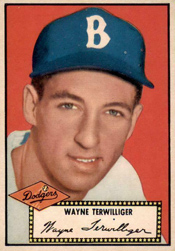
In 1951, the Dodgers dominated the Cardinals in a way few have. It wasn’t just future Hall of Famers Roy Campanella, Jackie Robinson, Pee Wee Reese and Duke Snider who did the damage. Players such as Wayne Terwilliger joined in, too.

A second baseman who played nine years in the majors, Terwilliger built a second career as a coach and manager.

Though he was valued more for his fielding than his hitting, Terwilliger helped the Dodgers extend a streak of success against the Cardinals during his short stay with them in 1951.

War and baseball

A Michigan native, Terwilliger joined the Marines in 1943 and saw combat in Saipan and Iwo Jima. After the war, he enrolled at Western Michigan University and played varsity baseball and basketball. He signed with the Cubs in 1948 after impressing them in a tryout.

Called up to the Cubs from the minors in August 1949, Terwilliger, 24, caught the attention of manager Frankie Frisch, the former standout second baseman for the Giants and Cardinals. Terwilliger was the Opening Day second baseman for Frisch with the Cubs in 1950 and 1951.

On June 15, 1951, Terwilliger was part of a blockbuster trade between the Cubs and Dodgers. The Cubs sent Terwilliger, outfielder Andy Pafko, pitcher Johnny Schmitz and catcher Rube Walker to the Dodgers for catcher Bruce Edwards, pitcher Joe Hatten, outfielder Gene Hermanski and infielder Eddie Miksis.

The key player for the Dodgers was Pafko, a power hitter with a strong arm. With Pafko in left, Duke Snider in center and Carl Furillo in right, the Dodgers had what the Cardinals’ Stan Musial called “the best-throwing outfield I ever saw.”

Terwilliger was acquired to be a backup to Jackie Robinson at second. It was a role that gave him little chance to play.

Late drama

The Cardinals and Dodgers split the first four games they played against one another in 1951. After that, the Dodgers went on a roll, winning seven in a row versus the Cardinals entering their game on July 21, 1951, a Saturday afternoon, at Ebbets Field in Brooklyn.

The Dodgers led, 2-0, until Cardinals left fielder Hal Rice hit a two-run home run in the eighth against starter Don Newcombe, tying the score.

Facing Cardinals reliever Tom Poholsky, Jackie Robinson led off the bottom of the ninth by looping a single to shallow left-center for his fourth consecutive hit.

The Cardinals’ infielders moved in, anticipating a sacrifice attempt from the next batter, Gil Hodges. On the first pitch, Hodges feigned a bunt, drawing the infielders closer. On the next pitch, he swung away and lashed a single to left.

As Robinson neared second, he saw Hal Rice in left didn’t charge the ball. Robinson turned up the speed and raced to third. Rice’s hurried throw was off the mark. Robinson got in safely and Hodges continued to second.

Roy Campanella was walked intentionally, loading the bases.

Good move

With a left-handed batter, Don Thompson, due up next, Cardinals manager Marty Marion relieved Poholsky with a left-hander, Harry Brecheen. Dodgers manager Chuck Dressen countered with Terwilliger, who batted from the right side. It was his first plate appearance in a week.

The Cardinals infielders came way in and “seemed to be expecting” the suicide squeeze bunt from Terwilliger, the New York Daily News observed.

Brecheen threw two outside pitches, hoping to foil a squeeze play, but Terwilliger offered at neither. On the third pitch, Terwilliger swung and hit a single through the drawn-in infield, scoring Robinson with the winning run and increasing the Dodgers’ win streak versus the Cardinals to eight. Boxscore

“The Cardinals continued to be the softest touch seen in these parts since Diamond Jim Brady left Broadway,” Bob Broeg wrote in the St. Louis Post-Dispatch.

Dazzling Dodgers

The Dodgers’ 1951 win streak against the Cardinals reached 14 before it ended on Aug. 23. For the season, the Dodgers won 18 of 22 games versus the Cardinals.

Spitball specialist Preacher Roe, a former Cardinal, was 7-0 for the Dodgers against the Cardinals in 1951. Carl Erskine was 4-0.

Most of the Dodgers’ regulars hit Cardinals pitching hard and often. The standouts, in alphabetical order, included:

_ Roy Campanella: .328, six home runs, 19 RBI in 19 games.

_ Carl Furillo: .326, 28 hits in 22 games.

Gil Hodges: .301, four home runs, 16 RBI in 22 games.

_ Andy Pafko: .516 on-base percentage, eight hits and eight walks in nine games.

_ Pee Wee Reese: .297, 27 hits in 22 games.

Jackie Robinson: .433 on-base percentage, 29 hits and 10 walks in 22 games.

Duke Snider: 23 hits, 12 walks, 16 runs scored and 13 RBI in 22 games.

The Giants, who edged the Dodgers for the National League pennant on Bobby Thomson’s home run in the ninth inning of the decisive playoff game, were 11-11 versus the Cardinals in 1951.

Long career

Terwilliger, a .172 hitter versus the Cardinals for his career, had a .538 on-base percentage (three hits, four walks) against them as a Dodger in 1951.

He spent the 1952 season in the minors and returned to the big leagues as the second baseman for the Senators in 1953 and 1954. Terwilliger’s final seasons in the majors were as a reserve for the Giants (1955-56) and Athletics (1959-60).

Terwilliger spent 18 years as a coach in the majors with the Senators (1969-71), Rangers (1972 and 1981-85) and Twins (1986-94). He coached for the Twins against the Cardinals in the 1987 World Series.

Terwilliger also was a manager for 17 years in the minors, mostly in the farm systems of the Senators and Rangers. In 2005, he was 80 when he managed an unaffiliated minor-league team, the Fort Worth Cats, to a Central League title.

In March 1993, when he was a Twins coach, Terwilliger, 67, told Knight-Ridder Newspapers his six rules for a long life:

_ Associate with young people.

_ Get up early.

_ Move with some bounce in your step.

_ A diet with plenty of distilled water, vegetables and chicken.

_ Find time each day to be by yourself.

_ Ignore the aches, pains and varicose veins.

Read Full Post »

In a span of eight months, umpire Emmett Ashford experienced the indignation of being assaulted by a player and the satisfaction of breaking down a racial barrier.

During a winter league playoff game in the Dominican Republic in January 1965, Ashford was punched by Julian Javier, who went into a rage because of the way the umpire called him out on strikes. Javier was the second baseman for the Cardinals during the major league season.

The year got a lot better for Ashford after that. An umpire in the minors for 15 seasons, Ashford was informed in September 1965 that his contract was being purchased by the American League for the 1966 season. Ashford became the first African-American umpire in the major leagues.

Skill and style

Born and raised in Los Angeles, Ashford went to Jefferson High School. He became the school’s first black student body president and also was the first black editor of a Los Angeles high school newspaper, according to the Los Angeles Times. He was a member of the school’s baseball and track teams, too.

After attending Chapman College, Ashford got a job as a postal clerk. He served in the Navy during World War II. Afterward, he resumed his job at the post office and began umpiring semipro games on weekends in Los Angeles.

In 1951, Ashford, 36, pursued umpiring fulltime. He worked games in the Southwest International League, becoming the first black umpire in the minors. He advanced to the Arizona-Texas League (1952), Western International League (1953) and Pacific Coast League (1954-65).

Displaying a “flamboyant style and distinctive motion for calling balls and strikes,” Ashford had “both skill and crowd appeal,” The Sporting News noted. 

When calling a pitch a strike, Ashford “lets fly with an ebullient ‘Stee-rike-ah’ that carries into the bleachers,” the New York Times reported.

In describing Ashford’s strike call, Jim Murray of the Los Angeles Times wrote, “His feet leave the ground at right angles in a semi-entrechat, his right arm shoots out, and in a voice that brings bull moose crashing out of the woods for miles around, he shouts, ‘Yes! Yes!’ or sometimes ‘Ste-ee-rike.’ “

Murray concluded, “They accuse him of being a showboat. In a game that too often resembles a slow boat, you’d think that would be desirable.”

Tropical heat

During winters, Ashford often refereed college basketball games in the United States or umpired baseball games in the Caribbean.

In January 1965, he was behind the plate for Game 1 of the Dominican Republic championship series between Leones del Escogido and Aguilas Cibaenas before a capacity crowd in Santo Domingo.

Julian Javier, a National League all-star in 1963 and the second baseman for the World Series champion Cardinals in 1964, played for Aguilas Cibaenas. Born and raised in the Dominican Republic, “Javier is a national hero,” wrote Jim Murray.

In the third inning, Javier was batting against Larry Miller, who played in the majors for the Dodgers. After throwing a strike on his first pitch to Javier, Miller delivered a slider on the outside corner at the knee.

“Javier couldn’t hit it with a butter paddle,” Murray wrote. “So he did the next best thing: he let it go by and hoped the umpire would mistake it for a ball.”

Ashford called it strike two.

Javier whirled around to face Ashford and argued the call.

In a 1977 interview with author Larry Gerlach, Ashford recalled Javier saying, “Why are you calling that pitch on me? You know I don’t like that pitch.”

Ashford said the discussion deteriorated into a “nonsensical argument.”

“I knew I had a powder keg on my hands,” Ashford said.

“As Javier’s invective rose in decibel and malevolence,” Murray wrote, “Ashford curtly instructed him to get back in the box.”

Ashford warned Javier if he didn’t immediately resume the at-bat he would, as the rules allowed him to do, order Miller to throw a pitch and would call it strike three.

Ashford said Javier leaned on his bat, crossed his legs and replied, “I dare you.”

Ashford motioned for Miller to throw. According to Murray, Javier was 10 feet away from the plate and had his back turned when Miller delivered his pitch.

“Strike three,” barked Ashford.

Losing control

Ashford lifted his mask to remonstrate. According to The Sporting News, Javier stepped around the catcher and punched Ashford twice in the face.

Javier “landed a left to the cheekbone and a right to the jaw,” Murray wrote. “It was a picture book one-two, but Ashford didn’t go down.”

Ashford reeled back, his mouth bleeding, and then counterattacked, using his iron mask to strike Javier before other players intervened and separated them.

A hush fell over the ballpark, Ashford said. He said he asked for a towel and ice, pressed it to his mouth between innings and continued working the game.

Ashford told author Larry Gerlach that when he returned to his hotel room after the game, “Javier called, crying.”

Ashford told Sid Ziff of the Los Angeles Times that Javier was in a bad mood when the game started because he had received a contract proposal from the Cardinals for the 1965 season and it was for less than he made in 1964.

For attacking Ashford, the Latin American Baseball Federation initially gave Javier an indefinite suspension, but soon the punishment was reduced to a three-day suspension and $50 fine.

“Politics took over,” Ashford told Gerlach.

A lighter sentence was imposed on Javier “because he is a popular figure at home,” The Sporting News reported.

Outraged, Ashford resigned, saying the punishment wasn’t severe enough “for the serious action committed by Javier.”

A short time later, according to The Sporting News, Ashford was persuaded to change his mind and work the remainder of the playoff series “after Javier apologized.”

When Javier was eligible to return to the lineup in the playoffs, it was a home game for Aguilas Cibaenas before a big crowd in Santiago de los Caballeros.

As Javier came to bat for the first time in the game, he “comes straight to me and sticks out his hand,” Ashford told Gerlach.

“Well, what could I do? I couldn’t be a lesser man. So I shook hands with him and the house went crazy.”

Sticking it out

After the Dominican Republic playoffs ended, Ashford returned to the United States to work his 12th season in the Pacific Coast League. Three years earlier, he’d been named umpire-in-chief for the league. He was wondering what more he needed to do to prove he belonged in the big leagues. 

“I was completely discouraged,” Ashford told the Los Angeles Times. “I had always clung to the hope I could make the big leagues, but as the years went by they picked up a lot of our umpires, but not me.”

Ashford was preparing to attend real estate school after the 1965 baseball season, he told columnist Melvin Durslag of The Sporting News. He canceled that plan on Sept. 15, 1965, when American League president Joe Cronin said Ashford had been hired for the 1966 season and would become the first black umpire in the majors. Video

Ashford, 51, worked spring training home games of the Angels and Indians in Arizona in 1966. His first regular-season assignment in the majors was the American League opener between the Indians and Senators at Washington, D.C., on April 11, 1966. Boxscore

After five seasons in the majors, Ashford retired in December 1970, two months after he worked the World Series and one month after he turned 56.

Two years later, in September 1972, Art Williams became the first black umpire in the National League.

Read Full Post »

« Newer Posts - Older Posts »