Feeds:
Posts
Comments

Archive for the ‘Games’ Category

(Updated Nov. 25, 2024)

Denis Menke was a menace to Bob Gibson.
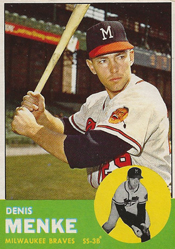
Menke was an infielder who played 13 seasons with the Braves (1962-67), Astros (1968-71, 1974) and Reds (1972-73). He also coached in the majors for 20 years.

Though he batted .184 against Gibson in his career, Menke delivered multiple game-winning hits to beat the Cardinals’ ace. The highlights:

_ A three-run home run against Gibson in a 6-3 Braves win in 1963.

_ Two home runs against Gibson to drive in all the runs in a 4-0 Braves win in 1966.

_ A two-run single against Gibson in a 3-2 Astros win in 1968.

In the book “Stranger to the Game,” Gibson’s friend and teammate Joe Torre said, “Denis Menke was one who hit Bob a little better than he should have.”

Menke told Joe Schuster of Cardinals Yearbook in 2018, “Any success I had against him (Gibson) might have involved more than just a little luck.”

Power provider

Born in Bancroft, Iowa, Menke developed into an amateur baseball standout and was signed by the Braves for $125,000 in May 1958. He made his debut in the majors with them in 1962.

Menke played all four infield positions, though his primary spot was shortstop.

In 1963, Braves manager Bobby Bragan put him at third base and moved the future Hall of Famer, Eddie Mathews, from third to left field.

On Aug. 9, 1963, in a Friday night game against the Cardinals at Milwaukee, the Braves featured a lineup with Hank Aaron, Mathews, Torre and Menke in the third through sixth spots in the batting order against Gibson.

In the second inning, Menke doubled and scored. In the third, he hit a three-run home run, giving the Braves a 6-0 lead. Menke’s homer provided them the margin of victory in a 6-3 win. Boxscore

Adjustments at-bat

Three years later, in 1966, the Braves relocated from Milwaukee to Atlanta. Menke had two big performances against the Cardinals that season.

The first was on June 5, a Sunday in Atlanta. Batting in the leadoff spot, Menke produced five hits and five RBI in the Braves’ 14-4 victory. He had a pair of singles against starter Al Jackson, a RBI-single versus Don Dennis, a three-run home run against Art Mahaffey and another RBI-single versus Hal Woodeshick. Boxscore

Two months later, the Braves fired Bobby Bragan and replaced him with Billy Hitchcock, who returned Menke to shortstop.

On Sept. 21, 1966, a Wednesday night in Atlanta, Gibson was seeking his 21st win of the season when he started for the Cardinals against the Braves.

Before the game, Hitchcock asked Menke to come to the ballpark early and review film of himself at the plate. “He could hardly believe what he saw,” Hitchcock told the Atlanta Constitution.

A right-handed batter, Menke was “pulling his left foot on almost every pitch. Bailing out, as the players say,” The Sporting News reported.

Hitchcock said, “The only pitch he could handle was the one in on him. Anything from the middle to the outside part of the plate, he just couldn’t reach.”

During batting practice that evening, Menke “concentrated on keeping his left foot in place, then stepping toward, or into, the pitch,” The Sporting News noted.

Gibson held the Braves hitless until, with two outs in the fifth, Menke lined a pitch to left. According to the St. Louis Post-Dispatch, the ball was “fair by inches” as it cleared the fence for a home run, giving the Braves a 1-0 lead. Cardinals manager Red Schoendienst said Menke was fooled by the pitch “and was stepping out when he hit it.”

In the seventh, Menke batted with runners on first and second, one out, and drove a Gibson pitch over the fence in left-center for a three-run home run and a 4-0 Braves lead. “He just hit a good pitch,” Schoendienst said.

Gibson limited the Braves to four hits in the game, but Menke’s two home runs supported the shutout pitching of Dick Kelley and gave the Braves the win. Boxscore

“Gibson pitched one heck of a game,” said Schoendienst. “He didn’t make any mistakes, really. That kid (Menke) just hit the ball. That’s all.”

Special delivery

Menke was dealt to the Astros after the 1967 season and became the second baseman in 1968 when Joe Morgan was sidelined because of a knee injury.

The 1968 season is when Gibson posted a 1.12 ERA and was the recipient of the National League Most Valuable Player Award and Cy Young Award, but Menke cost him a win that season.

On May 12, 1968, a Sunday in St. Louis, the Cardinals led the Astros, 2-1, when Menke faced Gibson in the seventh inning with the bases loaded and two outs.

Gibson’s first pitch to Menke was called a ball by plate umpire Bob Engel. Gibson told the Post-Dispatch, “The guy behind the plate was calling balls on pitches that were waist high. That’s what happened on Menke. The first pitch was a ball and I know it was a strike.”

The second pitch clearly was outside the strike zone, but instead of the count being 1-and-1, it was 2-and-0.

With the bases loaded, “I’m just trying to get the ball over” on the third pitch, Gibson said.

Menke hit it for a two-run single, giving the Astros a 3-2 lead.

Starter Larry Dierker held the Cardinals scoreless over the last three innings to seal the win for the Astros. Boxscore

Moving on

Menke was the Astros’ shortstop in 1969 and 1970, and was named to the National League all-star team both years.

Learning from Astros manager Harry Walker, the former Cardinal, how to hit to all fields, Menke led the club in hits (149) and RBI (90) in 1969, and in hits (171) and RBI (92) in 1970.

Traded with Morgan and others to the Reds in November 1971, Menke was their third baseman when they won consecutive division titles in 1972 and 1973. In the 1972 World Series versus the Athletics, Menke batted a mere .083, but he hit a home run against Catfish Hunter and fielded 29 chances flawlessly at third.

For his career, Menke produced 1,270 hits.

After three seasons as a minor-league manager, Menke was a coach in the majors with the Blue Jays (1980-81), Astros (1983-88), Phillies (1989-96) and Reds (1997-2000).
Read Full Post »

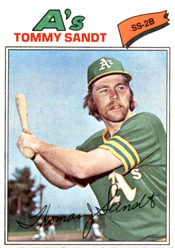
During his time in the Cardinals’ organization, Tommy Sandt won a labor grievance, played in the same infield with Tony La Russa and Jim Riggleman, and got traded for a pitcher who became a World Series hero.

Though he never played in the majors for the Cardinals, Sandt was in their farm system after being acquired from the Athletics.
It was an unconventional adventure.

Hanging in there

Sandt was chosen by the Athletics in the second round of the 1969 amateur baseball draft. He said he almost quit in 1973 when he was demoted from Class AA Birmingham to Class A Burlington, but Burlington manager Rene Lachemann convinced him to keep trying. “He saved my career,” Sandt told the Pittsburgh Post-Gazette.

Sandt hit .301 for Burlington and began to advance again. In 1975, his seventh season in the minors, Sandt was called up to the Athletics in June, made his debut in the majors as a defensive replacement at second base in a game against the Angels, and was sent back down. He hit .309 for Class AAA Tucson in 1975.

At spring training in 1976, Sandt was considered a longshot to earn a spot with the Athletics until he caught the attention of manager Chuck Tanner during a baserunning drill.

“The A’s wore white shoes then and I didn’t have any, so someone loaned me some new white shoes,” Sandt told the Pittsburgh Press. “I wore them to run the bases and came up with blisters. They started bleeding and Chuck told me to go in and change my shoes. I told him I’d gut it out. I didn’t know it, but Chuck told me later I made the club right there.”

Tanner confirmed to the Honolulu Star-Bulletin, “Tommy made my club that day. I figured if a guy will do that, he must want it bad.”

Sandt spent the 1976 season with the Athletics as a backup to second baseman Phil Garner and shortstop Bert Campaneris, played in 41 games and hit .209.

Instead of it being the start to a playing career in the majors, it turned out to be the end.

Money matters

Though Jack McKeon had become Athletics manager after cash-strapped club owner Charlie Finley traded Tanner to the Pirates, Sandt figured to be back with the team in 1977.

At spring training, Sandt got into a contract squabble with Finley. Rather than negotiate, Finley invoked a clause to renew Sandt’s contract and cut his salary by more than 20 percent. Under baseball’s labor agreement with the players’ union, Finley had the right to renew Sandt’s contract but the maximum he could cut a salary was 20 percent.

Sandt filed a grievance. Finley retaliated by selling Sandt’s contract to the Cardinals on March 26, 1977.

Off and on

The Cardinals assigned Sandt, 26, to their Class AAA New Orleans farm club. New Orleans opened its season with a double-play combination of Tony La Russa at second and Sandt at shortstop. In a game against Iowa, Sandt and La Russa each hit a home run.

La Russa, in his final season as a player before embarking on a Hall of Fame managing career, also was serving as a coach for New Orleans manager Lance Nichols. Ken Oberkfell eventually took over at second base. La Russa managed New Orleans for five games while Nichols was treated for lymphoma.

In the book, “Tony La Russa: Man on a Mission,” Oberkfell recalled a lesson he learned from La Russa and Sandt after Oklahoma City baserunner Lonnie Smith upended him on a slide into second.

“I guess it was kind of a cheap shot, but I didn’t really know any better and I didn’t think anything about it,” Oberkfell said. “I got to the bench after the inning and Tony and Tommy Sandt came up to me and said, ‘Don’t worry, we’ll get him for you.’ I was like, ‘Get who for what?’ That was a part of the game I really didn’t know much about.”

On May 28, 1977, an arbitrator who reviewed Sandt’s grievance against Finley ruled in favor of Sandt, declared the contract invalid and made him a free agent.

Sandt left the New Orleans club and went home, hoping to field offers. The Cardinals showed the most interest, and on June 18, 1977, they signed Sandt and sent him back to New Orleans.

The Cardinals also promoted Jim Riggleman from Class AA to be the New Orleans third baseman. Riggleman, a future Cardinals coach and big-league manager, and Sandt provided pop in the lineup. Four times, they combined to hit home runs in the same game.

Sandt was called up by the Cardinals when rosters expanded in September 1977, but never played in a game for them.

Moving ahead

The Cardinals were loaded with infielders at the major-league and Class AAA levels in 1978, so they loaned Sandt to the Blue Jays. Sandt was assigned to Class AAA Syracuse, a club managed by Vern Benson, a former Cardinals player and coach. Sandt played second base next to the shortstop, basketball’s Danny Ainge.

With his path to the Cardinals blocked by better prospects, Sandt was traded to the Pirates on Jan. 25, 1979, for a minor-league pitcher, John Stuper.

Stuper got called up to the Cardinals in 1982, became a member of the starting rotation and earned a complete-game win in Game 6 of the World Series, positioning them to clinch the championship the next night.

After three more seasons as a player in the Pirates’ farm system, Sandt became a minor-league manager for them in 1982. He managed for five seasons, including at Hawaii, where he was named manager of the year in the Pacific Coast League and helped a promising prospect, Barry Bonds.

In 1987, Sandt became a coach on the staff of Pirates manager Jim Leyland. Sandt was a Pirates coach for Leyland from 1987-96. Leyland kept Sandt on his coaching staff when he managed the Marlins (1997-98) and Rockies (1999). Sandt also was a Pirates coach for managers Gene Lamont (2000) and Lloyd McClendon (2001-02).

On Twitter, Pirates broadcaster Greg Brown called Sandt “a brilliant baseball man and as humble as they come.”

Asked by the Pittsburgh Post-Gazette what three words described him best, Sandt replied, “Fun-loving, emotional, dedicated.”

As a coach, Sandt developed a reputation for being a master at using the fungo stick to hit balls to players during fielding drills.

Another coach, Rich Donnelly, told the Miami Herald, “There’s no one better with a fungo. If the fungo was a sand wedge, Tommy Sandt would be Tiger Woods.”

Read Full Post »

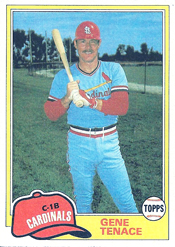
Gene Tenace brought to the Cardinals a winning pedigree, leadership and a consistent ability to get on base. Willing to accept a reserve role as a catcher and first baseman, Tenace was a good fit for a franchise looking to change its culture and transform from underachievers to champions.

On Dec. 8, 1980, the Cardinals got Tenace, pitchers Rollie Fingers and Bob Shirley, and a player to be named, catcher Bob Geren, from the Padres for catchers Terry Kennedy and Steve Swisher, infielder Mike Phillips and pitchers John Littlefield, John Urrea, Kim Seaman and Al Olmsted.

Fingers, a closer and future Hall of Famer, was the player who got the attention for the Cardinals when the deal was made, but Tenace was the one who contributed the most.

Four days after acquiring Fingers, Whitey Herzog, who had the dual roles of Cardinals manager and general manager, dealt him and another future Hall of Famer, catcher Ted Simmons, to the Brewers. Tenace remained with the Cardinals for two years, fulfilled the role Herzog envisioned for him, and helped them become World Series champions in 1982.

Finding his way

Tenace was born Fiore Gino Tennaci in Russelton, Pa. He grew up in Lucasville, Ohio, and his name was changed to Fury Gene Tenace because the family wanted it to be more American than Italian.

He was 18 and a shortstop when the Athletics selected him in the 20th round of baseball’s first amateur draft in 1965. Tenace was an outfielder and third baseman in the Athletics’ farm system before he was converted to catcher in 1968.

A right-handed batter, Tenace generated tremendous bat speed. “I play to hit,” Tenace told The Sporting News. “I love to hit.”

A turning point in Tenace’s career came in 1969 when he was assigned to Birmingham, a Class AA club managed by Gus Niarhos. A former big-league catcher who started for the 1948 Yankees before being replaced by future Hall of Famer Yogi Berra, Niarhos taught Tenace how to play the position.

Tenace, 22, was called up to the Athletics in May 1969. After he went 0-for-4 in his debut against Denny McLain, Tenace got a single the next day versus Luis Tiant for his first hit in the majors.

Though the Athletics liked Tenace’s hitting, the catcher they liked best was Dave Duncan, the future Cardinals pitching coach. Duncan was the Athletics’ starting catcher in 1971, when they won the first of five consecutive division titles.

Duncan was the starter again in 1972 before he went into a hitting slump. “He wasn’t doing it with the bat and it was beginning to affect his catching,” Athletics manager Dick Williams said.

Tenace replaced Duncan for the last two months of the 1972 season, and he was the starter when the Athletics went into the World Series against the Reds.

Valuable player

Tenace took center stage in the 1972 World Series. In Game 1, he became the first player to hit home runs in his first two World Series at-bats. The homers versus Gary Nolan produced all the runs for the Athletics in a 3-2 victory. Boxscore

Tenace hit .348 with four home runs and nine RBI against the Reds and was named most valuable player of the 1972 World Series. Video

Moved to first base in 1973, he had 24 home runs and a .387 on-base percentage. In the World Series against the Mets, Tenace had 11 walks and three hits.

In 1974, when the Athletics won a third consecutive World Series title, Tenace again played first base and hit 26 home runs. He returned to catcher in 1975 and had 29 home runs and an on-base percentage of .395.

Regarding his ability to get on base often, Tenace told the St. Louis Post-Dispatch, “I’ve always used discipline at the plate. I know my limitations. I’ve been in the game long enough to know I can handle only certain pitches.”

Herr almost dealt

Tenace became a free agent after the 1976 season and signed with the Padres. He was tough versus the Cardinals. In 1978, he had 11 RBI in 12 games against them and his on-base percentage was .467.

In 1980, Tenace and Fingers clashed with manager Jerry Coleman and asked to be traded. According to The Sporting News, the Padres tried to trade Tenace to the Cubs in July 1980, but it didn’t work out.

Herzog was interested in both Fingers and Tenace. The Padres wanted a young catcher, and the Cardinals’ Terry Kennedy and the Pirates’ Tony Pena were the two who appealed to them most.

In his book, “White Rat: A Life in Baseball,” Herzog said Kennedy approached him near the end of the 1980 season and asked to be traded to a team needing a starting catcher.

Herzog and Padres general manager Jack McKeon met during the 1980 World Series and agreed to a trade of Kennedy, second baseman Tommy Herr and others for Fingers, Tenace and Bob Shirley. “I can make that deal now,” Herzog told the Post-Dispatch.

Herr said, “I don’t know if I’d like it or not. I want to play with a contender.”

The trade “was close” to being made, The Sporting News reported, but it got held up because of a snag over Fingers’ contract.

Herzog and McKeon resumed their talks at the baseball winter meetings in December. In his book, Herzog said he almost traded Kennedy to the Reds for reliever Tom Hume, but when the Padres agreed to take other players instead of Herr, Herzog closed the deal with them.

Good as advertised

Herzog said Fingers was “the great relief pitcher I needed, but not the one I really wanted. The guy I was really after was Bruce Sutter.”

Fingers was insurance in case Herzog couldn’t make a deal for Sutter.

On Dec. 9, 1980, the day after the trade with the Padres, the Cardinals acquired Sutter from the Cubs. With catcher Darrell Porter joining the Cardinals earlier in the week as a free agent and Sutter filling the closer role, Herzog decided to package Fingers and Ted Simmons in a trade to the Brewers.

Tenace was projected to back up Porter at catcher and Keith Hernandez at first base. Unfazed about a reserve role, Tenace said, “I’ve been adjusting all my life.”

Tenace delivered what was expected of him. He had on-base percentages for the Cardinals of .416 in 1981 and .436 in 1982.

A leader in the clubhouse, he made sure the reserves were as ready as he was to play. Outfielder Tito Landrum said, “If I start having a letdown, he comes over and kicks my rear end. Literally. He pulls no punches. He lets you know.”

After the Cardinals won Game 7 of the 1982 World Series versus the Brewers, Porter, like Tenace in 1972, was named the Series’ most valuable player, meaning the Cardinals had two catchers on the same team who had received the honor.

Tenace became a free agent after the 1982 World Series. Herzog said the Cardinals wanted to keep him, but on a one-year contract. When the Pirates gave Tenace a three-year deal, he accepted.

After one season with the Pirates, Tenace was through playing. He went on to coach, manage and instruct, including a stint with the Cardinals as minor league hitting coordinator from 2002-07.

Read Full Post »

Kerry Robinson encountered multiple roadblocks and detours before he got a chance to play for his hometown Cardinals, completing a family quest his father began several decades earlier.

Robinson, 27, signed a minor-league contract with the Cardinals on Dec. 7, 2000, after becoming a free agent.
An outfielder with speed who hit for contact from the left side, Robinson was a St. Louis native who followed the Cardinals as a youth. His father, Rogers Robinson, spent 11 seasons as an outfielder and first baseman in the Cardinals’ farm system but never played in the majors.

Kerry Robinson was drafted and signed by the Cardinals in 1995 and played in their farm system before he was acquired by the Rays in 1997. Three years later, when he rejoined the Cardinals, Robinson was ticketed for the minor leagues, but he set his sights higher.

All in the family

Robinson was born in St. Louis in October 1973. His mother, Lois, was a special education teacher and his father, Rogers, was a pharmaceutical salesman, according to the St. Louis Post-Dispatch.

Before Kerry came along, Rogers Robinson was a professional baseball player. A St. Louis native and left-handed batter, Rogers Robinson had two stints in the Cardinals’ farm system: 1957-61 and 1964-69. He had a career batting average of .298, with 1,348 hits in 1,256 games, according to baseball-reference.com.

Rogers Robinson twice reached the Class AAA level (1961 and 1964) and hit .300 or better in six seasons. He twice had seasons of more than 80 RBI and he hit 15 or more home runs five times.

Kerry Robinson attended several Cardinals games at Busch Memorial Stadium as a youth. He also developed into a standout baseball, hockey and football player at Hazelwood East High School in St. Louis. As a senior, he scored 29 goals for the hockey team and hit .557 for the baseball team.

“I’m a big hockey fan,” Robinson told the Post-Dispatch. “That’s probably my favorite sport, with football next and then baseball.”

Baseball was the sport Robinson excelled in when he went to college at Southeast Missouri State. He had a 35-game hitting streak, an Ohio Valley Conference record, his senior season.

While working toward a degree in sports management, Robinson spent time as a public relations intern for the NFL Rams, but his future was in baseball. The Cardinals chose him in the 34th round of the June 1995 amateur baseball draft.

Winding road

Robinson adapted quickly to professional baseball. In 1995, his first season, he hit .296, with 74 hits in 60 games, for Johnson City.

At spring training the next year, Robinson caught the attention of Cardinals manager Tony La Russa. “Tony said, ‘If you keep hitting like you are now, you’ll be playing here.’ ” Robinson told the Post-Dispatch.

Assigned to Peoria in 1996, Robinson hit .359 and had an on-base percentage of .422. He also had 50 stolen bases. He got promoted to Class AA Arkansas in 1997 and did well again, hitting .321, swiping 40 bases and producing an on-base percentage of .386.

At 24, his career was on the rise, but it took a turn when the Rays selected him in the American League expansion draft in November 1997.

Called up to the Rays in September 1998, Robinson went hitless in three at-bats, got waived and was claimed by the Mariners, who sent him back to the minors. Traded to the Reds in July 1999, Robinson was called up in September, used as a pinch-runner and was hitless in one at-bat.

Released by the Reds in March 2000, Robinson considered quitting, but instead signed with the Yankees, his fifth organization. He went to their Columbus farm club, hit .318 and had 37 stolen bases.

Granted free agency after the 2000 season, Robinson returned to the Cardinals, who assigned him to Class AAA Memphis.

Opportunity knocks

Though he was a non-roster player, Robinson was determined to make an impression at Cardinals spring training camp in 2001.

“My dream is to play in Busch Stadium this season, even if it’s only one game, or one at-bat,” Robinson told columnist Bernie Miklasz. “I grew up watching baseball at Busch Stadium and I want to be on that field.”

Robinson hit so well throughout spring training that after he was reassigned to the minor-league complex the Cardinals brought him back to play in big-league exhibition games.

Robinson opened the 2001 season with Memphis, batted leadoff and hit .325 in 10 games. When Mark McGwire went on the disabled list on April 18, 2001, the Cardinals called up Robinson to fill a reserve outfield spot while Craig Paquette and Bobby Bonilla moved to first base to substitute for McGwire.

Asked about getting to the big leagues with the Cardinals after his father had tried so long to do the same, Robinson told the Post-Dispatch, “I’m sort of living out his dream. I’m so proud I can do that.”

Welcome to the club

On April 24, 2001, Robinson got his first major-league hit, an infield single for the Cardinals against the Expos’ Masato Yoshii. Boxscore

A month later, Robinson got his first major-league start in the outfield and got a two-run single for his first RBI, giving the Cardinals the lead in a victory against the Brewers. Boxscore

After getting two hits in a start in center versus the Reds on June 4, 2001, Robinson was hitting .368 for the season.

“He’s got a nice calmness about him,” La Russa said. “It’s like he hasn’t been intimidated at all. He’s really had some good at-bats in clutch situations. When he puts it in play, he runs like hell.”

Bernie Miklasz noted, “Robinson is a polished hitter. He knows how to work pitchers, he can draw walks, he makes contact.”

Going deep

On June 17, 2001, Robinson entered a game against the White Sox after McGwire was ejected for arguing a called third strike. Batting in the cleanup spot, Robinson hit his first major-league home run. Boxscore

Robinson hit .285 and had 11 stolen bases for the 2001 Cardinals. In the decisive Game 5 of the National League Division Series against the Diamondbacks, he batted for McGwire in the ninth inning and executed a sacrifice bunt. Boxscore

Robinson hit .260 for the Cardinals in 2002 and .250 in 2003.

Though optioned twice to the minors during the 2003 season, Robinson came back and hit .356 for the Cardinals in August. A highlight was a walkoff home run to beat the Cubs on Aug. 28, 2003. Boxscore and Video

Bernie Miklasz wrote, “Robinson’s hunger and energy are good for the team.”

“He’s an igniter for us,” said La Russa. “He’s got a good idea about being aggressive with a ball in the strike zone, not taking those pitches.”

In March 2004, the Cardinals traded Robinson to the Padres for outfielder Brian Hunter, who was released two months later and never played a game for them.

Read Full Post »

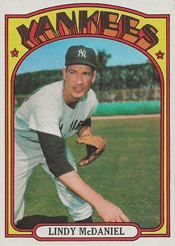
At an age when many pitchers are finishing their careers, Lindy McDaniel was establishing a personal standard for endurance.

On Aug. 4, 1973, McDaniel, 37, pitched 13 innings in relief and got the win for the Yankees in a game against the Tigers.

It was the most innings McDaniel had pitched in a game since entering the majors at 19 with the Cardinals in 1955. His previous high was 9.2 innings for the Cardinals in a start against the Dodgers at Brooklyn in June 1957.

“He is one of the best-conditioned athletes I have ever managed,” the Yankees’ Ralph Houk told The Sporting News.

McDaniel entered the game in the second inning and pitched through the 14th. He allowed one run, a home run by Mickey Stanley in the fifth, and held the Tigers scoreless over the last nine innings, the equivalent of a complete-game shutout.

Yankee dandies

The bullpen combination of McDaniel, a right-hander, and left-hander Sparky Lyle helped the Yankees contend in the American League East in 1973. “I don’t see any club in the division stronger in the bullpen than we are,” Houk said.

The Sporting News noted, “McDaniel and Lyle are as different as day and night. Lindy is the austere, quiet lay preacher who is all business at all times. Sparky is the bon vivant, the fun-loving Rover boy of loud laughter and practical jokes. Yet they have one similarity: neither frets about his day’s work when it is over, nor does either get too carried away by success.”

Entering their Saturday night game at Detroit, the Yankees (60-51) were tied with the Tigers (58-49) for second place, a half-game behind the Orioles (57-47).

The starting pitchers were left-handers, Fritz Peterson for the Yankees and Woodie Fryman for the Tigers.

In the first inning, the Tigers scored a run. While fielding a groundball for the third out, Peterson felt discomfort in his thigh. When he went out to pitch the second, Peterson threw one pitch to the first batter, felt pain in his leg and removed himself from the game.

Houk brought in McDaniel to relieve.

Good stuff

The Yankees reached Fryman for a run in the third, tying the score at 1-1, and Stanley’s home run against McDaniel put the Tigers back in front, 2-1, in the fifth.

Facing a Tigers lineup featuring Al Kaline, Willie Horton and Frank Howard in the third through fifth spots in the order, McDaniel kept them in check.

“The secret is velocity,” McDaniel told The Sporting News. “I can’t succeed without it. My velocity is better than it had been in a long time. If I have good velocity, I can be successful without a good forkball. A fastball and slider are enough, but when I also have the good forkball, I really can do a job. Without velocity, I can’t go to the fastball when my forkball is off.”

In the ninth, the Yankees had Hal Lanier on first with two outs, when Matty Alou came to the plate to face John Hiller, the Tigers’ closer. The matchup appeared to favor Hiller, the American League saves leader and a left-hander. Alou, who batted from the left side, drove a pitch to the wall in left-center for a double, scoring Lanier with the tying run.

The Tigers threatened in the 12th, loading the bases with two outs, but McDaniel got Tony Taylor to fly out to end the inning.

Oh, what a night

As the game entered the 14th, Houk decided he would lift McDaniel in the bottom half of the inning. Lyle was warming and ready in the bullpen.

Horace Clarke changed Houk’s thinking when he led off the top of the 14th with a home run, his first since September 1972, against Hiller. “I surprised myself as much as everyone in the park,” Clarke told the Detroit Free Press.

With the Yankees ahead, 3-2, Houk stayed with McDaniel to pitch the bottom half of the 14th. “I felt he deserved it,” Houk said.

McDaniel delivered, retiring the Tigers in order. Boxscore

The win boosted McDaniel’s record for the season to 9-3.

“I’m specializing in wins this year and letting Sparky take care of the saves,” McDaniel said to the Detroit Free Press.

McDaniel’s line for the game: 13 innings, 48 batters faced, 6 hits, 1 run, 3 walks, 3 strikeouts.

“Did you ever see anything like that in your life?” Houk asked.

Dick Young of the New York Daily News wrote, “Of all the wondrous things this night, the most magnificent was the job turned in by Lindy McDaniel.”

Joe Falls of the Detroit Free Press offered, “It was the most amazing night of his baseball life.”

McDaniel’s 13 innings in relief represented a personal best, but not a baseball best. On June 17, 1915, Zip Zabel of the Cubs pitched 18.1 innings of relief in a win against the Dodgers. Boxscore

According to the New York Daily News, the American League mark for most innings pitched in relief in a game was established by Eddie Rommel, who went 17 innings for the Athletics in a win versus the Indians on July 10, 1932. Boxscore

Durable winner

The Yankees and Tigers eventually fell out of contention, and the Orioles won the division title, finishing eight games ahead of the runner-up Red Sox.

McDaniel had a 12-6 record with 10 saves and a 2.86 ERA. He asked for a chance to start and Houk granted the request. As a starter in 1973, McDaniel was 0-2 with a 4.50 ERA. As a reliever, he was 12-4 with a 2.60 ERA.

Traded to the Royals after the 1973 season for Lou Piniella, McDaniel pitched two seasons for Kansas City. Though primarily a reliever, he made a few starts as well. On June 23, 1974, when he was 38, McDaniel pitched a three-hitter for the Royals in a 4-1 win versus the defending World Series champion Athletics. Boxscore

Read Full Post »

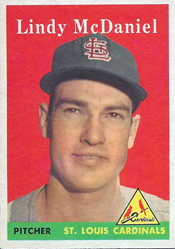
Though the Cardinals put Lindy McDaniel on their team because they had to, he showed he deserved to be there.

A right-hander who developed into a quality reliever and pitched 21 seasons in the major leagues, McDaniel was 19 when he got to the big leagues with the Cardinals as a teammate of Stan Musial in 1955. He was 39 when he pitched his final game with the Royals as a teammate of George Brett in 1975.

In addition to Cardinals (1955-62) and Royals (1974-75), McDaniel pitched for Cubs (1963-65), Giants (1966-68) and Yankees (1968-73). 

McDaniel led the National League in saves three times: twice with the Cardinals (1959 and 1960) and once with the Cubs (1963). He had a career record in the majors of 141-119 with 174 saves.

One of his most important wins was his first. It came when he was 20 years old and it helped convince the Cardinals his spot on the club was warranted.

Prime prospect

McDaniel was 19 when he signed with the Cardinals for $50,000 on Aug. 19, 1955. Because of the amount he received, the Cardinals were required by a baseball rule at the time to keep McDaniel on the big-league club for at least the next two years.

The Cardinals signed McDaniel on the recommendation of scout Fred Hawn, who called him “the best pitching prospect, maybe the best player, I’ve ever scouted for the Cardinals.,” the St. Louis Globe-Democrat reported. “His fastball and his curve are alive and he gets them over the plate.”

An amateur baseball standout in Oklahoma, McDaniel had been pursued by the Cardinals since he was 16 in 1952. He attended the University of Oklahoma for a year, but left to join the Cardinals, “fulfilling a childhood ambition to play with Dizzy Dean’s old club and alongside his idol, Musial,” the St. Louis Post-Dispatch reported.

The Phillies, Dodgers, Reds, Yankees, Indians and Red Sox also wanted to sign McDaniel, but “when I found out the Cardinals were interested, I told the others not to bother,” McDaniel said to The Sporting News. “They’re a team of the future with a young staff. I’ll get more chances to pitch with them than with other clubs.”

When Lindy and his father, Newell McDaniel, an alfalfa and cotton farmer, went to St. Louis for the contract signing, Lindy let his dad do most of the talking.

“He don’t talk much,” Newell said to the Post-Dispatch. “You won’t get much out of him. He concentrates on training. He’s one of those boys just born that way, not interested in girls or anything. Exercises every night before retiring. He’s a fanatic.”

According to The Sporting News, Lindy invested part of the signing bonus in purchasing a 160-acre farm near his home in Hollis, Okla., and turning it over to his father to tend.

Teen dream

McDaniel reported to the Cardinals on Sept. 1, 1955, and he made his debut in the majors the next day at Chicago. McDaniel, 19, entered in the seventh inning with the Cubs ahead, 11-1, and the second batter he faced, Walker Cooper, 40, hit a home run. McDaniel regrouped and didn’t allow another run over two innings. Boxscore

“That boy may never have to go down to the minors,” Cardinals manager Harry Walker told the Post-Dispatch.

On Sept. 19, 1955, McDaniel got his first start in the majors against the Cubs at St. Louis. He gave up a grand slam to Ernie Banks, making him the first player in the majors to hit five in one season. McDaniel gave up five runs, 10 hits and four walks in seven innings, but didn’t get a decision after the Cardinals rallied to win. Boxscore

McDaniel made four September appearances for the 1955 Cardinals and was 0-0 with a 4.74 ERA. According to The Sporting News, he “demonstrated he might be just more than ornamental in 1956.”

On his way

The Cardinals changed managers after the 1955 season, hiring Fred Hutchinson, a former pitcher, to replace Harry Walker.

McDaniel didn’t pitch much at spring training in Florida, but Hutchinson told The Sporting News, “I saw enough of him to know he had good stuff.”

As the Cardinals headed north from Florida to open the season, they were scheduled to play an exhibition game against the White Sox at Oklahoma City. McDaniel was supposed to pitch before a big crowd in his home state, but the game was canceled because of bad weather.

In the Cardinals’ final exhibition game at Kansas City two days before the season opener, McDaniel pitched two scoreless innings against the Athletics.

After losing two of their first three games of the regular season, the Cardinals were home to play the Braves on April 21, 1956, a Saturday afternoon.

With the Braves ahead, 5-3, McDaniel made his first appearance of the season, entering in the fifth inning in relief of starter Willard Schmidt.

Hutchinson “appeared to be taking a long gamble by bringing in a kid” whose “total professional experience consisted of 19 innings last September,” the Post-Dispatch reported, but Hutchinson “had been impressed with Lindy’s poise and potential.”

McDaniel rewarded his manager’s faith in him, retiring 12 of the 15 Braves batters he faced and pitching five scoreless innings. The Cardinals rallied for a 6-5 victory, giving McDaniel his first win in the majors.

A turning point came in the eighth inning. Eddie Mathews led off with a single and Hank Aaron walked, but catcher Bill Sarni made a snap throw to first baseman Wally Moon, picking off Aaron. McDaniel struck out Bobby Thomson and got Joe Adcock to ground out, ending the threat. He retired the side in order in the ninth.

“The kid did great,” Hutchinson said. Boxscore

Plate umpire Babe Pinelli told the Sporting News, “He showed one of the best curves I’ve ever seen and I’ve been in baseball 40 years. He doesn’t scare. He looks nerveless.”

Family affair

The win gave McDaniel a considerable boost. He was 4-0 with a 2.83 ERA entering June. Hutchinson tried him as a starter, but it didn’t work out. McDaniel finished the season at 7-6. He was 5-2 with a 2.58 ERA in 32 relief appearances and 2-4 with a 5.25 ERA in seven starts.

The next year, the Cardinals signed Lindy’s brother, Von McDaniel, 18, for $50,000 and he joined Lindy on the big-league club.

Von won his first four decisions with the 1957 Cardinals, finished 7-5 and flamed out.

Lindy was 66-54 with 66 saves in eight seasons with the Cardinals before he was traded with Larry Jackson and Jimmie Schaffer to the Cubs for George Altman, Don Cardwell and Moe Thacker on Oct. 17, 1962.

Read Full Post »

« Newer Posts - Older Posts »