Feeds:
Posts
Comments

Archive for the ‘Games’ Category

(Updated April 26, 2024)

Bob Gibson of the Cardinals and Tom Seaver of the Mets opposed one another 11 times in the regular season and the results paralleled the paths of their careers.
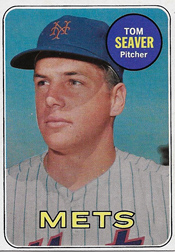
Seaver was the winning pitcher in six of the matchups, Gibson was the winning pitcher three times, and twice their duels ended in no decisions.

The first win for Seaver vs. Gibson came in 1969, a year when he paced the Mets to an improbable World Series title, and the other five occurred in the 1970s, when Seaver was in his prime.

Gibson’s wins versus Seaver came in a three-year stretch, 1968-70, when he twice won the National League Cy Young Award.

From 1971, the year Gibson turned 36, to 1975, Seaver won five decisions in a row versus Gibson.

According to the St. Louis Post-Dispatch, Seaver is the only pitcher to beat Gibson three times in one season. Seaver did it in 1971.

In Gibson’s three wins versus Seaver, the Mets scored a total of four runs.

In Seaver’s six wins versus Gibson, the Cardinals scored a total of seven runs.

Gibson told the Post-Dispatch in 1975, “I could beat him, but that was when I was giving up only one or two runs a game. Later, when I started giving up more runs, he was a tough guy to beat because he wasn’t giving up that many.”

In 2021, catcher Ted Simmons said to the Baseball Hall of Fame yearbook, “Gibson was the best pitcher I ever caught. Seaver was the best pitcher I ever faced, and that’s because I never had to face Gibson.”

Simmons also told the Post-Dispatch in 1976, “Jim Palmer and Nolan Ryan may throw as hard, but as far as total command of what he’s doing, nobody is better than Seaver.”

The first matchup of Gibson versus Seaver may have been the best.

Pair of aces

In 1967, Seaver’s rookie season, he faced the Cardinals once, a start versus Al Jackson.

Seaver’s second career start against the Cardinals came on May 6, 1968, a Monday night in St. Louis, versus Gibson.

Seaver, 23, was making his sixth start of the season and was 1-1 with a 1.71 ERA. He went eight innings in his previous start May 1, a no-decision versus the Phillies.

Gibson, 32, was making his sixth start of the season and was 2-1 with a 1.43 ERA. He went 12 innings in his previous start May 1, a win versus the Astros. “I made 179 pitches in that game, and after 179 pitches, your arm doesn’t feel too good for a while,” Gibson told the Post-Dispatch.

Before his start against Seaver and the Mets, Gibson said, “I had my arm under a heat lamp for 20 minutes, trying to get it loosened up.”

Costly mistake

The Cardinals went ahead, 1-0, with an unearned run against Seaver in the second inning. After Tim McCarver led off with a single, Mike Shannon grounded to first baseman Ed Kranepool, who fielded the ball and turned to throw to second base for what seemed like a certain forceout.

Kranepool cocked his arm but stopped, unsure whether shortstop Bud Harrelson would get to the bag in time to take the throw. When he finally made the throw, Kranepool was off balance. The ball skipped along the ground and bounced off Harrelson’s chest for an error. Julian Javier followed with a single to right, scoring McCarver from second.

The Mets got three hits in the game against Gibson and all came in the fourth inning.

Harrelson led off with a single and advanced to third on Ken Boswell’s single. Art Shamsky lined a hit to left, driving in Harrelson and tying the score at 1-1. With Ron Swoboda at the plate, an inside pitch got away from McCarver, the catcher, for a passed ball, allowing Boswell to move to third and Shamsky to second with none out.

Wrong route

Swoboda hit a fly ball to center. Curt Flood ran forward and made the catch, but as Boswell tagged at third, Flood hesitated before making a throw. “Boswell looked like a cinch to score,” the Post-Dispatch reported.

“I didn’t think we had a chance to get Boswell,” McCarver said.

Flood’s throw tailed toward the third-base line, and McCarver went up the line to retrieve the ball. Boswell beat the throw “by plenty,” the New York Daily News reported, but McCarver was “blocking the line without the ball.”

Instead of barreling into McCarver in a straight path to the plate, Boswell slid wide around the catcher and reached for the plate with his hand.

Boswell touched nothing but dirt. As the ball reached McCarver, he wheeled around and tagged out Boswell to complete a double play. Instead of a 2-1 lead for the Mets, the score remained tied.

Dick Young of the New York Daily News described Boswell’s play at the plate as a “chicken slide.”

“He should have scored easily with the lead run,” Young wrote. “He should have bowled over McCarver.”

Mets manager Gil Hodges told the Post-Dispatch, “In that situation, you can’t go around the catcher. You have to hit him.”

In control

From then on, Gibson and Seaver settled into a groove.

Gibson allowed one base runner after the fourth inning. After Swoboda walked with one out in the seventh, Gibson retired 14 batters in a row.

Seaver held the Cardinals hitless from the third through ninth innings. After Shannon walked in the fourth, Seaver retired 17 in a row until Shannon got an infield hit in the 10th.

As the game entered the 11th, Gibson and Seaver were approaching their limits.

Joe Hoerner was ready in the Cardinals’ bullpen and would have come into the game if it went to a 12th inning. “I can’t let (Gibson) throw his arm out,” manager Red Schoendienst said.

Seaver told the Post-Dispatch the 11th inning would have been his last, too.

Cream of the crop

It took a couple of future Hall of Famers, Lou Brock and Orlando Cepeda, to settle the duel between future Hall of Famers Gibson and Seaver.

Brock led off the bottom of the 11th with a drive to the wall in left-center for a triple. Seaver gave intentional walks to Flood and Roger Maris, loading the bases in hope of a forceout or double play.

Cepeda foiled the strategy, lining Seaver’s first pitch to right for a single to drive in Brock and give the Cardinals and Gibson a 2-1 victory. Boxscore

The win improved Gibson’s career mark against the Mets to 18-3.

“My arm doesn’t hurt half as much as it will tomorrow,” Gibson said, “but that’s the price you have to pay if you want to be a pitcher.”

The 11-inning game was played in a snappy 2:10.

“They don’t fritter around,” Dick Young wrote of Gibson and Seaver. “They get the ball and fire.”
Read Full Post »

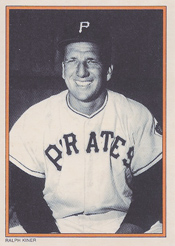
Cardinals manager Eddie Dyer preferred to put Pirates slugger Ralph Kiner on base, representing the potential winning run, rather than give him a chance to hit a walkoff home run.

On Sept. 3, 1950, with the score tied in the bottom of the 10th inning of a game between the Cardinals and Pirates at Pittsburgh, Dyer ordered pitcher Harry Brecheen to give an intentional walk to Kiner with the bases empty and two outs.
The unorthodox strategy backfired when the next batter, rookie Gus Bell, hit a double, scoring Kiner and giving the Pirates a 12-11 victory.

Home run king

The Cardinals carried a four-game losing streak into the Sunday afternoon series finale against the last-place Pirates at Forbes Field.

Kiner hit two home runs. The first was a solo shot against Red Munger in the opening inning. The second home run, a two-run clout versus Cloyd Boyer in the eighth, gave the Pirates a 9-8 lead.

In his first four seasons (1946-49) in the majors, Kiner led the National League in home runs in 1946 (23) and 1949 (54), and tied with Johnny Mize of the Giants for the top spot in 1947 (51) and 1948 (40). Kiner was on his way to winning the league’s home run crown again in 1950.

Comeback Cardinals

Bill Howerton of the Cardinals led off the top of the ninth with a home run into the upper deck in right against Junior Walsh, tying the score at 9-9.

Brecheen, usually a starter, relieved for the Cardinals in the bottom of the ninth and retired the Pirates in order.

In the top of the 10th, the Cardinals scored twice versus Bill Werle. With one out and none on, Red Schoendienst doubled, Stan Musial drove him in with a single and Enos Slaughter tripled, scoring Musial and extending the Cardinals’ lead to 11-9.

Dare to differ

Brecheen retired the first batter, Clyde McCullough, in the bottom of the 10th, but the next two, Pete Castiglione and Bob Dillinger, each hit a home run, tying the score at 11-11. For Castiglione, the home run was his third of the season and for Dillinger it was his first since the Pirates acquired him from the Athletics in July.

After the back-to-back home runs, Brecheen knocked down the next batter, Danny O’Connell, with his first pitch to him. O’Connell grounded out for the second out of the inning.

The next batter was Kiner. The only way he could beat the Cardinals was to hit a home run, but Dyer thought the risk was so high it was worth issuing an intentional walk.

Among the factors influencing Dyer’s thinking:

_ Kiner batted right-handed and Brecheen was a left-hander.

_ Brecheen already had given up two home runs in the inning and thus was vulnerable against Kiner.

“The fact it violated tried and true baseball strategy doesn’t bother us a bit,” columnist Bob Burnes wrote in the St. Louis Globe-Democrat. “We’ve always felt too many managers called too many plays in routine fashion purely because that’s the way the pattern said it should be.”

What did bother Burnes is the slumping Cardinals appeared to have lost confidence. “It was a desperation play, one dictated by something almost akin to panic,” Burnes said.

Take that!

As Kiner watched Brecheen lob four pitches wide of the plate, the fans booed.

With Kiner on first, cleanup hittter Gus Bell batted next. Bell had tripled twice and singled. Though a left-handed batter, Bell hit .320 versus left-handers in 1950.

Bell belted a pitch from Brecheen high and deep to right. The ball “appeared headed into the stands for a home run,” the Pittsburgh Press reported, but it hit high on the screen.

Right fielder Enos Slaughter gave chase and fell. The ball caromed about 35 yards from the screen, the Globe-Democrat reported, giving Kiner time to hustle from first base to home. Bell stopped at second with a double as Kiner crossed the plate with the winning run. Boxscore

The teams combined for 30 hits, including 20 for extra bases.

Each team hit three triples. The Pirates had five home runs and the Cardinals had three.

The Cardinals wasted a big performance from Stan Musial, who had four hits and two walks. Playing near his hometown of Donora, Pa., Musial had a two-run home run and scored four times.

Kiner went on to hit 47 home runs in 1950. Only eight came against left-handers.

Brecheen finished the 1950 season with a 3.55 ERA in 23 starts for the Cardinals and a 10.50 ERA in four relief appearances.

Read Full Post »

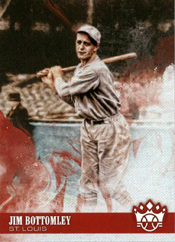
Dazzling defense by first baseman Jim Bottomley and ironman relief by Syl Johnson carried the Cardinals to an epic victory over the Cubs and helped change the momentum of the 1930 National League pennant race.

The Cardinals beat the Cubs, 8-7, in 20 innings on Aug. 28, 1930, at Wrigley Field in Chicago.
The triumph was the Cardinals’ ninth in a row and moved them 5.5 games behind the first-place Cubs. The Cardinals went on to win 21 of 25 games in September while the Cubs were 13-13 for the month. The sizzling surge enabled the Cardinals (92-62) to finish in first place, two games ahead of the Cubs (90-64).

The results might have been different if the Cardinals hadn’t won the 20-inning marathon.

Matchup of aces

The starting pitchers for the Thursday afternoon game were spitball specialist Burleigh Grimes for the Cardinals and Pat Malone for the Cubs. Grimes, acquired from the Braves two months earlier, had won six of his last seven decisions for the Cardinals. Malone had won seven in a row and was 16-6 for the Cubs. The matchup attracted about 20,000 spectators.

With the Cardinals ahead, 5-3, in the eighth, Jim Lindsey, working his first inning in relief of Grimes, gave up a two-run double to Footsie Blair, enabling the Cubs to tie the score.

Syl Johnson, who had a 4.83 ERA, replaced Lindsey in the ninth and was in command.

Sherrif Blake, who pitched a complete game two days earlier, became the fourth Cubs pitcher of the day in the ninth and also was sharp. After Blake held the Cardinals scoreless on one hit for three innings, Bob Osborn, who had a 4.84 ERA, took over for the Cubs in the 12th.

Diamond dandy

The Cardinals broke through against Osborn in the 15th. With two outs and none on, Jimmie Wilson singled and scored on Charlie Gelbert’s double. Syl Johnson drove in Gelbert with a single, giving the Cardinals a 7-5 lead.

Pitching in the bottom half of the inning, Johnson got into immediate trouble. Danny Taylor led off and doubled. After High Pockets Kelly flied out, Gabby Hartnett doubled, driving in Taylor, and Les Bell, a former Cardinal, singled, scoring Hartnett with the tying run.

After Osborn bunted Bell to second, Johnson issued an intentional walk to Footsie Blair. A right-handed batter, Woody English, was up next. He swung late at a pitch and slashed the ball hard on the ground along the first-base line.

“It looked like a sure base hit,” the St. Louis Post-Dispatch reported.

As the ball skipped over the bag, Bottomley lunged, extended his glove hand and barely reached the ball, knocking it down.

Bottomley grabbed the ball, rolled over and looked for Johnson to be covering first base, but Johnson wasn’t there. Thinking the ball was headed into the outfield as a game-winning hit, Johnson stayed, transfixed, on the mound.

Reacting quickly, Bottomley, still on the ground, flipped the ball toward home plate. “It wasn’t much of a throw,” the Post-Dispatch noted.

The runner on second, Les Bell, never imagined Bottomley would get to the ball hit by English, and slowed on his way to the plate after rounding third base.

Catcher Jimmie Wilson gathered in Bottomley’s off-target throw and tagged out Bell “an inch from the plate,” the Chicago Tribune reported.

Red Smith covering the game for the St. Louis Star-Times, called Bottomley’s stop of English’s smash “the grandest bit of defensive play” he’d ever seen.

The St. Louis Globe-Democrat described the play as “one of the most spectacular ever seen on a major-league diamond.”

Down to the wire

As the game progressed into the 20th inning, it was about 7 p.m. and darkness was gathering. With no lights at Wrigley Field, the 20th “probably would have been the last inning, regardless of the happenings therein,” the Chicago Tribune reported.

“The plate was in deep shadow and darkness was settling down,” the St. Louis Globe-Democrat confirmed.

With one out and none on, the Cardinals’ Taylor Douthit singled and moved to second when Sparky Adams grounded out to first. Andy High singled, scoring Douthit and giving the Cardinals an 8-7 lead.

In the Cubs’ half of the 20th, Hartnett led off with a single. After Bell flied out on a long drive to center, Hartnett moved to second on Wilson’s passed ball. Zack Taylor, who years later would manage the St. Louis Browns, ran for Hartnett.

The Cubs had two chances to drive in the tying run from second, but Johnson got Cliff Heathcote and Footsie Blair to fly out, ending the game. Boxscore

Fun facts

The game was played in 4 hours, 10 minutes.

Winning pitcher Syl Johnson went 12 innings, gave up nine hits and a walk, and struck out nine.

In addition to his defensive gem, Bottomley hit the game’s lone home run, a solo shot in the second.

All eight Cardinals position players played the entire game and each had at least one hit.

All eight Cubs position players played every inning, too. Hartnett was the only player in the game to get four hits. He also drew a walk.

Cubs cleanup hitter Hack Wilson, who hit .356 with 56 home runs and 191 RBI for the 1930 Cubs, was 0-for-7 with two walks and was the only Cubs batter to strike out three times.

“Any 20-inning game is something for a baseball bug to gurgle about, but this one will go down among the great games of National League history,” the Chicago Tribune concluded.

Cardinals manager Gabby Street told the St. Louis Star-Times, “I tell you, a club that can win a game like (that) can beat anybody.”

Read Full Post »

Before he became a reliable reliever for the 1964 World Series champion Cardinals, Ron Taylor began his big-league career as a starting pitcher for the Indians. His debut was remarkable.

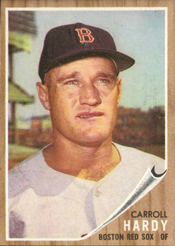
On April 11, 1962, the first time he played in a major-league game, Taylor got the start against the Red Sox at Boston’s Fenway Park, pitched 11 shutout innings and lost when he gave up a walkoff grand slam to Carroll Hardy in the 12th.
Taylor’s counterpart, Red Sox starter Bill Monbouquette, pitched 12 shutout innings and yielded four hits, two to Taylor. The Indians produced one hit, Taylor’s single in the sixth, in the first nine innings.

Smart prospect

Born and raised in Toronto, Taylor was signed by the Indians as a teen and spent six seasons (1956-61) in their farm system. During the winters, he attended the University of Toronto and in 1961 he received a degree in electrical engineering.

At spring training in 1962, Taylor, 24, was the Indians’ best pitcher in exhibition games, The Sporting News reported. The right-hander yielded one earned run in 15 innings and was chosen by manager Mel McGaha to start the second game of the regular season.

“He’s got brains and that isn’t going to hurt him any,” McGaha said.

Multiple talents

The Red Sox opened the season with a surprise choice, Carroll Hardy, as their right fielder. Described by the Boston Globe as a ‘chisel-chinned outfielder” and by the New York Times as having a “square Dick Tracy jaw,” Hardy had been a backup during his time in the big leagues.

An accomplished athlete from Sturgis, South Dakota, Hardy had a tryout with the baseball Cardinals after he graduated from high school and got a contract offer from them, according to the Society for American Baseball Research, but chose to attend the University of Colorado.

Hardy excelled in baseball, football and track. A halfback who averaged 6.8 yards per carry for Colorado, Hardy was chosen by the San Francisco 49ers in the third round of the 1955 NFL draft.

Opting to try both pro baseball and pro football in 1955, Hardy played in the Indians’ farm system and for the 49ers. An effective receiver out of the backfield, Hardy had 12 receptions, including four for touchdowns on passes from Y.A. Tittle. Hardy had a 78-yard touchdown reception against the Detroit Lions and made two touchdown catches in a game versus the Green Bay Packers.

After two years in the Army, Hardy opted to focus on baseball. A right-handed batter, he reached the majors with the Indians in 1958. Hardy’s first big-league home run, a walkoff three-run shot versus Billy Pierce of the White Sox, came when he batted for Roger Maris in the 11th inning. Boxscore

Hardy was traded to the Red Sox in June 1960.

Three months later, in the first inning of a game at Baltimore, Red Sox icon Ted Williams swung at a knuckleball from the Orioles’ Hal Brown and hit the ball straight down into his right foot. Williams suffered a severely bruised ankle, couldn’t put weight on his foot and had to leave the game. Hardy replaced him and thus became the only player to bat for Williams in a big-league game.

With the count 0-and-1, a runner on first and one out, Hardy bunted at the first pitch he saw from Brown and popped up to the pitcher. Brown snared the ball and threw to first in time to catch the runner off base for a double play. Boxscore

A year later, Hardy batted for another future Hall of Famer, Carl Yastrzemski, in the eighth inning of a game against the Yankees and bunted for a single versus closer Luis Arroyo. Boxscore

Goose eggs

In 1962, Hardy, 28, had two hits on Opening Day, but Dick Donovan shut out the Red Sox in a 4-0 Indians victory. Boxscore

The next day, Hardy was back in the starting lineup to oppose Ron Taylor in his debut.

The game became a duel between starting pitchers Taylor and Monbouquette.

Taylor broke up Monbouquette’s no-hit bid by poking an outside fastball to right for a single to lead off the sixth. The pitch “hit close to the end of his bat,” Monbouqette told the Boston Globe.

Monbouquette didn’t allow another hit until the 10th. In the 11th, Taylor singled to center with one out but was stranded.

When the Red Sox failed to score in the bottom half of the 11th, it extended to 20 their stretch of scoreless innings to start the season.

Mistake pitch

Yastrzemski led off the bottom of the 12th with a drive to deep center. “I thought I might have an inside-the-park homer,” Yastrzemski told the Boston Globe. “In fact, I thought the ball was going into the bleachers.”

The wind kept the ball in the park and center fielder Ty Cline got a glove on it but couldn’t make a catch. Yastrzemski reached third with a triple.

Looking to set up a forceout or induce a grounder for a double play, Taylor gave intentional walks to Frank Malzone and Russ Nixon, loading the bases with none out for Hardy.

“I was just hoping to hit a sacrifice fly,” Hardy said. “I figured Taylor was going to try to get me to hit the ball on the ground. I was looking for a low breaking ball away from the plate.”

Said Taylor: “I was trying to throw him a slider low and away.”

The pitch was belt high. Hardy swung and lofted the ball to left. It landed a foot over the wall for a grand slam and a 4-0 Red Sox triumph. Boxscore

The home run, the first for Hardy at Fenway Park since he joined the Red Sox two years earlier, “was covered with jewels and gold dust,’ wrote Harold Kaese in the Boston Globe.

Second careers

Taylor was 2-2 in eight appearances for the 1962 Indians before he was returned to the minors in May. After the season, the Indians traded Taylor to the Cardinals, who used him primarily in relief. Taylor had nine wins and 11 saves for the Cardinals in 1963, and eight wins and eight saves in 1964. He also got the save in Game 4 of the 1964 World Series. Boxscore

Taylor enrolled in medical school after his playing career, graduated in 1977 and became the team physician of the Blue Jays in 1979.

Hardy hit .215 with eight home runs for the 1962 Red Sox and was traded after the season to Houston.

After baseball, Hardy joined the front office of football’s Denver Broncos. In almost 25 years with them, Hardy served several roles, including director of scouting, director of player personnel and assistant general manager. Hardy died Aug. 9, 2020, at 87.

Read Full Post »

Hub Kittle practiced what he preached to Cardinals pitching prospects.

On Aug. 27, 1980, Kittle, a minor-league pitching instructor for the Cardinals, pitched an inning as the starter for their Springfield (Ill.) farm club.

Kittle, 63, became the only player to pitch in a professional game in both the 1930s and 1980s.

Baseball lifer

Kittle began his professional pitching career in the 1930s in the Cubs’ system. He pitched in the minors for several organizations. Though he had records of 18-8 for Ponca City, 20-10 for Yakima and 10-0 for Klamath Falls, Kittle never pitched in the big leagues.

He became a manager in the farm systems of the Phillies, Braves and Astros, and also managed clubs in the Dominican Republic during the winters. Among the pitchers he mentored was Joaquin Andujar.

Kittle finally reached the majors as an Astros coach from 1971-75. He joined the Cardinals in 1976 as a roving pitching instructor in the minors.

In 1977, Kittle managed the Cardinals’ St. Petersburg farm club to an 83-56 record. The team included future big-leaguers Leon Durham at first base and Tommy Herr at second, and a future agent, Scott Boras, at third.

Kittle returned to being a minor-league pitching instructor in 1978.

Mixing his pitches

Springfield manager Hal Lanier agreed to have Kittle pitch in a game for his team in 1980. Like Kittle, Hal Lanier’s father, Max Lanier, began his professional pitching career in the 1930s.

Hal Lanier chose to have Kittle start Springfield’s home game against Iowa, a White Sox farm club, on a Wednesday night near the end of the season. According to The Sporting News, Lanier decided before the game that Kittle would handle the first inning and throw one pitch in the second before departing.

Kittle’s battery mate was Springfield catcher Jody Davis, who would go on to play for the Cubs and Braves. Davis, 23, was 40 years younger than his pitcher.

Proving he could show as well as tell, Kittle retired the side in order on 10 pitches in the first inning. Mark Naehring and Rusty Kuntz each flied out. Marv Foley grounded out to first. Kuntz and Foley had major-league experience.

Determined to pitch rather than throw, Kittle used a mix of a fastball, curve, forkball and changeup. “I wasn’t going to throw fastball, fastball, fastball,” Kittle told Larry Harnly of The Sporting News. “I’m not that dumb.”

Springfield scored a run in the bottom of the first against Iowa starter Ted Barnicle. The interlude on the bench took a toll on Kittle’s right arm. When he returned to the mound to make a final pitch and take a bow from the crowd of 1,400, “the ball felt like a ton of lead,” Kittle said.

Hector Eduardo replaced Kittle, who handed the ball to Lanier and strode into the dugout, where he was congratulated by the players.

“I enjoyed pitching so much you can’t believe it,” Kittle said. “When I walked off the mound, I got that choked up feeling. I thought I was going to cry.”

Iowa teed off against the Springfield relievers and won, 7-6.

After the season, Kittle was promoted to pitching coach on Cardinals manager Whitey Herzog’s major-league staff. He was Cardinals pitching coach for three seasons, including 1982, when St. Louis won the World Series championship.

After the 1983 season, Kittle asked to be reassigned because his wife was ill and he wanted the flexibility to spend more time with her. At 67, he returned to being a minor-league instructor.


Read Full Post »

It didn’t take long for a Kentucky jury to determine a couple of Cardinals accused of doing wrong did right.

On Aug. 27, 1990, Cardinals pitcher Frank DiPino and catcher Tom Pagnozzi were found not guilty of misdemeanor charges of disorderly conduct. The jury of three women and three men deliberated for 30 minutes before returning the verdicts.

Earlier in the day, a charge of disorderly conduct against Cardinals pitcher Greg Mathews was dismissed by the judge before the trial began.

DiPino, Pagnozzi and Mathews were arrested on May 19, 1990, in Covington, Ky., across the Ohio River from Cincinnati, during a late-night altercation at a gas station.

The players said they were trying to help a woman who was assaulted, the St. Louis Post-Dispatch reported.

Trouble in river city

The Cardinals were in Cincinnati in May 1990 to play a four-game series with the Reds at Riverfront Stadium.

On May 18, a Friday night, Mathews was the Cardinals’ starter and pitched eight scoreless innings, but the Reds won, 1-0, on Paul O’Neill’s home run versus Ken Dayley with two outs in the ninth. Boxscore

After the game, Mathews, DiPino and Pagnozzi went to The Waterfront, a floating restaurant tied to moorings at Pete Rose Pier in Covington. The high-end steak and seafood place had stunning views of the Cincinnati skyline, a lively bar scene and a 1980s “Miami Vice” vibe.

Late in the evening, Stacey Winn, 23, of Cincinnati and two friends offered to drive the three players from the restaurant to the team hotel, the Cincinnati Enquirer reported.

At about 2:30 a.m., they stopped at a Covington gas station. Winn got out of the vehicle and was near the restroom when she said a man approached, made a suggestive remark and shoved her to the ground, The Cincinnati Post reported.

Defense attorneys identified the man as an off-duty police officer from nearby Dayton, Ky.

DiPino and Pagnozzi saw what happened, and ran over to help Winn and confront the man.

Winn testified the man punched DiPino, the Associated Press reported. DiPino and Pagnozzi fought back.

Covington police officers arrived, said they saw DiPino and Pagnozzi throwing punches and arrested them, the Post-Dispatch reported. The man who Winn said assaulted her was not arrested.

DiPino and Pagnozzi were handcuffed and put into the back seat of a police car. Mathews was arrested when he opened the back door of the police car.

The three players were taken to jail and released on bail.

That night, Saturday, May 19, DiPino pitched in the Cardinals’ game versus the Reds, facing three batters in relief of starter John Tudor. Boxscore

The next afternoon, Sunday, May 20, Pagnozzi caught in the series finale and drove in the go-ahead run for the Cardinals in the seventh inning of a 6-2 victory. Boxscore

Law and order

A trial date in Kenton County district court was scheduled for Monday, Aug. 27, 1990, a scheduled off-day in Cincinnati for the Cardinals before they opened a two-game series with the Reds.

Prosecutor John Fortner offered DiPino, Pagnozzi and Mathews a plea agreement, but they rejected it, preferring a jury trial, the Post-Dispatch reported.

“We brought this to trial so the jury could find out that what we did was correct,” DiPino told the Associated Press. “I just reacted as I thought any man should. If I saw the same thing happening again, I’m sure I’d run over there again.”

If found guilty, each player faced a maximum of 90 days in jail and a fine of $250.

On the eve of the trial, Pagnozzi said to the Post-Dispatch, “Manager Joe Torre told me I’m catching Tuesday (Aug. 28) if I’m not in jail.”

Justice served

On the morning of the trial, Judge Steven Jaeger dismissed the charge against Mathews. The judge said Mathews shouldn’t have been charged with disorderly conduct for opening the door of the police car because his teammates were handcuffed and Mathews’ action didn’t pose a threat, the Post-Dispatch reported.

During the trial, none of the players testified. Nor did the alleged assailant, who had been suspended by the Dayton, Ky., police department, The Cincinnati Post reported.

Defense attorney James Kidney of Newport, Ky., relied on the testimony of Stacey Winn to convince the jury the players came to her rescue and then defended themselves against the man who assaulted her.

After the jury returned its verdicts, Pagnozzi told the Associated Press, “We believed we were not guilty the whole time. I tried to do the right thing. We felt we did do the right thing.”

DiPino told the Post-Dispatch, “We believe what we did was right and we stuck to our guns.”

One of the women jurors, Pat Perry, told The Cincinnati Post, “We just did not feel they started it. They were only helping the girl. We all hoped if we were in the same position they would come to our aid.”

Read Full Post »

« Newer Posts - Older Posts »