Feeds:
Posts
Comments

Archive for the ‘Games’ Category

After six seasons in the minors, Chris Richard got called up to the Cardinals and, on the first pitch he saw, showed he belonged in the major leagues.
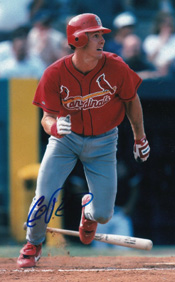
On July 17, 2000, at Minneapolis, Richard hit a home run in his first plate appearance in the big leagues. It came on the first pitch of the second inning from Twins starter Mike Lincoln.

A left-handed batter who played first base and the outfield, Richard, 26, lasted two weeks with the Cardinals, but went on to play in the majors for five seasons.

Prospect with power

Richard was at Oklahoma State University when he was chosen by the Cardinals in the 19th round of the June 1995 amateur baseball draft. Multiple injuries, including a left shoulder tear requiring rotator cuff surgery, slowed his progress in the Cardinals’ system.

In 1999, Richard was injury-free for the first time in nearly two years and produced a successful season. At Arkansas, he led the club in home runs (29) and RBI (94) and batted .294.

With Memphis in 2000, Richard had 16 home runs and 75 RBI before he was called up to the Cardinals in July to fill in for outfielder J.D. Drew, who went on the disabled list because of a severely sprained left ankle.

Sweet swing

On the day Richard joined the Cardinals at the Hubert H. Humphrey Metrodome in Minneapolis, manager Tony La Russa put him in the starting lineup as the left fielder, batting seventh.

After the Cardinals sent six batters to the plate in the first inning, Richard got his first chance to bat as the leadoff man in the second.

The first pitch to him was a fastball in the middle of the strike zone and Richard drove it to right-center. Twins center fielder Jacque Jones raced back in pursuit and reached over the short fence.

“I thought he was going to get it,” Richard told the St. Louis Post-Dispatch.

Instead, the ball cleared the fence just before Jones tried to grab it with his glove. As the umpires signaled a home run, “I think I was just floating,” Richard said. “It was just unreal.” Video

Retired Twins outfielder Kirby Puckett later approached Richard and needled him. “If I had been playing center field, you’d have been 0-for-1,” Puckett said. Boxscore

Dream come true

Richard became the fourth Cardinals player, and the second in two weeks, to hit a home run in his first plate appearance in the majors. Catcher Keith McDonald achieved the feat on July, 4, 2000.

Since then, several others have done it for the Cardinals. The complete list:

_ Eddie Morgan, pinch-hitter, April 14, 1936, vs. Cubs.

_ Wally Moon, center fielder, April 13, 1954, vs. Cubs.

_ Keith McDonald, pinch-hitter, July 4, 2000, vs. Reds.

_ Chris Richard, left fielder, July 17, 2000, vs. Twins.

_ Gene Stechschulte, pinch-hitter, April 17, 2001, vs. Diamondbacks.

_ Hector Luna, second baseman, April 8, 2004, vs. Brewers.

_ Adam Wainwright, pitcher, May 24, 2006, vs. Giants.

_ Mark Worrell, pitcher, June 5, 2008, vs. Nationals.

_ Paul DeJong, pinch-hitter, May 28, 2017, vs. Rockies.

_ Lane Thomas, pinch-hitter, April 19, 2019, vs. Mets.

“You dream about that kind of stuff, but for it to happen, it’s unbelievable,” Richard said.

Name game

Richard had two hits and two walks in 18 plate appearances for the Cardinals before Drew came off the disabled list. Richard was assigned to Memphis when on July 29, 2000, the Cardinals traded him and pitcher Mark Nussbeck to the Orioles for reliever Mike Timlin.

The Orioles projected Richard as a player to help them rebuild. “We really hate to give him up,” Cardinals general manager Walt Jocketty told the Post-Dispatch.

Viewing the trade as an opportunity to stick in the majors, Richard said to the Baltimore Sun, “I’ll have the chance to get some at-bats and get into some games. This team is going through a transition and it’s an atmosphere where we can kind of grow as a team.”

Orioles manager Mike Hargrove welcomed Richard, but told the Sun he was struggling to remember the newcomer’s name: “I told him, ‘I’m going to keep calling you Keith Richards for a while. Don’t get upset when it happens. I’m not even a fan of the Rolling Stones.”

Richard soon made a name for himself with the Orioles, hitting 13 home runs and batting .276 in 56 games in 2000. The next year, he led the Orioles in doubles (31) and tied for the club lead in home runs (15).

Besides the Cardinals and Orioles, Richard also played for the Rockies and Rays.
Read Full Post »

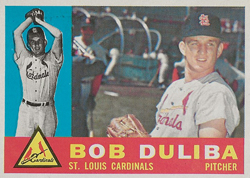
On a journey to join in a happy occasion, Cardinals pitcher Bob Duliba was injured in a car accident in which two infants and a woman were killed.

On July 12, 1960, Duliba was driving from St. Louis to Kansas City to attend the wedding of teammate Ray Sadecki when his car skidded in the rain near Boonville, Mo., and was hit head-on by another vehicle.
In Duliba’s car were his wife, Alice, 21, and two other passengers, Sophie Wilga, 40, and her nine-month-old daughter, Anna Marie Wilga. The girl was killed in the accident, and Duliba and the two women were injured.

In the other car were the driver, Robert Haukap, 26, of Columbia, Mo.; his wife, Margie Haukap, 24; and their two sons, Robert Jr., 3, and nine-month-old Timothy. Killed in the accident were Timothy and his mother. Robert Jr. and his father were injured.

Duliba was charged with careless and reckless driving, but the misdemeanor charge was dismissed by a prosecutor when a jury couldn’t reach a verdict. Duliba resumed his playing career with the Cardinals and went on to pitch for three other big-league clubs.

Pitching prospect

Duliba was born in Glen Lyon, Pa., about 30 miles west of Scranton. He was 9 when his father, who worked in the coal mines, died.

In 1952, when Duliba was 17, he signed with the Cardinals. A right-handed pitcher, he played four seasons in their farm system before enlisting in the Marines in 1956. After three years in the Marines, Duliba returned to baseball with the Cardinals’ Omaha farm team in 1959.

The Cardinals promoted Duliba to the big leagues in August 1959 and he posted a 2.78 ERA in 11 relief appearances for them. Citing the young pitching talent available to the Cardinals, The Sporting News reported, “Among those who look like money in the bank are Bob Duliba, Bob Miller, Bob Gibson, Ernie Broglio and Marshall Bridges.”

In the fall of 1959, the Cardinals brought Duliba to their Florida Instructional League club to have a couple of tutors, former pitchers Johnny Grodzicki and Howie Pollet, work on improving his curveball. “We certainly feel they helped him,” said Cardinals general manager Bing Devine.

Heading into spring training in 1960, Cardinals manager Solly Hemus said he was counting on Lindy McDaniel, Duliba and Bridges to be the club’s top relievers.

In the first half of the 1960 season, Duliba, 25, made 27 relief appearances for the Cardinals and was 4-4 with a 4.20 ERA.

At the all-star break, Duliba prepared to attend Ray Sadecki’s July 13 wedding.

Highway horror

At about 7 p.m. on July 12, Duliba was driving west on U.S. Highway 40, about 10 miles past Columbia, Mo., when he lost control of the car on a curve in a rainstorm, a state trooper told the Kansas City Times.

Duliba’s passenger, Sophie Wilga, testified in magistrate court that the road was slick and the vehicle began skidding, the St. Louis Post-Dispatch reported. Wilga said Duliba’s car came to a stop in the wrong lane immediately before being struck by the car driven by Robert Haukap.

According to the Kansas City Times, Robert Haukap was an engineering student at the University of Missouri and worked for the State Highway department. He suffered a back injury, concussion and cuts in the accident.

His son, Robert Haukap Jr., suffered cuts and bruises.

Duliba’s wife, Alice, fractured her pelvis.

Sophie Wilga, who suffered cuts in the accident, was a former neighbor of Ray Sadecki. She planned to visit family in Kansas City with her daughter after attending the wedding. She was traveling with the Dulibas because her husband Stanley, a grain inspector, remained in St. Louis to work, the Post-Dispatch reported.

Duliba suffered multiple injuries, including five rib fractures, a concussion, cuts and a bruised kidney, The Sporting News reported. The Cardinals declared him inactive for the remainder of the 1960 season.

Case in court

On Aug. 12, 1960, in the Boone County magistrate court, Duliba was charged with careless and reckless driving after a coroner’s jury held him responsible for the accident, citing his car being in the wrong lane when struck. Duliba posted a $100 bond and pleaded not guilty.

According to the Post-Dispatch, Haukap had no recollection of the accident, his attorney, James L. Walsh, said at the inquest.

Duliba declined to testify at the inquest on advice of his attorney, Arnold J. Willman, the St. Louis Globe-Democrat reported. According to the Post-Dispatch, Willman said his client had no auto insurance because he couldn’t afford it.

Willman requested a jury trial and a change of venue. His requests were granted, and the case was shifted from Columbia, Mo., to Fayette, Mo.

A month later, on Oct. 17, 1960, the charge against Duliba was dismissed. Prosecuting attorney Larry Woods of Boone County recommended dismissal after the trial in magistrate court resulted in a hung jury, the Post-Dispatch reported.

Playing again

Duliba recovered from his injuries and played winter ball in Venezuela with Cardinals teammate Bob Gibson before reporting to spring training in 1961. Duliba spent the 1961 season in the minors and made 59 relief appearances.

Back in the minors at the start of the 1962 season, Duliba, 27, got called up to the Cardinals in July. In his first appearance in the majors since the accident, he worked two scoreless innings in relief of Gibson. Boxscore

On July 19, 1962, Duliba got his first save for the Cardinals in three years when he sealed a win for Sadecki against the Cubs. Boxscore

Duliba was 2-0 with two saves and a 2.06 ERA in 28 relief appearances for the 1962 Cardinals.

He figured to be in the club’s plans for 1963, but on April 5 he was optioned to the minors. Duliba “angrily demanded the Cardinals trade him,” the Globe-Democrat reported, and he was sent to the Angels for pitcher Bob Botz.

In three seasons with the Cardinals, Duliba was 6-5 with three saves and a 3.07 ERA in 66 relief appearances. He went on to pitch for the Angels (1963-64), Red Sox (1965) and Athletics (1967). His best season was 1964 when he was 6-4 with nine saves in 58 games for the Angels.

Read Full Post »

Cardinals second baseman Red Schoendienst showed a slugger’s swagger when brought together with baseball’s best.

On July 11, 1950, Schoendienst hit a towering home run in the 14th inning to lift the National League to victory in the All-Star Game at Comiskey Park in Chicago. The feat captured the attention of a nation watching the first televised All-Star Game.

A switch-hitter, Schoendienst’s style was to spray doubles to the gaps rather than bash balls over walls, but he had a feeling he could muscle up that day. According to multiple published reports, Schoendienst, in an uncharacteristic burst of Babe Ruthian bravado, called his game-winning home run before he went to the plate.

Powerful premonition

Schoendienst, 27, was a reserve on the 1950 National League all-star roster. Fans voted Jackie Robinson of the Dodgers to be the starting second baseman. Also selected as starters were three of Schoendienst’s Cardinals teammates: shortstop Marty Marion, first baseman Stan Musial and outfielder Enos Slaughter.

In his autobiography, “Red: A Baseball Life,” Schoendienst said he was shagging fly balls in the outfield before the game when he turned to his teammates and said if he got to play, “I’m going to hit one right up there, in the upper deck.”

The comment drew laughter from the other players, Schoendienst said. He’d hit a mere three home runs in the first half of the regular season and his long balls usually were line drives rather than majestic clouts.

From his seat on the bench, Schoendienst watched as the National League’s reigning home run king, Ralph Kiner of the Pirates, hit a ball deep to left field in the first inning. Ted Williams of the Red Sox crashed into the wall as he made the catch. Williams felt intense pain in his left arm, but stayed in the game, played eight innings and produced a hit and a RBI. The next day, X-rays revealed Williams fractured his left elbow in colliding with the wall and needed surgery to remove several bone fragments.

During the game, Schoendienst reiterated his home run prediction. According to the St. Louis Post-Dispatch, he pointed to the upper deck and told teammates in the dugout, “I wish they’d give me a chance. I’d put one up there.”

The Sporting News reported Schoendienst said, “I’m going to surprise all you by hitting a homer if I ever get into this fight.”

Late entry

With the American League ahead, 3-2, Kiner led off the top of the ninth and hit a fastball from Art Houtteman of the Tigers into the upper deck in left for a home run, tying the score.

After the American League batters went down in order in the bottom half of the ninth, extra innings were played in an All-Star Game for the first time.

In the 11th, National League manager Burt Shotton of the Dodgers made a controversial decision. With one out, and runners on first and second, Shotton sent Johnny Wyrostek of the Reds to bat for Jackie Robinson against Yankees right-hander Allie Reynolds. Shotton made the move because Wyrostek batted from the left side, but he removed the reigning National League batting champion.

Wyrostek flied out to center and the National League failed to score. With Robinson out of the game, Schoendienst went in to play second base in the bottom half of the 11th.

Getting his pitch

Schoendienst got his first chance to bat leading off the top of the 14th against left-hander Ted Gray of the Tigers. Schoendienst hit most of his home runs from the left side, but against Gray he batted right-handed.

He fouled off the first pitch from Gray and took the second for a ball, evening the count. Plate umpire Babe Pinelli called the next one a strike, but Schoendienst thought it was outside the zone and beefed a little. “A little beefing is a lot from mild-mannered Schoendienst,” the Post-Dispatch reported. The next pitch was wide, making the count 2-and-2.

Schoendienst said he looked for Gray to throw a fastball over the plate rather than risk running the count full. Gray grooved one and Schoendienst hit a mighty blow. The ball was 50 feet high at the 360-foot marker when it went into the upper deck seats in left for a home run, the Detroit Free Press reported. Video

Gray told the Associated Press the pitch was a “low, fast one.” The Free Press described it as a sidearm curve.

When Schoendienst was asked about the pitch, he jokingly called it a “double knuckleball.” According to the Chicago Tribune, when it was suggested the pitch may have been a fastball, Schoendienst replied, “A fastball? It couldn’t have been very fast. I pulled it.”

The home run put the National League ahead, 4-3. In the bottom half of the 14th, the American League had one out and Ferris Fain of the Athletics on first when the Yankees’ Joe DiMaggio came to the plate against Ewell Blackwell of the Reds.

Making his final appearance as an all-star, DiMaggio got a curve to his liking. “I was swinging for distance,” he told the Tribune. Instead, he bounced the ball to third baseman Willie “Puddin’ Head” Jones, who threw to Schoendienst for the force on Fain. Schoendienst whipped a throw to Musial at first to nip DiMaggio and complete the game-ending double play. Boxscore

Schoendienst played in the All-Star Game nine times and hit .190. The home run in the 1950 game was his only career RBI as an all-star.

Read Full Post »

In the year he won the National League Cy Young Award, Mike McCormick did his part to try to enable the Giants to keep pace with the Cardinals in the pennant race, but he didn’t get enough help from a pair of future Hall of Famers on the pitching staff.

McCormick, a left-hander, pitched 16 years in the major leagues. He had his best season in 1967 when he was 22-10 with a 2.85 ERA for the Giants.

Relying on a screwball to keep batters off stride, McCormick was 3-0 in three starts against the 1967 Cardinals.

The Cardinals finished with a 101-60 record, 10.5 games ahead of the second-place Giants (91-71). One reason the Giants couldn’t catch the Cardinals was the performances of two starters destined for Cooperstown, Juan Marichal and Gaylord Perry. Marichal was 0-2 versus the Cardinals in 1967 and Perry was 0-5.

ERA leader

A baseball standout from Alhambra, Calif., McCormick was 17 when he signed with the Giants for $50,000 in August 1956. He went directly to the majors and made his debut with a scoreless inning of relief versus the Phillies on Sept. 3, 1956. “He could really throw when I first saw him,” Giants second baseman Red Schoendienst told The Sporting News.

McCormick’s first decision in the big leagues was a loss to the Cardinals in a start on Sept. 15, 1956, at the Polo Grounds in New York. Alvin Dark, who became McCormick’s manager with the 1961-62 Giants, hit a home run against him. Boxscore

The Giants moved from New York to San Francisco after the 1957 season. At their Bay Area home, McCormick and his wife became collectors of antique clocks. “I specialize in school and railroad clocks from the period between 1860 and 1880,” McCormick told The Sporting News.

In 1960, McCormick led the National League in ERA at 2.70. The runner-up was the Cardinals’ Ernie Broglio (2.74). Hall of Fame left-hander Carl Hubbell, the Giants’ farm director, told the Sporting News, “McCormick has a lot of what I call pitching instinct. He doesn’t have a set pattern for pitching to any particular hitter, but he senses what to throw next. Mike amazes me with his poise and control.”

Two years later, the Giants won the National League pennant, but McCormick, who developed a left shoulder injury, was limited to 98.2 innings and had a 5-5 record. He didn’t pitch in the World Series against the Yankees.

After the season, the Giants traded him to the Orioles. “He had a sore arm, a hot temper and a fastball he thought he could throw past any batter,” The Sporting News noted.

Continuing to experience shoulder pain, McCormick was 6-8 for the Orioles in 1963 and 0-2 in 1964 before he was demoted to the minors. In April 1965, the Orioles dealt McCormick to the Senators and he was 19-22 for them over two seasons before being traded back to the Giants in December 1966.

“We think he can help us in relief and as a spot starter,” said Giants general manager Chub Feeney.

Pitching lessons

No longer a power pitcher, McCormick, 29, relied on control and changing speeds in his second stint with the Giants.

It wasn’t an easy transition. Because of rainouts and days off, he made a mere two starts in April 1967. At the end of May, his record was 3-2 with a 4.64 ERA and manager Herman Franks sent him to the bullpen. One of McCormick’s relief appearances came June 16, 1967, against the Cardinals. He pitched 4.1 innings and allowed one run. Boxscore

Returned to the starting rotation, McCormick won seven consecutive decisions from June 19 to July 15. One of those wins was June 27, 1967, a shutout versus the Cardinals at St. Louis. McCormick scattered seven hits and walked none. In contrast, Cardinals starter Steve Carlton walked six in 4.2 innings and gave up four runs. Boxscore

Cardinals hitting coach Dick Sisler said batters made the mistake of trying to pull McCormick’s screwball.

“You can’t play long ball against a screwball,” Sisler told the St. Louis Post-Dispatch. “You’ve got to hit to the opposite field.”

Doing his part

On Aug. 10, 1967, the Giants opened a four-game series against the Cardinals at St. Louis. The Giants were nine games behind the first-place Cardinals and needed to win the series if they were going to challenge for the pennant. “If anybody can catch them, it’s us,” McCormick said.

Hoping to set the tone, McCormick prevailed in the opener, limiting the Cardinals to six hits in a 5-2 victory.

“When he makes you hit his pitch, he’s got you,” Sisler said. “When he wins, I’d say that nine out of 10 batters swing at bad pitches.” Boxscore

Unfazed, the Cardinals won the final three games of the series, beating Gaylord Perry and two former Cardinals, Lindy McDaniel and McCormick’s road roommate, Ray Sadecki. The Giants left St. Louis 11 games behind with 47 left to play.

Top of his game

McCormick faced the Cardinals for the final time in 1967 on Aug. 23 at San Francisco and beat them again, pitching another shutout. His ERA versus the Cardinals for the season was 0.86. Boxscore

“McCormick has done about all he can to stall the Cardinals’ pennant express,” declared the Post-Dispatch.

Said Cardinals outfielder Roger Maris: “He’s always on the borderline with his pitches. He’s on the inside corner or the outside corner, or right on the borderline high or low, but he never has thrown me a pitch down the middle of the plate.”

In games not started by McCormick, the Giants were 4-11 versus the Cardinals in 1967.

McCormick led the league in wins (22) and became the first Giants left-hander with 20 in a season since Johnny Antonelli in 1956. In winning the Cy Young Award, McCormick got 18 of 20 votes from the baseball writers.

McCormick followed the 1967 season with 12 wins for the Giants in 1968 and 11 in 1969 before he was traded to the Yankees in 1970. His last season in the majors was 1971 with the Royals. He finished with a career record of 134-128.

Read Full Post »

Mike Morgan delivered a special performance for the Cardinals at a special time in his life.

On July 3, 1995, Morgan came close to pitching a no-hitter. He held the Expos hitless until giving up an infield single with one out in the ninth at Busch Stadium.

Morgan’s gem capped a life-altering three-week stretch in which he became a father for the first time and got dealt from the Cubs to the Cardinals.
Trial and tribulation

A right-handed pitcher, Morgan was 18 when he was selected by the Athletics in the first round of the 1978 amateur baseball draft. He went directly from high school in Las Vegas to the big leagues and made his debut with the Athletics in a start against the Orioles on June 11, 1978.

Morgan embarked on an odyssey, pitching for the Athletics (1978-79), Yankees (1982), Blue Jays (1983), Mariners (1985-87), Orioles (1988), Dodgers (1989-91) and Cubs (1992-95). The Cardinals were the eighth of 12 teams he pitched for in the majors.

The most successful seasons Morgan had were 1991 with the Dodgers (14-10, 2.78 ERA) and 1992 with the Cubs (16-8, 2.55).

His most trying year was 1994. His mother had stomach surgery, his father developed a brain aneurysm and his wife suffered a miscarriage. Morgan was the Cubs’ Opening Day starter, went on the disabled list three times for multiple physical ailments as well as emotional stress, and finished the strike-shortened season with a 2-10 record and 6.69 ERA.

When the 1995 season began, Morgan was on the disabled list again with an injured rib cage, but his outlook brightened in late May. Morgan’s wife, who got pregnant again in October, was progressing encouragingly and Morgan returned to the Cubs’ rotation.

After winning two of three decisions for the 1995 Cubs, Morgan told The Sporting News, “If I’m healthy, I can pitch with anyone, and right now I’m healthy.”

The Cubs came close to dealing Morgan to the Phillies, prompting him to say, “I don’t want to go anywhere. Four years are the longest I’ve been with one club. These are my friends. They’re great dudes.”

Big changes

On the morning of June 16, 1995, Morgan was with his wife, who had gone into labor, at a hospital near their home in Utah. Soon after his wife gave birth to their first child, a girl, Morgan got a phone call from the Cubs. Expecting congratulations, Morgan instead was told he’d been traded to the Cardinals with two minor-league prospects for first baseman Todd Zeile. Morgan also learned the Cardinals had fired manager Joe Torre.

Morgan said goodbye to his wife and daughter, and dutifully reported to St. Louis, where two days later, June 18, 1995, he started for the Cardinals and took the loss against the Giants. Boxscore

He earned a complete-game win versus the Phillies in his second start and lost to the Astros in his third, giving him a 1-2 mark and 4.19 ERA with the Cardinals.

Taking control

Morgan, 35, made his next start against the Expos on a Monday night in St. Louis.

The Cardinals got a run in the first and five in the eighth, including John Mabry’s first home run in the big leagues, while Morgan kept the overeager Expos from getting a hit, enticing them to chase pitches.

“This is precisely the kind of guy who gives an undisciplined team like ours trouble,” Expos manager Felipe Alou told the Montreal Gazette.

The Expos didn’t get a ball out of the infield until Darrin Fletcher lined out to left in the eighth. Fletcher described Morgan’s pitches as “a little cutter away, a sinker away, a little harder sinker. Nothing inside.”

Rondell White, one of the Expos’ top hitters, said, “You get anxious because he’s not doing anything but throwing the ball to the outside. You’re up there hoping you get that fastball, just one of them, but it never comes.”

White hit a groundball in the eighth between first and second. Ranging to his left, second baseman Geronimo Pena gloved the ball, spun and threw blindly to first. The throw was wide and low, pulling first baseman Danny Sheaffer off the bag.

Official scorer Jack Herman gave an error to Pena. “I thought he had time to make a good throw,” Herman told the St. Louis Post-Dispatch. He also admitted to the Montreal Gazette, “I might have scored it differently if it wasn’t a no-hitter.”

Alou called the ruling “an insult.” Morgan said, “Let’s face it, that ball gets hit like that in Montreal and it’s scored a hit.”

The next batter, Jeff Treadway, hit a drive to deep center. Brian Jordan raced to the wall and made a twisting catch.

Tough play

In the ninth, after Curtis Pride led off and flied out to left, Tony Tarasco drew a walk and Wil Cordero came to the plate.

Cordero hit a grounder down the third-base line. Scott Cooper grabbed the ball with his bare hand and fired a low throw to Sheaffer, who scooped it out of the dirt as Cordero streaked across the bag for a single.

Umpire Wally Bell told the Post-Dispatch, “I don’t think he would have beaten it out if the throw was good.”

Sheaffer said, “He had it beat, no question.”

Said Morgan: “Cooper did everything he could.”

With the no-hit bid gone, Jeff Parrett, a former Expo, relieved Morgan and secured the win, striking out David Segui and getting Moises Alou to ground out. Boxscore

Morgan lost his next four decisions and didn’t win again until Aug. 25. He was 5-6 with a 3.88 ERA for the 1995 Cardinals.

In 1996, Morgan was 4-8 with a 5.24 ERA for the Cardinals before he was released in August. He went on to pitch for the Reds (1996-97), Twins (1998), Cubs again (1998), Rangers (1999) and Diamondbacks (2000-2002).

With the 2001 Diamondbacks, Morgan, 42, got to the World Series for the first and only time. He made three relief appearances versus the Yankees and held them scoreless over 4.2 innings.

Morgan finished his career in the majors with a 141-186 record.

Read Full Post »

(Updated Nov. 24, 2024)

An impressive collection of managerial talent participated in an important game in the evolution of the Cardinals.

The Cardinals played a regular-season home game at Sportsman’s Park in St. Louis for the first time on July 1, 1920.

In addition to managers Branch Rickey of the Cardinals and George Gibson of the Pirates, seven of the players in the game went on to manage in the big leagues.

Moving in

The Cardinals had been playing their home games at dilapidated Robison Field until club owner Sam Breadon convinced his counterpart with the American League Browns, Sportsman’s Park landlord Phil Ball, to take in the cash-strapped Cardinals as a tenant.

The move to renting at Sportsman’s Park enabled Breadon to demolish Robison Field and sell most of the property to the city of St. Louis for $200,000 and sell the rest of the land for $75,000 to a trolley company.

On June 6, 1920, a Sunday afternoon, the Cardinals played their last game at Robison Field before going on a road trip for the rest of the month. Boxscore.

When the Cardinals got back from the trip, their first game at Sportsman’s Park was scheduled for a Thursday afternoon against the Pirates.

Attracting a crowd

The Pirates vs. Cardinals game was the feature of a program of events held at Sportsman’s Park that day to benefit the St. Louis Tuberculosis Society.

Described by the St. Louis Star-Times as an “athletic carnival.” the program included a five-inning matchup between Army and Navy baseball teams and the completion of a high school boys’ road run. The Navy beat the Army, 7-5. The game between the Pirates and Cardinals was scheduled to follow at 4 p.m.

According to an advertisement in The Sporting News, the price for a ticket to the day’s entire program ranged from 50 cents to $1.50.

Customers poured into Sportsman’s Park early. By 2 p.m., “the reserved seats were taken,” the St. Louis Post-Dispatch reported.

Those with tickets for unreserved seats, referred to by the Post-Dispatch as “the unseated mob,” preferred standing room on the field to the “sun-baked bleachers” and they “swarmed into roped off areas” on both sides of left and right fields.

When the game began, attendance was 20,000, the Star-Times estimated.

Lots of leaders

Lineups for the two teams featured these future big-league managers:

_ Pirates center fielder Max Carey, who became manager of the Dodgers (1932-33).

_ Pirates right fielder Billy Southworth, who became manager of the Cardinals (1929 and 1940-45) and Braves (1946-51). Southworth managed the Cardinals to three National League pennants and two World Series titles. He also won a pennant with the Braves.

_ Pirates shortstop Bill McKechnie, who became manager of the Pirates (1922-26), Cardinals (1928-29), Braves (1930-37) and Reds (1938-46). McKechnie managed the Cardinals to the 1928 pennant. He also won a pennant and World Series title with the Pirates, and two pennants and a World Series championship with the Reds.

_ Pirates first baseman Charlie Grimm, a St. Louis native who became manager of the Cubs (1932-38, 1944-49 and 1960) and Braves (1952-56). Grimm managed the Cubs to three pennants.

_ Cardinals left fielder Burt Shotton, who became manager of the Phillies (1928-33), Reds (1934) and Dodgers (1947-50). Shotton managed the Dodgers to two pennants.

_ Cardinals second baseman Rogers Hornsby, who became manager of the Cardinals (1925-26), Giants (1927), Braves (1928), Cubs (1930-32), Browns (1933-37 and 1952) and Reds (1952-53). Hornsby managed the Cardinals to their first pennant and World Series title in 1926.

_ Cardinals third baseman Milt Stock, who managed the Pirates for one game in 1951 and was a longtime coach in the majors.

Five of the participants in the game _ Carey, Hornsby, McKechnie, Rickey and Southworth _ would be inducted into the National Baseball Hall of Fame. Carey and Hornsby got in as players, Southworth and McKechnie as managers and Rickey as an administrator.

Pirates prevail

The Pirates led, 2-0, through seven innings, but the Cardinals got a run in the eighth and another in the ninth, tying the score at 2-2.

In the 10th, Cardinals starter Ferdie Schupp was relieved by Bill Sherdel, whose “slants were eaten up like hot waffles,” according to the Pittsburgh Daily Post.

Carey led off with a single to left and Southworth struck out looking. Possum Whitted singled to right and Carey dashed to third, beating the throw of right fielder Joe Schultz.

Whitted rounded first on the play, drawing a throw from third baseman Milt Stock. Carey broke for home as Stock’s throw went to first baseman Jack Fournier. Whitted got back to the bag safely and Fournier hurried a throw toward home plate, hoping to nail Carey.

“Fournier should have had him by 40 feet,” the Pittsburgh Press declared, but the low toss eluded catcher Verne Clemons. As the ball rolled toward a dugout, Carey crossed the plate, putting the Pirates ahead, 3-2, and Whitted went to third.

Rattled, Sherdel walked McKechnie. Grimm doubled to center, scoring Whitted and giving the Pirates a 4-2 lead. The Pirates scored twice more against Sherdel and went on to a 6-2 victory. Boxscore

Though the outcome of their first game at Sportsman’s Park wasn’t what the Cardinals wanted, the move there was hailed as a positive for the franchise.

In its July 8, 1920, edition, The Sporting News reported, “Everyone seems happy over the shift of the Cards to the Browns’ park. The attendance at the games played there has been all that could be asked for by the club management, and everything has run smoothly to date.”

St. Louis fans of both the Browns and Cardinals, however, had a reputation for being tough on visiting players.

In his book “Busting ‘Em,” Ty Cobb said, “The two worst towns on the American League circuit for rooters riding visiting ballplayers are St. Louis and Philadelphia.”

Regarding fans in St. Louis, Cobb said, “It seems as if about half the spectators there attend the game for the fun of panning the visiting players. The names that the occupants of the bleachers call the outfielders could not be printed on asbestos paper. If they ever get a winner in St. Louis, every visiting ballplayer will have to have police protection each time the home club loses a close game.”

In the book “The Glory of Their Times,” Pirates right fielder Paul Waner recalled that when he reached the majors in 1926 his teammates warned him about the fans in St. Louis.

“So the first time we went into St. Louis, I figured if they jumped on me I’d have a little fun,” Waner said. “Sure enough, as soon as I showed up in right field, they started in and gave me a terrible roasting. I turned around and yelled, ‘They told me about all you fans in St. Louis, that all the drunken bums in the city come here, and now that I’m here, I see it’s true.’ Oh, did they scream!”

Waner said months later he won over the fans in St. Louis when he handed a ball to “some old fellow” in the stands.

The Cardinals continued to play at Sportsman’s Park, later renamed Busch Stadium, until May 1966 when they moved into a new stadium downtown.

Read Full Post »

« Newer Posts - Older Posts »