Feeds:
Posts
Comments

Archive for the ‘Games’ Category

(Updated Dec. 28, 2024)

In his first game against the Phillies after being traded to the Cardinals, Dick Allen savored sweet satisfaction.
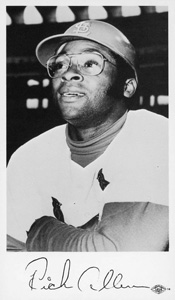
On May 11, 1970, Allen hit a three-run walkoff home run in the bottom of the ninth inning, ending a scoreless duel between future Hall of Famers Jim Bunning and Steve Carlton and carrying the Cardinals to a 3-0 triumph.

Seven months earlier, in October 1969, Allen was traded by the Phillies to the Cardinals in a multi-player deal involving Curt Flood, Tim McCarver and others. Allen’s relationship with Phillies management deteriorated when they suspended him for part of the 1969 season because of insubordination.

Given his first chance for revenge, Allen delivered a spectacular result.

Masters on the mound

The Monday night matchup between Bunning, 38, and Carlton, 25, was a classic. Bunning was in his second stint with the Phillies. He and Allen were Phillies teammates from 1964-67. Carlton was two years away from being traded to the Phillies and becoming their ace.

Carlton gave up two hits in the first inning and two more over the last eight. He retired 15 batters in a row until Tony Taylor hit a double with one out in the ninth.

Bunning held the Cardinals hitless until the sixth. With one out, Carlton singled to center and Jose Cardenal followed with an infield hit on a slow bouncer to short. After Leron Lee struck out, Lou Brock sliced a shot toward third. Don Money, the third baseman, lunged for the ball, knocked it down and held Brock to a single, loading the bases for Allen.

Working carefully, Bunning got the count to 1-and-2 to Allen and threw a low, inside pitch. Allen swung and missed.

Surprise sign

After Carlton worked out of a tight spot in the top of the ninth, getting former teammate Byron Browne to ground out with two on and two outs, the Cardinals went to work against Bunning in the bottom half of the inning.

Leron Lee led off and drilled a high pitch against the wall in right-center for a double. Looking to set up a force play and avoid facing a left-handed batter, Bunning gave an intentional walk to Brock, preferring to face Allen.

“It was a situation Rich must have been dreaming about,” wrote Philadelphia Inquirer columnist Frank Dolson.

Allen stepped into the batter’s box and looked for a sign from George Kissell, the third-base coach. Kissell signaled for Allen to bunt.

“Rich stared at him, seemingly unable, or perhaps unwilling, to comprehend the signal,” the Inquirer reported.

Allen asked for the sign again. Kissell walked up to Allen and told him to bunt.

Cardinals manager Red Schoendienst told the St. Louis Post-Dispatch he ordered the bunt because “the third baseman was playing back.”

Allen squared around and took the first pitch from Bunning for strike one.

“No way he wanted to bunt,” said Phillies pitcher Chris Short, who was watching the drama from the dugout.

Allen again looked toward Kissell and got the sign to swing away. Schoendienst said he switched gears because the Phillies’ corner infielders “were coming in” to play for a bunt.

Allen fouled the pitch back, making the count 0-and-2.

Wrong pitch

Bunning wanted the next pitch to be a fastball inside. “I wanted to get it in because he likes the ball out over the plate,” Bunning told the Inquirer.

Bunning hoped to drive Allen off the plate and come back with a pitch away. “I was trying to set him up for a curveball,” Bunning explained.

Instead, Bunning’s third pitch to Allen was “way up and over the middle of the plate,” Bunning said. “It was over his head, in fact.”

Allen swung his 40-ounce bat and drove the ball into the “fourth or fifth row of the bleachers in right-center,” the Post-Dispatch reported.

As Bunning walked slowly off the mound, “Allen trotted around the bases to be mobbed at home plate by his teammates,” the Inquirer reported. He was “the center of attention in the raucous Cardinals clubhouse, as noisy as if a team had just won a pennant.”

“Rich Allen wanted to hit that ball out of here something bad and he did it,” Carlton told the Philadelphia Daily News.

Said Allen: “I’m happy I helped Steve Carlton win a game the way he pitched.” Boxscore

Gene Mauch, who had issues with Allen when he managed him with the Phillies before going to the Expos, told The Sporting News, “I wouldn’t give him a high fastball or a fast highball.”

Allen had a career batting average of .478 versus Bunning. Of Allen’s 11 hits against him, three were home runs and three were doubles.

In December 2014, Bunning was a member of a Baseball Hall of Fame committee and lobbied for Allen to be elected to the shrine. Allen needed 12 of 16 votes from the committee and got 11. The close miss upset Bunning, who absolutely had firsthand knowledge of Allen’s qualifications.

Ten years later, in December 2024, Allen got the committee votes needed for election. The committee included his former Cardinals teammate, Joe Torre, and two other former Cardinals, Lee Smith and Ozzie Smith, as well as Dick Kaegel, who’d been a reporter for the Post-Dispatch.

Read Full Post »

The Cardinals gave Terry Francona a chance to finish his playing career as part of a Louisville outfield with Ray Lankford and Bernard Gilkey.

On May 5, 1990, the Cardinals signed Francona, 31, after he was released by the Brewers and put him on their Class AAA farm club at Louisville.
The Cardinals made the move because Francona provided insurance in case their left-handed pinch-hitter, Denny Walling, faltered, and because he brought experience to a Louisville lineup featuring prospects Lankford, Gilkey and first baseman Rod Brewer.

Francona’s lone season in the Cardinals’ system was his last as a player, but hardly the end of his baseball career.

In 2004, Francona managed the Red Sox to a World Series sweep of the Cardinals, and in 2011 he was a candidate to replace Tony La Russa as St. Louis manager.

All in the family

Tito Francona, Terry’s father, was an outfielder and first baseman in the majors for 15 years with nine teams, including the 1965-66 Cardinals.

Terry Francona followed his father into baseball. He batted .769 as a high school senior in New Brighton, Pa., and went on to play at the University of Arizona for coach Jerry Kindall, a teammate of Tito Francona with the 1962-64 Indians.

In 1980, Arizona won the College World Series championship. Terry Francona was named outstanding player of the tournament and he won the Golden Spikes Award as the top college baseball player of the year.

The Expos selected Francona in the first round of the 1980 amateur draft and he made his major-league debut with them a year later in August 1981. Like his father, Terry Francona batted left-handed and played outfield and first base.

On Sept. 16, 1981, Francona hit his first major-league home run and it came against Cardinals closer Bruce Sutter at Montreal. Francona said “Mr. Fanning,” Expos manager Jim Fanning, told him to take the first pitch from Sutter, the St. Louis Post-Dispatch reported. Francona did and it was called a ball. He swung at the second and hit it over the right-field wall.

“We felt that wasn’t a bad pitch,” said Cardinals manager Whitey Herzog.

Said Sutter: “The kid hit a home run. It couldn’t have been a good pitch.” Boxscore

Francona went on to hit .274 in a big-league career with the Expos (1981-85), Cubs (1986), Reds (1987), Indians (1988) and Brewers (1989-90). He batted .311 versus the Cardinals and had more career hits (46) against them than he did any other team.

Kentucky home

Francona’s last appearance in a big-league game was April 19, 1990, when he ran for Dave Parker. The Brewers released him April 27 and the Cardinals signed him a week later.

On May 5, 1990, in his first game for Louisville, Francona had a double and triple against Buffalo. Louisville’s outfield was Francona in right, Lankford in center and Gilkey in left.

Four days later, on May 9, 1990, those three played central roles in a wild inning.

Louisville scored 16 runs in the third inning of an 18-4 win at home against Nashville. Gilkey had two singles, a home run and four RBI in the inning. Francona and Lankford also hit home runs in the inning. Francona’s was a two-run shot and Lankford’s was his first grand slam as a professional.

Francona’s home run came against starter Rodney Imes, the first of three Nashville pitchers in the inning. The others were Bobby Moore and Neil Allen, the former Cardinal. Francona pitched the eighth and ninth innings of the blowout for Louisville and allowed one run on one hit, a home run by Keith Lockhart.

The next day, Louisville, naturally, was held to three hits, but one was a two-run home run by Francona, in a 4-1 win versus Indianapolis.

Francona played mostly against right-handers and finished the season with a .263 batting average, six home runs and 30 RBI. “We thought he’d hit better and for more power,” manager Gaylen Pitts told the Louisville Courier-Journal.

A left-handed thrower, Francona was an effective mopup reliever for Louisville. In five appearances as a pitcher, he had a 1.17 ERA, allowing one earned run in 7.2 innings and striking out six.

New career

After the 1990 season, Francona had reconstructive knee surgery. Receiving no offers to play again, he tried selling real estate but didn’t like it. He got back into baseball when his former Reds teammate, Buddy Bell, who was in the White Sox front office, offered him a job to coach in the minors. In 1992, Francona became manager of a White Sox farm team in South Bend, Ind.

Francona managed the Phillies from 1997-2000 and Red Sox from 2004-2011 before becoming Indians manager in 2013. He led the Red Sox to World Series titles in 2004 and 2007. The 2004 World Series championship was their first since 1918. He also managed the Indians to the 2016 American League pennant.

When Tony La Russa retired after managing the Cardinals to the 2011 World Series title, Francona was a candidate to replace him. Others were Mike Matheny, Ryne Sandberg, Jose Oquendo, Joe McEwing and Chris Maloney, the St. Louis Post-Dispatch reported.

A search committee interviewed Francona on Nov. 8, 2011, in Cincinnati where Cardinals owner Bill DeWitt Jr. resided and operated a private equity firm.

“We discussed pretty basic philosophy,” Francona told the Post-Dispatch. “I’d call it an enjoyable, casual conversation.”

A week later, on Nov. 14, 2011, Matheny was named manager of the Cardinals.

Read Full Post »

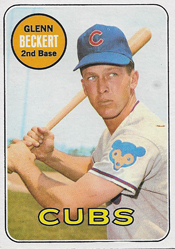
Glenn Beckert rarely struck out, but he did get knocked out by Mike Shannon.

Beckert was the Cubs’ second baseman from 1965-73 and finished his playing career with the 1974-75 Padres. A four-time all-star, Beckert won a Gold Glove Award in 1968.
On April 16, 1969, Beckert and Shannon were involved in a painful play at Busch Memorial Stadium. Shannon crashed into Beckert while trying to stretch a single into a double. Beckert suffered a concussion, was carried off on a stretcher and spent a night in a hospital. Shannon became woozy and was removed from the game.

Contact hitter

A Pittsburgh native, Beckert played shortstop at Allegheny College and graduated with a degree in political science. The Red Sox signed him and after a year in their farm system as a shortstop he was chosen by the Cubs in the November 1962 minor-league draft.

Beckert primarily played third base and shortstop in two years in the Cubs’ farm system. After the 1964 season, the Cubs converted him to a second baseman at their winter instructional league. Beckert adapted quickly, impressed at spring training and made his major-league debut as the starting second baseman and leadoff batter in the Cubs’ 1965 season opener versus the defending World Series champion Cardinals. Boxscore

At the plate, Beckert was adept at making contact. When Leo Durocher became Cubs manager in 1966, he took a liking to Beckert for his ability to execute hit-and-run plays and advance runners by hitting behind them. Beckert reminded Durocher of two other favorites he’d managed, Al Dark and Eddie Stanky.

“Glenn always gets a piece of that ball,” Durocher told The Sporting News.

A right-handed batter, Beckert choked up on the bat and perfected a short stroke. “I try not to swing too hard,” he said, “and when the pitcher gets two strikes on me, I concede a little more to him. I don’t choke up any further on the bat, but I cut down more on my swing.”

Bat control

Beckert five times led National League batters in fewest strikeouts per at-bat. In 1968, when he had a career-high in hits (189), Beckert struck out 20 times in 643 at-bats. He averaged one strikeout every 32.2 at-bats that season. By comparison, the next-best, Felix Millan of the Braves, averaged one strikeout every 21.9 at-bats.

In 1,320 career games in the majors covering 5,208 at-bats, Beckert had 1,473 hits and a mere 243 strikeouts. The most times he struck out in a season was 52 as a rookie in 1965.

“In this era of swinging from the heels, he has become the thinking man’s player,” The Sporting News reported in 1968.

Said Beckert: “Once I got home runs out of my mind, I stopped striking out. Now when I go to the plate, all I think about is making contact. I want to hit the ball.”

Beckert only once struck out three times in a big-league game. It happened on May 5, 1967, against the Cardinals at Wrigley Field. Starter Dick Hughes struck him out twice and Ron Willis got him once. Those were Beckert’s first strikeouts of the season after going 69 at-bats without a whiff. Boxscore

Dazed and confused

Two years later, on a Wednesday night in St. Louis, pitchers Ferguson Jenkins of the Cubs and Steve Carlton of the Cardinals were locked in an early-season duel.

The Cubs were ahead, 1-0, when Shannon led off the bottom of the seventh inning and lined a pitch down the third-base line. Shannon said he thought the ball was headed toward the left-field corner for a double. He didn’t see the ball hit Satch Davidson, a rookie umpire stationed at third, and drop to the ground. Cubs third baseman Ron Santo retrieved the ball.

As Shannon neared first base, he saw coach Dick Sisler point toward second base.

“I saw the ball hit the ump, but then I was blocked out by Santo,” Sisler told the St. Louis Post-Dispatch. “I thought the ball caromed away.”

Santo told the Chicago Tribune, “When I got the ball, I saw Shannon rounding first like he hadn’t seen what had happened.”

Santo threw to first baseman Ernie Banks, hoping to catch Shannon. Said Sisler: “When Santo came up throwing, he surprised everybody.”

The ball arrived too late to nab Shannon, who was steaming toward second.

Banks threw to Beckert and the ball arrived before Shannon did. Beckert braced and applied the tag as Shannon barreled into him, knocking him to the ground.

Santo said he saw Beckert’s head “jerk back and he went flat on the ground like he was paralyzed. He told me he couldn’t see out of his right eye.”

The collision was deemed a clean play. “The runner is trying to knock the ball loose,” Jenkins told the Post-Dispatch. “Shannon didn’t mean to hurt him. If we’d thought he did it on purpose, we’d have had a little brawl.”

While Beckert was taken to a hospital, Shannon complained of dizziness. “I didn’t pass out, but I did see wavy lines,” Shannon told the Post-Dispatch.

Phil Gagliano replaced Shannon at third base the next inning.

Jenkins completed a five-hit shutout for the win. Boxscore

The next day, Beckert was released from the hospital and diagnosed with a concussion and a stiff neck. Two days later, he was back in the Cubs’ lineup.

Read Full Post »

One ball, two home runs.

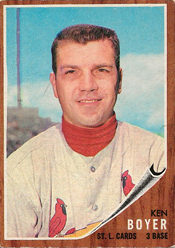
On April 23, 1960, Cardinals sluggers Ken Boyer and Daryl Spencer each hit a home run with the same baseball.

The unusual feat occurred in the second inning of a game against the Dodgers at St. Louis.
With the Dodgers ahead 4-0, Boyer led off the bottom of the second against Danny McDevitt and hit a home run into the pavilion in right-center. A spectator tried to catch the ball, but muffed it and the ball fell back onto the playing field, according to the Los Angeles Times.

Umpires examined the ball, “found it to be in good condition and put it back in play,” The Sporting News reported.

The next batter, Stan Musial, flied out to right fielder Sandy Amoros, who threw the ball back to the infield.

McDevitt, still using the same ball he threw to Boyer and Musial, delivered a pitch to Spencer, who connected for “one of the most robust home runs ever to dent the bleacher scoreboard” in left, the St. Louis Post-Dispatch reported. The ball “almost knocked the cap off” the electronic animated cardinal on the far left side of the scoreboard, according to the Post-Dispatch.

A spectator retrieved the ball and put it in his pocket, The Sporting News noted.

Boyer hit another home run, a two-run shot in the fifth, against Larry Sherry. He also had a run-scoring double and a sacrifice fly and finished with five RBI in a 9-5 Cardinals victory.

The game also was noteworthy for Cardinals right-hander Bob Duliba, who pitched five innings of relief for his first big-league win. Duliba also got his first hit in the majors, a single against Sherry. Boxscore


Read Full Post »

(Updated Nov. 25, 2024)

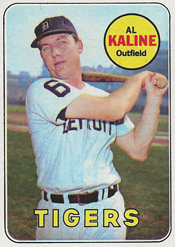
In a World Series filled with epic performances and major controversies, Al Kaline produced with his usual quiet consistency. His steady professionalism calmed the Tigers and inspired them to overtake the defending champion Cardinals.

The Hall of Fame right fielder played in the major leagues for 22 years, all with the Tigers, and appeared in one World Series, the 1968 classic.

After the Cardinals won three of the first four games, the Tigers rallied to win the last three, including Games 6 and 7 at St. Louis. The 1968 World Series was highlighted by:

_ The Cardinals’ Bob Gibson striking out 17 batters in Game 1.

_ The Tigers’ Mickey Lolich overshadowing teammate and 30-game winner Denny McLain by earning three wins, including Game 7.

_ Cardinals catalyst Lou Brock trying to score standing rather than sliding and being called out, turning the tide in the pivotal Game 5.

_ Gold Glove center fielder Curt Flood failing to catch a drive by Jim Northrup, allowing the Tigers to take control in Game 7.

Kaline, who got into the World Series lineup as the right fielder because of Tigers manager Mayo Smith’s bold decision to shift Mickey Stanley to shortstop, didn’t do anything epic or controversial, but his performance was integral.

Kaline batted .379 against the Cardinals and had an on-base percentage of .400. He had 11 hits, two home runs and eight RBI. He also fielded splendidly.

After the Tigers’ Game 7 triumph, Cardinals manager Red Schoendienst told the St. Louis Post-Dispatch, “You know what the turning point in the Series was? It was Kaline carrying them all along with him. That’s what beat us.”

Rising up

Kaline was born in Baltimore and grew up in a row house. His father worked in a broom factory and his mother scrubbed floors. His parents encouraged Kaline to play baseball.

“My dad was always there to play catch with me,” Kaline told Joe Falls of The Sporting News. “He’d be on his feet all day long at the factory and he’d come home dead tired, but we’d go down to the corner and start playing catch. He’d hit me some fly balls.”

In a 1965 profile, Sports Illustrated reported, “The Kaline family was poor, proud and hungry _ no Kaline had ever graduated from high school _ and before long the whole clan had decided little Al was going to be something different.”

Like his contemporary, Mickey Mantle, Kaline had osteomyelitis, a bone infection. “When he was 8 years old, doctors took two inches of bone out of his left foot, leaving jagged scars and permanent deformity,” Sports Illustrated reported. “They left him with a set of sharply swept-back toes on his left foot. Only two of those toes touch the ground when he walks, which has forced him to develop a running style on the heel and toes of his right foot and on the side of his left foot.”

Kaline overcame his physical limitations and developed into a top prospect. On June 19, 1953, Kaline, 18, signed with the Tigers for $30,000.

“He turned every penny of it over to his father and his mother,” Sports Illustrated reported. “The mortgage was paid off on the house and Mrs. Kaline’s failing eyesight was saved by an operation.”

On June 25, 1953, a week after his signing, Kaline made his debut in the majors against the Athletics at Philadelphia and never played a day in the minors.

Under pressure

In 1955, Kaline, 20, became the American League batting champion, hitting .340. He had 200 hits and struck out a mere 57 times.

Asked who Kaline reminded him of, Red Sox slugger Ted Williams replied, “Joe DiMaggio,” The Sporting News reported.

Kaline was called the Tigers’ best player since Hall of Famer Charlie Gehringer and comparisons also were made to Ty Cobb. For Kaline, it was too much too soon.

“The worst thing that happened to me in the big leagues was the start I had,” Kaline said. “This put the pressure on me. Everybody said this guy’s another Ty Cobb, another Joe DiMaggio. What they didn’t know is I’m not that good a hitter. I have to work as hard, if not harder, than anybody in the league.”

Described by Bob Broeg of the Post-Dispatch as “gracefully methodical,” Kaline remained the Tigers’ best player, even though he suffered setbacks such as a fractured cheekbone, fractured collarbone, rib injuries and a broken right hand.

According to Broeg, Chuck Dressen, who managed Kaline from 1963-66 after managing the Reds, Dodgers, Senators and Braves, said, “He’s the best player who ever played for me. Jackie Robinson was the most exciting runner I ever had and Hank Aaron the best hitter, but for all around ability _ hitting, fielding, running and throwing _ I’ll go with Al.”

On May 25, 1968, Kaline’s right forearm was broken when hit by a pitch from Lew Krausse of the Athletics. Mayo Smith moved Jim Northrup from center to right and put backup Mickey Stanley in center.

The outfield of Stanley, Northrup and Willie Horton in left excelled, and when Kaline returned to the lineup on July 1 he split time with Northrup in right and with Norm Cash at first base.

After the Tigers clinched the pennant, Smith moved Stanley to shortstop, a position he hadn’t played, for nine games in place of weak-hitting Ray Oyler. Satisfied Stanley could handle the switch, Smith kept Stanley at shortstop for the World Series and went with an outfield of Horton, Northrup and Kaline.

New heights

The Cardinals in 1968 were in the World Series for the third time in five years. The Tigers hadn’t been in a World Series since 1945. Kaline had waited 16 seasons for the chance. Entering Game 1 at St. Louis, “I’d never been so nervous in my life, ” Kaline told The Sporting News.

Kaline hit a double against Gibson but also struck out three times. Gibson tied Sandy Koufax’s World Series strikeout mark of 15 when he fanned Kaline for the first out in ninth before completing the game with strikeouts of Cash and Horton.

Said Kaline: “That was the greatest pitching I’ve seen in a long, long time.” Boxscore

(In 2018, Kaline told Joe Schuster of Cardinals Yearbook that Gibson “will always go down in my mind as the best pitcher I ever faced _ by far.”)

In Game 2, Kaline had two hits and scored two runs, but his defense was the story. In the first inning, the Cardinals had Julian Javier on second and Flood on first with one out when Orlando Cepeda lifted a ball to the corner in right. As the ball sliced into foul territory, Kaline, stationed in right-center, raced over, made a running one-handed catch and crashed through a gate.

“I guess I was only about a step, or a step and a half, away from the sideline fence out there,” Kaline told the Post-Dispatch. “I figured I’d make the catch, stop, pivot and throw, but when I hit the fence, I went through it. It’s well-padded out there, but there’s a gate, and I hit it. I was surprised when the fence opened.”

Kaline’s throw to the infield kept both runners from advancing.

The next batter, Mike Shannon, hit a looping fly to right-center and Kaline made another running one-handed grab. Boxscore

In Game 3 at Detroit, Kaline hit his first World Series home run, a two-run shot versus Ray Washburn. Boxscore In Game 4, Kaline had two of the Tigers’ five hits versus Gibson, but the Cardinals were a win away from clinching the championship. Boxscore

Title run

In the seventh inning of Game 5, the Cardinals led, 3-2, but the Tigers loaded the bases with one out. Kaline came up to face Joe Hoerner, a left-handed reliever. “The situation called for a right-handed replacement,” the Post-Dispatch declared, “but Schoendienst’s lack of regard for his right-handed relievers seemed even more pronounced than his confidence in Hoerner.”

Kaline took a mighty cut at a Hoerner pitch and missed. “He was trying for the home run with the bases loaded,” said Mayo Smith, “but then he realized he had to get the base hit.”

Kaline stroked Hoerner’s next pitch to right-center for a two-run single, giving the Tigers a 4-3 lead on the way to a 5-3 victory. Boxscore

“I wanted to hit it up the middle to get away from the double play,” said Kaline. “I enjoy batting with men on base. When there aren’t, there’s no incentive.”

The Series returned to St. Louis and the Tigers cruised to a 13-1 victory in Game 6. Kaline contributed three hits, four RBI and three runs. In the Tigers’ 10-run third inning, Kaline had two hits, a RBI-single against Washburn and a two-run single versus Ron Willis. In the fifth, he hit a solo home run off Steve Carlton. Boxscore

“I wanted it to go seven games,” Kaline said. “If we lose it, I want it to be to Gibson.”

Gibson and Lolich were locked in a scoreless duel in Game 7 until the Tigers broke through with three runs in the seventh and went on to a 4-1 victory. Boxscore

Cardinals general manager Bing Devine showed his respect by going into the Tigers’ clubhouse to congratulate Kaline and shake his hand.

For the Series, Kaline hit .571 with runners in scoring position. He was 4-for-5 versus Cardinals left-handers.

In the Post-Dispatch, Bob Broeg wrote, “It’s nice that this underrated athlete has made the most of the long-awaited Series opportunity, even if it has come at the expense of the Cards.”

Read Full Post »

Seeking a way to attract more customers and more revenue, the Cardinals saw the light and broke with tradition.

On April 18, 1950, the Cardinals became the first major-league team to play a season opener at night. Club owner Fred Saigh said he opted for an Opening Night game because it gave more working people a chance to attend.

The innovation was a success, though not as much as anticipated.

Expecting a crowd of 30,000 for their Tuesday night game against the Pirates at Sportsman’s Park in St. Louis, the Cardinals drew 20,871, the largest attendance for a Cardinals home opener. The previous high was 20,754 for the 1928 opener on a Wednesday afternoon versus the Pirates.

Time for a change

Though St. Louis was home to two teams, the National League Cardinals and the American League Browns, Opening Day there then wasn’t the grand event it was in places such as Cincinnati and Washington, D.C.

“This is a good baseball town, but the cash customers here don’t become too excited about Opening Days,” St. Louis Post-Dispatch sports editor J. Roy Stockton wrote in April 1950.

On the eve of the Cardinals’ 1950 opener, St. Louis Globe-Democrat sports editor Bob Burnes noted, “The last time anything special was done for Opening Day in St. Louis was 1936” when the Cubs and Cardinals players “appeared downtown in their baseball uniforms. Then they paraded through the downtown and midtown areas in open carriages.”

Later that afternoon, the Cubs thumped the Cardinals, 12-7, before 14,000 customers, putting an end to any more Opening Day parades.

After winning the 1946 World Series championship, their third in five years, the Cardinals drew 11,963 spectators to their 1947 home opener on a Friday afternoon against the Cubs.

The attendances for subsequent Cardinals home openers were 14,071 on a Tuesday afternoon against the Reds in 1948 and 10,121 on a Friday afternoon versus the Cubs in 1949.

In January 1950, Saigh, in his first year in charge of the Cardinals after the 1949 death of co-owner Robert Hannegan, made the decision to have his team become the first in the majors to open a season at night.

Of the Cardinals’ 77 home games in 1950, 54 were scheduled for night, their most since lights were installed at Sportsman’s Park in 1940. Saigh told The Sporting News a club survey showed fans, especially the growing number of women customers, wanted night baseball.

“The national industrious character of the population makes day games conflict with the bread-winning of too many,” Saigh told The Sporting News.

“The fans want night ball and they’re the only ones we have to consider.”

Saigh’s decision to have his team open at night was controversial.

“This is a history-making episode in the game and has caused a split in the ranks of the free thinkers,” Pittsburgh Post-Gazette sports editor Al Abrams wrote. “Some baseball men say Fred Saigh has gone too far in arranging for an opener to be played at night, especially at this stage of unsettled weather conditions. Others see nothing wrong with the innovation and credit Saigh with being foresighted.”

Abrams concluded, “Night baseball has helped attendance everywhere because it gives the working man and woman a chance to see more games. Time will come, and it isn’t far off, when day games will be played only on Sundays and holidays.”

Low-key event

In the Globe-Democrat, Bob Burnes wrote Saigh “is not a man to bow to the ancient dictates of a game which too often keeps itself wrapped in the same mothballs it used in 1910 or thereabouts.”

Saigh “expects at least 30,000 spectators to view this precedent-setter,” the Globe-Democrat reported.

First pitch for the 1950 Cardinals season opener was 8:30 p.m. Game time temperature was 56 degrees, but felt colder. “A change in the wind, which blew toward right field the rest of the night, discouraged late gate sale,” according to the Post-Dispatch.

The playing surface was in bad shape because the field had been used for soccer matches. “It was the first night opening game in big-league history and the first major-league game, probably, played on a grass infield with a skinned outfield,” the Post-Dispatch reported.

For the first time at Sportsman’s Park, pennants with the colors and names of all eight National League clubs hung from the outfield flagpole. The Cardinals’ pennant was on top and the Dodgers’ was on the bottom, even though they were defending league champions, the Globe-Democrat noted.

Opening ceremonies were brief. A Marine Corps Reserve band, accompanied by a color guard, played the National Anthem. Cardinals players were introduced at the plate by broadcaster Harry Caray. St. Louis mayor Joseph M. Darst threw out the ceremonial first ball and it was caught by Pirates infielder Hank Schenz. The park was draped in bunting.

“St. Louis in general has taken tonight’s historic opener in stride,” Bob Burnes observed. “As long as it is baseball, nothing else counts.”

Winning start

The starting pitchers were Bob Chesnes for the Pirates and Gerry Staley for the Cardinals.

In the first inning, Red Schoendienst hit a home run to the roof in right, giving the Cardinals a 1-0 lead. Stan Musial also hit a home run to the roof in right, leading off the third.

The Pirates tied the score at 2-2 in the sixth on a two-run single by Johnny Hopp, a former Cardinal. Joe Garagiola’s RBI-single in the bottom of the inning put the Cardinals ahead again, 3-2.

As a light rain began to fall, the Cardinals added a run in the seventh on consecutive two-out singles by Schoendienst, Musial and Enos Slaughter. Before stroking his single, Schoendienst almost hit a second home run, but his long drive into the upper grandstand in right narrowly hooked foul.

Staley pitched a complete game and limited the Pirates to six hits. He threw 95 pitches, including 66 for strikes.

The triumph “‘thrilled a chilled and damp gathering,” the Post-Dispatch reported. The Globe-Democrat noted the “first nocturnal opening game proved very gratifying to 20,871 chilled spectators.” Boxscore

Four days later, on Saturday afternoon, April 22, 1950, the Browns played their home opener at Sportsman’s Park against the Indians and drew 10,166.

The Cardinals played four consecutive home openers at night before returning to a daytime home opener in 1954 under Anheuser-Busch, which bought the club from Saigh. Since then, the Cardinals have had multiple day and night home openers.

Read Full Post »

« Newer Posts - Older Posts »