Feeds:
Posts
Comments

Archive for the ‘Games’ Category

(Updated Sept. 19, 2022)

As a youth in his hometown of Winston-Salem, N.C., where the Cardinals had a farm club, Don Cardwell rooted for a promising prospect, Joe Cunningham. A few years later, Cunningham made the dramatic final out in the best game Cardwell pitched in the major leagues.

On May 15, 1960, Cardwell pitched a no-hitter for the Cubs against the Cardinals at Wrigley Field in Chicago. It was Cardwell’s first appearance for the Cubs since being acquired from the Phillies, and it was the first no-hitter pitched against the Cardinals in 41 years. Before Cardwell, Hod Eller of the Reds was the last to do it on May 11, 1919.

Needing one more out to complete the no-hitter, Cardwell faced his boyhood favorite, Cunningham, who laced a sinking line drive. The ball seemed destined to drop for a single until left fielder Walt Moryn made a catch near his shoetops.

Cardinals connections

While in high school, Cardwell got a job at the Winston-Salem ballpark. “I used to hang up the score for each inning on the board and get $2.50 a night for doing it,” Cardwell told the St. Louis Post-Dispatch. “I went to the park often to watch Harvey Haddix, Vinegar Bend Mizell, Joe Cunningham and Don Blasingame.”

In his senior season of prep baseball, Cardwell pitched a pair of no-hitters. The first was a perfect game and the second occurred in the state title game.

Cardwell was 18 when the Phillies signed him in 1954. He made his big-league debut with them three years later. A 6-foot-4 right-hander, Cardwell threw hard from a sidearm delivery but had losing records with the Phillies.

“Catching his ball was like catching a brick. It was that heavy,” Phillies first baseman Ed Bouchee said in the book “We Played the Game.”

On May 13, 1960, the Phillies traded Cardwell and Bouchee to the Cubs for second baseman Tony Taylor and catcher Cal Neeman. Cardwell wasn’t surprised to be traded, but expected it would be to the Cardinals, whose manager, Solly Hemus, had been his Phillies teammate.

“I thought I’d be with your ball club by now,” Cardwell told the Post-Dispatch.

Hello, Chicago

Two days after the trade, Cardwell was the starting pitcher for the Cubs in Game 2 of a Sunday doubleheader against the Cardinals at Chicago.

In Game 1, Larry Jackson pitched a four-hitter in a 6-1 victory, ending the Cardinals’ eight-game losing streak. It was their first road win of the season in 13 attempts. Boxscore

Entering Game 2, Cardwell was an unlikely candidate to pitch a no-hitter versus the Cardinals. He had an 0-3 record against them since reaching the majors.

The Cardinals’ batting order was Cunningham, right field; Alex Grammas, shortstop; Bill White, first base; Ken Boyer, third base; Daryl Spencer, second base; Leon Wagner, left field; Curt Flood, center field; Hal Smith, catcher; Lindy McDaniel pitcher.

With one out in the first inning, Cardwell issued a walk to Grammas before retiring the next 26 batters in a row.

“His fastball was his best pitch,” Cubs catcher Del Rice told The Sporting News. “We used some breaking stuff early in the game, but from the fifth inning on I called fastballs almost entirely.”

Cardwell credited Rice and an unusual pitching delivery with making a difference in his performance.

Rice, 37, debuted with the Cardinals in 1945 and played for them the first 11 years of his major-league career. “I never had to shake Del off once,” Cardwell said. “He called the pitches perfectly.”

As for his pitching motion, Cardwell explained he developed a way to go into his windup with the ball in his glove instead of his hand because he suspected batters were detecting his pitches. “I was determined to hide my pitches better,” he said.

Cardwell “doesn’t have the ball in his right hand when he starts his windup,” The Sporting News observed. “The ball is in his glove. Cardwell pumps once with both arms going above his head, but with his right hand empty. Then he repeats the pumping action and at the top of the windup he takes the ball out of the glove and comes through with the pitch.”

Tough outs

The biggest threats to Cardwell’s no-hitter came in the last two innings.

In the eighth, Spencer led off “with a sizzling smash” to second baseman Jerry Kindall, who ranged to his right, “got in front of it, gloved it on a wicked first hop” and threw to first in time, The Sporting News reported.

After Wagner grounded out, Stan Musial batted for Flood. Cardwell threw sinking fastballs and Musial struck out. “I was swinging at the sound,” Musial told the Post-Dispatch.

Said Rice: “He was really humming at the finish.”

In the ninth, Cardwell’s former Phillies teammate, Carl Sawatski, batting for Hal Smith, led off and sent a drive to right. Bob Will, who stood 5 feet 10, usually played right field for the 1960 Cubs, but after Will went hitless in Game 1, manager Lou Boudreau put George Altman, who stood 6 feet 4, in right for Game 2. “Altman went back and grabbed the ball with a one-handed, leaping catch in front of the wall,” The Sporting News noted.

“When George Altman reached high to get Carl Sawatski’s drive, I went up three feet with him,” Cardwell told the Post-Dispatch.

Several Cubs told the St. Louis Globe-Democrat that Bob Will never would have reached Sawatski’s drive.

After George Crowe, batting for McDaniel, flied out to center, Cunningham came to the plate. The drama intensified with each pitch as Cunningham worked the count to 3-and-2.

Cunningham hit a low liner to left. Walt Moryn, nicknamed “Moose,” loped forward and reached down at the last moment to catch the ball before it landed.

“For this once,” wrote The Sporting News, “the Moose turned gazelle.”

Moryn told the Chicago Tribune, “If I’d have missed that last catch, I’d have been begging for an error.”

Said Cardwell: “When Walt Moryn came in and grabbed that low liner by Cunningham, I sank to the ground with him.” Video

“Thousands of fans poured onto the field and surrounded their new hero,” the Associated Press reported. “A score of ushers and police officers needed something like a half hour to get Cardwell safely into the Cubs dressing room.”

The Cubs won, 4-0, in a game played in 1:46. Boxscore

Changing places

On June 15, 1960, exactly one month after his big catch, Moryn was traded by the Cubs to the Cardinals.

Cardwell was 8-14 for the 1960 Cubs. He was 15-14 in 1961 and 7-16 in 1962.

On Oct. 17, 1962, the Cubs traded Cardwell, Altman and catcher Moe Thacker to the Cardinals for pitchers Jackson and McDaniel, plus catcher Jimmie Schaffer.

“Cardwell is a quality pitcher with a quality arm who has never lived up to his potential,” Cardinals general manager Bing Devine told the Globe-Democrat.

Cardwell never pitched for the Cardinals. A month after they acquired him, the Cardinals dealt Cardwell and shortstop Julio Gotay to the Pirates for shortstop Dick Groat and pitcher Diomedes Olivo. Groat played a key role in helping the Cardinals become World Series champions in 1964.

Cardwell twice was a 13-game winner for the Pirates. In 1969, he pitched for the World Series champion Mets.

In 40 appearances, including 32 starts, versus the Cardinals in his career, Cardwell was 5-19 with a 4.55 ERA.

Read Full Post »

Lon Warneke threw balls and strikes, and wanted to call those pitches, too.

On May 13, 1940, Warneke, a Cardinals pitcher, and Jimmie Wilson, a Reds coach, served as umpires in a game between the teams at Crosley Field in Cincinnati.

When National League umpires didn’t show for the game because of a scheduling snafu, one member of each team was chosen to fill in as arbiters.

The Cardinals, given their choice of a Reds representative, selected Wilson, their former catcher who played in three World Series for them. The Reds, asked to pick a member of the Cardinals, chose Warneke, who viewed umpiring as a dream assignment.

“I had a hankering for it even before I started playing baseball,” Warneke told The Sporting News. “Some kids want to become conductors, engineers, policemen, firemen. I wanted to be an umpire.”

Nine years later, Warneke became a full-time National League umpire.

“I like it better than pitching,” Warneke said. “I get just as much satisfaction out of umpiring a good game as I did out of pitching one.”

Failure to communicate

A communication breakdown between Reds management and National League officials created the need for Warneke and Wilson to fill in as umpires for a game.

After the Ohio River flooded and caused the postponement of the Cardinals-Reds game at Cincinnati on April 23, 1940, the teams agreed to a makeup game on Monday, May 13, at 3 p.m.

The date of the rescheduled game made sense. The Reds played the Cardinals in a Sunday doubleheader on May 12 in St. Louis and both clubs were scheduled to use May 13 as an off day before embarking on road trips to the East Coast.

There was only one problem: Reds officials “failed to notify us that the game, postponed from April 23, was to be played,” National League president Ford Frick told the Associated Press.

Therefore, no umpires were assigned.

Help wanted

As game time neared on May 13 and no umpires appeared, Reds officials frantically began making phone calls. One was to Larry Goetz, a National League umpire who lived in Cincinnati.

Goetz, Babe Pinelli and Beans Reardon were the umpires who worked the May 12 Reds-Cardinals doubleheader at St. Louis. The crew’s next scheduled game was May 14, Pirates vs. Giants, at the Polo Grounds in New York. On his way from St. Louis to New York, Goetz stopped home in Cincinnati.

“Goetz was at the railroad station ready to board a 3 o’clock train for New York when they located him,” the St. Louis Globe-Democrat reported.

The start of the game was delayed 29 minutes as the clubs waited for Goetz. During the delay, Warneke and Wilson were recruited to round out the umpiring crew.

Fair and square

It was determined Goetz would work the plate, Wilson would be the umpire at first base and Warneke would be stationed at third.

“Wilson wore an umpire’s cap and a black windbreaker over his uniform shirt,” the Globe-Democrat reported. “Warneke had on his regular uniform topped by a red windbreaker, which he soon discarded for a black one.”

Warneke and Wilson “had numerous close plays to decide on the bases and they turned in a good day’s work,” the Globe-Democrat reported. “Each called plays in critical moments against their own mates.”

For instance, in the second inning the Cardinals had the bases loaded with two outs when Stu Martin hit a line drive to center. Harry Craft raced in, dived headlong, rolled over and thrust his arm above his head to show he had the ball.

Some thought Craft trapped it, but Warneke “majestically called it an out,” the Dayton Daily News reported. “The Cardinals couldn’t plead with their own Honest Lon, and thus the side was retired.”

In the eighth inning, the Cardinals’ Joe Medwick “registered a mild beef against Wilson when he was called out on a close play at first,” the Globe-Democrat reported. Three innings later, when Medwick was called out by Warneke on another close play at second, he showed “his disgust by scooping a handful of dust and throwing it back to the ground. However, Medwick said nothing to Warneke.”

Fit to be tied

The game was noteworthy for more than the unusual umpiring setup. Johnny Mize hit three home runs for the Cardinals and Reds leadoff batter Bill Werber hit four doubles.

Mize’s third home run, a solo shot versus Milt Shoffner with two outs in the top of the 13th, gave the Cardinals an 8-7 lead.

In the bottom half of the inning, backup catcher Williard Hershberger, batting for shortstop Eddie Joost with two outs and none on against Clyde Shoun, doubled. Lee Gamble ran for Hershberger.

Pitcher Bucky Walters, batting for Shoffner, was up next. Walters struck out swinging for what should have been the game-ending out, but catcher Bill DeLancey allowed the ball “to squirt out of his hands and roll into the Cardinals dugout,” the Cincinnati Enquirer reported.

The error enabled Walters to reach first and Gamble to get to third. Jack Russell relieved Shoun and Werber smacked his first pitch for a single, his fifth hit of the game, scoring Gamble with the tying run.

After neither team scored in the 14th, Goetz stopped play at 7 p.m. because of darkness with the score tied at 8-8. Although Crosley Field had lights, a National League rule prohibited lights from being turned on to finish a day game. Boxscore

“It was a game that had everything but a decision at the end of it,” wrote Si Burick of the Dayton Daily News.

All statistics counted, but the tie didn’t count in the standings and the game was scheduled to be replayed as part of an Aug. 11 doubleheader at Cincinnati.

The Cardinals won both games of the Aug. 11 doubleheader, 3-2 and 3-1. Warneke was the winning pitcher in Game 2. The umpires for both games were the three who were supposed to officiate the May 13 game: Goetz, Pinelli and Reardon.

Career change

In July 1942, the Cardinals sold Warneke’s contract to the Cubs, whose manager was his one-time umpiring partner, Jimmie Wilson. Warneke pitched for Wilson in 1942 and 1943.

After finishing his playing career with the 1945 Cubs, Warneke became an umpire in the Pacific Coast League in 1946. He joined the umpiring staff of the National League in 1949 and remained on the job through the 1955 season.

“Hustling, being in the right position to see the plays, and calling them quickly is half the battle in good umpiring,” Warneke told The Sporting News.

“The first and hardest thing I had to learn when I became an umpire was to forget I played ball. As a pitcher, I anticipated where I would throw the ball and what I would do the minute it was hit to me. When I first started umpiring, I did the same thing, anticipating plays, but I soon learned everybody didn’t think like I did. When the play was made, I was often leaning or starting the wrong way. I decided to treat every play, every pitch, as a separate and distinct challenge and handle it accordingly.”

Read Full Post »

(Updated Dec. 28, 2024)

In his first game against the Phillies after being traded to the Cardinals, Dick Allen savored sweet satisfaction.

On May 11, 1970, Allen hit a three-run walkoff home run in the bottom of the ninth inning, ending a scoreless duel between future Hall of Famers Jim Bunning and Steve Carlton and carrying the Cardinals to a 3-0 triumph.

Seven months earlier, in October 1969, Allen was traded by the Phillies to the Cardinals in a multi-player deal involving Curt Flood, Tim McCarver and others. Allen’s relationship with Phillies management deteriorated when they suspended him for part of the 1969 season because of insubordination.

Given his first chance for revenge, Allen delivered a spectacular result.

Masters on the mound

The Monday night matchup between Bunning, 38, and Carlton, 25, was a classic. Bunning was in his second stint with the Phillies. He and Allen were Phillies teammates from 1964-67. Carlton was two years away from being traded to the Phillies and becoming their ace.

Carlton gave up two hits in the first inning and two more over the last eight. He retired 15 batters in a row until Tony Taylor hit a double with one out in the ninth.

Bunning held the Cardinals hitless until the sixth. With one out, Carlton singled to center and Jose Cardenal followed with an infield hit on a slow bouncer to short. After Leron Lee struck out, Lou Brock sliced a shot toward third. Don Money, the third baseman, lunged for the ball, knocked it down and held Brock to a single, loading the bases for Allen.

Working carefully, Bunning got the count to 1-and-2 to Allen and threw a low, inside pitch. Allen swung and missed.

Surprise sign

After Carlton worked out of a tight spot in the top of the ninth, getting former teammate Byron Browne to ground out with two on and two outs, the Cardinals went to work against Bunning in the bottom half of the inning.

Leron Lee led off and drilled a high pitch against the wall in right-center for a double. Looking to set up a force play and avoid facing a left-handed batter, Bunning gave an intentional walk to Brock, preferring to face Allen.

“It was a situation Rich must have been dreaming about,” wrote Philadelphia Inquirer columnist Frank Dolson.

Allen stepped into the batter’s box and looked for a sign from George Kissell, the third-base coach. Kissell signaled for Allen to bunt.

“Rich stared at him, seemingly unable, or perhaps unwilling, to comprehend the signal,” the Inquirer reported.

Allen asked for the sign again. Kissell walked up to Allen and told him to bunt.

Cardinals manager Red Schoendienst told the St. Louis Post-Dispatch he ordered the bunt because “the third baseman was playing back.”

Allen squared around and took the first pitch from Bunning for strike one.

“No way he wanted to bunt,” said Phillies pitcher Chris Short, who was watching the drama from the dugout.

Allen again looked toward Kissell and got the sign to swing away. Schoendienst said he switched gears because the Phillies’ corner infielders “were coming in” to play for a bunt.

Allen fouled the pitch back, making the count 0-and-2.

Wrong pitch

Bunning wanted the next pitch to be a fastball inside. “I wanted to get it in because he likes the ball out over the plate,” Bunning told the Inquirer.

Bunning hoped to drive Allen off the plate and come back with a pitch away. “I was trying to set him up for a curveball,” Bunning explained.

Instead, Bunning’s third pitch to Allen was “way up and over the middle of the plate,” Bunning said. “It was over his head, in fact.”

Allen swung his 40-ounce bat and drove the ball into the “fourth or fifth row of the bleachers in right-center,” the Post-Dispatch reported.

As Bunning walked slowly off the mound, “Allen trotted around the bases to be mobbed at home plate by his teammates,” the Inquirer reported. He was “the center of attention in the raucous Cardinals clubhouse, as noisy as if a team had just won a pennant.”

“Rich Allen wanted to hit that ball out of here something bad and he did it,” Carlton told the Philadelphia Daily News.

Said Allen: “I’m happy I helped Steve Carlton win a game the way he pitched.” Boxscore

Gene Mauch, who had issues with Allen when he managed him with the Phillies before going to the Expos, told The Sporting News, “I wouldn’t give him a high fastball or a fast highball.”

Allen had a career batting average of .478 versus Bunning. Of Allen’s 11 hits against him, three were home runs and three were doubles.

In December 2014, Bunning was a member of a Baseball Hall of Fame committee and lobbied for Allen to be elected to the shrine. Allen needed 12 of 16 votes from the committee and got 11. The close miss upset Bunning, who absolutely had firsthand knowledge of Allen’s qualifications.

Ten years later, in December 2024, Allen got the committee votes needed for election. The committee included his former Cardinals teammate, Joe Torre, and two other former Cardinals, Lee Smith and Ozzie Smith, as well as Dick Kaegel, who’d been a reporter for the Post-Dispatch.

Read Full Post »

The Cardinals gave Terry Francona a chance to finish his playing career as part of a Louisville outfield with Ray Lankford and Bernard Gilkey.

On May 5, 1990, the Cardinals signed Francona, 31, after he was released by the Brewers and put him on their Class AAA farm club at Louisville.

The Cardinals made the move because Francona provided insurance in case their left-handed pinch-hitter, Denny Walling, faltered, and because he brought experience to a Louisville lineup featuring prospects Lankford, Gilkey and first baseman Rod Brewer.

Francona’s lone season in the Cardinals’ system was his last as a player, but hardly the end of his baseball career.

In 2004, Francona managed the Red Sox to a World Series sweep of the Cardinals, and in 2011 he was a candidate to replace Tony La Russa as St. Louis manager.

All in the family

Tito Francona, Terry’s father, was an outfielder and first baseman in the majors for 15 years with nine teams, including the 1965-66 Cardinals.

Terry Francona followed his father into baseball. He batted .769 as a high school senior in New Brighton, Pa., and went on to play at the University of Arizona for coach Jerry Kindall, a teammate of Tito Francona with the 1962-64 Indians.

In 1980, Arizona won the College World Series championship. Terry Francona was named outstanding player of the tournament and he won the Golden Spikes Award as the top college baseball player of the year.

The Expos selected Francona in the first round of the 1980 amateur draft and he made his major-league debut with them a year later in August 1981. Like his father, Terry Francona batted left-handed and played outfield and first base.

On Sept. 16, 1981, Francona hit his first major-league home run and it came against Cardinals closer Bruce Sutter at Montreal. Francona said “Mr. Fanning,” Expos manager Jim Fanning, told him to take the first pitch from Sutter, the St. Louis Post-Dispatch reported. Francona did and it was called a ball. He swung at the second and hit it over the right-field wall.

“We felt that wasn’t a bad pitch,” said Cardinals manager Whitey Herzog.

Said Sutter: “The kid hit a home run. It couldn’t have been a good pitch.” Boxscore

Francona went on to hit .274 in a big-league career with the Expos (1981-85), Cubs (1986), Reds (1987), Indians (1988) and Brewers (1989-90). He batted .311 versus the Cardinals and had more career hits (46) against them than he did any other team.

Kentucky home

Francona’s last appearance in a big-league game was April 19, 1990, when he ran for Dave Parker. The Brewers released him April 27 and the Cardinals signed him a week later.

On May 5, 1990, in his first game for Louisville, Francona had a double and triple against Buffalo. Louisville’s outfield was Francona in right, Lankford in center and Gilkey in left.

Four days later, on May 9, 1990, those three played central roles in a wild inning.

Louisville scored 16 runs in the third inning of an 18-4 win at home against Nashville. Gilkey had two singles, a home run and four RBI in the inning. Francona and Lankford also hit home runs in the inning. Francona’s was a two-run shot and Lankford’s was his first grand slam as a professional.

Francona’s home run came against starter Rodney Imes, the first of three Nashville pitchers in the inning. The others were Bobby Moore and Neil Allen, the former Cardinal. Francona pitched the eighth and ninth innings of the blowout for Louisville and allowed one run on one hit, a home run by Keith Lockhart.

The next day, Louisville, naturally, was held to three hits, but one was a two-run home run by Francona, in a 4-1 win versus Indianapolis.

Francona played mostly against right-handers and finished the season with a .263 batting average, six home runs and 30 RBI. “We thought he’d hit better and for more power,” manager Gaylen Pitts told the Louisville Courier-Journal.

A left-handed thrower, Francona was an effective mopup reliever for Louisville. In five appearances as a pitcher, he had a 1.17 ERA, allowing one earned run in 7.2 innings and striking out six.

New career

After the 1990 season, Francona had reconstructive knee surgery. Receiving no offers to play again, he tried selling real estate but didn’t like it. He got back into baseball when his former Reds teammate, Buddy Bell, who was in the White Sox front office, offered him a job to coach in the minors. In 1992, Francona became manager of a White Sox farm team in South Bend, Ind.

Francona managed the Phillies from 1997-2000 and Red Sox from 2004-2011 before becoming Indians manager in 2013. He led the Red Sox to World Series titles in 2004 and 2007. The 2004 World Series championship was their first since 1918. He also managed the Indians to the 2016 American League pennant.

When Tony La Russa retired after managing the Cardinals to the 2011 World Series title, Francona was a candidate to replace him. Others were Mike Matheny, Ryne Sandberg, Jose Oquendo, Joe McEwing and Chris Maloney, the St. Louis Post-Dispatch reported.

A search committee interviewed Francona on Nov. 8, 2011, in Cincinnati where Cardinals owner Bill DeWitt Jr. resided and operated a private equity firm.

“We discussed pretty basic philosophy,” Francona told the Post-Dispatch. “I’d call it an enjoyable, casual conversation.”

A week later, on Nov. 14, 2011, Matheny was named manager of the Cardinals.

Read Full Post »

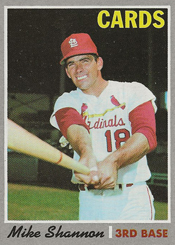
Glenn Beckert rarely struck out, but he did get knocked out by Mike Shannon.

Beckert was the Cubs’ second baseman from 1965-73 and finished his playing career with the 1974-75 Padres. A four-time all-star, Beckert won a Gold Glove Award in 1968.

On April 16, 1969, Beckert and Shannon were involved in a painful play at Busch Memorial Stadium. Shannon crashed into Beckert while trying to stretch a single into a double. Beckert suffered a concussion, was carried off on a stretcher and spent a night in a hospital. Shannon became woozy and was removed from the game.

Contact hitter

A Pittsburgh native, Beckert played shortstop at Allegheny College and graduated with a degree in political science. The Red Sox signed him and after a year in their farm system as a shortstop he was chosen by the Cubs in the November 1962 minor-league draft.

Beckert primarily played third base and shortstop in two years in the Cubs’ farm system. After the 1964 season, the Cubs converted him to a second baseman at their winter instructional league. Beckert adapted quickly, impressed at spring training and made his major-league debut as the starting second baseman and leadoff batter in the Cubs’ 1965 season opener versus the defending World Series champion Cardinals. Boxscore

At the plate, Beckert was adept at making contact. When Leo Durocher became Cubs manager in 1966, he took a liking to Beckert for his ability to execute hit-and-run plays and advance runners by hitting behind them. Beckert reminded Durocher of two other favorites he’d managed, Al Dark and Eddie Stanky.

“Glenn always gets a piece of that ball,” Durocher told The Sporting News.

A right-handed batter, Beckert choked up on the bat and perfected a short stroke. “I try not to swing too hard,” he said, “and when the pitcher gets two strikes on me, I concede a little more to him. I don’t choke up any further on the bat, but I cut down more on my swing.”

Bat control

Beckert five times led National League batters in fewest strikeouts per at-bat. In 1968, when he had a career-high in hits (189), Beckert struck out 20 times in 643 at-bats. He averaged one strikeout every 32.2 at-bats that season. By comparison, the next-best, Felix Millan of the Braves, averaged one strikeout every 21.9 at-bats.

In 1,320 career games in the majors covering 5,208 at-bats, Beckert had 1,473 hits and a mere 243 strikeouts. The most times he struck out in a season was 52 as a rookie in 1965.

“In this era of swinging from the heels, he has become the thinking man’s player,” The Sporting News reported in 1968.

Said Beckert: “Once I got home runs out of my mind, I stopped striking out. Now when I go to the plate, all I think about is making contact. I want to hit the ball.”

Beckert only once struck out three times in a big-league game. It happened on May 5, 1967, against the Cardinals at Wrigley Field. Starter Dick Hughes struck him out twice and Ron Willis got him once. Those were Beckert’s first strikeouts of the season after going 69 at-bats without a whiff. Boxscore

Dazed and confused

Two years later, on a Wednesday night in St. Louis, pitchers Ferguson Jenkins of the Cubs and Steve Carlton of the Cardinals were locked in an early-season duel.

The Cubs were ahead, 1-0, when Shannon led off the bottom of the seventh inning and lined a pitch down the third-base line. Shannon said he thought the ball was headed toward the left-field corner for a double. He didn’t see the ball hit Satch Davidson, a rookie umpire stationed at third, and drop to the ground. Cubs third baseman Ron Santo retrieved the ball.

As Shannon neared first base, he saw coach Dick Sisler point toward second base.

“I saw the ball hit the ump, but then I was blocked out by Santo,” Sisler told the St. Louis Post-Dispatch. “I thought the ball caromed away.”

Santo told the Chicago Tribune, “When I got the ball, I saw Shannon rounding first like he hadn’t seen what had happened.”

Santo threw to first baseman Ernie Banks, hoping to catch Shannon. Said Sisler: “When Santo came up throwing, he surprised everybody.”

The ball arrived too late to nab Shannon, who was steaming toward second.

Banks threw to Beckert and the ball arrived before Shannon did. Beckert braced and applied the tag as Shannon barreled into him, knocking him to the ground.

Santo said he saw Beckert’s head “jerk back and he went flat on the ground like he was paralyzed. He told me he couldn’t see out of his right eye.”

The collision was deemed a clean play. “The runner is trying to knock the ball loose,” Jenkins told the Post-Dispatch. “Shannon didn’t mean to hurt him. If we’d thought he did it on purpose, we’d have had a little brawl.”

While Beckert was taken to a hospital, Shannon complained of dizziness. “I didn’t pass out, but I did see wavy lines,” Shannon told the Post-Dispatch.

Phil Gagliano replaced Shannon at third base the next inning.

Jenkins completed a five-hit shutout for the win. Boxscore

The next day, Beckert was released from the hospital and diagnosed with a concussion and a stiff neck. Two days later, he was back in the Cubs’ lineup.

Read Full Post »

One ball, two home runs.

On April 23, 1960, Cardinals sluggers Ken Boyer and Daryl Spencer each hit a home run with the same baseball.

The unusual feat occurred in the second inning of a game against the Dodgers at St. Louis.

With the Dodgers ahead 4-0, Boyer led off the bottom of the second against Danny McDevitt and hit a home run into the pavilion in right-center. A spectator tried to catch the ball, but muffed it and the ball fell back onto the playing field, according to the Los Angeles Times.

Umpires examined the ball, “found it to be in good condition and put it back in play,” The Sporting News reported.

The next batter, Stan Musial, flied out to right fielder Sandy Amoros, who threw the ball back to the infield.

McDevitt, still using the same ball he threw to Boyer and Musial, delivered a pitch to Spencer, who connected for “one of the most robust home runs ever to dent the bleacher scoreboard” in left, the St. Louis Post-Dispatch reported. The ball “almost knocked the cap off” the electronic animated cardinal on the far left side of the scoreboard, according to the Post-Dispatch.

A spectator retrieved the ball and put it in his pocket, The Sporting News noted.

Boyer hit another home run, a two-run shot in the fifth, against Larry Sherry. He also had a run-scoring double and a sacrifice fly and finished with five RBI in a 9-5 Cardinals victory.

The game also was noteworthy for Cardinals right-hander Bob Duliba, who pitched five innings of relief for his first big-league win. Duliba also got his first hit in the majors, a single against Sherry. Boxscore


Read Full Post »

« Newer Posts - Older Posts »