Feeds:
Posts
Comments

Archive for the ‘Games’ Category

(Updated Jan. 21, 2020)

Ozzie Smith welcomed Derek Jeter as a peer among baseball’s best shortstops.

In 2014, when Jeter came to St. Louis with the Yankees for the last time as a player, he was embraced by Smith in a pre-game ceremony near home plate at Busch Stadium.

Smith, who won 13 Gold Glove awards, including 11 with the Cardinals, was elected to the Baseball Hall of Fame in 2002 in his first year on the ballot. Smith got 91.7 percent of the votes from the Baseball Writers Association of America.

On Jan. 21, 2020, Jeter was elected to the Hall of Fame in his first year on the ballot. Jeter got 99.7 percent of the votes from the baseball writers.

Parting gifts

After Jeter, 39, said 2014 would be his final season as Yankees shortstop, he was honored at each stop on the schedule.

The Yankees came to St. Louis for a three game series May 26-28 in 2014.

Jeter had played against the Cardinals in 2003 at Yankee Stadium and in 2005 at Busch Memorial Stadium in St. Louis. The 2014 visit was at the downtown ballpark that opened in 2006.

Before the Memorial Day series opener in 2014, the Cardinals presented Jeter with cuff links bearing the likeness of franchise icon Stan Musial. The Cardinals also gave Jeter a $10,000 donation to his Turn 2 Foundation. According to its Web site, the foundation “strives to create outlets that promote and reward academic excellence, leadership development and positive behavior” for young people.

Among those representing the Cardinals at the ceremony were Red Schoendienst, the Hall of Fame second baseman who wore the same uniform number (No. 2) as Jeter did, and Smith, the acrobatic fielder nicknamed The Wizard. Video

Special bond

Smith “put out his arms and embraced” Jeter, MLB.com reported.

Smith’s last two seasons in the majors (1995-96) were Jeter’s first two.

“He’s always treated me good, especially when I was a younger player,” Jeter said. “He’s a guy that I admire. I admire his career. When you’re a young player, you remember how guys treat you. Ozzie always treated me well.”

Smith told the New York Post, “He’s probably been the perfect example of what a baseball player should be. Great ambassador for the game. He’s done it the right way.”

Cardinals reliever Randy Choate, Jeter’s teammate from 2000-2003 with the Yankees, said to MLB.com, “He leads by example. When you play with him, you want to play like him.”

Showing respect

In his first at-bat after the ceremony, Jeter singled and received a standing ovation. Boxscore

Jeter “was feted at every opportunity” during the three-game series, the St. Louis Post-Dispatch reported.

Jeter started the first two games but sat out the third when the Yankees went with his backup, former Cardinal Brendan Ryan. In the seventh inning, Jeter got a standing ovation when the scoreboard camera showed him in the dugout. He responded by going to the top step and doffing his cap. Boxscore

“It’s much appreciated,” Jeter said. “It’s not something that’s expected.”

Hall of Fame stats

Jeter’s best performances against the Cardinals were in 2005 when he had five hits in 13 at-bats. His career batting mark versus St. Louis was .265 (9-for-34).

In 20 seasons (1995-2014) with the Yankees, Jeter won five Gold Glove awards and was named an American League all-star 14 times. One of his all-star appearances was the 2009 game in St. Louis.

Jeter produced a career batting mark of .310 and an on-base percentage of .377. He had 3,465 hits, including 544 doubles, with 1,311 RBI and 358 stolen bases.

Jeter has the most career hits of any shortstop.

According to MLB.com, the top six players all-time in career hits are Pete Rose (4,256), Ty Cobb (4,191), Hank Aaron (3,771), Stan Musial (3,630), Tris Speaker (3,515) and Jeter (3,465). Aaron is the only right-handed batter with more career hits than Jeter.

Jeter played in seven World Series and the Yankees won five of those. He had a World Series batting average of .321, with 50 hits in 38 games, and an on-base percentage of .384.

Read Full Post »

As a rookie with the 1951 Cardinals, Dick Bokelmann took over the role of closer.

A right-handed reliever, Bokelmann’s career in the majors consisted of spending parts of three seasons (1951-53) with the Cardinals.
He experienced his most success after his promotion from the minors in August 1951.

Handy man

Bokelmann, 20, was pitching for Northwestern University when he got an offer from the Cardinals and signed with them in 1947.

His breakout season came in 1951, his fifth year in the Cardinals’ farm system, when he posted a 10-2 record and 0.74 ERA as the closer for Houston of the Texas League.

“Dick began learning to place his sinking fastball and splendid curve where he wanted it,” The Sporting News reported.

Bokelmann, 24, was called up to the Cardinals and made his debut with them on Aug. 3, 1951, earning a save in relief of starter Harry Brecheen against the Giants at St. Louis. Boxscore

In his first three appearances for the Cardinals, all against the Giants, Bokelmann faced a total of 10 batters and retired all of them.

“A kid like Bokelmann comes in handy,” Brecheen told the St. Louis Post-Dispatch.

In the groove

Bokelmann’s emergence prompted Cardinals manager Marty Marion to move closer Al Brazle into the starting rotation, where he thrived, posting a 2.83 ERA in eight starts.

“If we had a relief pitcher like Dick Bokelmann all season, we could have started Brazle more often,” Marion said.

After a couple of shaky outings against the Dodgers and Braves in late August, Bokelmann experienced a hot streak. In four appearances from Aug. 26 to Sept. 9, Bokelmann yielded no runs over 16 innings, earning two wins and a save.

The save came on Sept. 6 when Bokelmann worked four scoreless innings in relief of starter Cliff Chambers against the Cubs at Chicago. Boxscore

The next night, Sept. 7, the Cardinals were at Pittsburgh and Bokelmann got his first big-league win, yielding one hit and no runs over five innings in relief of starter Tom Poholsky. Boxscore

On Sept. 9, at Pittsburgh, Bokelmann, the Cardinals’ third pitcher of the game, entered with one out in the fourth, held the Pirates to one hit over 5.2 innings and got the win. Boxscore

Changing careers

Bokelmann finished the season with a 3-3 record and three saves in 20 appearances for the 1951 Cardinals.

He opened the 1952 season with the Cardinals, gave up runs in seven of his 11 appearances and was sent back to the minors.

Bokelmann ended his big-league career with three appearances for the 1953 Cardinals. His overall record for them: 3-4, three saves and a 4.90 ERA in 34 games.

After his baseball career, Bokelmann worked for Prudential Insurance in Illinois for 30 years.

Read Full Post »

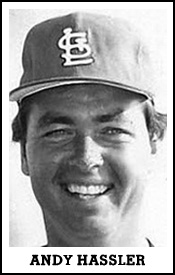
Andy Hassler was willing to return to the minor leagues for the first time in 10 years to show the Cardinals he belonged with them in the majors.

A left-hander, Hassler pitched for 14 seasons in the big leagues, primarily with the Angels.
In 1984, the Angels released Hassler at the end of spring training. He was 0-5 with a 5.45 ERA for them in 1983 and didn’t do enough at training camp the following spring to convince them to keep him.

The Cardinals offered Hassler, 32, a chance to stay in the game, but it was a humbling proposition. He would have to go to the minors, two levels down to Class AA. The last time he pitched in the minors was 1974. The last time he pitched in Class AA was 1970 when he was 18.

“It’s tough to go down after that many seasons,” Hassler told the St. Louis Post-Dispatch. “You have to question yourself why you really want to do it.”

Hassler did it, and by the end of the season he was back in the big leagues with the Cardinals.

Rapid rise

Hassler was 17 and recently graduated from high school in Tucson, Ariz., when he was chosen by the Angels in the 25th round of the 1969 amateur draft.

Two years later, on May 30, 1971, he made his major-league debut for them at 19 in a start at Yankee Stadium. Boxscore

Hassler lost his first eight decisions in the big leagues. Though he pitched for the Angels in parts of 1971 and 1973, his first win for them didn’t come until June 23, 1974, versus the Rangers. Boxscore

His career often was defined by extremes. He either was very good or very bad. In 1974, Hassler pitched a one-hitter against the White Sox and, on a staff with Nolan Ryan and Frank Tanana, led the Angels in ERA at 2.61. From 1975-76, he lost 18 consecutive decisions _ his last 11 of 1975 and his first seven of 1976.

“There were games in there where I pitched downright badly. I pitched poorly, period,” Hassler told the Boston Globe. “When I did pitch well, something (bad) would happen. I don’t like to make excuses, but it was a last-place team. There were a lot of plays that weren’t made.”

Hassler’s success depended on the effectiveness of his sinker.

“If I can keep the ball down, I don’t give a damn who’s up there,” Hassler told the Los Angeles Times.

Red Sox slugger Carl Yastrzemski rated Hassler “one of the four best left-handers in the league.”

Mutual admiration

On July 5, 1976, the Angels sold Hassler’s contract to the Royals, who were in first place in the American League West. The Royals’ manager, Whitey Herzog, had been an Angels coach in 1974 and 1975 when Hassler pitched for them.

According to The Sporting News, Angels owner Gene Autry told Hassler, “At least you are going to a team on top that will score some runs for you.” Regarding his Angels, Autry added, “You can’t get any lower than this one.”

After losing his first decision, his 18th in a row, with the Royals, Hassler won four in a row. “Without Andy, we wouldn’t be in first place,” Herzog said.

Said Hassler: “I have all the admiration in the world for Whitey.”

In 1984, Herzog was manager of the Cardinals when Hassler took the offer to go back to the minors.

Comeback trail

After signing with the Cardinals on May 2, 1984, Hassler reported to their Class AA farm club at Arkansas. In his Arkansas debut, Hassler took the loss, giving up a home run to Mets prospect Billy Beane, who years later became the Athletics general manager who inspired the book and movie “Moneyball.”

Hassler pitched in nine games for Arkansas, posted a 1-1 record with three saves and showed enough to earn a promotion to Class AAA Louisville.

The 1984 Louisville manager, Jim Fregosi, was Hassler’s teammate with the 1971 Angels and managed him with the 1981 Angels during Hassler’s second stint with the franchise.

Hassler regained his form with Louisville, putting together a stretch of 15 scoreless innings over nine appearances. With a 7-4 record, 10 saves and a 2.11 ERA at Louisville, Hassler got called up to the Cardinals in September 1984.

In his Cardinals debut on Sept. 16, 1984, against the Pirates at St. Louis, Hassler got the win when David Green produced a two-run single in the bottom of the 10th. Boxscore

Real pro

At spring training in 1985, Hassler allowed one earned run in 11 innings and got a spot as a reliever on the Cardinals’ Opening Day roster.

“If I was a right-hander, I’d have been done 10 years ago,” Hassler said. “Thank God there will always be teams looking for left-handers.”

Herzog said he liked Hassler “for his control and movement on his fastball.”

Hassler made 10 appearances for the 1985 Cardinals and was 0-1 with a 1.80 ERA, but with two other left-handers, Ken Dayley and Ricky Horton, in the bullpen, Hassler was sent back to Louisville in May to open a roster spot in St. Louis for outfielder Tito Landrum.

“I might be the first guy to get sent out with an ERA under two,” Hassler said.

At Louisville, Hassler, 33, mentored Todd Worrell, who struggled as a starter and was being converted into a reliever.

“It was just good timing that he was there to help me,” Worrell said. “What better source to get it from than somebody who’s been there?”

Worrell excelled as a reliever, got promoted to the Cardinals, became their closer in the last month of the 1985 season and helped them become National League champions.

Hassler was 4-5 with two saves and a 3.29 ERA for Louisville and retired from baseball in August 1985.

Pitching for six big-league teams (Angels, Royals, Red Sox, Mets, Pirates and Cardinals), Hassler was 44-71 with 29 saves.

Read Full Post »

(Updated July 3, 2024)

St. Louis Browns manager Marty Marion wanted to convert rookie pitcher Don Larsen into an outfielder.

Marion reconsidered after Larsen had a string of wins late in the 1953 season.

Three years later, with the Yankees, Larsen pitched the only World Series perfect game, a feat unlikely to have happened if Marion had implemented his plan.

Prized prospect

Larsen’s father, the son of Norwegian immigrants, was a watchmaker who moved the family from Indiana to San Diego. Larsen, 17, was pitching for an American Legion team when a Browns scout signed him for $850.

After four seasons (1947-50) in the Browns’ farm system, Larsen served stateside in the Army for two years (1951-52). He was on the roster of the San Antonio farm club when he reported to 1953 spring training with the Browns.

A right-hander, Larsen, 23, impressed in spring training and opened the 1953 season in the Browns’ starting rotation.

“He has the confidence and could be a terrific pitcher by the end of the season,” Browns general manager Bill DeWitt Sr. told The Sporting News.

ABC-TV broadcaster and former Cardinals ace Dizzy Dean said Larsen “could retire many of the big sluggers with only his blazing pitches if he could control them.”

Catcher Les Moss said Larsen’s curve and changeup improved with the help of Harry Brecheen, the left-hander who joined the Browns following his release by the Cardinals. Brecheen, 38, mentored multiple Browns pitchers.

Marion, who’d been an all-star shortstop for the Cardinals and managed them in 1951 before joining the Browns, said Larsen “is the best-looking pitching prospect I’ve seen in the American League this season. He’s not a finished product, but he has all the tools to make a great pitcher.”

Preparing an experiment

Larsen struggled to fulfill expectations.

After a loss to the Red Sox at Boston on Aug. 5, 1953, he was 2-10 with a 4.32 ERA, but his batting average was .288. Boxscore

Over a span of three games from July 24 to Aug. 5, Larsen produced hits in seven consecutive at-bats.

Intrigued by the combination of Larsen’s bat and arm, Marion wanted to make him an outfielder.

Immediately after the Aug. 5 game at Fenway Park, Marion “ordered a practice session during which he had Larsen shag flies in the outfield for some 30 minutes,” the St. Louis Globe-Democrat reported.

“Since spring training, I’ve been toying with the idea of trying Larsen as an outfielder,” Marion said. “The way he’s been hitting of late, I may take a look at him out there in a game in the near future.”

According to the St. Louis Post-Dispatch, Marion planned to start Larsen in the outfield the next day, Aug. 6, at Fenway Park.

“I decided against it at the last minute,” Marion said. “I was afraid he might run into the left field fence. As soon as I feel Don is mentally ready for the experiment, I’ll start him.”

Worth a try

After the series at Boston, the Browns went to Washington to play the Senators. In the series opener on Aug. 7, 1953, Browns left fielder Dick Kokos “bungled a fly ball” which fell for a double in the fifth inning, the Post-Dispatch reported. Marion replaced Kokos with Larsen in the sixth. Larsen played the final three innings in left field, had no fielding chances and grounded out in his one at-bat. Boxscore

Facing back-to-back doubleheaders, Marion used Larsen as a starting pitcher in one on Aug. 11 against the Tigers. Larsen was shelled for seven runs in four innings and took the loss, dropping his record to 2-11. Boxscore

The next day, the Globe-Democrat reported Larsen “has been working out afternoons as an outfielder.”

“He might be a better outfielder than a pitcher,” Marion told The Sporting News.

Said Larsen: “I’ll try anything they ask me to try. If I can’t make it in the outfield, I can always go back to pitching.

“If I get to play every day in the outfield, my hitting will improve. It’s worth trying and I’m happy Marty suggested it.”

Change of plans

A turnaround for Larsen occurred on Aug. 20, 1953, at Baltimore when the Browns played the minor-league Orioles in an exhibition game. Baltimore was trying to adopt the Browns and the game was important for the city. Larsen pitched a five-hitter, striking out 11, in an 8-2 Browns victory.

On Aug. 30, the Browns were at home to play their third doubleheader in seven days. Brecheen, scheduled to start Game 1 against the Senators, had a sore shoulder, so Marion went with Larsen.

In what the Globe-Democrat described as “the surprise of the day,” Larsen pitched a two-hit shutout for his first win since June. Boxscore

“After being considered seriously for the role of outfielder, Larsen just missed pitching a no-hitter,” the Post-Dispatch reported.

Larsen held the Senators hitless until Wayne Terwilliger singled with one out in the eighth. The other hit was a Pete Runnels single in the ninth.

The first batter of the game, Eddie Yost, walked on four pitches. When Larsen went to a 2-and-0 count on the next batter, Runnels, Marion called for Bob Cain to warm up in the bullpen. Larsen settled down and, starting with Runnels, struck out five batters in a row.

The shutout was the first of five consecutive wins for Larsen.

Browns owner Bill Veeck and Marion “vetoed all plans that had been afoot a few weeks ago to convert Larsen into an outfielder,” The Sporting News reported.

Larsen finished with a 7-12 record for the 1953 Browns and batted .284 with three home runs.

A year later, Larsen was traded to the Yankees and was 45-24 for them in five seasons. His career record in 14 big-league seasons was 81-91.

In his autobiography “The Mick,” Yankees slugger Mickey Mantle said Larsen “loved the nightlife” and “could drink more than any two guys I ever met.”

On the day he pitched his perfect game in the World Series, Larsen arrived at the ballpark and “you could smell liquor on his breath,” Mantle said.

Larsen was 0-3 with a 3.41 ERA in 19 appearances versus the Cardinals. One loss was in 1963 while with the Giants. The other losses came in 1964 while with the Houston Colt .45s, including one on Aug. 18 in his lone career start against the Cardinals. Boxscore

Read Full Post »

(Updated Jan. 30, 2024)

As a catcher for the Cardinals, Ted Simmons helped Steve Carlton achieve his first 20-win season. As an opposing hitter, Simmons hit with power against Carlton.

One reason Simmons was elected to the National Baseball Hall of Fame in December 2019 was he could hit any kind of pitching, including the best.

Of his 248 regular-season career home runs in the majors, Simmons hit 22 against future Hall of Famers.

The future Hall of Famer who Simmons hit the most home runs against was Carlton, who spent most of his career with the Phillies after being a teammate of Simmons with the Cardinals.

A switch-hitter, Simmons hit seven home runs against Carlton, a left-hander.

Here is a breakdown of the number of home runs Simmons hit versus future Hall of Famers:

_ Steve Carlton, 7 home runs against.

_ Tom Seaver, 3

_ Don Sutton, 2

_ Ferguson Jenkins, 2

_ Bert Blyleven, 2

_ Phil Niekro, 2

_ Rich Gossage, 1

_ Bruce Sutter, 1 (See story)

_ Lee Smith, 1

_ Gaylord Perry, 1

Battery mates

Carlton debuted with the Cardinals in 1965 and Simmons debuted with them three years later, in 1968.

Tim McCarver was Carlton’s primary catcher with the Cardinals from 1965-69. After McCarver got traded to the Phillies in October 1969, Simmons and Joe Torre split the catching for the Cardinals the next year. Torre caught Carlton in 20 games in 1970 and Simmons was his catcher in 15, according to baseball-reference.com.

The first time Carlton and Simmons started a regular-season game together was June 2, 1970, a 12-1 Cardinals win versus the Giants at St. Louis. Carlton pitched a four-hitter. Simmons had a single, a triple and a walk, scoring twice. Boxscore

In 1971, when Torre shifted to third base, Simmons was the Cardinals’ catcher. He caught in 33 of Carlton’s 37 games for the 1971 Cardinals.

On Sept. 28, 1971, Carlton earned his 20th win of the season, beating the Mets at New York. Simmons was the catcher and produced a single, a double and two RBI. Boxscore

It was the last time Carlton would pitch for the Cardinals. Five months later, on Feb. 25, 1972, he was traded to the Phillies on orders of Cardinals owner Gussie Busch, who was fed up with player salary demands.

Carlton and McCarver were reunited as Phillies. According to baseball-reference.com, the catchers who caught the most games pitched by Carlton were McCarver (236), Bob Boone (147), Bo Diaz (79) and Simmons (48).

Carlton had a 3.24 ERA over the 358.2 innings Simmons was his catcher.

Mighty matchup

Carlton’s career record against the Cardinals was 38-14 with five shutouts, 27 complete games and a 2.98 ERA.

Simmons batted .274 against Carlton. Of his 34 hits, 17 were for extra bases: nine doubles, seven home runs, one triple. Simmons had a .357 on-base percentage versus Carlton, drawing 16 walks and getting hit by a pitch once.

The most significant home run Simmons hit against Carlton was on June 25, 1977, at St. Louis.

In the seventh inning, with the Phillies ahead, 2-1, Hector Cruz led off for the Cardinals and pulled the ball down the third-base line. Third baseman Mike Schmidt snared it, but his throw sailed past first baseman Richie Hebner. Cruz was credited with a single and advanced to second on Schmidt’s throwing error.

Simmons, due up next, turned to teammate Mike Anderson and said, “I’m just going to look for anything inside that I can pull and hit hard,” the Philadelphia Inquirer reported.

With McCarver catching, the first pitch Carlton threw Simmons was a slider, low and on the inside corner of the plate.

“He might have wanted to get the ball in the dirt or something because usually he doesn’t give me the ball in the strike zone unless it’s outside,” Simmons told the St. Louis Post-Dispatch.

Simmons hit the ball into the left-field seats for a two-run home run, giving the Cardinals a 3-2 lead.

“That’s one of the hardest he’s hit right-handed,” said Cardinals manager Vern Rapp. “That was hit deep into the deck.”

Said McCarver: “Simmons is just a good hitter. He might be the purest hitter in the game outside of Rod Carew. Maybe even more than Pete Rose because Simmons has more power.”

Bob Forsch and Rawly Eastwick held the Phillies scoreless over the last two innings, preserving the win for the Cardinals. Boxscore

Three years later, on April 26, 1980, at Philadelphia, Simmons got another key hit against Carlton, but it wasn’t a home run. Carlton pitched a one-hitter versus the Cardinals. Simmons’ single in the second deprived Carlton of a no-hitter, a feat that eluded him throughout his career. Boxscore

Special deliveries

Among other noteworthy home runs by Simmons against fellow future Hall of Famers were one hit against the Braves and another hit for them.

On Aug. 23, 1975, Simmons hit a grand slam against Phil Niekro, snapping a 1-1 tie in the fifth and carrying the Cardinals to a 7-2 win over the Braves at St. Louis. Simmons said he hit a low screwball, not Niekro’s signature knuckleball.

“I just golfed it,” Simmons said. “He’s been throwing me a lot of screwballs.”

The grand slam was the fifth of Simmons’ major-league career but his first versus a right-hander. Boxscore

Simmons batted .203 against Niekro in his career. He had almost as many walks (15) as hits (16).

On Aug. 31, 1986, the Cubs played the Braves in Atlanta. The Cubs started and ended the game with two future Hall of Famers, Dennis Eckersley and Lee Smith.

Simmons, 37, and in his first season with the Braves, led off the ninth, batting for pitcher Jeff Dedmon with the score tied at 3-3.

Throwing sliders, Smith got ahead in the count 1-and-2.

“Being down 1-and-2 is not the best situation to be in against Smith,” Simmons told the Chicago Tribune. “You’re living on the edge.”

On the next pitch, “Simmons timed the slider properly and launched an electric rainbow to right field,” the Atlanta Constitution reported.

The walkoff home run gave the Braves a 4-3 triumph. Boxscore

“When they say go up there and get it done like this, it’s do or die,” Simmons said. “When you do, it’s the greatest. When you don’t, it’s the worst. I like it.”

In a 1981 interview with Roger Angell for the book “Late Innings,” Simmons said, “A Reggie Jackson, a Willie Stargell can fan three times in a game and walk up to the plate in the 10th inning, and still the pitcher is scared out there … because that man is feared.

“I’ve been in that position a few times. Some people have that kind of ability given to them, but I’ve had to learn it. I have it now. I have that respect. As far as I’m concerned, there is no greater pleasure in the world than walking up to the plate with men on base and knowing that you are feared.”

Read Full Post »

Ron Kline had an ominous start to his stint with the Cardinals, foretelling of rough times ahead for the right-handed pitcher.

On Dec. 21, 1959, the Cardinals acquired Kline from the Pirates for outfielder Gino Cimoli and pitcher Tom Cheney. Kline, 27, was expected to join a starting rotation with Larry Jackson, Vinegar Bend Mizell, Ernie Broglio and Bob Miller in 1960.

Two weeks after the trade, on Jan. 3, 1960, Kline was on a commercial flight to St. Louis to sign his contract when one of the airplane’s engines stopped working.

“Our plane had an engine conk out half an hour out of Pittsburgh and the pilot invited anybody who felt shaky to get out at Indianapolis,” Kline told the St. Louis Post-Dispatch.

Apparently, no one accepted the offer and the plane landed safely in St. Louis.

The precarious arrival set the tone for Kline. Over the next 15 months, he experienced a series of predicaments both on and off the field as a Cardinal.

Pirates product

Kline was born and raised in Callery, Pa., a railroad junction of about 400 residents located 27 miles north of Pittsburgh. He played for a town baseball team, got a tryout with the Pirates and signed when he was 18.

After two years in the minors, primarily at Class D, Kline, 20, earned a spot with the 1952 Pirates. Overmatched, he was 0-7 with a 5.49 ERA but bonded with a veteran starter, ex-Cardinal Howie Pollet.

Kline served in the Army in 1953 and 1954, returned to the Pirates in 1955 and lost his first two decisions, giving him an 0-9 record for his major-league career.

On May 1, 1955, Kline got his first big-league win, a shutout against the Cardinals at Forbes Field in Pittsburgh. Boxscore

Kline developed a reputation as a hard-luck starter whose record didn’t reflect his skill. His best Pirates seasons were 1956 (14-18, 3.38 ERA) and 1958 (13-16, 3.53).

In 1959, Kline was 11-13 with a 4.26 ERA. Disappointed he was limited to 186 innings after topping 200 in each of the previous three seasons, Kline said he wanted “to pitch more often or be traded,” the Pittsburgh Press reported.

“I have to pitch to make money,” Kline told the Pittsburgh Post-Gazette.

The Pirates shopped Kline for an outfielder. After being rebuffed by the Giants in a bid to get either Willie Kirkland, Felipe Alou or Jackie Brandt, the Pirates came close to shipping Kline and shortstop Dick Groat to the Athletics for Roger Maris.

Betting on a breakthrough

Kline was shoveling snow outside his home when he got a call from Pirates general manager Joe Brown, informing him of the trade to St. Louis. Kline was recommended by his former teammate, Pollet, the Cardinals’ pitching coach.

“I saw a lot of potential in the kid,” Pollet told the St. Louis Globe-Democrat. “He has great desire and I have enough confidence in my ability to think I can make him a regular winner. He has a good fastball, but for some reason he didn’t throw it last season. He tried to be cute and too fine with his control.”

Cardinals third baseman Ken Boyer, who hit .222 against Kline in his career, was glad to see him become a teammate. “Kline gave me as much trouble as anyone,” Boyer told The Sporting News.

At spring training with the Cardinals in 1960, Kline was impressive. In 28 innings pitched in exhibition games, his ERA was 0.64.

When the season began, it was a different story. Kline had a 5.06 ERA when he got his first Cardinals win, beating the Pirates on May 2, 1960, at St. Louis. Boxscore

Let’s make a deal

The satisfaction of beating his former team was short-lived. Kline lost six of his next seven decisions. He made his last start for the Cardinals on July 10 before being moved to the bullpen.

Kline finished the 1960 season with a 4-9 record and 6.04 ERA. Three of his wins were against the Pirates. He struggled both as a starter (3-7, 5.92) and as a reliever (1-2, 6.35).

In 117.2 innings pitched, Kline gave up 21 home runs. His average of allowing a home run every 5.6 innings was the highest in the National League in 1960.

The Cardinals (86-68) finished in third place, nine games behind the league champion Pirates (95-59). While Kline faltered with the Cardinals, Mizell, traded to the Pirates in May 1960 for second baseman Julian Javier, was 13-5 for Pittsburgh.

After the season, the Cardinals approached the Yankees and offered to trade pitcher Larry Jackson, catcher Hal Smith and Kline for pitchers Whitey Ford and Ryne Duren and catcher Elston Howard. The clubs “surveyed the pros and cons of such a trade” before the Yankees backed out, the Globe-Democrat reported.

The Cardinals also proposed sending Kline and Bob Gibson to the Senators for pitcher Bobby Shantz, but Washington preferred an offer from the Pirates.

Also, the Cubs and Cardinals discussed a swap of pitcher Moe Drabowsky for Kline but it didn’t get done.

Flummoxed by his inability to deal Kline, Devine said, “I realize his value is down, but I’m not going to throw him out the window.”

Spitball specialist

During the winter, Kline was hunting in Pennsylvania when a gun shell blew up in his face. Fragments of the brass shell lodged in each eye, but were removed without damaging Kline’s eyesight, according to the Society for American Baseball Research.

Kline reported to Cardinals spring training in 1961 and said he planned to work on a knuckleball. Unimpressed with the result, the Cardinals sold Kline’s contract to the Angels on April 11, 1961.

After stints with the Angels and Tigers, Kline thrived as a reliever for the Senators. In four years (1963-66) with them, he had 83 saves and a 2.54 ERA.

His turnaround came when he mastered the spitball, an illegal pitch. Sports Illustrated reported Kline had one of “the finest spitballs in the American League.” In his book “The Wrong Stuff,” Red Sox pitcher Bill Lee said, “Ron Kline had a great spitter.”

Kline pitched for nine teams (Pirates, Cardinals, Angels, Tigers, Senators, Twins, Giants, Red Sox and Braves) in 17 seasons. His career numbers: 114-144 record, 108 saves, 3.75 ERA.

Read Full Post »

« Newer Posts - Older Posts »