Feeds:
Posts
Comments

Archive for the ‘Games’ Category

In one of the most unusual at-bats of his Hall of Fame career, Ted Simmons stepped in for the Cardinals’ cleanup hitter against a pitcher who didn’t expect to be used in relief and hit a grand slam, accounting for all the runs in the game.
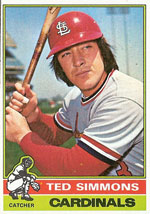
Batting for another switch-hitter, Reggie Smith, who had to depart because of back pain, Simmons hit an 0-and-2 pitch from Jon Matlack over the left-field wall, giving the Cardinals a 4-0 victory over the Mets in the second game of a doubleheader on June 23, 1975, at New York’s Shea Stadium.

It was the first of six pinch-hit home runs Simmons had in the major leagues.

Ready or not

Simmons caught Ron Reed’s shutout in Game 1 of the Monday night doubleheader, a 1-0 Cardinals victory. Simmons, batting cleanup, contributed a single and a walk. Boxscore

In the second game, Simmons was out of the lineup and Ken Rudolph was the starting catcher.

The game was scoreless when Cardinals pitcher John Denny led off the eighth inning with a single to left for his first major-league hit. Bake McBride moved him to second with a sacrifice bunt.

After Mike Tyson drew a walk from Mets starter George Stone, putting runners on first and second with one out, Cardinals manager Red Schoendienst told Simmons, “I’m probably going to use you to pinch-hit. Get a bat.”

As Simmons started out to the plate, he saw the scheduled batter, Luis Melendez, headed there, too, the Associated Press reported.

Ted asked Red, “Don’t you want me to hit?”

“Yeah, but for Reggie Smith,” Schoendienst replied.

Melendez singled to left, loading the bases, and Simmons came up to bat for the ailing Smith, who was 0-for-3 against Stone.

Sink or swim

In the Mets’ bullpen, Matlack had gotten up to fulfill his routine of throwing between starts. After the Cardinals loaded the bases, bullpen coach Joe Pignatano turned to Matlack and said, “Are you ready?”

“Ready for what?” Matlack replied.

Pignatano said, “You’re in the game.”

“I was almost done with my workout,” Matlack said to the Passaic (N.J.) Herald-News. “I had no idea they wanted me to go in as a reliever. I had been throwing out of my full windup and was just about done working out of the stretch.”

Mets manager Yogi Berra said, “I brought him in because he makes them hit a lot of groundballs. I talked to him before the game and told him I might have to use him.”

Matlack, who hadn’t appeared in relief in three years, said, “Being thrown in a game like that is an unnatural situation for me.”

Cat and mouse

When Matlack, a left-hander, entered the game, Simmons, a switch-hitter, stood in from the right side of the plate. He swung and missed at the first two pitches.

“The first pitch was a fastball down at the knees,” said Simmons. “The second was a slider around my neck. I said to myself, ‘I wish I could have that one back.’ ”

Matlack said he noticed Simmons “was pulling out on the first two pitches” and decided to throw a curve.

“The purpose of the 0-and-2 pitch is not necessarily a waste pitch,” said Matlack. “If anything, he was supposed to hit it foul. Or, if he doesn’t swing, it sets him up for the next pitch.”

Matlack’s curve looked like a slider or cut fastball, Simmons said, and came in low and inside.

“I was on the plate, trying to protect it and hoping to at least hit a fly ball for a run,” Simmons told the St. Louis Post-Dispatch.

Matlack said, “The pitch was a hell of a curve, I thought. It was right where I wanted it. I was surprised he even swung at it.”

Said Simmons: “I got all of it.”

After watching a television replay of the grand slam, Matlack noted, “As he hit the ball, his hands collapsed, It was almost as if he was looking for that pitch.”

Simmons’ slam enabled the Cardinals to sweep. A grateful Reggie Smith said, “We had the right man for the right job at the right time.” Boxscore

Simmons hit .377 (20-for-53) with two home runs versus Matlack in his career.

Of Simmons’ nine grand slams in the majors, seven were with the Cardinals and he hit one each with the Brewers and Braves.

Read Full Post »

(Updated April 17, 2022)

The Cardinals tried for a year to acquire second baseman Fernando Vina and, when they finally succeeded, they were rewarded for their effort.

On Dec. 20, 1999, the Cardinals got Vina from the Brewers for pitchers Juan Acevedo and Matt Parker, plus catcher Eliezer Alfonzo.

Vina gave the Cardinals the consistent leadoff batter they’d been lacking and solidified the infield defense.

AL all-star

Vina was born and raised in Sacramento, Calif., where his parents settled after immigrating to the United States from Cuba. In 1989, when Vina was attending Arizona State, he toured Cuba with Team USA.

A left-handed batter with speed, Vina played for the Mariners (1993), Mets (1994) and Brewers. In five seasons with the Brewers (1995-99), Vina batted .286 and produced 559 hits in 528 games. His best season with them was 1998 when he was named a National League all-star and batted .311 with 198 hits and 101 runs scored.

After the 1998 season, the Brewers shopped Vina because he had “the highest trade value” on their roster, The Sporting News reported, and rookie Ronnie Belliard was available to replace him.

The Cardinals, seeking a replacement for departed free agent Delino DeShields at second base, became serious suitors for Vina in December 1998, according to The Sporting News, but couldn’t come up with a pitcher the Brewers wanted.

On May 9, 1999, Vina collided with Brewers teammate Jeromy Burnitz while pursuing a pop fly and injured his left knee. He returned to the lineup three weeks later, developed tendinitis in the knee and was shut down for the season after June 3.

High praise

Joe McEwing was the Cardinals’ second baseman in 1999 and batted .275, but the the club wanted a leadoff batter with a high on-base percentage and speed.

The Cardinals pursued a deal with the Dodgers for second baseman Eric Young, offering reliever Ricky Bottalico, the St. Louis Post-Dispatch reported, but when talks stalled they turned their attention to Vina. The Cardinals offered pitcher Garrett Stephenson, but the Brewers insisted on Acevedo and the deal was made.

“He’s a legitimate top of the lineup guy,” said Cardinals manager Tony La Russa.

Vina said, “My plan is to get on base any way I can. This lineup is incredible … If I get on base, good things are going to happen.”

At spring training in 2000, Vina impressed Cardinals coach and former second baseman Jose Oquendo, who said, “He’s the best I’ve seen turning the double play, ever.”

Vina said, “Defense is a big part of my game. I don’t underestimate the momentum that can turn our way when you come up with a good defensive play or turn a double play.”

Vina also impressed Cardinals instructor Lou Brock, who cited Vina’s passion for wanting to improve his base stealing ability.

“I’ve learned more from Lou Brock about stealing bases in my first three weeks in spring training than I knew all my life,” Vina told Cardinals Magazine. “It’s incredible the little keys that can help you be that much better and help you steal more bases.”

After Vina hit .350 with a .426 on-base percentage in spring training exhibition games, general manager Walt Jocketty called him “the catalyst that we were hoping he’d be.”

Key contributor

On April 3, 2000, in the season opener against the Cubs at St. Louis, Vina had a successful Cardinals debut, producing two singles, a triple, scoring a run, driving in a run and turning a double play. Boxscore

Vina, who turned 31 two weeks into the season, batted .300 for the 2000 Cardinals, scored 81 runs, had an on-base percentage of .380 and led National League second basemen in fielding percentage.

He also was hit by pitches a league-leading 28 times in 2000. He achieved the total even though he was on the disabled list for two weeks in June because of a hamstring injury and sat out 14 September games because of a rib injury.

The Cardinals’ single-season record for most times hit by pitches is 31 by Steve Evans in 1910.

Vina had three more seasons of double-figure hit-by-pitch totals for the Cardinals _ 22 in 2001, 18 in 2002 and 11 in 2003.

According to The Sporting News, “Vina is the key to jump-starting the team’s offense … When Vina gets on, it makes it easier for No. 2 hitter (J.D.) Drew to hit the ball in the hole.”

Vina had his best Cardinals season in 2001 when he batted .303 with 191 hits and 95 runs scored.

He won Gold Glove awards for his defense in 2001 and 2002.

Vina played four seasons (2000-2003) with the Cardinals, generated 570 hits in 488 games and sparked them to three postseason appearances.

Ill-advised decision

After an injury-marred 2003 season, Vina became a free agent and signed with the Tigers. In December 2007, he admitted using Human Growth Hormone, a performance-enhancing drug banned by Major League Baseball, with the 2003 Cardinals in an attempt to heal more quickly from hamstring and knee ailments.

“I tried everything rehabbing,” Vina said. “I came to a point that I was desperate.

“Was it right? No. Obviously, it was wrong. I’m embarrassed by it. Bottom line, it was stupid. I’m embarrassed now, and it didn’t help, either.”

Read Full Post »

The Cardinals wanted Joe Girardi to be their backup catcher but settled for Mike Matheny.

On Dec. 15, 1999, the Cardinals signed Matheny, a free agent, after failing in their bid to get Girardi, who went to the Cubs.
The Cardinals’ No. 2 choice turned out to be a No. 1 catcher.

Matheny became the Cardinals’ starter in 2000, helped them become division champions and won a Gold Glove Award for his defensive excellence. Matheny played five seasons for the Cardinals, who got to the postseason in four of those years, and won the Gold Glove Award three times.

In a nifty twist, Girardi became a free agent after the 2002 season and signed with the Cardinals to be Matheny’s backup in 2003.

Prayers answered

After five years (1994-98) with the Brewers, Matheny was a backup to Blue Jays catcher Darrin Fletcher in 1999 and hit .215 in 57 games.

“Matheny is an intelligent, studious catcher with a quiet motion behind the plate and an easy rapport with the pitchers,” The Sporting News noted, but his weak hitting was keeping him from being a starter.

“It’s a simple matter of the requisite bat speed being absent,” The Sporting News concluded in September 1999. “Barring a miraculous transformation at the plate, his destiny is to be a backup catcher.”

When Matheny, 29, became a free agent after the 1999 season, the Brewers showed interest, but not the Cardinals.

St. Louis general manager Walt Jocketty “thought he had a good chance to sign Joe Girardi,” the St. Louis Post-Dispatch reported.

Girardi was with the Yankees from 1996-99 and played in three World Series for them before becoming a free agent. Though the Cardinals offered more money than the Cubs did, he signed with Chicago to be near his home.

Pitcher Pat Hentgen, whom the Cardinals acquired from the Blue Jays in November 1999, urged them to sign Matheny.

The Cardinals gave Matheny a one-year deal for $750,000 and planned to have him back up incumbent starter Eli Marrero.

“I like to think I’m an unselfish player and will be helpful whether I’m playing or not,” Matheny said. “That doesn’t mean I’m not interested in playing, because I am.”

An Ohio native who attended the University of Michigan, Matheny was residing with his wife, Kristin, and four children in Weldon Spring, Mo., about 25 miles from St. Louis. Kristin grew up in the St. Louis suburb of Chesterfield and she and her husband had decided to raise their family in the area.

“She must have some powerful prayers because we really didn’t think about the Cardinals being interested in us,” Matheny told the Post-Dispatch.

Fighting for a job

A couple of weeks before spring training began in 2000, the Cardinals signed another free-agent catcher, Rick Wilkins, creating competition for Matheny. Wilkins had been in the big leagues for nine seasons (1991-99) and hit .303 with 30 home runs for the 1993 Cubs.

If Matheny didn’t hit, Wilkins gave the Cardinals an option.

“I wish I could take a little of the enthusiasm I feel when I’m behind the plate and have it when I get into the batter’s box,” Matheny told the Post-Dispatch. “I just love being behind the plate, all the strategy that goes unseen there, but I’m working on revamping my swing and improving on the things that have held my statistics back.”

The Cardinals entered spring training committed to Marrero, 26, as their starting catcher. Marrero, diagnosed with thyroid cancer in 1998, hit .192 in 114 games for the Cardinals in 1999, but management expected him to be stronger and better in 2000.

Initially, all three catchers struggled to hit in spring training. Two weeks before the season opener, their batting averages were .091 for Matheny, .100 for Marrero and .217 for Wilkins.

“I put a lot more pressure on myself early on than I should,” Matheny said. “I was trying to do too much and open eyes … Then I started to panic, trying to make up for lost ground.”

A hot streak near the end of spring training earned Matheny the backup job over Wilkins, who was sent to the minor leagues. Wilkins “was very much in the picture until Matheny had a stronger last week offensively,” the Post-Dispatch reported.

On March 29, 2000, manager Tony La Russa informed Matheny he was on the Opening Day roster. “It was like making the big leagues for the first time,” Matheny said.

Taking charge

When the Cardinals opened the season on April 3, 2000, at home against the Cubs, the starting catchers were Matheny and Girardi. With his father and brothers attending from Ohio, Matheny contributed a single and a double and scored a run in the Cardinals’ 7-1 triumph. Boxscore

Experiencing an Opening Day in St. Louis for the first time, Matheny said, “I can honestly say it was about the most fun I’ve ever had playing in the game.”

Hitting and fielding well and displaying a quick release on throws, Matheny supplanted Marrero as the No. 1 catcher. In May 2000, The Sporting News declared, “Matheny continues to exceed expectations.”

On July 1, 2000, Marrero tore a ligament in his left thumb. A couple of weeks later, Matheny cracked a rib but continued to play. He wore a flak jacket and had his chest taped before every game. Carlos Hernandez, acquired from the Padres at the trade deadline, gave the Cardinals insurance at the catcher position.

Matheny hit .261 with 47 RBI in 128 games for the 2000 Cardinals and led National League catchers in number of runners caught attempting to steal (49). He sat out the postseason after he severed two tendons and a nerve in his right ring finger while using a hunting knife he received as a 30th birthday gift.

After their playing careers, Girardi and Matheny became big-league managers. Girardi won a World Series championship with the 2009 Yankees and Matheny won a National League pennant with the 2013 Cardinals.

Read Full Post »

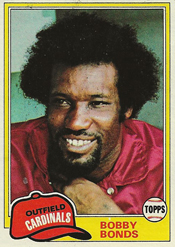
Bobby Bonds, expected to bring power and balance to the lineup, symbolized the dysfunction of the 1980 Cardinals.

On Dec. 7, 1979, the Cardinals acquired Bonds from the Indians for pitcher John Denny and outfielder Jerry Mumphrey.

An outfielder, Bonds figured to join George Hendrick to give the Cardinals two right-handed sluggers to balance a lineup with switch-hitters Ted Simmons and Garry Templeton and batting champion Keith Hernandez, who hit left-handed.

Bonds, who had 25 home runs and 34 stolen bases for the 1979 Indians, was projected to play left field and replace Lou Brock, who retired.

The deal turned out to be a dud. Bonds, 34, injured his right wrist early in the season and couldn’t hit for average or power. The 1980 Cardinals, who fired their manager and general manager during the season, finished 74-88.

All in the family

Bobby Lee Bonds was born in Riverside, Calif. An older brother, Robert Vernon Bonds Jr., a receiver and defensive back at San Jose State, got selected by the St. Louis football Cardinals in the fifth round of the 1965 NFL draft and played in Canada. A sister, Rosie, was a hurdler for the U.S. in the 1964 Olympics.

Bonds excelled in baseball, football and track in high school and became a state long jump champion. He married at 17 and became a father at 18 when his son, future home run champion Barry Bonds, was born in July 1964. A month later, with a wife and child to support, Bonds signed an $8,000 contract with the Giants.

The Giants sent Bonds to their farm club in Lexington, N.C., in 1965. Disheartened by the racism he encountered, Bonds wanted to quit, but Lexington manager Max Lanier, the former Cardinals pitcher, became his trusted mentor and advisor. Bonds stayed and began his rise through the Giants’ system.

On June 25, 1968, Bonds made his major-league debut against the Dodgers at Candlestick Park and hit a grand slam. Boxscore He formed a friendship with the Giants’ shortstop, Hal Lanier, Max’s son.

Mixed reviews

Bonds and Willie Mays were the first players to achieve 300 home runs and 300 stolen bases in their careers. Bonds won three Gold Glove awards and three times was an all-star.

He also struck out a lot and drank a lot. Bonds twice was arrested for drunk driving and had another arrest for an altercation with a police officer. Bob Broeg of the St. Louis Post-Dispatch wrote, “When the poor guy did drink too much, as one sympathetic soul put it, he must have gone looking for a policeman.” After his playing days, Bonds joined Alcoholics Anonymous, according to the Society for American Baseball Research.

Bonds played for six teams (Giants, Yankees, Angels, White Sox, Rangers and Indians) in six years (1974-79). In July 1979, he told the Indians he wanted to be traded unless they increased his yearly salary from $440,000 to $672,000. Indians fans responded with a barrage of boos. In September 1979, Bonds made an obscene gesture to a fan and was fined.

Asked about Bonds’ controversies after acquiring him, Cardinals general manager John Claiborne told The Sporting News, “I don’t know about his history and I don’t care. He has produced and that’s all I’m concerned about.”

Cardinals manager Ken Boyer said Bonds will “make a big difference in our offense” and “with Bonds’ arm, you’re going to see things defensively you haven’t seen in a while.”

Indians outfielder Rick Manning viewed Bonds differently, saying, “Bobby wouldn’t hit the cutoff man if he were King Kong.”

Bonds predicted, “If I just do what’s average, it should be enough to win the pennant and get in the World Series.” He also cautioned, “If it doesn’t go the way they expect it to go with the Cardinals, I’ll be the first one gone.”

A season unravels

Bonds preferred uniform No. 25, but in St. Louis it belonged to Hendrick, so Bonds became the first Cardinal to wear No. 00.

Boyer began the 1980 season with Bonds batting fifth in the order between Simmons and Hendrick.

On April 17, 1980, in Bonds’ seventh game with the Cardinals, he was hit on the right wrist by a pitch from the Pirates’ Eddie Solomon. Boxscore

Bonds continued to play, but the damaged wrist hampered his swing and he was committing too soon on breaking balls. On May 18, 1980, after striking out three times in a game against the Giants, Bonds asked Boyer to send someone to bat for him when his turn came again in the ninth. Boxscore

“Bonds swung a bat that resembled a fly swatter,” wrote Post-Dispatch columnist Tom Barnidge.

With the Cardinals’ record at 18-33, Boyer was fired in June 1980 and replaced by Whitey Herzog, who benched Bonds against right-handed pitching.

Bonds said he was experiencing “the most frustrating season of my life. I want to contribute and I haven’t been. I have no criticism of Whitey.”

On July 21, 1980, Bonds went on the 15-day disabled list. When he returned, he cut a finger on his right hand trying to get an item off a room service tray.

Claiborne was fired in August 1980 and one reason cited was the trade for Bonds.

Bonds hit no home runs after July 13 and had no hits after Aug. 18. He finished his Cardinals season with a .203 batting average, five home runs and 15 stolen bases. He batted .145 against right-handers.

On Dec. 22, 1980, after failing to trade Bonds, the Cardinals released him.

He played for the Cubs in 1981, his final big-league season, and twice in a span of three days, Sept. 7 Boxscore and Sept. 9 Boxscore, hit two home runs in a game against the Cardinals at St. Louis.

Read Full Post »

(Updated Dec. 21, 2024)

A grand start to his Cardinals career culminated with a grand slam for pitcher Brad Penny before an injury described as minor became something major.

On Dec. 7, 2009, the Cardinals signed Penny, a free agent, and projected him to join a 2010 starting rotation with Chris Carpenter, Adam Wainwright, Kyle Lohse and Jaime Garcia.
The move initially seemed to be a masterstroke by the Cardinals. Penny was 3-0 with an 0.94 ERA after four starts for them.

On May 21, 2010, three days before he turned 32, Penny hit a grand slam against ex-Cardinal Joel Pineiro of the Angels, but couldn’t continue pitching because of pain near his right shoulder. Originally described as a muscle strain, the injury turned out to be a muscle tear and Penny never played in another game for the Cardinals.

Hard thrower

Born and raised in Oklahoma, Penny followed the Cardinals as a boy.

“I grew up a Cardinals fan,” he told the St. Louis Post-Dispatch. “I grew up an Ozzie Smith fan.”

A pitcher at Broken Arrow High School, Penny was selected by the Diamondbacks in the fifth round of the 1996 amateur draft. He spent four seasons in the Diamondbacks’ farm system before he was traded to the Marlins.

In 2003, Penny was 14-10 for the Marlins and also won both his starts against the Yankees in the World Series.

The Marlins traded Penny to the Dodgers for outfielder Juan Encarnacion and others in July 2004.

A right-handed power pitcher, Penny thrived with the Dodgers and became part of the Hollywood scene. He dated actress Alyssa Milano and bought thoroughbred horses to race at Hollywood Park.

Penny had back-to-back 16-win seasons for the Dodgers in 2006 and 2007, but his right shoulder ached in 2008 and he finished 6-9 with a 6.27 ERA. Dodgers coach Larry Bowa said Penny was out of shape, but Penny said, “I was hurt all year. I didn’t have one game where my shoulder didn’t hurt.”

Granted free agency, Penny rejected surgery, signed with the Red Sox and started a shoulder strengthening program. Penny made 24 starts for the 2009 Red Sox, consistently fell behind in counts and was 7-8 with a 5.61 ERA.

Released by the Red Sox in August 2009, Penny signed with the Giants and experienced a turnaround. He was 4-1 with a 2.59 ERA in six starts for the Giants and entered free agency.

Learning new tricks

With three starting pitchers, Pineiro, Todd Wellemeyer and John Smoltz, becoming free agents, the Cardinals went shopping for a veteran to add to the rotation.

The Giants made a bid to keep Penny, but their one-year offer was tied to incentives. When the Cardinals proposed a one-year contract with a base salary of $7.5 million, plus a hotel suite on all road trips, Penny accepted.

“We’ve liked him ever since he was with Florida,” said Cardinals pitching coach Dave Duncan.

Penny’s reputation was he threw as hard as he could and built high pitch counts. “There would be games where he would throw 18 or 20 straight fastballs,” Dodgers pitching coach Rick Honeycutt told the Boston Globe. “You just can’t overpower everybody.”

Duncan and catcher Yadier Molina worked to get Penny to throw fewer pitches and use a sinker, or split-fingered pitch, to get groundball outs rather than strikeouts.

When Penny fell behind in the count, Molina urged him to trust the sinker instead of throwing the predictable pitch, a fastball.

(Asked in a 2019 interview with Stan McNeal of Cardinals Yearbook to explain how he helped pitchers, Molina said, “Pitchers want to go 100 percent every game. Sometimes when you’re 80 percent and go in a different direction, you still can win the game … When you can throw hard, it’s better to locate 94 mph and get a groundball than to throw 98 across the plate and see a double in the gap. As a catcher, you have to get them to know that.”)

The results were encouraging. After Penny beat the Giants on April 25, Duncan said, “He won the game without throwing a single pitch as hard as he could. He thought his way through that game. He’s pitching. He threw strikes, but he rarely gave them what they wanted.”

Penny was 3-1 with a 1.56 ERA in April and the Post-Dispatch declared he “may be the most impressive starter thus far.”

Penny said Duncan “gives me things that I’ve never even been talked to about as far as groundball outs to flyball outs, hits to runs.”

Regarding Molina, Penny said, “What makes it real easy on you is having a guy like Yadi behind the plate. He’s a real important part of it.”

Hit or miss

Penny lost his first three decisions in May, but pitched poorly in only one of those games and had a 2.73 ERA entering his start against the Angels at St. Louis.

In the third inning, with the score tied at 4-4, the Cardinals had runners on second and third, two outs, when Pineiro issued an intentional walk to Skip Schumaker, bringing Penny to the plate.

Penny swung at the first pitch and hit it over the wall in left for a grand slam, his first big-league home run in seven years. Video

When Penny went out to toss his warmup pitches in the fourth, Duncan noticed something was wrong and stopped him from continuing. Boxscore

Penny told the Post-Dispatch he wasn’t injured on the home run swing. He said he felt soreness since his previous start versus the Reds and didn’t tell anyone.

The Cardinals placed Penny on the 15-day disabled list and expected him to be ready for the second half of the season.

On July 7, Penny was pitching a simulated game in Denver when he complained of renewed pain in the right shoulder. A week later, Penny revealed tissue was torn from the bone.

Unable to pitch the remainder of the season, he finished his short Cardinals stint at 3-4 with a 3.23 ERA.

After the season, Penny was granted free agency and signed with the Tigers, joining a rotation with Justin Verlander and Max Scherzer. Penny was 11-11 with a 5.30 ERA in 31 starts for the 2011 Tigers.

Read Full Post »

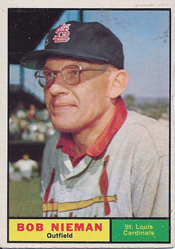
Outfielder Bob Nieman, who made an unprecedented debut with the Browns, returned to St. Louis as an accomplished hitter with the Cardinals.

On Dec. 2, 1959, the Cardinals acquired Nieman from the Orioles for outfielder-catcher Gene Green, plus catcher Chuck Staniland.

Eight years earlier, Nieman became the first player to hit home runs in his first two major-league at-bats. Since then, the only other player to do it is the Cardinals’ Keith McDonald.

A right-handed batter, Nieman appealed to the Cardinals because he hit left-handers well and “southpaws have been a constant plague” to them, The Sporting News reported.

Marty Marion, the former Cardinals shortstop who was Nieman’s teammate with the Browns, said to the St. Louis Post-Dispatch, “He’s only a mediocre outfielder and he’s a hypochondriac, but, man, he can whale that ball.”

Overcoming hurdles

Nieman was born in Cincinnati and began going to Reds games when he was 3 with his father, a semipro catcher.

Nieman developed into a baseball catcher and football fullback in high school. After graduation, he joined the Army, was stationed in France and got pneumonia. The drugs used to treat him damaged his kidneys and he developed nephritis. Given a medical discharge, Nieman returned home, recovered, married his high school sweetheart and tried out with the Reds.

After Nieman signed a minor-league contract with the Reds, a tumor was discovered in his right arm and he underwent surgery. When he healed, the Reds converted him from catcher to outfielder. In 1948, his first minor-league season, Nieman hit .367.

During his off-seasons in the minors, Nieman pursued a college education at Kent State. Nieman was studying journalism in the hope of being a sports reporter and his wife, Patricia, was majoring in advertising.

“Next to actual participation, I can think of no life more enjoyable than watching games and being paid to do so,” Nieman said.

In June 1951, the Reds determined they had a surplus of outfielders in the minors and placed Neiman on waivers. He was claimed by Oklahoma City, an unaffiliated team in the Texas League. Nieman led the league in hitting (.324) and his contract was purchased by the Browns.

Boston fireworks

Nieman, 24, joined the Browns in Boston. Manager Zack Taylor didn’t plan to play him, but changed his mind when the Red Sox started a left-hander, Mickey McDermott. Nieman played left field and batted fifth in the Friday afternoon game on Sept. 14, 1951, at Fenway Park.

When he came to bat for the first time as a big-leaguer in the second inning, Nieman hit a solo home run. In his second at-bat in the third, he hit a two-run home run. According to the Post-Dispatch, those were the only pitches he swung at in those at-bats.

“This is really the day of my life,” Nieman said.

He almost got upstaged in the eighth when Satchel Paige, 45, relieved for the Browns and faced Ted Williams. With the count 0-and-2, Williams moved up in the batter’s box, expecting an off-speed pitch. Paige fired a fastball and Williams swung and missed, striking out.

When Williams got to the dugout, he “smashed his bat into pieces,” the Boston Globe reported. “He first whacked it against the railing leading to the dressing room. When that didn’t suffice, Williams flung the bat toward the rack. He still wasn’t satisfied, so he smashed it on the floor of the dugout. That ended the bat’s worth for good.”

Watching from the mound, Paige “was laughing his head off,” the Globe noted.

“I’ve never seen anything like it in the big leagues,” Paige said. “He was sore because I crossed him up.”

Asked about Nieman’s performance, Paige said the burly rookie “is just a lot of boy. Leans into that ball pretty good and hits the pitch where it is.” Boxscore

Designated hitter

Nieman hit .372 in 12 games for the 1951 Browns. The next year, he led the 1952 Browns in batting average (.289), home runs (18) and RBI (74), but they traded him to the Tigers after the season. Nieman played for the Tigers (1953-54), White Sox (1955-56) and Orioles (1956-59). He batted .322 for the Orioles in 1956 and .325 in 1958.

In 1959, when Nieman hit .292 with 21 home runs for the Orioles, The Sporting News described him as “a terror at the bat but sometimes frightful in the field.” Bob Broeg of the Post-Dispatch suggested Nieman “thought defense was the time to rest.”

The Cardinals got Nieman for his hitting, not his fielding. He batted .287 in 81 games in 1960 and had an on-base percentage of .372.

Among his highlights:

_ A home run against Sandy Koufax in a 2-0 triumph over the Dodgers on Aug. 21. Boxscore

_ A double, triple and home run for four RBI against Dick Ellsworth in a 4-3 victory versus the Cubs on Sept. 4. Boxscore

_ A ninth-inning home run against Johnny Podres to force extra innings against the Dodgers on Sept. 21. Boxscore

In 1961, Nieman, 34, was hitting .471 (8-for-17) when the Cardinals traded him to the Indians on May 10. The Cardinals made the deal because they wanted to give more playing time to Charlie James, 23, who they were grooming to replace Stan Musial in left.

“At least Nieman has the consolation of being one of the few .471 hitters ever traded,” the Post-Dispatch concluded.

Nieman said, “I certainly hate to leave this club. I mean it when I say this is the finest outfit I’ve ever been associated with.”

As he departed, Nieman wrote a message on the blackboard in the Cardinals’ clubhouse: “Good luck, boys, see you in the World Series.”

The Cardinals didn’t reach the World Series in 1961, but Nieman did a year later. After hitting .354 in 39 games for the Indians in 1961, they traded him to the Giants the next year and Nieman appeared in the 1962 World Series.

Read Full Post »

« Newer Posts - Older Posts »