Feeds:
Posts
Comments

Archive for the ‘Games’ Category

The franchise of Dizzy Dean and Bob Gibson gave Bryn Smith the most lucrative contract of any Cardinals pitcher.

On Nov. 28, 1989, Smith, a free agent, signed a three-year $6 million contract with the Cardinals.

“It’s more money than I ever dreamed of,” Smith told the St. Louis Post-Dispatch.

Smith’s contract was the second-highest in Cardinals history, behind only shortstop Ozzie Smith, the Post-Dispatch reported.

Looking for a proven winner to join Joe Magrane (18-9 in 1989) and Jose DeLeon (16-12) in their starting rotation, the Cardinals chose Smith, 34, who had six consecutive seasons of double-digit wins with the Expos but who also lost eight of his last nine decisions in 1989 and finished with a losing record (10-11).

Show time

Smith grew up in Santa Maria, Calif. His mother and father were introduced to one another by actress Jane Russell while working at RKO Pictures in Hollywood. Smith’s mother dated actor Cary Grant before she married.

Smith’s unusual first name was derived from the initials of his maternal grandfather, Baxter Robert Young Nisbet.

When Smith was 15, his mother took him to a Dodgers game and he decided he wanted to play baseball. He tried out for the high school team and discovered he could play.

Smith, 17, was selected by the Cardinals in the 49th round of the 1973 amateur draft but chose to enroll in junior college. A year later, he signed with the Orioles.

“I got $1,000 to sign and I spent half of it on an engagement ring and I went out and blew the rest,” Smith said.

He spent three seasons in the Orioles’ farm system, got traded to the Expos and made his major-league debut with them in 1981. His best season was in 1985 when he was 18-5 with a 2.91 ERA.

A fan of the rock group Rush, Smith joined them on tour for a week and credited the lead singer with teaching him how to deal with crowds.

A right-hander, Smith pitched to contact, issued few walks and relied on changing speeds. The palmball was a favorite pitch. “I’m not a power pitcher,” he said. “I have to be a control pitcher and make use of the park.”

Money ball

After finishing seven games behind the first-place Cubs in the National League East in 1989, the Cardinals decided to find a starting pitcher in the free agent market and focused on two Expos defectors, Smith and left-hander Mark Langston.

The Giants and Braves also were interested in Smith and the Angels wanted Langston. When the Yankees signed another Expos defector, free-agent pitcher Pascual Perez, to a three-year, $5.7 million contract in November 1989, it established the market value and prompted the Cardinals to make their offer to Smith.

“It was an offer I couldn’t refuse,” said Smith.

Soon after, Langston signed with the Angels for five years and $16 million.

Stung by the departures of Perez, Smith and Langston from their starting rotation, Expos owner Charles Bronfman told the Associated Press, “People are being financially irresponsible. I mean, you can have bidding for players, but you don’t have to be a damned fool about it. Right now, some people are.”

Noting Smith’s career record of 81-71, Expos president Claude Brochu said, “Bryn is a good, average pitcher. That’s what he is _ a .500 pitcher. If you triple his salary, it’s not suddenly going to make him a 20-game winner.”

Unfazed, Cardinals general manager Dal Maxvill said Smith “probably has the best control of any pitcher in the National League. Whitey (Herzog) and I both think that with Bryn pitching in Busch Stadium, with an outstanding defense behind him, he can be a big winner.”

Injury issues

Smith made his Cardinals debut on April 10, 1990, against the Expos at St. Louis, got the win and drove in a run. Boxscore

A shoulder ailment prevented Smith from pitching from late July to early September and he finished the 1990 season at 9-8 with a 4.27 ERA.

In 1991, Smith got the start on Opening Day, earned a win against the Cubs in Chicago and went on to finish 12-9 with a 3.85 ERA. He led the 1991 Cardinals in wins (12), starts (31) and innings pitched (198.2).

The 1992 season was a bust for Smith. He made one start in April, had elbow surgery and was used as a reliever when he returned in September. Smith was 4-2 with a 4.64 ERA for the 1992 Cardinals, became a free agent after the season and signed with the Rockies.

In three seasons with St. Louis, Smith was 25-19 with a 4.06 ERA.

Read Full Post »

With one swing of his exceptionally hot bat, Irv Noren struck back at the team that cast him aside and kept the Cardinals in the thick of the 1957 National League pennant race.

Noren was an outfielder for 11 seasons in the major leagues, including five (1952-56) with the Yankees and three (1957-59) with the Cardinals.
A left-handed batter, Noren, 32, was claimed by the Cardinals on Aug. 31, 1957, when he was placed on waivers by the Athletics.

Thought by some to be washed up after undergoing surgeries on both knees and hitting .213 for the 1957 Athletics, Noren went on a tear with the Cardinals and helped them make a run at the first-place Braves in the final month of the season.

American Leaguer

After serving in the Army during World War II, Noren signed with the Dodgers in 1946 and excelled in their farm system for four years.

In 1949, playing for manager Fred Haney with the Hollywood Stars of the Pacific Coast League, Noren batted .330 with 29 home runs and 130 RBI, but the Dodgers sold his contract to the Washington Senators after the season.

As a rookie with the 1950 Senators, Noren hit .295 with 98 RBI. The Yankees acquired him in May 1952 and Noren was valuable, playing all three outfield spots as well as first base. In 1954, he led the Yankees in batting (.319).

Noren played for the Yankees in three World Series, all against the team that rejected him, the Dodgers.

Hunger to win

The Cardinals were 7.5 games behind the front-running Braves when they acquired Noren. “As long as we’ve got an outside chance to win the pennant, or for that matter, increase our chances of finishing second, we are going to do all we can,” Cardinals general manager Frank Lane told the St. Louis Post-Dispatch.

The Braves were managed by Fred Haney, who eight years earlier had managed Noren with the Hollywood Stars.

After being swept by the Reds in a Labor Day doubleheader on Sept. 2, 1957, the Cardinals fell 8.5 games out of first. Then they won 11 of their next 13. Noren helped, getting seven hits in his first 15 at-bats as a Cardinal.

On Sept. 17, 1957, the Dodgers, who had made public their plans to abandon Brooklyn after the season and relocate to Los Angeles, came to St. Louis to open a two-game series against the Cardinals.

For Noren, it would be his first chance to face his original franchise in a regular-season game.

In the seventh inning, the Cardinals led, 6-5, and had the bases loaded with one out. Ken Boyer was due to bat against right-hander Ed Roebuck.

Seeking a hit to break open the game, Cardinals manager Fred Hutchinson sent Noren to the plate for Boyer, preferring to have a batter from the left side face Roebuck.

Noren swung at Roebuck’s first pitch and lined it into left-center, clearing the bases with a three-run triple and giving the Cardinals a 9-5 lead.

The Cardinals went on to a 12-5 victory and were three games behind the Braves with 10 play. Boxscore

The triple gave Noren, the Dodgers’ castoff, a .529 batting average as a Cardinal.

“We are a hungry team,” Lane said to the Associated Press.

Helping hand

The Cardinals split their next four games, dropping five behind the Braves. The Braves then won two of three against them in Milwaukee and the deflated Cardinals lost their last three to the Cubs, finishing in second place.

Noren batted .367 (11-for-30) for the 1957 Cardinals and had an on-base percentage of .429. He had 10 RBI in 17 games.

After the season, Noren opened a bowling alley in Pasadena, Calif. When the Cardinals played the Dodgers in their first season in Los Angeles in 1958, Noren had several of his teammates as his guests at the bowling lanes.

Noren hit .264 in 117 games for the 1958 Cardinals. He was traded to the Cubs in May 1959.

Noren was the third-base coach for the Athletics when they won three consecutive World Series championships (1972-74).

Read Full Post »

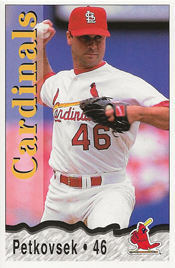
Mark Petkovsek, barely clinging to the fringes of the major leagues, revived his pitching career with the Cardinals.

Petkovsek signed a minor-league contract with the Cardinals on Nov. 18, 1994, his 29th birthday. Projected to spend 1995 with the Louisville farm club, Petkovsek was called up to the Cardinals when injuries depleted their pitching staff.
Given the opportunity, Petkovsek became a valuable, versatile Cardinals pitcher.

Long, hard road

Born and raised in Beaumont, Texas, Petkovsek was the youngest of eight children. He excelled at multiple sports, went to the University of Texas and became a top pitcher. A right-hander, he had a 29-3 record in three seasons and his 15 wins in 1987 tied for the most in the nation among college pitchers.

Petkovsek was selected by the Rangers in the first round of the 1987 amateur draft. Four years later, he made his debut with them in a start against the Yankees and was tagged for seven runs in 4.2 innings. He pitched in four games for the Rangers before being returned to the minors.

Granted free agency after the 1991 season, Petkovsek signed with the Pirates. In 1993, his lone season with them, Petkovsek was 3-0 with a 6.96 ERA in 26 relief appearances. He joined the Astros’ organization in 1994, spent the season with their Tucson farm club and pitched a no-hitter versus Colorado Springs.

Cardinals director of player development Mike Jorgensen decided to take a chance on Petkovsek and signed the free agent. “He’s not a dominating pitcher … He’s a control guy, kind of like Bob Tewksbury,” Jorgensen said to the St. Louis Post-Dispatch.

Dependable pitcher

Major-league players went on strike in August 1994 and remained out of work when spring training camps opened in February 1995. As a player signed to a minor-league contract and not on the 40-man Cardinals roster, Petkovsek was required to report. He was one of 55 pitchers, many of them replacement players, in Cardinals camp at St. Petersburg, Fla.

When the Grapefruit League exhibition schedule began, Petkovsek was one of about 10 Cardinals minor-leaguers who declined to participate in games with replacement players.

After the strike was settled in April 1995, Petkovsek was assigned to Louisville. He was 4-1 with a 2.32 ERA in eight starts when the call came to join the Cardinals in May 1995.

Relying on a sinkerball and changeup, Petkovsek said, “I try to get ahead and get them out with as few pitches as possible.”

Put into the starting rotation, Petkovsek won three of his first four decisions, including a shutout of the Dodgers at St. Louis. Boxscore

“I never stopped believing,” Petkovsek said.

He led the 1995 Cardinals pitching staff in starts (21) and innings pitched (137.1), posting a 6-6 record and 4.00 ERA.

The next season, Petkovsek became what the Post-Dispatch called the Cardinals’ “good luck charm.” Used as a starter and reliever in 1996, Petkovsek was 11-2 with a 3.55 ERA for the Cardinals, who reached the postseason for the first time in nine years.

Petkovsek deflected credit for his role in the club’s success. “I’m not into this for the glamour,” he said. “I’m not sure I’d know what to do with the limelight if I got it.”

Petkovsek pitched four seasons (1995-98) for St. Louis and was 28-19 with two saves before he was traded to the Angels for catcher Matt Garrick.

Read Full Post »

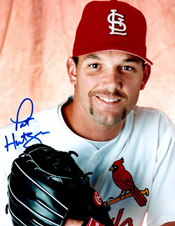
The Cardinals began to rebuild their starting pitching rotation for the 21st century with the acquisition of a Cy Young Award winner.

On Nov. 11, 1999, the Cardinals traded catcher Alberto Castillo, reliever Lance Painter and pitching prospect Matt DeWitt to the Blue Jays for Pat Hentgen.
It was an important deal for the Cardinals, who sought to become contenders after three years (1997-99) of failing to qualify for the postseason. Better pitching was one of their needs.

Hentgen, 31, achieved double-digit win totals for the Blue Jays in seven consecutive seasons (1993-99) and received the American League Cy Young Award in 1996.

After acquiring Hentgen, the Cardinals added pitchers such as Darryl Kile, Andy Benes and reliever Dave Veres, and, along with the emergence of rookie Rick Ankiel, the upgrades made a difference.

After finishing 75-86 in 1999 with a starting rotation primarily of Darren Oliver, Kent Bottenfield, Jose Jimenez, Kent Mercker and Garrett Stephenson, the Cardinals in 2000 finished 95-67, won a division title and reached the National League Championship Series with a rebuilt rotation of Kile, Hentgen, Stephenson, Ankiel and Benes.

Reliable starter

Hentgen, a right-hander, made his major-league debut with the Blue Jays in September 1991, started and won Game 3 of the 1993 World Series for them against the Phillies and got the Cy Young Award in 1996 when he was 20-10 and led the American League in innings pitched (265.7), complete games (10) and shutouts (three).

He made 183 consecutive starts for the Blue Jays without missing a turn before shoulder tendinitis ended the streak in August 1998.

After a slow start to the 1999 season, Hentgen regained strength in his shoulder. Though he no longer had an overpowering fastball, he relied on location to frustrate batters. He often put pitches on the outside corner to induce groundballs and, if batters edged closer to the plate, he could deliver a pitch inside.

In August 1999, Blue Jays manager Jim Fregosi decided to have Hentgen skip a turn in the rotation, but didn’t inform the pitcher. Hentgen learned of the decision from a newspaper reporter. A month later, Hentgen and Fregosi had a heated argument in a closed-door clubhouse meeting, the National Post reported.

Hentgen finished the 1999 season with an 11-12 record and 4.79 ERA in 34 starts, but was 5-5 with a 2.87 ERA after Aug. 1.

The Blue Jays shopped him and the Tigers expressed interest, but the Cardinals made the best offer. The Blue Jays wanted Painter to replace left-hander reliever Graeme Lloyd, who departed for free agency.

Good fit

Hentgen was the fifth Cy Young Award winner acquired by the Cardinals since the honor was initiated in 1956. The others were Bruce Sutter (who won the award with the 1979 Cubs), Fernando Valenzuela (1981 Dodgers), Rick Sutcliffe (1984 Cubs) and Dennis Eckersley (1992 Athletics). Bob Gibson and Chris Carpenter are the only pitchers to receive the award as Cardinals.

The Cardinals had talked to the Dodgers about a trade for pitcher Ismael Valdes before making the deal for Hentgen, according to the St. Louis Post-Dispatch.

“We’ve been working on this deal for a long time,” Cardinals general manager Walt Jocketty said. “We had tried to acquire him earlier in the year, but we weren’t able to. Finally, we got it worked out.”

Jocketty described Hentgen as a pitcher with “great upside.”

“I’m very confident he’s going to be a horse for us,” Jocketty said.

Cardinals manager Tony La Russa said Hentgen reminded him of Todd Stottlemyre, a former Blue Jays pitcher who excelled for the Athletics and Cardinals with Dave Duncan as his pitching coach.

Post-Dispatch columnist Bernie Miklasz predicted Hentgen and Duncan would work well together. “Hentgen appears to be the ideal Duncan project,” Miklasz wrote.

The Cardinals also were seeking a catcher and Hentgen recommended his 1999 Blue Jays teammate, Mike Matheny. When the Blue Jays released Matheny after acquiring Castillo in the Hentgen deal, the Cardinals followed Hentgen’s advice and signed Matheny.

Big fix

When Hentgen struggled with command of his pitches early in spring training with the 2000 Cardinals, Duncan studied video of the performances and discovered a flaw in Hentgen’s delivery, the Post-Dispatch reported.

“Instead of going straight to the plate, I’m going toward the on-deck circle,” Hentgen said. “It’s as if I’m pitching to the plate five seats over.”

As a result, “the arm just drags, so I had nothing on the ball and no location,” Hentgen said.

Hentgen made his Cardinals debut with a start in the second game of the 2000 season and got the win in a 10-4 victory over the Cubs at St. Louis. He retired 11 consecutive batters from the second through fifth innings. Boxscore

On Sept. 14, 2000, Hentgen beat the Cubs again, pitching a three-hit shutout at St. Louis. Boxscore

“He kept the ball down and got ahead in the count,” said Matheny.

Duncan said, “His delivery was perfectly consistent from start to finish … When you’re getting called third strikes on good hitters, you’re executing your pitches.”

Hentgen finished with a 15-12 record for the 2000 Cardinals, winning six of eight decisions from Aug. 2 to Sept. 14, and was second on the staff in games started (33). He also started and lost Game 5 of the 2000 National League Championship Series when the Mets clinched the pennant.

Granted free agency after the postseason, Hentgen signed with the Orioles.

In 14 seasons in the big leagues, Hentgen was 131-112.

Read Full Post »

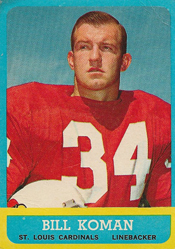
Bill Koman was a talented, durable outside linebacker and one of the respected leaders of the Big Red defense of the St. Louis football Cardinals in the 1960s. He also was outspoken and controversial.

Koman played 12 seasons in the NFL for the Baltimore Colts (1956), Philadelphia Eagles (1957-58), Chicago Cardinals (1959) and St. Louis Cardinals (1960-67). He owned a real estate development company and built it into a successful business in St. Louis.

Koman is remembered as a devoted family man, business owner and philanthropist.

Will to succeed

William John Koman Sr. was born in 1934 in Ambridge, Pa., located on the Ohio River 16 miles northwest of Pittsburgh. The town was formed by the American Bridge Company and attracted thousands of immigrants to work in the steel mills.

Koman grew up in Aliquippa, Pa., and when he was 9 he suffered a severe injury to his left knee in a bicycle accident, according to Bob Broeg of the St. Louis Post-Dispatch. Infection set in and there was concern amputation would be needed.

The leg was saved, but Koman faced a lengthy recovery.

“I’ll never forget the agonizing look on my father’s face when a man sympathized with him for having a crippled son who couldn’t be an athlete,” Koman told Broeg.

Koman said he worked diligently to strengthen the knee, running four miles a day and doing other exercises. When he enrolled at Hopewell High School, he was a trumpet player in the band until healthy enough to play football as a junior.

(Following Koman as athletic alumni of Hopewell High School: big-league pitcher Doc Medich and Heisman Trophy winner and Pro Football Hall of Fame running back Tony Dorsett.)

Smart and athletically gifted, Koman earned a scholarship to the University of North Carolina. He excelled in football and in the classroom, earning a degree in economics. “I was a lot better student than I was an athlete,” Koman said to the Chicago American.

Straight talk

The Colts chose Koman in the eighth round of the 1956 NFL draft. He was released after one season and signed with the Eagles. Two years later, he was traded to the Cardinals.

Named to the Pro Bowl team in 1962 and 1964, Koman played in 120 consecutive games for the Cardinals and missed only one. In the mid-1960s, Cardinals linebackers Larry Stallings, Dale Meinert and Koman were widely respected.

Koman intercepted seven passes in the NFL, including six for the Cardinals, from quarterbacks such as Norm Van Brocklin, Sonny Jurgensen and Don Meredith. “It’s a game of mental attitude and emotion,” Koman said to the Post-Dispatch. “Give me 11 guys who will hit their mothers in the back and we’ll beat anyone. There are too many nice guys in this game.”

In an August 1964 interview with Bill Gleason of the Chicago American, Koman said, “My attitude toward the game is I don’t feel anybody can block me. I also feel I’m the best doggone linebacker in the league my size. Because I believe it, I go out there and prove it.”

Koman offered his views on other NFL linebackers:

_ Sam Huff of the New York Giants: “If I played one game the way Sam Huff plays an entire season, I wouldn’t have had a pro career. I would have quit. Huff has always been overrated.”

_ Joe Fortunato of the Chicago Bears: “Nobody admires Joe Fortunato more than I do. He gives 125 percent of himself every game, but don’t try to tell me he’s a great linebacker.”

_ Chuck Bednarik of the Eagles: “Chuck Bednarik had great ability, but he was not a smart football player. When I was a kid with the Eagles, I told coach Buck Shaw, ‘I don’t have to take Bednarik’s stuff. I have an education.’ So they traded me to the Cardinals.”

“It doesn’t mean a damn whether they agree with me or not,” Koman said. “Whether they like me or not, they’re going to try to beat the hell out of me the next game. What I say I believe.”

Three months later, after Koman was hit in the face during a November 1964 game versus the Pittsburgh Steelers, he told the Post-Dispatch, “When the doctors took those stitches in my chin, somebody wondered why he sewed up my chin and not my mouth.”

Culture clash

In 1967, racial tension among the Cardinals resulted in black players bringing a list of grievances to coach Charley Winner before the last game of the season.

Two months later, in February 1968, when Koman, 33, retired, Broeg described him as “the red-necked Red Dog of the Big Red.”

Koman summarized his NFL career as “12 extremely enjoyable, highly challenging, somewhat controversial and many times frustrating years” and cited his business commitments as an incentive to quit playing.

In July 1968, Sports Illustrated published a story about the racial problems experienced by the 1967 Cardinals.

A month after the Sports Illustrated story appeared, Murray Olderman of the Newspaper Enterprise Association interviewed Koman about the race issue. Citing his respect for black Cardinals players such as Jimmy Hill and Luke Owens, Koman said he judged teammates on job performance rather than skin color.

“When I play, I want the best athlete beside me. I never played with a finer cornerback than Jimmy Hill or a finer man than Luke Owens,” Koman said.

“When it comes to football, I’ll play beside anybody as long as he shows the willingness to do the job. Nobody ever questioned my preparedness to play football. I simply felt a few players were kept around who lacked the ability to play in the National Football League and had a bad attitude.”

After football, Koman’s company developed projects such as City Place in Creve Coeur, Mo., and shopping centers in the St. Louis area. According to a press release from the family, Koman was one of the original five founding members of the Casino Queen, an economic boon to East St. Louis, Ill. His family has continued to grow the business into the Koman Group.

Read Full Post »

George Culver, a dapper dresser who threw a sharp slider, seemed suited for a spot in the starting rotation of the Cardinals until his season unraveled like a spool of cheap threads.

On Nov. 5, 1969, the Cardinals acquired Culver from the Reds for pitcher Ray Washburn.

Culver, 26, and Washburn, 31, were right-handers who pitched no-hitters in the major leagues. Culver threw a no-hitter for the Reds against the Phillies on July 29, 1968. Boxscore Washburn had a no-hitter for the Cardinals versus the Giants on Sept. 18, 1968. Boxscore

The Cardinals projected Culver as a younger, more versatile version of Washburn and acquired him on the recommendation of Vern Benson and Hal Smith, former Cardinals players and coaches who were Reds coaches on the staff of manager Dave Bristol when Culver pitched for Cincinnati in 1968 and 1969. After Bristol was replaced by Sparky Anderson, Benson and Smith rejoined the Cardinals and urged general manager Bing Devine to make a deal for Culver.

Culver earned a spot in the Cardinals’ starting rotation in spring training and won his first three starts of the 1970 regular season, but an elbow ailment curtailed his progress and the Cardinals traded him to the Astros.

Here’s the scoop

When Culver was in eighth grade, he combined his passion for sports with an interest in writing.

“I’d listen to a game on the radio and then write a story about the game,” he told the St. Louis Post-Dispatch. “Then I’d compare what I wrote with the story of the game that would appear in the newspaper.”

As a freshman in Bakersfield, Calif., Culver became sports editor of the high school newspaper and eventually covered prep sports events as a freelancer for the local newspaper, the Bakersfield Californian.

When he wasn’t covering sports, Culver excelled at participating. He was best at baseball. He eventually signed with the Yankees, spent a season in their farm system and was selected by the Indians in the minor-league draft.

Culver, 23, made his major-league debut with the Indians in September 1966. He arrived in the clubhouse wearing a sport jacket and carrying a suitcase containing one suit. For the next month, he wore the jacket or the suit every day and was needled by teammates for lacking a better wardrobe, he told the Post-Dispatch.

“I didn’t want to be a country dresser,” Culver said. “The next year, I got a $5,000 bonus for being in the big leagues 90 days and I went out and spent about two grand on clothes.”

From then on, Culver became as well-known for his outfits as he was for his pitching.

Fashionable player

A reliever in 1967, Culver led Indians pitchers in appearances (53) and posted a 7-3 record with three saves. Traded to the Reds, he became a starter, led them in innings pitched (226) and was 11-16 with a 3.23 ERA in 1968.

Described by the Bakersfield Californian as a “mod-style bachelor,” Culver, who was divorced, developed what the Post-Dispatch called “nocturnal habits.” He liked to golf during the day and shoot pool and play bridge or poker at night.

Whatever he did, he looked marvelous doing it.

“Culver is a good-looking, green-eyed guy who resembles his idol, golf’s dashing Doug Sanders, in physical appearance and sartorial splendor,” Bob Broeg of the Post-Dispatch observed.

On the day they met, Broeg reported, Culver was wearing “white shoes, cream-colored trousers and a brilliant orange sweater.”

Culver told Broeg he liked to wear purple or pink. “I know those colors aren’t very manly,” Culver said, “but they’re beautiful.”

According to the Bakersfield newspaper, Culver had a “purple Edwardian-style suit,” but he said, “I don’t wear that purple outfit anymore. I favor all-white suits now.”

Culver said he had 150 pairs of slacks and 50 Banlon shirts. “I’d rather spend 50 bucks on clothes than on a date,” he told Broeg.

The focus on fashion paid off. A Los Angeles clothing manufacturer hired Culver as a sales representative and he carried “sample swatches of material as well as color and style charts on his baseball travels,” the Bakersfield Californian reported.

Even the back of Culver’s Topps baseball card noted, “George likes to wear mod-style clothes.”

Fresh start

In July 1969 while with the Reds, Culver became ill. He was sent to a Cincinnati hospital and diagnosed with hepatitis. He returned to the club late in the season, made five appearances and finished with a 5-7 record and 4.26 ERA.

The bout with hepatitis gave Culver “a good warning about the condition of his liver” and inspired him to change his lifestyle, the Post-Dispatch reported. After his trade to the Cardinals, Culver said, “I’ve given up drinking and I’ve recently kicked a four-pack-a-day cigarette habit.”

At Cardinals spring training camp in 1970, Culver competed with Chuck Taylor and Jerry Johnson for the fifth starter spot in a rotation with Bob Gibson, Steve Carlton, Nelson Briles and Mike Torrez.

Benson said Culver has “the arm to start and relieve and the heart to do both.”

Culver won the starting role by posting a 1.73 ERA in 26 innings in Grapefruit League games.

“He keeps the ball down consistently,” said Cardinals manager Red Schoendienst.

Culver made his Cardinals debut with a start in the home opener against the defending World Series champion Mets on April 10, 1970, at Busch Memorial Stadium. He limited the Mets to two earned runs in 7.2 innings, contributed two RBI and got the win in a 7-3 Cardinals triumph before 45,960. Boxscore

Culver got complete-game wins in each of his next two starts, beating the Pirates in Pittsburgh Boxscore and the Reds at St. Louis. Boxscore After three starts, he was 3-0 with a 1.40 ERA.

Meet the press

When Culver began his professional baseball career, the Bakersfield newspaper gave him a twice-a-month sports column, “Culver’s Clubhouse,” and he still was writing it while with the Cardinals.

“I write all my own stuff,” Culver said. “I try to give the readers information they wouldn’t ordinarily get.”

While with the Cardinals, Culver’s columns included insights on:

_ Teammate Bob Gibson: “He’s one of the hardest workers in camp and you’d never know he’s 34 years old. There isn’t a tougher competitor in the game.”

_ Artificial turf in St. Louis: “One thing the AstroTurf should cut down is infield hits. It’s almost impossible to hit a slow groundball and you will never see a ball die after being bunted unless the hitter uses a sand wedge.”

_ Pitching in Pittsburgh: “I’m glad they don’t have AstroTurf there yet. I might get one of our infielders killed.”

He also was considering writing a book about his adventures playing winter baseball in the Caribbean. The working title: “Maybe Mañana.”

Short stay

Since late in spring training with the Cardinals, Culver’s right elbow was aching. After the 3-0 start to the season, Culver was winless in his next four starts and his ERA increased to 4.66.

Schoendienst moved Culver to the bullpen in mid-May and replaced him in the rotation with rookie Santiago Guzman. In four relief appearances, Culver was 0-1 with a 4.32 ERA.

On June 13, 1970, the Cardinals traded Culver to the Astros for two utility players, Jim Beauchamp and Leon McFadden, and promoted rookie Al Hrabosky to take his spot in the bullpen.

Culver made 32 relief appearances for the 1970 Astros, was 3-3 with three saves and a 3.20 ERA and had elbow surgery after the season. He went on to pitch for the Dodgers and Phillies, finishing with a career record of 48-49, 23 saves and a 3.62 ERA in nine big-league seasons.

Read Full Post »

« Newer Posts - Older Posts »