Feeds:
Posts
Comments

Archive for the ‘Games’ Category

(Updated Nov. 25, 2024)

Ron Fairly tormented Bob Gibson as an opponent and helped him as a teammate.
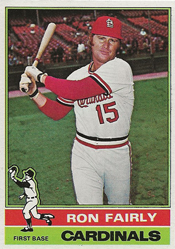
A first baseman and outfielder, Fairly played 21 years (1958-78) in the major leagues, primarily with the Dodgers and Expos, and spent two seasons (1975-76) with the Cardinals. He played in four World Series for the Dodgers, including 1965 when he batted . 379 against the Twins.

A left-handed batter with a line drive stroke, Fairly did some of his best work against Gibson, the Cardinals’ ace.

During his Hall of Fame career, Gibson yielded more hits (48) and more doubles (10) to Fairly than he did to any other batter.

In addition to having his career highs in hits and doubles against Gibson, Fairly produced a career-best 24 RBI versus him.

In his 1968 book, “From Ghetto to Glory,” Gibson said, “I don’t have to make a mistake against Fairly. Whatever I throw, he just hits it _ I don’t care what it is _ and always when somebody is on base. The guy is just a pretty good hitter.”

Four decades later, in his book, “Sixty Feet, Six Inches,” Gibson described Fairly as a batter who “would punch the ball over the shortstop’s head and you couldn’t strike him out. I tried to pitch him in, like I did a lot of left-handed hitters, and I didn’t have any luck with that. I’d pitch him away, make a good pitch, and he’d dump it over the shortstop’s head.”

In 1975, Fairly’s first season with the Cardinals and Gibson’s last, Gibson benefitted from Fairly’s formidable hitting.

On July 27, 1975, Fairly had two hits, two walks, one RBI and scored a run in the Cardinals’ 9-6 victory over the Phillies at St. Louis. Gibson got the win, the 251st and last of his career, with four scoreless innings of relief. Boxscore

Fairly talented

Fairly attended the University of Southern California, signed with the Dodgers in June 1958 and made his debut with them three months later at age 20.

He established himself as a smooth fielder at first base and a consistent hitter.

Chicago columnist Jerome Holtzman rated Fairly “the best first baseman I’ve ever seen coming in on a bunt.”

Dodgers manager Walter Alston, in a 1965 interview with Bob Broeg of the St. Louis Post-Dispatch, said he regarded Fairly the best hitter with runners on base of any of the players he’d managed.

For his career, Fairly had 17 home runs and 100 RBI versus the Cardinals. He batted .302 against Gibson, with 48 hits, including four home runs, in 159 at-bats. Fairly’s on-base percentage versus Gibson was .369.

In Gibson’s autobiography, “Stranger to the Game,” Gibson’s friend and teammate Joe Torre said, “Ron Fairly hit Gibby about as well as anybody did.”

On July 15, 1964, Fairly hit two home runs, one against Gibson and the other versus Ray Washburn, in a 13-3 Dodgers victory over the Cardinals at St. Louis. Boxscore

Regarding the Gibson fastball he hit for the homer, Fairly said, “I just got around in front of the pitch and laid the bat on the ball. Gibson supplied the power.”

The next day, Fairly hit a homer against Ray Sadecki. For the three-game series, Fairly had 10 RBI and six hits in 13 at-bats.

A year later, on June 3, 1965, at St. Louis, Fairly hit a two-run home run off Barney Schultz with two outs in the eighth, erasing a 10-9 deficit and lifting the Dodgers to an 11-10 victory. Boxscore

Fairly hit the first walkoff home run of his major-league career on Sept. 25, 1970, for the Expos against the Cardinals in Montreal. With the Cardinals ahead, 5-4, the Expos had two on and two outs in the ninth when Fairly hit an 0-and-2 fastball from rookie Al Hrabosky for a game-winning homer. Boxscore

“I can’t hit a ball any better than that,” Fairly said to the Montreal Gazette.

Proud pro

On Dec. 6, 1974, the Cardinals acquired Fairly from the Expos for a pair of prospects, first baseman Ed Kurpiel and infielder Rudy Kinard. Cardinals general manager Bing Devine projected Fairly to be a pinch-hitter and backup to rookie first baseman Keith Hernandez. Fairly, 36, told The Sporting News, “I expect to play a lot. I’d like to play every day.”

Hernandez, 21, opened the 1975 season as the starter, struggled and was sent to the minors in June.

Fairly, getting starts at first base and in the corner outfield spots, became a valuable player for the 1975 Cardinals. He hit .301 and had an on-base percentage of .421. He also hit .343 as a pinch-hitter. On July 8, 1975, at St. Louis, Fairly hit a grand slam against Pete Falcone of the Giants. Boxscore

“I don’t fool around in batting practice,” Fairly said. “I try to hit with game situations in mind. Too many players fool around too much in batting practice and that gets them in bad habits.”

Fairly shared his knowledge with Cardinals teammates. According to The Sporting News, catcher Ted Simmons, “regarded by many as the purest hitter now active in the game,” listened to the advice Fairly gave him on hitting.

Hernandez returned to the Cardinals in September 1975 and regained his starting job. In his memoir, “I’m Keith Hernandez,” Hernandez said Fairly “took the time to show me how to better break in a first baseman’s mitt and how to cheat a little bit on a close putout at first.”

“You’re moving forward to get the ball with the glove, extending your body, and your foot comes off the bag just before the ball arrives,” Fairly told Hernandez. “Don’t rush it, or the ump will catch you pulling your foot.”

In his book, Hernandez said, “I worked on it every day during infield until I had it, and took Ron’s sly little move with me for the rest of my career.”

Fairly found his old nemesis, Bob Gibson, to be a good teammate. In an interview with Cardinals Yearbook in 2018, Fairly told Joe Schuster that Gibson “was really good with my kids.”

“He was their favorite player,” Fairly said. “They would go by his locker and talk to him until he got tired. Then he’d call them little green flies _ ‘That’s enough now. You little green flies need to leave me alone since I have to take a shower and get out of here.’ They loved him and I have tremendous respect for him.”

Watching Fairly’s impact on the Cardinals, Expos owner Charles Bronfman admitted, “That Fairly deal was very unfortunate. I think Ron fooled a lot of us by playing a lot better than we expected.”

The next season, Fairly hit .264 and had an on-base percentage of .385 for the Cardinals before they sold his contract to the Athletics on Sept. 14, 1976. He batted .364 with runners in scoring position for the 1976 Cardinals.

Overall, in his two St. Louis seasons, Fairly batted .289 with a .409 on-base percentage.

He went on to play for the Athletics, Blue Jays and Angels, finishing his career with 1,913 hits.
Read Full Post »

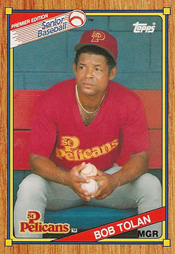
Bobby Tolan, who played on championship clubs with the Cardinals and Reds, was a champion as a manager in the Senior Professional Baseball Association.

On Nov. 1, 1989, the Senior Professional Baseball Association launched its inaugural season. Each of the eight teams played a 72-game schedule from November to February in Florida.

Seeking to match the success of the Senior PGA Tour, the baseball league, founded by real estate developer Jim Morley, focused on nostalgia by bringing back former major-league players 35 and older. An exception was made for catchers, who could be as young as 32.

Former Cardinals outfielder Curt Flood was league commissioner. Several other ex-Cardinals, including Joaquin Andujar, Jose Cruz, George Hendrick, Al Hrabosky, Tito Landrum, Bake McBride and Ken Reitz, signed as players.

For Tolan, hoping to manage in the majors, the senior league provided a chance to prove he could succeed with players who had big-league experience.

Learning to manage

Tolan was 19 when he made his debut as a major-league player with the Cardinals in September 1965. He played in four seasons (1965-68) with the Cardinals and was a reserve outfielder on their National League championship clubs in 1967 and 1968.

In October 1968, the Cardinals traded Tolan and pitcher Wayne Granger to the Reds for outfielder Vada Pinson. The deal was a steal for the Reds. Granger became an effective closer and Tolan developed into a top talent for manager Sparky Anderson, helping the Reds win National League pennants in 1970 and 1972 with his hitting and base stealing.

After his playing career, Tolan was a Padres coach for four seasons (1980-83), the last two with manager Dick Williams.

Hoping to lead a major-league team someday, Tolan agreed to go back to the minors to get experience. He managed the Padres’ farm club at Beaumont, Texas, for two years (1984-85) and one of his top players was 20-year-old catcher Benito Santiago.

In 1987, Tolan became a coach for the Mariners, reuniting with Williams, their manager. Tolan returned to managing in 1988 with Erie, a club in the Orioles’ farm system.

Law and order

In August 1989, after two seasons at Erie, Tolan was named manager of the senior league’s St. Petersburg Pelicans.

“This is almost like a dream come true,” Tolan said to the St. Petersburg Times. “For me, this is the closest thing to the major leagues.”

Determined to produce a winner, Tolan vowed the Pelicans would be physically fit and fundamentally sound. He banned beer from the clubhouse and imposed a curfew. He said he expected the level of play to be comparable to a good Class AAA club.

“I’m managing major-league ballplayers,” Tolan said. “Some are just a little past their prime, some just a little further.”

According to the St. Petersburg Times, Tolan “was criticized by opposing teams and former players for running a tough camp with strict rules.” Winter Haven manager Bill Lee, the former Red Sox pitcher known as “Spaceman,” likened Tolan’s approach to “a militaristic regime.”

Familiar names

The senior league teams for the 1989-90 season were:

_ Bradenton Explorers. Manager: Clete Boyer. Key players: Bruce Kison, Hal McRae, Al Oliver.

_ Fort Myers Sun Sox. Manager: Pat Dobson. Key players: Amos Otis, Dan Driessen.

_ Gold Coast Suns: Manager: Earl Weaver. Key players: Joaquin Andujar, George Hendrick, Cesar Cedeno, Bert Campaneris. Asked why he would come out of retirement to manage in the senior league, Weaver said, “After golfing 20 days in a row, then what?”

_ Orlando Juice: Manager: Gates Brown. Key players: Pete Falcone, Jose Cruz, Bill Madlock, Ken Reitz.

_ St. Lucie Legends: Manager: Graig Nettles. Key players: Vida Blue, Bobby Bonds, George Foster, Clint Hurdle.

_ St. Petersburg Pelicans. Manager: Bobby Tolan. Key players: Jon Matlack, Milt Wilcox, Steve Kemp, Steve Henderson, Ivan DeJesus.

_ West Palm Beach Tropics. Manager: Dick Williams. Key players: Rollie Fingers, Al Hrabosky Dave Kingman, Mickey Rivers, Tito Landrum.

_ Winter Haven Super Sox. Manager: Bill Lee. Key players: Ferguson Jenkins, Jim Bibby, Bill Campbell, Tony Scott.

Some thought the senior league would receive a needed publicity boost if it allowed Pete Rose to play. Rose was banished from the big leagues because of his involvement in a gambling scandal. Flood ruled Rose ineligible for senior baseball unless the major leagues reinstated him.

Alive and well

Even without Rose, the senior league began its first season with optimism and sense of purpose.

“These aren’t cadavers waiting to be buried,” Flood said to the St. Petersburg Times. “These men are serious about playing baseball. I think a lot of people are going to be surprised at the caliber of play.”

Dick Williams told the Palm Beach Post, “We’re dead serious about this. Very much so. We may be a step slower because they’re all older, but there are no pot bellies out there.”

Weaver noted the San Francisco Giants used hulking 40-year-old pitcher Rick Reuschel in the 1989 World Series and said, “He’s older and fatter than most of our guys.”

Media reviews of the Opening Day games generally were favorable.

The St. Petersburg Times noted, “It’s like a baseball card collection come to life.”

Palm Beach Post columnist Tim Rosaforte rated it “good, fundamental baseball. Certainly better, and more exciting, than spring training.”

Best of the bunch

Though a ticket to most senior league games cost about $5, attendance was poor. The West Palm Beach Tropics drew best, averaging 1,600 spectators per game, “but many of those fans received free or discounted tickets,” the Palm Beach Post reported.

Most teams averaged fewer than 1,000 spectators per game. The Orlando Juice did worst, with an average attendance of 400.

Some of the former Cardinals who performed well were Andujar (5-0, 1.31 ERA), Falcone (10-3), Driessen (.333 batting average, 49 RBI), Landrum (.346, 55 RBI) and Cruz (.306, 10 home runs, 49 RBI).

The West Palm Beach Tropics finished first in the Southern Division at 52-20 and the St. Petersburg Pelicans topped the Northern Division at 42-30.

In a winner-take-all championship game on Feb. 4, 1990, the Pelicans prevailed, 12-4, validating Tolan’s managing skill and style.

“I guess this shuts everybody up,” Tolan said. ” Maybe if I weren’t looking for a big-league job I would have run an easy team, but I want a big-league job and I wanted to prove I could run a successful team. I took this seriously and it all paid off by this championship.”

Struggling financially, the senior league reorganized for the 1990-91 season. Flood departed and the number of teams was reduced from eight to six. Four teams remained in Florida and two went to Arizona.

Tolan returned to manage St. Petersburg and he had the Pelicans in first place at 15-8 when the league disbanded on Dec. 26, 1990.

Tolan never did get to manage in the majors. After the senior league folded, his next chance to manage in professional baseball came at age 60 in 2006 with the White Sox rookie league club in Great Falls, Montana.

Read Full Post »

(Updated Sept. 1, 2024)

Bobby Del Greco was a graceful center fielder with a strong arm, but he was no Bill Virdon.

Del Greco was a principal figure in one of the Cardinals’ most lopsided trades.

On May 17, 1956, the Cardinals dealt center fielder Bill Virdon to the Pirates for Del Greco and pitcher Dick Littlefield.
Virdon, 24, was the winner of the 1955 National League Rookie of the Year Award. Del Greco, 23, was seeking a chance to play regularly in the major leagues.

The deal was a dud for the Cardinals. Virdon played 11 years with the Pirates, producing 1,431 hits, earning a Gold Glove Award and helping them win a World Series championship. Del Greco played part of one season for the Cardinals, couldn’t hit consistently and was sent to the Cubs.

Great glove

A Pittsburgh native, Del Greco was signed to a Pirates contract by Hall of Famer Pie Traynor. In 1952, Del Greco was 19 when he made his major-league debut with the Pirates against the Cardinals and produced three hits and a walk in five plate appearances. Boxscore

After hitting .217 in 99 games for the 1952 Pirates, Del Greco spent the next three seasons in the minor leagues. He played for the Hollywood Stars of the Pacific Coast League in 1955 and hit .287 with 26 doubles and 21 stolen bases for manager Bobby Bragan. Del Greco also caught the attention of Fred Hutchinson, manager of the rival Seattle Rainiers.

In 1956, Bragan became manager of the Pirates and Hutchinson became manager of the Cardinals. Bragan chose Del Greco to be the Opening Day center fielder for the 1956 Pirates.

Del Greco has “a strong, accurate arm and the instinct of throwing to the right base,” The Sporting News noted. He “gets a tremendous jump on any fly ball and can outrun some of them.”

Seeing is believing

The Cardinals opened the 1956 season with Wally Moon as the first baseman and an outfield of Hank Sauer in left, Virdon in center and Stan Musial in right.

After batting .281 as a Cardinals rookie in 1955, Virdon got off to a slow start in 1956. Cardinals general manager Frank Lane suspected Virdon might have deteriorating vision. Also, Virdon, like Musial and Moon, batted left-handed and Lane wanted an outfielder who batted from the right side.

Hutchinson suggested Del Greco as a replacement for Virdon and Lane began trade talks with the Pirates after the Phillies declined to deal center fielder Richie Ashburn for Virdon.

On May 13, 1956, Del Greco hit two home runs in a game at Pittsburgh against the Phillies’ Harvey Haddix, a former Cardinal. Lane was at the game to scout Del Greco and was impressed. Boxscore

Del Greco’s two-homer game “was the biggest boost for the trade,” Pirates general manager Joe Brown told The Sporting News.

Pirates plunder

Though Virdon was batting .211 in 24 games for the 1956 Cardinals, the trade was viewed as a major risk for them. Moon told Cardinals Yearbook in 1999, “Bill was an exceptionally good defensive player. I was most unhappy when they traded him to Pittsburgh.”

Del Greco was batting .200 for the 1956 Pirates and they primarily were playing him against left-handers.

Hutchinson called Del Greco “a terrific outfielder” with “a real good arm and speed.” He told the St. Louis Post-Dispatch, “Yes, I’d have to say (he’s) better than Virdon.”

Lane said, “We liked Del Greco because he seemed to have more drive than Bill.”

Citing the eyesight issue, Lane said, “Maybe, as has been suggested, we decided it would be better to let Pittsburgh or another club worry about whether he still has major-league vision.”

Lane added, “It wasn’t only Virdon’s failure to get base hits. Bill wasn’t even hitting the ball hard.”

Brown said the Pirates “wanted Virdon badly,” and when Lane readily agreed to the deal, “I began to wonder if there might be something wrong with Virdon.”

Turns out, Virdon was fine. He batted .334 with 170 hits in 133 games for the Pirates in 1956 and played a splendid center field. Virdon “is certainly on a par even with the fabulous Willie Mays,” The Sporting News remarked. “Pittsburgh fans compare him with the gifted Vince DiMaggio and Lloyd Waner.”

Del Greco batted .215 in 102 games for the 1956 Cardinals. He hit .176 in home games and overall his batting average with runners in scoring position was .098 (5-for-51).

“What a terrible deal,” Sauer said in the book “We Played the Game.” Virdon “was a great fielder, much better than Del Greco.”

A defiant Lane told The Sporting News, “I make no pretensions of perfection in trading. I merely hope to make more good deals than bad ones.”

Moving on

After the 1956 season, Del Greco played winter ball in Havana. Cardinals scout Al Hollingsworth went to Cuba to see Del Greco and said, “One thing he’s got to learn is to forget the long ball.”

At spring training in 1957, rookie Bobby Gene Smith won the Cardinals’ center field job when Del Greco batted .101 in Grapefruit League exhibition games.

On April 20, 1957, the Cardinals traded Del Greco and pitcher Ed Mayer to the Cubs for outfielder Jim King.

Del Greco played for the Cubs (1957), Yankees (1957-58), Phillies (1960-61 and 1965) and Athletics (1961-63), and batted .229 in his career in the majors.

Read Full Post »

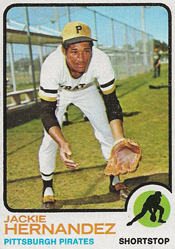
Jackie Hernandez experienced one of his most joyful moments in baseball after one of his most frustrating performances.

Born in Cuba, Hernandez was a shortstop in the major leagues for nine seasons with the Angels (1965-66), Twins (1967-68), Royals (1969-70) and Pirates (1971-73).

Hernandez had his most memorable season in 1971 when the Pirates won the World Series championship. He opened the season as the starting shortstop because incumbent Gene Alley was sidelined with a broken hand. Late in the season, Alley had a bad knee and Hernandez was the primary shortstop in the pennant stretch and in the postseason.

PIrates manager Danny Murtaugh “isn’t looking for base hits from Hernandez,” The Sporting News reported. “The manager wants steady shortstop play.”

On Sept. 22, 1971, at St. Louis, Hernandez struck out four times against Bob Gibson, but the Pirates beat the Cardinals, 5-1, and clinched the National League East Division title.

Hernandez contributed with his fielding, helping the Pirates turn three double plays.

As the Pirates celebrated inside the clubhouse at Busch Memorial Stadium, Hernandez smiled as he wiped champagne off his spikes. He never had been on a club that qualified for the postseason.

“For the first time in my life, I struck out four times and it didn’t bother me,” Hernandez said to the St. Louis Post-Dispatch. “I don’t care if I get a hit, or if I get on base. Just so we win the game. That’s all I cared about.” Boxscore

Hernandez started six of the seven games in the 1971 World Series against the Orioles and committed no errors in 53.2 innings at shortstop.

In the ninth inning of Game 7, with the Pirates clinging to a 2-1 lead at Baltimore, Hernandez cleanly handled the last two outs.

After Frank Robinson popped out to Hernandez for the second out in the ninth, Merv Rettenmund hit one on the ground. “The ball skipped up the middle and a foot or so to the right of second base,” The Sporting News reported. “Base hit? No chance. Hernandez was playing almost behind second. It wasn’t a routine play, but he was there in plenty of time to grab the ball and fire to first baseman Bob Robertson for the clinching out.” Boxscore

Hernandez hit .208 in his major-league career, including .205 versus the Cardinals.

One of his most productive games with the bat occurred against the Cardinals on May 17, 1972, at Three Rivers Stadium in Pittsburgh. Hernandez, batting eighth in the order, was 3-for-4 with three RBI in a 12-0 Pirates victory.

He entered the game with a season batting average of .167 and no RBI.

Hernandez broke the game open in the fourth inning. The Pirates led, 3-0, when Hernandez batted against Cardinals starter Reggie Cleveland with one out and the bases loaded. Hernandez hit a single to left, driving in two and giving the Pirates a 5-0 lead.

In the fifth, the Pirates scored three times against Joe Grzenda, extending their lead to 9-0. Hernandez scored Richie Hebner from third with a two-out single.

Hernandez also had a double to left in the seventh against Lance Clemons. Boxscore


Read Full Post »

(Updated June 25, 2021)

On a rainy St. Louis Sunday in 1961, the Cubs became convinced the Cardinals had someone inside the Busch Stadium scoreboard who was stealing the signs of catcher Sammy Taylor.

On May 7, 1961, the Cubs and Cardinals were scheduled to play a Sunday doubleheader at St. Louis. The starting pitchers in Game 1 were Don Cardwell for the Cubs and Ernie Broglio for the Cardinals. Caldwell, who brought a 3-0 season record into the game, had pitched a no-hitter against the Cardinals the year before.
Detective work

In the doubleheader opener, the Cubs scored twice in the first inning and the Cardinals got a run in the bottom half on Ken Boyer’s sacrifice fly.

In the second, the Cardinals battered Caldwell, scoring three runs on four hits. Carl Sawatski, batting eighth in the order, drove in a run with a single and Julian Javier knocked in two with a double. The damage could have been worse if the Cardinals hadn’t had a runner thrown out at the plate.

Cubs manager Harry Craft concluded batters knew what pitches were coming and suspected it was because the Cardinals were stealing the signs Taylor gave Caldwell.

Craft said he “became suspicious when Cardinals hitters in the lower end of the batting order were hitting pitches they ordinarily wouldn’t be able to handle,” The Sporting News reported.

According to Chicago reporter Jerome Holtzman, Craft and Cubs players “discovered someone from inside the Cardinals’ left-field scoreboard was signaling on every pitch.”

“It was very simple,” Craft said. “Someone just lifted what looked like a white tile into one of the scoreboard openings every time Caldwell was going to throw a curve. When he would throw a fastball, they would just leave the opening black.”

The switcheroo

Craft and Caldwell came up with a plan to cross up the Cardinals.

Craft told Taylor to give the sign for a curve, but to expect Caldwell to throw a fastball.

When Boyer came to the plate to lead off the third for the Cardinals, Taylor gave Caldwell the sign for a curve. Boyer leaned “way over the plate,” Craft told The Sporting News, in anticipation of a breaking ball.

Instead, Caldwell buzzed a fastball near Boyer’s chin and the pitch nearly hit him.

For the remainder of the game, the Sporting News reported, “there was no more signaling from the scoreboard.”

Caldwell held the Cardinals scoreless for the next three innings. The game was called after five innings because of rain and the Cardinals, on the strength of those early runs, won, 4-2. Boxscore

Do unto others

Two months later, on July 1, 1961, when the Cubs beat the Cardinals, 13-1, at Wrigley Field in Chicago, the Cardinals accused the Cubs of spying.

Cardinals manager Solly Hemus “charged that the Cubs have been stealing the catcher’s signs the past two days by placing a spy in center field,” the St. Louis Post-Dispatch reported.

Cardinals catcher Jimmie Schaffer said “he noticed that a red television light in center field would blink when he called for a fastball,” the Post-Dispatch noted.

Schaffer added, “If it was a curve, the light didn’t blink.”

According to the Post-Dispatch, a Cardinals pitcher was sent to the center field seats “as a counter-spy.” Boxscore

Read Full Post »

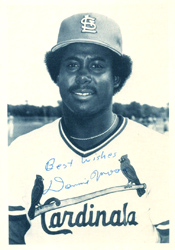
Donnie Moore embraced the opportunity to join the Cardinals, but his two-year stay in the organization was marred by his involvement in a deadly accident.

On Oct. 17, 1979, the Cardinals traded second baseman Mike Tyson to the Cubs for Moore, a right-handed relief pitcher.

Moore opened the 1980 season with the Cardinals, pitched in 11 games, was ineffective and got sent to the minors.

Near the end of spring training with the 1981 Cardinals, Moore was involved in a fatality in Florida. A passenger was killed when the car Moore was driving became airborne and crashed upside down. Moore was injured, recovered and pitched in the Cardinals’ farm system in 1981.

The fatal accident drew little national attention, but eight years later, long after Moore left the Cardinals, he was involved in another horrific incident.

On July 18, 1989, Moore’s life came to a violent end when he shot himself in the head after critically injuring his wife.

Looking for work

Moore began his professional career in the Cubs’ organization and, like fellow prospect Bruce Sutter, learned to throw a split-fingered pitch taught by instructor and former Cardinals pitcher Fred Martin.

“The best at it, besides Bruce, is Donnie Moore, but he threw it so much harder,” Cubs pitcher Mike Krukow said to The Sporting News.

Moore made his major-league debut with the Cubs in 1975 and had his breakout season in 1978 when he earned nine wins, four saves and led the club in games pitched (71) as the setup reliever for the closer, Sutter.

In May 1979, Moore’s role changed when the Cubs acquired Dick Tidrow from the Yankees. Tidrow became the setup man for Sutter. As Moore’s workload decreased, so did his effectiveness and he finished the season with a 1-4 record and 5.18 ERA.

After the 1979 season, the Cubs approached the Cardinals about Tyson, who had lost the second base job to Ken Oberkfell. Tyson was eligible to be a free agent, so the Cardinals were delighted when the Cubs offered to make a trade if Tyson would agree to a long-term contract. When Tyson, 29, accepted their five-year offer, the Cubs dealt Moore, 25, for him.

“I’m truly happy to be going to St. Louis,” Moore told the St. Louis Post-Dispatch.

Warning sign

Like many on the 1980 Cardinals, Moore struggled. He allowed 15 runs in 21.2 innings and was 1-1 with a 6.23 ERA. Even in his win against the Giants on May 6, 1980, he gave up four runs in 1.2 innings. Boxscore

(Third baseman Ken Reitz recalled to Jeff Gordon of the Post-Dispatch that during a 1980 Cardinals road trip Moore showed him two loaded guns in his suitcase. “The guy was a little off-center,” Reitz said.)

In late May 1980, the Cardinals sent Moore to their farm club in Springfield, Ill., and he produced a 6-5 record and 3.07 ERA.

The next year, Moore went to spring training as a Cardinals non-roster player.

On April 11, 1981, four days after he was assigned to the Cardinals’ minor-league camp, Moore was injured and his passenger, Donald Harvey, 31, was killed when Moore’s car sped through a dead-end street in St. Petersburg, Fla., shortly after 2 a.m., police told the St. Petersburg Times.

Moore was driving a 1981 Mustang “at a high rate of speed,” a police spokesman said to the newspaper. The car “jumped a curb and rode up an incline to a railroad track,” the Tampa Tribune reported. The car “became airborne, flipped several times and landed upside down atop several junk cars in a vacant lot,” according to the St. Petersburg Times. A police spokesman told the Tampa Tribune the car soared 152 feet before landing.

Harvey “was thrown from the car and died at the scene,” police said to the newspaper. Moore “suffered lacerations and internal injuries.”

According to Pinellas County public records, Moore was charged with one count of manslaughter, entered a plea of no contest and was placed on probation.

Ups and downs

Moore rejoined the Cardinals’ Springfield club in the middle of May 1981. After posting an 8-6 record and 3.42 ERA for Springfield, the Cardinals traded Moore to the Brewers for cash on Sept. 3, 1981.

Moore pitched in three September games for the Brewers, but they returned him to the Cardinals two months later “without telling us why,” Cardinals manager Whitey Herzog told The Sporting News.

On Feb. 1, 1982, the Cardinals traded Moore to the Braves for pitcher Dan Morogiello. Working with Braves minor-league instructor Johnny Sain, Moore produced 12 saves and a 2.29 ERA for Richmond.

“I learned it’s better to get someone out with one pitch rather than trying to strike everybody out,” Moore said.

In August 1982, Moore was called up to the Braves. Playing for manager Joe Torre and coach Bob Gibson, Moore was 3-1 with a save in helping the Braves win a division title. Moore pitched 2.2 scoreless innings against the Cardinals in the 1982 National League Championship Series.

“Moore now uses a split-fingered changeup that leaves hitters flat-footed,” The Sporting News noted. “He no longer tries to break a bat with every pitch.”

In 1984, Moore became the Braves’ closer and had 16 saves and a 2.94 ERA.

“I’ve been on a roller coaster my whole career,” Moore said. “Up and down. Up and down. That gets old after a while. Maybe I’m a survivor.”

After the 1984 season, Moore became a free agent and Torre, fired by the Braves, became an Angels broadcaster. The Angels signed Moore on Torre’s recommendation. Moore earned 31 saves for them in 1985 and 21 in 1986.

In the best-of-seven 1986 American League Championship Series, the Angels won three of the first four games against the Red Sox. In Game 5 at Anaheim, the Red Sox trailed, 5-4, with two outs and a runner on first in the ninth inning. Needing one more out to clinch the pennant, Angels manager Gene Mauch brought in Moore to relieve Gary Lucas and face Dave Henderson.

Moore’s moment of glory turned into a nightmare when Henderson hit a two-run home run, giving the Red Sox a 6-5 lead. Video Though the Angels rallied to tie the score in the bottom of the ninth, the Red Sox won, 7-6, scoring a run against Moore in the 11th. Boxscore

The Red Sox won the next two games at Boston, advancing to face the Mets in the World Series.

Terror and pain

Moore, plagued by shoulder and rib ailments, was limited to 14 appearances for the 1987 Angels. In 1988, he had a 4.91 ERA when he was released in August.

In 1989, the Royals signed Moore on the recommendation of their catcher, Bob Boone, Moore’s former Angels teammate, and assigned him to Omaha. Moore, 35, pitched in seven games for Omaha, had a 6.39 ERA and was released in June 1989, about the same time he and his wife, Tonya, also 35, separated.

A month later, Donnie and Tonya Moore met at the house they owned in Anaheim. The couple argued after Moore said he wanted to sell the $850,000 estate. Moore grabbed a .45-caliber handgun and fired at his wife. Tonya Moore was struck by three bullets, one in the neck and two in the upper torso.

The Moore’s 17-year-old daughter, Demetria, who was in the house with her two brothers, ages 7 and 10, and her best friend, managed to get her mother into a car. Before they drove off, Donnie Moore pointed the gun at his head and, in front of his sons, killed himself with a single shot, police said to the Los Angeles Times.

Demetria got her mother to a hospital, where she underwent surgery and eventually recovered from her wounds.

Donnie Moore “was despondent over his failing career and marital troubles,” the Associated Press reported.

Moore’s agent, David Pinter, cited the home run to Henderson as a contributing factor. “Ever since Henderson’s home run, he was extremely depressed,” Pinter told the Associated Press. “He blamed himself for the Angels not going to the World Series.”

Pinter said to the Los Angeles Times, “That home run killed him.”

A week after the shooting, the attorney for the Moore family, Randall Johnson, revealed he arranged to have Moore’s body brought to the hospital where Tonya Moore was being treated. The lawyer acted on the request of Tonya Moore, who wanted a private viewing because she couldn’t travel to Texas for the funeral. According to the Los Angeles Times, “The body was delivered to a vacant room at the hospital and Tonya Moore was wheeled from her private room.”

In an interview from her hospital bed, Tonya Moore told the Los Angeles Times, “I told him I forgive him. I told him I love him. I asked, ‘Why?’ “

Read Full Post »

« Newer Posts - Older Posts »