Feeds:
Posts
Comments

Archive for the ‘Games’ Category

Andrew Miller made his first major-league start for the Tigers against the Cardinals, impressed Jim Leyland and Tony La Russa and helped his club achieve a measure of redemption against the defending World Series champions.
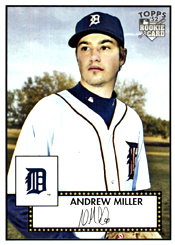
On May 18, 2007, three days before he turned 22, Miller pitched six scoreless innings and got his first big-league win against the Cardinals at Detroit.

The 6-foot-7 left-hander pitched with poise and skill and appeared to be headed toward a long, distinguished career as a starter.

Eleven years later, Miller, a free agent, joined the Cardinals with the expectation he would be their top left-handed reliever. He hadn’t made a start in seven years.

Escape artist

Miller was a standout pitcher at the University of North Carolina, establishing the school’s career strikeout record, and was selected by the Tigers in the first round of the 2006 amateur draft.

After making his major-league debut with the Tigers in 2006 and appearing in eight games, all in relief, Miller was at Class AA Erie in May 2007 when he got called up to Detroit to fill in for injured starter Jeremy Bonderman.

Miller’s first big-league start was the Tigers’ first game versus the Cardinals since losing four of five against them in the 2006 World Series.

Pitching before a sellout crowd of 40,816 at Comerca Park, Miller worked in and out of trouble in the first three innings.

The Cardinals loaded the bases in the first on singles by Albert Pujols and Juan Encarnacion and a walk to Scott Rolen, but with two outs Ryan Ludwick popped out to second baseman Placido Polanco.

In the second, the Cardinals had Yadier Molina on third with one out, but stranded him when David Eckstein grounded out to short and So Taguchi flied out to right.

The Cardinals put runners on first and second with one out in the third before Miller retired Rolen and Ludwick.

After that, Miller yielded no hits and walked two over his last three innings.

The Tigers scored seven runs against Cardinals starter Braden Looper and another seven against Kelvin Jimenez and won, 14-4. Miller’s line: 6 innings, 4 hits, 0 runs, 3 walks, 2 strikeouts, 1 batter hit by pitch. The Cardinals were 0-for-5 against him with runners in scoring position. Boxscore

Rave reviews

Under the headline, “Dandy, Andy,” the Detroit Free Press declared Miller “arrived amid some fanfare and delivered on cue, showing he might have as much to do with the team’s current fortunes as its future.”

Other comments about Miller after the game:

_ Tigers manager Jim Leyland: “This is real talent. He should have a very, very bright future.”

_ Cardinals manager Tony La Russa: “I was impressed with how often he was around the plate and how when he had the potential to throw a ball through the screen, he stayed within himself and didn’t try to strike out the side. Very impressive.”

_ Tigers pitching coach Chuck Hernandez: “I learned he’s got a little feel for pitching to go along with a good fastball.”

_ Free Press columnist John Lowe: “He confirmed anew that he will one day be a dominant big-league pitcher.”

Said Miller: “I know that I can do this.”

Bullpen specialist

Miller went on to have more bad outings than good ones as a starter in the major leagues. He finished 5-5 with a 5.62 ERA for the 2007 Tigers and was part of a package of prospects traded to the Marlins after the season for slugger Miguel Cabrera and pitcher Dontrelle Willis.

In three seasons with the Marlins, Miller was 10-20 with a 5.89 ERA. They traded him to the Red Sox and he was 6-3 with a 5.54 ERA in 2011 before being converted into a reliever.

Miller was consistently effective in relief roles for the Red Sox (2012-14), Orioles (2014), Yankees (2015-16) and Indians (2016-18). He earned 36 saves for the 2015 Yankees and was 4-0 with a 1.55 ERA for the 2016 pennant-winning Indians.

Miller was an American League all-star with the Indians in 2016 and 2017 and was named most valuable player of the 2016 AL Championship Series when he struck out 14 Blue Jays in 7.2 scoreless innings.

Through 2018, Miller had a 49-48 record, 3.98 ERA and 53 saves in 13 big-league seasons. He was 20-27 with a 5.70 ERA as a starter and 29-21 with a 2.56 ERA as a reliever.

On Dec. 21, 2018, Miller, 33, agreed to terms with the Cardinals on a two-year, $25 million contract with an option for 2021.

“Andrew Miller is one of the premier relievers in the major leagues,” said Cardinals president of baseball operations John Mozeliak.
Read Full Post »

Jim Campanis was ready to leave the Dodgers and Al Campanis was ready to make it happen.

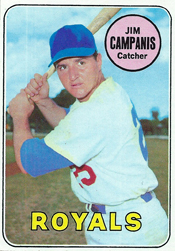
On Dec. 15, 1968, Jim, a catcher, was traded by the Dodgers to the Royals for cash. The Royals also agreed to loan two players to the Dodgers’ minor-league club in Spokane.

The deal was made by Jim’s father, Al, the Dodgers’ director of player personnel.

Jim had been in the Dodgers’ system since 1962, no longer was prominent in their plans and had said during the 1968 season his best chance for an extended shot at the big leagues probably was with another organization.

Al, longtime Dodgers scouting director, took over the duties of general manager in November 1968 and did his son a favor by sending him to the Royals, who were entering the American League as an expansion team in 1969 and seeking experienced players.

However, because the transaction was the first made by Al in his new role and because it featured his son, it created a media sensation.

The Los Angeles Times headline blared, “Campanis Peddles Son, Jim, to KC,” and The Sporting News featured a headline of, “No Room For Sentiment _ A Daddy Sells His Son.”

The trade was “further evidence supporting the premise that baseball and sentiment are not synonymous,” the Los Angeles newspaper reported.

All in the family

Al Campanis was born in 1916 in Kos, a Greek island in the Aegean Sea, and came to New York City with his family as a youth. After graduating from New York University, he joined the Dodgers as an infield prospect in 1940 and played briefly for the big-league club in 1943. Al was the second baseman for the Dodgers’ minor-league club at Montreal in 1946 when Jackie Robinson was the shortstop.

Al became Dodgers scouting director in 1960 and two years later, in 1962, when his son, Jim, was graduating high school, the Dodgers were one of the clubs in pursuit of the prospect. According to The Sporting News, when Dodgers owner Walter O’Malley asked whether the club was likely to sign Jim, Al responded, “I think I have a good chance. I’m pretty close to his mother.”

O’Malley approved a $10,000 bonus offer and Jim accepted.

Jim made his major-league debut with the Dodgers on Sept. 20, 1966.

Cardinals connections

In 1967, Jim began the season as a backup to Dodgers starting catcher John Roseboro. On April 24, 1967, Jim got his first big-league hit, a double down the left-field line against Cardinals reliever Joe Hoerner in the 13th inning at Los Angeles. The hit sparked a comeback by the Dodgers, who erased a 5-4 deficit and won, 6-5. Boxscore

“The kid saved our necks,” Dodgers manager Walter Alston said to the St. Louis Post-Dispatch.

Four months later, on Aug. 9, 1967, Jim was a central figure in a bizarre ending to a game against the Cardinals at St. Louis.

In the eighth inning, batting for Don Drysdale, Jim hit a solo home run high over the Busch Stadium wall in left against Larry Jaster, tying the score at 2-2, and stayed in the game as the catcher.

In the 11th, after the Cardinals loaded the bases with none out against Phil Regan, Eddie Bressoud popped out to first baseman Wes Parker. Mike Shannon, the runner on third, bluffed an advance toward the plate. Parker should have held the ball and run toward Shannon until he retreated to third. Instead, Parker lobbed a throw to Campanis.

“I was off balance … I didn’t trust myself to get set,” Parker said.

Said Alston: “Instead of throwing the ball like an old woman, he should have put something on it.”

The ball bounced in front of the plate, skidded between the legs of Campanis and rolled away. Shannon hesitated before making a dash to the dish and scored the winning run. Boxscore

“The catcher should not have let such an easy roller get away from him,” Alston scolded.

New roles

Campanis batted .161 for the 1967 Dodgers. Before the 1968 season, the Dodgers dealt Roseboro to the Twins and acquired Tom Haller from the Giants to be the starting catcher. Campanis spent most of the 1968 season in the minor leagues. At 24, he acknowledged he was looking ahead to the November 1968 National League expansion draft when the Padres and Expos would stock their rosters with players from existing franchises.

“Although I would like to play on a winner like the Dodgers, I would just be happy to be in the big leagues with any club,” Jim told The Sporting News in May 1968.

Asked whether his father being Dodgers scouting director was a help or hindrance, Jim replied, “I know it’s slowed me down. I know a couple of times I feel I should have gone to a higher classification, but didn’t because I don’t think they wanted it to look like they were showing favoritism.”

In June 1968, Dodgers general manager Buzzie Bavasi left to become president of the Padres. The Dodgers promoted farm director Fresco Thompson to replace him. Five months later, Thompson, 66, died. O’Malley gave Al Campanis the title of player personnel director and assigned him the same responsibilities of a general manager.

Jim wasn’t chosen in the expansion draft, but Royals director of player procurement Charlie Metro rated him a prospect and contacted Al to propose a deal.

“I said this was a very difficult situation for me to be involved in,” Al responded.

Al discussed it with O’Malley and they agreed the trade should be made because it would give Jim “an opportunity to go to a club he can play for regularly,” Al told the Los Angeles Times.

Jim was playing winter ball in the Dominican Republic for a team managed by Cardinals second baseman Julian Javier when Al called and told him of the trade. “He was pleased,” Al said. “He has been told he’ll get a shot at being the first-string catcher.”

The transaction was the first one Al made in his new role, according to The Sporting News. “If it means the boy is going to get a chance, this is one time I won’t mind too badly if the Dodgers made a bad deal,” Al said.

Controversial comments

Jim made the 1969 Royals’ Opening Day roster as the backup to catcher Ellie Rodriguez. In the franchise’s first regular-season game, April 8, 1969, versus the Twins at Kansas City, Jim batted for pitcher Tom Burgmeier in the sixth inning and delivered a RBI-single. Boxscore

Jim played for the Royals in 1969 and 1970 and ended his major-league career with the 1973 Pirates. He batted .147 in six big-league seasons.

Al remained the top executive of Dodgers baseball operations until April 1987 when he resigned under pressure for making insensitive racial comments during an interview with Ted Koppel of the ABC News show “Nightline.”

Read Full Post »

After making a pitch for Barry Larkin of the Reds, the Cardinals turned to a younger, less expensive shortstop, Edgar Renteria of the Marlins.

On Dec. 14, 1998, the Cardinals traded pitchers Braden Looper and Armando Almanza, plus infielder Pablo Ozuna, to the Marlins for Renteria.

The Cardinals went to the baseball winter meetings at Nashville determined to acquire a shortstop to replace Royce Clayton, whom they traded to the Rangers five months earlier.

Larkin and Renteria were atop the Cardinals’ shopping list and, if they couldn’t get either one, Pat Meares of the Twins was an alternative, according to the St. Louis Post-Dispatch.

Seeing red

Larkin was unhappy with the Reds and asked to be traded. The Reds had their second consecutive losing season in 1998 and Larkin, who had a Hall of Fame resume, wanted to be with a contender. Reds general manager Jim Bowden had vowed to rebuild the roster around Larkin and second baseman Bret Boone, so when Bowden traded Boone to the Braves in November 1998, Larkin felt betrayed.

“I’ve been lied to consistently,” Larkin said to the Dayton Daily News. “I’ve heard rebuild, rebuild, rebuild to get better. If that’s the case, I should see some light at the end of the tunnel. All I see is a tunnel filled with water.”

Because he had spent 10 years in the major leagues, including the last five with the same club, Larkin could veto any trade. He gave the Reds a list of five teams to which he would accept a trade: Cardinals, Cubs, Dodgers, Padres and Rangers.

“If they can move me, please do it now,” Larkin told the Dayton newspaper on the eve of the winter meetings.

“I feel as if I’m being held hostage by a team with no immediate plans to be competitive.”

Trade talk

Larkin batted .309 with 34 doubles for the 1998 Reds, earning his eighth of nine Silver Slugger awards. The three-time Gold Glove Award winner ranked second among National League shortstops in fielding percentage that year.

The Cardinals “keep inquiring about Larkin,” the Dayton newspaper reported.

Cardinals general manager Walt Jocketty offered the Reds a package of players, including pitcher Manny Aybar, who in 1998 was 10-0 for minor-league Memphis and 6-6 for the Cardinals.

Bowden’s response to Jocketty was: “You know who I want.”

According to the St. Louis and Dayton newspapers, the players Bowden wanted in exchange for Larkin were outfielder J.D. Drew and pitcher Rick Ankiel.

Bowden said the Cardinals and Mariners, who made a bid on behalf of Larkin’s friend, Ken Griffey Jr., were the clubs most interested in Larkin “but neither offered quality big-league players or top-notch prospects. We listened, but nothing was substantial. Teams felt they could steal him for nothing.”

Big catch

Unable to reach an agreement with the Reds, the Cardinals turned to the Marlins.

Renteria became a Marlins hero in 1997 when he delivered a RBI-single against Charles Nagy of the Indians in the 11th inning of World Series Game 7, clinching the title. Video

In 1998, Renteria batted .282 with 41 stolen bases for the Marlins and was named to the National League all-star team.

Renteria, 22, was younger than Larkin, 34, and Larkin was under contract to make $5.3 million in 1999 compared with $2 million for Renteria.

The Marlins were agreeable to trading Renteria because they had a highly regarded shortstop prospect, Alex Gonzalez, who was ready for the big leagues.

Initially, the Cardinals and Marlins discussed a deal of Renteria for Looper and another pitcher, Mike Busby, the Palm Beach Post reported, but Marlins general manager Dave Dombrowski, looking to get three players instead of two, opted for Almanza and Ozuna, along with Looper, rather than Busby.

“I want to play for the Cardinals,” Renteria said. “I want to show the fans I can play hard for a team that can win.”

Cardinals manager Tony La Russa said he planned to bat Renteria in the leadoff spot, with Drew second and Mark McGwire third.

Post-Dispatch columnist Bernie Miklasz rated the acquisition of Renteria a plus for the Cardinals. “He’s magic in the field and will take excellent care of Ozzie Smith’s cherished ground,” Miklasz concluded.

Good as expected

Renteria played six seasons (1999-2004) for the Cardinals and helped them to four postseason appearances. His best season for St. Louis was 2003 when he hit .330 with 47 doubles, 100 RBI and 34 stolen bases.

Overall with the Cardinals, Renteria won three Silver Slugger awards, two Gold Glove awards and posted a .290 batting average with 148 steals. He batted .333 for the Cardinals in the 2004 World Series against the Red Sox. Afterward, Renteria became a free agent and signed with the Red Sox.

In 2010, playing for the Giants against the Rangers, Renteria was the recipient of the World Series Most Valuable Player Award, hitting .412 with two home runs.

Read Full Post »

Wally Moon shined for the Cardinals for four years, but wore out his welcome in a single season when he slumped at the plate and displayed what some perceived as an indifferent attitude toward his outfield play.

On Dec. 4, 1958, the Cardinals traded Moon and reliever Phil Paine to the Dodgers for outfielder Gino Cimoli.
Four years earlier, Moon won the 1954 National League Rookie of the Year Award when he batted .304 and scored 106 runs for the Cardinals. He followed that by batting .295 with 19 home runs in 1955, .298 with a league-leading 11 triples in 1956 and .295 with 24 home runs in 1957.

Moon, a left-handed batter, posted consistently high on-base percentages, including a .390 mark in 1956. He combined with Stan Musial and Ken Boyer to give the Cardinals a formidable attack.

Though he went into a tailspin in 1958 and hit .238 with seven home runs, he didn’t start a game for a month after injuring his left elbow.

After the 1958 season, Moon joined the Cardinals on their goodwill tour of Japan, impressed new manager Solly Hemus and appeared to be back in the club’s plans, but the Dodgers, who’d shown interest in Moon all year, convinced general manager Bing Devine to trade him.

The deal revived Moon’s career and sparked the Dodgers to a World Series championship.

Season of struggles

During spring training in 1958, the Cardinals got trade offers for Moon from the Phillies and Reds, but Devine was reluctant to give up a power hitter, according to The Sporting News.

Moon never got untracked at training camp and Cardinals manager Fred Hutchinson was disappointed in his “light hitting and uninspiring defensive play,” The Sporting News reported.

In April, the Dodgers offered to deal outfielder Duke Snider to the Cardinals for Moon and Boyer, the Post-Dispatch reported, but Devine didn’t want to give up both players.

Moon’s funk carried through the first two months of the regular season. He was batting .246 with no home runs entering a May 31 game against the Giants at St. Louis. In the fifth inning, Moon, playing center field, and left fielder Joe Cunningham collided at the outfield wall while chasing a line drive by Orlando Cepeda. Moon suffered severe bruises to his left elbow and didn’t start another game until June 29. Boxscore

Moon hit .211 in July, rebounded in August with five home runs and 20 RBI and slumped again in September, batting .204.

Full Moon rising

The Cardinals finished 72-82 in 1958 and Hemus replaced Hutchinson after the season.

On Oct. 3, 1958, the Los Angeles Times reported Devine met with Dodgers general manager Buzzie Bavasi and discussed a deal of Moon for Cimoli. The Times described Cimoli as “a gifted athlete but something less than a favorite” of manager Walter Alston. Cimoli was in and out of the Dodgers lineup in 1958 “and made no attempt to veil his dissatisfaction with the situation,” the Times reported.

The Cubs wanted Cimoli, too, and Bavasi was in no rush to deal. “We’re being offered players for Cimoli that would help our farm clubs, but they wouldn’t strengthen the Dodgers,” Bavasi said.

As the Cardinals prepared to embark on their trip to Japan, trade talks with the Dodgers cooled, the Times reported, because “there are other St. Louis players Bavasi would prefer to Moon.”

Also, Hemus wanted to keep Moon and told The Sporting News, “You just can’t give up on a guy like that.”

Devine became less receptive to offers for Moon and noted, “A poor year sometimes is a challenge to a player and he comes back with a great season. We feel Moon can do it.”

After the goodwill tour, Hemus said Moon “looked good, improved … He looked like the Moon of old at times.”

Determined to deal

At the 1958 baseball winter meetings, the Braves made a bid to acquire Moon and the Cardinals were talking to the Cubs about left-handed power hitter Walt Moryn. The Cardinals also resumed negotiations with the Dodgers, and when Devine offered to include Paine, the Moon-for-Cimoli deal was made.

“The Cardinals made a mistake in letting me go because Cimoli isn’t the longball hitter they need,” Moon said.

Devine admitted the Cardinals sought a power threat in return for Moon, but opted for Cimoli because he “not only is better defensively, but also his ability to hit to right-center will be useful at Busch Stadium.”

According to Post-Dispatch sports editor Bob Broeg, Moon “disappointed consistently afield, both fly chasing and throwing. He seemed so satisfied with his inadequacies that his lean and hungry look appeared merely an unfortunate illusion.”

Alston acknowledged Moon “isn’t a great defensive outfielder,” but said he enhanced the Dodgers’ lineup because “he’s aggressive, he can run and what I like best about him is his power.”

The Dodgers projected Moon to be their left fielder and the Cardinals planned for Cimoli to start in center.

Cimoli said he looked forward to joining the Cardinals because “I can sit next to Stan Musial and pick up some hitting pointers.”

That’s a winner

Actually, Musial advised Moon, suggesting he develop an inside-out swing to take advantage of the short distance from home plate to the left-field screen at Los Angeles Memorial Coliseum.

Moon got off to hot start for the 1959 Dodgers, batting .352 in April. He also finished strong, hitting 11 home runs in the last two months of the season, including six in a six-game September stretch.

Moon concluded the season with a .302 batting mark, 19 home runs, 93 runs scored and an on-base percentage of .394. The Sporting News described him as “a dedicated hustler whose inspiration lifted the entire team.”

The Dodgers clinched the National League pennant and beat the White Sox in the World Series. Moon hit a two-run home run in the decisive Game 6. Boxscore

Cimoli batted .279 with 40 doubles for the 1959 Cardinals, who finished next-to-last at 71-83. After a torrid start, when he hit 30 doubles in three months, Cimoli tailed off in the second half and was traded to the Pirates in December.

Moon produced two more big seasons for the Dodgers, batting .299 with a .383 on-base percentage in 1960 and .328 with a .434 on-base percentage in 1961.

He was a role player from 1962-65 and concluded his playing career with another World Series championship with the 1965 Dodgers.

Read Full Post »

Chuck Essegian, a Renaissance man who played the violin, studied to be a doctor, became a lawyer and excelled in two sports, began the 1959 baseball season as a Cardinals reserve and ended it as a World Series hero for the Dodgers.

On Dec. 3, 1958, the Cardinals acquired Essegian from the Phillies for shortstop Ruben Amaro.
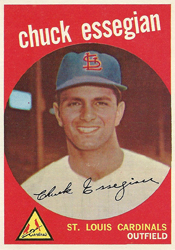
Essegian was an outfielder with a weak throwing arm, but the Cardinals were intrigued by his power.

After a short stint with them, Essegian was demoted by the Cardinals to the minor leagues in June 1959 and nearly quit baseball to pursue a medical career, but reconsidered after the club offered to relocate him to a West Coast franchise.

Four months later, Essegian achieved an unprecedented feat in the World Series.

Stanford standout

Essegian (pronounced Uh-see-jee-un) was born in Boston and moved with his family to Los Angeles when he was a boy. Essegian’s father was an Armenian immigrant who became a mail carrier.

Essegian was a standout baseball and football player at Fairfax High School in Los Angeles as well as a promising violinist. “If he could belt a tune the way he batters that baseball, the Philharmonic missed a hot bet,” the Los Angeles Times reported.

He enrolled at Stanford, played baseball and was a linebacker and fullback in football, appearing in the 1952 Rose Bowl game against Illinois. Essegian earned a degree in biology and considered pursuing a career as a doctor or dentist, but first tried professional baseball.

From 1953-55, Essegian played mostly for unaffiliated minor-league clubs. In 1956, he led the Northwest League in hitting at .366 for Salem (Ore.).

Essegian asked the National Association, overseeing minor-league baseball, to declare him a free agent because of irregularities in the handling of his 1956 contract. On Dec. 4, 1956, National Association president George Trautman ruled in favor of Essegian, granting him free agency and giving Salem 30 days to appeal, The Sporting News reported.

The next morning, Dec. 5, 1956, the minor-league draft was held and the Cardinals’ Rochester farm team, unaware Essegian was a free agent, selected him off Salem’s roster.

Rochester was allowed to cancel its selection and choose another player, but stuck with Essegian, hoping the free agency ruling was reversed on appeal.

While awaiting the results of the appeal, Essegian took graduate courses, “which may lead to a career in dentistry,” the Capital Journal in Salem reported.

On Feb. 15, 1957, an executive committee of the minor leagues rejected Salem’s appeal.

Free to make his own deal, Essegian signed with the Phillies.

Cards come calling

Essegian spent 1957 in the Phillies’ farm system and led the Eastern League in hitting at .355 for Schenectady.

In 1958, Essegian reached the major leagues, batted .246 for the Phillies and hit his first big-league home run against Sandy Koufax of the Dodgers. Essegian became a friend of Phillies second baseman Solly Hemus, who after the season was named Cardinals manager. Hemus suggested the club acquire Essegian.

Essegian, 27, displayed impressive power for the 1959 Cardinals in spring training. On March 15, he hit two home runs against Dick Donovan of the White Sox in an exhibition game at Tampa and the next day he hit another home run off the Yankees’ Don Larsen at St. Petersburg.

Essegian “doesn’t have a good throwing arm, a result of a football injury,” but “is eager to give baseball a good try before returning to medical school at his alma mater,” the St. Louis Post-Dispatch reported.

Essegian made the Opening Day roster and in his second regular-season game for the Cardinals he drove in three runs against the Dodgers. Boxscore

Highlights were few, however. Essegian hit .179 and on June 3, 1959, the Cardinals assigned him to Rochester.

Essegian balked at reporting and “talked of quitting baseball unless he could spend more time on the West Coast,” according to The Sporting News.

After the Cardinals assured him they’d try to accommodate him, Essegian went to Rochester and hit four home runs in 10 games. Good to their word, the Cardinals traded Essegian and pitcher Lloyd Merritt to the Dodgers on June 15, 1959, for infielder Dick Gray.

Series slugger

Essegian was sent to Spokane and hit nine home runs before being called up to the Dodgers on Aug. 4, 1959. Batting .304 over the last two months of the season, Essegian earned a World Series roster spot against the White Sox.

In Game 2 at Comiskey Park in Chicago, the White Sox led, 2-1, in the seventh when Essegian, batting for pitcher Johnny Podres, got a high slider from Bob Shaw and drove it deep into the upper deck in left for a home run, tying the score. “It had to be the best ball I ever hit,” Essegian said. The Dodgers won, 4-3, and Essegian was credited with sparking the comeback. Boxscore

The Dodgers led the decisive Game 6, 8-3, in the ninth at Chicago when manager Walter Alston, playing a hunch, had Essegian bat for Duke Snider. Essegian lined the first pitch from Ray Moore into the lower left-field stands, capping a championship-clinching triumph.

“He broke his bat on that homer, you know,” said Dodgers coach Pee Wee Reese. “How about that for power?” Boxscore

Essegian became the first player to hit two pinch-hit home runs in a World Series. Another former Cardinal, Bernie Carbo, matched the feat in 1975 for the Red Sox against the Reds.

Essegian also became the second athlete to play in a Rose Bowl and a World Series. The other, Jackie Jensen, appeared in the 1949 Rose Bowl for Cal and the 1950 World Series for the Yankees.

Law and order

Even with his World Series heroics, Essegian barely survived the last roster cut at spring training in 1960 and his name was omitted from the Opening Day program.

A crowd of 67,550 filled Los Angeles Memorial Coliseum to see the defending World Series champions open the 1960 season against the Cubs. With the score tied 2-2 in the 11th, Essegian batted for pitcher Don Drysdale and hit a slider from Don Elston high into the left-field seats for a walkoff home run. Boxscore

The 1960 season was Essegian’s last with the Dodgers. In 1961, he played for three American League teams _ Orioles, Athletics and Indians. He became an everyday player for the first time in the big leagues in 1962 and hit 21 home runs for the Indians. “Because of his medical school aspirations, (teammates) are calling him Dr. Essegian and Ben Casey,” The Sporting News reported. “He’s handsome and has the scowl. All he needs is the stethoscope.”

Traded back to the Athletics, Essegian played his last year in the big leagues in 1963. He spent 1964 with the Osaka Kintetsu Buffaloes of the Japan Pacific League and hit 15 home runs.

Essegian never did become a doctor or dentist. Instead, he earned a law degree and became a prosecutor in Pasadena before entering private practice.

Though often asked about the World Series home runs, Essegian downplayed the feat.

“I didn’t think that was so spectacular,” he told the Baltimore Sun. “I was just doing a job. Luck has a great deal to do with something like that. You have to have the right situation, the right pitch and be lucky enough to hit it.”

In a 2006 interview with the Los Angeles Times, Essegian said, “I’m not sure, but I think those home runs probably hurt my career. You kind of get labeled as a certain kind of player. If you’re a pinch-hitter, you’re a pinch-hitter because you’re not good enough to play everyday.”

In 161 regular-season plate appearances as a pinch-hitter in the major leagues, Essegian hit three home runs. In four World Series plate appearances as a pinch-hitter in the 1959 World Series, he hit two.

Read Full Post »

(Updated Jan. 12, 2026)

In seeking a third consecutive pennant, the Cardinals traded six players to get a No. 5 starter for their rotation.

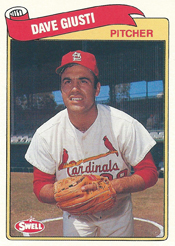
On Dec. 3, 1968, the Cardinals reacquired pitcher Dave Giusti from the Padres for infielder Ed Spiezio, outfielder Ron Davis, catcher Danny Breeden and pitcher Philip Knuckles.

Two months earlier, on Oct. 11, 1968, the Cardinals got Giusti and catcher Dave Adlesh from the Astros for catchers Johnny Edwards and Tommy Smith, but then the Padres snatched him in the Oct. 14 National League expansion draft.

The Cardinals, who won league championships in 1967 and 1968, were determined to add Giusti to a 1969 starting rotation with Bob Gibson, Steve Carlton, Nelson Briles and Ray Washburn, but the payoff didn’t match the price.

In exchange for Edwards, Smith, Spiezio, Davis, Breeden and Knuckles, the Cardinals got a pitcher who earned three wins in his lone season with them.

Houston calling

Giusti was a successful college pitcher at Syracuse and nearly signed with the Cardinals when he turned pro in June 1961. The Cardinals and Houston Colt .45s each offered Giusti a signing bonus of about $35,000 and Giusti was leaning toward choosing St. Louis, partly because his former Syracuse roommate, Doug Clemens, was a Cardinals outfielder.

“If the Cardinals had hurried just a bit at that point, they undoubtedly would have landed Giusti,” The Sporting News reported.

Giusti opted for the Colt .45s, entering the National League as an expansion club in 1962, because he said “it would be the fastest way to the big leagues.”

Giusti made his major-league debut in April 1962 and developed into a durable starter for the club, which was renamed the Astros in 1965. In each of three consecutive seasons (1966-68), Giusti reached double digits in wins and topped 200 innings pitched.

During the off-seasons, Giusti, who earned a master’s degree in physical education, was a substitute teacher in a Syracuse suburb.

Giusti was delighted when the Cardinals acquired him from the Astros. With Dal Maxvill at shortstop, “I’ll have more experience behind me at that spot than I’ve had before,” Giusti said, and with an outfield of Lou Brock, Curt Flood and Vada Pinson to chase down drives “you don’t have to worry about making the perfect pitch all the time.”

Come and go

To help stock the rosters of the expansion Expos and Padres, the National League held a draft on Oct. 14, 1968, consisting of six rounds. The Expos and Padres each were allowed to select five players per round from the existing National League franchises.

Each existing team initially could protect 15 players. A team could protect three more players each time one was taken from its list of unprotected.

After the Cardinals got Giusti from the Astros, he asked general manager Bing Devine whether he’d be protected and Devine “didn’t say yes or no,” Giusti said.

The Cardinals wavered until the last minute before protecting Washburn instead of Giusti, the St. Louis Post-Dispatch reported. The Cardinals would have protected Giusti in the second round if another one of their players was chosen in the first round, according to the Post-Dispatch, but Giusti was the first Cardinals player drafted. The Padres selected Giusti with their second pick in the first round.

“I’m very disappointed,” Giusti said. “Nobody in St. Louis told me this was going to happen. I wanted to work for a championship club.”

Let’s make up

Trade offers for Giusti poured in to the Padres from the Reds, Orioles, Astros and Cardinals. The Reds were offering shortstop Leo Cardenas or outfielder Hal McRae, The Sporting News reported.

Devine came up with the package of four players at positions the Padres were looking to fill. “We needed numbers and the Cards wanted the proven starting pitcher,” said Padres president Buzzie Bavasi.

Devine called to inform Giusti he’d been reacquired by the Cardinals and said, “You can stop being mad at me. We’ve got you back.”

In addition to a fastball and slider, Giusti threw a palmball, which is similar to a changeup. “The difference is the pitcher grips the ball back in the palm rather than with the fingertips,” the Post-Dispatch explained.

“Learning to throw the palmball was a matter of survival,” Giusti said. “I found out early the hitters up here can hit the fastball. I had to come up with another pitch.”

Said Cardinals pitching coach Billy Muffett: “He can throw the palmball over the plate just about any time he wants. He’s not afraid to throw it no matter what the situation. He never tips off the pitch.”

Starter to closer

In his first regular-season appearance for the Cardinals, on April 12, 1969, Giusti pitched a shutout and scored the lone run in a 1-0 victory over the Mets. The run came in the third inning when Giusti doubled and scored on Flood’s double against Don Cardwell. Boxscore

Giusti pitched a three-hitter against his favorite patsy, the Cubs, for his second Cardinals win. (Giusti finished with a career record of 23-9 versus the Cubs). Boxscore.

His season began to unravel in late May when he wrenched his back while fielding during batting practice. He was on the disabled list for a month and in his absence Chuck Taylor and Mike Torrez won rotation spots. Giusti was used in long-inning relief in August and September as the Cardinals faded from contention.

He finished the season at 3-7 with a 3.61 ERA in 22 appearances.

On Oct. 21, 1969, the Cardinals traded Giusti and catcher Dave Ricketts to the Pirates for outfielders Carl Taylor and Frank Vanzin. Pirates general manager Joe Brown made the deal on the recommendation of outfielder Roberto Clemente, who told him Giusti “always had good stuff and he is a tough competitor.” (Clemente had one hit, an infield single, in his last 10 career at-bats versus Giusti.)

The Pirates converted Giusti into a closer and he became one of the best. Against the Cardinals in 1970, he was 3-0 with a save. In one of those wins, he smacked a two-run triple against Bob Gibson. Boxscore

In 1971, Giusti led the National League in saves (30) for the World Series champions. Giusti pitched 5.1 scoreless innings against the Orioles in the 1971 World Series and earned a save in Game 4 when he retired all six batters he faced. Boxscore

Regarding how he assessed pitchers, Bing Devine told the Post-Dispatch in 1971, “The only way I can judge a pitcher is by how the ball misses the bat. There are some pitchers who can overpower the hitters, and some who win when you know they’re not that good. The majority is in the middle group, and you judge them by how many times the ball gets to the catcher’s glove.”

In seven seasons (1970-76) with the Pirates, Giusti was 47-28 with a 2.94 ERA and 133 saves.

Read Full Post »

« Newer Posts - Older Posts »