Feeds:
Posts
Comments

Archive for the ‘Games’ Category

Mort Cooper was a talented Cardinals pitcher with a troubled soul whose life was shortened by too much booze.

On Nov. 17, 1958, Cooper died at 45 in an Arkansas hospital. Death was caused by cirrhosis of the liver and a staph infection, according to published reports.

In the 1940s, Cooper was a Cardinals ace, a three-time 20-game winner and recipient of the 1942 National League Most Valuable Player Award. The right-hander pitched for pennant-winning Cardinals clubs in 1942, 1943 and 1944. His records those seasons were 22-7 in 1942, 21-8 in 1943 and 22-7 in 1944.

Off the field, Cooper drank to excess, wasted his earnings and resorted to petty crime.

St. Louis Post-Dispatch columnist Bob Broeg described Cooper as “a great pitcher and pathetic figure, a simple fun-loving man for whom life became all too complicated and all too short.”

Climbing up

Mort Cooper was born in 1913 in Atherton, Mo. He and his younger brother, catcher Walker Cooper, played amateur baseball in the Ban Johnson League in Kansas City.

In 1933, Mort turn pro, played in the minors at the Class A level Western League and caught the attention of Cardinals scout and minor-league manager Joe Schultz Sr., who recommended him to club executive Branch Rickey. Mort signed with the Cardinals, who followed his suggestion and signed Walker, too.

Mort made his major-league debut with the Cardinals on Sept. 14, 1938, and two years later Walker joined him.

In June 1941, Mort had surgery to remove bone chips in his right elbow, but he recovered and became the Cardinals’ premier pitcher.

Cooper led the National League in wins (22), ERA (1.78) and shutouts (10) in 1942. He also was the league leader in wins (21) in 1943 when he pitched consecutive one-hitters and in shutouts (seven) in 1944. “Except for Dizzy Dean, probably no pitcher ever had three more successful consecutive seasons in a Cardinals uniform than Mort Cooper,” the Post-Dispatch reported.

Among Cooper’s highlights were two World Series wins.

On the morning of Oct. 6, 1943, Mort and his brother were informed of the death of their father, but both decided to play that afternoon in Game 2 of the World Series at Yankee Stadium. Mort pitched a six-hitter and the Cardinals won, 4-3. Boxscore

The next year, Mort pitched a shutout with 12 strikeouts in Game 5 of the 1944 World Series versus the Browns. Boxscore

Even with his success, Cooper’s right elbow continued to bother him and he “chewed aspirin like peppermint to dull the physical distress during key games,” according to the Post-Dispatch.

Trials and tribulations

Meanwhile, Cooper experienced a series of personal troubles.

In 1936, his wife Mary was killed in a car accident, according to a report by the Society for American Baseball Research. Soon after, on Oct. 14, 1936, Cooper married Bernadine, 19, but his drinking strained the relationship.

As Bob Broeg slyly noted in the Post-Dispatch, Cooper’s career was a tribute to “his own private brand of courage. Usually, any brand was just fine with Mort.”

Cooper spent money freely and frivolously. “In many ways, Cooper never grew up,” the Associated Press surmised. “He used to spend a lot of money each month in gadget shops, buying odd things like water guns. He laughed fate in the face.”

On May 23, 1945, amid a contract dispute, the Cardinals traded Cooper to the Braves for pitcher Red Barrett and $60,000. Three months later, Cooper had a second operation on his right elbow.

Cooper’s elbow “had more chips than a gambling casino and sounded at times like dice thrown on a marble floor,” the Post-Dispatch reported.

On Nov. 6, 1945, Cooper’s second wife filed for divorce, claiming he had a violent temper and drank too much.

Hard road

Cooper married his third wife, Viola, in 1946 and had his last good season in the big leagues, posting a 13-11 record for the Braves.

In June 1947, the Braves traded Cooper to the Giants and he was 1-5 with a 7.12 ERA for them. Severely overweight, he announced his retirement during spring training in 1948.

A few months later, in October 1948, Cooper was arrested in St. Louis for passing bogus checks. Former Cardinals owner Sam Breadon came to his rescue, posting $2,000 in bonds for Cooper’s release. Soon after, charges against Cooper were dismissed by a St. Louis judge on the recommendation of the prosecuting attorney when Breadon made restitution on the $270 worth of bad checks, the St. Louis Star-Times reported.

“Mort is such a good-hearted fellow,” Breadon told The Sporting News. “When he was pitching for the Cards, he was probably the smartest pitcher in the business, but when it came to outside interests involving money he was just like a little child. He never did have any sense of business or of handling money.”

Breadon revealed Cooper “doesn’t have a cent of his baseball earnings left. He’s been a free spender.”

“I know he’s not a criminal,” Breadon said. “He wouldn’t harm anyone. On the contrary, he’d give you the shirt off his back.”

On Breadon’s recommendation, the Cubs gave Cooper a chance to make a comeback in 1949, but he pitched in one regular-season game for them, gave up a three-run home run to Duke Snider without retiring a batter and was released.

In his 11 seasons in the major leagues, Cooper posted a record of 128-75, including 105-50 with the Cardinals.

Life after baseball

Cooper eventually settled in Houston, worked as a security guard for a steel company and operated a small bar called “The Dugout.”

In August 1958, Bert West, a correspondent for the Victoria Advocate, visited Cooper at the bar and reported, “His various escapades on the personal life side apparently left him a lonely, but not bitter, man. He said that I was the first newspaperman he had seen in a long time and he had no contact with former players, except his brother, in several years.”

Two months after that, Cooper was traveling in Arkansas, where he reportedly intended to relocate, when he was admitted to a hospital on Oct. 31, 1958. He died there three weeks later. Cooper was survived by his wife, son, mother and several siblings, including his brother Walker.

About 150 people, including former Cardinals teammate Johnny Hopp, attended the funeral in Independence, Mo., according to United Press International.

In a column for the Chicago Tribune, David Condon concluded, “Mort never was one of fortune’s favorite children.”
Read Full Post »

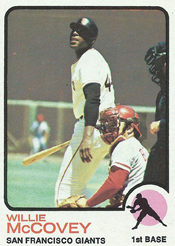
Willie McCovey made the Cardinals pay for disrespecting an elder.

On June 15, 1979, with the score tied at 6-6, a Giants runner on second and two outs in the bottom of the 13th inning, the Cardinals opted to give an intentional walk to Jack Clark and take their chances with McCovey, who was 41 years old and in the twilight of a Hall of Fame career.

McCovey foiled the strategy, hitting the first pitch from Darold Knowles over the fence at Candlestick Park and lifting the Giants to a 9-6 walkoff victory.

McCovey hit 521 home runs, including 41 against the Cardinals, in a 22-year career in the big leagues with the Giants, Padres and Athletics.

One of his most impressive feats came in June 1979 when he silenced skeptics by hitting three home runs in less than 24 hours in a pair of wins against the Cardinals.

Still in the game

At spring training in 1979, critics clamored for the Giants to start Mike Ivie at first base instead of McCovey. Ivie was 26 and batted .308 for the Giants in 1978. McCovey hit .228 for the 1978 Giants and appeared to some to be finished as a ballplayer.

Ivie opened the 1979 season as the Giants’ first baseman but after two months his batting average was .244 and manager Joe Altobelli began playing McCovey more.

When the Cardinals came to San Francisco for a three-game series on June 15, 1979, McCovey was in the lineup as the cleanup batter and first baseman for the Friday night opener.

McCovey led off the fourth inning and lined a 3-and-0 pitch from starter Pete Vuckovich over the wall in left-center for a home run, giving the Giants a 2-1 lead.

The Giants led, 6-5, until the Cardinals got a run in the eighth.

McCovey nearly delivered a game-winning hit in the 11th. With one out and runners on second and first, McCovey hit a line drive to right-center. Rob Andrews, the runner on second, took off, thinking the ball was a hit, but right fielder George Hendrick was positioned to make the catch and throw to second before Andrews could get back, completing a double play.

“They had no business playing me the way they did,” McCovey said to United Press International. “Since when doesn’t the right fielder play me on the line? They did the wrong thing and got lucky.”

Big Mac attack

In the 13th, the Giants had Larry Herndon on first base, one out, when Andrews hit a bouncer to third baseman Ken Oberkfell, who was thinking he could turn a double play, but the ball struck Oberkfell in the chest and he was only able to get the out at first.

“I got caught between hops,” Oberkfell said to the St. Louis Post-Dispatch

With Herndon on second, two outs, Clark was at the plate and McCovey was on deck. Clark, the future Cardinal, was a right-handed batter facing Knowles, a left-hander. After the count went to 2-and-0, Knowles was instructed to walk Clark intentionally.

McCovey batted left-handed and the Cardinals figured Knowles had a better chance of retiring him than he did Clark. McCovey had produced two hits in 14 career at-bats versus Knowles.

The strategy backfired. Knowles’ first pitch to McCovey was a mistake, “a hanging slider,” he said, and McCovey uncoiled his 6-foot-4 frame and crushed a towering drive over the fence in right-center for the sixth walkoff home run of his career.

“I knew it was gone the second I hit it,” McCovey said.

Knowles, disgusted, flung his glove into the air as McCovey circled the bases. Boxscore

Experience matters

The long game required a quick turnaround for the players, who returned to Candlestick Park the next morning, June 16, 1979, for a Saturday afternoon start time.

McCovey was back in the cleanup spot and in the third inning he hit a two-run home run against starter Silvio Martinez, extending the Giants’ lead to 3-0 and propelling them to a 6-1 triumph. Boxscore

“Willie McCovey is one of the chosen people,” Altobelli said to the San Francisco Examiner. “He’s a living legend.”

The home run was the sixth in McCovey’s last eight games.

“You can’t judge a guy on age,” McCovey said. “Guys over 35 can still do it, but for some reason you have to keep proving it. Our society is geared to youth and people are brainwashed that you have to be young to do anything.”

McCovey finished with 15 home runs in 1979 and he returned for a final season in 1980, enabling him to play in four decades during a big-league career started in 1959.

McCovey hit 421 of his career home runs against right-handers and he had success against several Cardinals, including Bob Gibson (.290 batting average against, seven home runs), Nelson Briles (.353, seven home runs) and Ray Washburn (.366, three home runs).

Read Full Post »

Tigers catcher Bill Freehan was a central character in one of the most controversial plays in Cardinals history.

In the 1968 World Series, the defending champion Cardinals won three of the first four games against the Tigers. Freehan was the goat. He went hitless in the first four games, made two errors and was tormented by Cardinals baserunners, especially Lou Brock, who swiped seven bases.

Things changed in Game 5 at Tiger Stadium on Oct. 7, 1968.

In the third inning, Brock was at first when Freehan called for a pitchout and nailed the speedster at second. “That was the first lucky guess I’ve made all Series,” Freehan told Milton Gross of the New York Post.

The big play came two innings later.

The Cardinals led 3-2 in the fifth and were threatening to knock out starter Mickey Lolich. With Brock at second, Julian Javier lined a single to left. Willie Horton, a left fielder not known for his defense, unleashed a strong, accurate throw to the plate. (Lolich told the Associated Press, “As fast as Brock is, I didn’t even figure there would be a throw.”) The peg took one clean hop directly to Freehan, who stood, blocking the plate, “like the towering Washington monument,” wrote Milt Richman, columnist for United Press International.

Brock tried to score standing, collided with Freehan and was called out by umpire Doug Harvey, igniting an animated protest from the Cardinals.

The momentum _and the Series _ shifted to the Tigers with that play. “It was the biggest play of the game,” Brock said to the Associated Press. “It was the turning point. We had the makings of a big inning, and instead of one run, one man on and one out, there were two outs and no runs.”

Detroit rallied to win, 5-3, and send the Series back to St. Louis, but the debate raged about whether Brock was safe or out. Brock said his foot touched the plate before Freehan tagged him. Freehan said Brock came up short of the plate. Others thought Brock stepped on Freehan’s planted foot and bounced off and around the plate. Video

Columnist Milton Gross reported this exchange:

Freehan: “Harvey told me if Lou had slid, he would have been safe. He just never touched the plate.”

Brock: “I was safe. I touched the center of the plate right between Freehan’s legs. Freehan came up behind me as we were arguing after the play and tagged me.”

Freehan: “I was surprised he didn’t slide. There I was, set. With my left foot planted where it was, he’d have had to slide through it or touch the plate with his hand simply because I was between him and the plate. When he hit me on the left side, he just spun away from the plate. The reason I tagged him a second time was I saw him coming back _ like a reflex, you know?”

Brock: “If I slid, he would have had a good chance of blocking me out. He was standing wide-legged, his feet four or five feet apart, one up the third-base line, the other at the corner of the plate. If you slide, he gets down on one knee and you don’t get in.” Boxscore

The on-deck batter, Curt Flood, gestured for Brock to slide, but “I didn’t have time to look at anyone,” Brock said to the St. Louis Post-Dispatch. “The play was in front of me and I had to look at the catcher.”

Flood said Brock was safe because “half of Brock’s foot was on the plate.”

In his World Series column for the Post-Dispatch, Cardinals pitcher Bob Gibson said he thought Brock was safe and did right by not sliding. “When the catcher is blocking the plate, you can slide and never get to it,” Gibson said.

Years later, in his book “Stranger to the Game,” Gibson saw the play differently. “In my heart, I wish Lou had slid,” Gibson said.

The Tigers won Game 6. Facing Gibson in Game 7, Detroit broke a scoreless tie in the seventh, with Freehan’s double driving in Jim Northrup after Northrup lined a two-run triple that was misjudged by Flood in center.

In the ninth, Cardinals catcher Tim McCarver fouled out to Freehan to end the game, won by Detroit, 4-1, giving the Tigers their first World Series championship in 23 years. Boxscore

Though the Cardinals had 11 stolen bases in 16 attempts against Freehan in the Series and he batted .083 (2-for-24), he is remembered most for his block of home plate in Game 5.

Brock, interviewed in 2012 by Mike Stone of CBS Detroit, still insisted he was safe on that play.

“I did not have a great jump, but I thought I could make it,” Brock told Stone. “But Willie Horton made the throw of his life. I never thought Horton could make that throw. The next thing I know I was going to collide with Bill Freehan _ and we know who would have won that. I was safe, but the umpire called me out, so I was out.”

Previously: Should Curt Flood have caught Jim Northrup’s drive?

Read Full Post »

Benny Valenzuela, a pioneering Mexican-born ballplayer, emerged from a humble start in professional baseball and reached the majors, but the Cardinals were the wrong club for a rookie third baseman.

Valenzuela played briefly for the Cardinals in two stints with them in 1958. The Cardinals, though, were set at third base with a premier player, Ken Boyer, and that meant Valenzuela had little opportunity to play.

The Cardinals traded Valenzuela after the 1958 season and he never got back to the big leagues. He did, however, continue his playing career in the minors and he went on to have success as a manager for many years in the Mexican League.

Big break

Benjamin Beltran Valenzuela was born in Los Mochis, a city founded by Americans near the Gulf of California in northwestern Mexico. His nickname was Papelero because as a boy he sold newspapers to help his widowed mother.

Benny Valenzuela, no relation to fellow Mexican and former Cardinals pitcher Fernando Valenzuela, became a bat boy for a Los Mochis team managed by former Washington Senators pitcher Syd Cohen. In 1949, when Valenzuela was 16, Cohen became exasperated by a Los Mochis outfielder who couldn’t track fly balls in the sun. Cohen lifted the outfielder during a game and replaced him with the bat boy, Valenzuela, who’d showed an ability to play.

Three years later, in 1952, Cohen was manager of the Bisbee-Douglas Copper Kings of the Arizona-Texas League and he gave his former bat boy a spot on the team. Bisbee-Douglas was in the low levels of the minors, a remote Class C league with no affiliation to any franchise in the majors, but it was professional baseball in the United States and Valenzuela was grateful to Cohen to get the opportunity.

Valenzuela spent three seasons with Bisbee-Douglas, learning the craft, and produced batting averages of .352 in 1952, .347 in 1953 and .388 in 1954.

The Cardinals took notice and on Nov. 30, 1954, they selected Valenzuela, 21, in the minor-league draft.

Rising above

Valenzuela continued his strong hitting in the Cardinals’ system. He batted .354 for Fresno in 1955, .305 with 107 RBI for Omaha and Houston in 1956 and .286 with 24 home runs and 90 RBI for Houston in 1957.

At spring training with the Cardinals in 1958, Valenzuela impressed general manager Bing Devine and moved “to the front row among candidates for pinch-hitting jobs,” the St. Louis Post-Dispatch reported.

Valenzuela also had a strong arm and the Post-Dispatch reported he “gets a ball away more quickly than any infielder we can remember. He frequently gets the ball to the first baseman before the batter has reached the halfway mark to first base.”

Valenzuela was listed as being 5 feet 10, 175 pounds, but often was described in unflattering terms. The Sporting News called him “thick-legged” and “stubby.” The Post-Dispatch resorted to “chunky.”

“He resembles Yogi Berra,” The Sporting News decided.

Stereotyping was common. The Sporting News, for instance, labeled him “the peppery Mexican” and cited his “chili con carne English.”

Trailblazer

Valenzuela, 24, made the Opening Day roster of the 1958 Cardinals and became the 10th Mexican-born player to reach the major leagues, according to Frontera.info. He was the second Mexican-born player to join the Cardinals. The first was pitcher Memo Luna, whose big-league career with the Cardinals consisted of two-thirds of an inning in 1954.

Mel Almada, an outfielder with the 1933 Red Sox, was the first Mexican-born player in the big leagues.

Valenzuela made his Cardinals debut on April 27, 1958, when he batted for pitcher Larry Jackson and singled to right against Johnny Podres of the Dodgers. Boxscore

“He’s hitting 1.000, a heck of an average in any man’s language,” the Post-Dispatch declared.

On May 6, 1958, Valenzuela doubled against Bob Buhl of the Braves, but the Cardinals demoted him to Omaha on May 14 after he appeared in five games.

Moving on

On June 29, 1958, another Mexican-born player, shortstop Ruben Amaro, who’d been Valenzuela’s teammate for two seasons at Houston, made his major-league debut with the Cardinals.

Meanwhile, Valenzuela hit. 284 with 72 RBI for Omaha and was named the third baseman on the Parade Magazine Class AAA all-star team.

On Sept. 2, 1958, the Cardinals recalled Valenzuela to the big leagues and he appeared in five more games, producing a single against Bob Rush of the Braves on Sept. 18.

For the season, Valenzuela hit .214 (3-for-14) in 10 games for the Cardinals. Boyer, 27 and entrenched at third base, hit .307 and led the Cardinals in runs (101), hits (175), home runs (23) and RBI (90).

On Oct. 7, 1958, the Cardinals traded Valenzuela, pitcher Billy Muffett and catcher Hobie Landrith to the Giants for pitchers Ernie Broglio and Marv Grissom.

Valenzuela played three seasons (1959-61) in the Giants’ farm system before continuing his career as a player and manager in the Mexican League. Among the former major leaguers he managed in Mexico were ex-Cardinals pitchers Diego Segui and Pedro Borbon.

Valenzuela, Vinny Castilla and Aurelio Rodriguez are among the most prominent Mexican-born third basemen to reach the major leagues.

In 1986, Valenzuela and Amaro were inducted together into the Mexican Baseball Hall of Fame in Monterrey.

Read Full Post »

Jake Powell was an outfielder who spent 11 years in the major leagues and played in three World Series for the Yankees, but after his baseball career he got involved in unlawful behavior and it led to a stunning and tragic conclusion.

On Nov. 4, 1948, Powell was at police headquarters in Washington, D.C., being questioned on charges of writing bogus checks, when he pulled a gun from his pocket and killed himself. Powell’s suicide was a grisly close to a life filled with athletic achievement but marred by personal irresponsibility.
Reaching the top

Alvin Jacob Powell was born in Silver Spring, Md., in 1908, played sandlot baseball in Washington, D.C., and was signed by the hometown Senators.

Powell made his major-league debut with the Senators in 1930, spent the next three seasons in the minors and got back to the big leagues in 1934. United Press described him as “a player of outstanding ability who used rough-and-ready tactics on the field and frequently did not observe training rules to the letter.”

In a game against the Tigers, Powell hit a groundball, sprinted toward the bag and crashed into Hank Greenberg, breaking the first baseman’s wrist.

On June 14, 1936, the Senators traded Powell to the Yankees for outfielder Ben Chapman. Powell hit .302 for the 1936 Yankees and achieved his greatest success in the World Series that year against the Giants.

In Game 6, with the Giants ahead, 2-0, Powell hit a two-run home run against Freddie Fitzsimmons, tying the score. Powell was 3-for-5 with four RBI and three runs scored in the game, pacing the Yankees to a 13-5 championship-clinching victory. Boxscore

Playing in a World Series lineup with Bill Dickey, Joe DiMaggio, Lou Gehrig and Tony Lazzeri, Powell batted .455 with eight runs scored in six games. He produced a .538 on-base percentage with 10 hits and four walks in 26 plate appearances.

Powell also appeared in the 1937 and 1938 World Series for the Yankees.

In 1938, Powell was suspended 10 days by commissioner Kenesaw Mountain Landis for making a racist comment during a radio interview in Chicago.

Head case

On April 10, 1940, the Yankees were working their way north after spring training in Florida and stopped in Ashland, Ky., to play an exhibition game. Powell was pursuing a fly ball when he crashed into an iron light pole and suffered a head injury, most likely a concussion and possibly a fractured skull.

Powell was sidelined until July 15 and was limited to playing in 12 games for the 1940 Yankees. He spent the next two seasons (1941-42) in the minors before he returned to the big leagues with the Senators in 1943.

In July 1945, the Senators sent Powell to the Phillies. He had a hit and a RBI in each game of a doubleheader against the Cardinals on Sept. 16, 1945.

Comeback try

Powell was out of baseball in 1946 and 1947. He and his wife and daughter resided in Dayton, Ohio, and Powell worked as a factory guard. He wasted most of his baseball earnings “betting horses and on wine and song,” the Dayton Daily News reported, and “gambled away” his first World Series check.

“He became bitter and was subject to fits of brooding which led him to drink,” Los Angeles Examiner columnist Vincent X. Flaherty reported. “He faded rapidly after that and the downward path became increasingly tragic.”

In 1948, Powell, 40, attempted a baseball comeback in the Florida State League with the Gainesville G-Men, who were managed by his former Yankees teammate, Myril Hoag. Powell met Josephine Amber, 34, co-owner of a nightclub.

In late October 1948, Powell and Amber traveled to Washington, D.C., and checked into the Ambassador Hotel, registering as Mr. and Mrs. Powell. They stayed at the hotel for three days and Powell cashed about $300 in personal checks drawn on a bank in Dayton, according to the New York Daily News.

At the end of their hotel stay, Powell paid with a check. A hotel manager became suspicious and told another employee to follow the pair, the Baltimore Evening Sun reported. The manager called the Dayton bank and learned Powell had no account there. The hotel employee followed Powell and Amber to Union Station and police met them there as the couple waited to board a train to New York.

Powell was arrested on suspicion of writing bogus checks and taken to police headquarters. Amber went with them.

Deadly decision

At headquarters, police learned a warrant was issued a few weeks earlier charging Powell with passing a bogus check at a drugstore in Washington, D.C. Police also discovered Powell was wanted in Florida on bad check charges and Dayton police said Powell “had been in trouble numerous times in recent years on charges of passing bad checks.”

While being questioned about the charges, Powell asked to speak to Amber, “a tall blonde in a red dress,” according to the Baltimore newspaper.

The request was granted and Powell stepped a few paces away and outside the door, though two detectives stood nearby and kept watch with the door open, the Associated Press reported.

Amber suddenly shouted, “You’d better frisk him.”

“To hell with it,” Powell said. “I’m going to end it all.”

Powell took a .25-caliber revolver from his pocket, fired a shot in his chest and another in his right temple. He was pronounced dead 10 minutes later.

Police didn’t customarily search suspects arrested on bad check charges, the Dayton Daily News reported.

Wedding plans

Amber told police she and Powell had planned to get married in Washington that day, but canceled the plan and decided to go to New York and get married there, the Baltimore newspaper reported.

Powell’s wife, Elizabeth, told reporters she and Powell were not divorced and had been married since 1932.

Amber told police she’d known Powell for about four months and knew nothing about the charges against him.

After Powell’s death, New York Herald Tribune columnist Red Smith described him as “a guy who never knew fear and never knew what was good for him, a guy who always acted on impulse and was wrong more often than not.”

Read Full Post »

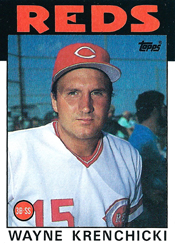
For Wayne Krenchicki, who usually didn’t do well against Cardinals pitching, a game-winning hit, even a crummy one, was a special achievement.

Krenchicki played eight years in the major leagues as an infielder for the Orioles (1979-81), Reds (1982-83 and 1984-85), Tigers (1983) and Expos (1986).

A left-handed hitter, he had a career batting average of .266, though he hit .169 lifetime against the Cardinals.

Right spot

On May 23, 1983, the reigning World Series champion Cardinals looked to end a three-game losing streak when they faced the Reds at Cincinnati. Cardinals starter Joaquin Andujar was matched against Joe Price. Krenchicki played third base and batted seventh.

In the sixth inning, with the Cardinals ahead, 1-0, Johnny Bench drew a one-out walk from Andujar and Ron Oester doubled to right, moving Bench to third. Cardinals manager Whitey Herzog ordered an intentional walk to Paul Householder, loading the bases for Krenchicki.

The Cardinals were hoping for an inning-ending double play from Krenchicki, who was batting .167 for the season. Krenchicki was seeking a sacrifice fly. “I wanted to hit in the air to the outfield,” Krenchicki said to the Cincinnati Enquirer. “All I wanted was the one run.”

Andujar got ahead in the count, 1-and-2, and threw a slider “right in on my fists,” Krenchicki told the Dayton Journal-Herald.

Krenchicki swung and looped a floater to the opposite field. The ball fell softly inside the left-field foul line, barely fair, for a bloop double, scoring Bench and Oester and giving the Reds the lead.

“It was just crummy enough that I knew nobody would catch it,” Krenchicki said to the St. Louis Post-Dispatch.

“Yeah, I’d agree with that,” Herzog said to United Press International. “It hit right in the middle of the chalk line.”

Andujar yelled at Krenchicki, “You throw the ball harder than you hit it.”

Bill Scherrer relieved Price, held the Cardinals hitless over the last three innings and the Reds won, 2-1. Boxscore

Cardinals connection

A month later, the Reds traded Krenchicki to the Tigers and reacquired him after the 1983 season. Krenchicki played two more years with the Reds before he was dealt to the Expos in March 1986 for pitcher Norm Charlton, who became one of the Nasty Boy relievers who helped give the Reds their swagger in their World Series championship season in 1990.

Krenchicki, a Trenton, N.J., native, was a standout shortstop at the University of Miami and played for the Hurricanes when they made their first appearance in the College World Series in 1974. Krenchicki, a first-round draft choice of the Orioles in January 1976, was inducted into the University of Miami Sports Hall of Fame in 1990.

Krenchicki’s last season as a professional player was 1988 when he played for three minor-league teams, including the Cardinals’ Class AAA affiliate, the Louisville Redbirds. Playing for manager Mike Jorgensen, Krenchicki hit .195 in 18 games for Louisville before he was released on June 17, 1988.

After his playing career, Krenchicki spent 20 years (1991-2010) as a minor-league manager, primarily with independent teams not affiliated with major-league organizations. He managed the Newark Bears to the Atlantic League championship in 2007.

Read Full Post »

« Newer Posts - Older Posts »