Feeds:
Posts
Comments

Archive for the ‘Hitters’ Category

They were a couple of neighborhood guys from the Bedford-Stuyvesant section of Brooklyn. Lenny and Tommy. Common names. Uncommon talents.

Lenny Wilkens and Tommy Davis grew up playing stickball and church league basketball against one another. At Boys High School, they became friends.

Davis was a prep baseball and basketball standout. Wilkens was trying to find his way. When Wilkens was a senior, he acted on Davis’ suggestion and went out for the basketball team. It opened the door to a lifetime of opportunity.

Wilkens became a player and coach in the NBA. He was elected to the Naismith Basketball Hall of Fame for success in both roles. Davis became a big-league baseball player. He was a two-time National League batting champion and twice hit game-winning home runs against Bob Gibson.

St. Louis was where Wilkens began his pro career. The best of his eight seasons for the St. Louis Hawks was 1967-68 when the slender guard was runner-up to a giant, Wilt Chamberlain, for the NBA Most Valuable Player Award.

As a player, Wilkens twice led the NBA in assists (1969-70 and 1971-72). As a coach, he led the Seattle SuperSonics to a NBA title (1978-79) and amassed 1,332 wins. Only Gregg Popovich (1,390) and Don Nelson (1,335) achieved more wins as NBA coaches. Wilkens was 88 when he died on Nov. 9, 2025.

Hard road to travel

Wilkens was the son of a black father and white mother. He was about kindergarten age when his father, a chauffeur, died of a perforated ulcer.

Lenny’s mother, Henrietta, raised him and his three siblings in a cold-water tenement flat. Heat came from a coal stove. They survived “on powdered milk and peanut butter,” according to the New York Daily News.

“Quite frankly, it is a mystery to me how any kid was able to make it under such circumstances,” Rev. Thomas Mannion, a parish priest at Brooklyn’s Holy Rosary Catholic Church, told the New York Times.

Henrietta worked in a candy factory. At 8, Lenny got a job in a market, scrubbing floors and delivering groceries. Father Mannion became a surrogate dad. “I had great faith in him,” Wilkens said to the New York Times. “I’d get discouraged and sometimes pretty angry, but Father Mannion … was always there to prod me and keep me from giving up.”

In 1979, Wilkens’ wife, Marilyn, told the newspaper that Father Mannion “was a tremendous influence on (Lenny). He kept him out of trouble in those early days when Lenny was growing up in a very bad neighborhood.”

Wilkens was an altar boy. According to the Los Angeles Times, Tommy Davis recalled a day during their youth when police frisked Wilkens for switchblades and instead found only rosary beads. As Father Mannion told the New York Times, “He somehow rose above the neighborhood.”

The priest was among the first to teach Wilkens about basketball, “setting up chairs for Wilkens to dribble in and out of in the Holy Rosary gym,” according to the New York Daily News.

Get in the game

Wilkens had a bad experience the first time he tried out for the high school basketball team. Coach Mickey Fisher “inadvertently whacked him in the face with his hand as he demonstrated a technique,” the New York Daily News reported.

Offended, Wilkens left and stayed away from the basketball team his first three years in high school. Meanwhile, Tommy Davis developed into an all-city forward. As Davis recalled to United Press International, early in their senior year he said to his friend, “Come on out and play, man. You know Mickey didn’t mean it. You can make this team. We need you.”

Father Mannion also urged Wilkens to try out for the team because he saw basketball as a path to a college scholarship.

Wilkens relented and made the team for the 1955-56 season. However, he was scheduled to graduate in January 1956. So he played in just seven games before receiving his diploma and leaving school.

Undeterred, Father Mannion wrote to a friend, a priest, Rev. Aloysius Begley, athletic director at Providence College, and asked him to consider awarding Wilkens a basketball scholarship. Providence coach Joe Mullaney wanted Tommy Davis, but the Brooklyn Dodgers signed him. After Mullaney’s father scouted Wilkens in a New York summer tournament and recommended him, Providence gave the scholarship.

Wilkens was thin and barely taller than 6-foot. Though his features were frail, he had a basketball toughness honed from playing against older, bigger foes on the Brooklyn playgrounds. He was an aggressive defender and an electric playmaker. As Wayne Coffey of the New York Daily News noted, Wilkens had “the body of a twig and the hands of pickpocket, and a calm that followed him like a shadow.”

An economics major who spent summers working on Brooklyn docks loading cargo, Wilkens planned to teach. He was surprised when St. Louis selected him with the sixth pick in the first round of the 1960 NBA draft. The top two picks were Oscar Robertson (Cincinnati Royals) and Jerry West (Los Angeles Lakers).

“I never thought I was good enough to play up there,” Wilkens told the Springfield (Mass.) Republican. “Playing pro ball after I graduated from Providence wasn’t on my list of things to do.”

Tasked with trying to convince Wilkens he could succeed, St. Louis scout Stan Stutz took him to his first NBA game _ Hawks at Boston in the playoffs. “Stutz told me to watch the play of the Hawks guards (Sihugo Green and Johnny McCarthy),” Wilkens recalled to the Springfield newspaper. “After watching them, I told myself I could play as good as those guys. That’s when I decided I had a chance to make it in the NBA.”

The right stuff

Wilkens was correct about his abilities. He excelled in the NBA as a savvy backcourt talent and unassuming team leader. “The quietest man ever to come out of Brooklyn,” Frank Deford of Sports Illustrated described him.

When he joined the Hawks, Wilkens’ job was to pass the ball to the frontcourt trio of Bob Pettit, Cliff Hagan and Clyde Lovellette. “It was pattern ball, not really my game,” Wilkens told Sports Illustrated, “but you had to adjust to it.”

The cast of teammates eventually changed but Wilkens remained the constant, running the show on the floor. “He can dribble through a briar patch,” Sports Illustrated declared. “He knows the perfect pass to make and, perhaps more important, realizes that most often it need not be a fancy one … Best of all, he has the ability to pace a game, to enforce a tempo.”

Wilkens did it all without fanfare. Frank Deford described him as “shy, with mournful brown eyes.” Jim Murray of the Los Angeles Times noted, “He looks constantly as if he got bad news from home or a telegram from the front. He makes a basset hound look happy.”

Before the 1967-68 season, coach Richie Guerin gave Wilkens the green light to run a fast-break offense and pressure defense. Wilkens made it work. He was the quarterback of a team that included Zelmo Beaty, Bill Bridges, Joe Caldwell, Lou Hudson and Paul Silas. The Hawks won 16 of their first 17 games. Wilkens “is more responsible for our success than anybody,” Guerin told Jim Murray.

For the season, Wilkens averaged 20 points and 8.3 assists per game. He had a triple double _ 30 points, 12 rebounds, 13 assists _ in an October game against the New York Knicks, and was unstoppable (39 points, 18 assists) in a January win versus Seattle. Game stats and Game stats

Hawks management declared the 1967-68 regular-season finale, a home game against Seattle, as “Lenny Wilkens Night.” In a halftime ceremony, the club gave him a green Cadillac and other gifts. Cardinals baseball outfielder Curt Flood, an artist, did an oil painting of Wilkens and presented it to him. Then Wilkens went back to work. He finished the game with 19 points and 19 assists. Game stats

Facing the San Francisco Warriors in the playoffs, the Hawks were beaten in four of six games. The second of their two wins came in Game 5 at home when Wilkens had 20 points and 10 assists. It turned out to be the last game for the Hawks in St. Louis. The franchise relocated to Atlanta in May 1968. Game stats

Enduring friendship

Wilkens never played for Atlanta. On Oct. 12, 1968, he was traded to Seattle for Walt Hazzard. Three days later, Tommy Davis was selected by the Seattle Pilots in the American League expansion draft.

More than a decade after Davis convinced Wilkens to try out for high school basketball, the two friends were reunited nearly 3,000 miles from Brooklyn as professional athletes in Seattle.

As a boy, baseball was Wilkens’ sport of choice, according to the New York Daily News. During the spring and summer of 1969, Wilkens seldom missed a Seattle Pilots home game, the Tacoma News Tribune reported. He’d wait for Davis outside the clubhouse afterward.

Though he was traded to Houston on Aug. 30, 1969, Davis at season’s end was the Pilots’ leader in RBI (80) and doubles (29).

Grateful for the time he and Wilkens had together that year, Davis told Sports Illustrated, “I love Lenny. He is … a true friend who can be depended upon … He is steadfast and honorable … I love Lenny for what he has achieved. He went in there with all those big guys and proved to them he could do it on quickness and guts and dedication. We used to say of him that he was like the man who wasn’t there _ he wasn’t there until you read the box score.”


Read Full Post »

A player with the baseball smarts Whitey Herzog had didn’t need to be told when it was time to quit. It was autumn 1963. Herzog just turned 32, but his prime playing days had past. “His baseball epitaph could read: A Nice Guy Who Couldn’t Hit The Slow Curve,” Detroit columnist Joe Falls noted.

A journeyman outfielder, Herzog squeezed out every bit of talent he had, lasting eight seasons in the majors, mostly with losing teams, before the Tigers removed him from their big-league roster after the 1963 season. The Tigers offered him a role as player-coach at Syracuse, with a promise he’d be considered for a managerial job in their farm system some day, the Detroit Free Press reported. The Kansas City Athletics proposed he join them as a scout.

Herzog, though, was through with baseball. He could earn more ($16,000 a year) supervising construction workers for a company back home in Kansas City than he could coaching in the minors or pursuing prospects on the sandlots.

So Herzog took the construction job, but soon found he didn’t like it, mainly because he had little say in selecting the crew he was tasked with supervising. Hoping to trade his hard hat for a ball cap, Herzog asked the A’s if the scouting job still was open. It was, and he was hired to scout amateur players in 1964.

The scouting experience with the A’s, and then the Mets, gained Herzog a reputation as an astute talent evaluator and helped him develop the managing skills that would lead to his eventual election to the Baseball Hall of Fame.

Going pro

As a teen in New Athens, Ill., Herzog was a good basketball player. “Your basic small, scrappy guard,” he said in “White Rat,” his autobiography. Herzog received seven college basketball scholarship offers, but he wanted to play pro baseball. He could run, throw and hit a fastball.

The St. Louis Browns made an offer: no signing bonus, a minor-league salary of $200 a month and a chance to pitch. Herzog said no. Actually, he claimed in his autobiography, he said to Browns scout Jack Fournier, “Now I know why you guys are in last place all the time, if you wanted to sign a wild-ass left-hander like me.”

On the day after he graduated from high school in 1949, Herzog was invited to a Yankees tryout camp in Branson, Mo. The Yankees told him he could make it as an outfielder. Heck, they said, Joe DiMaggio would be retiring just about the time Herzog should be ready for the majors. (What he didn’t know is that another prospect, Mickey Mantle, was signing with the Yankees in 1949, too.) Herzog took the Yankees’ offer of a $1,500 bonus and a minor-league salary of $150 a month.

Years later, Herzog told the Kansas City Star, “If I had gotten more money, it would have been all right, but I was foolish to sign for that kind of a bonus. I could have gone out and broken my leg the first year, and then where would I have been? If I had it to do over, I would have gone to college (on a basketball scholarship) and then signed a baseball contract.”

Tough breaks

Herzog played five seasons in the Yankees’ farm system and served a two-year Army hitch. He never did appear in a regular-season game for the Yankees, but he got to know their manager, Casey Stengel, during 1955 and 1956 spring training and developed a fondness for him. “Of all the managers I’ve ever played for, Casey had the most influence on me,” Herzog said in his autobiography. “Casey took a liking to me, spent a lot of time with me.”

On Easter Sunday in 1956, after attending a church service with Yankees players Tony Kubek and Bobby Richardson, Herzog was called up to Stengel’s hotel suite. “When I got there,” Herzog recalled in his autobiography, “I saw that Casey had already been celebrating Easter with a few drinks. He was rambling on.”

After a while, Stengel blurted out that Herzog was going to the majors _ with the Washington Senators. “Go over there and have a good year,” Stengel told him, “and I’ll get you back.”

As Herzog noted in his book, “I never had that good year, and I never wore the pinstripes in Yankee Stadium. In my heart, though, I was always a Yankee. I never got over the fact that they’d traded me.”

Herzog was with the Senators (1956-58), A’s (1958-60) and Orioles (1961-62) before being traded to the Tigers in November 1962. Going to Detroit meant he’d do a lot of sitting, not playing. Herzog was an outfielder and first baseman, and the Tigers had standouts with Rocky Colavito in left, Bill Bruton in center, Al Kaline in right and Norm Cash at first base. “There was no use kidding myself _ all those guys were better ballplayers than I was,” Herzog told the Kansas City Times.

To pass the time, Herzog told teammates he would keep count of the home runs he hit in batting practice all season.

“I hit my 250th in Detroit in late August,” Herzog told Kansas City journalist Joe McGuff. “(Coach) Bob Swift was pitching that day. I hit my 249th into the upper deck in right field. (Teammate) Gates Brown was standing by the batting cage and I told Gates I was really going to crank up and see if I could hit my 250th on the roof. Sure enough, I did. There was an usher nearby and I asked if he’d mind going up on the roof and getting the ball for me. He found it and brought it back. The ball landed in a big patch of tar. So it looked legitimate. I got it autographed (by teammates) and fixed up and I’ve got it in a trophy case at home.”

In Baltimore, on the day before the 1963 season finale, Herzog hit his 299th batting practice homer. “Everybody on the club knew I was going for my 300th on the last day,” he said, “so they told me I could keep hitting until I got 300. It rained that day and they had to call off batting practice, so I wound up with 299.”

A tiger in batting practice, Herzog was a pussycat in the games that season. He hit no homers and batted .151. “You’ll find no nicer guy on the Tigers than Whitey Herzog,” Joe Falls of the Detroit Free Press informed readers, “and it grieves us to see him struggling so much at the plate.”

Talent hunt

Jim Gleeson left the A’s scouting department to join the coaching staff of Yankees manager Yogi Berra, creating the opening for Herzog to quit the construction job and return to baseball.

Herzog displayed the same desire and determination for scouting amateurs as he had for playing in the pros. In June 1964, he told the Kansas City Star, “Last month, I saw 52 high school and college games. I’ve been averaging about 1,500 miles a week on the road. I’ve been seeing the country.”

Though he was competing with other scouts to sign talent, Herzog earned their respect. The scouts welcomed him into the fraternity and offered their advice on how to succeed.

“The old scouts like Bert Wells of the Dodgers and Fred Hawn of the Cardinals took him under their wing and really helped him,” Herzog’s colleague, Joe McDonald, recalled to Cardinals Yearbook in 2010. “He always talked about them. It’s not easy doing amateur scouting for the first time. You have to find ballparks (and) call the coach in advance to try to determine if the pitcher you want to see is pitching. You have to do all that preliminary work. Whitey did all that, which was a great foundation (to managing), because his evaluating skills matched his strategic ability in game situations. That was the key.”

The best of the 12 prospects Herzog signed in 1964 were Chuck Dobson, who went on to pitch nine seasons in the American League and won 74 games, and catcher Ken Suarez, who played seven seasons in the majors, including 1973 with the Rangers when Herzog managed them.

The one who got away was pitcher Don Sutton, the future Hall of Famer. “I had him in my hotel room, ready to sign an A’s contract for $16,000,” Herzog said in his autobiography. “What a bargain he would have been.”

The deal needed the approval of Charlie Finley, but the A’s owner wouldn’t go over $10,000. “I went out and told Bert Wells of the Dodgers that he ought to sign him,” Herzog said. The Dodgers did and Sutton went on to pitch 23 seasons in the majors, winning 324 games and pitching in four World Series, including three with the Dodgers and one with the Brewers against Herzog’s 1982 Cardinals.

Wise judge

After rejecting an offer to become head baseball coach at Kansas State, Herzog coached for the A’s in 1965 and for the Mets in 1966. He scouted pro talent as a special assistant to Mets general manager Bing Devine in 1967, then was promoted to director of player development. “The people in the organization reached the point where they relied more and more on my judgment about who to sign and who to get rid of,” Herzog said in his autobiography.

After the Mets vaulted from ninth-place finishers in 1968 to World Series champions in 1969, Herzog went to the victory party at Shea Stadium to congratulate manager Gil Hodges. In recalling the moment years later to Cardinals Yearbook, Herzog said, “When he saw me coming, he jumped out of his chair and said, ‘I want to congratulate you. Every time I’ve called you and asked for a ballplayer, you’ve sent me the right one.’ That meant a lot to me.”

Later, when Herzog managed the Royals to three division titles and then led the Cardinals to three National League pennants and a World Series championship, his skill as a talent evaluator often was cited as a significant factor in his success.

“It wasn’t just Whitey’s ability to manage a game,” Jim Riggleman, a coach on Herzog’s St. Louis staff before becoming a big-league manager, told Cardinals Yearbook. “There are other good game managers. It was his ability to evaluate talent. He knew who could play and who was on the last leg.”

Red Schoendienst, who managed St. Louis to two pennants and a World Series title before coaching for Herzog, said to Cardinals Yearbook, “You manage according to what you have. That’s what managing is all about, knowing your ballplayers … Whitey had a lot of practice judging players … He could see the kind of abilities they had and whether they just came out to play or if they were winners … Some guys just know how to win. Those are the guys you want.”

Read Full Post »

Dick Nen reached the pinnacle of his career in his first big-league game. He played in 366 more after that, but nothing topped what he did against the Cardinals in his debut.

On Sept. 18, 1963, in his second at-bat in the majors, Nen slammed a home run for the Dodgers, tying the score in the ninth inning and stunning the Cardinals. The Dodgers went on to win, completing a series sweep that put them on the verge of clinching a pennant.

Three decades later, reflecting on his storybook feat in St. Louis, Nen told the Palm Beach Post, “I should have walked away right then. That was my one day.”

Prized prospect

The California town of South Gate, seven miles south of downtown Los Angeles and dubbed the “Azalea City,” is the birthplace of Dick Nen as well as other sports figures such as NFL commissioner Pete Rozelle, Baseball Hall of Fame umpire Doug Harvey and Red Sox second baseman Doug Griffin.

After attending Los Angeles Harbor College, Nen went to Long Beach State and played baseball there. A left-handed batter, he hit with power and fielded gracefully at first base. Kenny Myers, the scout who brought Willie Davis to the Dodgers, signed Nen for them. Two weeks later, the Cubs offered $100,000 for Nen, but the Dodgers declined, the Los Angeles Times reported.

In 1961, Nen’s first pro season, with Reno, he produced 32 home runs, 144 RBI and batted .351. In a home game against Fresno, he blasted a ball out of the park and onto the roof of an indoor municipal swimming pool 100 feet beyond the outfield fence. With 177 hits and 102 walks, he had a .458 on-base percentage.

Promoted from Class C Reno to Class AAA Spokane in 1962, Nen was limited to 72 games. He joined the team after the season started because of a military commitment and then was sidelined when a thrown ball struck him below the right eye. Back with Spokane in 1963, Nen had 84 RBI and a .369 on-base percentage (167 hits and 75 walks).

Welcome aboard

On Tuesday night, Sept. 17, 1963, Spokane lost in the finale of the Pacific Coast League championship series at Oklahoma City. Nen was called up to the Dodgers after the game. On Wednesday, Sept. 18, he boarded a flight in Oklahoma City, arrived in St. Louis in the afternoon and went directly to the ballpark, where the Dodgers were to play the Cardinals that night in the finale of a three-game series. Issued uniform No. 5, Nen took batting practice, then settled in to watch the game from the dugout.

After losing the first two games and falling three behind the front-running Dodgers, the Cardinals desperately needed a win in Game 3. With Bob Gibson pitching for them, the Cardinals appeared on their way to achieving their goal, leading 5-1 through seven innings.

A pitcher, reliever Bob Miller, was due to be the first batter for the Dodgers in the eighth. Dodgers manager Walter Alston, seeking a left-handed pinch-hitter to send against Gibson, had two options: Derrell Griffith, called up from Class AA, or Nen, called up from Class AAA. Neither had been in a big-league game.

Alston chose Nen. “I was scared stiff,” Nen recalled to the Los Angeles Times. “I had no idea I’d be called upon.”

In making his big-league debut, Nen joined Truck Hannah (1918 Yankees), Johnny Reder (1932 Red Sox) and Eddie Kazak (1948 Cardinals) as players whose last names spell the same forward and backward. Since then, the list includes Toby Harrah (1969 Senators), Mark Salas (1984 Cardinals), Dave Otto (1987 Athletics), Robb Nen (1993 Rangers), Juan Salas (2006 Rays), Marino Salas (2008 Pirates), Fernando Salas (2010 Cardinals) and Glenn Otto (2021 Rangers).

Nen lined out sharply to center fielder Curt Flood, but the Dodgers went on to score three times in the inning, cutting the St. Louis lead to 5-4. Nen stayed in the game, taking over at first for Ron Fairly, who had been lifted for pinch-hitter Frank Howard during the eighth-inning rally.

In the ninth, with one out, none on, Nen batted for the second time. Right-hander Ron Taylor threw him a fastball, low and away. “I put the ball where I wanted it,” Taylor told the St. Louis Post-Dispatch.

Nen drove it onto the pavilion roof in right-center for a home run, tying the score. “I knew I hit it good,” Nen told the Los Angeles Times, “but I had no idea it was a home run until I saw the umpire give the home run sign.”

Watching on TV in California, Nen’s father and sister whooped with joy. Nen’s mother, attending a church function, got a call from her daughter, who exclaimed, “Richard hit a home run to tie the (score).”

The game moved into extra innings and became a duel between relievers Ron Perranoski (Dodgers) and Lew Burdette (Cardinals). With two on in the 11th, Nen nearly got a game-winning single, but second baseman Julian Javier ranged far to his left, made what the Post-Dispatch described as “an improbable glove-hand stop” of the grounder, wheeled and threw out Nen at first. In the 13th, with Dodgers runners on second and third, one out, Burdette issued an intentional walk to Nen. “A pretty high compliment for a rookie in his first big-league game,” columnist Jim Murray noted.

Maury Wills followed with a grounder, sending home the runner from third with the winning run. Boxscore

On the Dodgers’ flight home, most of the talk concerned Nen’s heroics. “I never saw anybody break in more spectacularly,” pitcher Johnny Podres told the Long Beach Independent. “That was the biggest homer of the year. It gave us the shot in the arm we needed.”

The Dodgers’ plane landed at 4:08 a.m. When Nen got home, his parents greeted him with a big spaghetti breakfast, featuring their homemade sauce.

A few days later, Sept. 24, the Dodgers clinched the pennant. Then they swept the Yankees in the World Series. Nen joined the club too late to be eligible, but he pitched batting practice before Game 4 and was given a $1,000 winner’s share.

Wanted in Washington

Nen’s home run against the Cardinals turned out to be his only hit as a Dodger.

Entering 1964 spring training as a candidate to earn a spot on the Dodgers’ Opening Day roster, Nen “developed the bad habit of lowering his back shoulder when he swings,” the Associated Press reported.

He was sent back to Spokane and spent the season there. In December 1964, the Dodgers dealt Nen, Frank Howard, Ken McMullen, Pete Richert and Phil Ortega to the Senators for Claude Osteen, John Kennedy and $100,000.

The Senators were managed by ex-Dodgers first baseman Gil Hodges. At spring training in 1961, Hodges had given pointers to Nen on how to play first base.

Nen, 25, began the 1965 season in the minors, but when Senators first baseman Bob Chance failed to hit as hoped, Nen was brought up in July to replace him. Nen started 63 games at first base for the 1965 Senators and hit .317 with runners in scoring position. He slugged two homers against Catfish Hunter, a walkoff homer to beat Luis Tiant and a grand slam versus Fred Talbot. Boxscore Boxscore Boxscore Boxscore

“This boy has all the qualifications to be a dandy player,” Senators general manager George Selkirk told the Washington Daily News. “… He’s our first baseman and I don’t see anyone taking it away from him.”

The good vibes didn’t last long. Nen had a terrible spring training in 1966. When the season opened, ex-Cardinal Joe Cunningham was the Senators’ first baseman and Nen was on the bench. In June, the Senators got Ken Harrelson from the Athletics and he took over at first base. Nen batted .213.

Nen “has the idea in his head that he is going to be lousy in the spring and so naturally he is,” Senators coach Joe Pignatano told Jerry Izenberg of the Newark Star-Ledger. “You can’t come in here thinking that way and expect to be anything but bad. When you do that, you concede the job. He could win it in a minute if he’d hit the way we think he can.”

Years later, Nen said to the Miami Herald, “I struggled most of my career, especially with the mental part. I always had to find ways to overcome the bad times and look forward to the good times. It seems like I went through more bad times than good. I should have done a lot better.”

In 1967, Nen was the Senators’ Opening Day first baseman, but in May they got Mike Epstein from the Orioles and he became the starter. Nen batted .218.

Seeking a pinch-hitter, the Cubs acquired Nen a week before the start of the 1968 season. On May 15, his two-run single in the ninth inning against Jack Billingham beat the Dodgers. It was Nen’s first National League hit since his 1963 home run versus the Cardinals. Boxscore

After batting .181 for the 1968 Cubs, Nen was returned to the Senators. He played his last game in the majors for them in June 1970.

All in the family

Nen’s son, Robb Nen, became a prominent big-league reliever. In 10 seasons with the Rangers (1993), Marlins (1993-97) and Giants (1998-2002), Robb had 314 saves, 45 wins and a 2.98 ERA. He pitched in two World Series (1997 Marlins and 2002 Giants) and was the National League saves leader (45) in 2001.

“Nen has the kind of arm that comes along once every 10 years,” Marlins general manager Dave Dombrowski told the Miami Herald in 1997.

Dick Nen said to the San Francisco Examiner, “We don’t know where the good arm came from. It didn’t come from me. He must have gotten it from my wife.”

Read Full Post »

In 2025, Tony La Russa was interviewed by Jon Paul Morosi for the Baseball Hall of Fame podcast “The Road to Cooperstown.”

Here are excerpts:

Being a lifelong learner:

La Russa: “The educational emphasis was from my mother … She was insisting on me going to college. (La Russa earned a law degree from Florida State.) The other thing she did, for which I am forever thankful, as early as I can remember, I learned to read. She always made books available, a lot of times they were books about the West, and to this day I have a love affair with books. You’ll never see me without one.

“The other part of learning is the game of baseball, and that was my dad. His brothers, my uncles, they ate it and talked it, and that’s all we ever discussed. I learned about baseball when I was 4, 5, 6 years old and have loved it ever since.”

First language he spoke as a youth in Tampa’s Ybor City section:

La Russa: “Totally Spanish because my dad spoke Spanish … The truth is that as I got ready to go to elementary school, as I was approaching 6 years old, I had to learn to speak English.”

Baseball team or player he followed as a youth:

La Russa: “My dad was a 6-day-a-week hard laborer. I mean, he worked, but on Sunday, during spring training, we’d go see the Reds or White Sox in Tampa, or we’d go to St. (Petersburg) for the Cardinals or Yankees. At that early age, the guy who caught my attention was Mickey Mantle.”

In 1963, La Russa, 18, with the Kansas City Athletics, got his first big-league hit, a triple versus the Orioles’ Steve Barber, who won 20 that year. La Russa’s first big-league RBI came against the Twins’ Camilo Pascual, a 21-game winner in 1963. Boxscore and Boxscore

What it was like being in the majors as a teen:

La Russa: “The players, by and large, were not hard on me at all. That’s when I first met Charlie Lau. He was a backup catcher (and later a coach on La Russa’s White Sox staff.) Guys like … Norm Siebern, Jerry Lumpe. These guys were really careful, especially when we got to big cities, that I didn’t get in trouble.”

Playing for the Atlanta Braves the last part of the 1971 season:

La Russa: “For six weeks I watched Henry Aaron and got to know him. That’s a blessing that’s impossible to describe unless you know Hank. Just a beautiful man … We used to fly commercial back then. One day I’ll never forget, we were flying back from L.A. to Atlanta at night and everybody’s sleeping, and I’m walking down the aisle and Hank is awake and he said, ‘Sit down.’ We talked for the rest of the flight and mostly what we talked about was experiencing the Dodgers and how often they hit him or knocked him on his butt …

“In those days, there wasn’t the protection of the hitter that there is today. These guys today don’t have any idea … If you swung the bat, they’d aim right at your head to try to scare you. The courage of those great sluggers was something special. I just wish that today’s hitters would be more thankful that Major League Baseball is protecting them, because it’s a scary thing when guys are throwing at your head … Hank, they couldn’t scare him and they couldn’t stop him.”

On getting a single (against the Orioles’ Dave McNally) as a pinch-hitter in his first at-bat for the Oakland Athletics, after their move from Kansas City, in 1968 and scoring the winning run as a pinch-runner (for the Cubs’ Ron Santo) in his last big-league appearance in 1973:

La Russa: “I like to use that as an example of just how lousy my (big-league playing) career was … Pinch-hitting. Pinch-running. Those are my highlights and they’re best forgotten.” Boxscore and Boxscore

Toughest challenge he faced when he became a big-league manager with the White Sox in 1979:

La Russa: “When you go into a game and you know you are overmatched. Think about it: In 1979, the managers were legends you knew by their first names. Billy (Martin), Earl (Weaver), Whitey (Herzog), Sparky (Anderson), Gene (Mauch), Chuck (Tanner). What they would contribute to the game versus what I could …

“I used to ask these great men questions. Every one of them but two answered right away … Gene Mauch and Earl Weaver were very honest and told me, ‘Young man, do you know what the longevity of a major-league manager is nowadays?’ I said, ‘No.’ They said, ‘Maybe three years.’ So they said, ‘If you’re still here three years from now and you ask me a question, I’ll answer it, but I’m not going to waste my time with you (now) because I don’t think you’ll be around.’ ”

Advice from former White Sox and Orioles manager Paul Richards, who was White Sox director of player development when La Russa began managing in their organization:

La Russa: “He said two things to me. One, if (the players) don’t trust you, they won’t follow you. So don’t ever, ever not tell them the truth … Paul also said … (because) you have such scrutiny of every move you make, you have a natural instinct sometimes to cover your butt, and he said, ‘Tony, if you do that, you’ll never know if you’re good enough.’ He said, ‘Trust your gut, don’t cover your butt.’ … I can honestly say, maybe because I had a law degree waiting (if managing didn’t work out), I never managed afraid, and it was a big asset.”

On Dave Duncan, the catcher who was La Russa’s teammate with the A’s before becoming pitching coach for most of the clubs La Russa managed:

La Russa: “Dunc early on was always somebody that stood out with his maturity, intelligence, competitiveness, toughness. I mean, he caught Game 7 of the 1972 World Series against the Big Red Machine and that was his only start. The A’s were getting ready to upset The Machine.

(In the bottom of the ninth, with Oakland ahead, 3-2, the Reds had a runner on first, two outs, and switch-hitter Pete Rose at the plate against Rollie Fingers when manager Dick Williams went to the mound.)

“Dick had Vida Blue warming up. He went out there to make the (pitching) change and said, ‘I’m going to turn Pete Rose around, to the right side. Dunc said, ‘Dick, don’t do that. Vida’s a starter. Who knows what you’re going to get. Rollie can get this guy out.’ Dick said, ‘OK.’ ”

Rose flied out and the Athletics were World Series champions. Boxscore

Managing against Dusty Baker:

La Russa: “The only time he and I had big problems was when we were in the same division together. That was Cubs and Cardinals; Reds and Cardinals … I can’t wait to welcome him into the Hall of Fame, which is going to happen very soon.”

On the backup slider Dodgers’ Kirk Gibson hit for a walkoff home run to beat Dennis Eckersley and the A’s in Game 1 of the 1988 World Series:

La Russa: “When we got two strikes on him, you see Dunc (in the dugout) give the sign: Up and away. That two-strike pitch should have been a high fastball. He could have gotten a base hit, but he wouldn’t have hit a home run.” Boxscore

How the A’s recovered to become World Series champions the next year:

La Russa: “Adversity can be the best teacher … The next spring we decided we were going to be on a mission … Talented guys on a mission … Their minds were just zeroed in on (there will be) no regrets.”

Managing the Cardinals to World Series titles in 2006 and 2011:

La Russa: “We got in the (playoffs) the last day of the year both times … We got in (there) in fighting, competitive form … So much of getting to October and winning in October is about head, heart and guts. It’s about taking that talent and never giving in, never giving up … It’s mindset … You’re surrounded in the clubhouse with guys who are tough-minded and … never stop competing. I’m very proud of those clubs.”

On Game 6 of the 2011 World Series when the Cardinals, on the brink of elimination, scored twice in the ninth and twice in 10th before winning in the 11th:

La Russa: “When you get that far, you have such a feeling of confidence and pride … Even at the end, when we were down two in the ninth … we felt confident … Guys were on the top step of the dugout, without any prompting, saying, ‘We can do this.’ … Don’t ever underestimate the importance of how strong your mind is and your will and what you can accomplish.”

On retiring from managing after the 2011 World Series and coming back at age 76 to manage the White Sox in 2021:

La Russa: “I kept hearing I was too old and couldn’t relate, but we won 93 games. We had six winning months … The next year I got cancer and I had to leave in August.”

On the state of big-league baseball today:

La Russa: “I’m not pleased with the game that I see _ the accent on getting the ball in the air, and strikeouts are OK, and getting overwhelmed by pitching …

“Putting the ball in play and hitting where it’s pitched creates rallies. I think it’s easier to win now if you’re playing against a team that has a guy on second base with nobody out, down a run, and guys try to hit two-run homers, and get beat by a run. When the pitching is really good and you’re trying to do the most things (at the plate), that is stupid, right? When the pitching is really good, you better work to get a single, do something to advance the runners, score. Big is not going to beat you. Little is going to give you a chance to win.”

On starting pitchers not being expected to go deep into games:

La Russa: “We got to change that. The game is better when people say, ‘Hey, do you know who’s starting today,’ and they (the starters) get into the last third of the game … We got to stretch them out.”

On being inducted into the Baseball Hall of Fame:

La Russa: “The great Tom Seaver, a friend, told me the day I got in, ‘You know, you’re a coattail Hall of Famer.’ Right away, I said, ‘I know, because the Hall of Fame is for players that have been great.’ To get a manager in there, it’s because of the organization, the scouting, the player development, the players. I said, ‘I understand, Tom.’ Then he told me, ‘You know what an honor it is to be here?’ I said, ‘I think so. Why?’ He said, ‘If you mess this up, I’ll have you deducted faster than you were inducted.’ “

Read Full Post »

Though it is a franchise that has benefitted from hitters the likes of Stan Musial, Rogers Hornsby, Albert Pujols, Lou Brock and Enos Slaughter, the Cardinals have had only one player achieve 20 doubles, 20 triples and 20 home runs in a season: Jim Bottomley.

A left-handed batter whose stroke regularly produced highly elevated line drives, Bottomley totaled 42 doubles, 20 triples and 31 home runs in 1928, the year he earned the National League Most Valuable Player Award and helped the Cardinals win their second pennant.

Bottomley is one of seven players in the 20-20-20 club. The others are Frank Schulte (1911 Cubs), Jeff Heath (1941 Indians), Willie Mays (1957 Giants), George Brett (1979 Royals), Curtis Granderson (2007 Tigers) and Jimmy Rollins (2007 Phillies). Schulte, Mays, Granderson and Rollins also had 20 stolen bases in the seasons in which they produced 20 doubles, 20 triples and 20 home runs.

Finding his footing

In 1916, when Bottomley was 16, he quit high school in Nokomis (Ill.) and worked as a truck driver, grocery clerk, railroad clerk and blacksmith’s apprentice while also playing semipro baseball, according to the Associated Press. His father and brother were coal miners. The brother was killed in a mine accident.

“I know how hard that kind of work was on my father and how much my mother worried about it,” Bottomley later told The Sporting News. “When I went into baseball, it was a choice of making good at that or returning to the mines. It hardly was any choice at all.”

A policeman saw Bottomley hit two home runs and three triples in a local game and told Cardinals manager Branch Rickey he should give Bottomley a look. In the meantime, Bottomley wrote to Rickey and asked for a tryout. Cardinals scout Charley Barrett was sent to watch Bottomley play and was impressed.

In early fall of 1919, Bottomley, 19, was summoned to St. Louis so that Rickey could see him perform. Rickey sought prospects for the farm system he was starting to build.

Bottomley’s introduction to the big city was expensive. Unsure how to get to Robison Field, he hailed a taxi when he arrived at the bus station. The driver charged him more than $4 to go to the ballpark, according to the Brooklyn Eagle.

When Bottomley reported to the field, Rickey hardly could believe what he saw. The first baseman wore shoes half a dozen sizes too large for him. The shoes curled up at the toes and had spikes nailed to the front. The Brooklyn Eagle described them as Charlie Chaplin clown shoes. Bottomley tripped over the bag, falling on his face and then on his back.

“I told Charley Barrett this fellow could never do it because his feet were too big,” Rickey recalled to the Brooklyn newspaper, “but Barrett declared his feet were all right. It was that pair of shoes.”

In the book “The Spirit of St. Louis,” Rickey said, “Bottomley, properly shod, had the grace and reflexes of a great performer.”

The Cardinals signed Bottomley for $150 a month and arranged for him to report to the minors in 1920.

Man of the people

Bottomley gave the Cardinals a big return on their modest investment. Called up to the majors in August 1922, he became their first baseman. He hit .371 in 1923 and the next year drove in 12 runs in a game against the Dodgers. Boxscore

Using a choked grip on a heavy bat, Bottomley drove in more than 110 runs six seasons in a row (1924-29), and hit better than .300 in nine of his 11 years with the Cardinals. (In the other two years, he hit .299 and .296.)

When he was Cardinals manager, Rogers Hornsby told United Press, “I’d rather see Jim Bottomley at the plate when a run is badly needed than any other player I could name.”

Bottomley “was the best clutch hitter I ever saw,” Hall of Famer Frankie Frisch said to the New York Times.

Nicknamed Sunny Jim _ “He has a disposition that refuses to see the gray outside of the clouds of life,” Harold Burr of the Brooklyn Eagle noted _ Bottomley was a fan favorite, especially with the Knothole Gang kids and the Ladies Day crowds.

“Cap perched jauntily over his left eye, the smiling Bottomley walked with a slow swagger that was as much a trademark as his heavy hitting,” Bob Broeg of the St. Louis Post-Dispatch noted.

Bottomley was a bachelor during his playing days with the Cardinals. (In 1933, he married Betty Brawner, who operated a beauty salon in the Missouri Theater building in St. Louis.) Cardinals bachelors stayed at a hotel in the West End of St. Louis during Bottomley’s time. According to The Sporting News, “There every night you could see Jim and his cohorts seated in chairs out in front of the hotel, holding court with the fans.”

Gold standard

Of Bottomley’s 187 hits in 1928, roughly half (93) were for extra bases. His 362 total bases led the league.

Dodgers pitcher Rube Ehrhardt told the Brooklyn Eagle, “Bottomley is a great slugger … He pulls a ball to right field by a combination of strength, wrist snap and perfect timing.”

By June 1928, Bottomley had his 20th double of the season, and his 20th homer came the next month. All he needed were 20 triples to become baseball’s second 20-20-20 player. Entering September with 14 triples, Bottomley made his run for the mark.

He hit a triple at Cincinnati on Sept. 2, then got triples in three consecutive home games _ Sept. 9 versus the Pirates and Sept. 10-11 against the Reds. His 19th triple came Sept. 22 at the Polo Grounds versus the Giants.

On Sept. 29 at Boston, the Cardinals went into the next-to-last game of the season with a 94-58 record, two games ahead of the Giants (92-60). A win would clinch the pennant.

Leading off the game for the Cardinals, Taylor Douthit hit a slow roller to second. Braves player-manager Rogers Hornsby tried to scoop it, but the ball trickled between his legs and into right field for a two-base error. After a Frankie Frisch single scored Douthit, Bottomley drove a pitch from ex-Cardinals teammate Art Delaney into right-center. Eddie Brown, the center fielder, reached for it, but the ball caromed off his glove and hit the bleacher wall. Frisch scored and Bottomley streaked into third with his 20th triple. Chick Hafey followed with a sacrifice fly, scoring Bottomley, and the Cardinals went on to a 3-1 pennant-clinching win. Boxscore

For the season, Bottomley hit .325, scored 123 runs and drove in 136. He had a .402 on-base mark and a .628 slugging percentage. Bottomley batted .359 with runners in scoring position.

“Bottomley is the Lou Gehrig type _ a hustler, carefree, great in the pinches,” Yankees pitcher Waite Hoyt told North American Newspaper Alliance.

(Bottomley clouted a home run versus Hoyt in Game 1 of the 1928 World Series at Yankee Stadium. He also was credited with a triple in Game 3 at St. Louis when Yankees center fielder Cedric Durst took several steps toward the ball, then futilely tried to turn back as it sailed over his head. Boxscore)

For being named National League MVP by the Baseball Writers Association of America, league president John Heydler awarded Bottomley $1,000 in gold.

The league and the Cardinals arranged for the prize to be given before a game against the Phillies at St. Louis on June 8, 1929. Because of Bottomley’s popularity with youngsters, Cardinals owner Sam Breadon invited girls and boys of school age to attend the Saturday afternoon game for free.

A total of 12,806 youths _ 9,643 boys and 3,163 girls _ attended. “They packed the upper and lower decks of the left wing of the grandstand and overflowed into the bleachers and pavilion,” the Post-Dispatch reported. Paid attendance was 7,000, putting the total number of spectators at 19,806.

Before the game, Bottomley tossed many baseballs to youngsters in the stands. Then, in a ceremony at home plate, Heydler gave Bottomley $1,000 worth of $5 gold coins in a canvas sack.

During the game, “all available paper was made into schoolroom airplanes and sailed out into the field” by the urchins, the Post-Dispatch noted. Bottomley produced two hits, including a triple, and the Cardinals beat Phillies starter Phil Collins like a drum, winning, 7-2. Boxscore

Read Full Post »

Nearly 40 years before the 1984 movie “The Natural” transformed fictional baseball character Roy Hobbs into a pop culture icon, Bama Rowell of the Boston Braves did what Hollywood screenwriters only could imagine.

On May 30, 1946, in the second game of an afternoon doubleheader against the Dodgers, Rowell launched a towering drive to right. The ball struck the Bulova clock high atop the scoreboard at Ebbets Field in Brooklyn, shattering the dial’s neon tubing and showering right fielder Dixie Walker with falling glass. As the New York Times put it, “The clock spattered minutes all over the place.”

In the film version of “The Natural,” Roy Hobbs, portrayed by actor Robert Redford, clouted a ball into the outfield lights, sending an explosion of sparks into the night. Hobbs’ walkoff home run clinched the pennant for the fictitious New York Knights. Movie clip

(In Bernard Malamud’s superior 1952 novel “The Natural,” Hobbs strikes out.)

Bama Rowell’s clock-shattering shot was a ground-rule double, not a home run, and it came in the second inning for a team on its way to a fourth-place finish in an eight-team league.

Good hit, no field

Carvel William Rowell was from Citronelle, Alabama. Once the territory of the Chickasaw tribe, the town was named for the citronella grass prevalent in the area. Citronella oil is a popular insect repellent.

A high school and semipro pitcher, Rowell also was a prep football, basketball and track standout. He accepted a football scholarship to Louisiana State University, but before he had a chance to play for the varsity, he signed a pro baseball contract, according to the Mobile (Ala.) Register.

Because he could hit, Rowell was converted into a second baseman in the minors, but fielding was a struggle. Playing in the Dodgers’ system in 1938, he made 64 errors _ 12 in 17 games with Winston-Salem and 52 in 114 games with Dayton.

After the season, baseball commissioner Kenesaw Mountain Landis declared Rowell a free agent on a technicality. (His transfer from Winston-Salem to Dayton hadn’t been filed properly.)

Despite his fielding woes, the Boston Braves were impressed by the .310 batting mark, 30 doubles and 23 stolen bases Rowell produced for Dayton. Jocko Munch, a Braves representative, handed him a wad of 20 $50 bills. Rowell pocketed the $1,000 and signed with Boston.

Sent to minor-league Hartford in 1939, Rowell became an outfielder. He still couldn’t cope with balls that bounced his way. In desperation, he tried dropping to a knee. “You’re using the wrong knee,” outfielder Johnny Cooney told him. According to the Boston Globe, Rowell replied, “I knowed something was wrong.”

His Hartford teammates hung the Bama nickname on him. “They used to kid me about being from Alabama and the name happened to stick,” Rowell told the Minneapolis Star Tribune.

Casey takes a chance

Called up to Boston in September 1939, Rowell made 14 outfield starts. Early in the 1940 season, Boston manager Casey Stengel moved Sibby Sisti from second to third and put Rowell at second base.

(In a serendipitous twist, Sisti went on to have a role as the Pittsburgh manager in the film, “The Natural.”)

Stengel was well aware of Rowell’s shortcomings as a fielder (“The ball runs up his arm and you expect it to jump in a pocket like a little white rat,” Stengel told Harold Kaese of the Globe), but the manager took a liking to the rookie.

“The kid’s got a natural double play arm,” Stengel said to the Dayton Journal Herald. “He can whip that ball right across his chin while pivoting … He’s fast and he hustles … I’d like to see him make it. He’s a good kid.”

Rowell committed 30 errors during the 1940 season, but hit .305. In a June game against the Cardinals, he had three hits and three errors. In another game versus St. Louis in September, he drove in six runs. Boxscore and Boxscore

“He’s one of the best hitters in the National League,” Cardinals pitcher Lon Warneke told the Globe in August 1940. “He hasn’t got the power some other hitters have, but there isn’t anybody in our league that’s any tougher to get out.”

Rowell followed up with 60 RBI for Boston in 1941 (the team leader had 68) but made 40 errors at second base.

On Dec. 4, 1941, three days before the Japanese attack on Pearl Harbor, Rowell was inducted into the U.S. Army. He served in artillery duty during World War II and missed four baseball seasons before he was discharged from the military in October 1945.

Stop a clock

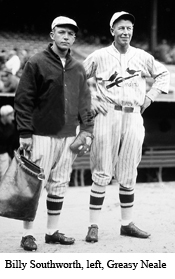
When Rowell returned to the Braves at 1946 spring training, Casey Stengel was gone and Billy Southworth was the manager. Southworth joined Boston after leading the Cardinals to three consecutive National League pennants and two World Series titles.

Southworth shifted Rowell, 30, from second base to the outfield. A left-handed batter, Rowell played primarily against right-handed pitchers. Southworth tried him in the fourth, second and fifth spots in the batting order. Then, for the May 30 doubleheader at Brooklyn, Rowell was put in the leadoff position.

In the opener, Rowell went hitless against Kirby Higbe. Boxscore

A rookie, Hank Behrman, started Game 2 for Brooklyn. Rowell led off by grounding out. In the second, with the score tied at 2-2, Boston had runners on first and third, one out, when Rowell came to the plate again.

Ebbets Field was packed with 35,484 spectators, the Dodgers’ largest home crowd of 1946. (Years later, the New York Times, noting Bernard Malamud was a Brooklynite “who haunted Ebbets Field as a youth,” pondered whether he was at the game and whether his experiences there reflected any scenes he wrote in “The Natural.”)

Behrman gave Rowell a pitch to his liking and he lofted it toward the scoreboard. It was common for batters to smack balls off the scoreboard in the Ebbets Field bandbox, but none had soared into the Bulova clock since it was installed atop the scoreboard in 1941.

Rowell’s drive smacked into the clock at 4:25 p.m. Because the scoreboard was in play, Rowell’s blast was a ground-rule double. It drove in the go-ahead run and knocked Behrman from the game.

“The clock continued to run for an hour, but stopped when the hand reached the spot that Bama’s ball had hit,” The Sporting News reported.

Bulova had promised a watch to any batter who hit the clock. Forty-one years later, in 1987, while doing research for a magazine article about home runs, sports reporter Bert Sugar read about Rowell’s smash off the Ebbets Field clock. When he tracked down Rowell, 71, in Citronelle, Alabama, the ex-ballplayer told him, “I never did get no watch.”

Sugar contacted Bulova officials and told them about the oversight. After persistent pestering from Sugar, a Bulova representative presented Rowell a watch in a ceremony in Rowell’s hometown on July 28, 1987. Boxscore

Clock runs out

A back ailment hampered Rowell in 1946. “It got so bad at one time that he couldn’t bend over to pick up a groundball,” the Globe reported.

The next year, platooning again in the outfield, he made 12 errors in left. At spring training in 1948, Rowell went to the Dodgers in the trade that brought Eddie Stanky to Boston. Stanky helped the Braves become National League champions in 1948. Rowell spent a few days with the Dodgers, who decided to send him to minor-league Montreal. When Rowell objected to the demotion, the Dodgers moved him to the Phillies.

The 1948 season was Rowell’s last in the majors. During his time in the National League, he hit .381 against Carl Hubbell, clouted home runs versus Johnny Vander Meer and Lon Warneke, smacked five hits in a game against the Phillies and three doubles in a game versus the Cubs, but, for pure drama, nothing topped his clock-smashing shot in Brooklyn.

Read Full Post »

Older Posts »