Feeds:
Posts
Comments

Archive for the ‘Hitters’ Category

(Updated June 28, 2024)

During his core years with the Pirates, Bob Skinner did a convincing impersonation of Stan Musial whenever he played against the Cardinals in St. Louis.

An outfielder who batted from the left side, Skinner had a level swing admired by teammates and foes alike.
In a six-season stretch from 1957-62, these were the numbers Skinner produced for the Pirates in games at St. Louis:

_ 1957: .412 batting average (14-for-34); .459 on-base percentage.

_ 1958: .364 batting average (8-for-22); .462 on-base percentage.

_ 1959: .410 batting average (16-for-39); .465 on-base percentage.

_ 1960: .345 batting average (10-for-29); .367 on-base percentage.

_ 1961: .500 batting average (14-for-28); .517 on-base percentage.

_ 1962: .308 batting average (8-for-26); .500 on-base percentage.

No wonder the Cardinals acquired him in their bid to get back into the 1964 pennant race.

Late bloomer

At La Jolla High School near San Diego, where his father taught Spanish and French, Skinner batted .200 as a junior. According to the Pittsburgh Post-Gazette, his high school coach said, “Of all the players I coached, I figured Bob Skinner was the least likely to succeed in baseball.”

Described by writer Myron Cope as sloped-shoulder, gangly and with “the features of a friendly hound dog,” Skinner moved deliberately around a ballfield. “It’s not that I’m lazy,” he told the Post-Gazette. “I just don’t waste any steps.”

Nonetheless, Pirates scout Tom Downey became fascinated with Skinner’s textbook swing, placed him in an amateur Sunday league and monitored his progress, the Post-Gazette reported. When Skinner, 19, learned to use that classic batting stroke to rap base hits consistently, Downey signed him to a Pirates contract in 1951.

He played in the minors that summer, then served two years stateside in the Marines and played baseball for service teams.

Skinner, 22, made the leap to the big leagues with the 1954 Pirates, becoming their first baseman and hitting .249 for a team that finished 53-101. Sent back to the minors in 1955, he returned to the Pirates the next year and settled in as their left fielder in 1957.

In the groove

Skinner’s sweet swing produced results _ .305 batting average and .370 on-base percentage in 1957, and .321 batting mark and .387 on-base percentage in 1958.

The Cubs’ Ernie Banks rated Musial, Hank Aaron and Skinner as the best hitters in the National League in 1958, The Pittsburgh Press reported. In the book “We Played the Game,” Tom Cheney, who pitched for the Cardinals and Pirates, said Skinner “was one of the best left-handed hitters I ever saw.”

In April 1959, New York Times columnist Arthur Daley wrote, “The successor to Stan Musial as the best left-handed hitter in the National League is Bob Skinner.”

Pittsburgh Press baseball writer Les Biederman noted, “The Pirates who see Skinner every day put him in Musial’s class as a hitter.”

Skinner told the newspaper, “I’ve become a better hitter now because I’m a better judge of the strike zone. I won’t swing at a bad pitch.” He credited Pirates instructor George Sisler, the former Browns first baseman, with helping him learn the strike zone.

“Mr. Sisler would show up any time you wanted to work with him and he’d stay as long as you wanted him to,” Skinner told the St. Louis Post-Dispatch. “He’d work mainly on the mental approach to hitting, on concentration, being ready and hitting only strikes.”

Two-time American League batting champion Mickey Vernon, who became a Pirates coach, said to the Post-Gazette, “Skinner has a beautiful, level swing. That’s the mark of a good hitter _ a level swing. Skinner has it. No reason why he shouldn’t hit well over .300 each year.”

Yet, after the 1958 season, Skinner didn’t hit better than .280 for three years in a row. “He is the first to tell you that his pretty swing has produced, over the years, some mighty ugly results,” the Post-Gazette noted.

Hit and miss

In 1959, Skinner hurt his back when he crashed into a fence chasing a Hank Aaron drive in Milwaukee. “I was out for nine days after foolishly trying to knock that fence down,” Skinner said to the Post-Gazette. “It pained like the devil. I realized later I tried to get back in the lineup too soon. My timing was off for a long time.”

He still managed to be a pain to Cardinals pitchers. On Aug. 6, 1959, Skinner had four hits, a walk and scored twice during an 18-2 rout of the Cardinals at St. Louis. Boxscore

In 1960, Skinner had a team-leading 33 doubles and a career-high 86 RBI, helping the Pirates win the pennant. In Game 1 of the World Series against the Yankees, he injured a thumb making a headfirst slide and didn’t play again until Game 7, scoring a run in the Pirates’ 10-9 triumph. Boxscore

Though he had a subpar 1961 season (.268), Skinner did have three doubles, three RBI and four runs scored in a 19-0 romp over the Cardinals at St. Louis. Boxscore

In 1962, Skinner hit .302 and led the Pirates in on-base percentage (.395), slugging percentage (.504), home runs (20), walks (76) and total bases (257).

(Though more a contact hitter than a slugger, Skinner had power. In May 1966, the Post-Dispatch reported that only nine fair balls ever had been hit to or over the right field roof at Pittsburgh’s Forbes Field and the only two batters to do it twice were Skinner and the Braves’ Eddie Mathews.)

Looking to make room for a young, slugging left fielder, Willie Stargell, the Pirates sent Skinner to the Reds in May 1963 for Jerry Lynch. Unable to crack an outfield of Frank Robinson, Vada Pinson and Tommy Harper, Skinner was a reserve.

Helping hand

The departures of three left-handed batters (Musial and Carl Sawatski retired, and George Altman was traded) after the 1963 season left the Cardinals with a gap in 1964. They hoped a couple of promising outfielders who batted from the left side, Doug Clemens and Johnny Lewis, could do the job, but both struggled, prompting general manager Bing Devine to go shopping.

On June 13, 1964, the Cardinals (in sixth place at 28-28) got Skinner from the Reds for cash and minor-league catcher Jim Saul. “Skinner fills the Cardinals’ need for an experienced outfielder who bats left-handed,” the Post-Dispatch reported.

Two days later, the Cardinals got another left-handed batter, Lou Brock, from the Cubs to take a starting spot in the outfield.

Brock’s acquisition was crucial to the Cardinals becoming National League and World Series champions in 1964. Skinner helped, too.

Playing almost exclusively against right-handed pitching, Skinner, 32, hit .333 with runners in scoring position for the 1964 Cardinals. He also hit .389 (7-for-18) against the front-running Phillies.

On July 14 at St. Louis, the Dodgers led, 7-4, entering the bottom of the ninth, but the Cardinals scored four times for an 8-7 triumph. With two outs, Skinner, batting for Julian Javier, drove in the tying and winning runs with a two-run single versus ex-Cardinal Bob Miller. Boxscore

A month later, Skinner again batted for Javier, and cracked a three-run home run against the Dodgers’ Howie Reed, carrying the Cardinals to a 4-1 victory at St. Louis. Boxscore

As he had as a Pirate, Skinner hit well in St. Louis for the Cardinals. His home batting average for them in 1964 was .290.

Skinner also provided leadership. The Post-Dispatch described him as “commander in chief of the St. Louis reserves.”

In the 1964 World Series against the Yankees, Skinner made four pinch-hit appearances and produced two hits and a walk.

All in the family

Skinner was an asset to the Cardinals again in 1965. He hit .309 overall and .319 as a pinch-hitter. According to the Post-Dispatch, Skinner in 1965 had the most pinch-hits (15) and the most pinch-hit RBI (15) in the National League. In games at St. Louis in 1965, he batted .339 overall.

Released by the Cardinals after an unproductive 1966 season, Skinner went on to manage the Phillies (1968-69) and coached for 19 years in the big leagues with the Padres, Pirates, Angels and Braves. He coached for manager Chuck Tanner’s 1979 World Series champion Pirates.

A son, Joel Skinner, was an American League catcher for nine seasons. Joel also coached in the majors for 10 years and was Cleveland manager for part of the 2002 season.

Besides Bob Skinner and Joel Skinner, other fathers and sons who have managed teams in the majors are Felipe Alou and Luis Rojas; Buddy Bell and David Bell; Bob Boone and Aaron Boone; and George Sisler and Dick Sisler.

Read Full Post »

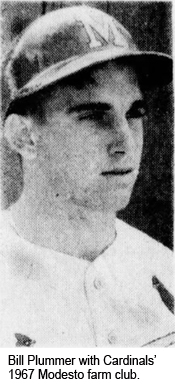
During the 10 years he was a catcher in the big leagues, Bill Plummer may have been the most patient man in baseball. For most of that time, he sat and watched, waiting to get called into a game.

Plummer had hoped to play for the Cardinals, the club that signed him to his first professional contract, but it didn’t happen. Instead, he was mostly with the Reds, whose starting catcher, Johnny Bench, performed at a level that earned him election to the Baseball Hall of Fame.
Being Bench’s backup kept Plummer on the bench. On the rare times Plummer did get on the field, the team he often did the best against was the Cardinals.

In the genes

Plummer came from a baseball family. His father, also named Bill, was a pitcher in the minor leagues for five seasons in the 1920s. An uncle, Red Baldwin, was a longtime minor-league catcher. Plummer’s father and uncle were teammates on the 1924-25 Seattle Indians.

Playing baseball at Shasta College in Redding, Calif., in April 1965, Plummer caught the attention of the reigning World Series champion Cardinals. Scout Bill Sayles offered him $10,000 and said the club also would finance the remainder of Plummer’s college education. “I came from a small country town (Anderson, Calif.), so I jumped at the offer,” Plummer recalled to the St. Louis Post-Dispatch.

According to the Redding Record Searchlight, “The Cardinals were interested in Plummer because of his hitting, ability as a catcher and rifle arm.”

Plummer, 18, joined the Cardinals’ 1965 Florida Rookie League team in Sarasota managed by George Kissell.

Behind the plate, Plummer looked terrific. He was “reputed to have one of the best arms in the Cardinals organization,” the Modesto Bee reported. Standing at the plate, he looked helpless. With Class A Eugene (Ore.) in 1966, Plummer batted .144 and had more strikeouts (33) than hits (18).

Catching on

Assigned to Class A Modesto in 1967, Plummer was managed by Sparky Anderson. The relationship did not begin well.

“I was using Sonny Ruberto for most of the catching early in the season and Plummer didn’t like it,” Anderson told the Post-Dispatch. “He gave me a mean stare one day as he entered the shower. I told him that stare would only get him back to Eugene if he kept it up. He played better after that.”

Plummer said to the Dayton Daily News, “I was young and had temper problems. I was frustrated and depressed because baseball was my career and I was floundering in the minors. I used to get so depressed I’d hide somewhere, and have a few cocktails where nobody talked baseball.”

Anderson eventually moved Ruberto to the infield and made Plummer the everyday catcher. Though he struggled to make contact (100 strikeouts, 93 hits), his catching skills were impressive. Modesto won a league championship.

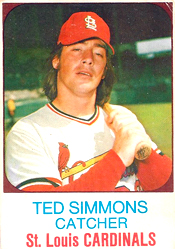
The Cardinals organization had an abundance of talent in 1967. The big-league club became World Series champions that year. One of its core players was the catcher, Tim McCarver. The Cardinals’ first-round pick in the amateur draft that year was McCarver’s heir apparent, Ted Simmons.

Plummer’s hopes of becoming a Cardinal went down the drain when they left him off the 40-man big-league winter roster after the 1967 season. The Cubs claimed him in the November 1967 Rule 5 draft.

Forgotten man

By drafting him, the Cubs were required to keep Plummer, 21, on their big-league roster the entire 1968 season or else offer him back to the Cardinals, but manager Leo Durocher wasn’t inclined to use a catcher who hadn’t played above the Class A level.

As the Chicago Tribune noted, Plummer “appears doomed to little work if Randy Hundley stays healthy behind the plate.”

Hundley caught nearly every game for the 1968 Cubs. Plummer was mostly ignored. He got into two games all season. In his debut, April 19, 1968, at St. Louis, he batted for pitcher Chuck Hartenstein and was struck out by Cardinals rookie reliever Hal Gilson. Boxscore

Plummer’s only other appearance came on May 12 during a Mets rout of the Cubs in the second game of a doubleheader at Wrigley Field. Plummer caught two innings as a replacement for Hundley and was retired on a fly to right. Boxscore

“It was so bad that when we played an exhibition game in the middle of the year against the White Sox they called a catcher from the minors up to catch the game,” Plummer told the Cincinnati Enquirer. “They didn’t even use me then.”

Spending most of his time in the bullpen located along the outfield sideline at Wrigley Field, Plummer was similar to a spectator in the stands. Mike Murphy, a founder of the ballpark’s Bleacher Bums, told McClatchy News Service, “He was like one of us. He sat on a bench, just like we did. He’d wave and smile at us. He hit lots of home runs in batting practice. All the girls noticed him.”

Though popular, the season of inactivity “set me back a couple of years,” Plummer said to the Associated Press.

Reserve duty

Plummer hoped to get drafted by one of the four expansion teams (Expos, Padres, Pilots, Royals) that entered the majors in 1969, or go to any other club needing to play a catcher, but instead the Cubs sent him to the Reds in January 1969 for reliever Ted Abernathy.

Johnny Bench, who in 1968 won National League Rookie of the Year and Gold Glove awards, had a lock on the Reds starting catching job and his backup was the former Cardinals veteran, Pat Corrales.

According to the Redding Record Searchlight, “there was some talk of converting Plummer into a pitcher,” but the Reds reconsidered. 

Plummer spent most of the next three seasons (1969-71) in the minors before emerging as Bench’s backup in 1972. According to the Modesto Bee, Sparky Anderson, who became Reds manager in 1970, said Plummer “already has an arm better than two-thirds of the catchers up here.”

Asked to describe the catching strengths he and Bench possessed, Plummer said to the Cincinnati Enquirer, “John had the excellent release, great foot movement and super hands. He was excellent at receiving throws from the outfield and making tags. I was the kind of guy who stayed in and blocked the plate and crunched people. Those were my skills.”

The Enquirer added, “Plummer was adept defensively. He was a fine handler of pitchers and had a strong arm. He could make all the plays behind the plate.”

Reds pitcher Jack Billingham said to the newspaper, “He couldn’t carry Bench’s bat, but, defensively, you didn’t lose much at all when Plummer was in there.”

In 797 career at-bats for the Reds, Plummer hit .186, but there were some highlights, especially against the Cardinals and one of their former pitchers.

Magic moments

On June 8, 1974, facing Steve Carlton at Veterans Stadium in Philadelphia, Plummer slugged two home runs and Bench, playing third, hit another, but the Phillies prevailed, 6-5. In 16 career plate appearances versus Carlton, Plummer batted .429 and had a .500 on-base mark. Boxscore

Plummer’s most productive game came almost exactly two years later, June 6, 1976, a Sunday afternoon at St. Louis. Filling in for Bench, who was experiencing muscle spasms, Plummer had seven RBI in the Reds’ 13-2 triumph at Busch Memorial Stadium.

Plummer had a RBI-single against Pete Falcone in the second, a three-run triple that knocked Falcone out of the game in the third, and a three-run home run versus Danny Frisella in the sixth.

“I actually felt chills when I circled the bases after hitting that homer,” Plummer told The Cincinnati Post. “Seven RBI. That’s almost a full season’s work for me.”

Plummer’s home run would have been a grand slam if George Foster hadn’t been picked off second on the previous play with the bases loaded.

As for Plummer’s bases-clearing triple, it came about when his liner took a high hop on the AstroTurf, went over the head of right fielder Willie Crawford and rolled to the wall. It was Plummer’s only big-league triple. Boxscore

A week later, playing the Cardinals at Cincinnati, Plummer had three hits, a walk, two RBI and scored twice, but the Cardinals won, 12-9. Two of Plummer’s hits _ a single and a home run _ came against Bob Forsch. Boxscore

Plummer had three three-hit games in the majors and two of those were against the Cardinals.

Of Plummer’s 19 RBI for the Reds in 1976, 10 came against the Cardinals. For the season, he hit .248 overall but .381 versus St. Louis.

Baseball teacher

During his time with Cincinnati, the Reds played in four World Series but Plummer never appeared in any of those games.

Released by the Reds in 1978, he played a final season with the Mariners.

Plummer managed in the minors for 20 years, primarily in the farm systems of the Mariners, Tigers and Diamondbacks. He also coached in the majors with the Mariners (1982-83 and 1988-91) and Rockies (1993-94).

Plummer got one chance to manage in the majors. That was with the Mariners in 1992. Though the team had future Hall of Famers Edgar Martinez (the American League batting champion that year), Ken Griffey Jr. and Randy Johnson, the 1992 Mariners finished with the worst record in the league (64-98). Plummer was fired and replaced by Lou Piniella.

A grandson of Plummer, Conner Menez, pitched in the majors for the Giants (2019-21) and Cubs (2022).

Read Full Post »

Ted Simmons clobbered the Cubs with his bat, but he also used brains and hustle to beat them.

On May 24, 1974, Simmons outmaneuvered the Cubs, escaping a rundown between third and home to score the run in a 1-0 Cardinals victory.

Hardly swift, the Cardinals’ catcher evaded the Cubs’ fastest player in a race to the plate.

Cubs tormentor

Sonny Siebert of the Cardinals and the Cubs’ Rick Reuschel were locked in a scoreless duel on a Friday afternoon at Chicago’s Wrigley Field when Simmons led off the ninth.

A switch-hitter, Simmons was a frightening sight on either side of the plate to Cubs pitchers. He would hit .466 against the 1974 Cubs, with a .500 on-base percentage and .781 slugging mark. Eleven of his 34 hits versus the 1974 Cubs were for extra bases. Reuschel was a favorite target. For his career, Simmons batted .357 (30 hits) against him and walked 10 times.

Sticking to the script, Simmons smashed a double to right to start the ninth. He moved to third on Bake McBride’s sacrifice bunt. Reuschel gave an intentional pass to Joe Torre (who hit .300 against him). Ken Reitz was due up next, but Cardinals manager Red Schoendienst sent Tim McCarver to bat for him.

McCarver pulled a grounder to the right of Billy Williams, who was moved to first base from the outfield that season.

Simmons broke from third when McCarver made contact, then stopped when Williams fired an accurate throw to rookie catcher Tom Lundstedt.

“I was a dead duck,” Simmons said to United Press International.

Path opens

Lundstedt ran toward Simmons, who turned and retreated toward third. Lundstedt then tossed the ball to third baseman Matt Alexander. “I thought Lundstedt released the ball too soon,” Simmons said to United Press International.

After making the throw, Lundstedt kept advancing until he was almost even with Simmons. Pivoting, Simmons (“exhibiting amazing reflexes,” the Chicago Tribune noted) turned his back to Alexander and could hardly believe his eyes. Home plate was unguarded. “I was somewhat startled,” Simmons said to United Press International, “because (until then) there was no way I was going to score.”

Reuschel, who had left the mound to cover first base when Williams pursued McCarver’s grounder, was standing near the bag, watching the play. Williams was alongside him.

What they saw was Simmons rush past Lundstedt and rumble toward home, his batting helmet off and long hair flowing, as Alexander chased after him. “It sounded like a fire behind me,” Simmons said to United Press International.

Normally, a race between Alexander and Simmons would be no contest, but “he had too big a head start,” Alexander told the Chicago Tribune.

Though Alexander (described by the Tribune as “the fastest of the Cubs”) was gaining on him, Simmons streaked across the plate before his pursuer could apply a tag, giving the Cardinals a 1-0 lead.

Arriving too late were Reuschel and Williams, whom the Tribune described as “somewhat confused.”

Torre and McCarver advanced to third and second on the play, but Reuschel got out of the inning without allowing anymore scoring. Siebert set down the Cubs in order in the bottom of the ninth, retiring Williams, Jose Cardenal and Rick Monday to complete the shutout. Boxscore

Blame game

Cubs manager Whitey Lockman said Reuschel should have gone from first to home to cover the plate when he saw Simmons in a rundown.

“Any one of a number of players should have covered the plate, but I guess in the final analysis it should have been Reuschel,” Lockman said to United Press International.

Schoendienst told the St. Louis Post-Dispatch he agreed that it was Reuschel’s responsibility to protect the plate. (Reuschel won National League Gold Glove awards when he was with the Pirates in 1985 and 1987.)

Cardinals coach George Kissell saw it differently, telling the Post-Dispatch that Williams should have covered the plate because the play was in front of him. (Two months later, Williams returned to the outfield and rookie Andre Thornton took over at first. The next year, Williams was a designated hitter for the Athletics.)

For his career against the Cubs, Simmons hit .334, including .339 at Wrigley Field.

Read Full Post »

(Updated Aug. 13, 2024)

At a critical point in a game against the Cardinals, Reds manager Birdie Tebbetts determined bold action was required.

With Stan Musial at the plate, Tebbetts yanked the Reds’ shortstop from the game and went with an alignment of four outfielders.

Tebbetts’ surprise move became the talk of baseball. According to The Sporting News, it was “probably the first four-man outfield formation of its kind ever used in the major leagues.”

Long wait

On May 22, 1954, a Saturday night at St. Louis, the Reds led, 4-2, in the bottom of the eighth when Red Schoendienst singled with two outs against Art Fowler, a 31-year-old rookie who used a quick pitch to keep the Cardinals off stride.

The Cincinnati Enquirer described Fowler as “an old head who knows all the tricks and has all the pitches. He has a fine sense of speeds and seldom makes two pitches alike to a batter.”

Fowler spent 10 seasons in the minors before getting his chance with the 1954 Reds. In explaining why it took him so long to reach the majors, he told the Dayton Journal Herald, “For nine years, I had no ambition whatsoever.”

Decision time

After Schoendienst reached first, up next was Musial, who’d singled twice against Fowler in the game. Musial was perhaps the National League’s best and hottest hitter. He batted .333 in April 1954, and did even better the next month. On May 2, Musial slugged five home runs in a doubleheader against the Giants. In the opener of the Reds series, he belted a grand slam versus Frank Smith. Musial would hit .390 in May 1954.

Knowing Musial was the biggest threat to the Reds’ lead, Tebbetts acted to foil him. Tebbetts, 41, was in his first year as a big-league manager, but he had spent 14 seasons as a catcher in the American League, playing for the likes of managers Mickey Cochrane, Joe Cronin, Joe McCarthy and Al Lopez.

When the Reds hired Tebbetts after he had one season as a manager in the minors, Si Burick of the Dayton Daily News described him as “a gambling type” who will “take advantage of every angle and thinks of everything.”

Tebbetts removed shortstop Roy McMillan from the game and replaced him with a fourth outfielder, speedy rookie Nino Escalera.

A month earlier, Escalera and teammate Chuck Harmon made their big-league debuts in back-to-back pinch-hit appearances, integrating the Reds seven years after Jackie Robinson entered the majors. Escalera was a Puerto Rican of African descent and Harmon was an African-American. Boxscore

Plot development

Escalera positioned himself in right-center, joining an outfield of left fielder Jim Greengrass, center fielder Gus Bell and right fielder Wally Post. The shortstop position was vacant.

“Birdie’s defensive formation against Musial was not something he thought up on the spot,” The Cincinnati Post noted. “For three weeks previous, Birdie talked to his infielders, pitchers, catchers and Nino Escalera about plans for devising shifts against certain dangerous hitters to prevent them from wrecking games for the Reds. Musial happened to be the first one against whom a radical shift was employed. When Birdie sprang it, he probably became the first in major-league history to use this exact sort of a switch in the positions of his players.”

Tebbetts told The Cincinnati Post, “By having the three regular outfielders play their normal positions with Escalera protecting right-center field, we attempted to eliminate the possibility of Musial (hitting) a double or triple, which would score Schoendienst and also put Musial in position to score the tying run.”

As Tebbetts noted to the St. Louis Post-Dispatch, “He’d have a hell of a time getting a ball between those four outfielders spaced so evenly apart.”

Also, if Musial lined a ball against the concrete wall in right or right-center, a fourth outfielder likely would retrieve it on the carom before Musial could advance past first, Tebbetts said.

“With only three outfielders playing for us, the ball might rebound for a double or triple,” Tebbetts told The Sporting News. “I figured that if he did line a ball against the wall, our right fielder, or our right-center fielder, or our center fielder could recover the ball quickly enough to keep Stan from getting more than a single.”

In addition, Tebbetts told The Sporting News, “I had our third baseman, Chuck Harmon, stay close to third to protect the foul line and reduce Musial’s chances of hitting a double past third.”

Tebbetts was unconcerned about Musial trying to push a pitch through the vacated shortstop position for a base hit. “If he should single through our unprotected shortstop position, that would be all right,” Tebbetts said to The Sporting News. “We still would not be in as much danger of losing as if he bounced a double or triple off the fence.”

If Musial opted to try for a single through the shortstop hole, Ray Jablonski would bat with the tying run on first, but Tebbetts said he wasn’t worried about that. “Not because I don’t think Jablonski isn’t a good hitter, but because he’s still not Musial,” Tebbetts told the Post-Dispatch.

Swing shift

All of the maneuvering didn’t matter because Musial struck out swinging to end the threat. According to the Post-Dispatch, Musial was trying to belt a pitch onto the pavilion roof in right for a two-run homer that would tie the score.

“He had to,” Tebbetts said to the St. Louis newspaper. “That’s what they pay him $80,000 a year for _ to go for the long hit in a tight spot. Since I couldn’t play a man on the roof, I did the next best thing by adding a fourth outfielder to prevent the only other kind of hit that would have bothered me _ a double that would have put the tying run in scoring position.”

In the ninth, Tebbetts sent Rocky Bridges in to play shortstop and Escalera was taken out of the game. Fowler retired the Cardinals in order to complete the win. Boxscore

Asked about what would happen if the Reds tried the same alignment against him again, Musial smiled and replied to the Post-Dispatch, “We’ll see. Maybe they’re underestimating Jablonski.”

Tebbetts’ tactic brought him national attention. The Cincinnati Post reported “the most talked about play in baseball today is Tebbetts’ four-man outfield.” The Cincinnati Enquirer called it “one of the most surprising defensive moves in the history of the game.”

The next day, May 23, the Cardinals used an exaggerated shift against the Reds’ Gus Bell, moving fielders to the right side, but he crossed them up with a double to left.

During the 1954 season, the Cardinals shifted heavily toward the right side, leaving only one infielder on the third base side, for Bell and the Braves’ Eddie Matthews. They shifted fielders to the other side for the Cubs’ right-handed sluggers, Ralph Kiner and Hank Sauer. All four consistently beat the shifts by hitting opposite-field doubles and singles. For the 1954 season against the Cardinals, Bell hit .320; Mathews, .304; Kiner, .282; and Sauer, .314.

Postscript

Tebbetts tried a four-man outfield against Musial again on Aug. 20, 1954. Trying to slice a single through the vacated shortstop hole, Musial grounded out to third. Boxscore

One of Tebbetts’ favorite ploys was to call for sacrifice bunts with one out. He did that 38 times in 1954 and 14 of those paid off, with the next batter driving in the runner from scoring position with two outs.

Tebbetts went on to manage 11 years in the majors with the Reds, Braves and Indians. In 1956, Bob Burnes of the St. Louis Globe-Democrat rated Tebbetts the best manager in the National League “by several thousand miles.” In the book “We Played the Game,” Art Fowler said, “Birdie was the best manager I ever played for.”

Fowler, whose older brother Jesse pitched for the 1924 Cardinals, had three consecutive double-digit win seasons (1954-56) for the Reds. He became the pitching coach on most of the big-league clubs managed by Billy Martin.

The 1954 season was the only one for Nino Escalera in the majors.

Stan Musial finished the 1954 season with a batting mark of .330, including .344 versus the Reds. He hit .353 for his career against Art Fowler.

Read Full Post »

In late July 1944, Allied troops were on the outskirts of Brest, a strategic seaport town in northwest France that the Germans occupied during World War II and turned into a submarine base. The Allies were determined to drive out the Nazis, and hoped to make the harbor a supply hub.

Among the infantry advancing on Brest was a U.S. Army private, Eddie Kazak, a St. Louis Cardinals infield prospect. In the combat that ensued, Kazak had a bayonet driven through his left arm and had his right elbow crushed during an artillery attack. It took more than a year for him to recover. Discharged in December 1945, doctors warned him against playing baseball again.

Four years later, Kazak was the Cardinals’ rookie third baseman and the starter for the National League in the 1949 All-Star Game.

Dangerous work

A son of Polish immigrants, Edward “Eddie” Tkaczuk was born in Steubenville, Ohio, and raised in Muse, Pa., 20 miles south of Pittsburgh. His father, Joseph Tkaczuk, was a coal miner, working “down deep where the sun and fresh air are withheld by earthen barriers as formidable as prison bars,” Bob Broeg wrote in the St. Louis Post-Dispatch.

After Eddie graduated from high school, he joined his dad as a coal digger. “To blink his way into the daylight and up to the cashier’s cage above ground for $50 checks every two weeks, he had to load 130 or more tons,” Broeg reported. 

One day, a coal car, swinging around a bend too fast, jumped a rail, overturned and pinned Eddie against a tunnel wall, cracking several ribs.

When he recovered, Eddie, 19, resumed playing amateur baseball, including on Sundays for the coal mine team. He got an offer to turn pro with the Valdosta (Ga.) Trojans, a Class D minor-league club with no big-league affiliation.

Eddie wanted to sign but sought approval from his father because it meant giving up the steadier income he shared with the family from mining. “Papa Tkaczuk was eager for his son to have an opportunity to spend his life above ground at an easier task,” Bob Broeg wrote. “The boy was given parental blessing.”

Purple heart

A second baseman who hit for average, Eddie played for Valdosta in 1940 and impressed Joe Cusick, manager of the Cardinals’ Albany (Ga.) farm team. On Cusick’s recommendation, the Cardinals bought Eddie’s contract for $1,000 and brought him into their system. He batted .378 with 221 hits for Albany in 1941.

While with the Houston Buffaloes in 1942, Eddie met Thelma Bee Gregg and they became a couple. After the season, Eddie, 22, enlisted for military duty and went into the Army. That’s how he ended up in France in the summer of 1944.

The Germans fortified their defenses at Brest and the fighting was intense. In hand-to-hand combat with a German soldier, Eddie was knocked to the ground. He rolled over as the attacker rushed forward and thrust a bayonet through Eddie’s left arm, just missing an artery. “I think I shot him then because suddenly I was free,” Eddie said to Bob Broeg.

The wound required 19 stitches and left a huge scar.

Two weeks later, during an advancement, Eddie came under heavy fire. Shell fragments rained all around, striking Eddie and bringing down a structure he was near. He was buried in bricks and his right elbow, the one he used for throwing a baseball, was shattered.

Eddie spent the next year and a half in military hospitals. Doctors wanted to amputate the arm but he was against it. “For nearly a year of that time, his right arm was shaped like a capital ‘L’ and he couldn’t move the first three fingers of his right hand,” Broeg reported. “Then there was a delicate operation. Pieces of crushed bone were removed and plastic was used to repair the shattered elbow.”

Movement returned to the fingers, but when he was cleared to return to civilian life, Eddie, 25, had to weigh the advice of doctors against his desire to resume his baseball career. “I was warned to give up baseball because throwing might dislocate the synthetic elbow,” he told the Associated Press. “The doctors also said that, if the elbow should lock, there was nothing they could do about it.”

Eddie thought it over and chose baseball.

Lots of changes

In 1946, Eddie married Thelma Bee Gregg and they settled in her hometown of Austin, Texas. He took an off-season job as a postman, delivering mail. “I like the walking, the exercise,” he told Broeg. He also chose a simplified spelling of his last name, changing Tkaczuk to Kazak. As broadcaster Harry Caray might say, Kazak spelled backwards is still Kazak.

Kazak came to 1946 spring training to play second base in the Cardinals’ system but almost quit. He told the Newspaper Enterprise Association, “I couldn’t throw or swing properly. The pain killed me.”

He did daily exercises to strengthen his right arm and gradually made enough progress to perform. He also changed his batting style to compensate for the damaged arm, moving his hands up the handle and using a choked grip. Broeg described him as a good wrist hitter, “meaning Kazak can delay his swing until the last second and then snap into a pitch, buggy-whipping the ball.”

As the Newspaper Enterprise Association noted, “His powerful wrists make him an extraordinary line drive hitter. He gets the bat around so quickly that he gives the impression of jerking the ball out of the catcher’s glove, pulling it into left field.”

Kazak’s hitting kept him in the game. He made 47 errors at second with Columbus (Ga.) in 1946, but batted .326 with 88 RBI in 93 games for Omaha in 1947.

Promoted to Class AAA Rochester in 1948, Kazak was moved to third base by manager Cedric Durst. “I hate to have to pivot and make those snap throws (at second),” Kazak told the Associated Press. As the Pittsburgh Post-Gazette noted, “The throw from third is longer but it is easier for Eddie to make.”

After hitting .309 with 85 RBI for Rochester in 1948, Kazak, 28, got called up to the big leagues in September and made his debut with the Cardinals. He got six hits, including three doubles, in six games.

Opportunity knocks

After Cardinals third baseman Whitey Kurowski had bone chips removed from his right elbow late in the 1948 season, he came to training camp the following spring and was unable to throw, opening the door for Kazak to make the team.

The 1949 Cardinals began the season with rookie Tommy Glaviano as the third baseman and Kazak as backup. When Glaviano struggled to hit, Kazak became the starter in the fifth game of the season. Kazak hit .385 in April and .359 in May.

On May 5, Cardinals second baseman Red Schoendienst was injured and Kazak replaced him, starting five games at second. It didn’t hurt his hitting. On May 9, he slugged his first big-league home run, a grand slam versus the Dodgers’ Joe Hatten at Brooklyn’s Ebbets Field. Boxscore

Two months later, Kazak was back in Ebbets Field as the National League starting third baseman for the All-Star Game. Kazak was selected ahead of the Giants’ Sid Gordon and the Braves’ Bob Elliott in fan balloting. “It’s the greatest thrill I’ve ever had,” Kazak told The Sporting News.

(The National League all-star catcher was the Phillies’ Andy Seminick, who, like Kazak, grew up in Muse, Pa.)

Kazak went 2-for-2 in the game _ a single against Mel Parnell in the second and a RBI-single in the third versus Virgil Trucks.

He also was involved in a fielding controversy in the first. After scooping up a George Kell grounder, Kazak made a low throw to first baseman Johnny Mize, who dropped the ball. According to umpire Cal Hubbard, Kell would have been out if Mize had held onto the ball. Official scorer Roscoe McGowen charged Kazak with the error, but later reversed his ruling, giving Mize the error instead. Boxscore

Painful slide

Two weeks later, the Cardinals (52-36) were in Brooklyn to play the first-place Dodgers (53-34). Facing Joe Hatten again in the second inning, Kazak drove a ball to deep center. It smacked against the wall and caromed directly to center fielder Duke Snider.

Kazak, not expecting the ball to get to Snider so quickly, initially thought he had a stand-up double. “I realized all of a sudden I had to slide,” he recalled to the Austin American-Statesman. “I was too close to the bag for a normal slide and I plowed right on through the cushion, breaking the strap and separating the bag from the iron pin.”

Kazak writhed in pain and was carried on a stretcher to the clubhouse. “I was scared to death because it hurt way up into my hip,” Kazak told the Austin newspaper. Boxscore

He suffered chipped bones in his right ankle, jamming it where it fits the socket, and was unable to play the remainder of July and all of August.

On Labor Day, Sept. 5, 1949, the Pirates led the Cardinals in the seventh inning at St. Louis when Kazak made a surprise appearance, hobbling to the plate to bat for pitcher Ted Wilks. The holiday crowd responded with a thunderous ovation. In a game for the first time since injuring his ankle, Kazak swung at the first pitch from Bill Werle and whacked it into the bleachers in left for a home run.

“As he limped slowly around the bases, the roar of the crowd increased in appreciation,” The Sporting News reported. Boxscore

Kazak made four more pinch-hit appearances that month. For the season, he batted .304 (including .312 versus the Dodgers) and had an on-base percentage of .362. The Cardinals (96-58) finished a game behind the National League champion Dodgers (97-57). “We’d have won it with Kazak in the lineup all season,” Cardinals manager Eddie Dyer said to the Austin American-Statesman.

In October, Kazak had an ankle operation. He was the 1950 Cardinals’ Opening Day third baseman. He started again the next night, made three errors and didn’t start again until June.

After beginning the 1951 season with the Cardinals, Kazak was demoted to the minors in May. A year later, he was dealt to the Reds. He appeared in 13 games for them and spent the rest of his playing days in the minors.

Read Full Post »

Lou Brock had the legs; Jerry Grote had the arm. What sometimes made the difference in their showdowns was their heads.

During Brock’s prime years with the Cardinals, when he led the National League in stolen bases eight times, one of the most difficult catchers to steal against was Grote, who played for the Mets.

“Grote has been hailed as the best defensive catcher in the game, equal to Johnny Bench and Carlton Fisk in mechanics but better at setting up hitters,” the New York Daily News noted in 1976.

According to the New York Times, Bench remarked, “If the Cincinnati Reds had Grote, I’d be playing third base.”

In 1966, when he led the NL in steals for the first time, Brock told Newsday that Grote “may be the toughest catcher in the league to steal against.”

To counter Grote’s quick release and strong throws, Brock used mind games in a bid to gain the upper hand.

Texas roots

After a year at Trinity University in his hometown of San Antonio, Grote, 20, played his first season of professional baseball in 1963 with the San Antonio Bullets, a Houston Colt .45s farm club. There, he was tutored by player-coach Clint “Scrap Iron” Courtney, the former St. Louis Browns catcher.

Called up to Houston in September 1963, Grote stuck with the big-league club in 1964, but “I caught knuckleballs from Ken Johnson and (Hal) Skinny Brown and I was fortunate to just hang on,” he told Newsday.

Prone to taking big swings, the rookie also struggled at the plate, batting .181 in 1964 and totaling more strikeouts (75) than hits (54). In a game at St. Louis, he struck out four times. Boxscore

After the season, the Mets offered outfielder Joe Christopher and others to Houston for catcher John Bateman. Houston instead proposed sending them Grote, but the Mets said no, according to Dick Young of the New York Daily News.

Grote spent the 1965 season in the minors. Afterward, when the Mets again asked for Bateman, Houston still offered Grote, but this time the Mets said yes. On Oct. 19, 1965, Grote was traded to the Mets for pitcher Tom Parsons and cash.

Transformer man

Though he didn’t hit much, Grote impressed with his catching skills and became the Mets’ starter. “He’s a catcher a team can win with,” Mets coach Whitey Herzog told Newsday in 1966.

A year later, in September 1967, when asked to rate the catcher who was the toughest to steal bases against, Lou Brock replied to the St. Louis Post-Dispatch, “For quickness in getting rid of the ball and accuracy, I have to pick Grote.”

Grote also had a reputation for constantly complaining to umpires about their calls. When Gil Hodges became Mets manager in 1968, he ordered Grote to stop bickering. According to Dick Young in the New York Daily News, Hodges said to Grote, “There is a time to argue. If you think he has blown one, tell him. Then get it over with. You have to be more concerned with the course of a game. You have to think about situations. There’s more to catching than putting down one finger, and here comes the fastball.”

Hodges also worked with Grote to improve his hitting _ and the results were immediate. After batting .195 in 1967, Grote hit .282 in Hodges’ first season as Mets manager in 1968. As Dick Young noted, “He cut down on his swing, and went to the opposite field with the pitch away from him.”

As a result, Grote was the National League starting catcher _ ahead of Johnny Bench, Tim McCarver and Joe Torre _ in the 1968 All-Star Game.

Psychological edge

With Grote catching pitchers such as Tom Seaver, Nolan Ryan and Jerry Koosman, the Mets became World Series champions in 1969. Grote threw out 56 percent (40 of 71) of the runners attempting to steal against him that season, but Brock figured out a way to foil him.

In 1968, when the Cardinals won their second consecutive National League pennant, Brock was successful on 84 percent of his steal attempts but was safe on just three of six tries against the Mets. A year later, Brock was perfect in seven steal tries versus the Mets.

“I used to have trouble stealing when Grote was catching,” Brock told Newsday. “I think he had caught me about six of 10 times. Then one day I passed him after a game and I hollered, ‘Grote!’ He didn’t appear to hear me. So I hollered louder, ‘Grote!’ He still didn’t answer me and I yelled his name a third time louder than the first two. His neck turned three shades of pink and I realized then that he didn’t like to be yelled at. So the next time I got on first in a game against the Mets, I hollered his name and he hollered back at me. Ever since then, I’ve had about 80 percent success stealing when Grote is catching.”

Once Brock saw he could light Grote’s short fuse, he never let up.

“One of the delights of a visit of the Cardinals to Shea Stadium when the Mets were an attraction was Brock’s confrontation with Jerry Grote, who had a gun for a catcher’s arm and a disposition to match,” Newsday’s Steve Jacobson noted. “Brock would take his lead off first base and scream his taunt: ‘Yaaah, Grote! I’m going, Grote!’ The challenge was thrown.”

In 1970, when asked again to rank the toughest catchers to steal against, Brock put Manny Sanguillen and Johnny Bench ahead of Grote. Brock claimed Grote was inching toward the plate to shorten his throws and compensate for diminishing arm strength. “Grote keeps moving in all the time.” Brock told the Post-Dispatch. “The way Grote’s always moving toward the pitcher, I’m surprised he hasn’t been hurt by a backswing.”

The Mets won their second National League pennant in 1973 and contended with the defending champion Athletics before losing in Game 7 of the World Series.

In a testament to how valuable he was to the team, Grote caught every inning of the Mets’ National League Championship Series and World Series games in 1969 and 1973. “He’s the best catcher a pitcher could want to throw to,” Tom Seaver told the New York Times.

Mellow my mind

Grote had a reputation for snapping at reporters and official scorers and for being gruff with teammates. George Vecsey of the New York Times described him as “the resident grump” of the Mets clubhouse. Milton Richman of United Press International wrote, “He was one of those sullen, unsociable citizens who preferred his own private company and wouldn’t hesitate to let you know it.”

Mets first baseman Ed Kranepool told the wire service, “He and I have always gotten along fine, but I know a lot of people sort of felt he was cold and distant.”

Pitcher Jon Matlack said to the New York Times, “I was scared to death that I’d bounce a curveball into the dirt and get him mad. You worried about him more than the hitter. One day I told him: ‘Look, I’ll pitch my game and you catch the ball. OK?’ After that, we got to be friends and roommates, and I began to see the many sides of Jerry Grote.”

In the mid 1970s, Grote joined teammate Del Unser in the daily practice of Transcendental Meditation. “I found it really relaxes me, gets me ready for the game and conserves energy,” Grote said to the New York Daily News.

Matlack told the New York Times, “On the field, he was all aggression. Off the field, he was many men: tender to his family, generous to his friends.”

Though not considered a slugger, Grote twice hit home runs to beat the Cardinals. A two-run shot against Bob Gibson provided the winning runs in a 1974 game. (For his career, Grote batted .139 versus Gibson and struck out 20 times.) Boxscore

In 1976, Grote’s ninth-inning homer against Pete Falcone gave Seaver and the Mets a 5-4 win. Boxscore

After Grote beat former teammate Tug McGraw with a ninth-inning home run at Philadelphia, the reliever told the New York Times, “Grote’s been catching me for 10 years and now he knows my mind better than I do.” Boxscore

The pitcher Grote hit best was Steve Carlton. In 85 plate appearances against the future Hall of Famer, Grote had a .405 on-base percentage.

Traded to the Dodgers, Grote appeared in the World Series with them in 1977 and 1978 as a backup to Steve Yeager. (Yeager told the Dayton Journal Herald, “There are only three real good, all-around catchers in the National League _ Johnny Bench, Jerry Grote and me.”

In 1981, when Grote, 38, played his final big-league season, he produced seven RBI for the Royals in a game against the Mariners. “The older the violin, the sweeter the music,” he told the Associated Press. Boxscore

Read Full Post »

« Newer Posts - Older Posts »