Feeds:
Posts
Comments

Archive for the ‘Hitters’ Category

Determined to find a shortstop with the potential to quickly reach the majors as a starter, the Cardinals got it right when they chose Garry Templeton.

garry_templeton2Two years after he was drafted and taught how to switch-hit, Templeton made his Cardinals debut and became a fixture at shortstop for six seasons in St. Louis.

Prep phenom

In 1974, the Cardinals wanted a shortstop to succeed Mike Tyson, who was better suited to play second base.

Templeton, 18, a senior at Santa Ana Valley High School in California, was the prospect who most excited the Cardinals. A right-handed batter, Templeton hit .437 as a senior and .402 for his high school career.

On June 4, the night before the 1974 draft, Cardinals scout Bob Harrison called Templeton’s high school coach, Hersh Musick, and said, “We’re going to take Garry on the first round if he isn’t grabbed up before we get a chance,” the Santa Ana Register reported.

The Cardinals had reason to be concerned about Templeton’s availability by the time they got to select with the 13th pick in the first round. Shortstops were in high demand. Three of the 12 teams selecting ahead of the Cardinals took shortstops. None, it turned out, developed into as good a player as Templeton.

Shortstops chosen ahead of Templeton: Bill Almon (No. 1 pick), Padres; Mike Miley (No. 10 pick), Angels; and Dennis Sherrill (No. 12 pick), Yankees.

Asked his reaction to being selected, Templeton told the Santa Ana newspaper, “It is what I have been working for since I was 8 years old. It didn’t make any difference to me what club took me, just as long as I get a chance … I just hope I can make it into Busch Stadium quickly.”

Said Musick: “Garry is a fantastic hitter, has tremendous speed, possesses a strong arm, can field with the best and is dedicated. What more could any ballclub ask for?”

Lot to learn

The Cardinals signed Templeton for about $40,000, The Sporting News reported.

Templeton was assigned to the Cardinals’ Gulf Coast League rookie club in Florida. One of his teammates was another Cardinals infield prospect, Scott Boras, who would become a high-profile agent for professional athletes.

In a May 2014 interview with Washingtonian magazine, Boras said one reason he became an agent was because of the Cardinals’ handling of the Templeton signing. “The thing that really got me into this was the unfairness of the draft,” Boras said. “I thought it was wrong for the game. I go back to Garry Templeton. He’s an African-American kid _ no representation _ he walks in and they have all the techniques to sign you. It’s a one-way situation. He did not get his value.”

Because of his speed, the Cardinals worked on teaching Templeton how to hit from both sides of the plate.

“I watched Templeton learn to switch-hit in three weeks,” said Boras. “Three weeks! He was a remarkable athlete.”

Templeton hit .268 for the Gulf Coast League Cardinals and advanced to Class A St. Petersburg, where he struggled, batting .211.

Stick with it

Templeton, 19, opened the 1975 season at St. Petersburg and continued to perform below expectations. Discouraged by his lack of progress, Templeton approached manager Jack Krol. According to Ron Martz, columnist for the St. Petersburg Tmes, the ensuing conversation went like this:

Templeton: “I want to hit just right-handed.”

Krol: “Stick with it (switch-hitting). It’s not like you’re 24 or 25 years old. You’ve got plenty of time to learn.”

“The Redbirds are thirsting for a shortstop who can switch-hit, run well and dazzle in the field,” The Sporting News reported. “That’s why they had Garry Templeton try switch-hitting shortly after landing him out of high school.”

With Krol’s patient prodding, Templeton got his batting average to .264 and was sent to Class AA Arkansas, where he hit .401 in 42 games.

Assured and comfortable, Templeton began the 1976 season at Class AAA Tulsa and produced 142 hits in 106 games, earning a promotion to the Cardinals.

The 20-year-old made his big-league debut on Aug. 9, 1976.

Templeton had 911 hits in 713 games over six seasons for the Cardinals, batting .305 with 138 steals. He twice was named an all-star as a Cardinal and led the National League in triples for three consecutive seasons: 1977 (18), 1978 (13) and 1979 (19). In 1979, Templeton produced a National League-best 211 hits and became the first major-league player to get 100 hits from each side of the plate in one season.

He also committed the most errors among NL shortstops for three seasons in a row: 1978 (40), 1979 (34) and 1980 (29).

After a run-in with manager Whitey Herzog for failing to hustle and for making obscene gestures to Cardinals fans who booed him, Templeton was traded to the Padres after the 1981 season. The deal brought shortstop Ozzie Smith to St. Louis, launching him onto a Hall of Fame career.

Previously: How Garry Templeton made 40 errors in 1978
Read Full Post »

In the span of five months, Mike Shannon transformed from Cardinals reject to World Series standout.

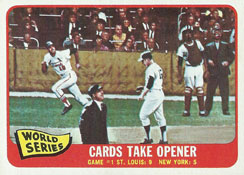
1964_game1Demoted to the minor leagues in May 1964 and shunted by Cardinals consultant Branch Rickey, Shannon recovered and sparked St. Louis to a Game 1 victory over the Yankees in the World Series.

“Show you can hit”

After short stints with the 1962 and 1963 Cardinals, Shannon, 24, began the 1964 season as a reserve outfielder with St. Louis. He got three at-bats and struck out each time.

In early May, general manager Bing Devine informed Shannon he was being sent to Class AAA Jacksonville. According to the Associated Press, Shannon and Devine had this exchange:

Shannon: “What do you want of me?”

Devine: “We’d like to see you hit more. If you show us you can hit, we’ll bring you back.”

Shannon produced 80 hits in 70 games for a Jacksonville club managed by Harry Walker. Good to his word, Devine brought back Shannon to the Cardinals on July 7. Manager Johnny Keane gave him the chance to be the everyday right fielder.

In mid-August, with the Cardinals in fifth place and apparently out of contention, team owner Gussie Busch, acting on the advice of Rickey, fired Devine with six weeks left in the season.

Bob Broeg, longtime St. Louis sports journalist, uncovered an Aug. 10 memo written by Rickey that urged the Cardinals to dump Shannon.

“I would let Shannon go back to Jacksonville for the balance of the (1964) season.” Rickey wrote in the memo, which was published in The Sporting News. “I would even let Shannon go to the draft of Triple-A if major league waivers could be secured. I don’t believe we can win the pennant in 1965 with Shannon as a regular player on the Cardinals club, or (Carl) Warwick or (Charlie) James or (Bob) Uecker or (Jerry) Buchek.”

Shannon, however, remained with the 1964 Cardinals. Keane continued to play him and Shannon produced. He delivered nine home runs and 43 RBI after his promotion from Jacksonville, helping the Cardinals surge and win the National League pennant on the last day of the season.

Denting the scoreboard

In Game 1 of the World Series, Shannon started in right field and batted sixth, between left-handed batters Bill White and Tim McCarver. In his first World Series at-bat, Shannon singled off Whitey Ford and scored.

The Yankees led, 4-2, when Shannon batted with one on and one out in the sixth. A south wind was blowing about 15 mph toward left field. When Ford delivered a high slider, Shannon connected and sent a towering shot toward left. Helped by the wind, the ball cleared the wall and kept rising until it crashed between the letters “B” and “U” in the Budweiser sign atop the 75-foot-high scoreboard at Busch Stadium.

Witnesses estimated the home run traveled more than 450 feet and likely as far as 475 to 500 feet.

“That was about the longest ball I’ve ever seen hit out here,” Keane said.

Said Shannon: “That homer gave me the biggest thrill of my life.”

The two-run home run, described by the Associated Press as a “Ruthian wallop,” tied the score at 4-4 and, according to The Sporting News, “seemed to ignite a spark among the Redbirds.” Video

The Cardinals scored twice more in the inning, taking a 6-4 lead, and won, 9-5. Shannon was 2-for-4 with three runs scored and two RBI. Boxscore

“If I picked the turning point of the game _ the one that got us the chance we needed and inspired the players _ it would have to be Shannon’s home run,” Keane said.

In his book “Whitey and Mickey,” Ford revealed that during the Cardinals’ four-run sixth, “My left hand went numb. It just went dead. No blood was getting down from the shoulder. The artery was blocked.”

Hit or miss

Shannon started in right field in all seven games of the 1964 World Series. He led the Cardinals in runs scored (six) and in strikeouts (nine) and batted .214 with no walks. Spanning two games, Shannon struck out in five consecutive at-bats: twice against Pete Mikkelsen in Game 5 and three times against Jim Bouton in Game 6.

He became the fifth player in World Series history to strike out in five consecutive at-bats. The others: Josh Devore, 1911 Giants; George Mogridge, 1924 Senators; George Pipgras, 1932 Yankees; and Mickey Mantle, 1953 Yankees.

Shannon was the first Cardinals batter to strike out nine times in a World Series since Jim Bottomley did so in 1930. Since then, Vince Coleman struck out 10 times with the Cardinals in the 1987 World Series. Two other Cardinals _ Jack Clark in 1985 and Willie McGee in 1987 _ each struck out nine times in a World Series.

For overcoming his doubters and contributing significantly to the Cardinals’ championship, Shannon was awarded a full World Series winners share: $8,622.19.

Read Full Post »

In a 1964 World Series Cardinals lineup of future Hall of Famer Lou Brock and standouts Ken Boyer, Curt Flood, Dick Groat, Bill White, the hitter who performed with the most sustained excellence was their 22-year-old catcher, Tim McCarver.

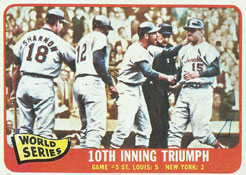
10th_inning_triumphDefeating the Yankees in seven games, the 1964 Cardinals received spectacular performances from pitcher Bob Gibson (two wins, 31 strikeouts in 27 innings), Boyer (two home runs, including a game-winning grand slam), Brock (nine hits, .300 batting average) and relievers Roger Craig and Ron Taylor (a combined 9.2 scoreless innings).

McCarver was every bit as good; perhaps the best of all. He hit a game-winning home run, stole home, led the Cardinals in hits (11) and walks (five) and fielded flawlessly (no errors in 63 innings) while helping a pitching staff navigate a Yankees lineup led by Mickey Mantle and Roger Maris.

Hot hitter

In hitting .478 with five RBI in the 1964 World Series, McCarver compiled a .552 on-base percentage.

The Cardinals have appeared in nine World Series since then and no St. Louis regular has had a higher on-base percentage than McCarver’s. (Among those who came close: Dane Iorg at .529 in 1982, Lance Berkman at .516 in 2011 and Brock, also at .516, in 1968.)

McCarver had the highest batting average by a Cardinal who played in every game of a World Series since Pepper Martin hit .500 in 1931, The Sporting News noted.

Gibson deservedly won the 1964 World Series Most Valuable Player Award, though a case could be made for McCarver, who was runner-up in the voting.

In Game 1, McCarver had a double and a triple against Whitey Ford, who was making his last World Series start in a Hall of Fame career. After his double in the sixth inning, McCarver scored the go-ahead run on a Carl Warwick single, breaking a 4-4 tie and sparking the Cardinals to a 9-5 victory at St. Louis. Boxscore

Swinging away

After the Cardinals and Yankees split the first four games, the score in Game 5 on Oct. 12, 1964, at Yankee Stadium was tied 2-2 after nine innings.

In the 10th, with White on third and Groat on first and one out, McCarver batted against reliever Pete Mikkelsen.

Cardinals manager Johnny Keane told The Sporting News he almost instructed McCarver to bunt.

“I considered a squeeze for Tim, but I was afraid of a pitchout,” Keane said.

With the count at 3-and-2, Mikkelsen threw a fastball and McCarver pulled it over the right-field fence for a three-run home run, lifting the Cardinals to a 5-2 victory. Boxscore and Video

“I was just trying to meet the ball, to get the guy (White) in from third base,” McCarver said. “I hit it good _ it was a waist-high fastball _ but at first I didn’t think it would be a homer. I didn’t think it would carry.

“I was dazed when I saw the ball go out. By the time I got to third, I was laughing out loud. I’m always laughing, even when I’m sad. The way I feel now, I’ll never be sad again.”

McCarver had singled in the two at-bats before hitting the home run. He also singled in his first two at-bats in Game 6, giving him five hits in a row. That was one short of the World Series record of six consecutive hits by Goose Goslin of the 1924 Senators.

Daredevil on base

In the fourth inning of Game 7, McCarver was on third and Mike Shannon on first with one out and the Cardinals ahead, 1-0. With Dal Maxvill at the plate and Mel Stottlemyre pitching, Shannon broke for second on a steal attempt.

Catcher Elston Howard threw to second, trying to nail Shannon, who eluded the tag of Bobby Richardson. McCarver dashed for home, beating Richardson’s return peg to Howard. McCarver had a steal of home. It would be his lone stolen base in 21 World Series games. Video

The Cardinals went on to a 7-5 victory and their first World Series title in 18 years. Boxscore

The next day, McCarver turned 23, celebrating his birthday as a World Series sensation.

Read Full Post »

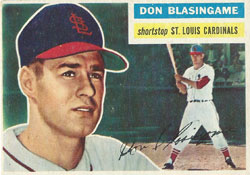
In 1956, Cardinals rookie second baseman Don Blasingame sprayed singles to all fields, ignited the offense with stolen bases and was superb at bunting for base hits.

don_blasingameWith the bases empty, Blasingame bunted for 66 hits in 77 attempts _ an 86 percent success rate _ during his 12-year big-league career, according to research conducted by James Gentile of SB Nation.

Of Blasingame’s 1,366 big-league hits, 1,105 (81 percent) were singles. In five years (1955-59) with the Cardinals, Blasingame produced 663 hits, with 528 (80 percent) being singles.

Blasingame got an opportunity to become the starting second baseman for the Cardinals because of a trade involving a fan favorite. In June 1956, the Cardinals dealt second baseman Red Schoendienst to the Giants, opening the position for Blasingame.

Gashouse Gang connection

In five games for the 1955 Cardinals after his promotion from the minor leagues in late September, Blasingame gave an indication of his electrifying potential. He had six hits and six walks in 23 plate appearances (a .545 on-base percentage).

Cardinals manager Fred Hutchinson opened the 1956 season with Schoendienst at second base and Alex Grammas at shortstop, but after three games Blasingame replaced Grammas.

Journalist Bob Broeg noted Blasingame wore uniform No. 3, the same worn from 1932-37 by Frankie Frisch, the Cardinals’ fiery Gashouse Gang second baseman who was elected to the National Baseball Hall of Fame.

In The Sporting News, Broeg wrote, “Blasingame’s skill at winning fans and followers _ as well as his share of games _ is no accident. For one thing, he’s extremely fast, probably the fleetest man on a St. Louis club that has its greatest collective speed since the famed Swifties of 1942.”

Blasingame said his playing style was inspired by Hall of Famer Ty Cobb. “I never saw him, of course, but I’ve read a lot about him, the way he could put the pressure on the other club and keep it there,” Blasingame said.

Firebrand like Fox

Because of his throwing arm, the Cardinals projected Blasingame as a better fit for second base than for shortstop. One of the players general manager Frank Lane acquired from the Giants for Schoendienst was Alvin Dark. Blasingame replaced Schoendienst at second, with Dark taking over at shortstop.

According to The Sporting News, Lane saw Blasingame “as a firebrand,” much like Nellie Fox, all-star second baseman of the White Sox.

“It was evident he had a chance for future greatness if he could be placed at second,” Lane said of Blasingame.

Wrote Broeg, “Blasingame, taking advantage of his speed and his small stature, has developed into an able leadoff man, a spray hitter and able drag bunter.”

Nicknamed the “Corinth Comet” (he hailed from Corinth, Miss.) and the “Blazer,” Blasingame finished his rookie season with 153 hits in 150 games, with 72 walks and 94 runs scored.

In his four full seasons (1956-59) with the Cardinals, Blasingame ranked in the top 10 in the National League in singles each year. In 1959, Blasingame led the league in singles, with 144, seven ahead of the runner-up, Reds second baseman Johnny Temple.

Blasingame also ranked among the top 10 in the league in stolen bases for three consecutive Cardinals seasons (1957-59).

The Cardinals, however, were last in the league in home runs in 1958 and sixth among eight teams in 1959. Desperate for power, Cardinals general manager Bing Devine traded Blasingame to the Giants for shortstop Daryl Spencer and outfielder Leon Wagner in December 1959.

Read Full Post »

(Updated May 15, 2020)

Three factors combined to make the last home run of Joaquin Andujar’s career both special and unconventional: It was a grand slam, he called the shot and the Cardinals pitcher, a right-hander, hit it left-handed.

joaquin_andujar5On May 15, 1984, Andujar pitched a complete game and slugged the fifth and final home run of his big-league career in the Cardinals’ 9-1 victory over the Braves at St. Louis.

In the eighth inning, the Cardinals led, 5-1, and had Andy Van Slyke on third and Ozzie Smith on second with two outs and catcher Tom Nieto at bat. The Braves opted to walk Nieto intentionally, loading the bases.

As reliever Jeff Dedmon delivered the mandatory four pitches outside the strike zone to Nieto, Andujar, waiting at the on-deck circle, pointed to the right-field wall.

“I told (teammates) George (Hendrick) and Tito (Landrum) that I was going to hit a home run,” Andujar told The Sporting News.

Smith, watching from second base, confirmed to the St. Louis Post-Dispatch he saw Andujar call his shot. “He pointed while he was in the on-deck circle and said he was going to do it,” Smith said. “Can you believe that?”

Said Andujar to the Atlanta Constitution: “Everyone knows that I’m strong.”

Special formula

Leaving the on-deck circle, Andujar strode toward the plate and settled into the left side of the batter’s box.

His first four major-league home runs had been hit right-handed. Andujar hit three homers _ off Bill Lee of the Expos, Steve Rogers of the Expos and Rick Wise of the Padres _ with the Astros. The fourth was hit for the Cardinals, again off the Expos’ Rogers, on April 27, 1984, at Montreal.

A career .127 hitter in his 13 major-league seasons, Andujar used a personal formula to determine whether he would bat right-handed or left-handed. He usually opted for the left side when facing a right-hander (such as Dedmon) with runners in scoring position, according to St. Louis reporter Rick Hummel.

Watching from the dugout, Cardinals manager Whitey Herzog never knew what side of the batter’s box Andujar would choose. “What the hell do I know?” Herzog said to The Sporting News. “I’m only the manager.”

Sultan of Swat

With the bases loaded, “I knew they’d have to pitch to me,” Andujar told the Associated Press.

Andujar dug in and waited for a pitch in the strike zone.

Dedmon delivered.

“It was right down the middle,” said Braves manager Joe Torre.

Andujar uncoiled what the Atlanta Constitution described as “his left-handed going deep swing” and hit the ball to where he had pointed _ over the right-field wall _ for his lone grand slam and his only home run struck left-handed. Boxscore and Audio

“Every day, I hit five or six home runs in batting practice,” Andujar told The Sporting News. “I know I’m not a good hitter. I know I’m a lousy hitter. But … if I make contact, it’s gone.”

Previously: Cardinals pitchers enjoy grand slam streak

Read Full Post »

For George Hendrick, the combination of a nervous pitcher and a hanging changeup was a recipe for hitting heroics.

george_hendrickOn May 12, 1984, Hendrick, the Cardinals’ cleanup hitter, ruined a no-hit bid by the Reds’ Mario Soto, slugging a home run with two outs in the ninth inning.

Though the Reds recovered to win, 2-1, against closer Bruce Sutter, Hendrick’s home run after Soto got within a strike of a no-hitter got the headlines.

Soto, 27, a right-hander, was in his eighth season with the Reds when he faced the Cardinals on a Saturday afternoon at Cincinnati’s Riverfront Stadium. Primarily relying on a fastball, Soto struck out 10 Cardinals in the first six innings and 12 overall.

Backed by sparkling defensive plays from second baseman Ron Oester, who stopped an Ozzie Smith grounder in the seventh and swatted the ball to first baseman Dan Driessen, and from right fielder Dave Parker, who made a diving catch of Tommy Herr’s liner to the gap in right-center in the eighth, Soto held the Cardinals hitless.

Nervous ninth

With a 1-0 lead, Soto faced Ozzie Smith leading off the ninth. Most of the 24,355 in attendance rose and cheered wildly. Instead of inspiration, Soto felt fear.

“I was too nervous,” Soto told the Associated Press. “I just couldn’t stand it out there. I was nervous after I made the last out in the eighth. I’ve never felt that way before.”

Still, Soto had a promising start to the ninth. Ozzie Smith grounded out and Lonnie Smith popped out to second. That brought up Hendrick, who had entered the game with one home run and a .224 batting average.

Soto got two strikes on the right-handed batter. Hendrick then fouled off a couple of pitches, building the drama. Hoping to induce Hendrick to swing and miss, Soto threw his next two pitches high. Hendrick wasn’t tempted, though, and the pitches were called balls, evening the count at 2-and-2.

Looking to catch Hendrick off-guard, Soto delivered a changeup.

“As soon as I threw the pitch, I said, ‘That’s trouble.’ I hung the pitch,” Soto said.

Hendrick swung at the high, inside offering and walloped it over the left-field wall, tying the score at 1-1.

Nowhere to hide

Soto appeared stricken as Hendrick circled the bases.

“I almost died right there,” Soto said. “I don’t think anybody felt worse than I did. I wanted to leave. I almost walked out.”

Instead, he walked the next batter, Andy Van Slyke, before getting Ken Oberkfell on a fly out to center, ending the inning.

Cardinals manager Whitey Herzog sent in Sutter to pitch the bottom half of the ninth, even though it wasn’t a save situation. With one out, Dave Concepcion singled and swiped second. Brad Gulden, the Reds catcher who began the day with a .103 batting average, singled, scoring Concepcion, lifting the Reds to a 2-1 victory and salvaging the win for Soto. Boxscore

In his next start, Soto pitched a three-hitter and got the win against the Cubs, even though he yielded a two-run home run on a changeup to Jody Davis. “I’d say that three or four of the seven homers I’ve given up this season have come on the changeup, but that’s not going to stop me from throwing it,” Soto said to The Sporting News.

Soto, who three times led National League pitchers in most home runs given up in a season, finished 1984 with an 18-7 record while yielding 26 home runs, second-most in the league and one behind Bill Gullickson of the Expos.

In his last of seven seasons with the Cardinals. Hendrick finished 1984 with nine home runs and a .277 batting mark.

Previously: George Hendrick influenced hitting style of John Mabry

Read Full Post »

« Newer Posts - Older Posts »