Feeds:
Posts
Comments

Archive for the ‘Hitters’ Category

(Updated Dec. 20, 2019)

Dick Groat and Roger Maris, players who helped the Cardinals win World Series championships in the 1960s, might never have played for St. Louis if the Pirates and Athletics had completed a proposed trade involving them.

maris_groatIn December 1959, the Pirates were close to dealing Groat to the Athletics for Maris but backed off at the last moment. Spurned, the Athletics turned to the Yankees and traded Maris to New York.

The decisions worked out well for the Pirates and Yankees _ and, eventually, for the Cardinals.

Groat, the Pirates’ shortstop, won the 1960 National League Most Valuable Player Award and helped the Pirates win the pennant and World Series championship, their first since 1925. Maris, the Yankees’ right fielder, won the 1960 American League Most Valuable Player Award and helped the Yankees win their 10th pennant in 12 seasons under manager Casey Stengel.

Two years later, in December 1962, the Pirates traded Groat to the Cardinals and he helped them win the 1964 World Series title, their first in 18 years. In December 1966, Maris was dealt by the Yankees to the Cardinals and he helped them win consecutive pennants and the 1967 World Series championship.

If Groat had been traded for Maris in December 1959, the chances of both landing with the Cardinals likely would have been diminished.

Pirates wanted power

Pirates general manager Joe L. Brown went to the 1959 baseball winter meetings determined to trade for a slugger. He told The Sporting News he made offers for Tigers outfielder Al Kaline, Indians outfielder Rocky Colavito, Senators third baseman Harmon Killebrew and Maris, an outfielder for the Athletics.

“Cleveland turned us down quickly for Colavito, but Detroit, Kansas City and Washington considered our propositions,” Brown said.

The Athletics wanted a shortstop because their starter, Joe DeMaestri, was considering retirement. If the Pirates would deal Groat, the Athletics were willing to send them Maris. Brown and Athletics general manager Parke Carroll agreed to make the trade.

Interviewed for the book “Roger Maris: Baseball’s Reluctant Hero,” Groat recalled, “I heard it was cut-and-dried.”

George Weiss, general manager of the Yankees, told The Sporting News in January 1960 that the Pirates came close to completing the deal for Maris.

The proposed deal was for the Athletics to send Maris, DeMaestri and catcher Hal Smith to the Pirates for Groat, center fielder Bill Virdon, pitcher Ron Kline and catcher Hank Foiles, The Sporting News reported. According to the Pittsburgh Press, the deal was Groat, Kline, outfielder Roman Mejias and pitcher Dick Hall to the Athletics for Maris, Smith and pitcher Ned Garver.

Under the headline “Swap Groat? Very Thought Jars Bucs Fans,” The Sporting News wrote, “The shocker developed when Dick Groat’s name bobbed up in discussions with several American League teams, notably the Senators and Athletics … Word from Kansas City has revealed that Groat’s name also was bandied about when the Pirates sought outfielder Roger Maris.”

Pirates manager balks

According to the Maris biography by co-authors Tom Clavin and Danny Peary, Brown and Pirates manager Danny Murtaugh stepped out of the room during a break in the talks with the Athletics.

Said Groat: “When they got out in the hallway, Danny said, ‘I don’t want to trade Groat.’ And they called it off.”

In a slightly different version, Brown told The Sporting News, “I believe we could have completed the deal for Maris, but the more I thought it over I felt perhaps we were giving up too much.”

“If we had gone through with this trade,” Brown added, “it would have been Page One in Pittsburgh and Kansas City.”

Wrote The Sporting News: “Chances are that thoughts of operating next season without Groat were the factor in casting the negative vote in Brown’s scheme. Brown and his aides probably couldn’t have visualized a Pirates team without the steadiness of Groat and thus backed out on the trade talk.”

On Dec. 11, 1959, the Athletics swapped Maris, DeMaestri and first baseman Kent Hadley to the Yankees for outfielders Hank Bauer and Norm Siebern, pitcher Don Larsen and first baseman Marv Throneberry.

“Had I gone to Kansas City, I’d have been buried for my career,” a grateful Groat told the Maris biographers.

Groat was the 1960 National League batting leader at .325 and paced the Pirates in hits (186).

Maris was the 1960 American League RBI leader with 112. He slugged 39 home runs and topped the league in slugging percentage (.581).

Previously: Cardinals nearly traded Bob Gibson to Senators
Read Full Post »

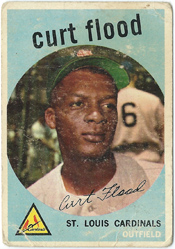
An email exchange among members of the Society for American Baseball Research offered a statistic about Curt Flood that surprised me.

curt_flood5In 1958, his rookie season with the Cardinals, Flood attempted 14 stolen bases and was caught 12 times.

Flood had speed. Even if some of the failed steal attempts were botched hit-and-run plays, he should have been successful more than twice in 14 tries in 1958.

In a March 5, 1958, article headlined “Flood Can Run _ Cards Hoping For Great Jump, Too,” The Sporting News reported Johnny Temple, Flood’s manager in the 1957 winter league in Venezuela, told Cardinals general manager Bing Devine that Flood “is one of the best I’ve seen in baserunning.”

But that speed didn’t transform him into a top base stealer.

Flood, 20, was caught stealing in his first attempt of 1958, was successful on his second and then had just one steal in his last 12 tries. He was unsuccessful in his last eight consecutive steal attempts.

Flood’s two steals in 1958 came against the Pirates and the battery of pitcher Bob Friend and catcher Danny Kravitz on May 24 Boxscore and against the Reds and the battery of pitcher Don Newcombe and catcher Ed Bailey on June 18. Boxscore

Bailey also nailed Flood twice that season (both times with Brooks Lawrence pitching).

Four other catchers also twice threw out Flood attempting to steal in 1958: Joe Pignatano of the Dodgers, John Roseboro of the Dodgers and Carl Sawatski of the Phillies. Don Drysdale was the pitcher who teamed with Roseboro on both plays.

Other catchers who caught Flood trying to steal in 1958: Del Crandall of the Braves, Joe Lonnett and Stan Lopata, both of the Phillies and Sammy Taylor of the Cubs.

Flood never developed into an exceptional base stealer. In 12 seasons with the Cardinals, Flood had 88 steals and was caught 72 times. That’s a success rate of 55 percent.

By comparison, his teammate, Lou Brock, had 888 steals in 1,173 attempts during his 16 Cardinals seasons. That’s a success rate of 75 percent.

In 1963, Flood had a single-season career high of 17 steals for the Cardinals. He was caught 12 times that year.

His most successful single-season rate was when he had 14 steals in 21 attempts for the 1966 Cardinals. That’s a success rate of 66 percent.

Previously: George Crowe: mentor to Curt Flood

Read Full Post »

Mark Ellis nearly lost a leg when injured playing against the Cardinals.

Less than two years later, a healthy Ellis has joined the Cardinals as a reserve infielder and mentor to second baseman Kolten Wong.

mark_ellisEllis, 36, a free-agent second baseman, signed a one-year contract with the Cardinals on Dec. 16, 2013. In 11 big-league seasons with the Athletics, Rockies and Dodgers, Ellis has a .265 batting average and 1,311 hits. He ranks third in fielding percentage among active major-league second basemen at .9907, behind Placido Polanco (.9927) and Dustin Pedroia (.9909).

On May 18, 2012, Ellis was playing second base for the Dodgers against the Cardinals at Los Angeles. In the seventh inning, with the score tied at 4-4, Tyler Greene was the baserunner at first for the Cardinals when Shane Robinson grounded to shortstop.

Dee Gordon fielded the ball and tossed it to Ellis, covering second. Greene slid into Ellis, who landed hard on his lower left leg.

Ellis remained in the game and lined out leading off the bottom of the seventh. When the pain and swelling in his leg increased, Ellis was replaced before the start of the eighth. The Dodgers won, 6-5. Boxscore

Dodgers manager Don Mattingly called the play “clean” and “a good, hard slide,” reported Joe Strauss of the St. Louis Post-Dispatch.

Greene said he wasn’t trying to hurt Ellis. “There’s nothing going on there,” Greene said. “You’re trying to break up the double play. I don’t think he anticipated me being there as soon as I was. The way he came off the bag into the baseline he almost went right in front of it. I think he mistimed it.”

The next day, before the Cardinals played the Dodgers, Ellis told trainer Sue Falsone the leg still was causing pain. After an examination, Falsone and the Dodgers medical staff got Ellis to a hospital.

Doctors determined Ellis needed an emergency fasciotomy. Surgeons cut a six-inch incision into Ellis’ left calf to drain blood and fluid, the Los Angeles Times reported.

Mattingly said he was told by the team’s physician, Dr. Neal ElAttrache, that Ellis might have required amputation of the leg had he not undergone the urgent fasciotomy, MLB.com reported.

“Doc said that if that thing goes another six or seven hours (Ellis) has a chance to lose a leg,” Mattingly said.

Ellis spent five days in the hospital. When the swelling went down, Ellis was diagnosed with a sprained medial collateral ligament, according to the Orange County Register.

On July 4, 2012, Ellis returned to the Dodgers’ lineup and resumed being the everyday second baseman. He played 110 games in 2012 and produced 107 hits. In 910.1 innings at second base that season, Ellis committed only three errors.

Previously: How Cardinals pursued trade for Don Mattingly

Read Full Post »

(Updated Jan. 8, 2014)

Frank Thomas spent his 19-year big-league career in the American League, which is fortunate for the Cardinals, because they were limited to facing him in interleague competition.

frank_thomasIn 12 games against the Cardinals from 1997-2000, the White Sox slugger punished St. Louis pitching. His .372 career batting mark versus the Cardinals (16-for-43) is his highest against any opponent whom he has 50 at-bats against.

Thomas, a first baseman and designated hitter for the White Sox, Athletics and Blue Jays from 1990-2008, was elected to the National Baseball Hall of Fame by the Baseball Writers Association of America on Jan. 8, 2014.

A two-time winner of the American League Most Valuable Player Award, Thomas hit .301 with 521 home runs and 1,704 RBI in his big-league career. He won an American League batting title (with .347 in 1997) and four times topped the league in on-base percentage.

Thomas’ last game against the Cardinals was one of the best of his career. He tied a career-high with six RBI in a 15-7 White Sox victory on July 15, 2000. Boxscore

It was one of only two times Thomas achieved six RBI in a game. He first did it on May 15, 1996, against the Brewers. Boxscore

Thomas got his six RBI against the Cardinals on two swings: a three-run home run in the first inning off Darryl Kile and a three-run double in the seventh off Mike Matthews.

The performance showed how Thomas had emerged as a White Sox leader.

In 1999, Thomas had feuded with White Sox manager Jerry Manuel. The two also got into a shouting match during spring training in 2000, according to the St. Louis Post-Dispatch.

“Manuel essentially challenged Thomas to take an active role in the club, to be a teammate to the young players,” the Post-Dispatch reported.

Thomas rose to that challenge in what was a contentious Cardinals-White Sox series in July 2000. Three Cardinals batters (Fernando Tatis twice and Fernando Vina once) were hit by pitches in the July 14 game against the White Sox. Boxscore

The next day, Tatis and teammate Eduardo Perez were hit by pitches and so, too, were Magglio Ordonez and Jose Valentin of the White Sox. It was after Valentin was plunked that Thomas hit his bases-clearing double, capping his six-RBI performance, and sending a message to his teammates.

“Being the leader has definitely been my role,” Thomas said. “I had to embrace that. It’s been a challenging year for me … Maybe I was down for a while and wasn’t motivated. I said to myself I was going to give my best, day in and day out, and be the best possible teammate I can be.”

Previously: As player, Robin Ventura was tough on Cardinals

Read Full Post »

(Updated Oct. 21, 2018)

As a rookie with the 1995 Cardinals, David Bell hit a magical home run and became friends with John Mabry.

david_bellThe former gave him a special lifetime memory.

The latter helped him reunite with the Cardinals.

Bell and Mabry were Cardinals teammates from 1995-98. Both also played for the Mariners in 1999 and 2000.

Their friendship helped lead to the decision by Bell to join the Cardinals as assistant hitting coach in 2014 when Mabry was the club’s hitting coach. In 2013, Bell was third base coach for the Cubs.

On Nov. 3, 2014, Bell was promoted to bench coach of the Cardinals, replacing Mike Aldrete, who resigned to join the Athletics staff. After the 2017 season, Bell left the Cardinals for a front office position, vice president of player development, with the Giants. On Oct. 21, 2018, Bell was chosen to be manager of the Reds.

Good genes

Bell, whose grandfather, Gus, and father, Buddy, were all-star players in the major leagues, made his big-league debut with the 1995 Indians, appearing in two games before being sent back to the minor leagues. Bell’s best positions were third base and second base, but the 1995 Indians had stellar players at those spots, with Jim Thome at third and Carlos Baerga at second.

On July 27, 1995, the Cardinals traded pitcher Ken Hill to the Indians for Bell, pitcher Rick Heiserman and minor-league catcher Pepe McNeal.

“I like David Bell,” Cardinals general manager Walt Jocketty told the St. Louis Post-Dispatch. “He’s a guy who has a chance to be a very good major league player for a long time.

“If, as a scout, you graded out his tools, you’d say he has a little below average speed, that he was an above average hitter with above average power and above average defensively. But he’s the type of player you know is going to get the job done. He’s been around the game for a while and it shows. He’s a character type of player who’s got a winning attitude.”

Asked about his son’s reaction to the trade, Buddy Bell, bench coach for the 1995 Indians, said, “He’s a little nervous. The first time you get traded, you never know what to expect. But he was getting impatient. He felt that no matter what he did at (Class AAA), it wouldn’t be enough to move him up there (to the Indians).”

Said David Bell: “It’s a nice break for me.”

David Bell was born and raised in Cincinnati. His grandfather Gus Bell had been a standout outfielder for the Reds from 1953-61, four times achieving more than 100 RBI in a season. David’s father Buddy Bell was a premier third baseman. He earned six consecutive Gold Glove awards in the American League from 1979-84. Buddy also played for the Reds from 1985-88.

David was the given name of both Gus Bell and Buddy Bell. David Bell was close to both his grandfather and father. On May 7, 1995, four days after David Bell made his major-league debut with the Indians, Gus Bell died.

Hometown home run

In late August 1995, just before the Cardinals went to Cincinnati for the first time since acquiring Bell, Mike Eisenbath of the Post-Dispatch wrote, “David, Gus and Buddy are so much alike. Quiet. Hard-working. Unassuming. Fundamentally sound afield, solid with a little pop in their bats. Respected. By his very nature, David seemed destined to follow Dad and Grandpa.”

On Aug. 30, 1995, playing in Cincinnati before a Riverfront Stadium crowd that included his grandmother, mother and several other family members and friends, Bell came to bat for the Cardinals in the sixth inning against Reds starter Mark Portugal. The score was tied at 2-2 and Ray Lankford was on first base for St. Louis.

Bell hit a Portugal pitch over the left-center field fence for his first big-league home run.

The ball caromed off a wall behind the fence and bounced back onto the field. Reds outfielder Darren Lewis retrieved the ball and threw it into the outfield seats.

Alerted to the significance of the home run, Lewis got another ball and tossed it into the stands in exchange for the ball Bell hit.

The Cardinals won, 4-3. Bell, 22, told the Post-Dispatch he would give the ball to his mother.

“It’s something I’ll remember,” Bell said. Boxscore

Postseason success

Used mostly as a utility infielder, Bell hit .225 with four home runs in four seasons with the Cardinals. In April 1998, the Cardinals, looking to send Bell to the minor leagues, placed him on waivers. He was claimed by the Indians.

Bell played 12 years (1995-2006) in the major leagues for the Indians, Cardinals, Mariners, Giants, Phillies and Brewers. He had a career .257 batting average, with 1,239 hits in 1,403 games.

In 1999, Bell had 31 doubles, 21 home runs and 78 RBI as the second baseman for the Mariners.

Three years later, Bell was the third baseman for the 2002 National League champion Giants. He had 29 doubles, 20 home runs and 73 RBI that year. In the National League Championship Series against the Cardinals, Bell batted .412 and hit a Game 1 home run off Matt Morris. Bell also hit .304 in the 2002 World Series against the Angels.

For pure drama, though, his first home run as a Cardinal is hard to top.

Previously: Buddy Bell almost joined Ozzie Smith in Cardinals’ infield

Read Full Post »

(Updated March 6, 2022)

David Freese always will belong to an exclusive Cardinals club: starting third basemen for World Series champions.

david_freese3The feat is so rare that only one Cardinals third baseman, Whitey Kurowski, has done it more than once for St. Louis.

The list:

LES BELL, 1926

_ Season performance: Bell, 24, had 189 hits, 33 doubles, 14 triples, 17 home runs, 100 RBI and batted .325 for the 1926 Cardinals. He became the first Cardinals third baseman to achieve 100 RBI in a season. Bell’s 301 total bases in 1926 ranked second in the National League behind teammate Jim Bottomley (305).

_ World Series performance: In Game 6, with the Cardinals facing elimination, Bell had three hits and four RBI in St. Louis’ 10-2 victory at Yankee Stadium. Bell hit a two-run single off Bob Shawkey in the first inning and a two-run home run off 19-game winner Urban Shocker in the Cardinals’ five-run seventh. In seven games, Bell had six RBI and batted .259 (7-for-27). Boxscore

SPARKY ADAMS, 1931

_ Season performance: Just 5 feet 5 and 150 pounds, Adams, 37, led the National League in doubles (46), scored 97 runs, had 16 steals and batted .293 for the 1931 Cardinals. He also led National League third basemen in fielding percentage (.963) and in double plays turned (29).

_ World Series performance: Hobbled by a leg injury, Adams was limited to four at-bats and a single in the seven-game Series versus the Athletics. Andy High, 33, was the primary replacement for Adams. In Game 7, High, batting leadoff, had three of the Cardinals’ five hits and scored twice in a 4-2 St. Louis victory. Boxscore

PEPPER MARTIN, 1934

_ Season performance: Martin, 30, led the National League in stolen bases (23) and batted .289 with 25 doubles and 11 triples for the 1934 Cardinals.

_ World Series performance: He hit .355 (11-for-31) in the seven games against the Tigers and scored eight runs. In Game 7, an 11-0 St. Louis victory, Martin batted leadoff and scored three times. Boxscore

WHITEY KUROWSKI, 1942, 1944, 1946

_ Season performances: Kurowski, 24, hit .254 as a rookie in 1942, .270 with 20 home runs in 1944 and .301 with 89 RBI in 1946.

_ World Series performances: His only World Series home run, a two-run shot off Red Ruffing in the ninth inning, snapped a 2-2 tie and carried the Cardinals to a 4-2 victory in the decisive Game 5 at Yankee Stadium. Boxscore

Kurowski had five hits in six games in the 1944 Series versus the Browns. He scored five runs and had eight hits, including four in the Cardinals’ 12-3 Game 4 triumph, against the Red Sox in 1946. Boxscore

KEN BOYER, 1964

_ Season performance: Boyer, 33, earned the National League Most Valuable Player Award, batting .295 with 30 doubles, 10 triples, 24 home runs and a league-leading 119 RBI for the 1964 Cardinals.

_ World Series performance: His sixth-inning grand slam off Al Downing in Game 4 lifted the Cardinals to a 4-3 victory at Yankee Stadium, tying the Series. He had two home runs and six RBI in the seven games. Boxscore

Ken Boyer’s younger brother, Clete Boyer, was the Yankees’ third baseman in that World Series. Recalling his brother’s grand slam that kept the Yankees from taking a three games-to-one advantage, Clete told Dave Anderson of the New York Times, “When he hit that homer, I loved it. In my heart, I think I was pulling for him that year because it was his first Series.”

MIKE SHANNON, 1967

_ Season performance: In his first season as a third baseman after converting from outfielder, Shannon, 28, produced 77 RBI (second on the team, behind Orlando Cepeda) and committed 29 errors (second-most among National League third basemen. Only Richie Allen of the Phillies had more, with 35).

_ World Series performance: Shannon had five hits in seven games, including a two-run home run off Gary Bell in the Cardinals’ 5-2 victory over the Red Sox in Game 3. Boxscore

KEN OBERKFELL, 1982

_ Season performance: Oberkfell, 26, led National League third basemen in fielding percentage (.972) and ranked third in assists (304). He also hit .289 with 136 hits in 137 games.

_ World Series performance: He had seven hits in seven games versus the Brewers and batted .292.

SCOTT ROLEN, 2006

_ Season performance: Rolen, 31, won his seventh Gold Glove Award and batted .296 with 48 doubles, 22 home runs and 95 RBI.

_ World Series performance: He hit safely in all five games against the Tigers and batted .421 (8-for-19) with three doubles and a Game 1 home run off Justin Verlander. Boxscore

DAVID FREESE, 2011

_ Season performance: Freese, 28, led National League third basemen in double plays turned (23) and batted .297 with 99 hits in 97 games.

_ World Series performance: His two-run, two-out triple off Neftali Feliz in the ninth tied the score at 7-7 and his walkoff home run against Mark Lowe leading off the 11th lifted the Cardinals to an epic 10-9 victory in Game 6. Freese hit .348 (8-for-23) for the Series with seven RBI. Boxscore


Read Full Post »

« Newer Posts - Older Posts »
