Feeds:
Posts
Comments

Archive for the ‘Hitters’ Category

(Updated Oct. 23, 2020)

If general manager Dal Maxvill had been willing to part with pitcher Joe Magrane, Don Mattingly might have been a first baseman for the Cardinals instead of spending his entire playing career with the Yankees.
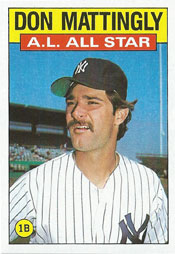
don_mattinglyIn 1988, Mattingly was feuding publicly with Yankees owner George Steinbrenner. That fueled media speculation the Yankees were willing to trade Mattingly, who expressed interest in the Cardinals because of the proximity of St. Louis to his hometown of Evansville, Ind.

“Growing up in Evansville, I was a fan of the St. Louis Cardinals,” Mattingly told the New York Daily News.

The Cardinals admitted interest in pursuing a deal. Media reports suggested the Yankees would want shortstop Ozzie Smith or center fielder Willie McGee in return, but the player New York apparently wanted most was Magrane, who at the time was St. Louis’ prized pitching phenom.

No respect

In August 1988, Mattingly, 27, was a five-time all-star who had earned an American League Most Valuable Player Award, one batting title and three Gold Glove awards, but he became disgruntled with the way he believed Steinbrenner was treating Yankees players.

“The players get no respect around here,” Mattingly said to the Associated Press. “They (management) give you money, that’s it. Not respect. Money is not respect.”

Reports spread quickly that an angry Steinbrenner intended to trade Mattingly. The Cardinals, who had just acquired first baseman Pedro Guerrero from the Dodgers, were willing to move Guerrero to left field and open the job at first base for Mattingly.

“I see where Mattingly wants to go to St. Louis,” Cardinals manager Whitey Herzog said to the St. Louis Post-Dispatch. “That takes care of us. Steinbrenner sure wouldn’t trade him where he wants to go. You know what I mean? He’d say, ‘I’ll show him. I’ll trade him to Seattle.’ ”

Still, baseball writers produced a stream of reports that speculated on a deal between the Yankees and Cardinals.

On Sept. 4, 1988, Rick Hummel of the Post-Dispatch wrote, “The Cardinals have some players in which the Yankees would seem interested. Certainly the Yankees would want a starting pitcher. Joe Magrane probably is unavailable. But Greg Mathews, if he shows he has recovered from elbow surgery, might be.”

Hummel suggested several possible packages to land Mattingly, including Mathews, McGee and catcher Tony Pena, or Mathews and Ozzie Smith.

About a month later, under the Post-Dispatch headline, “Maxvill Says He’ll Pursue Mattingly,” the general manager told Hummel, “I definitely want to talk to them.”

Wizard a Yankee?

Two days later, in a column that rocked Cardinals Nation, Tom Wheatley of the Post-Dispatch opined, “Ozzie Smith must go. And if the Wizard of Oz can be used as bait to land a whopper such as Don Mattingly, all the better.”

Maxvill said he made more inquiries about acquiring Mattingly, but he told Hummel, ‘I don’t think they’re interested in moving him as much as everybody thinks. That’s what I thought before and it’s been reinforced to me.”

Just when it appeared the possibility of a trade had waned, Murray Chass of the New York Times, citing an anonymous American League club executive, reported the Cardinals, Cubs, Padres or Giants were close to making a deal for Mattingly.

Wrote Chass: “If the Cardinals, for example, were really serious about the pursuit of Mattingly, they would have to offer the Yankees Joe Magrane … The Cardinals, however, will not offer Magrane; therefore, no deal.”

Magrane, 24, was the National League earned-run average leader (2.18) in 1988, his second season with St. Louis.

In December 1988, the Post-Dispatch reported why a deal for Mattingly appeared dead: “Maxvill said the New York Yankees never had asked seriously about acquiring (Ozzie) Smith in a Don Mattingly deal. Pitcher Joe Magrane’s name, on the other hand, did come up in discussions with the Yankees. But Maxvill said the Cardinals would be highly reluctant to part with him.”

Magrane achieved a career-high 18 wins for the 1989 Cardinals. Mattingly stayed with the Yankees and completed his 14-season big-league career with them in 1995. He finished with a .307 career batting mark and 2,153 hits.

Read Full Post »

(Updated April 30, 2020)

Stan Musial had such respect for the arm of Andy Pafko he included the National League veteran as part of the best-throwing outfield he’d ever seen.

andy_pafkoBecause he didn’t use that arm, Pafko committed a blunder that literally handed the Cardinals a comeback victory against the Cubs.

Wild ninth

Pafko was in center field for a Saturday afternoon game, April 30, 1949, against the Cardinals at Chicago’s Wrigley Field.

Behind the pitching of starter Bob Rush, who threw what the St. Louis Post-Dispatch described as a “crackling fastball and corner-cutting curve,” the Cubs entered the ninth inning with a 3-1 lead.

With Enos Slaughter on second base and two outs, Rush was on the verge of a victory until Eddie Kazak hit a pitch off his fists and looped a single to short left, scoring Slaughter and narrowing the Cubs’ lead to 3-2. Chuck Diering ran for Kazak and Rocky Nelson, a rookie first baseman, stepped to the plate for St. Louis.

With Pafko shaded toward right for the left-handed batter, Nelson lined the ball to left-center.

“Even though the ball was slicing away from him in a deep part of the park, his quick start and fleet legs enabled him to gain on the drive,” the Post-Dispatch reported. “Pafko lunged to his right, his gloved hand thrust outward in a bid for a backhanded catch.”

Pafko skidded across the grass before he “flung up his hand, clutching the ball, in a gesture of triumph,” the Post-Dispatch noted.

Umpire Al Barlick ruled Pafko trapped the ball, signaling with his hands extended and palms down in a safe call.

Diering and Nelson raced around the basepaths.

Great debate

According to The Sporting News, “Instead of throwing in the ball with his superb arm, Pafko, the ball still lodged in the webbing of his glove, came running in to second base to join the swarm of Cubs who were rushing toward Barlick.”

As Pafko held the ball, Diering scored the tying run and Nelson was waved toward the plate by third-base coach Tony Kauffman.

Pafko, unwilling to believe the no-catch ruling, waited too long before throwing the ball to the plate. The ball hit Nelson in the left shoulder as he was crossing the plate with the winning run.

Cubs fans protested by throwing objects, including cushions, fruit and vegetables, onto the field.

The stunned Cubs were retired in order by closer Ted Wilks in the bottom of the ninth and the Cardinals won, 4-3. Boxscore

The Sporting News summed up the game as probably the first in the history of big-league baseball “decided by what they describe not as an inside-the-park homer but as an in-the-glove homer.”

Two years later, June 1951, Pafko was dealt to the Dodgers, giving Brooklyn an outfield of Pafko in left, Duke Snider in center and Carl Furillo in right.

In his book “Stan Musial: The Man’s Own Story,” Musial said with Pafko, Snider and Furillo “the Dodgers had the best-throwing outfield I ever saw.”

“Andy was a strong hitter, a strong-armed fielder and good defensively,” Musial said. “He was steady, gave you a good day’s work.”

Playing for the Cubs, Dodgers and Braves from 1943-59, Pafko batted .285 with 213 home runs and 1,796 hits. In 258 games against the Cardinals, Pafko hit .273 with 22 homers and 120 RBI.

Read Full Post »

Snapshots from Stan Musial’s last game, Sept. 29, 1963, when the Reds played the Cardinals at St. Louis:

stan_musial29Mass and McMahon

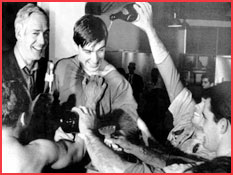
Musial attended Mass that Sunday morning at St. Raphael the Archangel Catholic Church near his St. Louis home. He drove to the ballpark with his friend, actor Horace McMahon, who was visiting from Connecticut, The Sporting News reported. McMahon had received an Emmy nomination for his role as a detective in the TV show “Naked City.” Musial was godfather to McMahon’s son.

Visit with Ducky

After parking his steel blue Cadillac, Musial entered the ballpark at 10:50 a.m. One of the first to greet him in the clubhouse was Joe Medwick, a slugger for the Cardinals from 1932-40. “Fellows,” Musial said to the reporters on scene, “this is the guy I replaced as regular left fielder 22 years ago.”

Salute to Shannon

When Cardinals outfielders Gary Kolb, 23, and Mike Shannon, 24, walked by, Musial asked them to stop and sit with him. With Kolb on one side of the retiring legend and Shannon on the other, Musial said to reporters, “And these are my protégés who’ll replace me next year.”

Sharp tune-up

Entering the field wearing the familiar No. 6 on his jersey, Musial went directly to the batting cage. Bill White stepped aside for Musial, who took his swings against Lloyd Merritt, a St. Louis native who pitched for the Cardinals in 1957. Musial hit Merritt’s last batting-practice toss onto the pavilion roof in right field.

Reds rooters

When he left the cage, Musial was greeted by Reds veterans Joe Nuxhall and Frank Robinson and rookie Pete Rose. Nuxhall and Robinson brought baseballs for Musial to sign. Rose shook hands with Musial and wished him well.

Diamonds are forever

During ceremonies before the game, Ken Boyer, the Cardinals’ captain, presented Musial with a gift from his teammates: a ring with six diamonds shaped in the number 6. In his book “Stan Musial: The Man’s Own Story,” Musial said, “Of all the gifts I’ve been given at one time or another, I believe I cherish most the ring … that was presented by my 1963 teammates. My world championship rings had been stolen from my house several years earlier.”

Feeling the strain

Musial opened the game in left field. In his 22-year Cardinals career, Musial played 929 games in left, the most of the three outfield positions. “My legs were wobbly from emotion and exhaustion as I trotted to the outfield to start my last game,” Musial said.

At-bat interruption

Facing Jim Maloney, a 23-game winner in 1963, Musial struck out on three pitches in the first inning. Musial didn’t swing at the first pitch. Umpire Al Barlick took the ball from catcher Johnny Edwards’ glove and gave it to Musial, who trotted over to a box seat and handed the ball to Sid Keener, director of the National Baseball Hall of Fame. Musial fouled off the next pitch and watched a curve snap in for strike three. Said Musial: “As I returned to the dugout, trainer Bob Bauman growled, ‘You weren’t bearing down up there.’ ”

No no-hitter

Maloney struck out six of the first 10 batters. When Musial came up in the fourth, the Cardinals were hitless. “I crouched low, trying to forget all else except the giant pitcher and the ball he fired so fast,” Musial said. With the count 1-and-1, Musial swung at a fastball, low and inside, and drilled it to the right of Rose at second base for a single.

The final swing

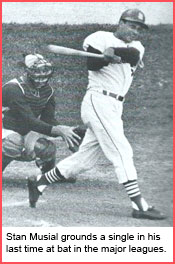
With Curt Flood at second in a scoreless game, Musial batted against Maloney in the sixth. Shadows covered the batting area. On a 2-and-1 pitch, Maloney threw a curve. “I picked up the spin of the ball in time,” Musial said. “My wrists whipped the bat down and in.” Musial grounded a RBI-single to right, his 3,630th hit.

Kolb relieves

Manager Johnny Keane lifted Musial for a pinch-runner, Kolb. It was the ninth time Kolb had been used as a pinch-runner for Musial, 42, in 1963. Kolb scored in the inning on a sacrifice fly by Charlie James, giving St. Louis a 2-0 lead. In the clubhouse, Musial told reporters, “I feel pretty good. Everyone was pulling for a home run, but I’m a singles hitter, so it seemed appropriate that I should go out with a pair of ’em.”

Classy warriors

After being replaced by a pinch-hitter in the eighth, Maloney went to the Cardinals clubhouse to congratulate Musial. When Musial saw Maloney enter, he said aloud, “Here’s a real tough guy. He had me worried.” Said Maloney to reporters: “I was glad to see him go out hitting.”

That’s a winner

The Cardinals won, 3-2, in 14 innings. Boxscore The Cardinals had won by the same score in Musial’s first game on Sept. 17, 1941. Like his finale, Musial had two hits in his debut game.

Holy cow

After saying more farewells, Musial did a post-game interview with Harry Caray for radio station KMOX. Musial told Caray that Warren Spahn was the best pitcher he faced in his career and Willie Mays was the best all-around player.

Celebration

At 7:45 p.m., nine hours after he had arrived, Musial left the ballpark, stopped home briefly and went with his family to a party in his honor at the restaurant he owned with business partner Biggie Garagnani. Among those attending the party were U.S. senator Stuart Symington, Missouri governor John Dalton and St. Louis mayor Raymond Tucker.

The next day, Musial and his wife, Lil, took a flight to New York to attend the World Series. Musial, dressed in a suit and with Joe DiMaggio at his side, threw the ceremonial first pitch on Oct. 2 before Game 1 between the Dodgers and Yankees. From there, the Musials went to Fort Riley, Kan., to get their first look at their first grandchild, Jeff, who was born Sept. 10.

Previously: Stan Musial and the Cardinals’ most iconic moments

Read Full Post »

Like a scene from the movie “The Natural,” Stan Musial achieved one of baseball’s rarest hitting feats with flair.

stan_musial28Shedding the bandages from his ailing wrists, Musial took just five swings in the Cardinals’ game against the Braves at Boston on Sept. 22, 1948.

Each swing produced a hit.

It was Musial’s fourth five-hit game of the season. No major-league player had done that in 26 years. Only two have done it since.

Joining Musial as the only big-league players with four five-hit games in a season: Willie Keeler (1897 Orioles), Ty Cobb (1922 Tigers), Tony Gwynn (1993 Padres) and Ichiro Suzuki (2004 Mariners).

Musial had jammed his left wrist making a diving catch at Brooklyn on Sept. 17, 1948. The next day, he was hit on the right hand, near the wrist, by a pitch.

With his wrists taped, Musial remained in the lineup as the Cardinals pursued the National League-leading Braves.

A win over the Cardinals on Sept. 22 would clinch for the Braves their first pennant in 34 years. The Braves started their ace, left-hander Warren Spahn.

Going for broke

When Musial arrived at the Boston ballpark that day, he noticed the wind was blowing out toward right field, favoring a left-handed batter.

St. Louis writer Bob Broeg approached Musial at the batting cage and said, “A great day for the hitters.”

“Yeah, but I can’t hit like this,” Musial responded.

In his book “Stan Musial: The Man’s Own Story,” Musial said, “I held up the wrists with the flesh-colored tape. Angrily, I ripped it off.”

Without the tape to restrict him, Musial wanted to be able to snap his wrists, no matter how painful, and try to take advantage of the favoring wind and the short carry (319 feet) to the right-field bleachers.

Musial’s first two hits that day came against Spahn.

In the first inning, Musial singled to left. He said he punched the ball in that direction “to minimize wrist strain.”

In the third, Musial lined the ball over the head of left fielder Mike McCormick for a double.

Musial batted in the fourth against right-hander Red Barrett, who had been a teammate on the 1946 Cardinals.

Said Musial: “He tried to fool me with a 2-and-0 changeup, but I saw it coming and said to myself, ‘To hell with the wrists.’ ”

Musial pulled the pitch over the right-field wall for a two-run home run, his 38th of the season.

Swing away

In the sixth, Musial singled off left-hander Clyde Shoun. Musial said he was “entirely aware” Cobb had been the last player to achieve four five-hit games in a season.

“I wanted that fifth hit,” he said.

In the eighth. Musial got his chance against Al Lyons.

The first two pitches from the right-hander missed the strike zone. Musial didn’t want a walk.

“I made up my mind, with the Cardinals far ahead (8-2), that I’d swing at anything close to the plate _ wrists be hanged,” Musial said.

“The next pitch was a bit outside, but I jerked it around … It bounced in the hole between first and second and got through. Saving the sore wrists as much as possible, I had hit safely five times by taking the absolute minimum number of swings _ just five.” Boxscore

All four of Musial’s five-hit games in 1948 came away from home.

“If I could have played the 1948 season on the road, I might have hit .400 and ripped the record book apart,” Musial said.

Instead, Musial batted .376 overall _ .415 on the road and .334 at home.

Here is a look at his other five-hit games in 1948:

_ April 30, 1948, at Cincinnati: Musial hit a home run, two doubles and two singles off four right-handers in the Cardinals’ 13-7 victory over the Reds. The homer, a two-run shot, was off starter Howie Fox. Musial batted .447 (21-for-47) at Crosley Field in 1948. Boxscore

_ May 19, 1948, at Brooklyn: Musial singled twice off right-hander Rex Barney, tripled against right-hander Erv Palica and had a single and double off left-hander Preacher Roe in the Cardinals’ 14-7 victory over the Dodgers. Musial batted .522 (24-for-46) at Ebbets Field in 1948. Boxscore

_ June 22, 1948, at Boston: Musial had five singles, four off right-handed starter Bill Voiselle and another against Shoun that snapped a 2-2 tie in the ninth inning, in the Cardinals’ 5-2 triumph over the Braves. Musial hit .467 (21-for-45) at Braves Field in 1948. Boxscore

In his 22-year big-league career with the Cardinals, Musial had eight five-hit games. In addition to the four in 1948, the others were:

_  July 21, 1943, versus the Giants, at St. Louis. It was his only five-hit game at home.

_ Sept. 19, 1946, at Boston. Former Cardinals ace Mort Cooper started for the Braves.

_ Sept. 3, 1947, at Wrigley Field in Chicago.

_ Sept. 27, 1962, two months before his 42nd birthday, at Candlestick Park in San Francisco. The fifth hit was a single off former teammate Stu Miller.

Previously: How Stan Musial turned in a great comeback year at 41

Read Full Post »

(Updated Feb. 27, 2022)

On weekdays, Ted Simmons was just another University of Michigan student. On weekends, he was a member of the National League champions.

ted_simmons17Simmons, the switch-hitting catcher, made his major-league debut with the Cardinals in September 1968.

After an outstanding season at Class A Modesto of the California League, Simmons was promoted to the Cardinals on Sept. 6, 1968.

A year earlier, the Cardinals selected Simmons in the first round of the amateur draft. Simmons signed for $50,000, played 53 games in the low minors and enrolled at the University of Michigan as a physical education and speech major, beginning classes in the fall of 1967.

In 1968, Simmons was assigned to Modesto, whose manager was Joe Cunningham, a former Cardinals first baseman. In 136 games for Modesto, Simmons had 163 hits, including 30 doubles and 28 home runs, and batted .331 with 117 RBI.

In his Hall of Fame induction speech, Simmons said, “Joe Cunningham, my manager at the A level, was the first major-league hitter to tell me that I would become one myself. I believed him because he had been one himself.”

Simmons was named winner of both the California League’s Most Valuable Player and Rookie of the Year awards.

Exceeding expectations

In the book “The Ted Simmons Story,” author Jim Brosnan, the former Cardinals pitcher, wrote, “Ted had set some goals for that (1968) season … He had outlined those goals to his girlfriend, an art major.”

Simmons’ goals were to hit 20 home runs with 80 RBI and bat .300 for Modesto.

“Simmons’ girl drew up a fancy chart to remind him of what he was trying to achieve and how well he was doing game by game,” Brosnan wrote. “Simmons hung the chart on the wall of his Modesto apartment, kept it up to date each night and eventually exceeded even his best expectation.”

When Simmons was called up to St. Louis, the Cardinals announced he would be with the club only on weekends because he was attending classes at the University of Michigan during the week.

Nine days after his promotion to the big leagues, Simmons, 19, was in the Cardinals’ clubhouse, participating in a wild pennant-clinching celebration at Houston on Sunday, Sept. 15. Simmons, who still hadn’t appeared in a game, and broadcasters Harry Caray and Jack Buck were among those who had their shirts ripped open in the rowdy fun, The Sporting News reported.

“Mike Shannon was telling me how great it was going to be to have a day off in San Francisco so the team could (continue to) celebrate,” Simmons recalled to Cardinals Magazine. “I told him I wasn’t going because I had class the next day. He said, ‘You’re crazy.’ I said, ‘That may be, but that’s what I’m going to do.’ ”

Back to school

When the party ended, Simmons returned to Ann Arbor, Mich., arriving at midnight, and the Cardinals continued their road trip to San Francisco.

In a 1978 interview with Sport magazine, Simmons recalled the atmosphere on the University of Michigan campus, with calls for social change and an end to the war in Vietnam.

“My first reaction was, ‘Don’t bother me with that stuff. I just want to play ball.’ But quickly I looked around and realized what was going on,” Simmons said. “All of a sudden, a new world opened up to me. It was then that I started to develop as a human being and as someone who tried to function in this world rather than someone who just tried to hit the slider.”

Simmons told Cardinals Magazine, “Walking across campus, you would see every kind of protest there was. Civil rights were just going crazy, and you were seeing this everywhere. It forced you to open your eyes and start thinking about what’s happening around you.”

Simmons rejoined the Cardinals in time for their Saturday, Sept. 21, game at Dodger Stadium. Cardinals manager Red Schoendienst put the rookie in the lineup that day as the starting catcher, batting seventh.

In his first big-league at-bat, facing left-hander Claude Osteen, Simmons struck out in the second inning.

He singled to right in the fifth for his first hit. The Dodgers’ first baseman was Ken Boyer, the former Cardinals third baseman. Simmons told Stan McNeal of Cardinals Gameday Magazine, “When I got to first, he turned to me and asked, ‘That your first hit, rookie?’ I said, ‘Yeah.’ He said, ‘I hope it’s the first of 2,500.’ ”

(Simmons would achieve 2,472 hits in his major-league career.)

In his final plate appearance of his debut game, Simmons walked in the eighth.

Catching Larry Jaster and Wayne Granger, Simmons had three putouts and an assist. The Dodgers, who had 11 hits and two walks in a 3-0 victory, didn’t attempt a steal. Boxscore

Simmons played in one more game for the 1968 Cardinals. In their season finale, on Sunday, Sept. 29, at St. Louis, Simmons replaced Tim McCarver in the eighth inning of a rout of the Astros. He grounded out to third in his only at-bat.

After the season, when the Cardinals players met to determine how to dispense with their bonus money for reaching the World Series, Simmons was awarded a share: $250.

Twenty-eight years later, in 1996, Simmons earned his degree from the University of Michigan. He said he wears his graduation ring to honor the achievement and to honor his late mother, Bonnie.

“I was the only one of four children to get a college education because we couldn’t afford for the others to go,” Simmons told Cardinals Gameday Magazine. “It was big for me, but bigger than life for my mom.”


Read Full Post »

(Updated on Sept. 12, 2018)

Helped by three newcomers, dubbed the Polish Falcons, the 1953 Cardinals led the major leagues in doubles with 281.

Eight members of the 1953 Cardinals each produced 20 or more doubles: Stan Musial (53), Red Schoendienst (35), Enos Slaughter (34), Solly Hemus (32), Rip Repulski (25), Steve Bilko (23), Ray Jablonski (23) and Del Rice (22).

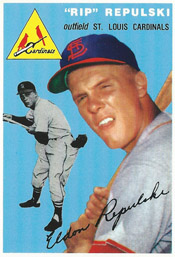
rip_repulski2Bilko, Jablonski and Repulski, all everyday starters for the first time in the big leagues, were called the Polish Falcons because of their Polish-American heritage. (Musial, in the majors since 1941, also was Polish-American.)

Eddie Stanky, manager of the 1953 Cardinals, played the trio in nearly every spring training game and they earned his trust. All three opened the season as starters _ Bilko at first base, Jablonski at third and Repulski in center.

(Stanky also was of Polish descent. He was born Edward Raymond Stankiewicz in Philadelphia.)

Bilko, 24, had appeared in 57 games for St. Louis from 1949-52, but never put in a full season with the Cardinals. Jablonski, 26, and Repulski, 24, both were making their big-league debuts with the 1953 Cardinals. All three had played together in 1952 for Rochester, a Cardinals farm team.

“During the training season, The Brat (Stanky) concentrated on the three Poles from Rochester, playing them daily, and they convinced him the Cardinals would field their strongest right-handed power since, first, Walker Cooper, and then George Kurowski left the Redbird batting order, seven and five years ago, respectively,” The Sporting News reported.

Said Stanky: “A lot of those left-handers who throw lollipops are going to find us an altogether different ballclub.”

In May, The Sporting News followed up with a glowing report on the Cardinals’ hitting: “The pickup in power had been a result largely of the presence of the three Polish Falcons, the newcomers from Rochester … They were hitting just about as had been hoped for.”

Polish power

Bilko, 6 feet 1 and at least 230 pounds, struck out a league-high 125 times in 1953, but he also punished pitchers with his power. On May 28, Bilko struck out five times in a game against the Reds. Boxscore The next day, against the Braves, Bilko doubled twice in the same inning _ one each against Vern Bickford and Ernie Johnson. Boxscore

In July, The Sporting News reported, “Although Repulski had been rested eight days after a slump and though Jablonski could look horrible in the field now and then and Bilko helpless against an occasional pitcher, the Falcons passed the first third of the season in fine style.”

The Falcons, all married with children, were friends as well as teammates. “On the road, they take in movies together (and) eat as a unit,” The Sporting News noted.

As the season wound down, the debut of the Polish Falcons was declared a success. “They’re better hitters than I thought they were and they’ll be even better next year with this season’s experience,” Musial said.

In a Sporting News story headlined “Cards Hit Jackpot with Polish Falcon trio,” Stanky said, “They have not only done as well as expected, but better.”

The final 1953 hitting statistics for the Falcons:

_ Bilko: 21 home runs, 84 RBI, .251 batting average.

_ Jablonski: 21 home runs, 112 RBI, .268 batting average.

_ Repulski: 15 home runs, 66 RBI, .275 batting average.

In voting for the National League Rookie of the Year Award, Jablonski placed third and Repulski tied with Braves outfielder Bill Bruton for fourth. The winner was Dodgers infielder Jim Gilliam, with Cardinals pitcher Harvey Haddix the runner-up.

Read Full Post »

« Newer Posts - Older Posts »