Feeds:
Posts
Comments

Archive for the ‘Hitters’ Category

In 1968, seven years after he broke Babe Ruth’s single-season home run record, Roger Maris hit the last homer of his career. He did it as a Cardinal on the afternoon St. Louis clinched its second consecutive National League pennant.
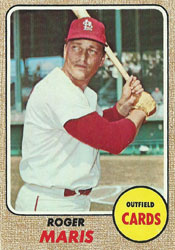
roger_maris2By then, Maris no longer was the slugger who had hit 61 home runs for the 1961 Yankees. Injury-plagued, he was tired of baseball and instead was looking forward to running an Anheuser-Busch distributorship in Florida.

Maris, 34, also was hampered by a right hand weakened by playing most of the 1965 season with a broken hamate bone. Without hand strength, Maris lacked a consistent power stroke, especially on fastballs. His home run production steadily decreased, dropping from 13 in 1966 to nine in 1967.

When Maris homered off a Don Wilson off-speed pitch on Sept. 15, 1968, at the Astrodome, it brought his season total to five. It was Maris’ first home run since July and the last of 275 over 12 big-league seasons. Boxscore

All five of the right fielder’s 1968 home runs were hit on the road. Three came against the Niekro brothers, Joe of the Cubs and Phil of the Braves.

Last hurrah

After Maris hit a two-run, third-inning homer off Phil Niekro on June 10, 1968, he removed himself from the game because of a bruised heel. After the all-star break, Maris improved and hit .359 (14-for-39) in July. On Aug. 5, Maris announced he would retire after the season.

A month later, when the Cardinals played the Mets for the last time that season in New York, where Maris had spent seven tumultuous years with the Yankees, the Shea Stadium scoreboard flashed this message in the third inning:

“To Roger Maris, making his last New York appearance as an active player today, we express our appreciation of an outstanding career and wish you and yours the best.”

Maris, who sat out that game, took quiet delight in hitting a double and two singles the previous night against the Mets in his New York finale. Boxscore

In the first two games of the Cardinals-Astros series at Houston Sept. 13-15, Maris went hitless in nine at-bats. After he popped out to the catcher in the Sept. 14 game, Maris “banged his bat hard against the roof of the dugout,” The Sporting News reported.

In his first at-bat against Wilson on Sept. 15, Maris struck out, extending his hitless skid to 10 in the series.

When he came up against Wilson in the third, with Curt Flood on first and one out, Maris launched a two-run home run, lifting the Cardinals to a 3-2 lead and sparking them to a 7-4 pennant-clinching victory. His last home run also was the only one he hit at the Astrodome.

Comfortable as Cardinal

On Sept. 29, the Cardinals honored Maris in ceremonies before the final game of the regular season at St. Louis’ Busch Stadium II.

After receiving a standing ovation from the crowd of 23,792, Maris said, “I want to thank the Cardinals for two of my most enjoyable years in baseball and I want to thank all the fans for accepting me the way they did.”

Maris, acquired by the Cardinals in a December 1966 trade with the Yankees, hit 14 home runs in his two seasons with St. Louis. Here is a look at those:

1967

1. May 9, solo HR vs. Woodie Fryman, at Pittsburgh.

2. May 21, solo HR vs. Don Cardwell, at New York.

3. June 10, 3-run HR vs. Dodgers’ Bob Miller, at St. Louis.

4. June 11, solo HR vs. Dodgers’ Ron Perranoski, at St. Louis.

5. June 23, solo HR vs. Phillies’ Rick Wise, at St. Louis.

6. July 16, solo HR vs. Mets’ Dick Selma, at St. Louis.

7. July 18, solo HR vs. Jim Maloney, at Cincinnati.

8. July 29, solo HR vs. Cecil Upshaw, at Atlanta.

9. Sept. 7, 2-run HR vs. Cal Koonce, at New York.

NOTE: Maris hit a solo homer off Jim Lonborg of the Red Sox in Game 5 of the 1967 World Series.

1968

1. April 14, 3-run HR vs. Joe Niekro, at Chicago.

2. April 14, solo HR vs. Joe Niekro, at Chicago.

3. June 10, 2-run HR vs. Phil Niekro, at Atlanta.

4. July 26, 2-run HR vs. Steve Blass, at Pittsburgh.

5. Sept. 15, 2-run HR vs. Don Wilson, at Houston.

Previously: Slider was key to 15 wins in a row for Bob Gibson in 1968
Read Full Post »

(Updated Sept. 13, 2025)

On the first swing of his first at-bat as a grandfather, Stan Musial had fans and teammates shouting, “Oh, baby!”

A few hours after his first grandchild was born, Musial, 42, hit the first pitch he saw from Cubs starter Glen Hobbie for a two-run home run atop the pavilion roof in right field at Busch Stadium in St. Louis.

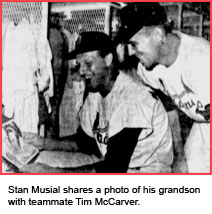
stan_musial_mccarverSharon Musial, wife of Stan’s son, Dick, gave birth to a son, Jeffrey, on Sept. 10, 1963, at Fort Riley Kan., where Dick, 23, was stationed as an Army lieutenant.

Musial and his wife, Lil, had waited until 1:30 a.m. on Sept. 10 before heading to bed. In his book “Stan Musial: The Man’s Own Story,” Musial said, “Lil and I awakened with a start at exactly the same time _ 4:40 a.m. _ and got up, troubled. As she brewed coffee, I paced the floor. Suddenly, the phone rang. Son Dick was calling from Fort Riley, Kan. Sharon had given birth to a boy. When? Just two minutes after Lil and I woke up.”

In a story headlined “Grandpa Musial Shuffles to Plate _ Celebrates by Swatting Homer,” The Sporting News reported, “The Man took a nap later in the morning so he could be better rested for the night game coming up.”

When he arrived at the ballpark, Musial said, he handed out cigars in the clubhouse. The Cardinals were honoring former St. Louis-area major leaguers that night and the old-timers gave Musial a ribbing.

“Hey, Gramp, you belong with us,” retired outfielders Joe Medwick and Terry Moore said to Musial.

With a laugh, Musial replied, “Next year.”

Musial, batting third and playing left field, came up in the first inning with Dick Groat on first and one out. He hit Hobbie’s first pitch for his 11th home run of the season and 474th of his 22-year big-league career. The homer came fewer than 16 hours after the grandchild was born.

“The remarkable Stan Musial set another major league record: Most home runs by a new grandfather, 1,” the Associated Press reported.

Said Musial: “That one was for Jeffrey Stanton Musial.”

In the book “Few and Chosen,” Cardinals catcher Tim McCarver said Musial “probably was the greatest low-ball hitter ever. Even in his 40s, there was no more devastating a low-ball hitter than Stan. Throw him a pitch down in the strike zone, even below the zone, and he would leave his feet.”

Musial’s home run overshadowed the performance that night of Bob Gibson, who hit a three-run homer off Hobbie and pitched a shutout in the Cardinals’ 8-0 victory, their 13th win in 14 games. Boxscore

Gibson and Musial were two of six future Hall of Fame members who played in the game. The Cubs started the other four: right fielder Lou Brock, left fielder Billy Williams, third baseman Ron Santo and first baseman Ernie Banks.


Read Full Post »

(Updated Sept. 7, 2019)

In comparing playing styles and careers, Carlos Beltran and Chris Duncan had little in common. Yet both prospered for the Cardinals as power producers from the No. 2 spot in the batting order.

chris_duncan2In 2013, Beltran, a switch-hitter in his 16th season, had 19 home runs while batting second in 83 games.

Beltran topped the 18 hit by Duncan from the No. 2 spot in 57 games for the 2006 Cardinals. Duncan, a left-handed batter, was a rookie who spent most of the first three months in the minors before sticking with St. Louis in July 2006.

Beltran had 24 home runs overall for the 2013 Cardinals. He hit 19 from the No. 2 spot, three from the No. 3 position and two from the cleanup spot in the batting order.

When batting No. 2, Beltran often benefitted from the high on-base percentage (.392) of leadoff batter Matt Carpenter. With Carpenter on base frequently, opponents often had to pitch to, rather than around, Beltran.

Protected by Pujols

In 2006, Duncan benefitted from batting directly in front of Albert Pujols. Because Pujols was having a sensational season (49 home runs, 137 RBI), opponents preferred taking their chances pitching to Duncan rather than Pujols.

“Duncan has aggressively jumped on the strikes he’s seeing when used as the No. 2 hitter in (manager Tony) La Russa’s lineup, batting before Pujols,” Bernie Miklasz, columnist for the St. Louis Post-Dispatch, wrote in July 2006.

Duncan batted .290 (62-for-214) from the No. 2 spot in 2006. Almost 30 percent of his hits from that spot were home runs. He had an on-base percentage of .368 (20 points higher than his career average) while batting second that year.

On July 24, 2006, Joe Strauss of the Post-Dispatch wrote, “La Russa agrees that Duncan’s recent breakout has provided a new look to the lineup’s No. 2 spot, which has bounced among 10 players since Juan Encarnacion opened the season in the role.”

Mentored by McRae

Duncan credited Cardinals hitting coach Hal McRae for instructing him on “hitting out, not hitting up” and encouraging line drives rather than high drives.

“He’s trying to work with me on staying in the (strike) zone longer and becoming a better overall hitter,” Duncan said. “If you stay through the zone more, the home runs will come.”

Duncan hit .361 from the No. 2 spot in August 2006. He was integral in the Cardinals’ successful push toward the National League Central title.

Wrote Miklasz on Aug. 21, 2006: “Where would the Cardinals be without Chris Duncan? Left field was a crater until he filled it. The No. 2 hole in the lineup was a weak spot until he stepped in.”

Duncan finished the 2006 season with 22 home runs overall. In addition to the 18 from the No. 2 spot, Duncan hit two from the seventh position and one each from the third and ninth spots.

The next year, Duncan hit 21 homers, nine from the No. 2 position. He spent five years in the majors before his career was cut short by injuries.


Read Full Post »

Kolten Wong is a native Hawaiian who bats left-handed and rates as a prized player for the Cardinals.

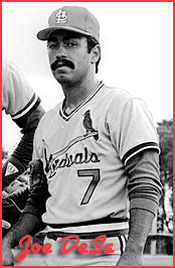
In 1977, the same description fit for Joe DeSa.

joe_desaWong, a second baseman and the 2011 first-round Cardinals draft choice, made his major-league debut with St. Louis on Aug. 16, 2013. He became the first native Hawaiian to play for the Cardinals since DeSa debuted with them in 1980.

DeSa, 17, was selected by St. Louis in the third round of the 1977 draft. A left-handed batter, he had been a high school standout in Honolulu.

DeSa, 5 feet 11, 170 pounds, entered the Cardinals’ minor-league system with a reputation as a line-drive hitter and smooth-fielding first baseman.

That reputation proved accurate.

In 1979, with the Cardinals’ Class AA Arkansas club, DeSa hit .317 with 32 doubles, 13 home runs and 86 RBI. He had 147 hits in 130 games.

In a 1979 interview with Larry Harnly of The State Journal-Register of Springfield, Ill., Cardinals manager Ken Boyer said of DeSa, “He’s about as good a looking hitter as you will see.”

No room at first

Though DeSa was performing to expectations, his path to the majors was blocked by Keith Hernandez, the Cardinals’ regular first baseman and 1979 National League batting champion.

DeSa was promoted to the Cardinals’ Class AAA Springfield (Ill.) team in 1980. The Cardinals’ 1980 media guide described DeSa as “a line-drive hitter with some power.”

He hit .293 with 25 doubles in 123 games for Springfield and was rated the best defensive first baseman in the league.

In September 1980, the Cardinals, far out of contention, called up DeSa.

After going hitless in his first five big-league at-bats, DeSa got hits in the last three games he played for St. Louis. His first was a pinch-hit single against the Expos’ Bill Gullickson on Sept. 30, 1980. Boxscore

In seven games for the 1980 Cardinals, DeSa batted .273 (3-for-11).

Those would be the only games he’d play for St. Louis.

Tony time

DeSa, converting from first base to the outfield, played the next three seasons for Cardinals Class AAA clubs. Then he became a minor-league free agent and signed with the White Sox.

In 1985, DeSa returned to the big leagues, appearing in 28 games for the White Sox, managed by Tony La Russa, and batting .182 (8-for-44) with two home runs.

DeSa spent the 1986 season with Buffalo, the Class AAA club of the White Sox, and was named the Bisons’ most valuable player. He hit 17 home runs and had 83 RBI.

After the season, DeSa became a minor-league free agent again, signed with the Royals and went to Puerto Rico to play winter league ball.

On Dec. 20, 1986, DeSa, 27, was killed in a car accident in Puerto Rico. He left behind a wife, Margarita, and a year-old son, Joe.

White Sox players collected more than $3,000 for his funeral expenses, The Sporting News reported. The Bisons established a memorial fund and raised nearly $7,000. The Class AAA club also established the annual Joe DeSa Most Inspirational Player Award. It still is presented to a Buffalo player near the end of each season.

On Aug. 16, 1987, the White Sox presented DeSa’s wife and son with a check for $120,000 in a ceremony honoring DeSa before a Pacific Coast League game between Portland and Hawaii in Honolulu.

Previously: Warren Spahn and his Cardinals connection

Read Full Post »

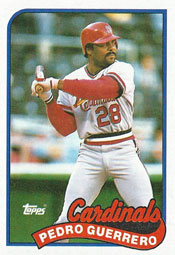
In the summer of 1988, some looked at Pedro Guerrero and saw a first baseman who was a defensive liability, a star diminished by injuries and a perceived lack of desire.

lana_turnerWhitey Herzog looked at Guerrero and saw Lana Turner.

On Aug. 16, 1988, the Cardinals, desperate to bolster a pop-gun attack, traded pitcher John Tudor to the Dodgers for Guerrero.

Because Guerrero had tendinitis in both knees and had spent most of June and July on the disabled list while recovering from a pinched nerve in his neck, some questioned whether the Cardinals had acquired damaged goods.

Responding to Rick Hummel of the St. Louis Post-Dispatch about those concerns, Herzog, the Cardinals’ manager, said of Guerrero, “His lower body isn’t the best in the world. His upper body looks like Charlie Atlas and his lower body probably looks like Lana Turner.”

Fortunately for the Cardinals, Guerrero could hit better than Turner, the long-legged actress of the 1940s and ’50s who played sultry roles in films such as “The Postman Always Rings Twice” and “Peyton Place.”

At the time of the trade, critics, such as columnist Scott Ostler of the Los Angeles Times, saw Guerrero as a one-dimensional player.

pedro_guerreroWrote Ostler: “When Guerrero isn’t hitting home runs and doubles _ which he hasn’t been doing much of lately _ he hurts you more ways than he helps you. Defense, for instance … The most you can say is that Guerrero sometimes makes the routine plays.”

The next Jack Clark

The Cardinals, though, needed a run-producer and they saw Guerrero as one of their best options. “He’s one of the few hitters in baseball who fits our need,” Herzog said. “He’s an impact player, like Jack Clark.”

St. Louis had tried to replace Clark _ who, as a free agent, departed the Cardinals for the Yankees after the 1987 season _ with Bob Horner, but that didn’t work. With the Cardinals out of contention by August 1988, management devised a plan for how to boost the team’s offense.

They decided to pursue during the impending off-season a pair of players who appeared headed toward free agency: Guerrero and Tim Raines of the Expos.

Guerrero was eligible to become a free agent after the 1988 season and the Dodgers expressed little interest in keeping him. Meanwhile, it widely was anticipated an arbitrator would declare Raines a free agent after ruling that team owners had colluded to limit offers to him when he first became eligible for free agency in November 1986.

Two factors caused the Cardinals to change those plans. First, word leaked that Raines was preparing to accept a three-year contract extension from the Expos. Also, there was speculation the Dodgers might trade Guerrero to the Phillies if they could get left-handed pitcher Don Carman in return.

Dodgers want Tudor

Concerned they might miss out on both Guerrero and Raines, the Cardinals pursued trade talks with the Dodgers. Seeking a left-handed starter to replace the injured Fernando Valenzuela, the Dodgers wanted Tudor, who was the National League leader in ERA at 2.29.

Cardinals general manager Dal Maxvill asked Herzog who he would want in return.

Said Herzog: “There’s only one guy I’d consider trading (Tudor) for.”

Guerrero.

The Cardinals agreed to a deal under one condition: Guerrero would have to accept a contract extension and relinquish his right to become a free agent that winter. Guerrero agreed and got an extension for three seasons at $6.2 million, including a $400,000 bonus, the Los Angeles Times reported.

“Basically, it’s a premier pitcher for a premier hitter,” Herzog said to the Associated Press.

Guerrero, 32, batted .298, with a .374 on-base percentage, in 59 games for the 1988 Dodgers.

Maxvill called Guerrero “an everyday player with outstanding run-producing potential.”

Said Cardinals pitcher Bob Forsch: “If he comes over and wants to play, he can help.”

Guerrero told the Associated Press, “I never thought I’d be a Cardinal. But now I’m here and I’m very happy … I always wanted a chance to play for Whitey.”

Tudor, 34, was going from an also-ran to a contender. He was a key starter for the Cardinals’ pennant-winning teams in 1985 and 1987. “I’ve enjoyed my time here,” Tudor said. “The people have been great to me and, as far as I’m concerned, there are no better fans in the world.”

Tudor was 4-3 with a 2.41 ERA in nine starts for the 1988 Dodgers, who won the World Series championship that year. Injured most of 1989, Tudor became a free agent after that season and returned to the Cardinals in 1990.

Guerrero hit .268 with five home runs and 30 RBI in 44 games for the 1988 Cardinals. He was outstanding in 1989, hitting .311 with 42 doubles and 117 RBI for St. Louis. His on-base percentage that season was .391.

As a Cardinal from 1988 to 1992, Guererro produced 505 hits in 500 games, posting a .282 batting average and .348 on-base percentage, with 44 home runs.

Previously: Redbirds ripoff: How Bob Horner replaced Jack Clark

Read Full Post »

Playing in lineups with the likes of Hank Aaron, Eddie Mathews, Roberto Clemente and Willie Stargell, shortstop Johnny Logan was a batter the Cardinals learned to respect.

johnny_loganIn 1957, when Logan was the starting shortstop for the World Series champion Braves, he reached base in seven consecutive plate appearances against the Cardinals over two games at St. Louis.

During a 13-year major-league career (1951-63), Logan batted .282 against the Cardinals and had 209 hits in 209 games versus them. He hit especially well at St. Louis, posting a .309 batting average there in 102 games while playing for the Braves and Pirates.

On May 10, 1957, Logan, batting sixth, went 4-for-4 with a walk and five RBI in the Braves’ 10-5 victory over the Cardinals. In his first two at-bats, Logan produced a two-run double and a RBI-single against starter Sam Jones.

In the fifth, Logan drew a walk from Lloyd Merritt. Logan followed that with a solo home run off Hoyt Wilhelm in the seventh and finished with a RBI-single off Jim Davis in the ninth. Boxscore

The next day, May 11, Logan, in his first two at-bats, had a RBI-double and a single off starter Lindy McDaniel. Logan had reached base in each of his first seven plate appearances of the series.

In the sixth, Willard Schmidt got Logan on a fly out. Logan doubled off Schmidt in the eighth _ his eighth time on base in nine plate appearances since the series began. Boxscore

A month later, the Braves acquired second baseman Red Schoendienst from the Giants. The former Cardinal paired with Logan to form an effective keystone combination.

“The first thing I did when we got Red was give (general manager) John Quinn a big kiss,” Logan told The Milwaukee Journal. “We had the best pitching in the league and a lot of power, but we (had) needed a second baseman.”

Logan remained the Braves’ starting shortstop through 1960 until he was replaced by Roy McMillan. In June 1961, the Braves traded Logan to the Pirates for outfielder Gino Cimoli.

Logan primarily was a utility player and pinch-hitter for Pittsburgh. One of his last big hits came against the Cardinals.

On July 16, 1962, Logan started at third base for the Pirates at Pittsburgh. In the sixth inning, with the Cardinals ahead, 2-1, the Pirates loaded the bases with two outs against starter Ray Sadecki.

Logan, homerless as a Pirate, stepped to the plate and delivered a grand slam, the last home run of his big-league career, leading Pittsburgh to a 5-2 victory. It also was Logan’s first extra-base hit of the season. Boxscore

“I’ve been saving this for a long time to show how much I appreciate the Pirates staying with me,” Logan said to The Sporting News. “I’m 35, all right, but I’m not over the hill yet.”

Previously: Hank Aaron and the home run that wasn’t vs. Cardinals

Read Full Post »

« Newer Posts - Older Posts »