Feeds:
Posts
Comments

Archive for the ‘Hitters’ Category

Lou Brock had the legs; Jerry Grote had the arm. What sometimes made the difference in their showdowns was their heads.

During Brock’s prime years with the Cardinals, when he led the National League in stolen bases eight times, one of the most difficult catchers to steal against was Grote, who played for the Mets.
“Grote has been hailed as the best defensive catcher in the game, equal to Johnny Bench and Carlton Fisk in mechanics but better at setting up hitters,” the New York Daily News noted in 1976.

According to the New York Times, Bench remarked, “If the Cincinnati Reds had Grote, I’d be playing third base.”

In 1966, when he led the NL in steals for the first time, Brock told Newsday that Grote “may be the toughest catcher in the league to steal against.”

To counter Grote’s quick release and strong throws, Brock used mind games in a bid to gain the upper hand.

Texas roots

After a year at Trinity University in his hometown of San Antonio, Grote, 20, played his first season of professional baseball in 1963 with the San Antonio Bullets, a Houston Colt .45s farm club. There, he was tutored by player-coach Clint “Scrap Iron” Courtney, the former St. Louis Browns catcher.

Called up to Houston in September 1963, Grote stuck with the big-league club in 1964, but “I caught knuckleballs from Ken Johnson and (Hal) Skinny Brown and I was fortunate to just hang on,” he told Newsday.

Prone to taking big swings, the rookie also struggled at the plate, batting .181 in 1964 and totaling more strikeouts (75) than hits (54). In a game at St. Louis, he struck out four times. Boxscore

After the season, the Mets offered outfielder Joe Christopher and others to Houston for catcher John Bateman. Houston instead proposed sending them Grote, but the Mets said no, according to Dick Young of the New York Daily News.

Grote spent the 1965 season in the minors. Afterward, when the Mets again asked for Bateman, Houston still offered Grote, but this time the Mets said yes. On Oct. 19, 1965, Grote was traded to the Mets for pitcher Tom Parsons and cash.

Transformer man

Though he didn’t hit much, Grote impressed with his catching skills and became the Mets’ starter. “He’s a catcher a team can win with,” Mets coach Whitey Herzog told Newsday in 1966.

A year later, in September 1967, when asked to rate the catcher who was the toughest to steal bases against, Lou Brock replied to the St. Louis Post-Dispatch, “For quickness in getting rid of the ball and accuracy, I have to pick Grote.”

Grote also had a reputation for constantly complaining to umpires about their calls. When Gil Hodges became Mets manager in 1968, he ordered Grote to stop bickering. According to Dick Young in the New York Daily News, Hodges said to Grote, “There is a time to argue. If you think he has blown one, tell him. Then get it over with. You have to be more concerned with the course of a game. You have to think about situations. There’s more to catching than putting down one finger, and here comes the fastball.”

Hodges also worked with Grote to improve his hitting _ and the results were immediate. After batting .195 in 1967, Grote hit .282 in Hodges’ first season as Mets manager in 1968. As Dick Young noted, “He cut down on his swing, and went to the opposite field with the pitch away from him.”

As a result, Grote was the National League starting catcher _ ahead of Johnny Bench, Tim McCarver and Joe Torre _ in the 1968 All-Star Game.

Psychological edge

With Grote catching pitchers such as Tom Seaver, Nolan Ryan and Jerry Koosman, the Mets became World Series champions in 1969. Grote threw out 56 percent (40 of 71) of the runners attempting to steal against him that season, but Brock figured out a way to foil him.

In 1968, when the Cardinals won their second consecutive National League pennant, Brock was successful on 84 percent of his steal attempts but was safe on just three of six tries against the Mets. A year later, Brock was perfect in seven steal tries versus the Mets.

“I used to have trouble stealing when Grote was catching,” Brock told Newsday. “I think he had caught me about six of 10 times. Then one day I passed him after a game and I hollered, ‘Grote!’ He didn’t appear to hear me. So I hollered louder, ‘Grote!’ He still didn’t answer me and I yelled his name a third time louder than the first two. His neck turned three shades of pink and I realized then that he didn’t like to be yelled at. So the next time I got on first in a game against the Mets, I hollered his name and he hollered back at me. Ever since then, I’ve had about 80 percent success stealing when Grote is catching.”

Once Brock saw he could light Grote’s short fuse, he never let up.

“One of the delights of a visit of the Cardinals to Shea Stadium when the Mets were an attraction was Brock’s confrontation with Jerry Grote, who had a gun for a catcher’s arm and a disposition to match,” Newsday’s Steve Jacobson noted. “Brock would take his lead off first base and scream his taunt: ‘Yaaah, Grote! I’m going, Grote!’ The challenge was thrown.”

In 1970, when asked again to rank the toughest catchers to steal against, Brock put Manny Sanguillen and Johnny Bench ahead of Grote. Brock claimed Grote was inching toward the plate to shorten his throws and compensate for diminishing arm strength. “Grote keeps moving in all the time.” Brock told the Post-Dispatch. “The way Grote’s always moving toward the pitcher, I’m surprised he hasn’t been hurt by a backswing.”

The Mets won their second National League pennant in 1973 and contended with the defending champion Athletics before losing in Game 7 of the World Series.

In a testament to how valuable he was to the team, Grote caught every inning of the Mets’ National League Championship Series and World Series games in 1969 and 1973. “He’s the best catcher a pitcher could want to throw to,” Tom Seaver told the New York Times.

Mellow my mind

Grote had a reputation for snapping at reporters and official scorers and for being gruff with teammates. George Vecsey of the New York Times described him as “the resident grump” of the Mets clubhouse. Milton Richman of United Press International wrote, “He was one of those sullen, unsociable citizens who preferred his own private company and wouldn’t hesitate to let you know it.”

Mets first baseman Ed Kranepool told the wire service, “He and I have always gotten along fine, but I know a lot of people sort of felt he was cold and distant.”

Pitcher Jon Matlack said to the New York Times, “I was scared to death that I’d bounce a curveball into the dirt and get him mad. You worried about him more than the hitter. One day I told him: ‘Look, I’ll pitch my game and you catch the ball. OK?’ After that, we got to be friends and roommates, and I began to see the many sides of Jerry Grote.”

In the mid 1970s, Grote joined teammate Del Unser in the daily practice of Transcendental Meditation. “I found it really relaxes me, gets me ready for the game and conserves energy,” Grote said to the New York Daily News.

Matlack told the New York Times, “On the field, he was all aggression. Off the field, he was many men: tender to his family, generous to his friends.”

Though not considered a slugger, Grote twice hit home runs to beat the Cardinals. A two-run shot against Bob Gibson provided the winning runs in a 1974 game. (For his career, Grote batted .139 versus Gibson and struck out 20 times.) Boxscore

In 1976, Grote’s ninth-inning homer against Pete Falcone gave Seaver and the Mets a 5-4 win. Boxscore

After Grote beat former teammate Tug McGraw with a ninth-inning home run at Philadelphia, the reliever told the New York Times, “Grote’s been catching me for 10 years and now he knows my mind better than I do.” Boxscore

The pitcher Grote hit best was Steve Carlton. In 85 plate appearances against the future Hall of Famer, Grote had a .405 on-base percentage.

Traded to the Dodgers, Grote appeared in the World Series with them in 1977 and 1978 as a backup to Steve Yeager. (Yeager told the Dayton Journal Herald, “There are only three real good, all-around catchers in the National League _ Johnny Bench, Jerry Grote and me.”

In 1981, when Grote, 38, played his final big-league season, he produced seven RBI for the Royals in a game against the Mariners. “The older the violin, the sweeter the music,” he told the Associated Press. Boxscore

Read Full Post »

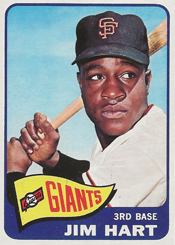
As a rookie with the reigning National League champion Giants in 1963, Jim Ray Hart learned the hard way that facing the Cardinals could be a pain.

On his first day playing in the majors, Hart suffered a fractured left collarbone when struck by a Bob Gibson pitch.

A month later, when he returned to the lineup, Hart was hit in the head by a pitch from the Cardinals’ Curt Simmons, ending his season.

Early times

Hart hailed from Hookerton, a town of about 500 residents, 40 miles from the nearest interstate, in eastern North Carolina. At 15, he began drinking corn whiskey, and his hankering for the homemade hooch led to heavier drinking later on, Hart told the Santa Rosa (Calif.) Press Democrat.

When he was 18, Hart signed with the Giants and entered their farm system. In 1961, he played shortstop but made 42 errors in 77 games. He did less damage at third base and in the outfield, and settled into those spots.

Hart’s hitting was what made him special. A right-handed slugger, he had a .421 on-base percentage and 123 RBI for Fresno in 1961, and a .403 on-base percentage and 107 RBI for Springfield (Massachusetts) in 1962.

After producing 99 hits in 83 games for Tacoma in 1963, Hart, 21, was called up to the Giants in July.

Hard lessons

Hart made his Giants debut in the first game of a July 7 doubleheader against the Cardinals at San Francisco’s Candlestick Park. His first big-league hits in that game were singles against Bobby Shantz and Lew Burdette. Hart also walked twice, scored a run and drove in one, helping the Giants to a 4-3 victory in 15 innings. Boxscore

Between games, Willie Mays reminded Hart that Bob Gibson was starting Game 2. In the book “Stranger to the Game,” Hart recalled, “I only half-listened to what he was saying, figuring it didn’t make much difference.”

Hart faced Gibson for the first time in the second inning. Gibson’s velocity that Sunday afternoon was exceptional. Cardinals catcher Tim McCarver told the St. Louis Post-Dispatch, “Gibson was so fast, I didn’t think my hands would hold out.”

In the book “Sixty Feet, Six Inches,” Gibson said the word on Hart was to pitch him inside because “he was a guy who’d kill you if you got the ball away from him. I was making sure he wasn’t going to kill me.”

In the batter’s box, “I started digging a little hole with my back foot to get a firm stance as I usually did,” Hart said in “Stranger to the Game.” “No sooner did I start digging that hole than I hear Willie (Mays) screaming from the dugout, ‘Nooooo!’ I should have listened to Willie.”

Gibson’s first pitch to Hart was tight. “He had a closed stance, with his left foot nearly on home plate, and was unable to move quickly enough to avoid an inside pitch, which I was obligated to throw as long as he cheated toward the outside corner,” Gibson said in “Stranger to the Game.”

Hart dug in again for the next pitch, a fastball up and in, and it struck him with such force that “there was a loud crack,” he said in “Stranger to the Game.”

Hart collapsed in agony. Taken to a hospital, he was found to have “a clavicle fracture about the size and roundness of a baseball,” the San Francisco Examiner reported. (Sixteen years later, in 1979, Hart told the Oakland Tribune, “I still can feel a small pain in my shoulder sometimes from that.”)

Gibson said his pitch was intended to move Hart away from the plate, not hit him. When informed Hart had a fractured bone, Gibson replied to the Examiner, “I’m sorry, but I don’t know what I can do about it. I know I wasn’t throwing at him.”

Hart told the newspaper, “I don’t think he was trying to throw at me, but I don’t know. He says he was pitching me tight … I wasn’t fooled on the pitch. It was just that it was in back of me … I just didn’t have a chance to avoid that pitch.”

The Giants were irate _ “It’s a terrible thing to have happen to him on his first day,” manager Al Dark told the Examiner. “It’s a disgrace” _ and retaliated. 

When Gibson batted in the third, Juan Marichal “threw a fastball at Gibson’s head that dumped him into the dirt and almost uncoupled him,” the Examiner reported.

Plate umpire Al Barlick rushed toward the mound, shook a finger at Marichal and warned him not to do that again.

“I think Marichal was throwing at me,” Gibson said to the Oakland Tribune. “If I had been throwing at the kid (Hart), it would have been justified. I wasn’t.”

In “Stranger to the Game,” Gibson said, “There was a big difference between throwing at a guy and brushing him back. The brushback pitch is a lot like the spitball in the sense that its effectiveness lies largely in the awareness it places in the batter’s mind.”

Stan Musial, 42, broke up the scoreless duel in the seventh with a two-run home run against Marichal. In the ninth, Gibson laced a two-run single versus reliever Jim Duffalo. Gibson pitched a six-hit shutout and the Cardinals won, 5-0. Boxscore

Down and out

Hart returned to the lineup on Aug. 12. Four nights later, with the Cardinals ahead, 13-0, in the ninth inning at St. Louis, he faced Curt Simmons and was struck on the left temple by an 0-and-2 fastball. “The ball hit the lower part of the helmet and Hart’s head,” the Examiner reported.

Simmons told the newspaper, “He never backed away. He seemed to freeze and stand right there.”

Hart slumped to the ground and was carried on a stretcher to the clubhouse. Cardinals manager Johnny Keane, who as a minor-leaguer suffered a fractured skull when clunked in the head by a pitch, went to the Giants’ clubhouse and stayed until an ambulance came, according to the Oakland Tribune.

Hart was diagnosed with a concussion. At the hospital, he “was speaking coherently” and was given permission to eat and smoke, Cardinals physician Dr. I.C. Middleman told the Examiner. Boxscore

Back in San Francisco, Hart complained of dizziness, headaches and blurred vision. He was examined by a neurosurgeon and shut down for the season.

Take that!

A year later, Hart tagged Gibson and Simmons with home runs.

On Aug. 10, 1964, Hart hit “a majestic home run over the scoreboard in left” at St. Louis against Gibson, the Oakland Tribune reported. “It was estimated the ball traveled around 500 feet. It cleared the scoreboard, which is 60 feet high at that particular spot, 408 feet from the plate.”

The ball landed on Sullivan Avenue. Boxscore

Two weeks later, at Candlestick Park, Hart hammered a two-run homer versus Simmons. Boxscore

Hart finished the 1964 season with 31 home runs. In 1965, he led the Giants in hits (177) and doubles (30) and batted .329 against the Cardinals. Hart made the National League all-star team in 1966, belting 33 homers and leading the Giants in hits (165) again.

The 1967 season may have been Hart’s best. He was the Giants leader in runs scored (98), hits (167), doubles (26), triples (seven), RBI (99), walks (77) and total bases (294). On June 29, 1967, Hart had four RBI on a single and a home run in the opening inning against Gibson.

Troubled times

Too many injuries, too much weight gain and too much drinking contributed to Hart’s decline.

He tore muscles in his right shoulder while making a throw from the outfield and was hit in the head again by a pitch from the Reds’ Wayne Simpson. Struck by pitches 28 times in the majors, Hart was called “Mr. Dent” by his teammates, United Press International reported.

On Oct. 30, 1968, a car driven by Hart struck and killed a woman in Daly City, Calif. Dorothy Selmi, 62, wife of former Daly City mayor Paul Selmi, was hit as she was crossing Mission Street at Como Avenue, the Examiner reported. Hart was questioned by police and released.

In April 1969, Hart crashed against the fence at Candlestick Park while chasing a Pete Rose drive and bashed his right shoulder. He was limited to 236 at-bats that season. “When I hit the ball, the pain goes from a nerve in my back, high on the shoulder, and winds up in my elbow,” Hart told the Examiner.

Hart batted .304 as a pinch-hitter in 1969. A highlight came on July 26 when he slugged a two-run homer in the ninth inning against Joe Hoerner to beat the Cardinals. Boxscore

During his playing days, Hart drank a lot. His preference was I.W. Harper whiskey. “A quart a day,” he said to Bob Padecky of the Santa Rosa Press Democrat. Hart told Padecky that Giants manager Herman Franks offered him money to stop drinking, but he couldn’t.

“I think I could have played longer in the big leagues if I hadn’t done as much drinking,” Hart said to Pat Frizzell of the Oakland Tribune.

In April 1973, the Giants sent Hart to the Yankees and he finished his playing days with them in 1974, totaling 1,052 career hits.

Read Full Post »

In Montreal, where the predominant language is French, he’s “Un Dominicain Coriace.” In his homeland, where Spanish is spoken, it’s “Un Dominicano Duro.”

Regardless of the locale, Joaquin Andjuar, the self-proclaimed “One Tough Dominican” pitcher, could back up his image with astonishing results.

One such instance occurred on April 27, 1984, for the Cardinals against the Expos at Montreal. Brushed back by a pitch, Andujar retaliated by belting the next delivery for a home run that put the Cardinals ahead for good.

Head games

For the Friday afternoon game at Olympic Stadium, the Expos produced a lineup that included Pete Rose in left, three future Hall of Famers _ Gary Carter at catcher, Andre Dawson in right, Tim Raines in center _ and a probable future Hall of Fame manager at first, Terry Francona.

The player who drew Andujar’s attention (and ire), though, was the Expos’ spunky second baseman, Bryan Little. Batting with one out and none on in the first inning, Little bunted for a single. He advanced to third on a hit by Raines and scored on Dawson’s sacrifice fly.

Andujar didn’t think much of a batter who used a puny bunt to get on base against him. When Little came up again in the third, he was sent spinning to the ground by a fastball. “He was throwing at me,” Little told the Montreal Gazette.

Andujar expected the Expos to seek retribution because when he batted in the fifth he wore a helmet with a protective ear flap, an unusual choice for him, when he dug in from the right side of the plate. “I didn’t want to get hit in the ear,” Andujar told the St. Louis Post-Dispatch.

Sure enough, Steve Rogers’ first pitch to him was a fastball near the head. Umpire Bruce Froemming warned Rogers he’d be ejected if he threw another like that.

My way

Andujar had his own system for determining which side of the plate to take as a batter. Though a right-hander, he sometimes batted from the left side, as he did in his first plate appearance of the game against Rogers.

According to the Post-Dispatch, Andujar said he batted from the left side versus right-handers when there were runners in scoring position because, “I make better contact left-handed.” He generally went to the right side when he was bunting or trying to slug a home run.

Usually, Andujar was trying for the long ball.

Cutting loose with savage cuts, he struck out 315 times in 607 career at-bats in the majors. As Rick Hummel of the Post-Dispatch noted, “If one watched Andujar swing his 40-ounce bat as if he were trying to beat a rug, one wondered what would happen if bat ever met ball.”

After throwing the brushback pitch to him, Rogers found out.

On with the show

Andujar powered the next pitch to deep left for a home run, breaking a 2-2 tie.

“He was pumped up and I threw a bad pitch right in his wheelhouse,” Rogers told the Post-Dispatch. “I was trying to throw a slider away and I threw a spinning nothing ball, middle in.”

Milking the moment, “Andujar majestically flipped his bat aside and watched his homer sail over the wall,” Rick Hummel wrote. “Then he literally walked the last 90 feet in his home run trot, pausing to step dramatically on home plate before continuing to the dugout.”

Cardinals infielder Ken Oberkfell told the Montreal Gazette, “We were all stunned … Now we’re going to have to listen to him talk about his power for a week.”

Andujar finished with a complete-game win. (His first 10 decisions versus the Expos all were wins and he ended his career with a 15-6 record against them.) Boxscore

Power supply

A career .127 hitter in his 13 major-league seasons, Andujar had five home runs, including two versus Rogers. With the Astros in 1979, Andujar homered against Rogers at Montreal. Boxscore

In addition to the two home runs off Rogers, Andujar hit another against the Expos _ in 1979, an inside-the-park poke versus Bill Lee at the Astrodome in Houston. Boxscore

Andujar’s first four home runs were right-handed. His last, a grand slam at St. Louis against the Braves’ Jeff Dedmon, was from the left side. Like Babe Ruth, Andujar called that shot.

Read Full Post »

After nine consecutive seasons (1975-83) with Keith Hernandez as their Opening Day first baseman, the Cardinals had a most unlikely successor: Art Howe.

Though he’d been a productive infielder, mostly at second base and third for the Astros, Howe was unemployed at the start of 1984. He sat out the 1983 season because of elbow and ankle surgeries, then became a free agent and, at 37, hoped to show he still could play.

The 1984 White Sox, managed by Tony La Russa, brought him to spring training to compete for a utility role as an unsigned player, but a rookie, Tim Hulett, won the job.

The Cardinals, seeking a pinch-hitter, threw Howe a lifeline, signing him on March 21, 1984. Two weeks later, Howe was in the Cardinals’ Opening Day lineup as the first baseman, batting fifth, against the Dodgers when the player who was supposed to start, David Green, strained his shoulder.

Howe’s longshot leap from unemployment to Opening Day starter was not the first time he defied the odds. He’d been doing that his entire playing career.

Better late than never

Growing up near Pittsburgh, Howe was a Pirates fan. “He used to stand in front of the TV when the Pirates were on and pretend he was playing,” Howe’s father, Art Sr., recalled to the Pittsburgh Post-Gazette. “He’d have his hat on and be holding a bat. He’d tell us that someday he’d play for the Pirates.”

The prediction came true, but the route Howe took hardly was routine.

A standout high school athlete, Howe accepted a football scholarship from the University of Wyoming because he’d also be allowed to play baseball. A quarterback, he hurt his back his freshman year and gave up football but stuck with baseball. Howe injured his thigh his senior season, underwent surgery and got no interest from big-league scouts.

He graduated from Wyoming with a degree in business administration in 1969, returned to Pittsburgh and became a computer programmer for Westinghouse.

“I worked with what we called the wire book,” Howe said to Dave Anderson of the New York Times. “We had to close all the books _ the money in, the money out. If anything was wrong, they’d call you in to stay until it proved. Stay all night if you had to. It was always the system analyst’s fault, never the input.”

Howe also had a disc operation for his ailing back in 1969. The next year, he played semipro baseball in the Greater Pittsburgh Federation League in his spare time. A friend arranged for him to attend a Pirates tryout camp. “I felt like a grandfather coming down there with all those 16- and 17-year-olds,” Howe recalled to the St. Louis Post-Dispatch.

Pirates scout Merrill Hess, who ran the tryout, said to the Pittsburgh Post-Gazette, “He had some impressive credentials. The problem was he was considered too old and too slow to be a major-league prospect.”

The Pirates still offered him a contract. Howe, 24, married, and a father, gave up the $1,500-a-month job at Westinghouse for $500 a month to play for a Class A farm club in Salem, Va., in 1971.

“I just didn’t want to be one of those ex-jocks who sit around with his grandson on his knee and wonder if I could have played major league baseball,” Howe said to the Post-Gazette. “I had the chance to find out, and I wanted to take it.”

No quit

Howe was 27 when he got called up to the Pirates in July 1974 as a backup to third baseman Richie Hebner. Howe’s first two home runs in the majors came against the Phillies’ Steve Carlton and the Mets’ Tom Seaver.

(For his career, Howe batted .389 versus Seaver, with 14 hits, including three home runs. He also hit three homers against Vida Blue. His .618 on-base percentage versus Blue included 15 hits and six walks.)

After the 1975 season, the Pirates sent Howe to the Astros, completing a trade for infielder Tommy Helms.

Howe hoped to replace Doug Rader, who’d been traded to the Padres, as the 1976 Astros third baseman, but Enos Cabell won the job. Two months into the season, Howe, 29, was demoted to the minors. With his career at a crossroads, Howe hit .355 for the Memphis Blues and was brought back to the Astros in September.

For the next six seasons, Howe was an Astros regular at second (1977-79), first (1980) and third (1981-82).

In May 1980, a pitch from the Expos’ Scott Sanderson struck Howe in the face, fracturing his jaw. He was sidelined less than a week, playing with a wired jaw and a special protective helmet. Five months later, in a one-game playoff against the Dodgers to determine the 1980 West Division champion, Howe had four RBI in the Astros’ 7-1 victory.

He batted .296 in 1981 and produced a 23-game hitting streak.

During the winters, Howe managed teams in Puerto Rico, hoping the experience would prepare him for a baseball job after his playing days.

Howe’s playing career was in jeopardy when he had to miss the 1983 season. “I started to get a stabbing pain in my (right) elbow the middle of the 1982 season,” Howe told the Chicago Tribune. “The elbow got weaker and weaker, and I had surgery in December of that year.”

A second elbow operation was performed in May 1983. In both surgeries, nerve transfers were performed, the Tribune reported. Howe also had surgery on his left ankle in 1983 for a problem with the tendon sheath.

Cardinals come calling

Howe attended the 1983 baseball winter meetings, looking for a job. The Astros and Giants made offers, but he chose to try out at spring training with the 1984 White Sox because he figured he could compete for a role as backup to third baseman Vance Law and viewed the club as a title contender.

Though manager Tony La Russa was impressed with what he saw from Howe, telling the Chicago Sun-Times, “He has made every throw he has had to make and showed a willingness to do whatever we ask,” Howe was informed he wouldn’t make the team.

That’s when the Cardinals stepped in. Their scout, Joe Frazier, tracked Howe in spring training and noted he moved and threw well, the Post-Dispatch reported.

The Cardinals had been talking to the Angels about acquiring Ron Jackson, who batted right-handed and played first and third. According to the Post-Dispatch, the Cardinals considered two proposals _ a straight swap of Bob Forsch for Jackson, and a three-way exchange in which St. Louis would send two prospects to the Dodgers for Burt Hooton, then flip Hooton to the Angels for Jackson.

Instead, when Howe became available, the Cardinals took him. Manager Whitey Herzog told the Post-Dispatch that Howe would be the club’s top pinch-hitter versus left-handers. “Howe is going to be better off the bench than (departed free agent) Gene Tenace was,” Cardinals pitcher Dave LaPoint told the newspaper.

When David Green’s ailing right shoulder made him unavailable to start at first base in the season opener against Dodgers left-hander Fernando Valenzuela, Howe replaced him.

Batting between George Hendrick and Willie McGee, Howe was not much of a factor in the Cardinals’ 11-7 victory. He grounded out in the second and hit into a double play in the third. When right-hander Pat Zachry replaced Valenzuela in the fourth, Dane Iorg batted for Howe and delivered a two-run single. Boxscore

Follow the leader

After that, Howe settled into the role Herzog had envisioned for him. He appeared in 89 games for the 1984 Cardinals, making 28 starts at third and three at first, and played all four infield positions.

Howe hit .318 as a pinch-hitter but .216 overall in 1984. A highlight came on July 14 when he had three RBI in the Cardinals’ 7-6 victory versus the Padres. Boxscore

After the season, the Cardinals signed Ron Jackson, who’d been released, but Howe beat him out for the utility infield job at 1985 spring training.

Then, three days before the season opener, the Cardinals acquired reserve infielder Ivan DeJesus from the Phillies. DeJesus could play third as well as short.

Howe, 38 and experiencing back problems, got three at-bats for the 1985 Cardinals, went hitless and was released on April 22. “Art kind of expected it,” Herzog said to the Post-Dispatch. “We hope to get him in our organization, maybe as a minor-league manager.”

Howe told the Pittsburgh Post-Gazette, “The Cardinals have offered me a job as a minor-league hitting instructor.”

A better offer came from Bobby Valentine, who replaced Doug Rader as Rangers manager in May 1985. Howe joined the Rangers’ coaching staff. “He came highly recommended by (his ex-Astros teammates) Nolan Ryan and Phil Garner,” Valentine told the Post-Gazette.

Howe went on to manage the Astros (1989-93), Athletics (1996-2002) and Mets (2003-04). He succeeded La Russa with the Athletics and Valentine with the Mets. With Howe, the Athletics had 102 wins in 2001 and 103 in 2002.

Read Full Post »

If not for a tragic twist of fate, baseball fans today might be recalling Charlie Peete much like they do Lou Brock or Curt Flood as being an integral part of Cardinals championship clubs.

An outfielder and minor league batting champion in the Cardinals system, Peete was on the cusp of becoming a prominent player in the majors.

On Nov. 27, 1956, four months after he made his major-league debut with the Cardinals, Peete, 27, was killed in an airplane crash in Venezuela. His wife and three children died with him.

Author Danny Spewak has written a biography of Peete. It’s a compelling page turner. If you appreciate good writing, original research and a gripping yarn, this book is for you. It’s “Cardinal Dreams: The Legacy of Charlie Peete and a Life Cut Short.” Order a copy on Amazon by clicking on this link.

Here is an email interview I did with Danny Spewak in February 2024:

Q: Congratulations on the book, Danny. As Jack Buck used to say, it’s a winner. What prompted you to choose Charlie Peete as the subject?

A: “Thank you so much, Mark. I’m a St. Louis native, lifelong Cardinals fan and avid reader of your site. Charlie Peete’s name first came on my radar after the tragic death of Oscar Taveras in 2014. The circumstances surrounding the loss of Taveras, a promising young Cardinals outfielder, shared many similarities with Peete’s passing in a 1956 commercial plane crash. More recently, when I began researching topics for my second nonfiction book, I revisited Peete’s story and discovered an incredible legacy worth sharing. Peete is not widely known to Cardinals fans, but he’s one of the franchise’s greatest ‘what-if?’ stories, the kind of player who could have developed into a real star if not for his premature death. More importantly, Peete played a key role in the integration of the Cardinals in the 1950s and, as the book argues, laid the foundation for the groundbreaking World Series teams of the next decade.”

Q: What qualities made Charlie Peete a top prospect?

A: “The Cardinals viewed Peete as a classic five-tool prospect and were thrilled by his performance in the minor leagues after drafting him in late 1954. Bing Devine, who eventually became the Cardinals general manager, singled out Peete as an example of how an organization could build a winning franchise through the draft process. At Class AAA stops in Rochester and Omaha, Peete displayed an impressive ability to hit for both power and average, and his outfield range and throwing arm were among the best in the organization.”

Q: Charlie Peete’s manager at Omaha in 1955 and 1956 was Johnny Keane. Keane later was an influential mentor for Bob Gibson. Was Keane a similar mentor to Peete?

A. “Absolutely. In a questionnaire he completed in 1956, Peete specifically listed Johnny Keane as one of his top influences in baseball and he flourished tremendously under Keane’s tutelage in 1955-56. Keane, who once compared Peete to Hack Wilson, worked closely with him on his batting stance and helped him to greatly improve his power numbers.”

Q: Tom Alston, the first black to play for the Cardinals, was a teammate of Charlie Peete at Omaha. Any insights on how they got along?

A: “Peete and Alston seemed to have a strong relationship with each other, and as two of the trailblazing players in the Cardinals minor-league system, their careers were wholly intertwined in the mid-1950s. At Omaha, they were the first two black players to break the professional baseball color barrier in that city, which at the time still had many segregated institutions such as the municipal fire department. Although they never did play together in St. Louis, Peete and Alston both helped to change public perceptions at a time when the American civil rights movement was quickly accelerating.”

Q: Jackie Robinson’s last season in the majors was Charlie Peete’s first and only season in the majors. The Cardinals played the Dodgers in St. Louis soon after Peete got called up in July 1956 and again a month later. Any indication of interaction between Robinson and Peete?

A: “Peete and Robinson appeared briefly on the same field at Busch Stadium on July 22, 1956, when an aging Robinson pinch-hit for the Dodgers while Peete played center field as a defensive replacement in the top of the ninth. It was a remarkable moment for Peete, who in 1949 had tried out unsuccessfully for the Dodgers organization in his home state of Virginia and undoubtedly drew inspiration from Robinson’s entrance into the majors in 1947. Although it is not known whether Peete met Robinson on that day in 1956, he certainly drew Robinson’s attention by recording two outfield assists, including a double play he completed with Stan Musial at first base.”

Q: The Cardinals were late to integrate. Do you think Charlie Peete was comfortable being with the franchise? How was he treated?

A: “It’s difficult to say. Publicly, Peete said he valued his time with the big-league club in St. Louis, and the organization had nothing but praise for him as a player. His teammates also recalled very fond memories of him. However, the experience for Peete must have been extremely isolating, given that he was one of only a handful of black players in the organization at the time and the only black player on the major-league squad during that portion of the 1956 season. That was a hard time for any black player anywhere in baseball. When Peete played in Omaha, he could not even bring his family to live with him because the housing market was so deeply segregated. Also, as you mentioned, the Cardinals had resisted integration in the late 1940s and early 1950s and drew significant criticism from civil rights leaders in St. Louis because of that decision. That all changed when Anheuser-Busch and Gussie Busch took ownership of the franchise in 1953 and immediately took steps to integrate the organization. Despite Busch’s more tolerant and forward-thinking stance, it still took some time for the Cardinals to shake their negative perception _ which certainly impacted Peete. For example, after Peete’s demotion from St. Louis in August 1956, one of the city’s leading African American newspapers, the Argus, questioned why he had been sent back to the minors so quickly and felt the Cardinals were still applying unfair and unrealistic standards to black players.”

Q. What kind of teammate was Stan Musial to Charlie Peete?

A. “Peete adored Musial. When asked, ‘Who is the greatest player you have ever seen?’ Peete listed Musial because he ‘was a real ballplayer all around.’ “

Q. In 1957, following Charlie Peete’s death, the Cardinals shifted third baseman Ken Boyer to center field. Do you think if he had lived that Peete would have been the center fielder for the 1957 Cardinals?

A. “Although there are no guarantees, I do believe Peete would have started in center field for the Cardinals in 1957. In the months after his death, the Cardinals struggled to find another candidate for the job and ended up making the emergency decision to shift Boyer to center _ something I don’t think they would have needed to do if they still had Peete. I think Peete had clearly shown during his 23-game trial in 1956 that he could play defense at an elite major-league level, given his perfect fielding percentage and several dazzling plays in the outfield. Peete’s .192 batting average with the Cardinals in 1956 was not good, but as the reigning Class AAA batting champion there wasn’t much doubt in the organization that he would hit eventually.”

Q. Do the Cardinals still trade for Curt Flood in December 1957 if Charlie Peete was on the team?

A. “This is a fascinating question. Bing Devine’s first trade as general manager was the one that brought Flood over from Cincinnati at the winter meetings that year. I can see a scenario where Devine, satisfied with Peete as his center fielder, opts not to trade for Flood. In that scenario, does Peete become the center fielder for the World Series teams of the sixties? Does Flood, having never been traded to St. Louis in the first place, ever challenge the reserve clause and take his case to the Supreme Court? The whole history of major-league labor relations might have been impacted. However, I still think it’s possible Devine might have traded for Flood anyway in December 1957, even if he had Peete on the roster. Flood had played infield during his brief time in the majors with Cincinnati and Devine seemed to like his overall skillset as a position player, not solely as a center fielder. (It was manager Fred Hutchinson who came up with the idea of putting Flood in the outfield.) It’s possible Peete and Flood could have co-existed together for the next decade.”

Q. Anything else you’d like to tell our readers about the book and why they should buy it?

A. “Despite the tragic ending, I hope readers will walk away from the book with a better appreciation for Charlie Peete’s remarkable life and accomplishments. This was someone who grew up in segregated Virginia and began his professional career in the Negro Leagues, at a time when opportunities for black baseball players were still extremely limited. Over the course of the 1950s, Peete played an important role in the integration of both the minor leagues and the major leagues, and he bridged a gap in Cardinals history that laid the groundwork for some truly historic teams of the 1960s. Charlie Peete is a name that Cardinals fans should know and remember.”

Read Full Post »

In a spring training camp with Reggie Jackson, Rick Monday and Sal Bando, another hitter who caught the eye of Joe DiMaggio was Tony La Russa.

In 1968, DiMaggio was in a green and gold Oakland Athletics uniform, giving instruction to players. La Russa was trying to make the team as a reserve infielder and return to the majors for the first time in five years.

DiMaggio became one of La Russa’s biggest boosters.

Bay Area bonanza

After the 1967 season, the Athletics moved from Kansas City to Oakland. Club owner Charlie Finley approached Joe DiMaggio and offered him a front-office position with the title of executive vice president. DiMaggio accepted, signing a two-year contract.

In explaining why he took the job, DiMaggio said to the Associated Press, “Probably the biggest thing was the shift of the club to Oakland. It’s only 25 minutes from home (in San Francisco).”

During the previous six years, DiMaggio had been a visiting batting instructor at Yankees spring training in Fort Lauderdale, Fla., but when club co-owner Dan Topping asked him to take a fulltime job, “I turned him down,” DiMaggio said to The Sporting News. “I decided to join Mr. Finley and the A’s because it was home.”

Frank Lane, former general manager of the Cardinals and Kansas City Athletics, said to the San Francisco Examiner, “The smartest move Finley made when he moved to Oakland was to hire DiMaggio. That gave the club instant prestige.”

As The Sporting News noted, Finley and DiMaggio agreed to “an extremely loose arrangement as far as office responsibilities are concerned.” His duties were to include advising on personnel decisions and player transactions.

DiMaggio emphasized he wouldn’t do community relations and promotional tasks. “I’m not going around talking to groups or making appearances at banquets,” he told The Sporting News. “As I understand the job, I’ll be busy all of the time with player personnel, working on possible trades and serving as an adviser.”

At the baseball winter meetings in Mexico City in December 1967, DiMaggio “was much in evidence (as) the spokesman for the club,” The Sporting News reported. When Athletics manager Bob Kennedy asked him to be an instructor at spring training, DiMaggio said yes.

Advanced placement

On Feb. 26, 1968, when the Athletics had their first spring workout at Bradenton, Fla., DiMaggio, 53, was in uniform. According to the Bradenton Herald, he “posed obligingly for photographers, chatted freely with reporters and smilingly handed out autographs.” He also gave batting tips to a 22-year-old catcher, Dave Duncan.

United Press International columnist Milton Richman was impressed by how DiMaggio fit in. “He hangs his street clothes in the same simple wooden lockers as the players do,” Richman observed. “His locker is between those of coaches Sherm Lollar and John McNamara.”

DiMaggio became engaged in the instructor’s role. He enjoyed working with the players and connected with them.

“This kid Rick Monday is shaping up as a hell of a fine ballplayer,” DiMaggio said to Richman. “He’s only 22 and I like the way he swings the bat. He bears down all the time … This boy knows he’s good, but he’ll listen when you tell him something.

“There’s another outfielder, Reggie Jackson, I’ve been working with. He’ll take a little time to learn, but he’s going to be a good one, too.”

DiMaggio worked with Jackson on hitting, fielding and base running. “He’s such a symbol of greatness to a ballplayer, something to strive for, someone to get approval from,” Jackson said to The Sporting News. “It would be embarrassing not to hustle in front of such a man.”

After seeing DiMaggio swing the bat, Jackson told columnist Joe Falls, “He’s the Rope Man. He hangs out those frozen ropes.”

Asked about his approach to teaching, DiMaggio said to Jack Hand of the Associated Press, “There is no set way of hitting. One fellow bats one way, another has a different style. Honus Wagner, Babe Ruth, Ty Cobb, Rogers Hornsby all had different styles, but they followed the same fundamentals. The main thing is being comfortable, holding the head rigid, taking a short stride, having the bat ready to swing.

“You can’t tell anybody how to hit. Nobody ever tried to teach me. If I tried to bat like Stan Musial, all curled up in that crouch, I’d be wound up in a knot. It’s the same way with my wide stance. A lot of fellows couldn’t do it my way. I didn’t start out that way either.

“If I see a fellow who has a decided weakness, I’ll talk to him. I wouldn’t try to change a player unless he has been around a while and had not shown any improvement.”

Strong man

Tony La Russa was 18 when he debuted in the majors with the 1963 Athletics. He spent the next four seasons in the minors. Injuries played a part in stalling his career. He dislocated his right shoulder twice, tore ligaments in his right knee, and injured his back and throwing arm.

When he got to spring training in 1968, La Russa, 23, told the Oakland Tribune, “I worked pretty hard during the winter to strengthen the spots where I had my injuries. I feel 100 percent now and I don’t feel I’m injury prone.”

Working with weights at a Tampa gym, La Russa bulked up and was bigger than his listed weight of 175 pounds. The Bradenton Herald described him as having “tremendously thick forearms and wrists, and Ted Kluszewski-sized biceps.”

“I’m staying right at 195 pounds now and never felt better,” La Russa said to reporter Vince Smith. “I figured I’d better start doing something about building myself up. If I was bigger and stronger, I wouldn’t be getting hurt all the time.”

Second base was La Russa’s best position, but the Athletics had John Donaldson and Dick Green there. Manager Bob Kennedy viewed La Russa as a backup to Sal Bando at third and possibly Bert Campaneris at shortstop, and planned to play him at those spots throughout spring training.

(“I’m the most uncomfortable at third,” La Russa said to the Oakland Tribune.)

Asked about La Russa, Kennedy said to the San Francisco Examiner, “We’re looking at the kid as a top prospect for infield utility duty … We certainly don’t want to give up on him. We feel there’s a good chance he’ll help us.”

DiMaggio took an interest in La Russa. After watching La Russa take swings in the batting cage at spring training, he offered advice. “He told me he noticed I had a little hitch in my swing and I was letting the ball get by me before I had my wrists cocked,” La Russa told the Bradenton Herald. “When he tells me something like that, naturally I’m going to listen.”

DiMaggio said to the Herald, “I think he really has a chance to make it. When you get the injuries this kid has had since he started, you never really get a chance to get going. He seems to be in real good shape out here now. He swings that bat and he swings it pretty good.”

According to the Oakland Tribune, La Russa went on to lead the Athletics in hitting (.364) in spring training games and earned a spot on the 1968 Opening Day roster as a backup infielder.

Highs and lows

Near the end of spring training, DiMaggio agreed to Kennedy’s request to be a coach all season. “He will be on the bench with me,” Kennedy said to The Sporting News. “This entails a fulltime duty with the club. I can think of no better man to teach young hitters and young outfielders than Joe DiMaggio.”

In explaining why he accepted the role, DiMaggio said to the Oakland Tribune, “These kids we have are the major reason I’ve decided to coach. They’re just great. I’ve become attached to them and the club. I think I can do a service.”

In introductions before the Athletics’ home opener on April 17, 1968, DiMaggio got the loudest ovation from the crowd of 50,164. Gov. Ronald Reagan threw the ceremonial first pitch and was booed, the Oakland Tribune reported.

In the game that followed, Dave McNally of the Orioles held the Athletics to two hits _ a Rick Monday home run and pinch-hit single by La Russa. Boxscore

Three weeks later, after just three at-bats, La Russa was placed on waivers and went unclaimed. The Athletics sent him to their Vancouver farm club and called up outfielder Joe Rudi.

DiMaggio had a successful season as a coach. As The Sporting News noted, “Being a coach in uniform this year has enabled DiMaggio to escape a desk job with vague responsibilities and ill-defined duties, and make a real contribution to the team. His mere presence has inspired the young A’s players, who hold him in high esteem but not the overwhelming awe they showed him when he first appeared in spring training.”

The 1968 Athletics finished 82-80, but Bob Kennedy was fired and replaced by Hank Bauer, who had been DiMaggio’s outfield teammate with the Yankees. DiMaggio said he didn’t want to coach again in 1969, the last year of his contract, but Bauer convinced him to change his mind.

La Russa began the 1969 season in the minors at Des Moines, hit .306 and got called up to the Athletics in June after Dick Green tore knee ligaments. La Russa got only eight at-bats with the 1969 Athletics and went hitless.

Read Full Post »

« Newer Posts - Older Posts »