Feeds:
Posts
Comments

Archive for the ‘Hitters’ Category

One of the most glorious seasons in Cardinals history was the most painful in the 13-year big-league career of Gus Triandos.

gus_triandosTriandos was a catcher with the 1964 Phillies, whose late-season collapse enabled the Cardinals to surge to the National League pennant and a World Series title.

A right-handed batter who three times slugged more than 20 home runs in a season for the Orioles, Triandos, 34, was nearing the end of his playing days when he platooned with Clay Dalrymple on the 1964 Phillies.

Though he broke into the majors with the Yankees in August 1953, Triandos never had appeared in a World Series. He spent most of his career with the Orioles before he was traded with outfielder Whitey Herzog to the Tigers in November 1962.

After a season with Detroit, he was dealt with pitcher Jim Bunning to the Phillies in December 1963.

The Phillies had finished last in the National League each season from 1958 through 1961. They hadn’t won a pennant since 1950. But amazing things began to happen for Triandos and the 1964 Phillies.

Triandos dubbed 1964 “the season of the blue snow,” an apparent reference to the Paul Bunyan and blue ox folklore.

What that meant, Triandos told the Chicago Tribune in a 2005 interview, was “so many odd things happened that year” he wouldn’t have been surprised if snow turned blue.

On June 21, 1964, Triandos caught Bunning’s perfect game against the Mets at Shea Stadium. Triandos also drove in two runs and scored a run. Boxscore

Triandos told The Sporting News that Bunning was so relaxed “he was jabbering like a magpie.”

“On the bench before the ninth,” Triandos related, “(Bunning) said, ‘I’d like to borrow (Sandy) Koufax’s hummer for that last inning.’ Then he’s out there with two hitters to go and he calls me out and says I should tell him a joke or something, just to give him a breather.”

The Phillies finished that day in first place. They entered September with a 5.5-game lead over the second-place Reds and were seven ahead of the fourth-place Cardinals.

Holding a 6.5-game lead over the Cardinals and Reds with 12 to play, a pennant seemed a near certainty for the Phillies.

Then they lost 10 in a row.

In that stretch was a three-game sweep by the Cardinals over the Phillies at St. Louis.

The middle game of the set was on Sept. 29, 1964. The Phillies had lost eight straight and had fallen into third place. Behind Ray Sadecki, seeking his 20th win, the Cardinals took a 3-0 lead.

In the fourth, the Phillies made a desperate bid to regain momentum and salvage their season. They loaded the bases on three walks. With two outs and Dalrymple due up, manager Gene Mauch called on Triandos to pinch hit. He singled to center, scoring two and pulling the Phillies within one.

But the Cardinals held on, winning, 4-2, and moved into a first-place tie with the Reds.

The next night, Sept. 30, the Cardinals prevailed, 8-5, over Bunning and the Phillies, while the Pirates beat the Reds, 1-0, in 16 innings. The Cardinals gained sole possession of first place.

Four days later, on the final day of the season, St. Louis clinched the pennant. The Cardinals had won 10 of their final 13, including a stretch of eight in a row.

“Everybody looked at each other and was like, ‘What happened?’ ” Triandos said to the Chicago Tribune in 2005.

The Phillies ended their season with Bunning’s shutout in a 10-0 victory over the Reds. Both the Phillies and the Reds finished a game behind the Cardinals.

In the locker room after the game, Triandos told the Associated Press, “I guess I was more disappointed than anyone. Anybody my age feels that way. There might not be another chance.

“It’s not snowing blue.”

Previously: 1964 Cardinals were menace to Dennis Bennett
Read Full Post »

In a tragic twist of fate, a deadly boating accident during spring training led the Cardinals to acquire outfielder Mark Whiten.

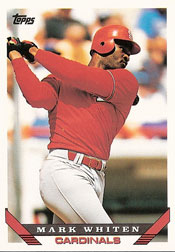
mark_whitenOn March 22, 1993, Indians pitcher Steve Olin was killed and pitchers Tim Crews and Bob Ojeda were injured severely in a boating accident on a Florida lake. Crews died the next day.

After the accident, Cardinals general manager Dal Maxvill called his counterpart with the Indians, John Hart, who asked whether pitcher Rene Arocha was available. Maxvill replied, “No.”

“He said, ‘We really need pitching now,’ ” Maxvill told the St. Louis Post-Dispatch. “I said, ‘Which one of our pitchers are you interested in?’ And he said, ‘Anybody, really.’ ”

Maxvill wanted an outfielder to back up projected starters Ray Lankford, Brian Jordan and Bernard Gilkey. Maxvill was about to make a deal for Braves outfielder Keith Mitchell, who was ticketed to open the 1993 season in the Atlanta farm system.

Hart was offering to trade Whiten, the Indians’ starting right fielder, to the Cardinals if Maxvill would offer a pitcher Hart liked.

Maxvill and Hart had discussed a possible deal during the winter meetings in December 1992. At that time, Hart asked about pitcher Mark Clark, who was 3-10 with a 4.45 ERA for the 1992 Cardinals.

Remembering that exchange, Maxvill offered Clark to the Indians. Hart wanted a second player added to the deal. When Maxvill suggested minor-league infielder Juan Andujar, Hart accepted.

Maxvill contacted the Braves and nixed the proposed trade for Mitchell. On March 31, seven days before the 1993 season opener, the Cardinals sent Clark and Andujar to Cleveland for Whiten.

“It was a shock for me,” Whiten said of the trade.

Whiten, 26, was joining his third major-league club. (He had played for the Blue Jays before joining the Indians.) He had a strong throwing arm, speed and power, but generally was considerd a raw talent. “I’m still learning,” Whiten conceded.

The acquistion of Whiten ended Ozzie Canceso’s spring training quest to make the Cardinals’ Opening Day roster as a reserve outfielder. Canseco produced four home runs and 14 RBI for St. Louis in spring training exhibition games, but admitted, “My defense is lacking … It’s something I realize I have to improve.”

Whiten became a standout for the 1993 Cardinals, generating 25 home runs, 99 RBI and 15 stolen bases. On Sept. 7, 1993, in the second game of a doubleheader at Cincinnati, Whiten hit four home runs and drove in 12 while batting sixth in the order. Whiten, who hit a grand slam, two three-run home runs and a two-run home run, tied the major-league single-game RBI record established by Cardinals first baseman Jim Bottomley in 1924. Boxscore

Clark finished 7-5 with a 4.28 ERA for the 1993 Indians. In three seasons with Cleveland, Clark was 27-15. Andujar never reached the big leagues.

In two seasons with St. Louis, Whiten had 39 home runs and 152 RBI. On April 9, 1995, the Cardinals traded Whiten and pitcher Rheal Cormier to the Red Sox for third baseman Scott Cooper and pitcher Cory Bailey.

Previously: Mark Whiten, Josh Hamilton: Same feat, different path

Read Full Post »

(Updated Dec. 27, 2024)

In 2003, Cardinals shortstop Edgar Renteria won both a Gold Glove Award and a Silver Slugger Award for the second season in a row.

edgar_renteria4The cumulative production numbers put up by Renteria in 2003 were unprecedented for a Cardinals shortstop: .330 batting average, 194 hits, 47 doubles, 13 home runs, 100 RBI and 34 stolen bases. The hits, doubles and RBI were single-season career highs for Renteria, who spent 16 years in the major leagues.

He was the first National League shortstop with 100 RBI since Hubie Brooks of the 1985 Expos.

“It’s not easy for a guy who is not a power hitter to get 100 RBI _ and I’m not a power hitter,” Renteria said to the St. Louis Post-Dispatch in September 2003.

Renteria came within six hits of joining Honus Wagner as the only National League shortstops to achieve 200 hits and 100 RBI in a season. Wagner had 201 hits and 109 RBI for the 1908 Pirates.

“To hit .330 with 100 RBI, a bunch of stolen bases and great defense _ what a year he’s had,” Cardinals manager Tony La Russa said to the Post-Dispatch in the final weekend of the 2003 season.

On Sept. 27, 2003, in the Cardinals’ next-to-last game of the season, Renteria got his 100th RBI when his fielder’s choice grounder to short scored Albert Pujols from third with the deciding run in St. Louis’ 3-2 victory over the Diamondbacks at Phoenix. Boxscore

Renteria twice drove in five runs in a game in 2003.

On April 13, in the Cardinals’ 11-8 victory over the Astros at Houston, Renteria hit a pair of home runs against Roy Oswalt and had five RBI. Boxscore

On Sept. 18, Renteria was 4-for-4 with two doubles and five RBI in the Cardinals’ 13-0 victory over the Brewers at St. Louis. Boxscore

Renteria hit .492 (30-for-61) with 17 RBI against the Brewers in 2003.

In his report card on the Cardinals’ 2003 season, Joe Strauss of the Post-Dispatch wrote, “Edgar Renteria compiled one of the best offensive seasons of the last 20 years by a National League shortstop while committing fewer errors (16) than during last year’s Gold Glove season (19).”

Looking back on his time with the Cardinals, pitcher Woody Williams said to Stan McNeal of Cardinals Magazine in 2024, “Edgar Renteria … had such a desire to win. He wasn’t a big talker, but I appreciated the way he carried himself and loved being around him. He was a pro all the time.”

Read Full Post »

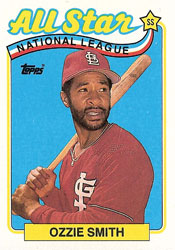
The shortstop position was a model of stability when Ozzie Smith was on the Cardinals roster.

ozzie_smith5Smith played for the Cardinals for 15 seasons (1982-96). He was their starting shortstop on Opening Day in 13 of those years.

The exceptions: 1996, when first-year manager Tony La Russa went with newcomer Royce Clayton, and 1989, when Smith opened the season on the disabled list because of a pulled muscle in his left side.

If not for that injury, Smith would have made 14 consecutive Opening Day starts at shortstop for St. Louis.

The only player other than Smith to start at shortstop for the Cardinals from 1982 to 1995 was Jose Oquendo, who shifted from second base as the substitute for Smith in 1989.

On March 30, less than a week before the Cardinals’ 1989 regular-season opener, Smith was injured stealing third base in an exhibition game against the Blue Jays at Dunedin, Fla. The initial prognosis was he would be sidelined until May 1. Smith was placed on the disabled for the first time since 1984.

Manager Whitey Herzog decided to move Oquendo from second base to shortstop and place utilityman Tim Jones at second base. Asked why he opted for Oquendo rather than Jones at shortstop, Herzog told the St. Louis Post-Dispatch, “Jones can play it. I just think that Oquendo probably is as good a shortstop as there is in the National League.”

The Cardinals opened the 1989 season on April 3 at New York against the Mets. Oquendo, batting sixth, went 0-for-4, striking out twice against starter Dwight Gooden and once against Don Aase. The Mets won, 8-4. Boxscore

Oquendo, who had hit .384 (28-for-73) in spring training, appeared to be pressing. He went hitless in his first 13 at-bats.

The Cardinals stayed with the starting middle infield duo of Oquendo and Jones for the first seven games. Oquendo batted .167 and made one error. Jones hit .200 and fielded flawlessly.

Smith returned to the lineup on April 15, in the Cardinals’ second home game, against the Mets. Batting second, behind Vince Coleman, Smith was 2-for-5. His 10th-inning single moved Coleman from second to third _ “I can’t run into an out,” Coleman explained in why he agreed with third-base coach Rich Hacker’s stop sign _ and positioned Coleman to score the game-winning run on Pedro Guerrero’s one-out single.

Appearing comfortable with Smith in the lineup, Coleman swiped three bases in the Cardinals’ 3-2 victory. “I know he (Smith) is going to sacrifice himself so I can steal,” Coleman told the Post-Dispatch. Boxscore

With Smith at shortstop, Oquendo went back to second base and Jones to the bench.

Smith started in 152 games in 1989, leading National League shortstops in assists (483) and winning his 10th consecutive Gold Glove Award.

Previously: Buddy Bell almost joined Ozzie Smith in Cardinals’ infield

Read Full Post »

Imagine the Cardinals opening a season with a starting shortstop who had a career batting average of .217, more than twice as many strikeouts (68) as walks (29) and a reputation as an erratic fielder.

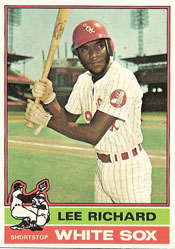
lee_richardThat’s precisely what the Cardinals did when they selected Lee “Bee Bee” Richard as their Opening Day shortstop in 1976.

Richard, a speedster, was acquired on Dec. 12, 1975, by the Cardinals from the White Sox for outfielder Buddy Bradford and pitcher Greg Terlecky. The Cardinals projected him as a backup to shortstop Don Kessinger, who joined St. Louis two months earlier in a trade with the Cubs.

Nicknamed “Bee Bee” as a hard-throwing high school pitcher in Louisiana, Richard attended Southern University and converted to shortstop.

Scouts were enamored with his speed and strong throwing arm. Richard was a first-round choice of the White Sox in the June 1970 amateur draft. He was the first shortstop selected. “We were fearful he might be picked by the time our turn came,” White Sox general manager Ed Short said to The Sporting News.

After watching Richard in a workout, White Sox coach Luke Appling, a Hall of Fame shortstop, said, “He’s got good hands. He’ll be a good one.”

Richard, 22, made his big-league debut on April 7, 1971, as the starting shortstop and leadoff batter for the White Sox in their season opener against the Athletics at Oakland. He singled twice against Catfish Hunter, drove in a run and was caught stealing by catcher Dave Duncan. Boxscore

Richard, however, wasn’t ready to be a big-league regular. He committed 26 errors in 68 games at shortstop in 1971. “I know some people told me I’d have been better off if I’d go down to the minors,” Richard said.

Undeterred, White Sox manager Chuck Tanner said, “He’s going to be a great shortstop … Give him a couple of years.”

Richard, who spent four seasons with the White Sox, was dubbed “The Juggler” by broadcaster Harry Caray because of poor fielding. The White Sox also tried him at center field, third base, second base, right field and designated hitter.

During a game in which Richard committed a pair of errors, the Washington Post reported, Caray told listeners, “Richard just picked up a hot dog wrapper. It’s the first thing he’s picked up all night.”

On April 9, 1976, the Cardinals opened their season at home against the Cubs and manager Red Schoendienst posted this batting order:

1. Lou Brock, left field.

2. Lee Richard, shortstop.

3. Bake McBride, center field.

4. Ted Simmons, catcher.

5. Reggie Smith, right field.

6. Keith Hernandez, first base.

7. Hector Cruz, third base.

8. Mike Tyson, second base.

9. Lynn McGlothen, pitcher.

After McGlothen retired the first two batters, Bill Madlock grounded to Richard, who booted the ball for an error on his first chance as a Cardinal. The next two batters reached before McGlothen worked out of the bases loaded jam.

Richard produced a single in four at-bats and St. Louis won, 5-0. Boxscore

Kessinger got the start at shortstop in the next game and remained the starter until the Cardinals called up rookie Garry Templeton in August.

In 13 games, six as a starter, at shortstop for the Cardinals, Richard committed four errors. By July 15, Richard’s batting average dropped to .059. Used primarily as a reserve infielder, Richard appeared in 66 games for the 1976 Cardinals, batted .176 and stole one base.

The Cardinals released him after the season and he never appeared in the major leagues again.

Read Full Post »

(Updated Nov. 27, 2018)

In 1973, the Cardinals lost a gamble when they selected Ray Busse as their starting shortstop.

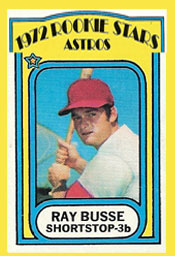
ray_busseBusse was a top prospect in the Astros system when he hit .271 with 13 home runs in 92 games for Class AAA Oklahoma City in 1971. Bob Kennedy, the Cardinals’ director of player development, rated Busse the best shortstop in the minor leagues that year, The Sporting News reported.

Misfortune struck in 1972. Busse’s father committed suicide. Busse suffered a shoulder injury. Limited to 70 games, Busse hit .207 and committed 27 errors for Oklahoma City in 1972.

Cardinals general manager Bing Devine went to baseball’s winter meetings in November 1972 determined to find  “a shortstop with some sting in his bat,” The Sporting News reported. The Cardinals were seeking a replacement for Dal Maxvill, who they traded to the Athletics in August 1972.

Harry Walker, who joined the Cardinals as a hitting instructor after managing the Astros, recommended Busse. So did Kennedy.

On Nov. 28, 1972, the Cardinals dealt catcher Skip Jutze and infielder Milt Ramirez to the Astros for Busse and infielder Bobby Fenwick.

“Walker considers Busse a good gamble because of his age (24) and his batting potential,” Devine told The Sporting News.

Said Kennedy: “He (Busse) has a fine arm, good range and could become a good hitter.”

Busse went to spring training in competition with Mick Kelleher, Mike Tyson, Dwain Anderson and Ed Crosby for the starting shortstop position and “quickly took charge of the shortstop sweepstakes,” The Sporting News reported.

In his first spring training at-bat for the Cardinals, Busse singled in a run. Soon after, he hit a three-run home run against the Mets’ Ray Sadecki. Busse completed spring training as the Cardinals’ leader in RBI (11) and hit .254.

Though he ended spring training in an 0-for-18 slump, the Cardinals named him their starting shortstop. “He’s done a real fine job,” Cardinals manager Red Schoendienst told Larry Harnly of The State Journal-Register of Springfield, Ill. “He’s done everything expected of him … If you make a mistake on Busse, he’ll hit that ball.”

The Cardinals opened the 1973 regular season on April 6 at Pittsburgh with an all-rookie left side of the infield (Ken Reitz was at third base).

It was a disaster for Busse from the beginning.

Busse made an error on the first ball hit to him _ a grounder by Pirates leadoff batter Rennie Stennett in the first inning. Busse went 1-for-4, made two errors and the Pirates won, 7-5. Boxscore

The Cardinals lost 20 of their first 25 games. Busse took much of the blame.

On May 14, 1973, fans booed Busse and Reitz throughout a 10-5 Phillies victory at St. Louis. The loss dropped the Cardinals’ record to 8-23. Busse was batting .143 with 21 strikeouts in 24 games and he had committed 11 errors. Boxscore

After the game, Reitz shrugged off the boos when approached by reporters. Busse responded to the booing by saying, “Often I wonder what we come to the ballpark for. When you’re down, it’s pretty easy for somebody to get down on you, but that’s when you need them (the fans) the most.”

Busse never appeared in another game for the Cardinals. Schoendienst named Tyson the starting shortstop. Busse remained on the bench until the Cardinals traded him back to the Astros for infielder Stan Papi on June 8, 1973.

Asked by The Sporting News whether he had been given a fair shot by the Cardinals, Busse replied, “No, but that’s nobody’s fault but my own.”

Astros manager Leo Durocher said, “We’re tickled to get him back.”

Busse never recovered. He hit .059 in 15 games for the Astros in 1973 and .206 in 19 games for them in 1974, his last season in the major leagues.


Read Full Post »

« Newer Posts - Older Posts »