Feeds:
Posts
Comments

Archive for the ‘Hitters’ Category

Stan Musial achieved many remarkable feats in his Cardinals career. One of the most unheralded was his success at stealing home. Musial did it four times within four years.
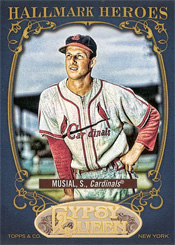
Musial had 78 stolen bases in a 22-year Cardinals career. His single-season high was nine in 1943, his second full year in the big leagues.

In the book “Musial: From Stash to Stan the Man,” author James N. Giglio said Musial “became a terror in taking the extra base or in flustering the pitcher by threatening to steal.”

Giglio described how, in a 1942 game at Pittsburgh, Musial tripled and scored the tying run when he faked a steal of home, causing the pitcher, Luke Hamlin, to balk.

That alertness and hustle paid off for Musial and the Cardinals on May 24, 1950, at the Polo Grounds in New York. In the eighth inning, with the Cardinals ahead, 1-0, Musial singled and advanced to second when Johnny Lindell reached on an error.

With Enos Slaughter at the plate, pitcher Monty Kennedy unleashed a wild pitch. The ball “dropped right in front of the plate but the daring Musial made it to third,” United Press reported, while Lindell held at first.

Slaughter popped out and Marty Marion came to the plate. When Kennedy made a pickoff throw to first, Musial broke from third and streaked home with a steal, extending the Cardinals’ lead to 2-0.

An Associated Press photo of the play shows Giants catcher Wes Westrum straddling the plate, his arms extended as he awaits the throw from first baseman Tookie Gilbert, while Musial slides toward the dish.

“It’s that old Cardinal Gashouse spirit,” St. Louis manager Eddie Dyer said. “You can laugh all you want to, boys, but it still wins ballgames.” Boxscore

Musial stole home again on Sept. 18, 1951, at St. Louis. Musial was on third and Slaughter on first with two outs in the sixth when they executed a double steal, with Musial racing home with the final run of a 7-1 Cardinals victory over the Dodgers. Boxscore

In 1953, Musial had a season total of three stolen bases _ two were steals of home and both came against the Phillies.

On July 24, 1953, at Philadelphia, Bob Miller issued a walk to Musial, who advanced to second on an error and to third on a wild pitch. With two outs, Musial took off for the plate. An Associated Press photo shows catcher Stan Lopata tagging Musial on his right knee while Musial’s left foot is across the plate. Phillies manager Steve O’Neill protested, but the photo is evidence umpire Bill Jackowski made the correct call.

The sixth-inning steal of home tied the score 1-1, but the Phillies scored in the ninth and won, 2-1. Boxscore

Two months later, Sept. 13, 1953, at St. Louis, Musial stole home again versus the Phillies. In the first inning, Musial was on third and Ray Jablonski on first when the pair executed a double steal, igniting the offense in a 17-3 Cardinals triumph. Boxscore

Previously: No one hit more triples and as many home runs as Stan Musial
Read Full Post »

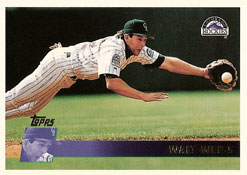
The Cardinals wanted free agent Walt Weiss to be their shortstop for the 1996 season, but Weiss declined St. Louis’ offer because he was concerned how fans would react to him replacing Ozzie Smith.

St. Louis instead acquired shortstop Royce Clayton from the Giants. Weiss re-signed with the Rockies.
As Weiss anticipated, the transition of Smith from St. Louis starter to part-time player was marred by controversy. Smith felt he deserved to remain the everyday shortstop and he clashed with Tony La Russa when the manager chose Clayton as the starter in 1996. Meanwhile, Weiss quietly extended a four-year stretch as the Rockies’ regular shortstop.

Weiss started his major-league career in 1987 with the Athletics and played six seasons in Oakland for La Russa. During that time, Weiss won the American League Rookie of the Year Award and helped the Athletics win three pennants and a World Series title.

Traded by Oakland to the Marlins after the 1992 season, Weiss spent a year in Florida and then two with the Rockies. In November 1995, he declared for free agency.

When the Rockies offered him a two-year contract at $2 million per year, the Cardinals were prepared to counter with a two-year deal plus an option year at $2 million per year, according to the St. Louis Post-Dispatch. The Cardinals were seeking a shortstop because of their concern about whether Smith, who hit .199 in 1995 and who was about to turn 41, could handle the everyday shortstop role in 1996.

On Nov. 20, 1995, St. Louis reporter Rick Hummel wrote: “Free-agent shortstop Walt Weiss apparently has whittled his list to two teams _ Colorado, for whom he played the last two seasons, and the Cardinals.”

A day later, the Rockies announced Weiss had accepted a $4.1 million two-year contract with a player option for 1998 to remain with Colorado.

“Going to St. Louis, I wouldn’t have had the fan support I have (in Denver), especially coming in behind Ozzie,” Weiss said to the Rocky Mountain News.

Post-Dispatch columnist Bernie Miklasz wrote that Weiss rejected the Cardinals “in part because he didn’t want to be the co-star in an Ozzie soap opera.”

Miklasz, writing with foresight, added, “La Russa should have the freedom to choose the lineup. If the Cardinals are serious about winning, then any Ozzie-related PR repercussions should be irrelevant … It’s too bad that this mutually beneficial relationship seems destined to end in so much rancor and bitterness.”

A .258 career hitter in 14 major-league seasons, Weiss was a terror against the Cardinals. The switch-hitter batted .333 (79-for-237) in 76 regular-season games against St. Louis. He had more hits versus the Cardinals than he did against any other team in his big-league career. Weiss batted .357 (41-for-115) in 35 regular-season games at Busch Memorial Stadium.

Perhaps Weiss’ most memorable game against the Cardinals came in Game 1 of the 2000 National League Division Series, when St. Louis starter Rick Ankiel experienced his infamous meltdown.

Playing for the Braves in his final big-league game, Weiss started at shortstop in Game 1. In the third inning, Weiss delivered the two-run single that knocked Ankiel from the game after the left-hander had thrown five wild pitches and walked four that inning. It would be Weiss’ last hit of his big-league career. Boxscore

“Walt Weiss had a superb day afield and at the plate, going 2-for-3 with two RBI and making a great catch on Andres Galarraga’s errant throw to second base in the third.” the Atlanta Journal-Constitution reported. “With runners on first and second, Galarraga made a fine stop on Fernando Vina’s smash, but threw wildly to second. Weiss, fully extended, reached far and low to his right to catch the ball, then searched with his right foot before touching the bag for the force.”


Read Full Post »

(Updated Dec. 27, 2015)

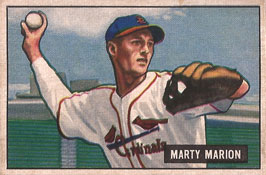
If Marty Marion is elected to the National Baseball Hall of Fame, it will be because he was perhaps the finest-fielding shortstop of the 1940s, a starter on Cardinals teams that won four pennants and three World Series titles and a winner of the 1944 National League Most Valuable Player Award.

Marion wasn’t known for his hitting _ he usually batted in the seventh and eighth spots in the order during a 13-year big-league career _ but much like another Cardinals standout shortstop, Ozzie Smith, Marion worked to enhance his value at the plate.
Marion, a Cardinals shortstop from 1940-50, twice has been one of 10 candidates on the Pre-Integration Era ballot being considered for election to the Hall of Fame in Cooperstown, N.Y. The ballot is for players, managers, umpires and executives whose most significant achievements came before 1946.

To be elected, a candidate must receive votes from at least 12 of the 16 voters. Marion didn’t receive enough support when voting was done in 2012 and again in 2015.

With a .263 career batting average and 1,448 hits in 11 seasons with the Cardinals and two with the Browns, offensive numbers alone won’t qualify Marion for the Hall of Fame, but his batting shouldn’t disqualify him either.

In 1942, his third season with the Cardinals, Marion, a right-handed batter, initially struggled at the plate so badly that some wondered whether he could remain in the big leagues. Though he was the everyday shortstop, he was hitting .188 on May 31 that season.

Years later, Marion explained to St. Louis writer Bob Broeg how he improved as a hitter. “I began studying hitting on my own, changing my batting stance, observing the pitchers, laying off bad pitches and hitting more to right field,” Marion said.

Marion finished the 1942 season with a .276 batting mark and helped the Cardinals win the pennant and the World Series championship that year.

Perhaps Marion’s most productive game for the Cardinals occurred on June 3, 1945, in the opener of a doubleheader against the Giants at St. Louis. Marion had a career-high six RBI with a triple, double and two flyouts in an 11-3 Cardinals victory. Boxscore

Five years later, in 1950, Marion’s last season as a Cardinals player before becoming their manager in 1951, the shortstop hit a home run in each of four consecutive games he started. Those were his only homers of the season and his last of 34 as a Cardinal.

The unexpected power supply began May 30, 1950, when Marion went 3-for-6, including a three-run home run off Vic Lombardi, in the Cardinals’ 17-13 victory over the Pirates in the opener of a Memorial Day doubleheader at Pittsburgh. Boxscore

After a pinch-hit appearance in the second game of the doubleheader, Marion made his next start June 1 against the Dodgers at St. Louis. Facing Preacher Roe, Marion hit a grand slam with two outs in the sixth inning, erasing a 2-0 Brooklyn lead and lifting the Cardinals into a first-place tie with the Dodgers with a 5-2 victory. Boxscore

The New York Times described Marion’s only career grand slam as “electrifying”  for the Cardinals and the St. Louis crowd of 32,180.

“For 11 major-league years, Mr. Shortstop went quietly about his business,” wrote the Associated Press. “Never did he hit a home run with the bases loaded. Never, until last night.”

Wrote United Press: “Imagine Marty Marion, of all people, blasting a grand slam to beat the Brooklyn Dodgers and putting the rollicking Redbirds into a first-place tie with the Flatbush boys.”

With the grand slam, Marion had produced eight RBI in back-to-back games started. He didn’t stop there.

In his next game, June 2, Marion hit a solo home run off the Dodgers’ Don Newcombe. Marion followed that with another solo homer in his next game started against the Phillies’ Curt Simmons. The 10 RBI in four consecutive games started accounted for a quarter of Marion’s season total in 1950.

The Sporting News reported Marion’s four-game stretch as “the most memorable week of hitting in his major-league career.”

“Better timing, that’s all,” Marion explained. “But it’s quite a thrill and I hope it happens more often.”

Previously: How Marty Marion won MVP Award by one point

Read Full Post »

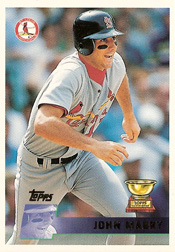
In 1997, during a 20-game hitting streak for the Cardinals in which he batted .418, John Mabry applied lessons taught to him by St. Louis hitting coach George Hendrick.

Mabry improved his batting average from .240 to .309 during the 20-game streak from May 19 through June 9 in 1997. The left-handed batter had 10 multi-hit games during that stretch. It was the longest hitting streak by a Cardinal since Willie McGee hit safely in 22 consecutive games in 1990.
Hendrick, cleanup batter for the 1982 World Series champion Cardinals, urged Mabry to be aggressive with first-pitch fastballs.

“I’ve tried to do that all the time,” Mabry said to the St. Louis Post-Dispatch in explaining the streak. “That’s the whole deal, to hit that fastball when they try to get ahead of you. That’s usually the best fastball to hit.”

Told of Mabry’s praise, Hendrick responded, “Credit his success to his understanding of work ethic. It’s got nothing to do with me.”

Mabry had several outstanding games during the hitting streak. The best was on June 3, 1997, when he had three hits and six RBI in the Cardinals’ 15-4 victory over the Rockies at St. Louis. Mabry cracked a three-run home run off Jeff McCurry in the fifth inning. Boxscore

After the game, Cardinals manager Tony La Russa said Mabry is “seeing that ball like it’s huge.” Said Mabry: “It doesn’t look huge. It still looks like a mouse running across the floor at times.”

Mabry spent three stints as a Cardinals player: 1994-98, 2001 and 2004-05. He and Matheny were teammates in 2001 and 2004.

Mabry hit .281 overall with the Cardinals. That’s 18 points better than his career average in 14 big-league seasons with eight clubs.

As the everyday first baseman for the 1996 Cardinals, Mabry hit .297 with 161 hits in 151 games. He had 30 doubles, 13 home runs, 74 RBI and a .342 on-base percentage.

Mabry hit for the cycle on May 18, 1996, against the Rockies at Denver. He singled to center in the second, doubled to right in the fourth, tripled off the center-field wall in the fifth and homered 400 feet to right in the seventh.

Mabry became the first Cardinal to hit for the cycle since Ray Lankford in 1991.

Some of the joy from the accomplishment was diminshed by the game’s outcome. Handed an 8-4 lead to protect in the bottom of the ninth, Cardinals closer Dennis Eckerlsey surrendered five runs and Colorado won, 9-8. Boxscore

“This is a really strange feeling,” Mabry said. “You’ve got to win the game. That’s all I know.”

Two months later, July 6, 1996, Mabry was 5-for-5 in a 9-5 Cardinals victory over the Pirates at Pittsburgh. Boxscore

Asked to compare Mabry with other batters, La Russa said, “Guys who hit well into the threes (.300) take every at-bat like it’s their last. (Paul) Molitor, (Wade) Boggs, (Frank) Thomas. They use the whole field, they handle a bunch of different pitches and, most importantly, they don’t throw at-bats away. I don’t think I’ve seen (Mabry) throw one away since spring training.”

The 5-for-5 performace at Pittsburgh was one of 11 times Mabry had four hits in a game for St. Louis during his career.

Mabry hit one grand slam and it occurred for the Cardinals against the Royals’ Zack Greinke on May 20, 2005, at Kansas City. Boxscore

Previously: Braves fans’ behavior recalls Dodgers’ forfeit to Cardinals

Read Full Post »

Before the 1967 season, Ted Savage competed with Mike Shannon for the role of starting third baseman of the Cardinals. Neither could have imagined then that both would have long careers with the Cardinals after their playing days.

Shannon, who would win the third base job, played until 1970. After a year as the franchise’s assistant director of promotions and sales, Shannon became a Cardinals broadcaster in 1972 and remained in the job through the 2021 season.
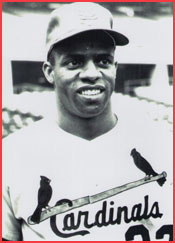
Savage spent three (1965-67) of his nine years in the majors as a Cardinals reserve. He joined their front office in September 1987 as assistant director of community relations and minor-league instructor. The 2012 season was his 25th and last in the Cardinals’ front office. At 75, he retired as director of target marketing in the Cardinals Care and community relations department.

A native of the St. Louis-area town of Venice, Ill., Savage signed with the Phillies as an amateur free agent in 1960 and quickly made a favorable impression. In 1961, Savage was named most valuable player of the Class AAA International League after hitting .325 with 24 home runs, 31 stolen bases and 111 runs scored for Buffalo.

Savage became the Phillies’ left fielder as a rookie in 1962 and hit .266 with 16 stolen bases. He was traded to the Pirates after the season, beginning a journey that would land Savage with eight big-league teams between 1962 and 1971.

In December 1964, the Pirates traded Savage and pitcher Earl Francis to the Cardinals for second baseman Jack Damaska and outfielder Ron Cox.

A substitute school teacher in St. Louis during the off-season (he was graduated from Lincoln University, with a bachelor’s degree in education), Savage reported to spring training in 1965 with the Cardinals’ minor-league players. He began the regular season with Class AAA Jacksonville, stole 34 bases in 87 games and was called up to St. Louis on July 23 after reserve outfielder Carl Warwick was dealt to the Orioles.

Savage didn’t get a hit until his 19th at-bat as a Cardinal. The slump-busting double on Aug. 2 sparked a winning rally against the Dodgers. Boxscore

Two weeks later, Savage hit his first and only Cardinals home run, a two-run shot off Joe Nuxhall of the Reds. Boxscore

The highlights were too few. Savage hit .159 (10-for-63) in 30 games for the 1965 Cardinals. He opened the 1966 season with Class AAA Tulsa.

“Ted is really something,” Tulsa manager Charlie Metro told The Sporting News. “He can do everything _ and well. I consider him a better center fielder than eight of those now up in the big leagues.”

Savage, hitting .317 with 34 doubles, 18 homers and 43 steals for Tulsa, was called up to the Cardinals in August 1966. He was instrumental in helping St. Louis to a 5-1 victory over the Pirates on Aug. 27. Savage doubled and scored against starter Steve Blass and rapped a two-run double off reliever Pete Mikkelsen. Boxscore

Just as in 1965, though, Savage mostly struggled, batting .172 (5-for-29) in 16 games for the 1966 Cardinals.

After the season, Savage was sent by the Cardinals to the Florida Instructional League with the intent of being converted to a third baseman. He also received instruction on playing second base. Savage responded well to the challenges.

Wrote The Sporting News: “Besides playing a slick hot corner, Savage also won three straight games for the Cards. In one, he stole home with the winning run. In another, he drove in the deciding run with a single. And, in the third, he hit a game-winning 415-foot homer.”

Meanwhile, Shannon also was working toward a conversion from outfield to third base. In December 1966, the Cardinals traded their starting third baseman, Charlie Smith, to the Yankees for right fielder Roger Maris.

Though Shannon was regarded the frontrunner to replace Smith, Savage was considered a good bet to win a spot with the 1967 Cardinals. St. Louis ace Bob Gibson told The Sporting News, “Ted’s really improved. He’s got lots of guts and he could help some team right now.”

His confidence bolstered, Savage had a spectacular spring training, hitting .364 in exhibition games. Cardinals hitting instructor Joe Medwick said, “Savage became a good hitter again by going with the pitch.”

Savage made the 1967 Opening Day roster as a reserve infielder-outfielder. (Shannon was the starting third baseman and Lou Brock, Curt Flood and Maris were the outfielders).

However, Savage hardly played _ and when he did, he wasn’t effective. With his batting average at .125 (1-for-8), Savage was in the visitors’ clubhouse at Forbes Field in Pittsburgh when manager Red Schoendienst informed him he was being optioned to Tulsa. Angered, Savage grabbed a ukelele he had purchased and smashed it against his locker, The Sporting News reported.

The Cardinals switched gears. They sent Savage to the Cubs rather than return him to the minor-league system. Savage made an immediate impression in Chicago. He twice scored on steals of home. On June 2, his first time facing the Cardinals since his departure, Savage hit a home run against Steve Carlton, one of two he would hit against the St. Louis left-hander that season. Boxscore

Savage told The Sporting News he was sorry he had smashed the ukelele and explained, “I figured I had done everything they (the Cardinals) had asked me to. I just wasn’t going to go back to the minors.”

Savage also would play for the Dodgers, Reds, Brewers and Royals. His best season was 1970 when he hit .279 with 12 homers and 50 RBI for the Brewers.

After his playing career, Dr. Ted Savage earned a Ph.D. degree in urban studies from St. Louis University and spent nine years as athletic director at Harris-Stowe State University in St. Louis before joining the Cardinals’ front office.

Read Full Post »

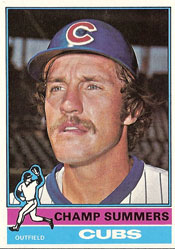
In 11 big-league seasons, Champ Summers hit only one home run against the Cardinals. Like many of the events involving Champ Summers, it was bigger than life.

The last home run of Summers’ major-league career was a pinch-hit grand slam off the Cardinals’ Bob Forsch, lifting the Padres to a 7-3 victory on April 10, 1984, at San Diego.

It was fitting that Summers’ final home run was struck as a pinch-hitter with the bases loaded. His first big-league homer _ hit for the Cubs against the Astros’ Jim York on Aug. 23, 1975, at Chicago _ also was a pinch-hit grand slam. Boxscore

From his colorful nickname to his unusual path to the major leagues, Summers was one of the game’s endearing characters.

In 1984, Summers, 38, was in his last big-league season, primarily employed as a left-handed pinch-hitter for San Diego. In their sixth game of a three-city West Coast trip to open the season, the Cardinals were leading the Padres, 3-1, in the fifth inning when Summers batted for pitcher Andy Hawkins with the bases loaded. He lined Forsch’s second pitch into the right-field seats. Boxscore

Summers rounded the bases so slowly his home run trot “made a wedding march look like a 40-yard dash,” wrote Bud Shaw of the San Diego Evening Tribune.

“I did take some time to watch that one,” Summers said with a smile. “I felt like I won the lottery.”

Summers told Phil Collier of the San Diego Union, “Hitting is like dancing. If you can’t hear the music, you can’t dance. I feel like I could dance all night.”

Under the headline “Performance of Padres’ Champ Worth an Oscar,” Shaw wrote, “For just one day, it would be nice to live the charmed life of Champ Summers. Preferably on a day when the rent is overdue, the unemployment check is lost in transit and your mother-in-law isn’t.”

Asked about his at-bat against Forsch, Summers said, “I don’t know what the pitch was and I don’t know where it was. I never know.”

John Junior Summers was born June 15, 1946, in Bremerton, Wash. He was nicknamed “Champ” at birth.

“My father was a prizefighter in the Navy,” Summers told the Belleville (Ill.) newspaper. “He said when I was born I looked like I went 10 rounds with Joe Louis. It’s a sad story, but true.”

Champ Summers moved with his family to the St. Louis metropolitan area. He was a natural athlete. At 17, while attending Madison (Ill.) High School, Summers was challenged to a tennis match by a local 13-year-old looking to test himself against worthy competition. The phenom was Jimmy Connors.

Summers entered the Army, became a paratrooper and served in Vietnam. When he came back to the U.S., he enrolled at Southern Illinois University Edwardsville and played basketball and baseball. He was playing in a men’s softball league when a scout for the Oakland Athletics discovered him and signed him to a free-agent contract in 1971.

When Summers reached the major leagues with Oakland in 1974, the year he turned 28, he was known as John Summers, the name he had used throughout his minor-league career as well.

One day, Summers said, as he was signing autographs before a game at Oakland during his rookie season, teammate Reggie Jackson watched him slowly sign “John J. Summers Jr.” on each item handed him. Reggie asked Summers whether he had a nickname. When Summers replied “Champ,” Jackson told him he’d be a fool not to use it.

When Summers was traded to the Cubs in 1975, he introduced himself as Champ Summers _ and it remained his big-league moniker.

Summers played in the majors, primarily as an outfielder, for six teams (Athletics, Cubs, Reds, Tigers, Giants and Padres) from 1974 through 1984.

A career .255 hitter, he batted .271 against the Cardinals. He was tough versus St. Louis with the Cubs in 1975 (.313) and with the Giants in 1982 (.364).

In 2001, Summers returned to the St. Louis region as the first manager of the Gateway Grizzlies of the Frontier League in Sauget, Ill.

Previously: Rick Horton: Bob Forsch was heart, soul of Cardinals’ staff

Read Full Post »

« Newer Posts - Older Posts »