Feeds:
Posts
Comments

Archive for the ‘Hitters’ Category

Willie Mays was the first right-handed batter to hit 400 home runs in the National League. The milestone homer came against a familiar foe, Curt Simmons of the Cardinals, and was witnessed by another 400-homer hitter, Stan Musial.

On Aug. 27, 1963, at Candlestick Park in San Francisco, Mays capped a two-month hot streak with his 400th career home run for the Giants.

At the time, nine others had achieved the feat: Babe Ruth (714), Jimmie Foxx (534), Ted Williams (521), Mel Ott (511), Lou Gehrig (493), Stan Musial (472), Eddie Mathews (419), Mickey Mantle (415) and Duke Snider (403).

(Musial, Mathews, Mantle and Snider still were active. Musial would finish with 475, Mathews 512, Mantle 536 and Snider 407.)

The only right-handed batter in the 400-homer group besides Mays was Foxx. (Of his 534 home runs, Foxx hit 524 as an American Leaguer and 10 as a National Leaguer.) All the others, except Mantle (a switch-hitter), batted from the left side.

Mays, 32, was considered the best bet to break the National League career home run mark of 511 held by Mel Ott.

On a roll

After leading the National League in home runs (49) and total bases (382) and powering the Giants to a pennant in 1962, Mays got baseball’s highest salary in 1963 _ $105,000.

He had a substandard start to the season, hitting .233 in April and .257 in May. At the urging of the Giants, Mays got his eyes examined “and was told they were fine,” according to his biographer James S. Hirsch.

He found a groove after the all-star break and nearly was unstoppable. Mays hit .322 in July, .387 in August and .378 in September.

From July 28 through Aug. 27, Mays hit safely in 27 of 28 games. In that stretch, he raised his 1963 season batting average from .274 to .308.

His only hitless game in that period came on Aug. 13 when Jim Maloney of the Reds shut out the Giants on a two-hitter.

(The game was noteworthy for another reason. It was the first time Mays played a position other than center field in the majors. In the eighth inning, after Norm Larker batted for shortstop Ernie Bowman, manager Al Dark put Larker at first base, moved Orlando Cepeda from first to left, Harvey Kuenn from left to right, Felipe Alou from right to center and Mays from center to shortstop. Mays had no fielding chances in his one inning at short, but he told the Associated Press, “Man, that’s too close to the plate.” Boxscore)

Numbers game

On Aug. 25, 1963, facing the Reds’ Joe Nuxhall at Candlestick Park, Mays hit his 399th home run. Later , with Joey Jay pitching, Mays drove a pitch to deep left. “If Frank Robinson hadn’t caught the ball a scant foot from the top railing, Willie would have had his 400th major-league homer,” The Sporting News reported.

The next day, Aug. 26, the Cardinals opened a series at San Francisco. Mays got two singles, but no home run, against Ernie Broglio. Curt Simmons provided another opportunity on Aug. 27.

Mays had a history of success against Simmons. In 1961, for instance, Mays had a .692 on-base percentage versus the Cardinals left-hander, reaching base nine times (six hits, two walks, one hit by pitch) in 13 plate appearances. For his career, Mays finished with a .423 on-base percentage (39 hits, 22 walks, two hit by pitches) versus Simmons.

In the Aug. 27 game, with the Giants ahead, 3-0, Mays led off the third inning and lined a 2-and-1 pitch from Simmons the opposite way to right. The ball carried over the outstretched glove of George Altman, struck a railing and went over the fence for home run No. 400.

Orlando Cepeda followed with another homer against Simmons, who then was lifted for Barney Schultz. The first batter he faced, Felipe Alou, hit the Giants’ third consecutive home run of the inning. Boxscore

“I stay in good shape and I think I can hit a lot more,” Mays said to United Press International. “I may be able to reach the 500 mark.”

Stan Musial, stationed in left field when Mays hit his 400th homer, told The Sporting News, “He has an excellent chance to beat Mel Ott’s National League mark of 511 before he decides to call it quits.”

Asked about Musial, who had declared two weeks earlier that he would retire after the 1963 season, Mays said to Si Burick of the Dayton Daily News, “Nicest man I ever knew. When I was a kid coming up, I never thought a star on another team would help you, but he talked to me a lot about hitting. He even let me use his lighter bat a couple times when I was in a slump.”

(The kindness shown by Musial was paid forward by Mays. A week after Mays’ 400th home run, Cardinals pitcher Bob Gibson hit a 400-foot homer against the Pirates’ Don Schwall with a bat Mays had given him, The Sporting News reported. At 34 ounces, it was two ounces heavier than Gibson’s bat. Boxscore)

Join the club

On the same day Mays hit his 400th home run, Hank Aaron of the Braves slugged his 333rd (against Don Nottebart of the Houston Colt .45s). Three years later, on April 20, 1966, Aaron achieved home run No. 400 versus the Phillies’ Bo Belinsky.

Aaron went on to hit 755 home runs and Mays finished with 660.

In his book, “I Had a Hammer,” Aaron said, “I considered Mays a rival, certainly, but a friendly rival. At the same time, I would never accept the position as second best (to him). I’ve never seen a better all-around ballplayer than Willie Mays, but I will say this: Willie was not as good a hitter as I was. No way.”

In August 2023, 60 years after Mays became the 10th player to reach 400 career home runs, the total number of players achieving the feat had risen to 58.

Read Full Post »

A right-handed batter with power, Mike Ivie couldn’t cope with the expectations and pressures of professional baseball.

When he felt overwhelmed, he walked out on his team. He did that multiple times in stints with the Padres, Giants and Astros.
He kept getting chances to return because, when he was focused rather than fearful, he hammered the ball. The Cardinals encountered that side of him a lot.

A .269 hitter in 11 seasons in the majors, Ivie batted .316 against the Cardinals in his career.

Head game

A standout high school athlete in Atlanta, Ivie, 17, was taken by the Padres with the No. 1 overall pick in the 1970 amateur baseball draft. Projected to be a catcher, “He’s got better hands than Johnny Bench,” Padres scout Leon Hamilton said to the Tri-City Herald of Pasco, Washington.

Ivie told the newspaper, “I don’t anticipate any problems making the adjustment to pro ball.”

In September 1971, after his second season with a Class A farm team, Ivie, 19, got called up to the Padres. He caught 39 innings for them and hit .471.

All eyes were on Ivie when he came to spring training in 1972. The Padres expected him to compete for their starting catcher spot. Instead, Ivie unraveled. “He couldn’t throw the ball back to the pitcher in batting practice without hitting the protective screen,” the Miami Herald reported.

In his first intrasquad game, he double- and triple-pumped before returning the ball to the pitcher, Sports Illustrated reported.

Frustrated, Ivie quit, went home, and said he didn’t want to be a catcher. “I’ve developed a mental block about catching,” Ivie told The Sporting News.

He sat out all of spring training. When the 1972 season started, he reported to the Padres’ Class AA affiliate in Alexandria, Louisiana, and was put at first base. Playing for manager Duke Snider, Ivie hit .291 with 24 home runs. When the Padres offered to promote him to the majors during the season, he declined because they wanted him to be a catcher, The Sporting News reported.

Blue in Hawaii

When Ivie came to spring training in 1973, he did an about-face, telling the Padres he wanted to compete for the starting catching job. Visits to a psychiatrist during the winter helped him change his mind about catching, Ivie told The Sporting News. “The psychology sessions convinced me my problem was fear of failure in baseball,” Ivie said.

He was having a good spring until he injured both hands. Damaged blood vessels in his left hand caused Ivie to lose feeling in a finger. That put an end to the catching plans.

The Padres assigned Ivie to Class AAA Hawaii in 1973 and put him back at first base. In June, he told manager Roy Hartsfield he couldn’t cope with the travel, quit and sat out the rest of the season.

He came back in 1974 and played the season in the minors. Ivie, 22, finally stuck with the Padres in 1975, sharing first base with Willie McCovey and playing some third base, too.

Cardinals nemesis

From 1976-79, Ivie pounded Cardinals pitching.

In 29 plate appearances versus the 1976 Cardinals, Ivie had 12 hits and four walks _ a .552 on-base percentage. Two of those hits were home runs against John Curtis and Pete Falcone. (Ivie batted .450 versus Falcone for his career.)

The next year, Ivie posted a .438 on-base percentage (17 hits, four walks) in 48 plate appearances versus the Cardinals. One of those hits won a game highlighted by a record-setting Lou Brock achievement.

On Aug. 29, 1977, at San Diego, Brock’s second stolen base of the game broke Ty Cobb’s major-league career record. In the eighth, with the Cardinals ahead, 3-2, Ivie spoiled their fun, hitting a two-run home run against Al Hrabosky, and the Padres won, 4-3. Boxscore

“I fouled off the first fastball he threw me and decided right then he was probably going to challenge me all the way, so I was looking for fastballs,” Ivie told the Associated Press. “If he had thrown me a breaking pitch after that, I probably would have screwed myself to the ground swinging at it.”

As the St. Louis Post-Dispatch noted, “Ivie would like to make a career of hitting against the Cardinals.”

For certain, he didn’t want to make a career of playing for the Padres. He wanted to be traded, preferably to the Braves, so he could be at home in Georgia. “He has a wealth of talent,” Braves manager Bobby Cox said to The Sporting News. “I hope we can get him.”

Instead, the Padres dealt him to the Giants.

Bench strength

Filling in for Willie McCovey at first base and Terry Whitfield in left, Ivie hit .308 overall and .387 as a pinch-hitter for the 1978 Giants. He clubbed four pinch-hit homers., including the only walkoff of his big-league career, against the Cardinals.

On July 25, 1978, at San Francisco, the Cardinals led, 2-1, when Larry Herndon singled against Bob Forsch with one out in the bottom of the ninth. Ivie, batting for shortstop Roger Metzger, followed with a two-run home run to left, giving the Giants a 3-2 victory Boxscore

“When you are a little kid, you play the dream game,” Ivie said to the Sacramento Bee. “You pretend you’re in a real game and you pretend you just hit a home run. You dream of the day you can do it for real. Now that I’ve done it, now that I’m living my dream, I can’t believe this is happening to me. I just feel numb all over.”

Asked to explain his pinch-hitting success. Ivie said to the San Francisco Examiner, “It’s more of a mental thing than a physical one. I drink a lot of coffee, smoke a lot of cigarettes, try to keep my hands warm and wait for the opportunity to be called upon.”

Ivie told the Post-Dispatch he shared tips with Cardinals pinch-hitter Roger Freed. “Freed and I talk a lot about what size bats to use in certain pinch-hitting situations,” Ivie said. “I’ve been studying pinch-hitters, especially guys like (the Phillies’) Tim McCarver, who seems to get good wood on the ball every time he bats. I watch Tim like a hawk.”

Down and out

Ivie had his best season in 1979 with the Giants. Sharing first base with Willie McCovey, he had 27 home runs and 89 RBI in 402 at-bats.

On June 7, 1979, at St. Louis, the score was tied at 9-9 with two outs in the ninth when Ivie slugged a Mark Littell fastball 420 feet to center for a three-run home run. The Giants won, 12-10. Boxscore

The good times didn’t last.

In December 1979, Ivie sliced a tendon in a finger while cleaning a hunting knife and underwent surgery. He had a poor spring training and a shaky start to the 1980 season, hitting no home runs in April and batting .209 in May.

The Giants were going to trade him to the Phillies, who planned to flip him to the Astros in exchange for pitcher Joaquin Andujar, but the deal got canceled when Ivie landed on the disabled list in late May 1980. Giants general manager Spec Richardson told The Sporting News that Ivie was experiencing “mental exhaustion.” Ivie called it “depression.”

When his stint on the disabled list ended, Ivie, 27, appeared in one game, then quit. “I was right at the point of a nervous breakdown,” he told Sports Illustrated.

About a month later, in July 1980, he changed his mind and returned to the club. “The guys can handle Mike’s return, but I just don’t know if he can,” outfielder Jack Clark told The Sporting News. “I think Mike is really sick.”

Troubled times

In April 1981, the Giants dealt Ivie to the Astros. A month later, he was found weeping in the locker room. Again, he quit and sought treatment for what he called “problems of anxiety,” The Sporting News reported.

“He was afraid to fail and he was afraid to succeed,” Astros owner John McMullen told the New York Times.

In June, big-league players went on strike. When play resumed in August, Ivie was with the Astros for a road trip that began in San Francisco. After one day there, he quit again.

“It goes back to when I was a kid in the Little League and was supposed to get six hits every five times I went to bat,” Ivie told Joe Durso of the New York Times in September 1981. “It’s professional pressure, I guess. When I was a kid, I was pretty near the best. Then, after I got to the big leagues, I found that I wasn’t the best player in the world. After a couple of seasons, it started getting to me. Now I go to the doctor, the psychiatrist, three times a week.”

Released by the Astros in April 1982, Ivie was signed by the Tigers.

Asked about Ivie’s history, Tigers manager Sparky Anderson said to Ira Berkow of the New York Times, “If he says he’s scared, or fears failure, let me tell you, he’s not a special case. This is a tough business, and all of us are scared to various degrees. I’ve seen guys so scared, they’re shaking. I’ve gone to guys in pressure situations to pinch-hit, and they said they couldn’t. I’ve had guys come to me and ask me to take them out of ballgames. I’ve seen a pitcher’s hand swell up when he was told he’s going to pitch a big game the next day.”

Ivie hit .232 with 14 home runs as a designated hitter for the 1982 Tigers. He was 30 when he played his last game in the majors for Detroit in May 1983.

Read Full Post »

(Updated Jan. 9, 2025)

A couple of Hoosiers made life miserable in Brooklyn for the Cardinals.

In 1953, the Cardinals were 0-11 for the season against the Dodgers at Ebbets Field in Brooklyn’s Flatbush section.

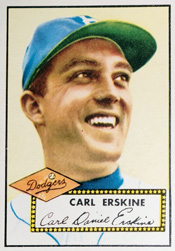
The players most responsible for the Cardinals’ troubles there were pitcher Carl Erskine of Anderson, Ind., and first baseman Gil Hodges of Princeton, Ind.

Dominant Dodgers

The 1953 Brooklyn Dodgers, subjects of the Roger Kahn book, “The Boys of Summer,” were a powerhouse, featuring a lineup with five future Hall of Famers _ Roy Campanella, Gil Hodges, Pee Wee Reese, Jackie Robinson and Duke Snider.

They rolled to the National League pennant with a 105-49 mark, finishing 13 games ahead of the runner-up Braves (92-62) and 22 ahead of St. Louis (83-71).

The Cardinals won seven of 11 against the 1953 Dodgers at St. Louis, but it was a much different story at Brooklyn. Not only did they lose all 11 games at Ebbets Field, they often got crushed. The Dodgers outscored them, 109 to 36, in those 11 games at Brooklyn.

The Cardinals were beaten by scores of 10-1 on June 7, 9-2 on July 16, 14-0 on July 17, 14-6 on July 18, 20-4 on Aug. 30 and 12-5 on Sept. 1.

There were two one-run games, the Dodgers winning both by scores of 5-4. The cruelest for the Cardinals was on June 6, when Hodges wiped out a 4-2 St. Louis lead with a three-run walkoff home run versus Stu Miller in the ninth. Boxscore

Home sweet home

Many players contributed to the Dodgers’ perfect home record against the Cardinals in 1953, but Erskine and Hodges did the most damage.

A right-hander who mixed an overhand curve and changeup with his fastball, Erskine, 26, was nearly unbeatable at Ebbets Field that year. He ended the regular season with a home record of 12-1, including 4-0 versus the Cardinals. All four of his home wins against St. Louis were complete games.

Erskine also won Game 3 of the 1953 World Series at Ebbets Field, setting a record by striking out 14 Yankees batters, including Mickey Mantle four times. “Erskine made the Yankees look like blind men swatting at wasps,” J. Roy Stockton reported in the St. Louis Post-Dispatch. Boxscore

(Since then, the only pitchers with more strikeouts in a World Series game are Bob Gibson, who fanned 17 Tigers in Game 1 in 1968, and Sandy Koufax, who struck out 15 Yankees in Game 1 in 1963.)

“Look, up in the sky….”

When Erskine beat the Cardinals with a five-hitter on May 6, 1953, at Brooklyn, it was his seventh consecutive win against them, dating back to September 1950. Erskine went undefeated versus the Cardinals in 1951 (4-0) and 1952 (2-0). Boxscore

The streak was snapped a week later, May 14, 1953, at St. Louis when Erskine was knocked out in the first inning without retiring a batter. “He had no control, no stuff and no outs,” Dick Young reported in the New York Daily News. “He warmed up for 15 minutes and pitched for five.” Boxscore

Back in Brooklyn, Erskine ducked into a phone booth, donned his Superman cape and beat the Cardinals for the second time in 1953, a four-hitter in a 10-1 rout on June 7. “It was the sort of affair that grew progressively more one-sided and monotonous, finally reaching the stage where many of the fans amused themselves by launching paper planes onto the field,” Dick Young reported. “Some of these came close to hitting Erskine. So did the Cardinals, but not many succeeded.” Boxscore

A month later, Erskine beat the Cardinals at Brooklyn for a third time, even though he gave up nine hits and two walks, threw a wild pitch and committed two errors. Boxscore

Erskine’s fourth home win against the 1953 Cardinals, on Aug. 30, also was his 13th consecutive win at Ebbets Field. Erskine contributed three RBI and scored a run. Boxscore

“Some pitchers were spooked by the thought of working in Ebbets Field with its cozy fences, but not Erskine,” the New York Times noted.

(In his next start, the Braves gave Erskine his lone home loss of 1953. With the score tied at 1-1 in the eighth, Eddie Mathews hit a three-run home run and Jim Pendleton had a two-run shot. Boxscore)

Erskine finished 1953 with a regular-season record of 20-6, including 6-2 versus the Cardinals.

For his career with the Dodgers, Erskine was 122-78, including 66-28 at Brooklyn. He was 23-8 against the Cardinals _ 13-2 at Ebbets Field.

(Erskine’s second win in the majors came against the Cardinals in a 1948 relief appearance. In the book “We Would Have Played For Nothing,” Erskine recalled, “I beat Howie Pollet and he waited for me after the game in the runway to congratulate me. He said, ‘I like the way you throw.’ He was a class act. I think he identified with me because he had a unique pitch _ a straight change _ and I could throw that pitch.” Boxscore)

Among the Cardinals regularly baffled by Erskine were Enos Slaughter (.162 batting average against) and Red Schoendienst (.211). The exception, naturally, was Stan Musial. He batted .336 with eight home runs versus Erskine. According to Time Magazine, Erskine said, “I’ve had pretty good success with Stan by throwing him my best pitch and backing up third.”

In July 2023, Erskine, 96, recalled to Tyler Kepner of the New York Times that Musial “almost never missed a swing. He always hit the ball somewhere.”

In his book, “Stan Musial: The Man’s Own Story,” Musial said, “Erskine had control, a remarkable changeup and a great overhand curve.”

(Erskine had an association with the Cardinals in 1971 when he joined play-by-play men Jack Buck and Jim Woods as a guest analyst on select telecasts of games on KSD-TV Channel 5 in St. Louis.)

Lots of lumber

Three pitchers _ Stu Miller (0-3), Joe Presko (0-3) and Gerry Staley (0-2) _ accounted for eight of the 11 Cardinals losses at Ebbets Field in 1953.

Dodgers hitters were led by Gil Hodges, who had eight home runs and 23 RBI against Cardinals pitching in the 11 games at Brooklyn. Hodges had 16 hits and seven walks in those games.

(In 31 at-bats at St. Louis in 1953, Hodges had no home runs, no RBI and batted .129.)

Others who hammered the 1953 Cardinals at Ebbets Field were Roy Campanella (18 hits, 18 RBI), Jackie Robinson (18 hits, 11 RBI) and Duke Snider (four home runs and 11 RBI).

Read Full Post »

There was a time in the late 1950s when the Cardinals thought a left-handed slugger from the streets of New York City might be the successor to Stan Musial.

Duke Carmel certainly fit the part. He was named after Duke Snider, had the mannerisms of Ted Williams and could hit with the power of Mickey Mantle.

Rangy (6-foot-3) and strong (200 muscular pounds), “Duke Carmel on a baseball field looks like the player you’d put together if somebody asked you to draw a picture of a prospect destined for major-league stardom,” The Buffalo News reported. “The throwing arm, the running speed, the hitting power, the ideal size, the versatility.”

Problem was, he also had a hitch in his swing.

From city to country

Born and raised in East Harlem (“A pretty rugged neighborhood,” he told The Sporting News. “I’ve had to fight my way through all my life.”), Leon James Carmel was nicknamed Duke for his favorite player.

“All the kids there at the time rooted for either the Yankees or Giants,” Carmel told The Sporting News. “When I took up for the Dodgers, and particularly for Duke Snider, they started calling me Duke, too, and it stuck.”

As for his given name of Leon, Carmel said, “If anyone called me that, I might not turn around. I wouldn’t know who they meant.”

A first baseman and pitcher at Benjamin Franklin High School, Carmel, 18, was signed by Cardinals scout Benny Borgmann in 1955.

His breakout season came in 1957 for the Class C farm club at Billings, Mont., 2,000 miles (and worlds apart) from East Harlem. Carmel, 20, hit .324 with 29 home runs and 121 RBI. Moved from first base to the outfield, he had 18 assists. “The best prospect I have ever managed,” Billings manager Eddie Lyons told The Sporting News.

Though Carmel tried to downplay the achievements _ “The pitchers there are mostly throwers and sooner or later they run out of gas,” he told The Sporting News _ the Cardinals were intrigued and brought him to spring training in 1958.

Carmel has “a batting form and a willowy swing that remind observers of Ted Williams,” The Sporting News reported in February 1958.

A manager in the Cardinals’ farm system, former pitcher Cot Deal, said, “Carmel reminds you of Ted Williams.”

J. Roy Stockton of the St. Louis Post-Dispatch noted, “Carmel seems to have most of the requisites _ sharp eyes, lithe muscles, a cocky, happy disposition, and a sparkling desire to bash a baseball to distant places.”

Blind spot

Facing better pitching at Cardinals camp than he did at Billings, Carmel struggled to hit pitches with movement, especially those that jammed him. That’s when the flaw in his swing became evident.

Cardinals hitting coach Stan Hack, who batted .301 in 16 seasons in the majors, told the Post-Dispatch, “He has a hitch. He lowers his hands, holding the bat, and when the pitch is high, he’s helpless. He can correct it if he listens, understands and keeps trying, but it takes a lot of work. You can’t correct a thing like that in an hour, or a day, or a month.”

Carmel said to The Buffalo News, “You have to stay loose and relaxed to play this game, and every time I go up to the plate determined to hit that long ball, I hitch too much. Then I get upset, and before you know it, I’m in a slump. I have to conquer myself, not the pitcher.”

Looking to find a groove, Carmel spent most of 1958 and 1959 at the Class AA and AAA levels of the minors. He played for Johnny Keane at Omaha, Cot Deal at Rochester, Harry Walker at Houston and Vern Benson at Tulsa. There were flashes of brilliance, but nothing like the kind of season he’d had at Billings.

Carmel, 22, got called up to the Cardinals in September 1959. He and teammate Tim McCarver, 17, made their big-league debuts in the same game. After striking out against Braves reliever Don McMahon, Carmel told The Sporting News, “I still haven’t seen any of the three pitches he threw by me.” Boxscore

Cardinals general manager Bing Devine said Carmel was in the club’s plans for 1960. “He’s showing signs of arriving,” Devine told the Rochester Democrat and Chronicle. “His possibilities for the future look very good.”

Traveling man

Carmel went to spring training with the Cardinals for the third straight year in 1960, and, like the other times, didn’t make the Opening Day roster.

The Cardinals traded him each of the next three seasons and reacquired him every time. They traded him to the Dodgers in 1960, reacquired him that year, traded him back to the Dodgers in 1961 and reacquired him again. In 1962, Carmel was sent to the Indians, then the Cardinals got him back a third time. In his stints with the Dodgers and Indians, Carmel never got out of the minors.

Carmel was not on the Cardinals’ roster when he went to spring training with them in 1963. Little was expected, but he became “the pleasant surprise of the spring,” The Sporting News reported. In his first 29 at-bats in the exhibition games, Carmel made 14 hits, including two home runs, two doubles and a triple.

The performance earned him a spot as a reserve outfielder and first baseman on the 1963 Opening Day roster of Cardinals manager Johnny Keane.

In his first at-bat of the season, Carmel hit his first big-league home run, tying the score in the bottom of the ninth against Pirates closer Roy Face. Boxscore

The highlights, though, were too few. Carmel was batting .227, with more strikeouts (11) than hits (10), when the Cardinals traded him for the fourth time. He was shipped to the Mets on July 29, 1963. This time, there would be no return.

Carmel had mixed emotions about departing. “I had been with that organization for eight years and it had become like a home to me,” he said to The Sporting News. However, he told the New York Daily News, “I didn’t want to sit around there, playing maybe 60 games a year. I want to make money in this game, and if I do the job, I’ll make it here (with the Mets).”

Meet the Mets

In joining the Mets, Carmel, 26, became a teammate of his boyhood idol, Duke Snider. In his Mets debut, Carmel started at first base and Snider was the right fielder. Boxscore

A week later, Aug. 8, 1963, Carmel hit a game-winning home run against Cardinals left-hander Bobby Shantz at the Polo Grounds in New York. Shantz threw him a slow curve and Carmel propelled it “onto the overhanging scaffold which fronts the upper tier in right,” the New York Daily News reported. Boxscore

(That was the first major-league game I attended. I was 7, and to my eyes, Duke Carmel was quite a mighty player.)

Carmel hit .235 with three home runs for the 1963 Mets. After the season they acquired two outfielders who, like Carmel, batted from the left side (George Altman from the Cardinals and Larry Elliot from the Pirates). Another left-handed batter, Ed Kranepool, 19, was projected to take over at first base.

Carmel did himself no favors at spring training in 1964, hitting .217 and getting into a personality clash with manager Casey Stengel, according to the New York Daily News.

Expecting to make the 1964 Mets’ Opening Day roster, Carmel instead was sent to the Buffalo farm club. “I don’t think they have anybody on the Mets better than I am,” Carmel told The Buffalo News.

Playing for Buffalo manager Whitey Kurowski, a former Cardinals third baseman, Carmel, 27, had a big season _ 35 home runs, 99 RBI and 100 walks. In August, the Yankees tried to acquire him for the 1964 pennant stretch but the Mets wouldn’t deal, general manager Ralph Houk told United Press International.

(If the Yankees, who won the 1964 American League pennant, had gotten Carmel, he would have faced the Cardinals in the World Series.)

New York, New York

After the Cardinals won the 1964 World Series title, manager Johnny Keane left for the same job with the Yankees. Two of the coaches he hired were Vern Benson and Cot Deal. All three had managed Carmel in the Cardinals’ system. On their recommendations, the Yankees chose Carmel in the November 1964 draft of players left off big-league rosters.

Keane told Carmel he would open the 1965 season as a Yankees utility player. “He had a golden chance to have a glorious new life in his hometown, playing for the team that cashes checks every fall,” George Vecsey wrote in Newsday. “All he had to do was not get hit by the D train.”

Carmel avoided getting hit by a train, but also avoided getting any hits for the Yankees. He was 0-for-26 in spring training exhibition games and then 0-for-8 in the regular season.

Released in May 1965, Carmel returned to the minors. His last season was in 1967 with Buffalo, then a Reds farm club. Among his teammates was a 19-year-old catching prospect, Johnny Bench.

New game

In 1972, five years after Carmel’s professional baseball career ended, Joe Gergen of Newsday found him playing as a ringer for a CBS-TV softball team in New York’s Central Park.

At 230 pounds, Carmel was the team’s catcher and slugger. In the game Gergen saw, Carmel had a single, a triple and a three-run home run, “a towering fly ball which carried over the right fielder’s head.”

“Between innings,” Gergen wrote, “there was time for Duke to eat an ice cream pop, drain a bottle of soda, puff on a cigarette and sit with the kids.”

Carmel said, “I enjoy this. Here, there’s no curfew.”

Read Full Post »

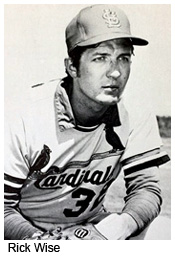
On a team with little pop, pitcher Don Durham qualified as somewhat of a slugger for the Cardinals.

A rookie right-hander with St. Louis in 1972, Durham had as many home runs (two) as wins (two). He batted .500 (seven hits in 14 at-bats) and had a slugging percentage of .929.

Durham was part of a Cardinals pitching trio, along with Bob Gibson and Rick Wise, that provided as much power as some of the infielders and outfielders.

Gibson (five), Durham (two) and Wise (one) combined for eight home runs on a club that ranked last in the 12-team National League in home runs (70) in 1972.

Catcher Ted Simmons (16) and third baseman Joe Torre (11) were the lone 1972 Cardinals to reach double digits in home runs. They and outfielder Bernie Carbo (seven) were the only Cardinals with more home runs than Gibson that year.

Even Durham, with his two in 14 at-bats, had as many home runs as second baseman Ted Sizemore (two in 439 at-bats) and center fielder Jose Cruz (two in 332 at-bats), and more than shortstop Dal Maxvill (one in 276 at-bats) and third baseman Ken Reitz (none in 78 at-bats).

Promising prospect

Though born in Kentucky, Durham was a resident of the Ohio village of Arlington Heights near Cincinnati between the ages of 6 and 9, according to the Cincinnati Enquirer. He played Little League baseball there and faithfully followed the 1950s Reds, The Sporting News reported,

At Western Kentucky University, Durham was a first baseman and pitcher. Though slender at 6 feet and less than 170 pounds, he threw hard and hit for power.

In a 1969 doubleheader versus Austin Peay, Durham started and won the first game, then belted a grand slam to help Western Kentucky complete the sweep, according to The Park City Daily News of Bowling Green, Ky. A year later, he struck out 14 in pitching a no-hitter against Bellarmine. Durham led the team in hitting (.418) his final season, according to The Sporting News.

On the recommendation of scout Mo Mozzali (who signed Ted Simmons three years earlier), the Cardinals chose Durham in the seventh round of the 1970 draft. After a strong season with Class A Modesto in 1971 (13-7, 2.80 ERA, 202 strikeouts in 177 innings, plus a .240 batting average), the Cardinals decided Durham should bypass Class AA and move to Class AAA Tulsa in 1972.

On June 3, 1972, Durham pitched a shutout and hit a home run against Indianapolis. The two-run homer came after Durham fouled off two pitches trying to bunt and then was told by manager Jack Krol to swing away. “I’ve always been proud of my hitting,” Durham said to the Tulsa World.

Four days later, with Tulsa ahead, 1-0, in the last of the ninth inning at Evansville, Durham needed one out to complete a no-hitter, but Bob Coluccio grounded a single to left. Exasperated, Durham flung his glove into the air. After a brief discussion with Krol on the mound, Durham faced Darrell Porter, who the night before lined a two-out, two-run home run in the bottom of the ninth to lift Evansville to a 4-2 victory.

On Durham’s first pitch to him, Porter lofted a high fly that carried over the fence, barely beyond the reach of right fielder Bob Wissler, for a game-winning home run. “To tell you the truth, I didn’t think I hit the ball that good,” Porter said to Tom Tuley of The Evansville Press. “I thought it was going to be caught.”

Sitting alone on the dugout steps after going from possible no-hitter to losing pitcher in two pitches, Durham told Tuley, “I’m still in shock.”

Fitting in

A week later, Durham, 23, was called up to the Cardinals and put into the starting rotation, even though he had pitched only a partial season at a level higher than Class A.

He made his big-league debut against his boyhood favorite, the Reds, at St. Louis on July 16, 1972. The first batter he faced, Pete Rose, grounded out. The next, Joe Morgan, flied out. In the second inning, Durham struck out the side. One of the victims was Tony Perez.

Durham went seven innings, allowed three runs, got little support and was the losing pitcher in a 4-1 Reds triumph. Bobby Tolan hit a solo home run _ the only homer Durham would allow in 47.2 innings for the 1972 Cardinals.

“The kid had good stuff,” Cardinals manager Red Schoendienst said to the St. Louis Post-Dispatch. “He’s going to be a good pitcher. He had a good fastball and his control was good. We just didn’t get a break for him.”

Reds manager Sparky Anderson told the Dayton Daily News, “The kid had a good fastball and he kept it around the plate real well.”

According to the Post-Dispatch, Cardinals catcher Ted Simmons nicknamed Durham “The Rattlesnake” because of the way he uncoiled as he delivered a pitch. Boxscore

Tough going

On Aug. 4, 1972, when the Phillies faced the Cardinals, the starting pitchers had a combined season record of 0-11. Ken Reynolds was 0-8 and Durham was 0-3.

In the second inning, using a Bob Gibson bat, Durham got his first big-league hit, a three-run home run on a fastball down the chute from Reynolds. Then he retired the Phillies in order in the second through fifth innings and contributed two more hits, both singles. “If ever a pitcher seemed destined for victory, Durham was the guy,” the Post-Dispatch noted.

It wasn’t to be, though. The Phillies scored six runs in the eighth and won, 8-3. “Sitting forlornly in the clubhouse,” Durham was “so despondent he could hardly bring himself to talk,” the Post-Dispatch reported. 

He described himself to the newspaper as “a choke artist.” Boxscore

Giant killer

After losing a fifth consecutive decision, Durham finally got his first big-league win on Aug. 18, 1972, against the Giants at Candlestick Park in San Francisco.

In addition to limiting the Giants to a run in 6.1 innings before being relieved by Diego Segui, Durham scored the Cardinals’ first two runs. Using a Ted Simmons bat, he singled and scored in the third and walloped a hanging slider from Jim Willoughby for a solo home run in the fifth.

After the game, Durham went around the clubhouse, getting autographs on a baseball from all of his teammates, the Post-Dispatch reported.

“My confidence has been restored,” Durham told the Post-Dispatch. Boxscore

Durham got one more win and again it came against the Giants. Facing a lineup with the likes of Bobby Bonds, Willie McCovey and Dave Kingman, Durham pitched a three-hitter. He also stroked two singles _ one against Juan Marichal and the other versus Sam McDowell.

“After the first inning, I zeroed in nicely on the outside zone and took the power away from their big hitters,” Durham told the San Francisco Examiner. Boxscore

End game

Durham pitched in 10 games, making eight starts, for the 1972 Cardinals and was 2-7 with a 4.34 ERA.

At some point, he experienced elbow problems and was sent back to Tulsa for the 1973 season.

On July 16, 1973, the Cardinals traded Durham to the Texas Rangers, who were managed by Whitey Herzog. The American League had the designated hitter rule, so Durham didn’t get a chance to bat. When he pitched, he wasn’t effective.

After posting a record of 0-4 with a 7.59 ERA for the 1973 Rangers, Durham, 24, was finished in the big leagues.

Read Full Post »

Stan Musial won a game for the Cardinals with a walkoff pop-out.

It happened on May 31, 1963, against the Giants at St. Louis.

In the ninth inning, with the score tied at 5-5, reliever Don Larsen, the former Yankee who pitched a World Series perfect game, walked Cardinals leadoff batter Curt Flood.

Bill White tried to move Flood to second with a sacrifice bunt, but fouled off two attempts. Then he swung away, rapping a grounder to second baseman Cap Peterson. A rookie, Peterson’s throw to shortstop Jose Pagan covering second was too late to get Flood, and White was safe at first on the fielder’s choice.

Bobby Bolin relieved and Dick Groat bunted, pushing the ball between the mound and third base. Bolin fielded it and tried getting Flood at third, but Flood beat the toss and Groat was credited with an infield single, loading the bases for Musial.

A left-hander, Billy Pierce, was brought in to face him.

Giants manager Al Dark moved the infield in and called for his outfielders to play shallow, hoping to make a play at the plate if necessary.

Musial swung at Pierce’s first pitch and hit a pop-up toward the right side of the infield. The umpires shouted, “Infield fly,” meaning Musial automatically was out.

Dazed and confused

The infield fly rule is called on a fair ball that can be caught by an infielder with ordinary effort when runners either are on first and second, or when the bases are loaded, before two are out. The rule is for the benefit of the runners because it keeps infielders from letting a shallow fly drop with the intention of causing a force play at second and third, or second, third and home, according to MLB.com. A runner is allowed to attempt to advance at his own risk.

When Musial’s pop fly went into the air, Peterson turned and started back toward his normal second base position, the San Francisco Examiner reported. Then he froze, according to the St. Louis Globe-Democrat.

When center fielder Willie Mays and right fielder Felipe Alou saw Peterson fail to react, they raced in to try for a catch.

“Mays came closest to getting the ball,” the St. Louis Post-Dispatch reported, but it fell among he and Alou and Peterson. According to the Examiner, “the ball landed right where Peterson was standing when the ball was pitched.”

When Curt Flood on third saw that the ball was unlikely to be caught, he dashed to the plate. Mays tried to grab the ball on one bounce so that he could throw home, the Post-Dispatch reported, but he could not come up with it. Flood streaked across the plate with the winning run and Musial was credited with a RBI.

Disgusted, Mays kicked his glove about 30 feet, the Post-Dispatch reported. Boxscore

The pop fly was Peterson’s responsibility to catch, Dark said to the Post-Dispatch. Regarding the outcome of a game being decided on an infield fly rule out, Dark told the newspaper, “I’ve never seen such a play at any point in any game.”

The wining pitcher was Bob Gibson, who had entered in the top of the ninth and pitched a scoreless inning of relief. He retired Willie McCovey, Matty Alou and Harvey Kuenn in order.

Read Full Post »

« Newer Posts - Older Posts »